Site Preparation in Texas
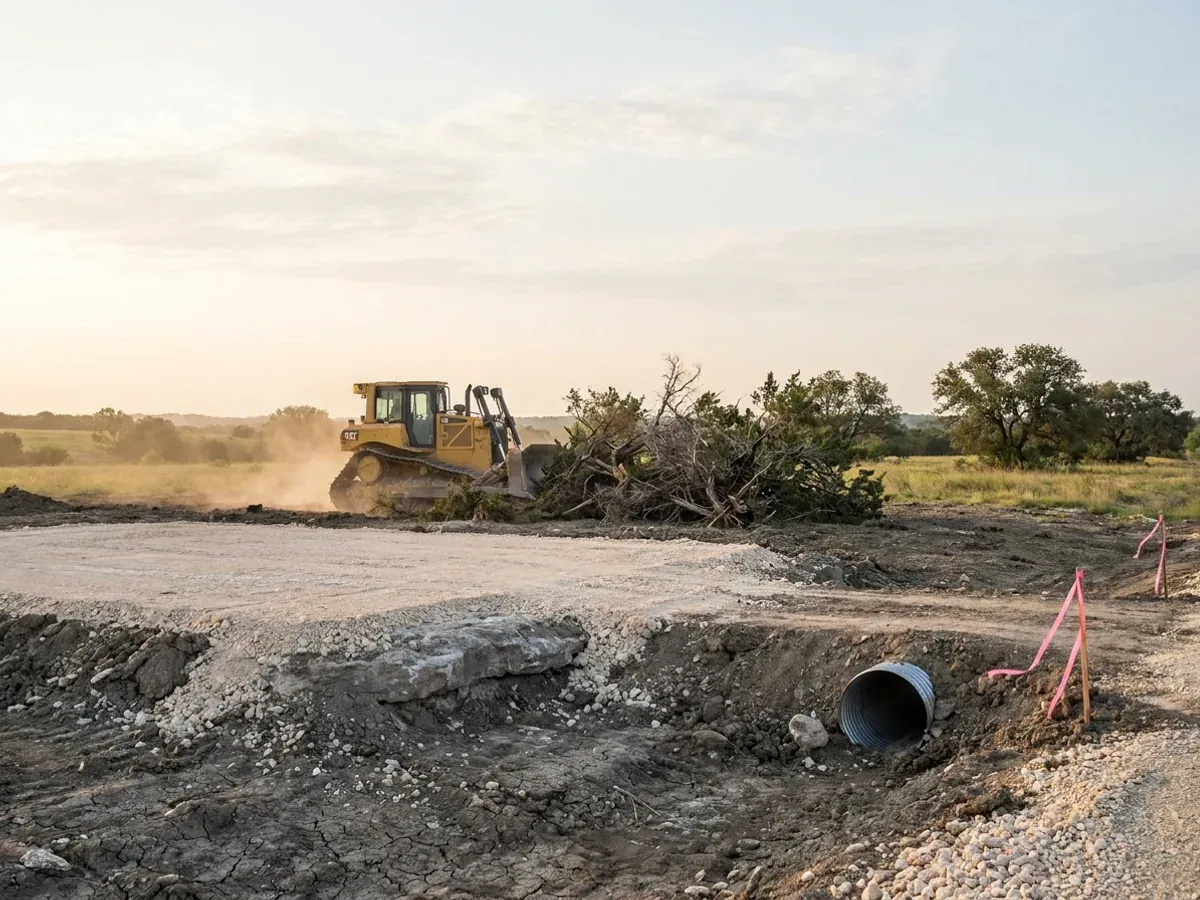
Everything expensive that goes wrong on a barndominium goes wrong below the slab. Site prep is clearing, grubbing, cut and fill, compacted pad, drainage, culvert and driveway, and getting power, water, and septic to the building. In Texas it is also where the soil gets dealt with honestly: shrink-swell clay is the default across most of our markets, and a slab that was not detailed for it is the single most expensive mistake available on this building type.
How a site preparation project runs
Four stages, in this order. The sequence matters more than it looks: getting engineering and permitting settled before anything is fabricated is what keeps a build from stalling.
Survey and soil
Boundary and topographic survey plus a soils report. In Texas the soils report is your first read on how much the ground moves, which drives the foundation design and can require an engineer by law. Septic runs on its own clock through TCEQ or whichever authorised agent holds the programme locally — often the county or a public health district, and outside a city it is frequently the only construction permit anyone issues. Note Texas does not use a percolation test: the rules classify soil by texture, and ground can fail for draining too fast as easily as too slow.
Clearing and grubbing
Vegetation and stumps out, with tree protection observed where the county requires it. Cleared material is hauled or mulched on site.
Pad and compaction
Cut and fill to design elevation, then a compacted pad tested to spec. If the parcel is in a flood zone the pad elevation is set by the flood requirement, not by preference.
Drainage and utilities
Swales and culverts so water leaves the building, then power, water or well, and septic or sewer stubbed to the pad.
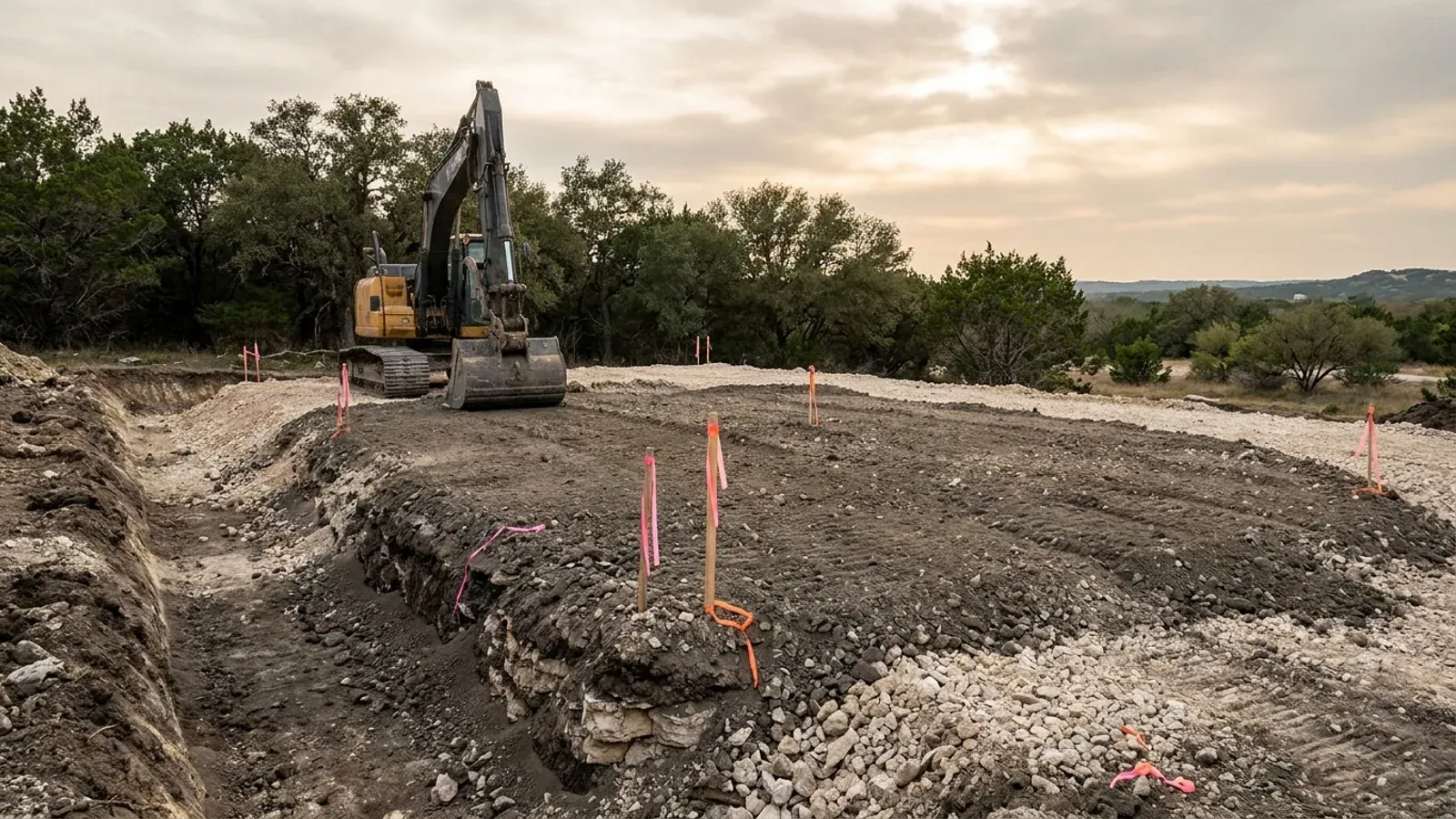
In Texas the expensive surprises are under the slab, and the soil decides both of them
The USDA Natural Resources Conservation Service describes Major Land Resource Area 86A — the Blackland Prairie — as lying entirely in Texas, names Austin, Dallas, San Antonio, San Marcos, Temple and Waco as sitting within its boundaries, and characterises its soils by their shrink-swell nature, running from the Red River down to San Antonio. A second clay belt, MLRA 150A, runs east of the Trinity River toward the coast. On that ground the foundation is engineered work rather than a place to economise, and the code and the Occupations Code arrive at that conclusion by two separate routes. The other expensive item is the septic system, and it is decided by the same thing: what the soil under your parcel actually is.
Serving clients across the entire region
We deliver site preparation across Texas, and what the job has to satisfy changes with the parcel. Inside a city limit you are under that city's adopted code and its own filled-in Table R301.2. Outside one, a county has no general building-code power unless it has opted in — and even then there is no county permit and no county inspector. Two parcels twenty miles apart can carry completely different engineering. Tell us where the land sits and we will tell you which rules land on it.
What actually decides the price
Square footage is the number everyone leads with, and it is rarely the one that moves a barndominium budget. These four do.
-
What the soil does when it gets wet
Expansive clay is the single biggest physical variable in Texas site work. IRC R403.1.8 sends a foundation on expansive soil to IBC §1808.6 — engineered design — at a plasticity index of 15 or more, and that provision was found unamended in all five of the big-city code compilations checked. The free, parcel-level place to look before you buy is the NRCS Web Soil Survey, and it takes minutes.
-
Cut, fill and the building pad
Slope drives the earthwork, and balancing cut and fill on the parcel is far cheaper than importing or exporting material, so a good pad design tries hard to balance. The pad itself is not where to save money: it is what the foundation engineering assumes, and an under-compacted pad is invisible until it is not.
-
The septic field, and the soil class under it
Texas sizes a drainfield from soil texture class, and the spread is large. A Class IV silty clay or clay loads at 0.10 gallons per square foot per day where a Class Ib loamy sand loads at 0.38, and the required absorptive area is the design flow divided by that rate — so the same house needs a field several times bigger on clay than on sand. Where the field goes then governs the layout, and the layout governs the house.
-
Access, water and power to the building site
Driveway length and construction, the well or the water tap, and the distance a utility has to run are ordinary costs that are entirely parcel-specific, and they are the ones buyers have most often not budgeted. Worth knowing when you compare figures: the Census Bureau’s contract-price data for contractor-built houses excludes land and excludes site work altogether — no driveway, no septic, no well, no clearing. Those costs are real; they are simply not in the number people quote at you.
Site Preparation in Texas: common questions
8 questions we get asked most often about building in Texas. If yours is not on the list, ask it directly.
What should I check before I buy the land?
Do I really need an engineer for the foundation?
Do I need a percolation test for the septic system?
How much land do I need for a septic system?
I have more than ten acres. Am I exempt from the septic rules?
How is the septic sized for a barndominium — does the shop count?
Is the septic permit the only permit I need out in the county?
How long does the septic permit take, and what does it cost?
Keep reading
The pages that answer the next question this one raises.
Ready to put site preparation against a real plan? Start there and the rest follows.
Tell us about the land
Send the parcel ID or an address and we will come back with what can be built on it, the wind load it has to meet, and a realistic budget range. That conversation costs nothing.