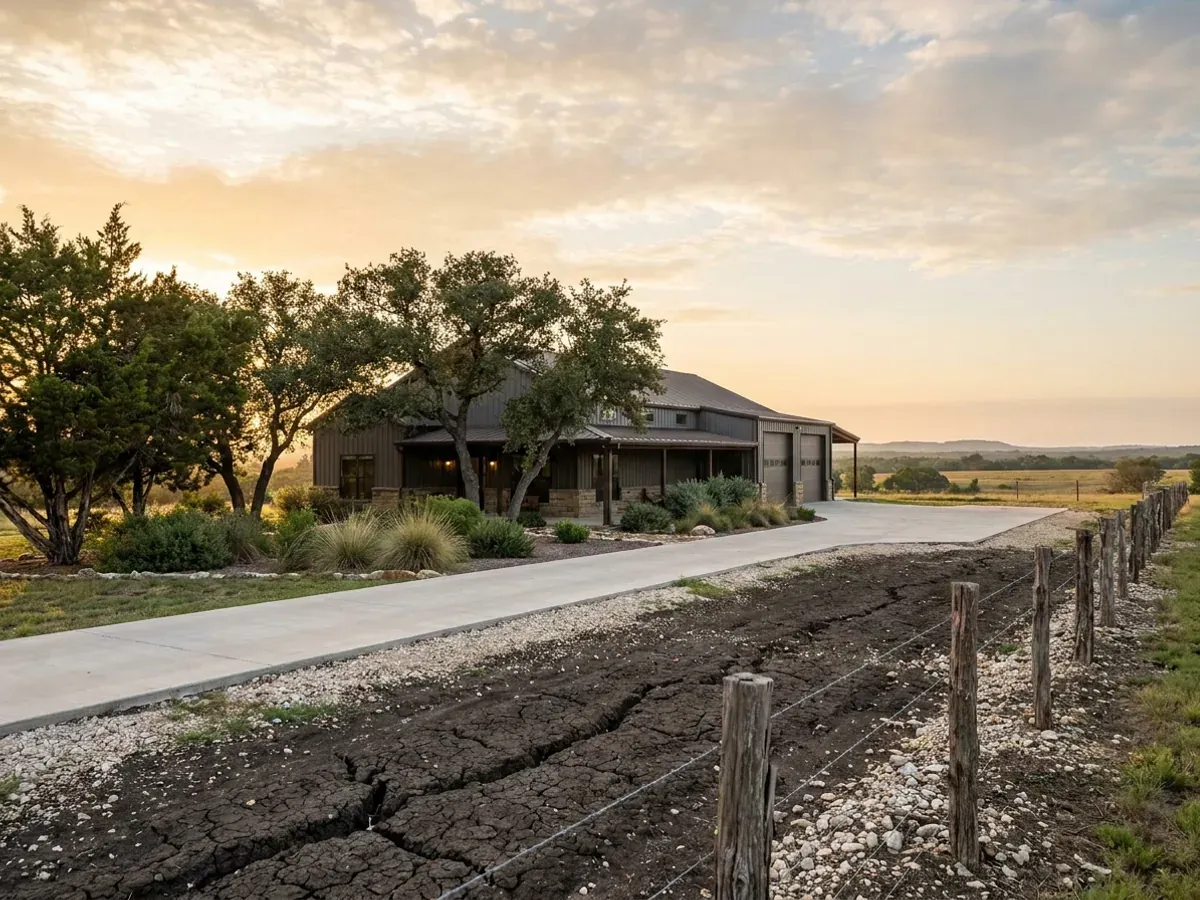
A completed barndominium home viewed from the front corner, with finished landscaping, a covered entry porch and an attached shop bay.

Turnkey Builds in Texas

Turnkey means you sign once and get keys. We take the project from raw lot through permitting, site work, foundation, shell erection, mechanical rough-in, and interior finish. One contract, one schedule, one point of contact, and one party responsible when an inspector has a question.

Permit-ready stamped drawings
Engineered to your jurisdiction's criteria

How a turnkey builds project runs

Four stages, in this order. The sequence matters more than it looks: getting engineering and permitting settled before anything is fabricated is what keeps a build from stalling.

1

Feasibility and budget

Before anything is drawn we check zoning, setbacks, utility access, and flood zone on your parcel, then build a line-item budget. This is where most barndominium projects succeed or fail.

2

Design and permit

Plans are drawn, engineered, and submitted to your city or county building department. We manage the review comments and resubmittals so the permit clock keeps moving.

3

Site work and shell

Clearing, pad, and slab, then the frame goes up and the building is dried in. Dried-in is the milestone that protects everything that follows.

4

Finish and handover

Mechanical, electrical, plumbing, insulation, interior finish, and fixtures, then final inspection and certificate of occupancy. We walk the punch list with you before handover.
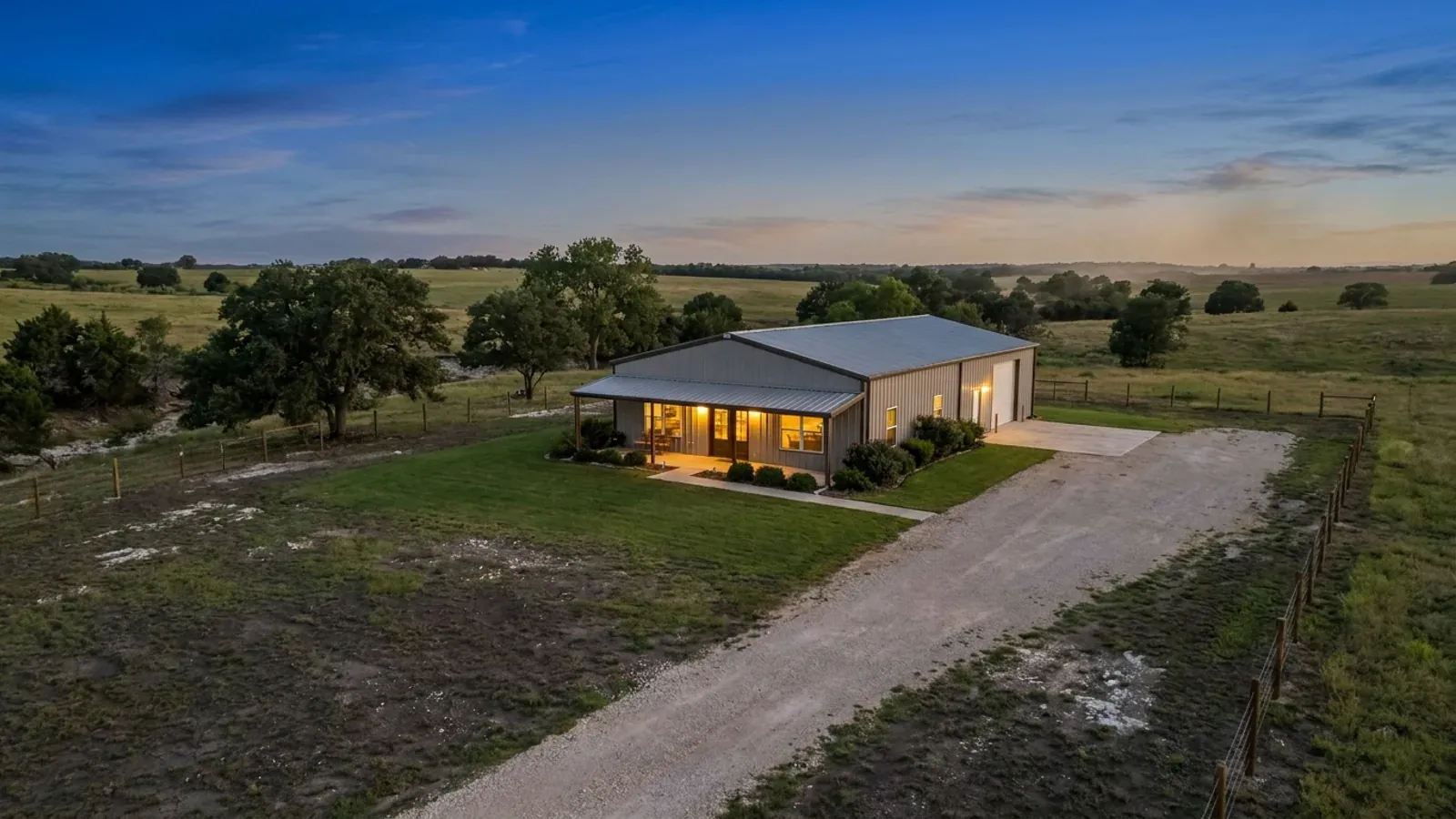
A finished barndominium at dusk with warm interior lighting glowing through its large windows.
City limits, ETJ, or neither

One line on the map decides who regulates your build

A Texas parcel sits in one of three places, and they are not variations on a theme. Inside a city limit, the municipality enforces its building code — frozen by §214.212(a) at the IRC as it existed on 1 May 2012, and freely amendable by ordinance. In that city’s extraterritorial jurisdiction, Texas courts have held that a city cannot enforce its building codes at all, in *Town of Lakewood Village v. Bizios* (Tex. 2016) for a general-law city and in *Collin County v. City of McKinney* (Tex. App.—Dallas, 2018) for a home-rule one — but McKinney also confirms the city can still make you plat, and the landowner there lost on exactly that. Beyond the ETJ, the county has a residential code only if its commissioners court adopted one, and no permit or fee even then. Getting that answer right before a deposit changes hands is the first thing a turnkey contract is for.

Coverage

Serving clients across the entire region

We deliver turnkey builds across Texas, and what the job has to satisfy changes with the parcel. Inside a city limit you are under that city's adopted code and its own filled-in Table R301.2. Outside one, a county has no general building-code power unless it has opted in — and even then there is no county permit and no county inspector. Two parcels twenty miles apart can carry completely different engineering. Tell us where the land sits and we will tell you which rules land on it.

Before you commit

What actually decides the price

Square footage is the number everyone leads with, and it is rarely the one that moves a barndominium budget. These four do.

  • Which side of the line the parcel sits on

    Inside a city you are buying plan review, permit fees and inspection scheduling on the city’s terms. Waco publishes a residential building permit at $0.35 per square foot plus a $60 plan submittal and a $15 technology fee, and doubles the fees for work started without a permit. Dallas prices a new single-family permit on square-footage tiers with plan review at $0.046 per square foot or a $577 minimum. Outside a city there is no county permit fee at all, but there is a platting question and there are inspectors to engage.

  • Finished versus unfinished square footage

    Shop space and living space are not the same product. Two buildings with identical footprints can differ enormously depending on how much of the inside is finished to residential standard, and the split matters again downstream — septic capacity in Texas is sized on living area, not on total structure area.

  • Site work, utilities and septic

    Well, septic, power runs and the driveway are the line items most likely to surprise a rural buyer, and distance to the nearest connection matters more than the size of the house. The septic permit runs through the county or district acting as TCEQ’s authorized agent on its own clock. The Waco–McLennan County Public Health District, our own, publishes a single-family septic permit at $510 with an added $100 for an aerobic system.

  • Finish level

    Cabinets, flooring, fixtures and trim carry an enormous range. This is the part of the budget you actually control, and the part where a number quoted before selections are made is not a real number.

A completed barndominium home viewed from the front corner, with finished landscaping, a covered entry porch and an attached shop bay.

Turnkey Builds in Texas: common questions

8 questions we get asked most often about building in Texas. If yours is not on the list, ask it directly.

What does turnkey actually include?
Raw parcel through final sign-off: feasibility on the parcel, plans, engineering, whatever platting or permitting the jurisdiction genuinely requires, the site evaluation and septic authorization, clearing and pad, foundation, shell erection and dry-in, mechanical, electrical and plumbing, insulation, interior finish, fixtures, and the inspections — whether those are a city’s inspectors or the ones we contract under §233.154(a)(3) out in the county. One contract, one schedule. What is excluded is written down rather than assumed, because excluded items are where disputes come from.
How do I know whether my land is in a city, in its ETJ, or in neither?
Ask the city, and read the title commitment. The extraterritorial jurisdiction is a statutory ring around a municipality set by Local Government Code §42.021(a), keyed to the city’s population rather than the county’s: half a mile under 5,000 people, one mile at 5,000 to 24,999, two miles at 25,000 to 49,999, three and a half miles at 50,000 to 99,999, and five miles at 100,000 and over. Every major Texas city sits in that top bracket, so each carries a five-mile ring — a great deal of land, and exactly the land a barndominium buyer is shopping. Those tiers are long-standing and were not changed by the recent ETJ legislation. We get the answer for your specific parcel in writing at feasibility rather than inferring it from a map.
Can a city enforce its building code on my land in its ETJ?
Texas courts have held that it cannot. In *Town of Lakewood Village v. Bizios* (Tex. 2016) the Texas Supreme Court held that a general-law city has no extraterritorial building-code authority, and said of §233.153(c) that it neither confirms nor grants such authority — that provision is a precedence rule, not a power. In *Collin County v. The City of McKinney* (No. 05-17-00546-CV, Tex. App.—Dallas, 10 May 2018, rehearing denied and mandate issued) the court closed the home-rule gap: McKinney “lacks authority to enforce its building codes and related building inspection requirements within its extraterritorial jurisdiction.” The court’s reasoning is worth understanding, because it is often reported backwards: the home-rule power of self-government reaches the city’s own territory, while the ETJ is created by the legislature, so out there a city needs a grant it has not been given. The Texas Municipal League tells its own members the same thing. Two honest limits. First, McKinney is one of fifteen intermediate appellate courts and the Texas Supreme Court has never decided the home-rule question, so this is what courts have held rather than a statute you can point at. Second, and this is the half people miss: the same opinion holds the city can require a landowner to plat property in its ETJ, and the landowner there lost on exactly that, over a driveway. A city may also adopt a development plat requirement that stops new construction in its ETJ until a surveyor-prepared plat is approved. So ask the city, and read the title commitment.
Can I get my land released from a city’s ETJ, and should I want to?
Sometimes, and it is narrower than the headlines suggest. S.B. 2038 (2023) created two routes: a release by petition, available to a resident or to owners of a majority in value of the area, where the city “shall immediately release” and release happens by operation of law if the city stalls; and a petition-and-election route. Release is one-way — the land cannot be brought back in or annexed without the owner’s own request. But the exclusions are as important as the rule, and one is aimed squarely at suburban buyers: in the large-metro bracket the routes do not reach lots under 12 acres, or a single lot within a subdivision of 25 or more lots. They also do not reach military base buffers, industrial districts or strategic partnership areas. So release is largely a large-acreage remedy in the big metros, and a half-acre owner should not count on it. The Texas Supreme Court has described the statute as presumed constitutional and as remaining the law, and has said release “is a matter of paperwork.” Whether it helps you is a different question from whether you can do it, which is the next one.
If my land leaves the ETJ, does it become unregulated?
No. Release changes who regulates, not whether. Under §242.001(j), subdivision regulation passes to the county on release — and Texas requires exactly one named plat authority per ETJ anyway, fixed by a city–county agreement, so which body you deal with is a local fact rather than a statewide one. Worth knowing: a city–county agreement of that kind transfers platting authority only. In McKinney the appellate court struck “inspection and building code” out of the trial court’s finding by modification, so the natural inference that a plat agreement carries building-code power with it is simply wrong. There is also a clean acreage asymmetry that catches people who subdivide: a tract escapes platting above five acres in the ETJ, but needs more than ten acres to escape it in the county. Crossing the line can therefore change the acreage rule that applies to you.
Does Texas require a contractor licence for a build like this?
There is no such licence to hold. Texas has no state licence, registration or certification for a general residential contractor or home builder. The Texas Residential Construction Commission went through Sunset review in the 81st Legislature and was not continued, nothing replaced it as a licensing body, and its statute is gone from the Property Code. The Texas Department of Licensing and Regulation’s full programme list runs to dozens of trades — electricians, air conditioning and refrigeration contractors, water well drillers, industrialized housing — and contains no general, residential or building contractor licence of any kind. So when a Texas builder leads with a licence, it is fair to ask which one. What replaced licensing is liability law: Property Code Chapter 27, the Residential Construction Liability Act, defines a contractor purely by conduct, requires a specific bold-type contract disclosure, and runs a 60-day notice-and-repair process that cannot be waived. Texas regulates builders after the fact through the courts, not before the fact through a licence. The trades are a different matter — a licensed plumber is required on new construction, electricians are licensed, and a builder of industrialized housing must register with TDLR. Cities vary too, and the variation is wider than people expect: Fort Worth registers building contractors by name annually at $168.75, while Waco ninety miles away publishes a registration requirement for the state-licensed trades — plumbing, electrical and mechanical — at no fee.
What does a turnkey barndominium cost in Texas?
The honest answer starts with why every number you have read is soft. No rigorous, representative cost data exists for barndominiums as a building type, and the reason is structural rather than a gap in anyone’s research: the Census has no barndominium category, so there is no sampling frame. Officially the building type does not exist. Almost every source publishing a per-square-foot range sells something, and the ranges that circulate tend to be one number wearing several coats — we have traced a lender’s published figures back to a home-services website. Even the Texas Real Estate Research Center at Texas A&M, which writes about barndominiums, publishes no dollar figure at all. What can be cited is broader housing data, with its limits attached. The Census Bureau’s Survey of Construction puts the median contract price for a contractor-built house in the South region at $388,100, the median at $157.30 per square foot, and reports 54% of contractor-built houses started in the South in 2025 at $150 per square foot or more, up from 21% in 2020. Read those carefully: they cover the whole 17-state South region rather than Texas alone, they exclude owner-built houses, and the contract price excludes land and excludes site work — no driveway, no well, no septic, no clearing. Those are exactly the costs a rural buyer has not budgeted. We price your building on your parcel and show site work as its own line rather than hiding it in a per-square-foot figure.
What is the biggest thing that goes wrong on these projects?
Buying before checking. Someone buys a kit or a parcel and then finds out which of the three regimes they are in, that the subdivision’s recorded restrictions will not allow the building they had drawn, or that the soil will not take a conventional septic system. In Texas there is a particular version of it: assuming that because the county has no building code, nothing applies. Platting, floodplain rules, the licensed-plumber requirement, the state energy certification and the recorded deed restrictions all survive that assumption, and the deed restriction is the one that can actually stop the build. All of it is cheap to check first and expensive to discover second. Our feasibility stage exists to front-load exactly those questions, and we would rather tell you a parcel is wrong than sell you a building for it.

Ready to put turnkey builds against a real plan? Start there and the rest follows.

Tell us about the land

Send the parcel ID or an address and we will come back with what can be built on it, the wind load it has to meet, and a realistic budget range. That conversation costs nothing.