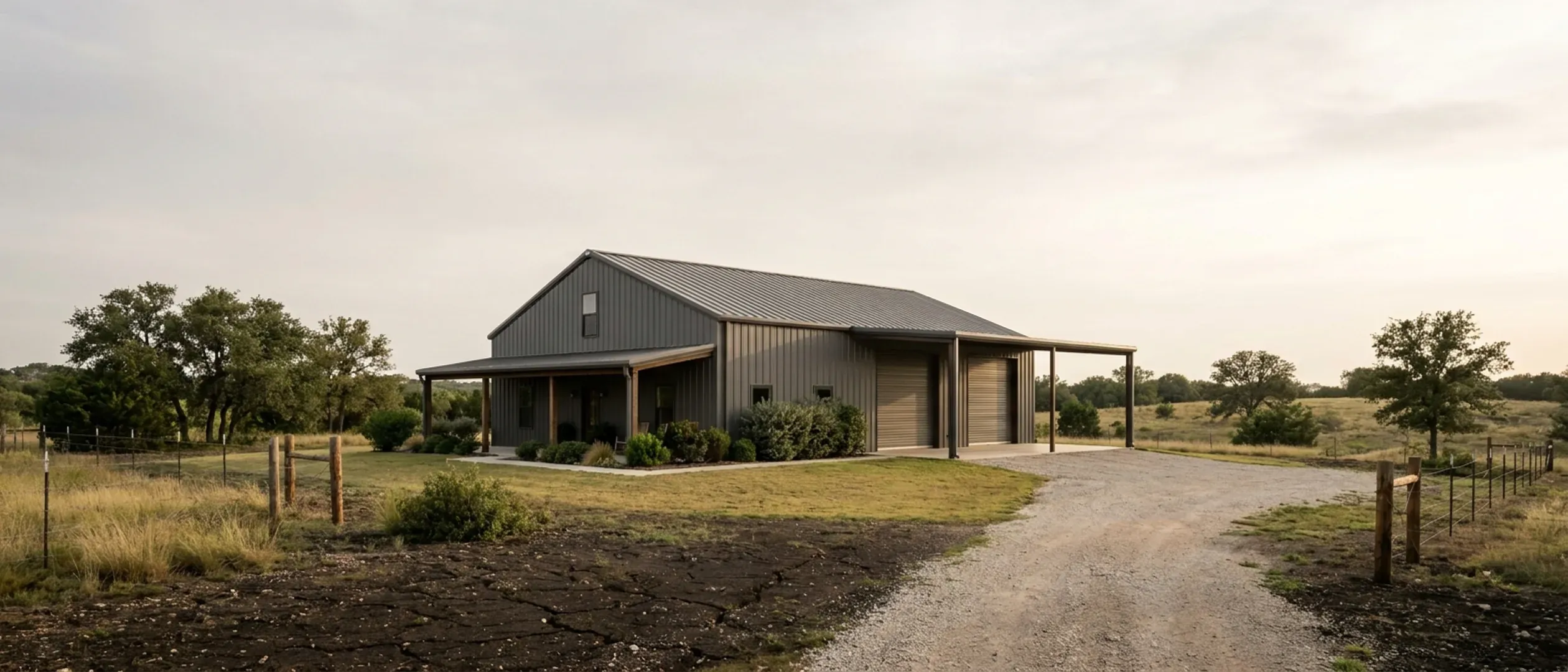
How Much Does a Barndominium Cost in Texas?
Nobody has measured this. The United States Census Bureau runs the only representative survey of what American houses cost to build, and it has no barndominium category. A steel-framed, metal-clad house with a shop bay is recorded there as a site-built single-family house with a particular exterior wall material. There is no sampling frame, so no representative statistic about what a barndominium costs can exist, at the Census or anywhere downstream of it. Every dollar figure on this page is therefore somebody else's, named and dated, with a note on who actually generated it, because we publish no pricing of our own. What we can add is the half a national cost guide cannot see. In Texas the permit is measured on a square footage that every authority defines differently, the connection fees swing by an order of magnitude and several of them key off the date your lot was platted, the septic design keys off living area rather than footprint, and on most unincorporated land no building inspector is involved at all. Those are the parts of the number that are knowable, and they are the parts a calculator never asks about.
Figures below are industry data from cited third-party sources, not a quote from Texas Barndominium Builders. Every project is priced individually.
Bottom line up front
- There is no representative cost data for this building type: the Census Bureau's Survey of Construction has no barndominium category, so no sampling frame exists and no honest statistic can. Every figure on this page is somebody else's, named and dated.
- The knowable half is local and published. Your jurisdiction's permit rate and the square footage it measures, the impact fee schedule your lot's plat date puts it under, and your county's septic permit fee are all checkable in an afternoon, before you talk to a builder.
- Decide which jurisdiction the land is in first — city, extraterritorial jurisdiction, or unincorporated county. That one answer decides whether there is a permit at all, which code edition applies, whether an impact fee is charged and who inspects.
Cost per square foot, by tier
The spread is wide because "barndominium" covers everything from a bare shell to a fully finished custom home. Tier is what actually explains the range, not location.
| Tier | Range | Source |
|---|---|---|
| Barndominium kit - shell and onsite assembly | $30–$50 per sq ft | Texas Farm Credit, "Texas Barndominiums", dated 24 February 2026. The lender does not generate this figure: on its own page the number is hyperlinked out to HomeGuide, a lead-generation marketplace. Quoted as covering the shell and onsite assembly, and expressly excluding site prep, foundation and any interior components. |
| Standard finished build, around 2,000 square feet | $65–$160 per sq ft | Texas Farm Credit, "Texas Barndominiums", 24 February 2026, verbatim: "$65-160/sq. ft. for standard builds on an average 2,000 sq. ft barndo". That figure is hyperlinked on the page to HomeGuide, so this is a lender relaying a lead-generation marketplace. The same band circulates on Angi and across the metal-building sites. |
| Any contractor-built house, Census South region - median to average | $157.3–$179.96 per sq ft | U.S. Census Bureau, Survey of Construction, "Median and Average Contract Price per Square Foot of New Contractor-Built Single-Family Houses Started", 2025 data, workbook last saved June 2026. Median $157.30 and average $179.96 for the South region - 17 states and the District of Columbia, not Texas alone, and not barndominiums. Relative standard error 9 percent on the median, 8 percent on the average. Contract price excludes the land and excludes site work. |
Estimate a range for your square footage
Pick a size and a tier and this multiplies them against the same industry ranges printed in the table above, nothing new, nothing ours. It's a starting orientation, not a quote.
Estimated range
$0 – $0
This estimate comes from the industry cost data cited in the table above, not from Texas Barndominium Builders. It doesn't account for your site, county, or finish choices, all of which move the real number. Send us the parcel for one that does.
What actually moves the number
Which square footage the fee counts
Every Texas authority measures a different area, and each publishes its own definition. Waco charges $0.35 per square foot on living area and non-living area and accessory structures alike, so the shop bay is inside the fee. Temple charges $0.135 per square foot on total square footage under roof. Killeen charges $0.20 per square foot and excludes accessory buildings, which take a separate $70 permit. On a building that is half workshop, that one definition is the difference between two very different bills.
Impact fees, and the plat date behind them
These are charged on a city water or wastewater connection, and they swing enormously. Austin Water publishes a combined water and wastewater capital recovery fee of $7,700 per service unit on a lot platted after 1 October 2023, with five lower historic schedules behind it. Georgetown's current published schedule charges $12,000 for water and $10,250 for wastewater at a three-quarter-inch meter. Fort Worth charges $2,824 and $2,680 on a five-eighths-inch meter and steps up on 1 October 2026. A tract on a private well and a septic system does not meet any of them.
Five unrelated reasons an engineer joins the job
None of them is simply that a code says so. Expansive clay reaches the Engineering Practice Act. Waco requires engineer-sealed foundation drawings on an accessory structure of 500 square feet or more. Gillespie County requires an engineer's drainage study where total impervious cover reaches 40 percent. San Antonio requires a registered design professional on a building of 5,000 square feet or more. Bexar County requires every septic design to bear a professional engineer's or registered sanitarian's seal. Round Rock and Georgetown want an engineered foundation on every new house.
The septic system sizes off living area
State rules size an on-site sewage facility off bedrooms or living area, whichever gives the higher figure, and not off the building's total footprint. The counterintuitive result is that the smaller building can need the larger drainfield. A 1,200 square foot all-dwelling barndominium with three bedrooms is a 300 gallon-per-day design, which on Class IV clay is 3,000 square feet of absorptive field. The same 1,200 square feet of living space inside a 2,400 square foot half-shop building with two bedrooms is 225 gallons per day and 2,250 square feet of field.
How much land the county makes you buy
This is a cost item almost nobody counts. Comal County's regulations set 5.01 acres for a new lot not served by a public water supply; Guadalupe County's read 1.0 acre for a septic lot either way. Same metro, sometimes one road apart, five-fold difference. Bandera County requires ten acres for a new lot on a well and a septic system. In Kerr County the groundwater district will not allow a well at all on a tract platted on or after 10 August 2023 unless it runs to ten acres.
The ground, which is the largest physical variable
Blackland Prairie clay runs under Waco, Dallas, Austin and San Antonio, and it carries the lowest wastewater loading rate of any Texas soil class, so it enlarges the foundation and the drainfield at the same time. The Hill Country problem is the opposite: limestone at shallow depth, where the question becomes excavation and what the slab bears on. Neither is knowable from a map at the scale of a state. Get a geotechnical report for the parcel, not for the county.
Whether anyone inspects it at all
A Texas county has no general building-code authority over a house in its unincorporated area unless it has opted into Subchapter F of Local Government Code Chapter 233, and most have not. That takes a plan-review fee and an inspection queue out of the budget. It also takes out the independent check that catches an error before it is covered up, which is a cost that arrives later rather than a saving. Inside a city, the fee, the code edition and the inspection schedule are all that city's own.
Site work, which the best source excludes
The Census contract price is explicit that it excludes the land, and excludes contracts awarded to a different contractor for work on the grounds around the house. Driveway, clearing, the well and the septic system all sit outside it. On rural Texas acreage those are not small, and they are exactly the items a first-time rural buyer has not put in the budget. Any per-square-foot figure you find elsewhere almost certainly excludes them too.
Why nobody can tell you what a barndominium costs
This is the part every other page answering this question skips, and it is the most useful thing on this one.
The federal survey has no category for the building type
The Census Bureau's Survey of Construction is the only representative survey of what American houses cost to build. The characteristics it publishes are construction method, primary and secondary exterior wall material, foundation type, framing, square footage and price. A steel-framed, metal-clad house with a shop bay is recorded as a site-built single-family house with a particular wall material and nothing more. There is no sampling frame for barndominiums, so no representative statistic about them can exist - not at the Census, and not anywhere downstream of it. What readers are searching for has not been measured, because officially it is not a distinct thing.
Trace any circulating figure and it ends at a marketplace
Search for rigorous barndominium cost data and what comes back is a lead-generation marketplace, a land brokerage, a metal-building lead generator, a plan seller, a pole-barn builder and a steel-building company. There is no university, no state agency, no federal survey and no independent statistical body anywhere in the result set. The bands on those pages are largely one number wearing many coats - the same ranges reappear from site to site because they are copied from one another rather than independently collected.
Even a lender's page is quoting a marketplace
Texas Farm Credit publishes a barndominium resource dated 24 February 2026 that ranks in the top ten for this search, and it is a real agricultural lender with genuine standing on rural building and on how these projects get financed. But its cost numbers are not its own. Read the live page and every one of them hyperlinks out: the per-square-foot bands to HomeGuide, the all-sizes average to HomeAdvisor, the Dallas-Fort Worth comparison to a homebuilder selling houses. That is why every figure taken from it on this page carries a double attribution - the lender, and whoever the lender is quoting.
The one credible Texas academic source publishes no figure at all
The Texas Real Estate Research Center at Texas A&M University does write about barndominiums, in an article by Bryan Pope dated 9 February 2017. It contains not one dollar figure. It is about financing, siting and site preparation, and its most durable point is the financing one: many banks do not consider a barndominium a dwelling, so the loan length and the interest rate are not the same as for a conventional house. A research centre declining to publish a cost number is not an oversight. It is what a research centre does when the data is not there.
What has actually been measured, and what it leaves out
One source on this subject has a published methodology, published definitions and published error bars. It is not about barndominiums, and saying so is part of using it properly.
The Census figures, and the geography they really cover
For contractor-built single-family houses started in the South region in 2025, the Census Bureau publishes a median contract price of $388,100 and a median contract price per square foot of $157.30. The South region is 17 states and the District of Columbia, not Texas alone. The Survey of Construction does not publish price at the census-division level at all, so there is no West South Central figure to be had however often one is quoted elsewhere - a check that was run by parsing the published workbooks rather than by reading a summary of them.
What that price does not include
The Census defines contract price as the price on the original contract awarded to the general contractor, and states that it does not reflect change orders, does not include contracts awarded to a different contractor for work on the grounds around the house, and does not include the cost of the land. For a rural buyer that is the driveway, the clearing, the well and the septic system, all sitting outside the number. It also covers contractor-built houses only, so owner-built and speculative houses are excluded - and owner-directed rural builds are a large share of exactly this audience.
The most useful single statistic, and it is a distribution
In the Census data for the South region, 54 percent of contractor-built houses started in 2025 were at $150 per square foot or more, against 21 percent in 2020. That is a real, attributable distribution with a published margin of error rather than a point estimate, which makes it more honest than any single headline figure. It is still not about barndominiums, and it still excludes the land and the site work.
Read the error bars, and respect the survey's own splits
The Census publishes a relative standard error beside every one of these figures. On the South region the median contract price carries 8 percent and the average carries 9 percent, and the average moved 27 percent in a single year between 2024 and 2025. Quoting one year alone overstates the precision. The survey also splits its own series: contract price is published by start year while floor area is published by completion year, so the two do not describe the same houses and should never be multiplied together.
The Texas half a national cost guide cannot see
Everything above is national. Everything below is published by a named Texas jurisdiction and will actually be charged, or not charged, depending on where your land is.
The permit is a rounding error, and knowing that is worth something
A residential building permit in Texas is priced on floor area rather than on the value of the work, which is why the rates read as fractions of a dollar. Against construction cost these are small, and no honest page should let them look otherwise. What matters about them is not the money but the measurement: the same schedule that sets the rate also defines what area it applies to, and that definition tells you how the city classifies your shop bay before anyone has drawn a plan.
Five unrelated triggers put a design professional on the drawings
None of them is a general rule and none of them is the same rule. Waco requires engineer-sealed foundation drawings for an accessory structure of 500 square feet or more, so a shop bay is essentially never under it. Gillespie County requires an engineer's construction plans and drainage study where a tract's total impervious cover reaches 40 percent. San Antonio requires a registered design professional on a building of 5,000 square feet or more, or three storeys, and a barndominium reaches that without feeling large because the shop counts in the area. Bexar County requires every septic design to be sealed by a professional engineer or registered sanitarian where state rules would let the owner prepare the planning materials. And Round Rock and Georgetown require an engineered foundation on every new house regardless of soil.
Expansive clay, and the statute people state too flatly
The Engineering Practice Act removes the private-dwelling exemption for engineering work on a residential dwelling slab located on expansive soil. Two things about that are usually got wrong. Its object is a slab, so it does not reach a basement retaining wall. And both of its limbs are conditioned on the expansive soil provisions of the residential code as applied in the jurisdiction - which on unincorporated land in a county that never adopted one has no local referent at all. No Texas court decision or attorney general opinion resolving that situation was located. Inside a city it works as written, and in North Texas the point is largely moot because the regional amendment set requires an engineer on every foundation whatever the soil. Outside a city the honest answer is that the soil risk is real, the statute is worded the way it is worded, and the practical route is a geotechnical report and an engineer registered in Texas.
The septic arithmetic, worked
State rules give each soil class a loading rate and divide the design flow by it to get the absorptive area - there is no percolation test in Texas at all. Design flow keys off bedrooms or living area, whichever gives the higher figure, and the state's own form asks for living area rather than total structure area. Run it at a small footprint and the result inverts: 1,200 square feet that is all dwelling with three bedrooms is 300 gallons per day, which on Class IV clay needs 3,000 square feet of field, while the same 1,200 square feet of living space inside a 2,400 square foot half-shop building with two bedrooms is 225 gallons per day and 2,250 square feet. The smaller building needs the larger drainfield. Then check the agent, because in McLennan County a loft or an attached shop apartment is counted in.
Land minimums are a cost item nobody counts
A minimum lot size is a purchase price, and in Texas it is set by septic and subdivision rules rather than by zoning, because counties have no general zoning power. Comal County requires 5.01 acres for a new lot not served by a public water supply. Guadalupe County next door reads 1.0 acre for a septic lot whether or not it is on public water. Same metro, sometimes one road apart, and a five-fold difference in how much land you have to buy. Bandera County sets ten acres for a new lot on a well and a septic system, and in Kerr County the groundwater district will not permit a well on a tract platted since 10 August 2023 unless it runs to ten acres - which decides whether a listing is buildable at all.
Letting the building changes the question
Across the jurisdictions researched for this site, renting out a barndominium or part of one changes what applies in eleven different ways, and one of them is worth flagging on a cost page. In College Station the test for shared housing is structural: it identifies the category by the characteristics of the building rather than by who lives in it. A large barndominium can trip a definition like that with a single family in it. If letting is anywhere in the plan, ask the question before the plan is drawn rather than after the certificate of occupancy.
How to build a number you can actually rely on
The parts of this that are knowable are all knowable before you spend anything. Work them in this order.
Establish which jurisdiction the land is in, first
City limits, a city's extraterritorial jurisdiction, or unincorporated county - that answer decides whether there is a building permit at all, which code edition applies, whether an impact fee is charged, and who inspects. It is not always obvious from an address or a listing, and it is the one input that changes every other line. The location pages on this site carry the published answer for each of the jurisdictions researched here, with the fee schedule, the adopted edition and the septic authority named.
Get the three published numbers before you get a single quote
The building permit rate and what square footage it is measured on. The impact fee schedule, if the lot is on a city water or wastewater connection, and which historic schedule the plat date puts it under. And the septic permit fee from whichever body is the authorised agent for that county. All three are published, all three are checkable in an afternoon, and none of them requires talking to a builder.
Buy a geotechnical report before you buy a foundation design
Soil is the largest physical variable in this building type and it changes across a single city. In Round Rock, downtown and the west side sit on stony clay with hard limestone about eleven inches down, while a few miles east the mapping becomes a shrink-swell clay running deeper than six feet. Both need an engineer; they need very different designs. County-level soil maps are useful for orientation and useless for a foundation.
Separate the fee from the cost, and treat estimates as estimates
A published government fee is a fact - a named body published it and will charge it. A per-square-foot band from a marketplace is an estimate, and usually a recycled one. Keeping the two apart is the single biggest improvement most people can make to their own budget, because it stops a firm-looking total from being built out of one solid number and four soft ones. Everything on this page is labelled with which kind it is.
Then ask a builder to price the actual drawing
A number for a parcel and a program is a real number. A number for a building type is not. Send the parcel, the square footage split between living space and shop, the bedroom count, what the water and wastewater situation is, and what finish level you have in mind, and the answer stops being a range copied from a marketplace and starts being arithmetic about your project.
Reading this because you are weighing a build? The next step is a plan drawn for your program.
What's different about Texas
There is no state code edition to price a plan against
Texas sets no minimum edition. Local Government Code Sec. 214.212 freezes each city on the edition in force on that city's own adoption date, and Sec. 233.153(a) gives an opted-in county a builder's election between the 1 May 2008 International Residential Code and the version used by the county seat. Across the 54 jurisdictions researched for this site, four editions run at the same time - 2024, 2021, 2018 and 2015 - plus that 2008 statutory floor. What a set of plans has to satisfy, and therefore what it costs to draw and to build, is a question about your jurisdiction and about nothing else.
The permit is measured, and each city measures differently
Waco charges $0.35 per square foot and its schedule says the rate applies to living area and non-living area and accessory structures alike. Temple charges $0.135 per square foot of total square footage under roof, and says that one figure also covers electrical, mechanical, plumbing, flatwork, the certificate of occupancy and plans review. Killeen charges $0.20 per square foot with a $200 minimum and excludes accessory structures, which take a separate $70 permit. College Station charges $0.74 per square foot for the house and $0.56 for a detached accessory building, so the shop is a separate calculation at a lower rate. And Georgetown is the only jurisdiction of the 54 researched here that names porches in its own fee footnote: square feet includes garages, porches and patios.
Impact fees vary by an order of magnitude
Austin Water publishes a water and wastewater capital recovery fee of $7,700 per service unit for a lot platted after 1 October 2023, and five lower schedules for older lots. Georgetown publishes eleven historic schedules for the same reason, because once a fee is assessed the amount per service unit cannot be increased, so an older platted lot inherits an older and materially lower rate. Fort Worth charges $2,824 in water and $2,680 in wastewater impact fees on a five-eighths-inch meter for a permit issued through 30 September 2026, stepping up the day after. All of these are charged on a city connection, so a tract on a well and a septic system does not meet them at all.
The plat date keeps deciding things, and nobody checks for it
Several separate findings in this research turn on when the tract was created rather than on how big it is. Austin's impact fee schedule keys off 1 October 2023, and its Save Our Springs impervious cover limit is lifted entirely for a lot that existed on 1 November 1991. Bandera County's well rules step in 2002 and 2022. Kerr County's ten-acres-to-drill rule reaches anything platted on or after 10 August 2023, and older tracts keep the rule in force when they were made. Ask when the lot was platted, and read what the plat itself says, before you make an offer.
Impervious cover is the quiet variable, and one version of it never stops applying
Four thresholds with four different consequences. The state environmental agency's Edwards Aquifer recharge-zone exemption at 30 Texas Administrative Code Sec. 213.5(h)(2) turns on impervious cover of 20 percent or less and has no acreage limb at all - and it is a continuing condition, so if cover later rises above 20 percent the exemption for the whole site may no longer apply and the owner has to notify the regional office. A barndominium owner can lose an exemption they validly held by adding the shop apron and the second drive. Gillespie County sets 40 percent for its drainage study. In Burnet County the Lower Colorado River Authority's Highland Lakes Watershed Ordinance needs a development permit once impervious cover passes 10,000 square feet. And Austin's Save Our Springs cap is 15 percent in the Edwards Aquifer recharge zone - absolute, except that the code lifts it entirely for a lot that existed on 1 November 1991.
The septic rule is set by the state, and the local agent may be stricter
State rules size the system off living area, so the shop bay normally does not count against you. But an authorised agent may adopt more stringent standards, and in McLennan County the Waco-McLennan County Public Health District has: "All separate structures (e.g., loft, mini-apartments, etc.) or any other structures that can be used for living quarters, regardless of the time duration, or if attached to a garage, will be deemed a living structure." That lands squarely on the barndominium shape. Both statements are true at their own level, and the only way to know which applies to you is to read your own county's agent.
Two state requirements follow you where the county does not
Health and Safety Code Sec. 388.004 obliges a builder working outside any municipality to certify energy compliance and to retain that certification for three years. And Sec. 388.003(j) sets Energy Rating Index thresholds that genuinely are statewide - 57, 57 and 61 for climate zones 2, 3 and 4 since 1 September 2025, stepping to 55, 55 and 59 on 1 September 2028. Sec. 388.003(k) then expires the whole subsection on 1 September 2031, so any figure quoted from it needs the date it was true attached. Plumbing work on new construction also needs a plumber holding a state licence, whatever the county does or does not do.
Ten acres does not buy you out of the standards
The state environmental agency amended its own septic rule in 2023 and said why in plain words: the old wording "has been misinterpreted by homeowners, installers, authorized agents, and other stakeholders as meaning that single-family dwellings on 10 acres or more were exempt from the entirety of Chapter 285." Ten acres buys you out of the paperwork and the inspection. It does not buy you out of the design standards. And several counties close even that door - Bexar County's order eliminates the ten-acre exemption in terms, and Bandera County requires a licence from its licensing authority for every system regardless of lot size or acreage.
Pros and cons, honestly
Pros
- The shell is where this building type saves, and the finish level decides most of the total - so one footprint genuinely can be built to very different budgets.
- State septic rules size the system off living area rather than total footprint, so at state level the shop bay does not enlarge the drainfield.
- Most Texas counties run no residential building code in the unincorporated area, so there is no county plan-review fee and no county inspection queue on a house there.
- Under one roof, several cities treat the shop bay as part of the single residential permit rather than as a second accessory-structure permit at its own rate.
- Impact fees are charged on a city water or wastewater connection, so a tract on a private well and a septic system does not meet them at all.
- The Census contract price excludes the land, which happens to suit a reader who already owns the acreage.
- An older platted lot can inherit a materially lower impact fee schedule than raw land platted today, and the schedules are published.
Cons
- There is no representative cost data for the building type, so every published range you find was written by someone with something to sell.
- The systems and the finishes cost what they cost regardless of what holds the roof up, so the saving is concentrated in a minority of the total.
- Site work sits outside almost every published figure - driveway, clearing, the well and the septic system are all extra on rural acreage.
- Where a city does apply, the permit is measured on a square footage that includes the workshop in some jurisdictions and excludes it in others, and you cannot tell which without reading that city's own schedule.
- Blackland Prairie clay enlarges the foundation and the drainfield at the same time, and it is the default under much of Central and North Texas.
- A lender may not treat the building as a dwelling, which changes the loan terms and therefore the cost of the money.
- No county inspection also means no independent check that catches an error before it is covered up.
- A minimum lot size set by septic or subdivision rules is a purchase price, and it can differ five-fold between two adjoining counties.
Common questions
8 questions people ask most about barndominium cost. If yours is not on the list, ask it directly.
How much does it cost to build a 2,000 square foot barndominium in Texas?
What does a barndominium cost per square foot in Texas?
Is there a barndominium cost calculator worth using?
Is a barndominium cheaper to build than a conventional house?
What do the cost guides say $200,000 or $350,000 will build?
What do the permits and the septic system actually cost?
Why will you not publish your own prices?
What should I check before I trust any cost estimate on my land?
Questions answered? Tell us what you want to build and we will put real numbers against it.
Keep reading
The pages that answer the next question this one raises.
Barndominium vs house cost
The comparison people actually want, and what can honestly be said about it when only one side has been measured.
Read itWhat size fits your budget
The same question from the other end: how far a figure reaches once the site costs are in it.
Read itBarndominium financing
Why a lender may not treat the building as a dwelling, and what that does to the loan terms and the cost of the money.
Read itBarndominium law in Texas
Permits, code editions, septic authority and what a county can and cannot do, which is what decides most of the fee side.
Read itBarndominium kits
What a kit package includes and where in the build the shell savings actually sit.
Read itEvery Texas location we have researched
Each one carries its own published permit rate, impact fee schedule, adopted code edition and septic authority.
Read itWant a real number instead of a range?
Start your plans and we will come back with a budget for what you actually want to build, not a national average. Send the parcel ID or an address when you have one and we will price it against your land. That conversation costs nothing.