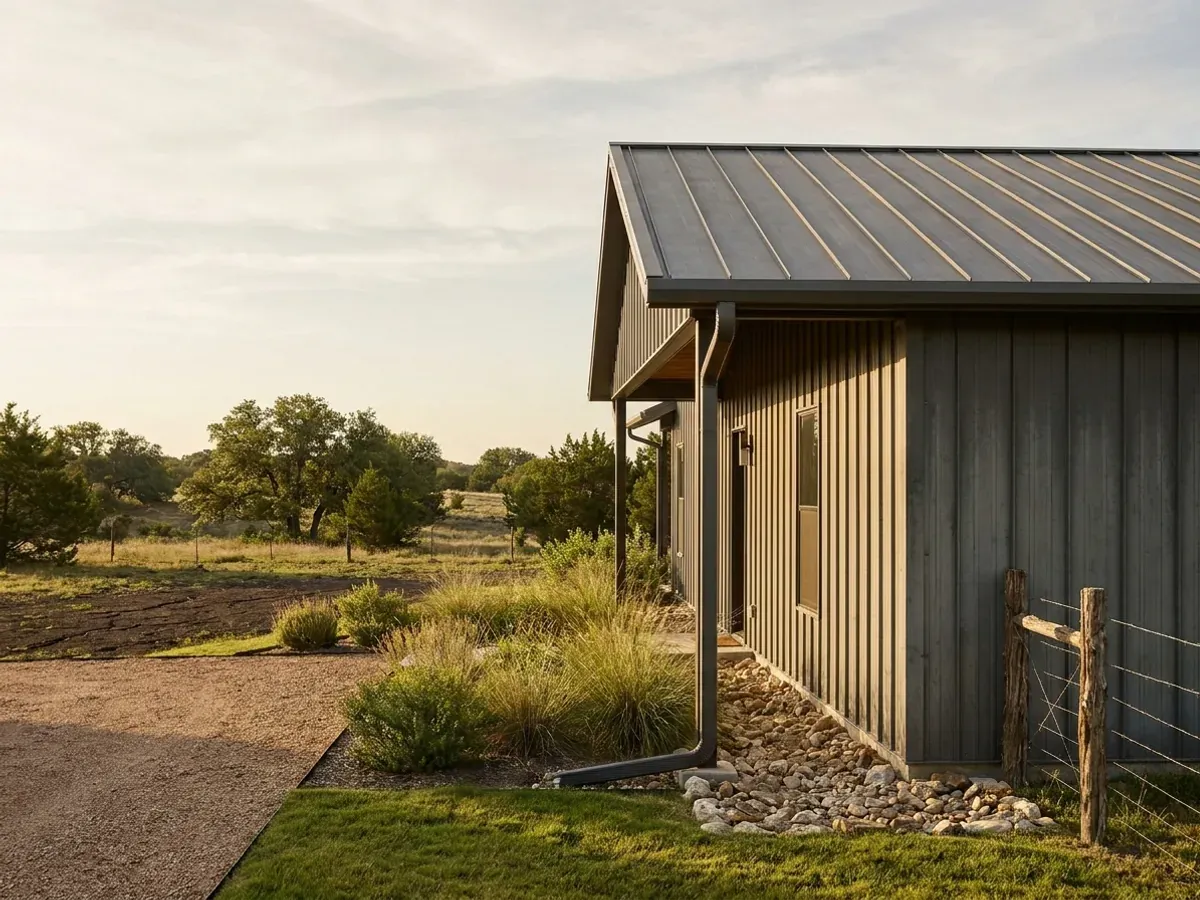
Exterior detail of a metal-clad home showing standing seam roofing, vertical wall panels, and a downspout discharging away from the wall.

Metal Homes in Texas

A metal home wraps an engineered frame in a standing-seam or exposed-fastener metal envelope: a roof that shrugs off UV and driving rain, and a skin termites will not touch. Texas spans a wider band of energy climate zones than any state we have built in, so the insulation and vapour strategy is set by where the parcel is rather than by a house style. Panel gauge and fastener selection matter more where the building stands exposed on open prairie or within reach of the coast.

Permit-ready stamped drawings
Engineered to your jurisdiction's criteria

How a metal homes project runs

Four stages, in this order. The sequence matters more than it looks: getting engineering and permitting settled before anything is fabricated is what keeps a build from stalling.

1

Envelope and panel choice

Standing-seam versus exposed-fastener, gauge, finish warranty, and fastener metallurgy. Within a few miles of salt water these choices decide how the building looks in fifteen years.

2

Insulation and vapor strategy

Metal and Gulf humidity make condensation a real design problem, and the answer on a humid coastal parcel is not the answer on the dry High Plains. We specify the whole assembly deliberately rather than defaulting to batt.

3

Frame and dry-in

Frame erection followed by roof and wall panels, sealed at every penetration and transition.

4

Interior build-out

Interior framing, systems, and finish, with the thermal envelope verified before drywall closes it up.
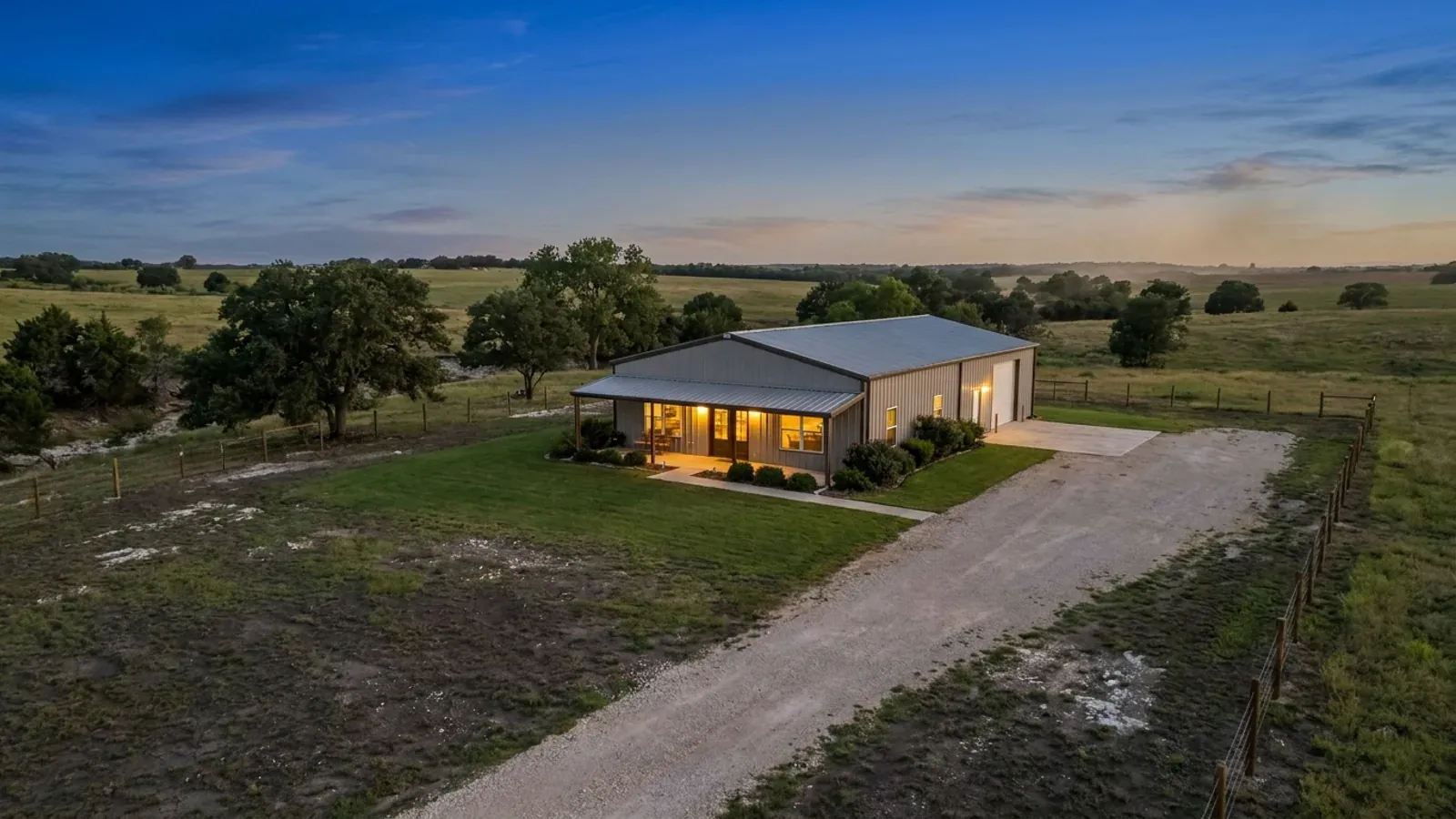
A finished barndominium at dusk with warm interior lighting glowing through its large windows.
The envelope

Texas is five climate zones, and eight counties changed zone between two maps

Texas does not sit in one climate zone. It spans 1A through 4B on the 2021 map, and 2A, 2B, 3A, 3B and 4B on the map before it. Exactly eight counties moved between the two: Dallas, Tarrant, Ellis, Johnson and Navarro went from 3A to 2A, and Cameron, Hidalgo and Willacy went from 2A to 1A. That is Dallas, Fort Worth, Arlington, Brownsville, McAllen and Edinburg — six of the biggest markets in the state — and it means the insulation specification for those parcels depends on which edition of the code the jurisdiction actually adopted. It also means an R-value lifted from a national article is describing a zone that may not be yours, under a code Texas has not adopted, because the IECC does not govern single-family houses in Texas at all.

Coverage

Serving clients across the entire region

We deliver metal homes across Texas, and what the job has to satisfy changes with the parcel. Inside a city limit you are under that city's adopted code and its own filled-in Table R301.2. Outside one, a county has no general building-code power unless it has opted in — and even then there is no county permit and no county inspector. Two parcels twenty miles apart can carry completely different engineering. Tell us where the land sits and we will tell you which rules land on it.

Before you commit

What actually decides the price

Square footage is the number everyone leads with, and it is rarely the one that moves a barndominium budget. These four do.

  • Climate zone, and the code edition behind it

    Texas runs from 1A on the lower Rio Grande to 4B out west, and the envelope requirement is genuinely different at the two ends. In DFW and the Rio Grande Valley a second question stacks on the first, because those counties are assigned differently on the pre-2021 and the 2021 climate maps. The zone you are designing to is a consequence of the edition your jurisdiction adopted, so establishing that is the first thing we do rather than the last.

  • Air and vapour control

    A steel skin is a condensing surface, and where the moisture ends up is decided by the assembly rather than by the R-value on the invoice. The correct detail on a humid Gulf parcel is not the correct detail in the dry western zones — the B in a 2B or 4B assignment means a dry climate — and it changes which side of the assembly the control layers belong on. This is the line item that is cheapest to get right on the drawings and most expensive to fix afterwards.

  • Panel profile, gauge and coating class

    Standing seam and exposed-fastener systems, the gauge behind them and the coating class over them span a wide range in both first cost and service life. Coating is an exposure decision before it is a colour decision, and a parcel within sight of the Gulf is not specified the same way as one on the Caprock. Fastener schedule and flashing details belong on the drawings rather than being improvised on the day.

  • Exterior mix and glazing

    Board and batten, stone, brick or timber on the elevations that face the road change the look substantially and the budget noticeably, and most of the buildings people admire are not metal on every face. Glazing area moves the envelope calculation and the invoice together, and a wall of west-facing glass in a Texas summer is a mechanical decision before it is an aesthetic one.

Exterior detail of a metal-clad home showing standing seam roofing, vertical wall panels, and a downspout discharging away from the wall.

Metal Homes in Texas: common questions

8 questions we get asked most often about building in Texas. If yours is not on the list, ask it directly.

Which energy code applies to a house in Texas?
Not the one almost everyone names. The IECC does not apply to single-family residential construction in Texas. Health and Safety Code §388.003(a) puts houses on the energy efficiency chapter of the International Residential Code as it existed on 1 May 2015, effective 1 September 2016, and leaves the 2015 IECC to govern everything else from 1 November 2016. Adoption sits with the State Energy Conservation Office, acting on stringency findings from the Energy Systems Laboratory at Texas A&M, no more than once every six years and with an effective date at least nine months out, so it is a slow-moving target rather than a rolling one. There is also one genuinely statewide number worth knowing, and there are very few: §388.003(j) sets Energy Rating Index thresholds of 57, 57 and 61 for climate zones 2, 3 and 4 respectively, in force since 1 September 2025. A municipality that has adopted its own newer edition can change the answer inside its limits, which is why we confirm the jurisdiction instead of quoting the state at you.
What climate zone is my county in?
It has two possible answers in eight Texas counties, and the honest response is to name the edition before naming the zone. Texas spans 1A through 4B on the 2021 climate map and 2A through 4B on the map before it, and the 2024 code carries the 2021 assignments unchanged, so there are only ever two maps in play. Five counties — Dallas, Tarrant, Ellis, Johnson and Navarro — moved from 3A to 2A between them, and three more — Cameron, Hidalgo and Willacy — moved from 2A to 1A. Those eight cover Dallas, Fort Worth, Arlington, Brownsville, McAllen and Edinburg. If somebody quotes you an R-value for one of those places without saying which edition it comes from, they have skipped the question that decides the answer. Everywhere else in the state the assignment is stable across both maps, and the zone is simply a fact about your parcel.
I am building outside any city. Does the energy code still reach me?
Yes, and this surprises people who have been told rural Texas is a free-for-all. Health and Safety Code §388.004 obliges a builder constructing outside the limits of any municipality to certify that the building meets the state energy code, and to keep that certification for three years. There is no county inspector standing over it, but the obligation is real and it belongs to the builder. It is not the only rule that survives out there either: the rural plumbing exemption at Occupations Code §1301.052 expressly excludes plumbing performed in conjunction with new construction, so a licensed plumber is required on a new rural build even where there is no county code, no permit and no inspector. The county may have nothing to say about your house. The state energy code and the plumbing licence still do.
Will a metal home be hot in a Texas summer?
That is an envelope question rather than a cladding question. What makes any building hot is air leakage, missing or discontinuous insulation and unshaded glass, and all three are decisions rather than consequences of the material on the outside. A light-coloured reflective roof, a continuous and correctly detailed insulated assembly and sensible glazing make a steel-framed house comfortable through a Texas August. The part people underestimate is that Texas asks two different questions of the envelope depending on where you are: on the Gulf side the hard problem is latent load and humidity, which is solved with air sealing and a properly sized mechanical design rather than a bigger unit, while in the dry western zones the hard problem is solar gain and the daily temperature swing. Same building type, two different specifications.
Is a metal home loud in the rain?
Not once it is a house. The noise people remember is from an uninsulated barn or shop where the panel is also the ceiling and there is nothing between the two. With a finished, insulated assembly between you and the roof panel, a metal home is unremarkable in a storm, and several of the assemblies used are quieter than a conventional roof over an unfinished attic. If quiet matters to you, say so early — it is an assembly decision made on the drawings, and it costs almost nothing to specify at that stage.
Will the inside of the steel sweat?
It will if the assembly is wrong, and that is a design problem rather than a property of steel. Condensation happens when moist air reaches a surface below its dew point, so the fix is to control where the air goes and where the vapour goes, and the right answer differs across Texas. On a humid Gulf Coast parcel the drive is inward for much of the year and the detail that works in a dry climate can trap moisture in the wall. Out on the High Plains, in a 3B or 4B assignment, the problem inverts. This is exactly why a specification copied from a national blog is risky here: it is usually describing one climate, and Texas contains at least five. We draw the control layers rather than leaving them to be worked out on site.
Does the termite classification change the insulation detail?
It can, and this is one of the few places where a local table reaches directly into the envelope. Dallas and Fort Worth both publish a termite classification of “very heavy”; San Antonio, Lubbock, El Paso and Pleasanton publish “moderate to heavy”, and Austin publishes only “YES”. A very heavy classification is the trigger that bars foam plastic below grade at the foundation, which is an insulation-detail decision in the largest market in the state. Two cautions worth carrying: the code section moved between editions, from Figure R301.2(7) and §R318 in the 2018 code to Figure R305.4 and §R305 in the 2024, so a plan note citing one edition means something different under the other; and the newer map no longer fills in the design criteria table by itself, its footnote asking instead for a history of local subterranean termite damage. So this is a per-jurisdiction fact, and we get it from the jurisdiction.
How long does the exterior finish last?
Coating class decides it far more than the steel does. A quality finish has a long service life with a warranty behind it, and repainting is a realistic mid-life option rather than a replacement. What varies across Texas is the exposure the coating is being asked to survive. A parcel near the Gulf has a salt-air problem that a parcel in the Panhandle simply does not, and the dry western zones ask more of ultraviolet stability than of corrosion resistance. Beyond that it is ordinary and controllable: gauge, coating class, fastener specification and whether the flashing details were drawn or invented. Those are the four things worth reading on a quote, and they are the four most likely to be missing from a cheap one.

Ready to put metal homes against a real plan? Start there and the rest follows.

Tell us about the land

Send the parcel ID or an address and we will come back with what can be built on it, the wind load it has to meet, and a realistic budget range. That conversation costs nothing.