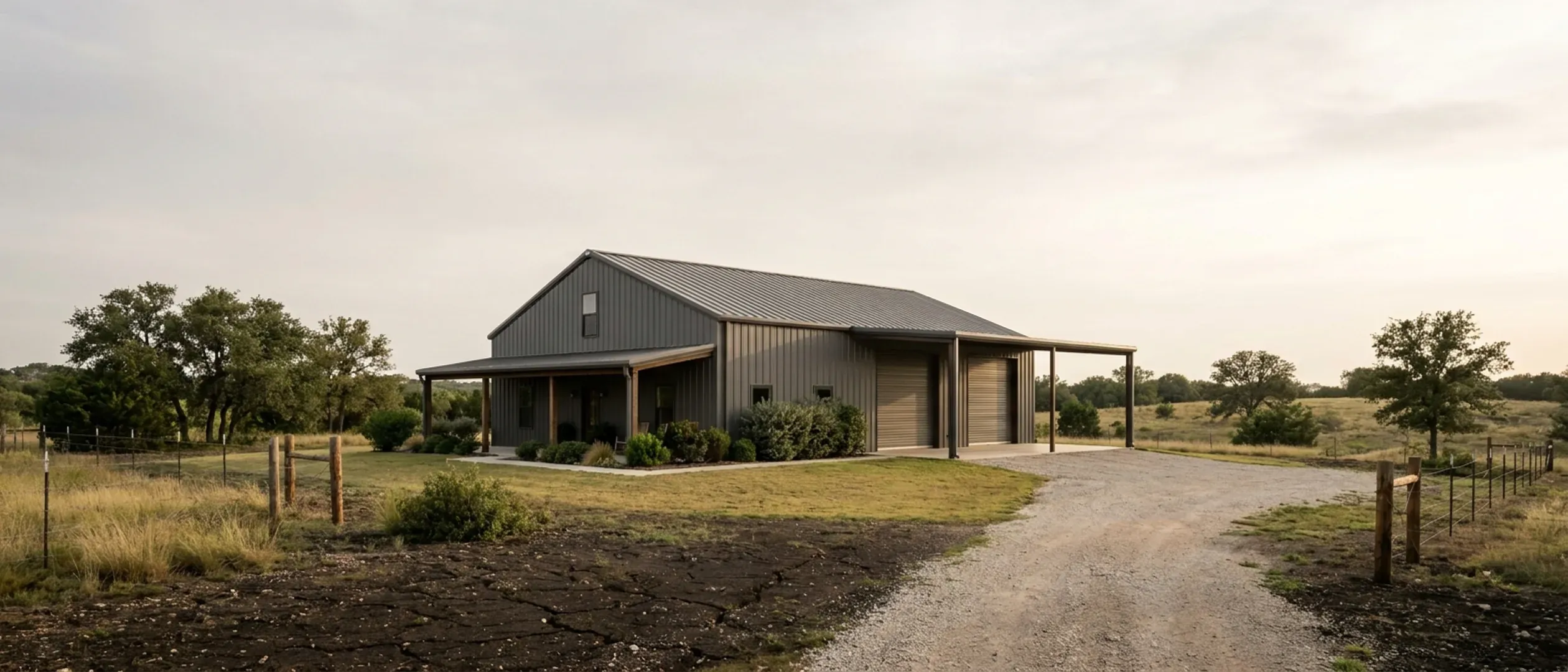
Barndominium Financing in Texas: Loans, Appraisal and Insurance
A barndominium is an awkward object to lend against, and the reason is not that lenders dislike steel. It is that three separate professionals — an underwriter, an appraiser and an insurance underwriter — each have to fit a house with a workshop in it into a category that was written for something else. The Census Bureau's Survey of Construction, the only genuinely representative survey of what American houses cost to build, has no barndominium category at all; a steel-framed, metal-clad house with a shop bay is recorded as a site-built single-family house with a particular exterior wall material. There is no sampling frame for the building type, so there is no representative statistic about it, and that absence follows the building all the way to the appraisal. Everything below is somebody else's published rule — Fannie Mae's Selling Guide, the Texas Constitution, the Texas Property Code, the Texas Department of Insurance, a Texas A&M research centre and a Farm Credit System lender — named and dated in the sentence that uses it. We build these. We do not lend, insure or advise, and this page states no rate, term or qualifying criterion of its own.
Figures below are industry data from cited third-party sources, not a quote from Texas Barndominium Builders. Every project is priced individually.
Bottom line up front
- The obstacle is evidence, not steel. With no barndominium category anywhere in the statistical system there are no comparable sales, and that absence follows the building all the way to the appraisal — where Fannie Mae's unique-housing rule is a test the appraiser has to satisfy rather than a ban.
- Mixed use is the crux, and it reaches the building from four directions at once: the secondary market's eligibility criteria, a lender's own published insurance caution, a city ordinance that identifies a building by its characteristics, and a county permit office that routes a let building differently.
- The Texas homestead rules are constitutional and genuinely statewide — get the sequence right, because Property Code § 53.254 requires the written homestead construction contract to be executed before the material is furnished or the labour performed. We build these; we do not lend, insure or advise, and no rate, term or qualifying criterion of ours appears on this page.
What actually moves the number
Comparable sales
Fannie Mae's Selling Guide B4-1.3-05 (06/04/2025) makes unique housing eligible where the appraiser has "adequate information to develop a reliable opinion of market value", and says the answer "will depend on the extent of the differences between the special or unique property and the more traditional types of houses in the neighborhood and the number of such properties that have already been sold in the neighborhood." How many have sold near you is the single biggest variable, and it is not one you control.
How much of it is shop
Fannie Mae B4-1.4-07 (06/04/2025) requires the appraisal on a mixed-use property to "report the market value of the property based on the residential characteristics, rather than of the business use or any special business-use modifications that were made." A heavily specified shop bay is a real cost to you and, under that rule, not a residential characteristic to the appraiser.
The parcel, entire
Fannie Mae B4-1.3-04 (06/04/2025): "The appraisal must include the actual size of the site and not a hypothetical portion of the site for the subject property" — its own example is that an appraiser "may not appraise only 5 acres of an unsubdivided 40-acre parcel." On acreage, the land you are not building on is inside the valuation whether you want it there or not.
What you can document
Texas Farm Credit's barndominium resource (24 Feb 2026) lists what it wants with an application: credit score, interior and exterior floor plans, a list of supplies, contractor or subcontractor bids and information, a realistic timetable and estimated costs. A lender publishing its own checklist is the cheapest preparation available.
Why a barndominium is an awkward building to lend against
None of this is a rumour about what banks think. It is what the published rulebooks say, and the rules are about evidence rather than about metal.
The building type has no statistical existence
The Census Bureau's Survey of Construction records construction method, exterior wall material, foundation type, framing, floor area and price — and has no barndominium category and no way to isolate one. A steel-framed, metal-clad house with a shop bay comes back as a site-built single-family house with a particular wall material. There is no sampling frame for the type, so no representative statistic about it can exist, at the Census or anywhere downstream of it. That is the reason every cost figure you have read circulates without a survey behind it, and it is also the reason an appraiser has to work harder here than on the house next door.
Fannie Mae's rule for unique housing is a test, not a ban
Fannie Mae's Selling Guide B4-1.3-05, Improvements Section of the Appraisal Report (06/04/2025): "Loans secured by unique or nontraditional types of housing, including, but not limited to, earth houses, geodesic domes, and log houses, are eligible for sale to Fannie Mae provided the appraiser has adequate information to develop a reliable opinion of market value." It adds that "On a case-by-case basis, both the appraiser and the underwriter must independently determine whether there is sufficient information available to develop a reliable opinion of market value." Two independent judgements, made property by property — which is exactly why two identical buildings in two counties can get two answers.
And the same topic states the refusal limb
B4-1.3-05 sets out both outcomes when appraising unique properties. Where the appraiser can make sound adjustments and "demonstrate the marketability of the property based on older comparable sales, comparable sales in competing neighborhoods, the existence of similar properties in the market area, and any other reliable market data, the property is acceptable as security in a sale of the loan to Fannie Mae." Where the appraiser "is not able to find any evidence of market acceptance, and the characteristics of the property are so significantly different that they cannot establish a reliable opinion of market value, the property is not acceptable as security in a sale of the loan to Fannie Mae." Nothing in that turns on the building being steel. It turns on whether anything like it has sold nearby.
A large shop can read as an agricultural building
B4-1.3-05 carries a table headed Properties with Outbuildings, and opens it by saying "A lender must give properties with outbuildings special consideration in the appraisal report review to ensure that the property is residential in nature." Minimal outbuildings such as small barns or stables need the appraiser to "demonstrate through the use of comparable sales with similar amenities that the improvements are typical of other residential properties in the subject area". An atypical minimal outbuilding is acceptable "provided the appraiser's analysis reflects little or no contributory value for it." And of significant outbuildings — "silos, large barns, storage areas, or facilities for farm-type animals" — the guide says their presence "may indicate that the property is agricultural in nature" and "The lender must determine whether the property is residential in nature, regardless of whether the appraiser assigns value to the outbuildings." This is the single most useful paragraph on this page for anyone weighing a detached shop against one under the same roof.
Highest and best use is a gate, and it is one sentence long
Fannie Mae B4-1.3-04, Site Section of the Appraisal Report (06/04/2025): "Fannie Mae will only purchase or securitize a loan that represents the highest and best use of the site as improved." The guide defines that as the use that is "legally permitted, financially feasible, and physically possible", and says the appraiser should treat the existing use as the highest and best use where "the use of comparable sales demonstrates that the improvements are reasonably typical and compatible with market demand for the neighborhood." Comparable sales decide this too.
On acreage, the whole parcel is inside the valuation
B4-1.3-04 also states that "The appraisal must include the actual size of the site and not a hypothetical portion of the site for the subject property", and gives its own example: an appraiser "may not appraise only 5 acres of an unsubdivided 40-acre parcel. The appraised value must reflect the entire 40-acre parcel." If you are buying more land than you intend to build on, this is worth raising with your lender before you make an offer rather than after.
A Texas university research centre said the blunt version in 2017
The Texas Real Estate Research Center at Texas A&M University published "Building a barndominium: How to finance it and where to build" by Bryan Pope on 9 February 2017. Its opening is still the plainest statement of the problem: "Financing a barndominium is different than financing a traditional home. Many banks do not consider barndominiums a dwelling so you will not get the same type of loans (length of loans or interest rates). Shop around for financing that is best for you." It is nine years old and should be read as a durable structural point rather than as current market commentary — but no Texas source with that standing has published anything since that contradicts it.
Mixed use is the crux, and four different authorities reach it from four directions
A building that is part dwelling and part workshop is not a conforming single-family residence to every reader of it. What is striking is that a secondary-market guide, a lender, a city zoning ordinance and a county permit office all arrive at the same difficulty by completely different routes.
The secondary market: Fannie Mae's mixed-use eligibility criteria
Fannie Mae B2-3-04, Special Property Eligibility Considerations (10/08/2025), says Fannie Mae buys mortgages "secured by properties that have a business use in addition to their residential use, such as a property with space set aside for a day care facility, a beauty or barber shop, or a doctor's office", and then sets four conditions: "The property must be a one-unit dwelling that the borrower occupies as a principal residence"; "The borrower must be both the owner and the operator of the business"; "The property must be primarily residential in nature"; and "The dwelling may not be modified in a manner that has an adverse impact on its marketability as a residential property." Read those against a house with a working shop bay in it and you can see where the conversation with an underwriter is going to go.
The appraisal side of the same rule is the harder half
Fannie Mae B4-1.4-07, Mixed-Use Property Appraisal Requirements (06/04/2025), requires the appraisal to "provide a detailed description of the mixed-use characteristics of the subject property"; to "indicate that the mixed use of the property is a legal, permissible use of the property under the local zoning requirements"; to "report any adverse impact on marketability and market resistance to the commercial use of the property"; and to "report the market value of the property based on the residential characteristics, rather than of the business use or any special business-use modifications that were made." That last requirement is the one that surprises people: money spent making the shop a good shop is, by that rule, outside the residential value being reported.
The lender: Texas Farm Credit's insurance caution, in its own voice
Texas Farm Credit — a Farm Credit System association that lends on rural Texas property — publishes a barndominium resource dated 24 February 2026 by Brittney Krolczyk. Its cost figures are relayed from other publishers and are treated as such elsewhere on this site, but its lending-side cautions are its own, and this is the one to read twice: "Insurance for barndominiums is more complicated. Since many barndos are mixed-use, such as home and work or storage space, traditional homeowners insurance may not cover it." It adds: "When comparing insurance plans, carefully read the policies to understand what's covered, as it may range dramatically by carrier." A mortgage requires cover, so an insurance problem is a financing problem.
The city: College Station identifies a building, not its occupants
College Station's Unified Development Ordinance, as amended by Ord. 2026-4675 on 23 April 2026, defines Shared Housing by reference to "structure or property characteristics that may be used to increase occupancy" — among them a residential structure containing more than four bedrooms, bedroom-to-bathroom parity in excess of four, more than one story where that limits the footprint to meet impervious cover, a property that "does not contain a garage, or if it contains a garage, can support additional living space", and parking that will allow more than four vehicles. Shared Housing is not a permitted use in the districts a house on acreage sits in there. The definition says the use "may be identified … by considering a combination" of those characteristics, so it is an administrator's assessment rather than an automatic trip at the fifth bedroom — but it is a test applied to the building itself, and a large barndominium can present several of those characteristics at once with a family living in it. Ask the Planner-on-Call before you draw.
The county: letting the building can change which office you are in
Montgomery County's own permit pages route rental homes — "anything that is rented out" — through the commercial office, where the Fire Marshal enforces the 2024 IFC and IBC, and the county charges $500 there against the $200 it charges for a development permit on a new residential structure over 200 square feet. The no-county-building-code picture that is true of the house you live in is not reliably true of the identical building you let, and a lender underwriting an income property will be looking at the second regime, not the first. This varies by county; the axis it varies on is intended use, and your county page is where the answer lives.
And the resale caution the same lender publishes
Texas Farm Credit's list of barndominium cons includes: "Selling. If you decide to sell your custom barndominium, you may struggle to find buyers who agree with your design choices." That is a lender describing the exit its own collateral depends on, which makes it worth more than the same sentence from a magazine. It is also the same problem as the comparable-sales problem, seen from the other end: the thinner the resale market for a specific design, the harder the next appraisal is.
What Texas law puts around a loan secured by your homestead
These are statewide and they are constitutional, which makes them among the very few things on this site that are true everywhere in Texas. They are also the part of the process most likely to be handled badly by somebody who has not built in Texas before.
Article XVI § 50(a)(5) — and read the two limbs separately
The Texas Constitution protects the homestead from forced sale except for a listed set of debts. Item (5) covers "work and material used in constructing new improvements thereon, if contracted for in writing, or work and material used to repair or renovate existing improvements thereon if" four further conditions are met. Those four, as the text sets them out, are: the work is contracted for in writing with the consent of both spouses in the case of a family homestead; the contract is not executed "before the fifth day after the owner makes written application for any extension of credit"; the contract "expressly provides that the owner may rescind the contract without penalty or charge within three days after the execution of the contract by all parties"; and the contract is executed by the owner and spouse "only at the office of a third-party lender making an extension of credit for the work and material, an attorney at law, or a title company." Which limb a given contract sits in is a question for your title company and your lawyer. The point for a reader is that the sequence and the venue of signing are constitutional facts here, not formalities.
Property Code § 53.254 — the contract has to exist before the first delivery
"To fix a lien on a homestead, the person who is to furnish material or perform labor and the owner must execute a written contract setting forth the terms of the agreement" (§ 53.254(a)). Subsection (b): "The contract must be executed before the material is furnished or the labor is performed." Subsection (c): "If the owner is married, the contract must be signed by both spouses." Subsection (e): "The contract must be filed with the county clerk of the county in which the homestead is located." A construction lender will want all four satisfied before it funds, which in practice means the paperwork precedes the first load of steel arriving on site.
§ 53.255 gives you a disclosure statement, and one line of it is about your loan
"Before a residential construction contract is executed by the owner, the original contractor shall deliver to the owner a disclosure statement described by this section" (§ 53.255(a)). The statement the Property Code prescribes includes: "If you borrow money from a lender to pay for the improvements, you are entitled to have the loan closing documents furnished to you for review at least one business day before the closing. Do not waive this requirement unless a bona fide emergency or another good cause exists". It also tells you that "Before construction commences, your contractor is required to provide you with a list of the subcontractors and suppliers the contractor intends to use on your project." If you did not receive that statement, that is a question worth asking out loud.
Article XVI § 51 — how much land can be inside the homestead
"The homestead, not in a town or city, shall consist of not more than two hundred acres of land, which may be in one or more parcels, with the improvements thereon; the homestead in a city, town or village, shall consist of lot or contiguous lots amounting to not more than 10 acres of land, together with any improvements on the land". The same section provides that the urban homestead may be used "as both an urban home and a place to exercise a calling or business", and that "any temporary renting of the homestead shall not change the character of the same, when no other homestead has been acquired."
Article XVI § 50(a)(6) — the home-equity route, and its published limits
If you are borrowing against equity you already have rather than taking a purchase or construction loan, § 50(a)(6) sets the terms in the Constitution itself. Among them: the loan, added to all other debt secured by the homestead, may not exceed 80 percent of the fair market value of the homestead on the date the credit is extended; fees to originate, evaluate, maintain, record, insure or service it may not exceed 2 percent of the original principal, excluding a third-party appraisal, a survey, the state base premium for a mortgagee title policy and a title examination report under that premium; it is "without recourse for personal liability" absent actual fraud; it may be foreclosed "only by a court order"; it is not secured by "any additional real or personal property other than the homestead"; it may not close before the twelfth day after application or the notice, nor before one business day after the borrower receives the loan application and a final itemised disclosure of actual fees, points, interest, costs and charges; it may not close before the first anniversary of any other § 50(a)(6) loan on the same homestead; and it is "closed only at the office of the lender, an attorney at law, or a title company." Your lender applies these, not us.
And the secondary market carries a whole subpart for them
Fannie Mae's Selling Guide devotes Section B5-4.1 to Texas Section 50(a)(6) loans. B5-4.1-02, Texas Section 50(a)(6) Loan Eligibility, requires that such a loan "must be secured by a single-unit principal residence constituting the borrower's homestead under Texas law", excludes two- to four-unit properties, investment properties and second homes, and adds that "The borrower's homestead property may not exceed the applicable acreage limit as determined by Texas law when the Texas Section 50(a)(6) loan is originated" and that "A borrower that owns adjacent land must submit appropriate evidence, such as a survey, that the mortgaged homestead property is a separate parcel that does not exceed the permissible acreage." On a rural build that is a survey line item, and it is better to know about it early.
Construction lending, draws, and the costs that land mid-build
A construction loan pays out in stages against work actually done. What follows is what named sources publish about how that works and what tends to arrive unbudgeted, rather than a description of the concept in the abstract.
Ask about draws before you ask about rate — a Texas A&M centre's advice
The Texas Real Estate Research Center at Texas A&M, in its 9 February 2017 piece by Bryan Pope: "Ask lenders about their contractor payment process, or 'draws.' Encourage draw inspections by your lender. In other words, the contractor should provide the lender an itemized list of expenses for each draw of funds he makes. The lender may send an inspector to the building location to confirm that the money draw was used appropriately." A borrower asking a lender to inspect more, rather than less, is unusual advice and it is the right kind.
And the same source on paying as you go
"If you plan to 'pay as you go' and finance yourself, use caution and common sense. Verify material deliveries and work progress before you pay a draw. Ask for copies of invoices for materials and sub-contractors." Self-funding removes a lender from the process and removes the lender's inspection with it — which is a trade, not a saving.
What one Texas lender says its own construction product does
Texas Farm Credit names four routes on its barndominium page dated 24 February 2026: a conventional loan for an existing barndominium, a rural home loan, a construction loan, and a cash-out refinance of an existing home to fund a barndominium-style addition. On construction it writes that "A construction or homesite loan offers a one-time loan, meaning you begin paying your mortgage at closing rather than waiting for the final construction. This can help save on additional fees and closing costs", and that "After closing the deal, your bank may help you manage the draw process to ensure the project moves on time and according to plan." It also publishes, of conventional loans, that "terms are often for 30 years, with no restrictions on acreage." Those are that lender's descriptions of that lender's products; another lender's answer will differ and only your lender's own terms bind anybody.
The utility connection is a real mid-build cost, and one utility documents it
Bryan Texas Utilities' Service Entrance Requirements Manual, 10th Edition, states that "For all installations greater than 200 Amps, prior to service being extended or determination of any CIAC amount, an electric load analysis must be provided by the Customer or their contractor to BTU Line Design with enough detail to adequately size BTU's electric facilities." A barndominium with a working shop — welder, compressor, lift, sub-panel — routinely goes past 200 amps, so on this building type that analysis is a step rather than an edge case. BTU publishes that there are no application fees for Line Design projects but that the customer pays a Contribution In Aid of Construction, "their contribution towards the construction cost of their project" — and it publishes no figure for it. Its timing note is that the scheduling process "does not begin until" the customer has mounted an approved meter loop, signed the damage waiver, executed necessary easements and paid that contribution. One utility, one city — but it is the shape of a cost that a construction budget written from a national cost guide will not contain.
If the land carries an agricultural valuation, building changes the tax picture
Tax Code § 23.55(a) provides a three-year rollback, with no interest, when land appraised as agricultural changes use. § 23.55(b) attaches a tax lien; § 23.55(d) taxes only the part that changed where the change affects part of a parcel; and § 23.55(i) provides that claiming a residence homestead is not itself a change of use. The Comptroller's Manual for the Appraisal of Agricultural Land (October 2024) states that buildings "must be appraised separately at market value." Older material describing a five-year rollback with interest is superseded. This is a tax matter — state the authority, then take it to your appraisal district and a tax professional.
Permit and septic fees are published, and they are not estimates
Unlike almost every cost figure attached to this building type, the jurisdiction's own permit, plan-review, inspection and on-site sewage fees are real numbers a government publishes and will actually charge. They are also the ones a construction budget most often omits, because national guides cannot carry them. Those figures sit on the location pages, county by county, and they are worth pulling before the loan amount is fixed rather than after.
Insuring a barndominium in Texas
Insurance belongs on a financing page because a mortgage requires cover, and because the mixed-use question that troubles a lender troubles an insurer for the same reason. Everything here is the Texas Department of Insurance's own published consumer guidance, the Insurance Code, a federal lending regulation, or a lender describing what it sees.
The law does not require it; your lender does
The Texas Department of Insurance's home insurance guide states it directly: "The law doesn't require you to have home insurance. But if you still owe money on your home, your lender will require you to have it." TDI also notes that Texas has a Consumer Bill of Rights for home and renters insurance, and that your insurer gives you a copy when you get or renew a policy.
Whether the shop is attached decides which coverage pays for it
TDI lists six coverages in most Texas home policies, and two of them matter here. Dwelling coverage "pays if your house is damaged or destroyed by something your policy covers." Other structures coverage "pays to repair structures on your property that aren't attached to your house. This includes detached garages, storage sheds, and fences." Other structures is normally a percentage sub-limit of the dwelling amount, so a large detached workshop and the same workshop under the house's roof are two different insurance problems. This is the same attached-or-detached decision that Fannie Mae's outbuilding table turns on, and the same one some zoning ordinances turn on. Design once, with all three in view.
How much you have to insure it for
TDI: "Most companies require you to insure your house for at least 80% of its replacement cost. Some companies require you to insure your house for 100% of its replacement cost." On a building type with no published value distribution, agreeing a replacement cost figure with a carrier is not a formality — it is the number your claim will be measured against.
Replacement cost and actual cash value are not the same policy
TDI: "Home policies provide either replacement cost coverage or actual cash value coverage. To be fully protected, make sure your policy has replacement cost coverage." Replacement cost "pays to repair or replace your house and personal property at current prices"; actual cash value "pays replacement cost minus depreciation." Texas Farm Credit, on barndominiums specifically, publishes that "barndo owners can get coverage ranging from actual cash value of the property to replacement costs and extended value policies" — so all three exist in this market and the difference between them is the whole conversation.
Flood is a separate policy, and the requirement is federal
TDI: "Most home policies don't cover damage caused by floods. If your home is in a designated flood zone, your lender requires you to have flood insurance." The federal side of that is a regulation on the lender rather than on you: 12 CFR § 339.3(a) provides that a supervised institution "shall not make, increase, extend, or renew any designated loan unless the building or mobile home and any personal property securing the loan is covered by flood insurance for the term of the loan", and § 339.2 defines a designated loan as one secured by a building "that is located or to be located in a special flood hazard area" — the words "or to be located" are what bring a construction loan inside it. TDI also notes that "more than half of homes flooded by Hurricane Harvey were outside of designated flood zones", and that most flood policies have a 30-day waiting period.
On the coast, a certificate comes before a policy
Insurance Code § 2210.258(b) provides that the Texas Windstorm Insurance Association "may not insure" a structure described by that section until a certificate of compliance has been issued — a prohibition on the association, not merely a condition on the owner — and § 2210.251(g) makes that certificate evidence of insurability. § 2210.2515(b) requires notice before construction begins and § 2210.2515(e) ends the certificate if forms and fees do not arrive within six months of final inspection; § 2210.258(d) allows a 30-day bridge while the certificate processes. TDI's consumer guide adds that on the coast "you might need flood insurance before TWIA will sell you a policy" and that you might need an inspection by an engineer or a windstorm inspector. TDI is also explicit that wind coverage is not legally required. Lenders require it — which is why it belongs on this page and not only on a coastal one.
If nobody will write it
TDI publishes two backstops. The Texas FAIR Plan Association "sells basic home insurance", available where you cannot find a company to insure you and at least two have turned you down. Surplus lines companies "are out-of-state companies that insure risks that companies in Texas won't insure", must meet state standards to sell here, and an agent "must make a good effort" to place the risk in the admitted market first. TDI says plainly that both are more expensive than standard coverage. For an unusual building this is worth knowing before you have a closing date.
Two policy conditions that catch people building or holding land
TDI publishes that a company may decline to renew if "your house is vacant for 60 days or more", and that most companies stop coverage at that point though they usually keep liability coverage running. It also publishes that where you owe money on the home, the claim cheque is made out to you and your mortgage company jointly, that the mortgage company releases funds as work is done, and that after it receives the information it asks for "it must release all or some of the money to you within 10 days." Both are worth reading before a build, not after a storm.
What this page deliberately does not tell you
The most valuable thing a page like this can do is mark the edge of what is actually established, rather than fill it in.
VA, USDA and FHA eligibility for this building type is unestablished here
No public authority located for this page publishes a rule that names the building type for the VA guaranty, the USDA Rural Development guaranteed loan or FHA insurance, so this page states nothing about whether any of the three will or will not accept a barndominium. What can be said honestly is that each of the three publishes its own property standards and its own lender handbook, and that in practice the same appraisal question runs underneath all of them — whether an appraiser can develop a supportable opinion of value. Put the question to the programme itself: the VA regional loan centre that serves Texas, USDA Rural Development's Texas state office, and the FHA Resource Center. A lender approved for the programme you want can also answer it in one call, and that answer is worth more than anything a builder could tell you.
No rate, term, qualifying criterion or eligibility rule of ours appears anywhere above
Every figure and every rule on this page is attributed in the sentence that carries it, to Fannie Mae's Selling Guide, the Texas Constitution, the Texas Property Code, the Texas Tax Code, the Insurance Code, the Code of Federal Regulations, the Texas Department of Insurance, the Texas Real Estate Research Center at Texas A&M, Bryan Texas Utilities, a named city ordinance, a named county, or Texas Farm Credit. Where a source relays somebody else's number rather than generating it, that is said. Nothing here is our number.
We build these. We do not lend, insure or advise
This page is written to make the conversation with a lender, an appraiser, an insurance agent and a tax professional a better one — by telling you which published rules they are working from before you sit down. It is not financial, insurance, tax or legal advice, and it is not a substitute for any of the four professionals named in that sentence. What we can usefully do is design and document the building so that the questions those professionals ask have answers: a clear split between habitable and shop space, drawings and a specification a lender can attach to a draw schedule, and a documented plan for the site.
Reading this because you are weighing a build? The next step is a plan drawn for your program.
What's different about Texas
The homestead is a constitutional object here, not just a tax status
Texas Article XVI § 50 protects the homestead from forced sale for all debts except a listed set, and construction work is on that list only on conditions the Constitution itself sets out. That is why a Texas construction contract on a homestead looks different from one anywhere else, and why your title company will care about the order in which documents were signed.
The rural homestead runs to 200 acres, and that has a lending consequence
Article XVI § 51: the homestead "not in a town or city, shall consist of not more than two hundred acres of land, which may be in one or more parcels, with the improvements thereon", and the homestead in a city, town or village "not more than 10 acres." Fannie Mae's Selling Guide B5-4.1-02 then requires that a borrower's homestead property "may not exceed the applicable acreage limit as determined by Texas law" on a Texas Section 50(a)(6) loan, and that a borrower who owns adjacent land "must submit appropriate evidence, such as a survey."
The Constitution already contemplates a house you also work in
Article XVI § 51 provides that the urban homestead "shall be used for the purposes of a home, or as both an urban home and a place to exercise a calling or business, of the homestead claimant", and that "any temporary renting of the homestead shall not change the character of the same, when no other homestead has been acquired." That is the oldest friendly authority on this page for a building that is part dwelling and part workshop — but it is homestead law, not zoning law, and it settles nothing about what your city permits.
On the coast, insurability is gated by a certificate
Insurance Code § 2210.258(b) provides that the Texas Windstorm Insurance Association "may not insure" a structure described by that section until a certificate of compliance has been issued, and § 2210.251(g) makes the certificate evidence of insurability. § 2210.2515(b) requires notice before construction begins, and § 2210.2515(e) kills the certificate if the forms and fees do not arrive within six months of final inspection. The Department of Insurance says plainly that wind coverage is not legally required — lenders require it, which is a different sentence.
Letting the building can move it into a different regime
Montgomery County routes rental homes — "anything that is rented out" in its own words — through its commercial office, where the Fire Marshal enforces the 2024 IFC and IBC and the county charges $500 rather than the $200 development permit fee for a new residential structure. A reader financing a build they intend to let, or who may sell to somebody who does, should establish this for their own county before the loan is written.
Agricultural valuation can end at the slab
Tax Code § 23.55(a) imposes a three-year rollback, with no interest, when the use of land appraised for agriculture changes. § 23.55(i) provides that claiming a residence homestead is not itself a change of use, and the Comptroller's Manual for the Appraisal of Agricultural Land (October 2024) states that buildings "must be appraised separately at market value." This is a tax matter; the appraisal district and a tax professional are the people to ask, not a builder.
Pros and cons, honestly
Pros
- Fannie Mae's published Selling Guide does not exclude the building type. B4-1.3-05 makes unique and nontraditional housing eligible "provided the appraiser has adequate information to develop a reliable opinion of market value" — a test about evidence, not a prohibition on steel.
- Where the shop is under the same roof as the house, it is part of the dwelling rather than an outbuilding — which is the friendlier side of Fannie Mae's Properties with Outbuildings table and of the other-structures sub-limit the Texas Department of Insurance describes.
- The Texas Constitution's urban homestead may expressly be used "as both an urban home and a place to exercise a calling or business" (Art. XVI § 51) — the oldest authority in Texas that contemplates a house you also work in.
- Texas Farm Credit publishes that its construction or homesite loan is a one-time close, "meaning you begin paying your mortgage at closing rather than waiting for the final construction", and that its conventional loan terms are "often for 30 years, with no restrictions on acreage."
- The Texas rural homestead can take in up to 200 acres under Art. XVI § 51, so acreage as such does not put a build outside homestead protection.
- Texas Farm Credit publishes a durability point that matters to an insurer and a lender both: barndominiums "often last 50-70 years or even more", with simpler maintenance than a wood-framed house.
Cons
- The Census Bureau's Survey of Construction has no barndominium category, so there is no representative value distribution for the building type — and the appraiser feels that absence as a shortage of comparable sales.
- Fannie Mae B4-1.3-05 states the refusal outcome explicitly: where the appraiser "is not able to find any evidence of market acceptance", the property "is not acceptable as security in a sale of the loan to Fannie Mae."
- Significant outbuildings — Fannie Mae's examples are "silos, large barns, storage areas, or facilities for farm-type animals" — "may indicate that the property is agricultural in nature", and the lender must then decide whether the property is residential in nature at all.
- Fannie Mae B4-1.4-07 requires a mixed-use appraisal to report value "based on the residential characteristics, rather than of the business use or any special business-use modifications that were made" — so money spent on the shop may not come back in the appraised value.
- Texas Farm Credit publishes that because many of these buildings are mixed-use, "traditional homeowners insurance may not cover it", and that what is covered "may range dramatically by carrier."
- The same lender publishes a resale caution: "If you decide to sell your custom barndominium, you may struggle to find buyers who agree with your design choices."
- The Texas Real Estate Research Center at Texas A&M wrote in 2017 that "many banks do not consider barndominiums a dwelling so you will not get the same type of loans (length of loans or interest rates)."
- Article XVI § 50(a)(5) and Property Code § 53.254 put constitutional and statutory conditions on the timing, signatures and filing of a homestead construction contract — get the sequence wrong and the lien is the thing that suffers.
Common questions
12 questions people ask most about barndominium cost. If yours is not on the list, ask it directly.
Can you get a mortgage on a barndominium in Texas?
Why does the lender keep asking about the shop?
Will a barndominium appraise?
What is a draw, and who checks the work?
Is barndominium insurance harder to get in Texas?
Does the workshop need its own insurance?
Will my lender make me buy flood insurance?
Do VA, USDA or FHA loans work for a barndominium?
Does renting it out change anything?
What does Texas law require before work starts on my homestead?
How much land can be in the homestead, and does that matter to a lender?
What happens to my agricultural valuation when I build?
Questions answered? Tell us what you want to build and we will put real numbers against it.
Keep reading
The pages that answer the next question this one raises.
What a barndominium costs in Texas
Third-party cost ranges, named and dated, plus the published jurisdiction fees a lender's budget has to carry. It also explains why no representative cost figure exists for the building type.
Read itPermits, codes and who regulates what
The regulatory half of the same conversation: which authority looks at the building, what a county can and cannot require, and where letting it changes the answer.
Read itAre barndominiums worth it?
The resale and value question the appraisal problem on this page is really about, set out with the same sourcing discipline.
Read itHow long a build takes
Useful alongside a draw schedule: a construction loan pays against stages, so the stages are worth understanding before you agree them.
Read itService areas across Texas
Permit routes, fee schedules and septic rules county by county and city by city — the published local numbers that a statewide page cannot carry.
Read itPermitting help
What we handle on the permit side of a build, and how the documentation lines up with what a construction lender asks for at each draw.
Read itWant a real number instead of a range?
Start your plans and we will come back with a budget for what you actually want to build, not a national average. Send the parcel ID or an address when you have one and we will price it against your land. That conversation costs nothing.