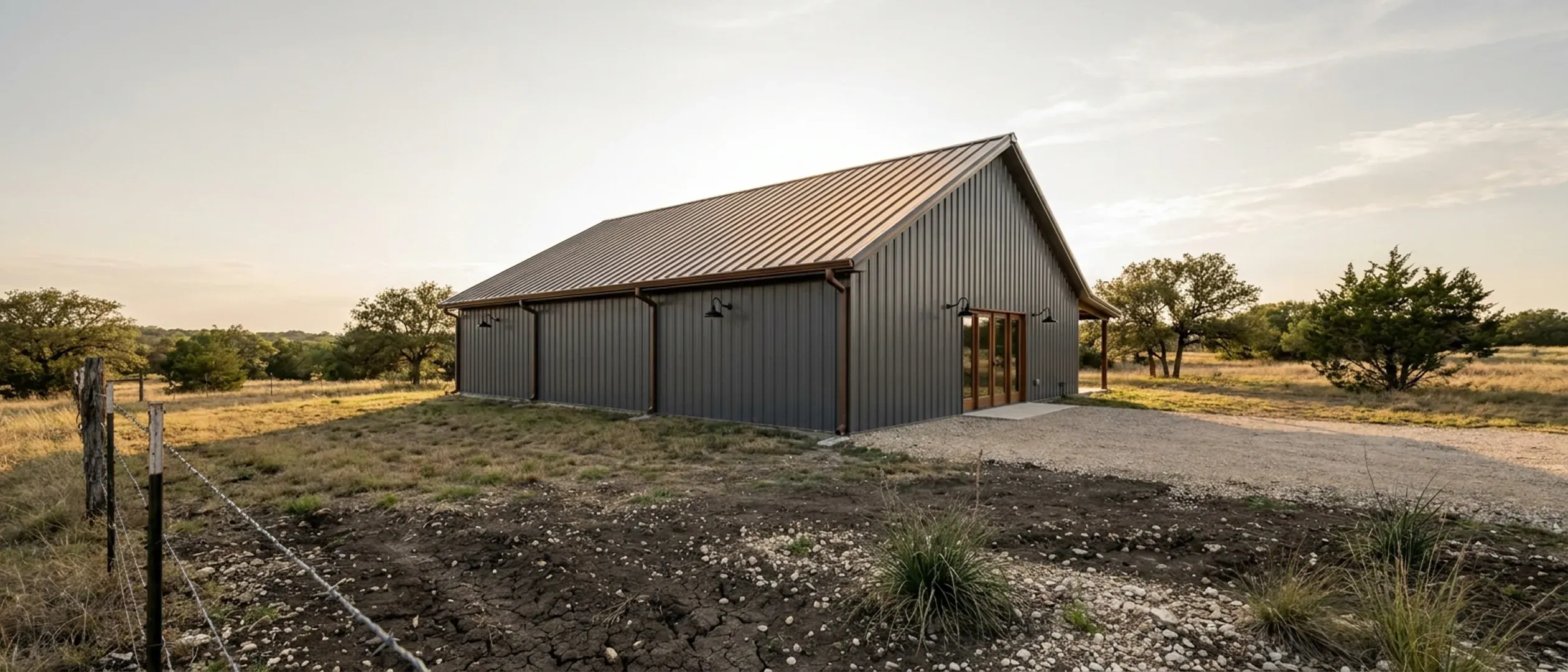
Are Barndominiums Legal in Texas?
Yes. A barndominium is a house, and Texas regulates it the way it regulates any other house — which is to say it depends entirely on where you put it. There is no statewide building code and no state minimum edition, so "is it legal" resolves into a better question: who decides what yours has to meet? Inside a city limit the city decides, and Local Government Code § 214.212 freezes it on the edition in force when it adopted, while letting it add, modify or remove requirements from that edition. Outside every city limit a Texas county has no general building-code authority at all unless its commissioners court affirmatively opted into Chapter 233, Subchapter F — and even where it did, there is no county permit, no county fee and no county inspector. Across the 54 Texas jurisdictions researched for this site the split is 31 cities with their own adopted edition, six counties opted in, seven recording no county residential code, and ten unresolved. This page explains the question. The location pages carry the sourced answer for each place.
Figures below are industry data from cited third-party sources, not a quote from Texas Barndominium Builders. Every project is priced individually.
Bottom line up front
- Yes — a barndominium is a house, and Texas has no statewide building code, so the real question is which of four regimes your land sits in: inside a city limit, unincorporated with the county opted into Chapter 233 Subchapter F, unincorporated with no county code at all, or in a city's extraterritorial jurisdiction.
- Across the 54 Texas jurisdictions researched here the split is 31 cities with their own adopted edition, six counties opted in, seven recording no county residential code and ten unresolved. Local Government Code § 214.212 freezes a city on the edition in force when it adopted, so "the Texas code" is not a thing.
- "No building code" is not "no rules". The septic permit, platting, floodplain permits and three state requirements survive it — and the recorded deed covenant, which the legislature left untouched on exterior materials, minimum house size and permitted use, is the constraint most likely to stop this building outright.
Who decides: the four regimes, and how to tell which one you are in
Everything else on this page follows from this one question. Establish it before you buy the land, because it is a property fact, not a building fact — and the location pages carry it jurisdiction by jurisdiction.
Inside a city limit — the city decides, and it may delete
Local Government Code § 214.212(a) puts a municipality on the International Residential Code as it existed on 1 May 2012, and § 214.212(c)(1) lets it adopt local amendments "that may add, modify, or remove requirements set by the code." There is no stringency floor, no ceiling, no state review and no state registry of local amendments. The only constraints are procedural — a public hearing and adoption by ordinance under § 214.212(e), plus a 21-day website notice (§ 214.217) and a 30-day delay before enforcement (§ 214.218) in a city over 100,000. So a generic statement about "the code in Texas cities" is never safe: a city may start from that 2012-vintage edition and delete from it. Ask the city for its adopting ordinance and its published amendment list.
Unincorporated land, county opted in — a code with no permit behind it
Where a commissioners court has adopted Subchapter F, the arrangement is deliberately weak and unusual. § 233.153(d)(1) says it may not be construed to require prior county approval before construction begins. § 233.153(f) bars a fee to defray enforcement costs. § 233.153(d)(2) withholds zoning. § 233.154(a)(1) requires three inspections — foundation before concrete, framing and mechanical before covering, and on completion — and § 233.154(a)(3) makes the builder contract them privately. § 233.157(b) makes a violation a Class C misdemeanor, which is a notice offence and not a stop-work power. Hays County states it from the inside in its own published FAQ: "Hays County does not perform inspections on single-family development. A builder will be required to contact a 3rd party to complete the inspections."
Unincorporated land, county never opted in — no county residential code at all
This is the largest category by land area, and the affirmative statements are better evidence than a silent record. Bell County's County Engineer says outright that there is no building permit, building code or zoning with which you must comply. Bexar County's Fire Marshal states in writing that unless a residential permit was issued voluntarily, the county "does not have legal authority to regulate residential construction, conduct residential construction inspections, or issue a residential Certificate of Occupancy." Williamson, Ellis and Fort Bend each say the equivalent in their own material.
The ETJ — a city can make you plat, and Texas courts have held it cannot enforce its building code
A city's extraterritorial jurisdiction reaches half a mile to five miles beyond the limit depending on the city's population (§ 42.021(a)). Two decisions govern what it means for a house. In Town of Lakewood Village v. Bizios (Tex. 2016) the Supreme Court held a general-law city has no ETJ building-code authority, and that § 233.153(c) is a precedence rule rather than a grant of power. In Collin County v. City of McKinney (Tex. App.—Dallas, 10 May 2018, final and published) the Fifth Court reached the same conclusion for a home-rule city — while holding the city could require the landowner to plat. So platting yes, building code no; and note that McKinney is one of fifteen intermediate appellate courts and the Supreme Court has never decided the home-rule question itself. Ask the city, and read the title commitment.
Which body plats your tract, and the acreage asymmetry
Section 242.001 requires exactly one named platting authority per ETJ, fixed by a city–county agreement — so it is a per-location fact rather than a rule. A tract escapes platting above five acres in the ETJ (§ 212.004(a)) but needs more than ten acres to escape it in the unincorporated county (§ 232.0015(f)). And a § 242.001 agreement transfers platting authority only: in McKinney the appellate court struck "inspection and building code" out of the trial court's finding, so a city–county agreement cannot be read as carrying building-code power with it.
The questions to ask, in order
Is the parcel inside a city limit, and if so which one? If not, is it inside a city's ETJ, and who is the platting authority there? Has the commissioners court adopted Subchapter F — by order or by a codified county code chapter? Who is the authorised agent for on-site sewage? Is the parcel in a Special Flood Hazard Area, and does the county issue a development permit? And what does Schedule B of the title commitment list? Six answers, all obtainable before money moves, and none of them inferable from the county next door.
There is no single Texas code edition — there are four regimes and a builder's election
This is where national guides go wrong about Texas. The edition is not a state fact and it is not even always a jurisdiction fact.
Two frozen dates, six years apart
For a municipality, § 214.212(a) fixes the residential code at the International Residential Code as it existed on 1 May 2012. For an opted-in county, § 233.153(a) points at the version "published as of May 1, 2008." Note carefully what that second one does: it states a date, not an edition name. Identifying that date's edition as the 2006 IRC is a determination from publication timing — a February 2008 Federal Register notice published on the code council's behalf records the 2006 editions as the then-current I-Codes, with the 2009 editions due in the first quarter of 2009. The statute itself names no edition, so do not put an edition in a county's mouth.
The builder elects — and in Hays that election spans fifteen years
Section 233.153(a) is written in the disjunctive: construction "shall conform to" the version published as of 1 May 2008, "or the version … that is applicable in the county seat of that county." The best clue to who chooses sits at § 233.154(b)(3), which requires the builder's pre-construction notice to state the version that will be used. In Hays County that means electing between the 2008-date edition and San Marcos's 2021 IRC — fifteen years of code, named by the builder on a form. Who elects, whether the seat's version is a floor or a ceiling, and whether it means the seat's base edition or its amended one are questions the statute does not answer, and no Texas decision construing the disjunction has been located.
The county seat can drag a county forward
Anderson, the seat of Grimes County, adopted the 2015 IRC "and any future amendments, editions or derivatives beginning sixty (60) days after printing" — a rolling clause in a county seat, sitting against a statutory limb that points at the seat's applicable version. Grimes itself adopted the 2021 IRC in December 2024 under Subchapter F, and says in its own words: "A permit is not required… this is not a permit requiring Grimes County approval and there is no fee", and "Grimes County does not inspect residential structures." That is the whole of Subchapter F in a county's own sentences.
The coast is the only Texas regime whose code moves
In the designated catastrophe area along the Gulf, 28 TAC § 5.4013 adopts the 2024 IRC and IBC effective 1 April 2026, by commissioner order, and it has stepped forward repeatedly over two decades. Everywhere else the edition is frozen by statute at a date. So the newest residential code in Texas applies to the smallest and wettest sliver of it — which is the clearest possible proof that "the Texas code" is not one thing. If you are building near the coast, the windstorm certificate chain is a separate track with its own forms and deadlines, and whether a given parcel falls inside the designated area is a county-by-county fact — start with the location page for the place you are building.
Never take a bare section number from a national article
Four editions run simultaneously across the jurisdictions covered here, and the 2024 edition renumbers extensively — sprinklers, mezzanines, ceiling height, egress and habitable attics all move, and it adds a sleeping-loft section that exists in no earlier edition. A section number quoted without its edition and its jurisdiction is ambiguous at best. Two of the code-viewer sites that rank well for Texas code searches serve something other than the residential code a Texas city adopted — one serves the state's industrialized-housing code and another the windstorm association's own code. Ask the jurisdiction which edition it adopted, in writing.
"No building code" is not "no rules" — what still applies
The county's silence about your framing is real. It is not the same thing as an unregulated parcel, and treating it that way is the single most expensive mistake available on rural Texas land.
The septic permit is the one the county does issue
Health & Safety Code § 366.051(a): a person must hold a permit and an approved plan to construct, alter, repair, extend or operate an on-site sewage disposal system. The same county that has no building-code power must, wearing its state-delegated hat, permit and inspect the septic system — with a 30-day decision under 30 TAC § 285.3(c) and an authorization valid one calendar year. Capacity keys off living area rather than total structure area at state level, which matters on this building type: a 4,000 sq ft barndominium with 1,800 sq ft of three-bedroom living space and a 2,200 sq ft shop sizes as a three-bedroom house, not as a 4,000 sq ft one.
Who the authorised agent is cannot be guessed — five shapes have been found
The delegated programme may sit with the county; with a separate public health district (the Waco–McLennan County Public Health District, in McLennan County); with a river authority (the Lower Colorado River Authority, inside a 2,200-foot band around the Highland Lakes in Burnet County); with the county naming a district in its own order (Brazos); or with the county serving everywhere except named cities (Guadalupe, Hays, Bexar). Reading only the county's own order in a two-instrument county returns a confidently wrong answer that will look well sourced. Run the county through the state's authorised-agent search and find out which body publishes the rules.
The agent may be stricter than the state — in either direction
State rules are a floor, and agents raise it. McLennan's order deems a loft or a structure attached to a garage a living structure, so the shop bay does enlarge the drainfield there. Parker County's order is exhaustive and says nothing about lofts or attached garages, so it does not. Bexar County requires every design sealed by an engineer or registered sanitarian where state law lets the owner prepare it. Grayson and Fort Bend permit and inspect regardless of tract size. And the regulator itself has corrected the ten-acre myth in its own words: the old wording had been "misinterpreted … as meaning that single-family dwellings on 10 acres or more were exempt from the entirety of Chapter 285." Ten acres buys you out of the paperwork, not out of the standards.
Floodplain and development permits — and one county calls it a building permit
Water Code § 16.315 and § 16.3145 require every city and county to adopt the orders necessary to take part in the National Flood Insurance Program, so floodplain regulation exists everywhere even where a building code does not. Several counties go further. Liberty County requires a permit for any building 100 square feet or larger, and its own fee schedule lists $125 for it — but the county publishes no edition, no design criterion and no structural inspection anywhere. Burnet County publishes a Class A building permit at $25 followed by its own parenthesis, "(No Inspections required for the structure)". A county that issues something it calls a building permit and never once looks at the building is the Texas regime in one sentence.
Platting can foreclose the build entirely
This is the trap no buyer checks for. In Grayson County, land divided under the agricultural-use or phased subdivision exemptions is "not eligible for an E911 address or an OSSF permit", and no septic, culvert or other required permit issues for a lot in a subdivision whose plat was never approved. No address and no septic permit means no house, on land that was divided perfectly lawfully. The county's own answer is free: a written exemption determination in ten business days. Ask for it before you sign, not after.
Three state requirements survive the county's silence
First, a plumber: Occupations Code § 1301.052's rural exemption expressly excludes plumbing performed in conjunction with new construction, repair or remodeling, so a licensed plumber is required on a rural barndominium even where there is no county code, permit or inspector. Second, energy: Health & Safety Code § 388.004 obliges a builder outside any municipality to certify energy compliance and retain the certification for three years, and § 388.003(j) sets energy rating index thresholds of 57/57/61 for climate zones 2/3/4 — true as at 1 September 2026, stepping to 55/55/59 on 1 September 2028, with § 388.003(k) expiring the schedule on 1 September 2031. Third, water: a well must be drilled by a state-licensed driller and pump installer, and an exempt domestic well is still registered with the groundwater district and cased to its rules.
The county powers that are not a building code
"A Texas county cannot zone" is close to true and wrong as written. Five distinct powers have turned up that regulate the building, the site or the site's electricity without any building code being involved.
Airport zoning — the one zoning power a county has
Under Local Government Code Chapter 241 a county may join a joint airport zoning board. Bell County appoints two of the seven members of the Killeen, Harker Heights, Bell County Joint Airport Zoning Board. For a barndominium this closes a worry rather than opening one — it is a height rule, and nothing under 75 feet needs a permit under it. But the flat claim that a Texas county has no zoning power should always be qualified.
Building and set-back lines — Chapter 233, Subchapter B
A county with no building code and no zoning still routinely regulates where on the lot you may build. Ellis County sets 25 feet from an ordinary road right-of-way and 50 feet from a thoroughfare-plan or state highway road, alongside a one-acre minimum lot and a 150-foot width. Johnson County has Order 2022-65 on building and setback lines and Order 2022-64 on minimum lot frontages. The county cannot regulate what you build and does regulate where you put it.
Outdoor lighting near a military installation — and platting status decides it
Under Chapter 240, Subchapter B, Bexar County adopted an order on 21 May 2019 regulating outdoor lighting on residences within five miles of Camp Bullis, the Lackland Training Annex and Martindale — with an exemption for "a tract of land that is maintained as a single-family residence and that is located outside the boundaries of a platted subdivision." The same house is regulated inside a platted subdivision and exempt on unplatted acreage. Whether your tract was platted is a fact about the deed, and it changes what applies to the building.
A county fire code — a population bracket, and it may not reach a house
Section 233.061(a) lets only a county over 250,000, or one adjacent to such a county, adopt a fire code, and only permissively. It also applies to specified building types, so establish which before assuming. Bexar's county building-permit power comes from that fire-code subchapter rather than Subchapter F — and its own guidance, updated 6 October 2025, says the permit "does not apply to single family residential homes (including duplexes and triplexes)." Brazos County, meanwhile, sits under the bracket by fewer than a thousand people, so the mechanism is arithmetically unavailable there for now.
An emergency services district can enforce a fire code — and issue stop-work orders
This is a regulator most readers have never heard of. Under Health & Safety Code § 775.036 — not Chapter 233 at all — Burnet County ESD No. 2 adopted the 2018 International Fire Code with appendices, effective 15 May 2025, with a Fire Code Official who reviews plans and issues stop-work orders; the ordinance sets a Class C misdemeanor plus a civil penalty of $2,000 a day, and amends fire access roads and security gates to 25 feet. Whether it reaches a detached single-family house on acreage has not been established here, and no residential exemption was located in it. Name the district and ask it directly — that is a body with stop-work power over your site in a county with no building code.
The electric meter as the enforcement point
A county with no building permit to withhold can build leverage somewhere else. Grimes County's commissioners court ordered on 21 January 2026 that permanent electric service is barred until the county issues a Certificate of Compliance. That is the practical answer to "what actually happens if I ignore all this", and it is far more concrete than a Class C misdemeanor.
The deed is where the real restrictions live
In much of Texas the recorded covenant does the work that zoning does elsewhere, and it is the only one of these constraints that can actually stop the build.
The law tilts toward the covenant
Property Code Chapter 202 applies restrictive covenants "regardless of the date on which they were created" (§ 202.002(a)); they are of no effect until filed in the county real property records (§ 202.006); they are liberally construed (§ 202.003(a)); a property owners' association's discretionary decision is presumed reasonable (§ 202.004(a)); and § 202.004(c) puts civil damages at $200 for each day a violation continues. A covenant is a private contract that runs with the land, and neither the county's silence nor the absence of a code touches it.
The three restrictions that stop a barndominium have no statutory protection
The Legislature has carved out solar devices, certain shingles, flags, generators, firearms storage and pools from covenant enforcement. It has left exterior materials, minimum square footage and permitted-use covenants entirely alone. Those are precisely the three that decide whether a metal-clad house with a shop bay may be built. No survey or count exists of how common such covenants are on Texas acreage, so treat any figure you see quoted as unsourced — read your own instrument instead.
What one actually says
In Tarr v. Timberwood Park Owners Ass'n (Tex. 2018) the Supreme Court reproduced a covenant that carries nearly every barndominium obstacle at once: "not less than 1,750 square feet, exclusive of open porches, breezeways, carports and garages, and having not less than 75% of its exterior ground floor walls constructed of masonry… and no garage may be erected except simultaneously with or subsequent to erection of residence… no structures or house trailers of any kind may be moved on to the property." Tarr was decided on short-term rentals, so it is cited here for the covenant text it reproduces and not as a holding about masonry.
Living in the shop while the house goes up — the restriction that catches people
In Cliffhanger Developments v. Lubitz (Tex. App.—Austin, affirmed 14 August 2026) a 1953 Travis County deed restriction was enforced by permanent injunction. Its terms: a minimum "900 square feet of ground floor area"; "Said house shall be of frame or better construction"; and "No garage or garage apartment or other facilities shall be used for residence purposes until the principal dwelling house is erected." The opinion records that the 2022 purchaser took title subject to "all presently recorded and validly existing restrictions." A seventy-year-old instrument, enforced against a recent buyer, in a live judgment.
How to find them before you buy
The state-promulgated title commitment, Form T-7, carries "SCHEDULE B — EXCEPTIONS FROM COVERAGE… 1. The following restrictive covenants of record itemized below." That is the checkable step: get the commitment, read Schedule B, and pull the recorded instruments it names from the county clerk. Do it during the option period, because a covenant that bars metal exteriors or sets a minimum heated square footage cannot be permitted around.
The Woodlands — no city, no county code, absolute private control
About 120,000 people live in The Woodlands. It is not a city — Montgomery County's own jurisdiction test carves it out by name — and the county has no residential building code. What it does have is a covenant committee whose written approval is required before any structure. Public code: none. Private control: absolute. If you want one place that proves "no building code" and "no rules" are different statements, that is it.
A small rural subdivision gets fewer protections, not more
Property Code Chapter 209's owner protections apply only where a property owners' association has mandatory membership and collects assessments (§ 209.003), and its architectural-review protections at § 209.00505 apply only to associations of more than 40 lots — and not during the development period. Typical small rural subdivisions fall outside both, which leaves the § 202.004(a) presumption that the association's decision was reasonable and very little else.
Letting it out changes the answer — in a different way in every jurisdiction
A barndominium is often built with a guest wing, a future rental, or a resale buyer in mind. Intended use is a hinge in Texas law, and eleven distinct mechanisms have turned up across the jurisdictions researched here. There is no state rule and there is not even a pattern.
It can change which code applies
Montgomery County's permit pages route rental homes — "anything that is rented out" — through the commercial office, where the Fire Marshal enforces the 2024 International Fire Code and International Building Code, and the county charges $500 rather than the $200 it charges for a new residential structure over 200 square feet. So "no county building code" is true of the house you live in and not reliably true of the identical building you let.
Or it can cost you the exemption instead
McLennan County has no county commercial track and no county fire code at all, so letting changes no code. What it costs you is the defence: § 233.157(c) exempts a person from the Subchapter F notice offence only where they build it themselves or act as their own contractor and intend it as their own primary residence. Both limbs are required. The same mechanism bites harder in Brazos County, because Brazos is opted in — so the exemption is lost against a code the county says applies.
Or it can be a zoning question, a tax question, or a flat prohibition
In Waco short-term letting is a zoning matter needing a special permit in its largest residential district. In Gillespie County there is no commercial track to route it into, and what changes instead is a 13 per cent hotel occupancy tax from the first night plus a short-term-rental permit that applies inside the city limits only. In New Braunfels, § 144-5.17-3 says plainly that "Short term rental within residential districts is prohibited" — including in both of the acreage districts a barndominium buyer would look at.
The structural one — a rule that never asks who lives there
College Station replaced its occupant head-count with "Shared Housing", redefined in April 2026 as a congregate living facility identified by building characteristics: more than four bedrooms; bathroom parity above four; an extra storey used to hold down impervious cover; a garage that "can support additional living space"; and parking for more than four vehicles. It is not a permitted use in eight residential districts. A large barndominium can present several of those at once with a single family living in it — which is exactly the fact pattern a shop bay with a bathroom and a parking apron produces.
Even the septic form asks
Guadalupe County's on-site sewage application carries a line asking whether the structure will be rented. Between the appraisal roll, the septic application and the permit counter, intended use gets asked in more places than a buyer would anticipate. Answer it accurately, and establish the consequence in your own county before you design a wing you intend to let.
There is no builder's licence in Texas — and what that means for you
This surprises almost everyone, and it changes how you should read a competitor's marketing.
The licence does not exist, so nobody holds one
Texas has no state licence, registration or certification for a general residential contractor or home builder. The Texas Residential Construction Commission went through Sunset review in the 81st Legislature and was not continued, nothing replaced it as a licensing body, and its statute is gone from the Property Code. The state licensing department's full programme list runs to 41 programmes — electricians, air-conditioning contractors, industrialized housing, water well drillers — and contains no general, residential or building contractor licence of any kind. So be sceptical of anyone advertising as a "licensed home builder in Texas." There is nothing there to hold. We make no such claim and never will.
What replaced licensing: liability law, not regulation
Property Code Chapter 27, the Residential Construction Liability Act, defines "contractor" purely by conduct — a builder contracting with an owner — and mentions no licence anywhere. It works through a mandatory ten-point boldface contract disclosure (§ 27.007), a 60-day notice-and-repair regime, and § 27.009, which makes waiver void. Texas regulates builders after the fact through the courts rather than before the fact through a licence. That puts the burden on you to check references, read the contract and hold retainage — the gatekeeping other states do at the licensing board simply does not happen here.
The trades that DO require a licence
Plumbers are licensed by the state plumbing board, whose governing statute now runs to 2033. Electricians and water well drillers and pump installers are licensed by the state licensing department. And there is one builder registration in the picture: Occupations Code § 1202.102 requires a builder of industrialized housing to register with the state, which is the other half of the headline and should always travel with it. On a rural build with no county code, the plumbing licence, the well driller's licence and the energy certification are the three requirements that survive.
Engineers, expansive clay, and a statute that has to be read carefully
Occupations Code § 1001.056(c)(2) removes the private-dwelling exemption from the Engineering Practice Act for a residential dwelling slab located on expansive soil. Read closely, its object is a slab rather than a foundation generally, and both of its limbs are conditioned on the residential code "as applied in the jurisdiction" — so on unincorporated land where no code is applied, neither limb has a local referent, and no Texas decision or Attorney General opinion construing that situation has been located. So do not treat it as a flat legal command out there. Treat it as what it is: the Blackland Prairie clay that runs under Waco, Dallas, Austin and San Antonio is the biggest physical risk on the site, and a geotechnical report plus a Texas-licensed engineer is the right answer whether or not a statute compels it. Inside many North Texas cities the point is moot anyway, because a regional amendment set requires an engineer on every foundation regardless of soil.
Owner-builder exemptions are personal, and none of them travels
Every Texas concession keys to the same idea in different words — homestead, primary residence, "owns and resides", "owned solely as the person's home." Section 233.157(c) exempts the owner from the Subchapter F notice offence and does nothing to the Occupations Code. An owner may do their own plumbing, electrical, mechanical and well work on their own home, but every exemption is personal to the owner doing the work, licenses no third party, and none of them survives an intention to sell.
Telling the three regimes apart on site
A HUD-code manufactured home carries a red metal plate and is governed by Occupations Code Chapter 1201. Industrialized housing under Chapter 1202 carries a white acrylic decal with a blue star. A site-built house carries neither. The distinction decides which agency, which code and which title system applies, and it is not a matter of material or of the word "kit" — the test is whether the construction is closed in a way that prevents adequate inspection at the site without damage or reconstruction. A steel chassis does not make a house manufactured, and no state guidance on barndominiums as such exists.
Reading this because you are weighing a build? The next step is a plan drawn for your program.
What's different about Texas
A county's authority is enumerated, and building codes are not on the list
Local Government Code Chapter 233 is the whole of a Texas county's power over structures, and it runs: Subchapter A dangerous shoreline structures, B building and set-back lines, C fire code, D alarm systems, F residential building code standards, Z miscellaneous. There is no general building-code subchapter. Subchapter F applies only where the commissioners court has adopted a resolution or order saying so (§ 233.152) — absent that adoption there is no county residential building code for your land at all. That is a different arrangement from most states, where a state code applies and a county may or may not enforce it.
The counties that opted in all did it in the same fortnight
H.B. 2833 created Subchapter F and took effect on 1 September 2009. Travis and Brazos adopted on the 1st; Hays on the 15th. And Kerr County's commissioners court was asked on 24 August 2009 — a week before the statute took effect — and declined out loud, in a verbatim court-reporter transcript, with no motion and no second. The counties that were going to take the power took it immediately, and the ones that were going to refuse refused in the same fortnight. Seventeen years on, that fortnight still decides the answer for a great deal of Texas land.
The opt-in can be codified rather than filed — so ask for the county code, not just an order
Travis County had opted in all along, but not as a loose commissioners-court order you can find by searching orders. It lives in Travis County Code Chapter 480, "Residential Construction Standards", adopted 1 September 2009 and renumbered from Chapter 80 in 2018. An order search alone returns a confident, wrong "no". When you ring your own county, ask two questions rather than one: is there an order, and is there a codified county code chapter? Ten of the 54 jurisdictions here are recorded as unresolved precisely because a silent order index is not proof of a silent county.
Going modular ADDS regulation on rural land, rather than removing it
Industrialized housing under Occupations Code Chapter 1202 is held to a TDLR-mandated set of model codes, and § 1202.203(b) makes a third-party on-site inspection mandatory outside a municipality, on top of factory inspection and state design review. A site-built house on the same unincorporated acreage faces the § 233.153(a) floor, the county seat's version, or nothing at all. Never assume modular means lighter oversight in rural Texas — it is the opposite. And a flat-packed kit is expressly not industrialized housing: § 1202.002(c)(1) excludes housing built of a sectional or panelized system that does not use a modular component.
A Texas county form has a barndominium checkbox
Brazos County's floodplain development permit form asks for a "Description of Proposed Development" and offers: Slab on Grade Home, Manufactured Home, Modular Home, Barndominium, Other. A county has given this building type its own category on a mandatory form — in a county that issues no certificate of occupancy, while Article 4 § C(4) of its flood ordinance makes it unlawful to occupy until the permit issues.
Unincorporated is not a synonym for rural
In Fort Bend County the "balance of county" outside every city limit is 581,659 people of 975,191, at roughly 1,130 per square mile — which is why more than two hundred municipal utility districts sit there. A large share of unincorporated population in the Houston and Dallas–Fort Worth rings lives in master-planned, district-served subdivisions where the recorded covenant, not any code, is the binding constraint on what you may build.
Pros and cons, honestly
Pros
- Where no county has opted into Subchapter F, there is no plan review and no county inspector — which for a non-standard building removes an argument before it starts.
- Section 233.153(d)(2) withholds zoning from the commissioners court, so on unincorporated land use, materials and appearance are not a county question.
- Even in an opted-in county, § 233.153(f) bars a fee to defray the cost of enforcing the standards, and § 233.153(d)(1) bars any requirement of prior county approval before construction begins.
- Section 233.157(c) exempts an owner who builds their own primary residence, or acts as their own contractor on it, from the Subchapter F notice offence.
- There is no residential contractor licence in Texas, so no licensing board can shut a builder out of your project — and none can hold one over you either.
- The metal exterior that a recorded covenant would bar inside a platted subdivision is unremarkable on unplatted acreage, which is why the deed matters more than the code here.
Cons
- No county inspector means no second pair of eyes. Where Subchapter F applies, the three inspections at § 233.154(a)(1) are contracted and paid for by the builder under § 233.154(a)(3).
- The rules that do apply arrive from bodies you would not think to ring: an authorised agent for septic, a floodplain administrator, a river authority, a groundwater district, an emergency services district.
- Recorded deed restrictions are the constraint most likely to stop the build outright, and Property Code Chapter 202 tilts toward the covenant rather than the owner.
- Letting the building out can move it into a different regime or cost you the owner-builder exemption, and the mechanism differs in every jurisdiction.
- Which code edition the house was built to has no single Texas answer, which becomes an awkward conversation with a lender, an appraiser or an insurer later.
- "No county building code" does not mean no permits. Septic, floodplain, platting, an E911 address and in several counties a county development permit all sit between you and a finished house.
Common questions
11 questions people ask most about barndominium cost. If yours is not on the list, ask it directly.
Are barndominiums legal in Texas?
Do I need a building permit for a barndominium in Texas?
Which building code applies on unincorporated land?
How do I find out whether my county has a building code?
Can a city enforce its building code on my land outside the city limits?
Can I live in the shop or the barn while the house is being finished?
Do I need a licensed contractor to build one?
Can a deed restriction or an HOA stop a metal building?
Does renting it out change anything?
What actually happens if I ignore all of this?
Is a barndominium kit a modular or manufactured home?
Questions answered? Tell us what you want to build and we will put real numbers against it.
Keep reading
The pages that answer the next question this one raises.
All 54 Texas locations
This page explains the question; the location pages carry the answer. Each one records the regime, the adopted edition where there is one, the septic agent and the county's own permits, sourced to the jurisdiction's own documents.
Read itPermits and approvals
What the permitting sequence actually looks like once you know which regime you are in — septic, floodplain, platting, address and the county development permit where one exists.
Read itWhat a barndominium costs
Published third-party cost ranges by tier and by size, set against the jurisdiction fees and design triggers that move a Texas total before anything is drawn.
Read itBarndominium pros and cons
The honest trade-offs, including the financing, insurance and resale questions that the legal regime on this page tends to create later.
Read itPlans drawn for your land
Once the regime is established, the plan has to answer it — the county seat's edition or the statutory floor, the setback order, the covenant's minimum square footage.
Read itWant a real number instead of a range?
Start your plans and we will come back with a budget for what you actually want to build, not a national average. Send the parcel ID or an address when you have one and we will price it against your land. That conversation costs nothing.