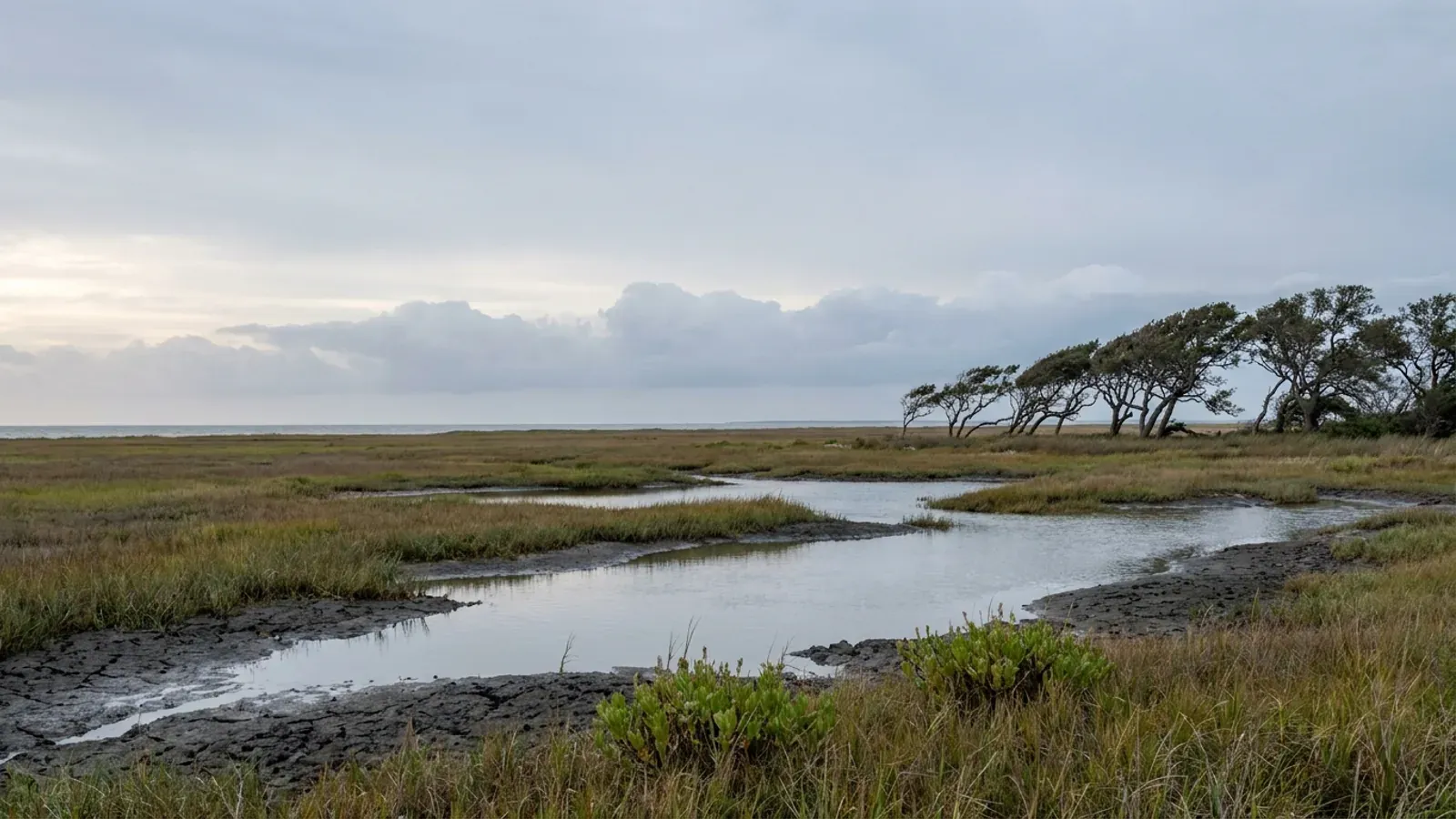
Barndominium Builders in Corpus Christi, TX
Two codes reach a Corpus Christi barndominium, and they are there for different reasons. The City of Corpus Christi enforces the 2021 International Residential Code at Code section 14-291, with a long list of local amendments and several outright deletions, and that is the edition the permit and the city's inspections are measured against. Separately, because Nueces County lies wholly inside the designated catastrophe area, 28 TAC section 5.4013 requires work begun on or after 1 April 2026 to comply with the 2024 IRC or 2024 IBC to be eligible for catastrophe property insurance. The city's own Building Division published a bulletin saying so in January 2026. Neither displaces the other. And Corpus Christi still has land: about 30,000 acres inside the limits carry Farm-Rural zoning at a five-acre minimum, where a house and agriculture are both permitted by right.
Corpus Christi at a glance
- County
- Nueces County
- Population
- 317,247
- Where we build
- Corpus Christi, Nueces County, San Patricio County, Aransas County
- Site visits
- We come to the land — Corpus Christi and the rest of Nueces County alike
ZIPs 78401, 78402, 78404, 78405, 78407, 78408, 78409, 78410 and more
Building conditions in Corpus Christi
What actually changes from one Texas jurisdiction to the next: who issues the permit, whether the residential code is enforced there at all, what the structure has to be engineered to, and what the ground is like. These are the numbers your drawings have to satisfy.
Corpus Christi Code of Ordinances secs. 14-291 and 14-201; 28 Texas Administrative Code sec. 5.4013; TDI, Adopted Building Codes (tdi.texas.gov/wind/adopted-codes.html)
City of Corpus Christi Development Services, Informational Bulletin 021, TDI 2024 ICC Code Adoptions, 26 January 2026 (corpuschristitx.gov)
City of Corpus Christi Development Services, New Residential Buildings submittal list (corpuschristitx.gov); TDI windstorm forms listing (tdi.texas.gov/forms/form13windstorm.html)
Corpus Christi Code of Ordinances sec. 14-231, local amendments to the 2021 International Building Code, secs. 110.3.4.1 and 110.3.13
Corpus Christi Code of Ordinances sec. 14-291, local amendments to the 2021 International Residential Code, secs. R313.1 and R313.2
City of Corpus Christi Development Services, New Residential Buildings submittal list; Texas Occupations Code sec. 1001.056(c)(1)
Also worth knowing before you build in Corpus Christi
- Table R301.2, filled in - and a coastal city does publish one
- Code section 14-291 carries a completed Table R301.2 for the city. Ground snow load 0. Wind speed 140/150 mph. Topographic effects no, special wind region no, windborne debris zone yes. Seismic design category A. Weathering negligible, frost line depth 0, termite very high. Ice barrier underlayment not applicable. Flood hazards 1971. Air freezing index under 1500, mean annual temperature 72.2. The Manual J block gives elevation 19 feet, latitude 27 degrees north, outdoor winter design dry-bulb 36 and outdoor summer 94, a heating temperature difference of 34 and a cooling difference of 19, with a daily range of M.
- There is land here, and the zoning that fits is called Farm-Rural
- Corpus Christi is not a built-out suburb. The city's published zoning layer carries about 30,400 acres in 102 separate Farm-Rural tracts, roughly 48 square miles, plus about 1,840 acres of Residential Estate. FR sets a five-acre minimum lot and a 150-foot minimum width, permits a single-family detached house and agriculture uses by right, and is the default zoning for newly annexed land. RE sets a one-acre minimum. The largest single FR block, about 13,200 acres, is on Mustang Island, where beachfront construction certificates, dune protection and V-zone construction standards all come into play; the mainland FR tracts sit south-west toward Oso Creek and north-west around Calallen.
- Two rules cap how big the shop can be
- The UDC limits accessory buildings twice over. Section 5.3.1 requires detached accessory buildings to sit behind the front face of the house and caps the total square footage of all of them at 50 percent of the main principal structure - 75 percent in the FR district. Section 5.3.2.D caps garages for single-family residences at 49 percent of the main building, and where the garage is attached it is counted as part of the main building in working that percentage out. A detached accessory dwelling unit is separately allowed in any residential district, one per lot, capped at 1,000 square feet of habitable space in FR, RE and RS-22, with the owner required to occupy either it or the principal dwelling.
- A Corpus Christi address is not the same thing as the Corpus Christi jurisdiction
- The sixteen ZIP code tabulation areas that carry a Corpus Christi address cover about 296 square miles of land. The city itself is 167.8 square miles of land. So roughly two square miles in five with a Corpus Christi postal address sit outside the city limits, and outside the city's building code. Two ZIPs account for most of the gap: 78415 at 109 square miles, running south-west into unincorporated Nueces County, and 78418 at 73 square miles down Padre and Mustang islands. If you are buying land and the listing says Corpus Christi, the first question is whether the parcel is inside the limits - the city runs an address search site for exactly that.
- Step outside the city limits and the building code stops - the windstorm rule does not
- UDC section 1.4.2 applies only the subdivision and sign provisions of the code to the city's extraterritorial jurisdiction, on the authority of Chapters 242 and 216 of the Local Government Code. There is no city zoning and no city building permit out there, and the technical construction codes at Chapter 14 are written to the corporate limits. What does not stop at the city line is the windstorm regime: Nueces County is inside the designated catastrophe area in its entirety, so the TDI rule and the certificate chain follow the parcel into the ETJ and into unincorporated Nueces, San Patricio and Aransas counties alike.
- Flood: a foot above base flood, and the IRC's own chapter was deleted
- Section R322 of the IRC, Flood-Resistant Construction, is deleted in its entirety by section 14-291 and replaced by the city's Flood Hazard Prevention Code at Chapter 14, Article V. That code requires new residential construction to have the lowest floor, including basement, and machinery or equipment elevated to one foot above the base flood elevation, certified by a registered professional engineer, architect or land surveyor. In coastal high-hazard areas the bottom of the lowest horizontal structural member, excluding pilings and columns, must be a foot above base flood, on pilings anchored against flotation, collapse and lateral movement from wind and water loads acting at the same time. Section 14-532 adopts the FEMA Flood Insurance Study and Flood Insurance Rate Maps for Nueces County dated 13 October 2022. The state law reference the city's own instrument names is Water Code sections 16.3145 and 16.315.
- The ground is a smectitic clay, and it does not hide it
- The dominant soil in Nueces County is Victoria clay on 0 to 1 percent slopes, mapped over 306,451 acres of a 700,339-acre survey area - about 44 percent of the county in one map unit, and rated very limited for dwellings without basements. The Victoria series is classified fine, smectitic, hyperthermic Sodic Haplusterts, a vertisol. Clay content is 51.3 percent in the top 15 centimetres and rises to 60.7 percent deeper in the profile, with linear extensibility from 14.5 to 18.7 percent and saturated hydraulic conductivity of 0.6 micrometres per second. Unlike the Post Oak claypans further east, this surface does not lie about what is underneath it.
- One exemption in the building code, and it does not survive a dwelling
- A city amendment at section 105.1.4 of the adopted International Building Code creates a building permit exemption for a State or Federal Facility, an Industrial Facility, or an Agricultural Facility, conditioned on every connection to the city water system having a backflow prevention device or air gap. An Agricultural Facility is defined as any structure on a tract of land larger than 10 acres used exclusively in connection with ranching or agricultural use - and the definition expressly excludes structures used for residential, commercial or industrial purposes. A pure barn on acreage can claim it. The moment there is a dwelling in the building, it cannot.
- What the certificate is worth, and it binds the association
- Insurance Code section 2210.258(b) says the association may not insure a structure in the catastrophe area until a certificate of compliance has been issued for it, and section 2210.251(g) makes the certificate evidence of insurability. TWIA's own wording is that without one, TWIA lacks evidence that the structure conforms to applicable building codes and it may be considered uninsurable and ineligible for coverage with TWIA. Section 2210.258(d) allows a policy of no more than 30 days on an inspection verification while the certificate is processed. TDI says expressly that windstorm insurance is not required by law in Texas - but that a coastal lender will likely require it. TDI runs a windstorm field office in Corpus Christi.
- The certificate chain, and the deadline at each end
- A WPI-1 application, TDI form PC350, goes in first, and Insurance Code section 2210.2515(b) requires that notice before the person begins to construct. The inspector then files a WPI-2 inspection verification - form WPI-2-BC-8, TDI form PC439, for work begun on or after 1 April 2026 - and TDI issues the WPI-8 certificate. Section 2210.2515(e) bars TDI from issuing the certificate if the completed forms and all inspection fees have not reached it within six months of the final inspection. The completed-construction route, WPI-2E on form PC434 leading to a WPI-8-E, is open only to a Texas licensed professional engineer, and TDI says it may cost more because a finished structure is harder to inspect. The old WPI-8-C route closed on 31 May 2020.
- What else the city amended, including what it took out
- Beyond the sprinkler and flood deletions, section 14-291 removes IRC section R112 and section R113 entirely and sends appeals and penalties to Code sections 14-206 and 14-207; deletes IRC Chapter 11 and points energy compliance at the city's adopted 2015 International Energy Conservation Code; and deletes IRC Part VIII in favour of the 2020 National Electrical Code. Additions include a homeowner's permit for work on an owner-occupied homestead, barred for natural gas systems unless the owner is a Texas licensed master plumber; underground gas piping burial raised from 12 to 18 inches; a requirement that outdoor equipment be anchored to resist the wind loads in section R301.2.1.1; building sewers at least 18 inches below grade at a septic tank connection; and a new Section P2504 requiring a toilet facility for workers at each construction site, shared only between projects within 500 feet.
Corpus Christi Code of Ordinances sec. 14-291, Table R301.2, Climatic and Geographic Design Criteria
Corpus Christi Unified Development Code Table 4.3.3 and sec. 4.3.1 (online.encodeplus.com/regs/corpuschristi-tx); City of Corpus Christi open GIS zoning layer, ArcGIS OpenData FeatureServer layer 48, queried 1 September 2026
Corpus Christi Unified Development Code secs. 5.3.1, 5.3.2.A and 5.3.2.D
U.S. Census Bureau TIGERweb, 2020 Census ZIP Code Tabulation Areas and Incorporated Places layers (tigerweb.geo.census.gov), GEOID 4817000 AREALAND 434,520,061 sq m, queried 1 September 2026; City of Corpus Christi Address Search and Verification Site
Corpus Christi Unified Development Code sec. 1.4.2; Corpus Christi Code of Ordinances sec. 14-202 (definition of City); Texas Insurance Code sec. 2210.003; TDI, Adopted Building Codes
Corpus Christi Code of Ordinances secs. 14-291, 14-532, 14-552 and 14-556, Article V, Flood Hazard Prevention Code; Texas Water Code secs. 16.3145 and 16.315
USDA NRCS Soil Data Access, SSURGO survey area TX355 Nueces County (SDMDataAccess.sc.egov.usda.gov), survey version 24, published 5 September 2025; tables mapunit, muaggatt, component and chorizon, queried 1 September 2026
Corpus Christi Code of Ordinances sec. 14-231, local amendment adding sec. 105.1.4 to the 2021 International Building Code
Texas Insurance Code secs. 2210.258(b), 2210.258(d) and 2210.251(g); TWIA, Windstorm Certification (twia.org); TDI, What is windstorm insurance (tdi.texas.gov)
TDI, Windstorm forms listing (tdi.texas.gov/forms/form13windstorm.html); Texas Insurance Code sec. 2210.2515(b), (c) and (e); TWIA, Windstorm Certification
Corpus Christi Code of Ordinances sec. 14-291, local amendments to the 2021 International Residential Code; sec. 14-251, Energy conservation code
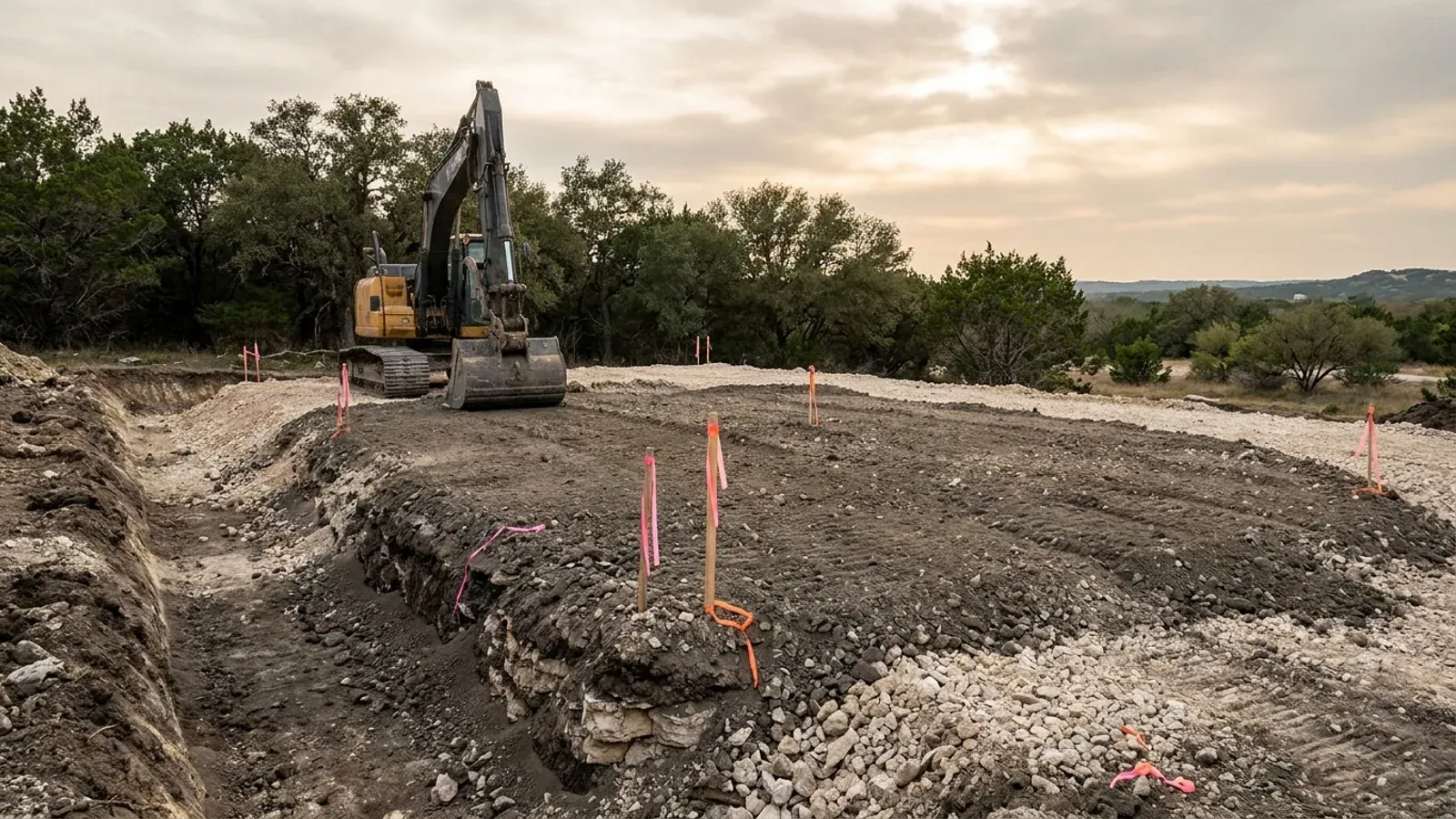
The expensive surprises are in the ground, not the building
What moves a Texas budget is usually below grade, and it is soil rather than rock: shrink-swell clay. The Blackland Prairie and the Gulf Coast clays move enough between a wet season and a dry one to drive the foundation design across the state's largest markets, which is why several DFW cities require an engineer's seal on the foundation of every new house. Those are the same conditions that decide whether a septic field passes its soil and site evaluation, so the grading plan, the foundation and the drainfield get resolved together rather than one at a time. We price the dirt before we price the building.
What we build in Corpus Christi
All nine of our services — kits, custom plans, post-frame and steel construction, site preparation, permitting and engineering, through to turnkey builds — are available across Nueces County. What a project costs depends far more on the parcel than on square footage, so we work from your land rather than from a rate card.
See what we buildWhat a build looks like
Three stages every Corpus Christi project passes through, from a raw parcel to a finished home. Site work first, because that is where the budget is decided.
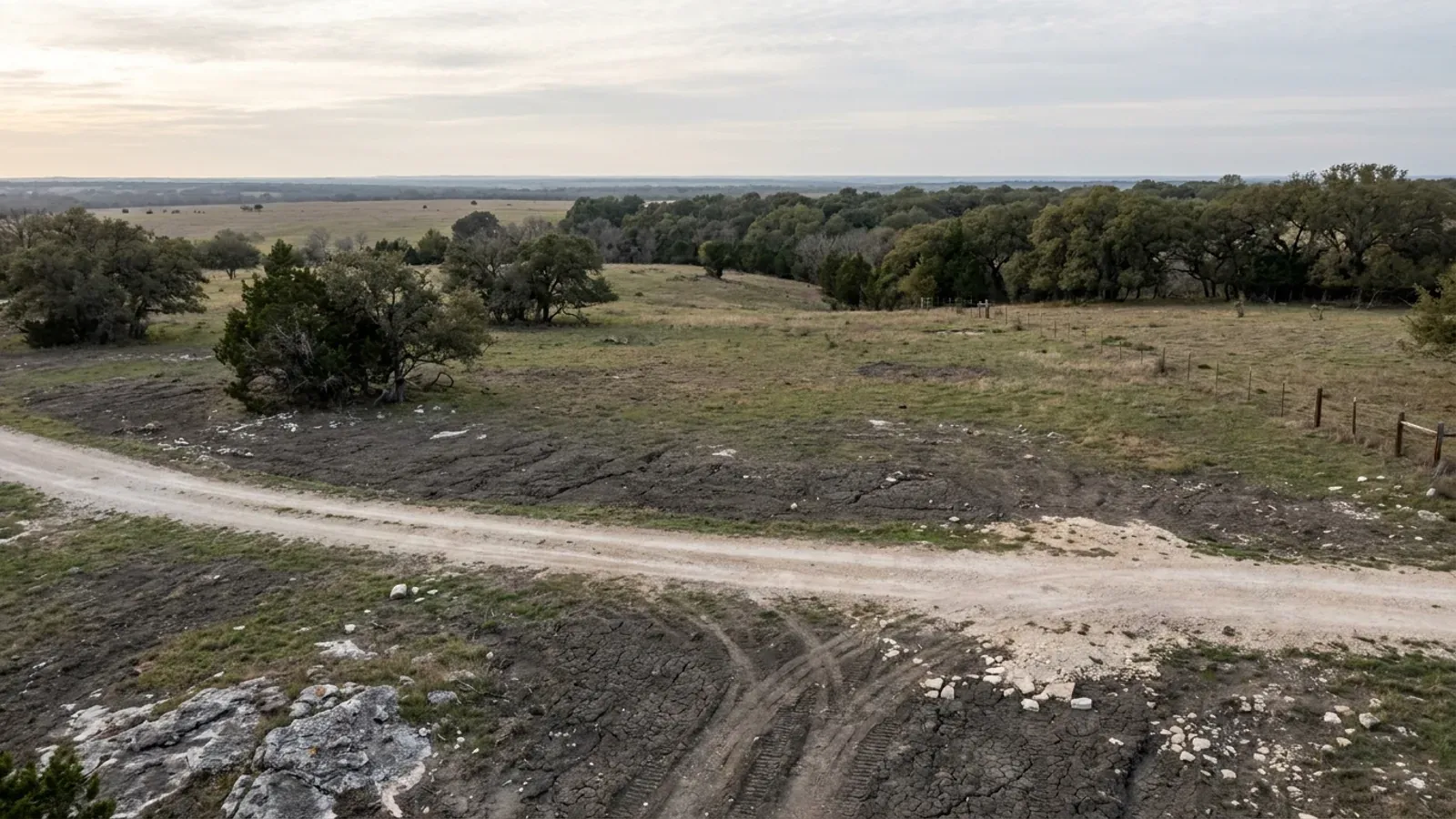
The parcel
Zoning, setbacks, flood zone and utility access get checked before anything is drawn.
Pad and permit
Clearing, grading and a compacted pad, while the submittal works through Nueces County.
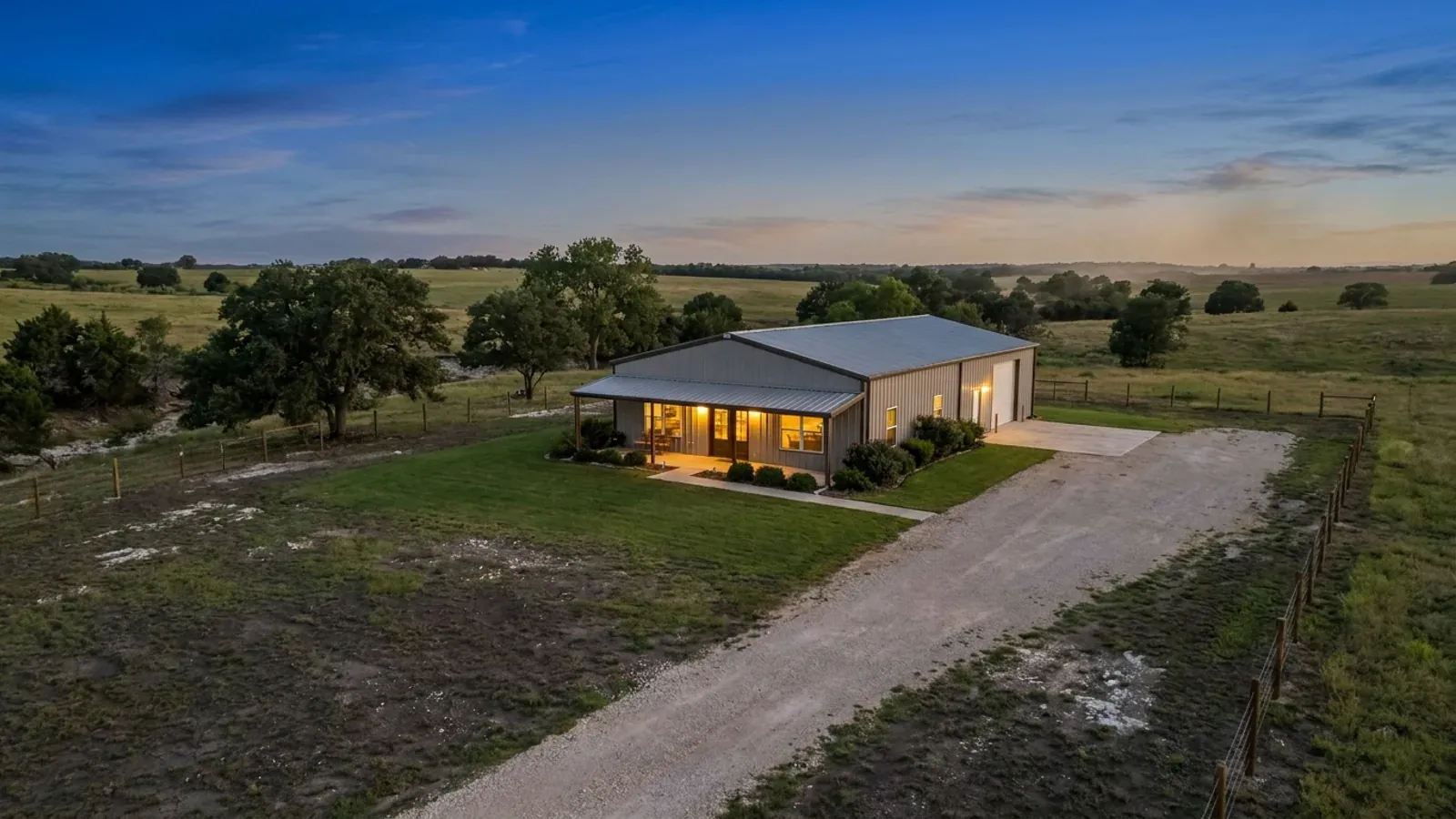
Frame to finish
Shell erected and dried in, then systems, insulation and interior finish through to CO.
Those are the rules for Nueces County. Tell us what you want to build and we will draw it to them.
Where we build around Corpus Christi
Nueces County and the rural land around it. The buildable acreage for a project this size usually sits outside the city limits, which is frequently what changes who issues your permit.
Keep reading
The questions that usually come next once you know what Corpus Christi allows.
Barndominium Cost Guide
Sourced per-square-foot ranges by tier and by size, with a calculator built on the same figures.
Read itIs It Legal in Texas?
Classification, zoning, the HOA gate, and why "nonresidential farm building" does not cover a home.
Read itHow Long Does It Take?
Census build-duration data, and what actually sets the permit clock where you are building.
Read itNearby areas we build in
Others we cover in this part of Texas. The permitting authority, the adopted design criteria and the zoning can all differ from one to the next.
Building in Corpus Christi: common questions
9 questions we get asked most often about building in Corpus Christi. If yours is not on the list, ask it directly.
Which building code applies in Corpus Christi?
What is the design wind speed in Corpus Christi?
Does a barndominium in Corpus Christi need fire sprinklers?
Does the building need an engineer?
How big can the shop be next to the house?
Is there anywhere in Corpus Christi to put one on acreage?
What changes if I build just outside the city limits?
Can I insure it without the certificate?
What does the city charge, and how is it measured?
Building in Corpus Christi?
Start with the plan. Tell us what you want to build and we will draw it, then confirm what Nueces County will actually let you put on the parcel and what wind load it has to meet. That conversation costs nothing.