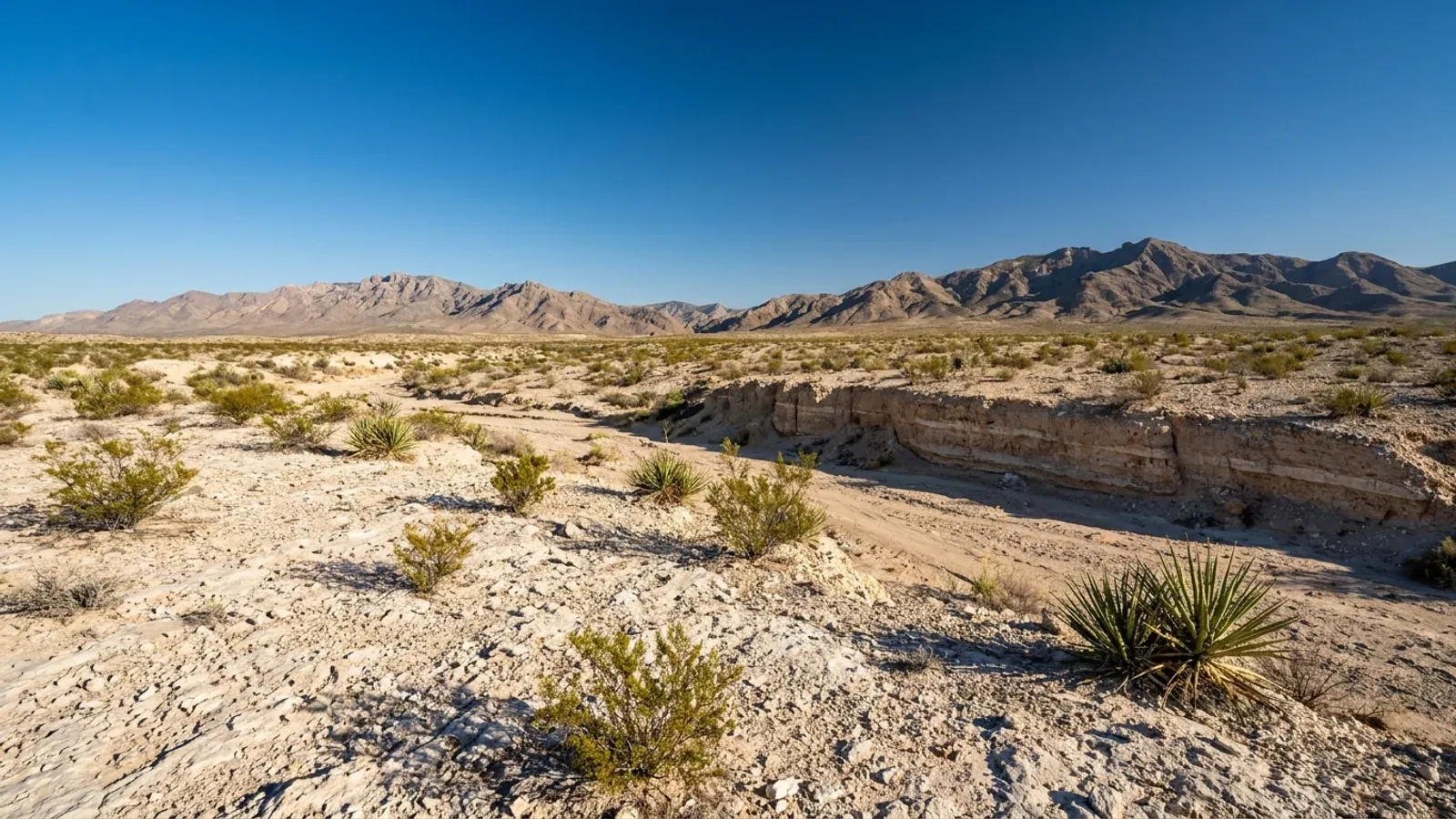
The arid Chihuahuan Desert basin near El Paso, with creosote, a dry arroyo exposing caliche, and bare mountains behind.
El Paso County 2021 IRC as adopted here

Barndominium Builders in El Paso County, TX

El Paso County is the exception to almost everything this site says about Texas counties. It is a border county, so Local Government Code Chapter 232 Subchapter B reaches it: the county genuinely regulates how land is divided, and no utility may connect water, sewer, electricity or gas to a lot until the Commissioners Court has signed it off. It is also one of the few Texas counties that opted into the residential building-code subchapter, on 17 September 2012, effective 1 January 2013. So a barndominium in the unincorporated county is built to the International Residential Code as adopted by the City of El Paso, inspected three times by an inspector the builder hires — and still with no county building permit and no county fee at any stage. The ground is different too: caliche under a large share of the county, shrink-swell clay along the Rio Grande, a hot-dry 3B climate, and Mountain Time.

El Paso County at a glance

County
El Paso County
Population
875,784
Where we build
El Paso

ZIPs 79821, 79835, 79836, 79838, 79849, 79853, 79927, 79928 and more

Site visits
Site visits scheduled across El Paso County, incorporated and unincorporated

Building conditions in El Paso County

What actually changes from one Texas jurisdiction to the next: who issues the permit, whether the residential code is enforced there at all, what the structure has to be engineered to, and what the ground is like. These are the numbers your drawings have to satisfy.

Build conditions for El Paso County , Texas : design wind speed 105 mph. BUILD CONDITIONS EL PASO COUNTY, TXEl Paso County2021 IRCDESIGN WIND SPEED105 mphFrom the completed Table R301.2(1) in El Paso Municipal Code Sec. 18.10.050, the code the county'sown residential inspection programme applies in the unincorporated area. The same table publishes…ZONING ·1 acre on a private well with septic…El Paso County has no zoning power and says so on its own permitspage, and Sec. 233.153(d)(2) confirms that even an opted-in county…CERTIFICATE OF PLAT COMPLIANCE$25Non-refundable, charged per request, and payable when the request ismade. It is not an impact fee and not a building fee: it is the…WHO ISSUES THE PERMITEl Paso County Public Works — Reside…Residential Inspection Program and forms: (915) 546-2015, 800 EOverland St Suite 407. Certificates of Plat Compliance: Public…
Build conditions for El Paso County, drawn from the sourced facts on this page. Every figure above is cited in the quick-facts panel below, with its source and vintage.
This county did opt into the state building-code order — most Texas counties never did
El Paso County's own Building Inspection Program summary records that on 17 September 2012 the Commissioners Court adopted an order implementing Local Government Code Chapter 233 Subchapter F, effective 1 January 2013, and its Inspections page still carries the notice today. That is more than three years after the enabling statute took effect on 1 September 2009, which is why a search of the 2009 record alone would suggest the opposite. The order reaches all new single-family homes and duplexes in the unincorporated county and additions that raise square footage or value by more than 50 percent. It still produces no county permit, no plan review and no county fee: Sec. 233.153(d)(1) forbids requiring prior county approval and Sec. 233.153(f) forbids charging to enforce the standards.

County of El Paso, Building Code Summary (Building Inspection Program), epcounty.com DocumentCenter items 1010 and 927; El Paso County Inspections page, epcounty.com/836/Inspections; Texas Local Government Code Secs. 233.151-233.157

No meter until the Commissioners Court signs off on your lot
Because part of El Paso County lies within 50 miles of the international border, Local Government Code Sec. 232.029 applies: a utility may not serve or connect subdivided land with water or sewer until it has the Commissioners Court's certificate or determination that the plat was reviewed and approved, and may not connect electricity or gas until the court has determined that adequate water and sewer are installed. The county runs this as the Certificate of Plat Compliance and states that it is required before connecting or reconnecting any utility, or changing utility service, for residential property outside city limits. The fee is $25, non-refundable, the request goes to Commissioners Court, and the certificate is available by noon the following Tuesday. A private well needs a certified laboratory letter on quality and quantity; septic needs a registration form or licence to operate from the county's on-site sewage department.

Texas Local Government Code Secs. 232.028 and 232.029; County of El Paso, Certificate of Compliance, epcounty.com/1049

Your design numbers come from the city, and they are all published
The county's order routes to the code of its county seat, so a house in the unincorporated county is built to the International Residential Code as adopted by the City of El Paso. El Paso Municipal Code Sec. 18.10.020 adopts the 2021 edition, and Sec. 18.10.050 fills in Table R301.2(1) completely: ground snow load 5 PSF, wind speed 105 mph, seismic design category C, weathering negligible, frost line depth 6 inches, termite moderate to heavy, no ice barrier underlayment required, air freezing index 1500, and no special wind region or windborne debris zone. The same table gives Manual J criteria including an elevation of 3,918 feet, an outdoor winter design dry-bulb of 25 degrees and an outdoor summer design dry-bulb of 98. The wind figure was 115 mph under the city's previous 2015-edition chapter, which Ord. No. 019528 replaced in its entirety on 1 August 2023.

City of El Paso Code of Ordinances Secs. 18.10.020 and 18.10.050 (Ord. No. 019528, 1 Aug 2023), read from the codified text current through Ord. No. 019889 of 23 June 2026; City of El Paso, Currently Adopted Codes and Amendments

Caliche on the mesa, shrink-swell clay in the valley — and they are miles apart
The NRCS soil survey for El Paso County maps 526,859 acres, and a petrocalcic layer — cemented caliche — sits under 119,976 of them, with a further 44,219 acres over lithic bedrock. Depth to the caliche varies sharply: about 66 cm under the Hueco component in the county's single largest map unit, the 165,095-acre Hueco-Wink association, but only about 41 cm under Simona and about 25 cm under Delnorte. That is an excavation and trenching question long before it is a foundation one. Along the Rio Grande the picture inverts: Tigua silty clay records a linear extensibility of 17, as shrink-swell as anything in the Blackland Prairie, with Glendale and Saneli at 7.5. Under Occupations Code Sec. 1001.056(c)(2) a slab on expansive soil loses the private-dwelling exemption, so the design goes to a Texas-licensed professional engineer.

USDA-NRCS SSURGO, soil survey area TX624 (El Paso County, Texas, Main Part), queried via SDMDataAccess; Texas Occupations Code Sec. 1001.056(c)(2); IRC R403.1.8

One house per lot — and it is written onto the plat and into your deed
Water Code Sec. 16.343(d) requires the Model Subdivision Rules to prohibit more than one single-family detached dwelling on each lot, and El Paso County executes that in Sec. 2.7 of its own Subdivision Regulations: no more than one single-family detached dwelling per lot, a note to that effect on the face of the final plat, and the restriction repeated in all deeds and contracts for deeds within the subdivision. So the thing that stops a second dwelling is not a county inspector — it is a plat note and a deed restriction that run with the land. Anyone planning a barndominium plus a casita, a guest house or a parent's place on one lot should read the recorded plat before buying. Sec. 2.6 adds minimum setbacks of 10 feet from roads and rights-of-way and 5 feet from adjacent property lines where there is no nationally recognised fire code and no water lines sized for fire protection.

Texas Water Code Sec. 16.343(d) and (e); Subdivision Regulations of El Paso County, Texas (revised 24 March 2014), Secs. 2.6 and 2.7

The septic permit is the one that gates the build, and it wants a recorded plat
El Paso County's On-Site Sewage Facility Department publishes its own fees: $190 residential, $510 commercial, and $300 plus $50 per unit to review a sewage disposal plan, paid at any County Clerk's office. Allow 30 days for a residential review and 45 for a disposal plan; an authorisation to construct is valid one calendar year. The application needs an official street address from County Road and Bridge or the relevant city, a site evaluation with soil analysis by a TCEQ-registered site evaluator or a professional engineer including two soil borings taken two feet below the proposed trench depth, and an official plat map showing block, lot, subdivision and the year the subdivision was recorded. There is no percolation test. TCEQ's own register names two authorised agents here: El Paso County for the entire county, and the El Paso County Tornillo Water Improvement District within its service area in ZIP 79853.

County of El Paso, How to Obtain a Permit to Construct an On-Site Sewage Facility, epcounty.com DocumentCenter item 967; TCEQ On-Site Sewage Facility Authorized Agent register (OARS), El Paso County; 30 TAC Chapter 285

Also worth knowing before you build in El Paso County

Chapter 232 Subchapter B regulates the land, not the house
The border-county subchapter is titled Subdivision Platting Requirements in County Near International Border, and it is addressed throughout to a subdivider, a plat or a subdivision. Sec. 232.030(c) closes the list of what the Commissioners Court must regulate at six items: potable water, solid waste, roads, sewer facilities, electric and gas service, and flood management to FEMA's minimum standards. There is no structural, life-safety or energy limb anywhere in it, and the words building code do not appear in the chapter at all. Even Sec. 232.0305, the section headed County Inspector, authorises only a fee on a subdivider for an inspection of the property against the subdivision regulations. Whatever building-code reach El Paso County has comes from its Chapter 233 order, which is a separate power — Sec. 233.153(e) says Chapter 232 controls if the two ever conflict.

Texas Local Government Code Secs. 232.021, 232.022, 232.030, 232.0305 and 233.153(d)-(e), read from the codified statute text

There is a real minimum lot size here, and it is not zoning
Section 2.8(q) of the county's Subdivision Regulations sets minimum lot sizes for residential subdivisions: 6,000 square feet with an approved public water system and organised off-site wastewater, 10,000 square feet where that lot also carries on-site ponding, half an acre with public water and on-site sewage disposal, and one acre where both the water and the wastewater are on-site. Minimum frontage is 50 feet on a 6,000 square foot lot and, on larger lots, no less than a third of the lot's length. Texas counties have no zoning power and El Paso says so plainly on its own permits page — these are subdivision design standards adopted under Chapter 232 and the Model Subdivision Rules, and they govern the creation of the lot rather than what may be done on one that already exists.

Subdivision Regulations of El Paso County, Texas, Secs. 1.1, 2.8(q) and 2.8(r); Texas Local Government Code Sec. 233.153(d)(2)

The county will tell you itself that it cannot issue a building permit
El Paso County's permits page states that the State of Texas does not allow the county to issue building permits, that it has no zoning authority and performs no environmental reviews, and that it holds no records responsive to such requests. The six permits its Planning and Development department does issue are a road cut permit, a driveway permit, an on-site sewage facility permit, a grading and drainage commencement of construction letter, a floodplain development permit, and a certificate of plat compliance, plus an official address. That is not a contradiction of the Chapter 233 order: an opted-in Texas county enforces standards through notices, third-party inspections and, if need be, a court — never through a permit counter. The page also refers building-permit questions to the county's two Emergency Services Districts.

County of El Paso, Permits, epcounty.com/839; County of El Paso, Plan Review, epcounty.com/844; Texas Local Government Code Sec. 233.153(d)(1)

A fire authority that is neither the city nor the county
Unincorporated El Paso County is covered by two Emergency Services Districts, and under Health and Safety Code Sec. 775.036(b) a district board may adopt and enforce a fire code and require inspections. That power carries neither the population bracket nor the commercial-buildings-only limit that Local Government Code Sec. 233.062 puts on a county fire code. El Paso County ESD No. 1 enforces the 2021 International Fire Code across its jurisdiction, requires an in-person appointment for plan review intake, and publishes a valuation-based fee for processing building plans submitted for building and fire code approval, starting at a $25 base. ESD No. 2 covers Anthony, Canutillo, Clint, Fabens, Montana Vista, San Elizario, Socorro, Tornillo, Vinton and surrounding unincorporated areas. Ask the district that covers your tract what it requires before you design around an assumption.

Texas Health and Safety Code Secs. 775.031 and 775.036; El Paso County ESD No. 1, Fire Marshal's Office plan review and construction pages and Construction/Operational Fee Schedule, epcesd1.com; El Paso County ESD No. 2, epcountyesd2.org

The unincorporated county is not empty land
The Census Bureau puts El Paso County at 875,784 people in July 2024 and publishes a balance-of-county figure — everyone living outside the seven incorporated municipalities — of 112,865. Those people are spread across about 706 square miles of unincorporated land, which works out at roughly 160 per square mile. That is denser than unincorporated Smith County and several times denser than Chambers or McLennan, and it is the reason the border-county platting rules, the Model Subdivision Rules and the plat compliance certificate all exist here in the first place. Anyone picturing the unincorporated fringe of El Paso as open ranch country will misjudge how much of it is already platted, already served and already occupied.

U.S. Census Bureau Vintage 2024 population estimates (co-est2024-alldata and sub-est2024) and 2024 Gazetteer county and place files
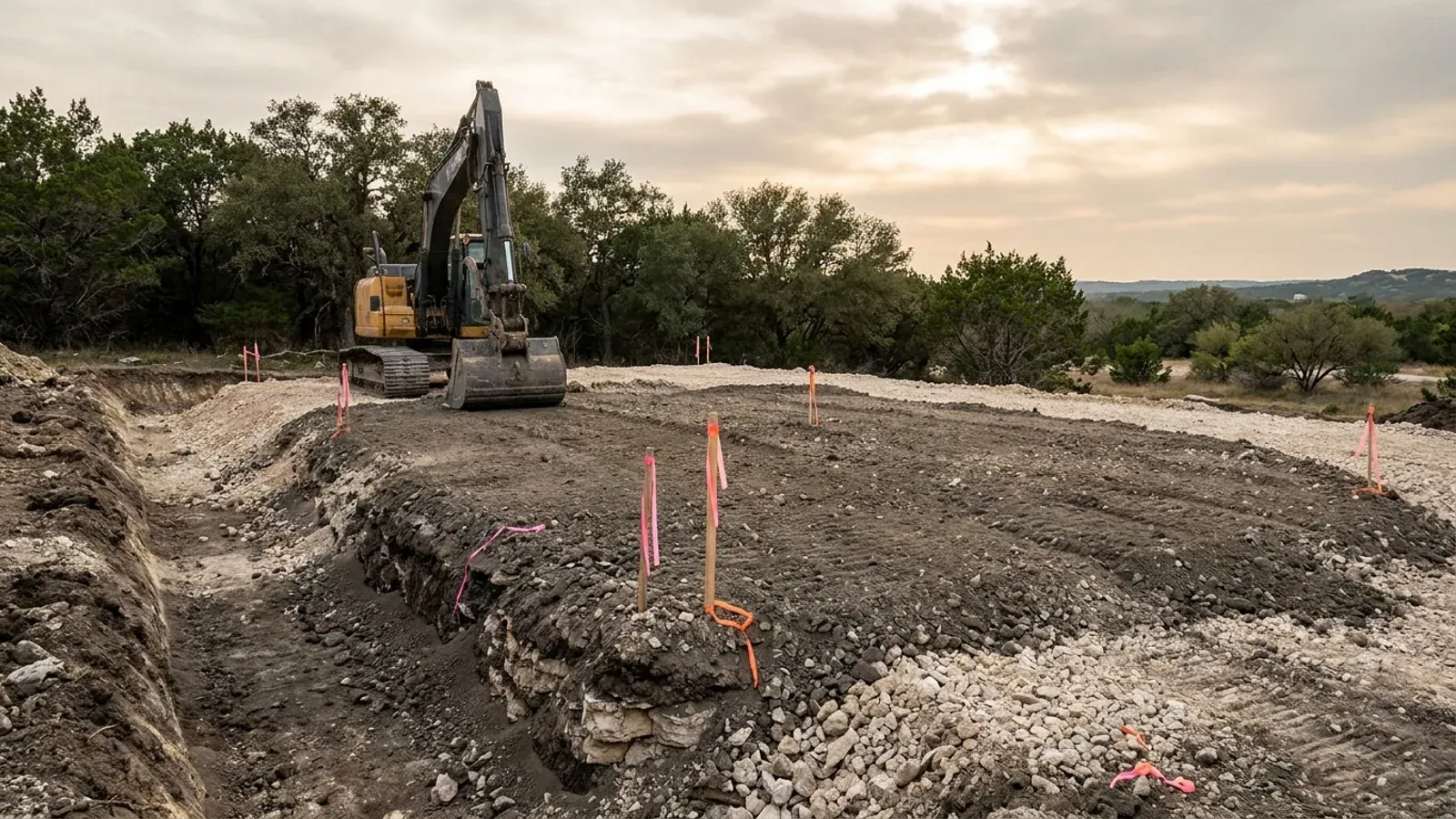
An excavator grading a compacted building pad on a cleared lot, with survey stakes and a drainage swale visible.
Below the slab

The expensive surprises are in the ground, not the building

What moves a Texas budget is usually below grade, and it is soil rather than rock: shrink-swell clay. The Blackland Prairie and the Gulf Coast clays move enough between a wet season and a dry one to drive the foundation design across the state's largest markets, which is why several DFW cities require an engineer's seal on the foundation of every new house. Those are the same conditions that decide whether a septic field passes its soil and site evaluation, so the grading plan, the foundation and the drainfield get resolved together rather than one at a time. We price the dirt before we price the building.

What we build in El Paso County

All nine of our services — kits, custom plans, post-frame and steel construction, site preparation, permitting and engineering, through to turnkey builds — are available across El Paso County. What a project costs depends far more on the parcel than on square footage, so we work from your land rather than from a rate card.

See what we build

What a build looks like

Three stages every El Paso County project passes through, from a raw parcel to a finished home. Site work first, because that is where the budget is decided.
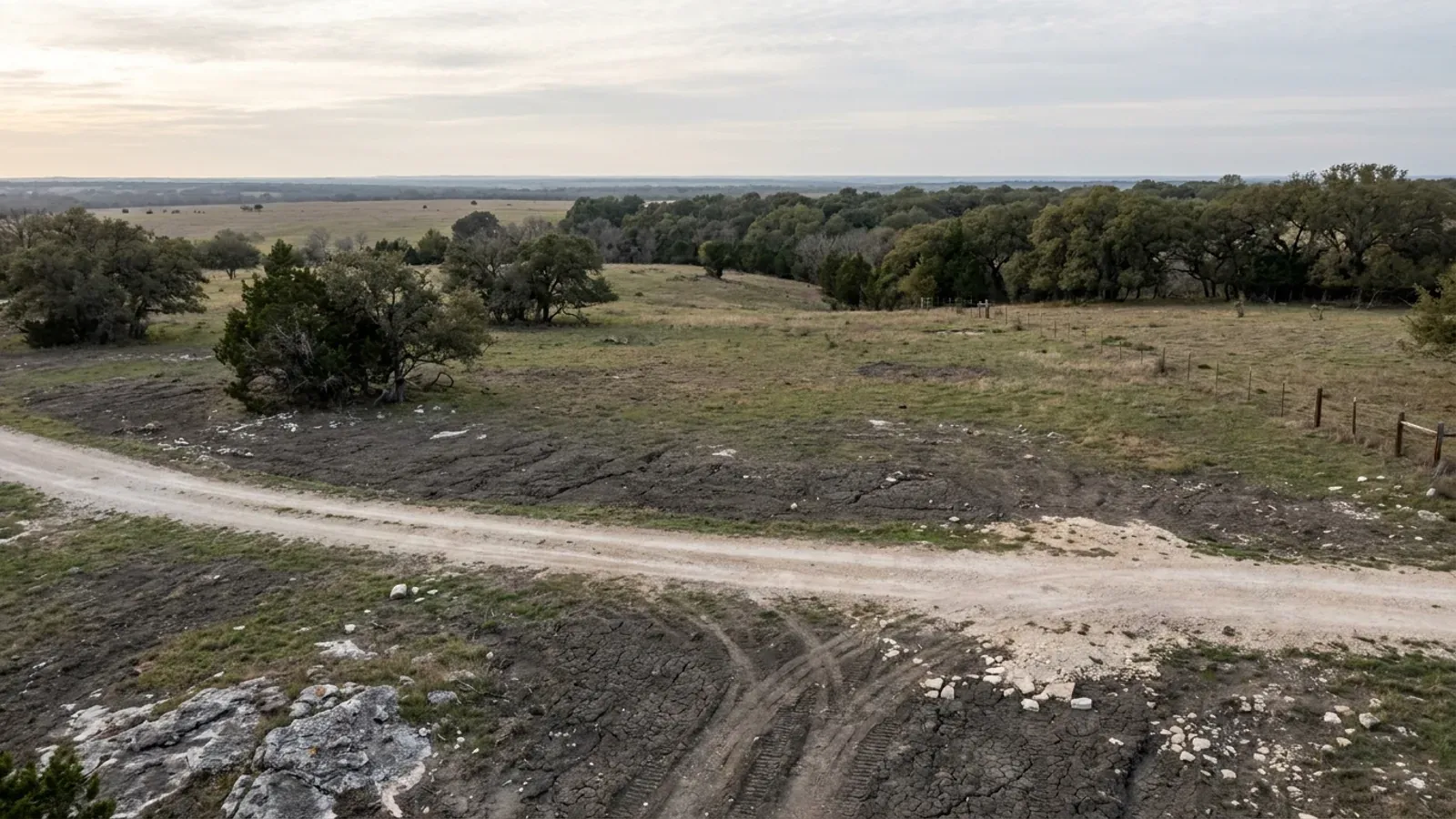
Aerial view of an undeveloped rural lot with cleared grass, a live oak and cedar elm treeline, and a pale gravel access track.
Stage one

The parcel

Zoning, setbacks, flood zone and utility access get checked before anything is drawn.

An excavator grading a compacted building pad on a cleared lot, with survey stakes and a drainage swale visible.
Stage two

Pad and permit

Clearing, grading and a compacted pad, while the submittal works through El Paso County.
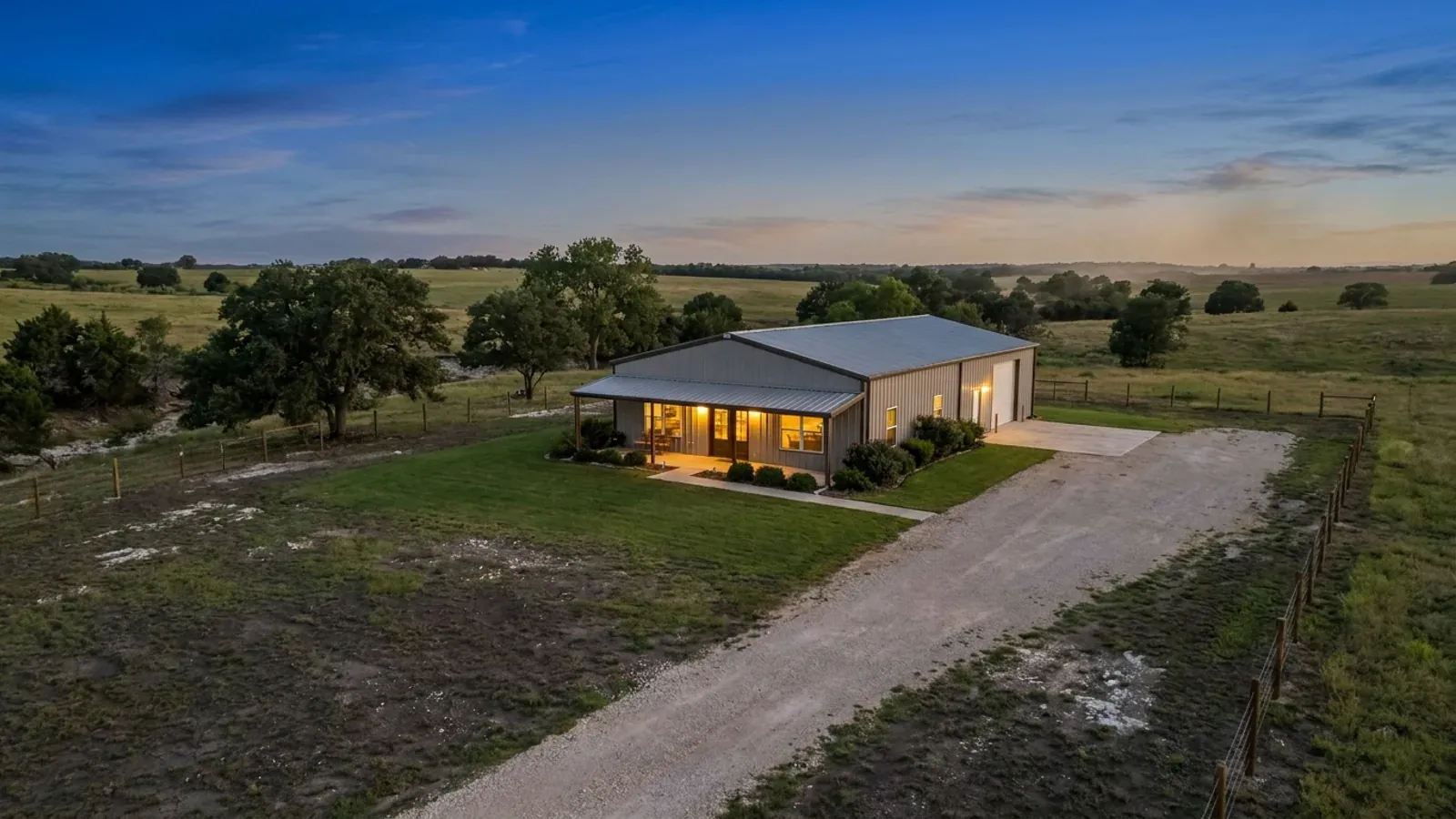
A finished barndominium at dusk with warm interior lighting glowing through its large windows.
Stage three

Frame to finish

Shell erected and dried in, then systems, insulation and interior finish through to CO.

Those are the rules for El Paso County. Tell us what you want to build and we will draw it to them.

Where we build around El Paso County

El Paso County and the rural land around it. The buildable acreage for a project this size usually sits outside the city limits, which is frequently what changes who issues your permit.

Our El Paso County service area, covering El Paso County and the surrounding rural acreage. This map marks the territory we serve, not a branch location.

Nearby areas we build in

Others we cover in this part of Texas. The permitting authority, the adopted design criteria and the zoning can all differ from one to the next.

Building in El Paso County: common questions

12 questions we get asked most often about building in El Paso County. If yours is not on the list, ask it directly.

Does El Paso County inspect a house in the unincorporated area?
Not itself, but inspections are required. The county adopted an order under Local Government Code Chapter 233 Subchapter F on 17 September 2012, effective 1 January 2013, and it applies to new single-family homes and duplexes and to additions that increase square footage or value by more than 50 percent. Three inspections are required: the foundation stage before concrete, the framing and mechanical stage before drywall, and completion. The county's own summary answers the question directly — no, the county does not provide them. The builder contracts and pays a Texas-licensed engineer, a registered architect, a TREC-licensed professional inspector, a municipal plumbing inspector, a building inspector employed by a political subdivision, or an ICC-certified residential combination inspector. The builder may use one inspector throughout or a different one at each stage.
So do I need a building permit from the county?
No, and you cannot get one. El Paso County's own permits page says the State of Texas does not allow it to issue building permits. Sec. 233.153(d)(1) expressly says the subchapter may not be read to require prior county approval before construction begins, and Sec. 233.153(f) forbids the county from charging any fee to defray the cost of enforcing the standards. What you file instead are two free notices: a Commencement of Residential Construction form before work starts, naming the location, the start date and the version of the International Residential Code you will build to, and a Completion notice within 10 days of the final inspection, sent both to the county and to the person the house is being built for.
Which code edition applies out in the county?
The county's programme summary says the code used is the International Residential Code and amendments as adopted by the City of El Paso, which is the county-seat route Sec. 233.153(a) permits, and that if another municipality has adopted a different code then that code applies inside it. The City of El Paso adopted the 2021 edition of the IRC by Ord. No. 019528 on 1 August 2023, replacing its previous 2015-edition chapter in full. So the practical answer for unincorporated land is the 2021 IRC as El Paso amends it — which matters, because the city amends the code in ways that reach a barndominium slab directly.
What is a Certificate of Plat Compliance and do I need one?
It is the county's Chapter 232 determination that your lot is properly platted and adequately served, and a utility needs it before it will connect you. The county states it is required before connecting or reconnecting any utility, or changing utility service, for residential property outside city limits, and that drinking water and an approved sewer or septic system must be in place before you can ask for electricity or gas. The fee is $25, non-refundable, per request. Approval goes to Commissioners Court and the certificate is ready by noon on the Tuesday of the following week, so build that into your programme rather than discovering it at meter-set. Requests go to Public Works, 800 E Overland Suite 200, (915) 273-3330.
Why does El Paso County have more power over land than other Texas counties?
Because it is within 50 miles of the international border. Local Government Code Sec. 232.022(a)(1) applies Chapter 232 Subchapter B to a county any part of which sits inside that band, and the subchapter gives the county platting, infrastructure and utility-connection authority that ordinary Texas counties do not have. It also requires the Commissioners Court to adopt and enforce the Model Subdivision Rules made under Water Code Sec. 16.343. But read the scope carefully: the subchapter regulates the subdivision of land, not the construction of a building. The phrase building code does not appear anywhere in Chapter 232, and Sec. 232.030(c) closes the list of what the county must regulate at water, solid waste, roads, sewer, electric and gas service, and flood management.
Can I put a second dwelling on the lot — a casita or a guest house?
Check the recorded plat and your deed before you assume so. Water Code Sec. 16.343(d) requires the Model Subdivision Rules to prohibit more than one single-family detached dwelling per lot, and Sec. 2.7 of El Paso County's Subdivision Regulations carries that through: one dwelling per lot, a note to that effect on the face of the final plat, and the restriction written into all deeds and contracts for deeds in the subdivision. It binds through the plat and the deed rather than through an inspection, which means nobody will stop you at permit stage — there is no permit — but the restriction is on the title. A lot created outside a platted subdivision may sit differently, which is a question for your title commitment and the County Clerk.
How deep is the caliche, and does it change what the build costs?
It varies enormously across short distances, and that is the point. The NRCS soil survey maps a petrocalcic — cemented caliche — layer under 119,976 of the 526,859 acres it covers in El Paso County. Under the Hueco component in the county's largest map unit it starts around 66 cm down; under Simona nearer 41 cm; under Delnorte around 25 cm. A further 44,219 acres sit over lithic bedrock. Caliche generally bears well and digs badly, so it shows up in trenching, septic drainfield excavation and utility runs rather than in the foundation design. We do not quote prices on this site. Pull your own parcel on the NRCS Web Soil Survey before you budget the sitework.
Is expansive clay a problem here, or is that only an East Texas thing?
It is a real issue on part of this county, and it tracks the Rio Grande rather than the mesa. SSURGO records Tigua silty clay at a linear extensibility of 17 — comparable to Blackland Prairie clay — across about 7,930 acres, with Glendale and Saneli around 7.5. A few miles away on the Hueco Bolson the ground behaves nothing like that. Where a slab sits on expansive soil, Occupations Code Sec. 1001.056(c)(2) removes the exemption that would otherwise let a private dwelling be built without engineered plans, and IRC R403.1.8 sends the foundation to the engineered route as well. That means a Texas-licensed professional engineer designs the foundation. It is a parcel-by-parcel question, not a county-wide one.
What is the seismic design category, and should I worry about it?
El Paso publishes seismic design category C in its own adopted Table R301.2(1) — the only Texas jurisdiction on this site publishing above A, which reflects the Rio Grande rift running under the region. That is a genuine geological difference from the rest of Texas, and it is separate from the injection-induced seismicity monitored further east in the Permian Basin, which does not apply here. What the category means for your particular structure and foundation is an engineering judgement, and it belongs to a Texas-licensed professional engineer. We state the published figure and route the design question to someone qualified to answer it.
What climate zone is El Paso County, and why does that matter?
3B, hot-dry — and unlike Dallas, Tarrant, Cameron and five other Texas counties, El Paso sits in the same zone on both the pre-2021 and the 2021 climate zone maps, so the answer does not shift with the code edition. It is the only large Texas market in a dry-B zone, which changes the insulation and envelope assumptions that work anywhere east of the Pecos. The City of El Paso adopts the 2021 IECC without amending the zone, but it does require air leakage and duct leakage testing to be performed by a certified third party who is registered with the city and has no financial interest in the builder.
Do I need a permit from the Emergency Services District?
Ask the district that covers your tract, because the county sends building-permit questions there and the districts have real authority. Health and Safety Code Sec. 775.036(b) lets an ESD board adopt and enforce a fire code and require inspections, without the population bracket or the commercial-only limit that Sec. 233.062 puts on a county fire code. ESD No. 1 enforces the 2021 International Fire Code, requires an in-person appointment for plan review intake, and publishes a valuation-based fee for processing building plans submitted for building and fire code approval. Its published material is written mostly for commercial work, and its Fire Marshal's duty statement covers residential only when state law requires it. Call ESD No. 1 on (915) 852-3204 or ESD No. 2 on (915) 851-0304 before you design around an assumption.
Is there a groundwater district controlling wells in El Paso County?
No district named for El Paso County appears among the districts the Texas Water Development Board lists, which is unusual — neighbouring Hudspeth County has one. The practical effect is that the burden of proving water falls on you rather than on a district. Sec. 2.2(b) of the county's Subdivision Regulations requires a groundwater availability study under 30 TAC 230.1 to 230.11 certifying 30 years of quantity and quality for individual wells, with the test water meeting community water system standards either untreated or through an identified commercially available treatment system. And the Certificate of Plat Compliance requires a certified laboratory letter on a private well before utilities connect. A domestic well in Texas is registered rather than permitted. TWDB's Groundwater Division on (512) 463-7847 is the place to confirm district coverage for a specific tract.

Building in El Paso County?

Start with the plan. Tell us what you want to build and we will draw it, then confirm what El Paso County will actually let you put on the parcel and what wind load it has to meet. That conversation costs nothing.