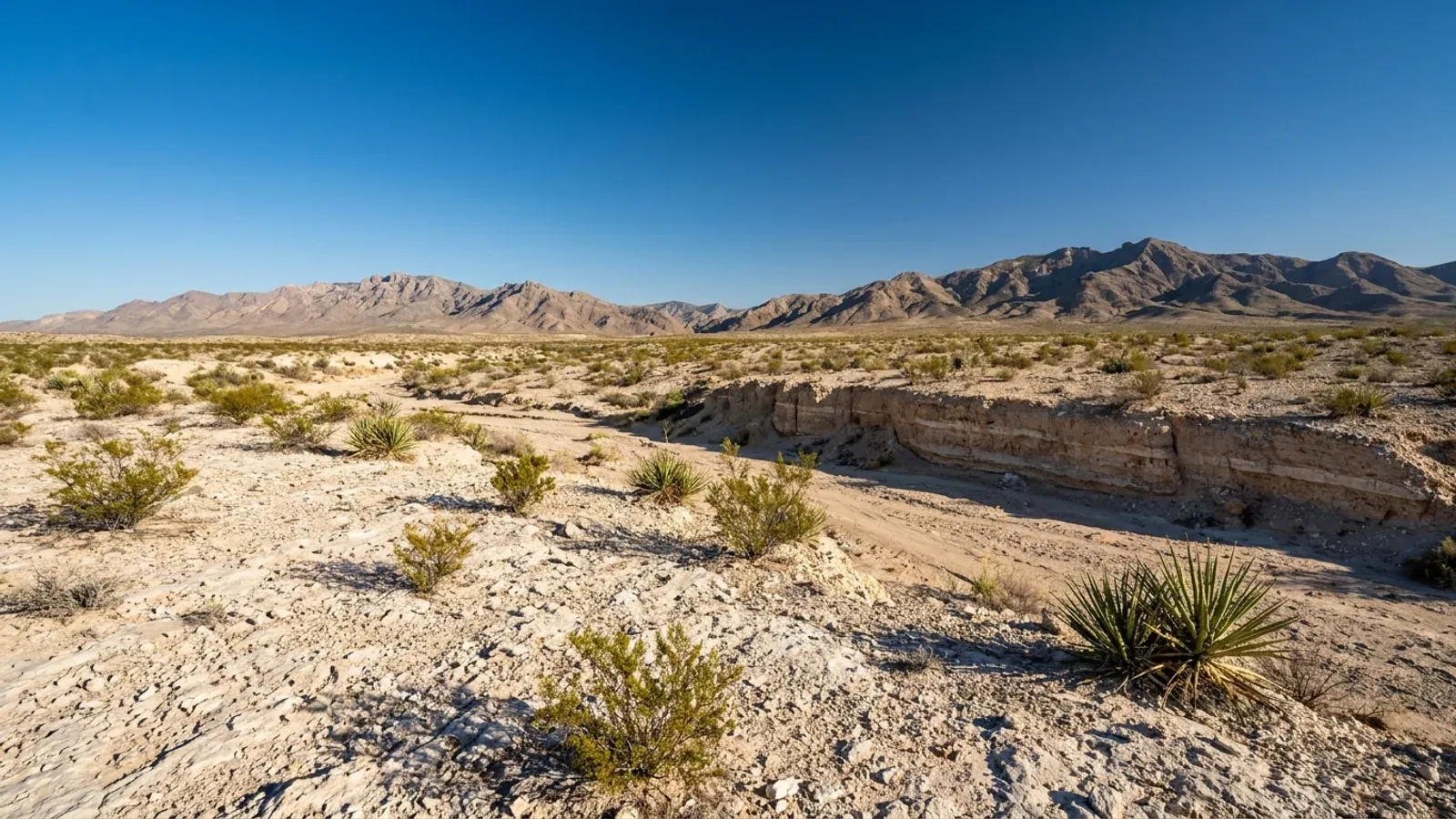
The arid Chihuahuan Desert basin near El Paso, with creosote, a dry arroyo exposing caliche, and bare mountains behind.
El Paso County 2021 IRC as adopted here

Barndominium Builders in El Paso, TX

El Paso is unlike anywhere else this site covers, and the differences are the reason to read further. It is 683,012 people across 258.8 square miles at the Census Bureau's 2025 estimate, up only 0.6 percent on 2020, so this is a settled city rather than a frontier. It sits at 3,918 feet, in climate zone 3B, hot-dry, on the only large Texas market in a dry-B zone. The city's own completed design table publishes a summer design grain difference of minus 26 and a daily temperature range of high, more than 25 degrees — the arithmetic opposite of the humid markets further east, and the reason moisture detailing written for the Gulf Coast does not belong here. There is buildable ground: the Ranch and Farm district takes a one-acre lot inside the limits. But settle two things before drawing anything. A detached accessory building is capped at one storey or fifteen feet, and turf grass may not exceed half the landscaped area.

El Paso at a glance

County
El Paso County
Population
683,012
Where we build
El Paso, El Paso County, Midland, Odessa

ZIPs 79901, 79902, 79903, 79904, 79905, 79907, 79912, 79924 and more

Site visits
Site walks booked in the city and across the rest of El Paso County

Building conditions in El Paso

What actually changes from one Texas jurisdiction to the next: who issues the permit, whether the residential code is enforced there at all, what the structure has to be engineered to, and what the ground is like. These are the numbers your drawings have to satisfy.

Build conditions for El Paso , El Paso County, Texas : design wind speed 105 mph. BUILD CONDITIONS EL PASO, TXEl Paso County2021 IRCDESIGN WIND SPEED105 mphSection 18.10.050 completes IRC Table R301.2(1) rather than leaving it blank. Ultimate design windspeed 105 mph, with topographic effects, special wind region and windborne debris zone all marked…ZONING · R-F RANCH AND FARM DISTRICT, AND R-1R-F single-family dwelling: 1 acre m…R-F is a special purpose district, not one of the residentialdistricts, and the code describes its purpose as affording areas…WATER AND WASTEWATER IMPACT FEES, BY SERVICE…$844 to $1,508 water and $372 to $1…Municipal Code Section 15.22.100, as adopted by Ord. No. 019626, §4, on 7 May 2024. A service unit is the water and wastewater flow…WHO ISSUES THE PERMITCity of El Paso Planning and Inspect…One Stop Shop, 811 Texas Avenue, El Paso, TX 79901, (915) 212-0104;City Hall, 300 N. Campbell, (915) 212-0000 or 3-1-1, Monday to…
Build conditions for El Paso, drawn from the sourced facts on this page. Every figure above is cited in the quick-facts panel below, with its source and vintage.
Adopted residential code, and what the city took out of it
The 2021 International Residential Code, adopted at Section 18.10.020 by Ord. No. 019528, § 1, on 1 August 2023, which rewrote Chapter 18.10 in its entirety. The amendments run both ways: Section R313 automatic fire sprinkler systems, Section R320 accessibility and Part VIII Electrical are deleted outright, while Section R802.10.2 is amended to require truss design drawings prepared, signed and sealed by a registered professional engineer licensed in Texas

City of El Paso Municipal Code Secs. 18.10.020, 18.10.080, 18.10.100, 18.10.120 and 18.10.310, codified through Ord. No. 019889 (23 June 2026), Supp. 95

El Paso publishes its design criteria, and one number tells the whole climate story
Section 18.10.050 completes IRC Table R301.2(1): ultimate design wind speed 105 mph, seismic design category C, ground snow load 5 PSF, weathering negligible, frost line depth 6 inches, termite moderate to heavy. Its Manual J block gives elevation 3,918 feet, a daily range of high — more than 25 degrees — and summer design grains of minus 26, meaning the design outdoor air carries less moisture than the indoor design condition

City of El Paso Municipal Code Sec. 18.10.050, Table R301.2(1) as completed by Ord. No. 019528, § 1 (1 August 2023)

The detached shop question, and El Paso answers it tightly
Section 20.10.030(A) caps a residential accessory building at one storey or fifteen feet in height, requires it to sit at least 60 feet back from the front lot line and at least five feet from the main building, and limits the combined gross floor area of all detached accessory buildings to the more restrictive of 50 percent of the main building's gross floor area or 40 percent of the rear yard — with one building of up to 400 square feet permitted regardless. Appendix B points Ranch and Farm accessory structures at that same section

City of El Paso Municipal Code Sec. 20.10.030 and Title 20 Appendix B, Table of Density and Dimensional Standards, row AA

What the ground actually does here, and it is not clay
USDA soil survey data for the El Paso County (Main Part) survey put four caliche-restricted map units over 226,888 of 526,859 profiled acres — Hueco, a Petrocalcic Paleargid, carries a cemented pan at 66 centimetres beneath 4.5 percent clay at the surface. Exactly one soil in the whole survey reaches a linear extensibility of 9 or more: Tigua silty clay, 7,930 acres on the Rio Grande floodplain, 65 percent clay and LEP 17 from 25 centimetres down. There are no Vertisols in the survey at all

USDA-NRCS Soil Data Access (SSURGO), survey area TX624 El Paso County, Texas (Main Part), components Hueco, Delnorte, Simona and Tigua, queried 1 September 2026

Water rules that reach the house, not just the utility
Municipal Code Section 15.13.130(B) provides that turf grass on a residential site permitted after 1 June 2002 may not be used for more than fifty percent of the total area to be landscaped, front and back yard combined, and subsection (A) prohibits turf in parkways, narrow strips and slopes of one in three or steeper unless sub-surface irrigation is used. Section 15.13.020(A) sets a standing three-day watering schedule: even-numbered addresses Tuesday, Thursday and Saturday, odd-numbered Wednesday, Friday and Sunday

City of El Paso Municipal Code Ch. 15.13, Water Conservation, Secs. 15.13.020 and 15.13.130 (Ord. 15106 § 2, 2002)

El Paso puts a bond and an annual registration where the state puts nothing
Texas issues no licence for a residential building contractor, so ask what the city requires instead. Section 18.02.104.2 makes an annual registration application with the department, with a fee, a precondition of being eligible to apply for any permit. Section 18.02.104.7 requires a $50,000 bond on file with the city from every contractor, firm or builder making contracts for work needing a permit, with a stated exception for a residential property owner doing the work on the residence they claim as their homestead

City of El Paso Municipal Code Secs. 18.02.104.2 and 18.02.104.7 (Ord. No. 019528, § 1, 1 August 2023)

Also worth knowing before you build in El Paso

The energy code, and the one thing El Paso cannot weaken
Section 18.70.020 adopts the 2021 International Energy Conservation Code. Sections 18.70.150 and 18.70.160 add local certification rules with real teeth: air leakage and duct leakage testing must be done by an approved third party holding a national or state certification, who may not be employed by nor hold a financial interest in the entity that constructs the building, and who must be registered with the city. Health and Safety Code Section 388.003(e) bars local amendments that would make energy requirements less stringent in nonattainment areas, and the City of El Paso is a designated moderate PM10 nonattainment area

City of El Paso Municipal Code Secs. 18.70.020, 18.70.150 and 18.70.160; Texas Health and Safety Code Secs. 386.001(2) and 388.003(e); TCEQ, El Paso: Current Attainment Status

The only El Paso district measured in acres
R-F, Ranch and Farm, is a special purpose district whose stated purpose is to afford areas where semi-rural, very-low-density residential and agricultural uses can be maintained. A single-family dwelling in R-F takes a one-acre minimum lot, 125 feet of average width and 200 feet of depth, 50-foot front and rear yards, a 20-foot side and a 25-foot side street yard, and a 35-foot height limit. Nursery, field crops, poultry and pasturage take five acres; kennels six; feeder lots twenty. The nearest thing to it elsewhere is R-1 at 20,000 square feet

City of El Paso Municipal Code Secs. 20.06.010 and 20.06.020, and Title 20 Appendix B, Table of Density and Dimensional Standards

Septic is a county permit, even inside the city
TCEQ's authorized agent search returns three records for El Paso County: the El Paso County authorized agent for the entire county, the El Paso County Tornillo Water Improvement District authorized agent for the WID service area in zip code 79853, and TCEQ Region 06 El Paso. The City of El Paso is not among them, so on TCEQ's own printed rule — if the city is not listed, contact the county — the county is the agent inside the city limits too. El Paso Water reports that it supplies 97 percent of all municipal water in El Paso County, so most city lots are on the sewer in any case

TCEQ On-Site Activity Reporting System, authorized agent search by county, El Paso, run 1 September 2026; El Paso Water, Water Resources

Flood: one foot above base flood, and a certificate to prove it
Municipal Code Section 18.60.200(A) requires new construction and substantial improvement of any residential structure to have the lowest floor, including basement, elevated a minimum of one foot above the base flood elevation, with a FEMA National Flood Insurance Program Elevation Certificate submitted to the floodplain administrator by a Texas registered professional engineer, architect or land surveyor. Section 18.60.010 cites the Flood Control and Insurance Act at V.T.C.A. Water Code Art. 16.311 as its authority

City of El Paso Municipal Code Ch. 18.60, Flood Damage Prevention, Secs. 18.60.010 and 18.60.200 (Ord. No. 019528, § 11, 1 August 2023)

A code section written for the desert
Section 18.10.150 replaces IRC Section M1413 with a full local evaporative cooling code. New and replacement coolers may not be provided or installed with bleeder lines; where the manufacturer requires one, an automatic draining system operating on at least a four-hour interval must instead discharge to the building drainage system or be conducted outside and discharged so that the effluent is used for watering landscaping or other outdoor vegetation, and in no event may cooler drainage be wasted into or upon the public way

City of El Paso Municipal Code Sec. 18.10.150, Section M1413 Evaporative Cooling Equipment, amended (Ord. No. 019528, § 1, 1 August 2023)

Plat first, then permit
The city's own guidance is that no permit shall be issued for any development on a property until a subdivision has been approved, subject to the exceptions at Section 19.01.10.C.2, and that a building permit cannot be applied for until the final plat has been filed with the County Clerk unless the timing criteria at Section 19.08.020.C.2 are met. Review runs 30 days for most plats and 10 days for an amending plat; amending and minor plats are approved administratively, the rest by the City Plan Commission at bi-weekly meetings. A plat must be signed and sealed by a surveyor or engineer registered in Texas

City of El Paso Planning & Inspections, Frequently Asked Questions, Subdivision section

Five miles of extraterritorial jurisdiction, and a slice of it cannot be petitioned out of
Local Government Code Sec. 42.021(a)(5) gives a municipality of 100,000 or more inhabitants an extraterritorial jurisdiction reaching five miles beyond its boundaries, and El Paso is well past that bar. The 2023 release-by-petition route does not reach everywhere in it: Sec. 42.101(1) excludes any area within five miles of the boundary of a military base at which an active training program is conducted, and Sec. 43.0117(a) defines a military base as a presently functioning federally owned or operated installation or facility. Fort Bliss adjoins the city

Texas Local Government Code Secs. 42.021(a)(5), 42.101(1) and 43.0117(a), read from the codified chapter text

The size of the city, and the size of the market
683,012 people on 258.823 square miles of land at the Census Bureau's 2025 estimate — about 2,640 to the square mile — up 0.6 percent on the 678,932 base for 2020. Barndominium search demand here is genuinely thin: measured against Google Ads phrase volume, El Paso runs at roughly a tenth of Lubbock and well under Amarillo or Abilene. This page exists because the rules here differ from the rest of Texas, not because the market is large

U.S. Census Bureau, Vintage 2025 subcounty population estimates (GEOID 4824000) and 2024 Gazetteer place file; Google Ads keyword planner phrase volumes
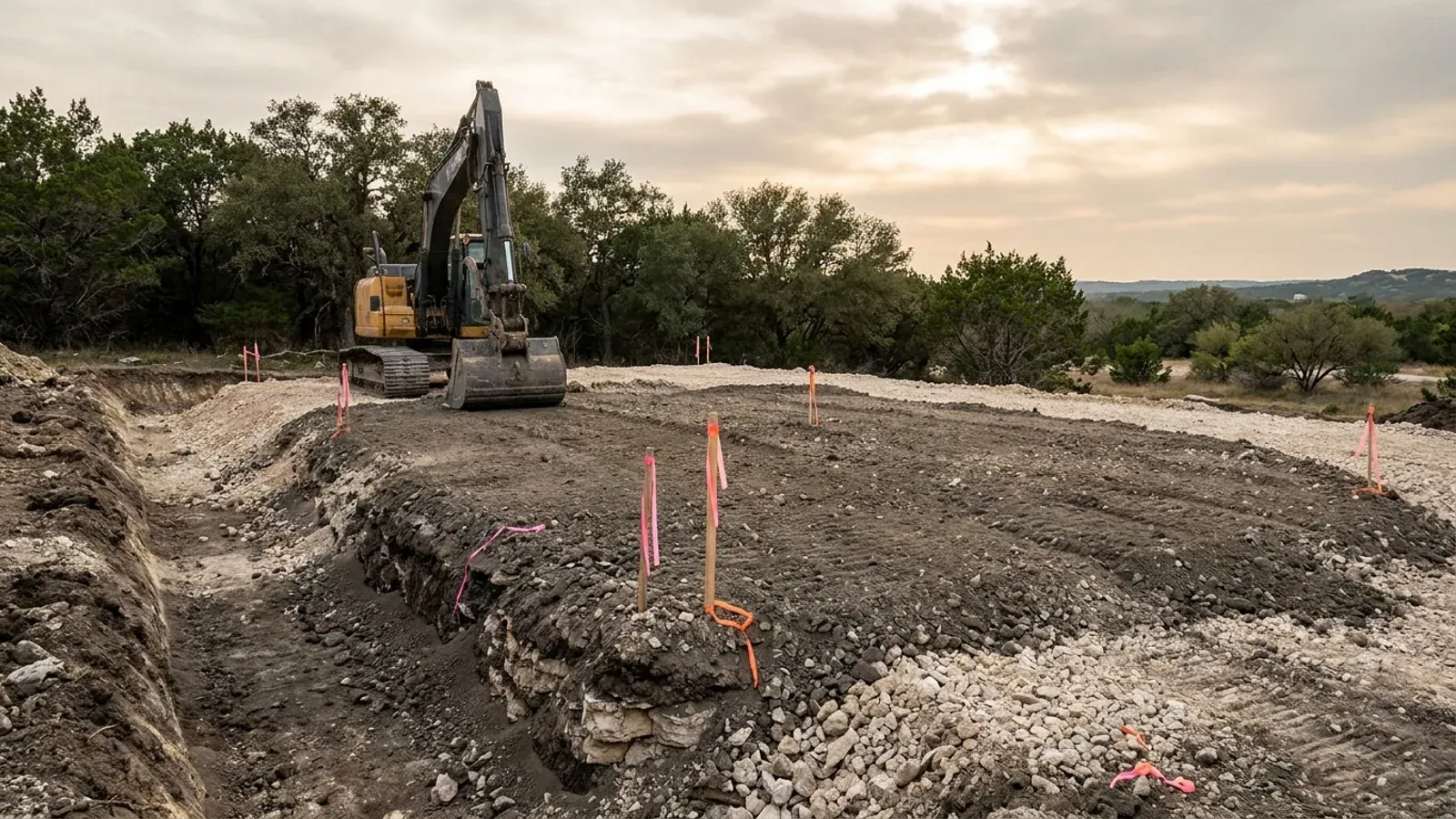
An excavator grading a compacted building pad on a cleared lot, with survey stakes and a drainage swale visible.
Below the slab

The expensive surprises are in the ground, not the building

What moves a Texas budget is usually below grade, and it is soil rather than rock: shrink-swell clay. The Blackland Prairie and the Gulf Coast clays move enough between a wet season and a dry one to drive the foundation design across the state's largest markets, which is why several DFW cities require an engineer's seal on the foundation of every new house. Those are the same conditions that decide whether a septic field passes its soil and site evaluation, so the grading plan, the foundation and the drainfield get resolved together rather than one at a time. We price the dirt before we price the building.

What we build in El Paso

All nine of our services — kits, custom plans, post-frame and steel construction, site preparation, permitting and engineering, through to turnkey builds — are available across El Paso County. What a project costs depends far more on the parcel than on square footage, so we work from your land rather than from a rate card.

See what we build

What a build looks like

Three stages every El Paso project passes through, from a raw parcel to a finished home. Site work first, because that is where the budget is decided.
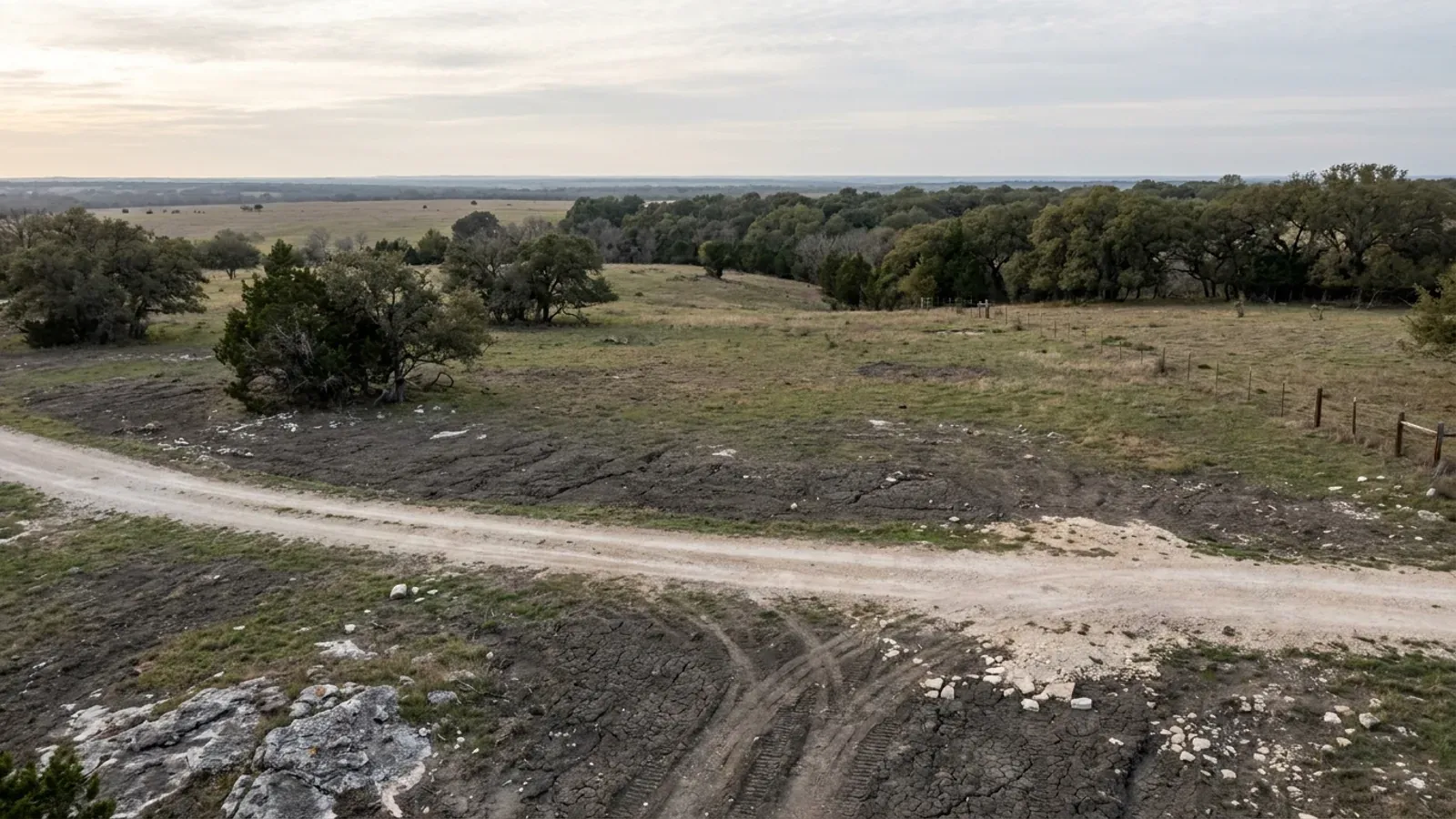
Aerial view of an undeveloped rural lot with cleared grass, a live oak and cedar elm treeline, and a pale gravel access track.
Stage one

The parcel

Zoning, setbacks, flood zone and utility access get checked before anything is drawn.

An excavator grading a compacted building pad on a cleared lot, with survey stakes and a drainage swale visible.
Stage two

Pad and permit

Clearing, grading and a compacted pad, while the submittal works through El Paso County.
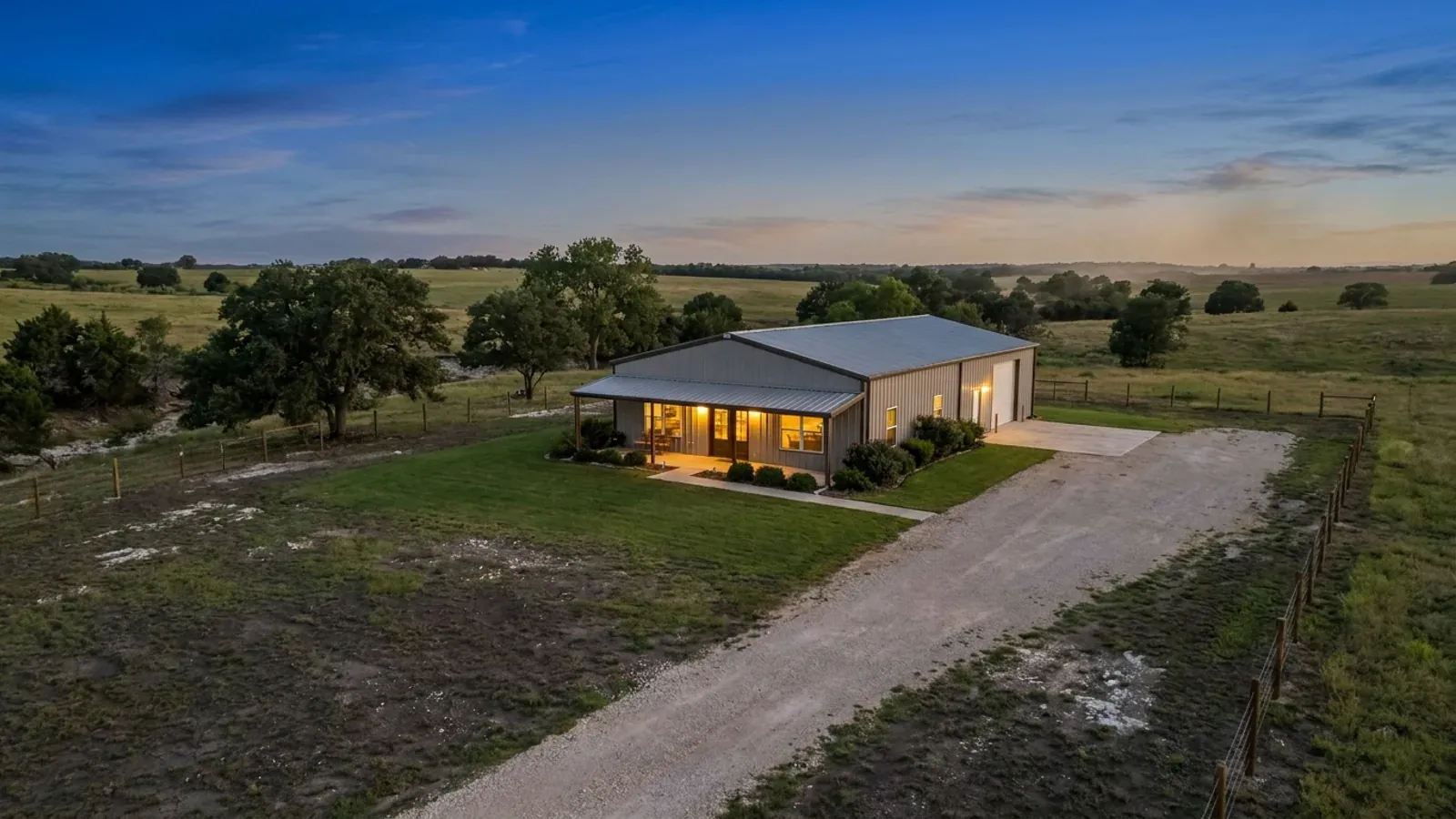
A finished barndominium at dusk with warm interior lighting glowing through its large windows.
Stage three

Frame to finish

Shell erected and dried in, then systems, insulation and interior finish through to CO.

Those are the rules for El Paso County. Tell us what you want to build and we will draw it to them.

Where we build around El Paso

El Paso County and the rural land around it. The buildable acreage for a project this size usually sits outside the city limits, which is frequently what changes who issues your permit.

Our El Paso service area, covering El Paso County and the surrounding rural acreage. This map marks the territory we serve, not a branch location.

Nearby areas we build in

Others we cover in this part of Texas. The permitting authority, the adopted design criteria and the zoning can all differ from one to the next.

Building in El Paso: common questions

12 questions we get asked most often about building in El Paso. If yours is not on the list, ask it directly.

What code does El Paso build to, and has the city changed it?
The 2021 International Residential Code, adopted at Section 18.10.020 of the Municipal Code by Ord. No. 019528, § 1, on 1 August 2023, together with the 2021 International Energy Conservation Code at Section 18.70.020. That ordinance rewrote Chapter 18.10 in its entirety and Section 18.10.390 repealed the three earlier adopting ordinances by name, including Ordinance No. 18510 of 31 May 2016 which had carried the 2015 edition. Yes, the city has changed it, and in both directions. Section R313 automatic fire sprinkler systems is deleted, so is Section R320 accessibility, so is the whole of Part VIII Electrical, which is replaced by the El Paso Electrical Code. Running the other way, Section R802.10.2 is amended to require truss design drawings to be prepared, signed and sealed by a registered professional engineer licensed in Texas; Section R506.1 sets a 3.5 inch minimum slab-on-ground with control joints no more than 30 feet apart; and Section R303.10 requires heating and cooling capable of holding an interior space between 68 and 90 degrees, with portable space heaters expressly excluded. Ask Planning and Inspections for the current amendment list before you finalise drawings.
Can I put a big detached shop beside the house inside El Paso city limits?
Not a tall one. Section 20.10.030(A) caps a residential accessory building at one storey or fifteen feet in height. It also requires the building to sit in a rear yard, or a side yard meeting the minimum side setbacks, to stand at least 60 feet back from the front lot line and at least five feet from the main building, and it limits the combined gross floor area of all detached accessory buildings on a lot to the more restrictive of 50 percent of the main building's gross floor area or 40 percent of the rear yard — with one building of up to 400 square feet allowed regardless. Fifteen feet is short of what a shop bay with a tall overhead door usually needs, so inside the city the workshop generally belongs under the same roof as the living space, where the district's 35-foot height limit applies instead. Two further wrinkles are worth reading: an accessory building placed closer than five feet to the main building is treated as part of the main building for setback purposes, and Appendix B points Ranch and Farm accessory structures at the same Section 20.10.030. Get the Planning Division's own reading in writing before you commit to a detached building.
Which El Paso zoning district still takes an acre?
R-F, the Ranch and Farm District. It is a special purpose district rather than one of the residential districts, and the code describes its purpose as providing for primarily fallow or agricultural areas within the city and affording areas where semi-rural, very-low-density residential and agricultural uses can be maintained. A single-family dwelling in R-F takes a one-acre minimum lot area, 125 feet of minimum average lot width and 200 feet of depth, 50-foot front and rear yards, a 20-foot side yard, a 25-foot side street yard and a 35-foot height limit, and no structure may sit closer than 50 feet to a major arterial right-of-way. Other R-F uses climb: nursery, greenhouse, field crops, poultry and pasturage take five acres, kennels and animal training six, feeder lots twenty. Everything else in the city is measured in square feet, and R-1 at 20,000 square feet is the next largest. On residentially zoned property you may build only one single-family dwelling per lot, though an accessory dwelling unit complying with Section 20.10.035 is allowed.
What is the ground like in El Paso, and will the slab need an engineer?
Nothing like the Blackland clay this site describes further east, and the difference is measurable. Across the El Paso County (Main Part) soil survey, four caliche-restricted map units cover 226,888 of 526,859 profiled acres. The largest single map unit in the county is the Hueco-Wink association at 165,095 acres, and Hueco is a Petrocalcic Paleargid: 4.5 percent clay in the top 10 centimetres, 13 percent below that, and a cemented petrocalcic pan at 66 centimetres. Delnorte carries its pan at 25 centimetres, Simona at 41. That is good bearing and hard digging, and it is a real cost line on trenching and utilities. Shrink-swell is the exception rather than the rule here: exactly one soil in the survey reaches a linear extensibility of 9 or more, Tigua silty clay on the Rio Grande floodplain, 7,930 acres, at 65 percent clay and LEP 17 from 25 centimetres down. There are no Vertisols in the survey at all. Whether your particular parcel trips the code's expansive-soil provisions is a question for a soil report and a Texas-licensed engineer, not for a county map — and El Paso leaves IRC R403.1.8 untouched while amending R506.1 to set a 3.5 inch minimum slab and control joints at no more than 30 foot intervals.
El Paso publishes a seismic design category of C. Does that change how my house is built?
It is the only jurisdiction on this site that publishes anything above A, so the question is fair. Section 18.10.050 completes Table R301.2(1) with seismic design category C. Under the IRC as adopted, the seismic provisions begin to apply to a detached one- or two-family dwelling at category D-zero, so C sits below that line. El Paso is a genuinely different seismic setting from the rest of Texas — the city lies on the Rio Grande rift, and the state's largest recorded earthquake, the magnitude 5.8 Valentine event of 16 August 1931, was in the Trans-Pecos rather than the oil patch. What none of that licenses is a builder telling you what your foundation must be designed for. State the published category to your engineer and let them size the structure: seismic design is engineering, and it belongs to a Texas-licensed engineer, not to a table on a website.
How is the climate different, and does it change the way the building is detailed?
Substantially. El Paso County is climate zone 3B, hot-dry, on both the pre-2021 and the 2021 maps — the only large Texas market in a dry-B zone, so unlike Dallas or Brownsville the answer does not depend on which edition you quote. The city's own Manual J block publishes elevation 3,918 feet, an altitude correction factor of 0.87, a daily range of high meaning more than 25 degrees, and summer design grains of minus 26. That last figure means the design outdoor air holds less moisture than the indoor design condition, which is the arithmetic opposite of the Gulf Coast, and it is why vapour-drive detailing written for a humid market is the wrong starting point here. It also explains a code section you will not see anywhere else on this site: Section 18.10.150 rewrites evaporative cooling in full, banning bleeder lines on new coolers and requiring the automatic drain to water landscaping rather than run into the street. Do not read arid as frost-free, though. The published outdoor winter design dry-bulb is 25 degrees, the frost line depth is 6 inches, and Section 18.10.240 prohibits plumbing in exterior walls unless they are at least 2 by 6 and the pipes are protected from freezing.
What water rules will a new house in El Paso actually run into?
More than in any other market on this site, and they are permanent rather than drought-triggered. Municipal Code Section 15.13.130(B) provides that turf grass on a residential site permitted after 1 June 2002 may not be used for more than fifty percent of the total area to be landscaped, front and back yard combined, and subsection (A) prohibits turf grass in parkways, narrow strips and slopes of one in three or steeper unless it is watered by sub-surface irrigation. Section 15.13.020(A) sets a standing three-day watering schedule keyed to your house number: even-numbered addresses may irrigate Tuesday, Thursday and Saturday, odd-numbered Wednesday, Friday and Sunday. An irrigation system needs a licensed irrigator and a city permit under Sections 18.47.030 and 18.47.040. El Paso Water reports it supplies 97 percent of all municipal water in El Paso County, drawing nearly half of the potable supply from the Rio Grande and the rest from the Mesilla and Hueco bolsons plus desalination, and that consumption has fallen 35 percent over nearly 30 years under a conservation ordinance adopted in 1991.
Is there any Texas licence I should be checking a builder against?
There is no Texas licence for a residential building contractor, and anyone advertising one is describing something that does not exist. Be sceptical of the phrase. What El Paso does instead is worth knowing, because it is unusual. Section 18.02.104.2 requires a contractor to file an annual registration application with the department, with a fee, before being eligible to apply for or obtain permits, and Section 18.02.104.3 makes that application list every company name and business address used in the last five years. Section 18.02.104.7 requires a $50,000 bond on file with the city from every contractor, firm or builder making contracts for work needing a permit, and Section 18.02.104.4 requires disclosure of any restrictions or exceptions on the company's bond or general liability coverage. There is a stated exception for a residential property owner doing the work themselves on the residence they claim as their homestead. Separately, the trades genuinely are licensed by the state — master plumber, master electrician, and a mechanical contractor licensed by the Texas Department of Licensing and Regulation, all required by Section 18.02.104.6. Ask to see the city registration and the trade licences.
What does the permit process look like, and what will the city charge?
Two gates come before the building permit. No permit is issued for development on a property until a subdivision has been approved, subject to the exceptions at Section 19.01.10.C.2, and you cannot apply for a building permit until the final plat has been filed with the County Clerk unless the timing criteria at Section 19.08.020.C.2 are met. Plat review runs 30 days for most plats and 10 days for an amending plat, with amending and minor plats approved administratively and the rest by the City Plan Commission at its bi-weekly meetings. Construction documents go in digitally under Section 18.02.105.7; a paper submittal of a full plan set attracts a conversion fee. On fees, the city publishes what it charges rather than burying it: water and wastewater impact fees per single-family service unit under Section 15.22.100 run $1,508 water and $372 wastewater in the Northeast service area, $844 and $1,187 on the Westside, and $892 and $1,178 on the Eastside, and are a condition of permit approval or meter connection. The building permit fee itself is set by square footage under the city's annual FY Schedule C rather than by a rate written into the code, so ask the One Stop Shop at (915) 212-0104 for the current schedule.
Does a house here need a sealed engineer's or architect's drawing?
Not by reason of size alone, for the house. Section 18.02.105.9 requires a registered design professional to seal the construction documents for all buildings and structures of five thousand square feet or more in area, and it expressly excludes Group R-3 occupancies — which is what a one- or two-family dwelling is. Three storeys or more still triggers it. Two other El Paso rules do reach a large barndominium, though. Section 18.10.120 requires truss design drawings to be prepared, signed and sealed by a registered professional engineer licensed in Texas, and a clear-span shop bay is exactly the case that produces long-span trusses. And every application to do electrical work on residential premises over five thousand square feet in living area must be accompanied by drawings and electrical load calculations signed by a master electrician, unless they bear the signature and seal of an electrical engineer. A floodplain lot adds a third: Section 18.60.200(A) requires a Texas registered professional engineer, architect or land surveyor to certify the elevation.
My land is outside the El Paso city limits. What still applies?
Platting, not the building code. The city's own guidance is that if the property lies within the City of El Paso's extraterritorial jurisdiction — the land surrounding the city — the subdivision regulations do apply. Local Government Code Section 42.021(a)(5) makes that ring five miles wide for a municipality of 100,000 or more, and El Paso is well over that. Chapter 19.11 of the Municipal Code makes the ETJ a dual jurisdiction: a plat application there is not complete without verification that a copy has been delivered to the County of El Paso, both the city and the county must approve and sign before anything is recorded with the County Clerk, and where the two sets of rules differ the more stringent applies. A subdivision in the ETJ must also show water service, with a written retail public utility agreement demonstrating the ability to supply the total anticipated flow for a minimum of thirty years. One thing that does not change at the city line is on-site sewage: TCEQ lists the El Paso County authorized agent as serving the entire county. Beyond the ETJ the land is unincorporated El Paso County, which is a different regime again — and El Paso is a border county, so the county's platting powers there are not those of an ordinary Texas county.
Is El Paso really a barndominium market?
Honestly, it is the thinnest one on this site, and it is better to say so. Measured against Google Ads phrase volume, explicit barndominium searches in El Paso run at roughly a tenth of Lubbock's and well below Amarillo's or Abilene's. The city is not growing quickly either: 683,012 people at the Census Bureau's 2025 estimate, up 0.6 percent on 2020, across 258.8 square miles at about 2,640 people to the square mile. What makes the place worth a page is that almost nothing written for the rest of Texas transfers here. The soil is caliche rather than clay, the climate is the only dry-B zone among the large Texas markets, the city publishes a seismic design category above A when no one else does, the water rules reach the landscaping around the house, and the accessory-building cap is fifteen feet. If you are building here, the honest advice is to start from El Paso's own ordinances rather than from a plan set drawn for Dallas or Houston, and to price the caliche before you price anything else.

Building in El Paso?

Start with the plan. Tell us what you want to build and we will draw it, then confirm what El Paso County will actually let you put on the parcel and what wind load it has to meet. That conversation costs nothing.