Gently rolling Blackland Prairie grassland with deep dark cracking clay soil in the foreground and post oak along a fence line.
Ellis County No county building code

Barndominium Builders in Ellis County, TX

Ellis County is where the DFW suburbs run out and the Blackland Prairie starts again. Waxahachie is the county seat, Midlothian and Ennis and Red Oak take most of the growth, and the county added a quarter to its population in five years without ever adopting a residential building code. It says so itself: the Department of Development publishes a standing letter confirming the county has adopted no order under Subchapter F, and therefore has no authority to enforce a building code, run a construction inspection or issue a certificate of occupancy outside a city limit. What it does have is a development permit, a septic permit, county setback lines and a plat process. And under all of it is the clay, which is why the most useful thing an Ellis County buyer can do is read the state's expansive-soil clause carefully and get a soil report on the actual parcel.

Ellis County at a glance

County
Ellis County
Population
240,867
Where we build
Waxahachie, Dallas, Johnson County, Kaufman County

ZIPs 75165, 75167, 75119, 76065, 75154, 75125, 75152, 76651 and more

Site visits
We meet you on the tract, Waxahachie or anywhere else in Ellis County

Building conditions in Ellis County

What actually changes from one Texas jurisdiction to the next: who issues the permit, whether the residential code is enforced there at all, what the structure has to be engineered to, and what the ground is like. These are the numbers your drawings have to satisfy.

Build conditions for Ellis County , Texas . BUILD CONDITIONS ELLIS COUNTY, TXEllis CountyNO COUNTY BUILDING…ADOPTED RESIDENTIAL CODENO COUNTY BUILDING…This jurisdiction publishes no design wind speed. It is settled in writing with the authority overyour parcel before the frame is ordered.ZONING · NONE. THE COUNTY'S OWN REGULATIONS S…1 acre general county minimum; 1 acr…No zoning does not mean no dimensional standards. Volume I of theEllis County Quality Growth Initiatives, effective 1 June 2026, set…ELLIS COUNTY DEVELOPMENT PERMIT$350 for a habitable structure; $75…From the county's Master Development Fee Schedule, effective 1September 2023. A Class III permit covers habitable uses including…WHO ISSUES THE PERMITEllis County Department of Developme…302 N. Monroe St., Waxahachie, TX 75165, mailing address 109 S.Jackson St., Waxahachie, TX 75165. Phone 972-825-5200, Monday to…
Build conditions for Ellis County, drawn from the sourced facts on this page. Every figure above is cited in the quick-facts panel below, with its source and vintage.
The county has put it in writing: no building code
A standing notice from the Ellis County Department of Development states that the county has not adopted any resolution or order requiring the application of Subchapter F of Chapter 233 of the Local Government Code, and that it therefore has no legal authority to regulate residential construction to any building code, conduct residential construction inspections such as plumbing, framing, electrical, HVAC or roofing, or issue a residential certificate of occupancy in the unincorporated areas outside any city limits. The letter tells the reader to engage an independent third-party inspector where a lender or service provider needs one.

Ellis County Department of Development, Notice Regarding Inspections & Certificates of Occupancy in the Unincorporated Areas of Ellis County, signed by the Director of Planning & Development, 20 January 2022, published on the county permit site

There is still a county permit, and it is a Water Code permit
The same letter says the county does require a development permit for any structure erected or placed on the property and for any excavation or grading. The county's fee schedule cites Texas Water Code secs. 16.315 and 16.324 as the authority for it, which is flood control, not building regulation. A habitable structure is a $350 Class III permit; an accessory building over 300 square feet is a $75 Class I permit; anything inside the 100-year floodplain adds $200. The county dates its authority to regulate floodplains and require permits to 1977.

Ellis County Department of Development notice of 20 January 2022; Ellis County Master Development Fee Schedule, adopted 10 October 2017, amended 11 July 2023, effective 1 September 2023; Ellis County Department of Development regulations page

Expansive soil and the engineering exemption
Texas Occupations Code sec. 1001.056(c)(2) withdraws the private-dwelling exemption from the Engineering Practice Act for engineering design or plans for 'a residential dwelling slab located on expansive soil that meets the expansive soil classification provisions of the International Residential Code as applied in the jurisdiction in which the residential dwelling is located, unless the construction ... meets the International Residential Code requirements as applied in the jurisdiction in which the residential dwelling is located.' Both halves of that clause are keyed to the code applied in the jurisdiction, which is why the question of what code applies to your parcel comes first.

Texas Occupations Code sec. 1001.056(c), added by Acts 2009, 81st Leg., R.S., ch. 1142 (H.B. 2649), sec. 1, effective 19 June 2009; enrolled text at capitol.texas.gov

The Blackland Prairie, in the soil survey's own words
Ellis County sits in USDA-NRCS Major Land Resource Area 86A, the Texas Blackland Prairie, which runs from the Red River to San Antonio and whose soils the agency describes as characterised by their shrink-swell nature. There is no county-wide plasticity index and no county-by-county expansive-soil list in Texas, because the variation is parcel-level. The NRCS Web Soil Survey will map the soil series inside your own boundary, and a geotechnical engineer's borings turn that into a foundation design.

USDA-NRCS, Land Resource Regions and Major Land Resource Areas of the United States, the Caribbean, and the Pacific Basin (Agriculture Handbook 296), MLRA 86A; USDA-NRCS Web Soil Survey

Climate zone 3A on unincorporated land, 2A inside a 2021-code city
Ellis County is one of only eight Texas counties that changed climate zone between the two maps, moving from 3A to 2A. Which one applies to your build depends on the code that governs the parcel. Health and Safety Code sec. 388.003(a) puts single-family construction statewide on the energy chapter of the 2015 International Residential Code, whose map has Ellis County at 3A, and the State Energy Conservation Office confirmed in October 2025 that the 2015 edition is still the adopted one. A city inside the county running the 2021 edition is on the newer map at 2A.

Texas Health and Safety Code sec. 388.003(a); State Energy Conservation Office, Single-Family Construction energy code page, Texas Comptroller; Texas Register, 24 October 2025, Comptroller of Public Accounts notice to persons interested in energy efficiency building codes

The county's septic rules are stricter than the state's
Ellis County is the TCEQ-authorised agent for on-site sewage facilities, under an order adopted 6 February 2024 and approved by the TCEQ executive director on 28 March 2024. It uses sec. 285.10's power to be more stringent: a tract on a septic system must be at least one acre if served by a public or private water supply and at least two acres if served by a private well, against the state's half-acre and one-acre floors; site evaluations may only be done by a professional engineer or a registered sanitarian holding a TCEQ site evaluator licence; and there are no property-owner installations unless the owner is a licensed installer.

Order of the Ellis County Commissioners Court regulating on-site sewage facilities, adopted 6 February 2024, secs. 6 and 9 and the more stringent requirements at (a)-(c); Texas Commission on Environmental Quality order in the matter of the application of Ellis County for a Health and Safety Code sec. 366.031 order, issued 28 March 2024, OSSF No. 620068

Also worth knowing before you build in Ellis County

No zoning, but county setbacks and a minimum lot
The county states plainly that there is no zoning in the unincorporated areas of Ellis County. It does have building set-back lines, which is a separate and much older county power under Local Government Code sec. 233.032: 25 feet from the right-of-way edge or property line on an ordinary road, and 50 feet where the road is on the county Master Thoroughfare Plan and 100 feet or wider, or is maintained by TxDOT. County standards also set a one-acre minimum lot, a 150-foot minimum lot width, 10-foot side yards and a 20-foot rear yard.

Ellis County Quality Growth Initiatives Volume I, Subdivision & Development Standards, Section I and Section II.B, last updated 26 May 2026, effective 1 June 2026

The county cannot enforce your deed restrictions
Volume I of the county's development standards says it directly: developer-initiated deed restrictions are private, Ellis County cannot enforce any deed restrictions, and enforcement rests solely with the developer, builder, property owners, purchaser or association. The county's own definitions section repeats it. That cuts both ways on a metal building. The county will not stop a covenant being enforced against you, and it will not enforce one for you either, so the title commitment is the document that decides what your exterior may look like.

Ellis County Quality Growth Initiatives Volume I, Section I.H and the Definitions article, effective 1 June 2026

A licensed plumber on new construction, even out here
The rural plumbing exemption in Texas is narrower than it looks. Occupations Code sec. 1301.052 exempts unlicensed plumbing on a tract not required to be platted, or outside a municipality and not connected to a public water system, but only for work 'other than plumbing performed in conjunction with new construction, repair, or remodeling.' New construction is carved out of the exemption. Separately, sec. 1301.051 lets a property owner do plumbing in their own homestead, and that exemption is personal to the owner.

Texas Occupations Code secs. 1301.051 and 1301.052

The energy code is certified by the builder
Because there is no municipal inspector outside a city, Health and Safety Code sec. 388.004 puts the compliance record on the builder. A building certified by an accredited energy efficiency programme is compliant, a building inspected by a private code-certified inspector against the IRC or IECC energy chapter is compliant, and a builder with access to neither certifies compliance on a form provided by the state laboratory, listing the code-compliance features. Documentation must be kept for three years and a copy given to the owner.

Texas Health and Safety Code sec. 388.004(a) and (b)

Growth without a code
Ellis County went from 194,322 residents on 1 July 2020 to 240,867 on 1 July 2025, a rise of 24.0 percent, while Dallas County next door managed 1.9 percent. All of that growth arrived under no county building code at all, which is a large part of why the buildable acreage is still here and why the market for it moves quickly.

U.S. Census Bureau, Vintage 2025 county population estimates, co-est2025-alldata.csv, POPESTIMATE2020 to POPESTIMATE2025

What the county does adopt: a fire code
Chapter 233 does give a Texas county a fire code power, and Ellis County has used it. The county's fire code adopts the 2018 International Fire Code together with the North Central Texas Council of Governments regional amendments, and the adopting order recites that Chapter 233 lets a county require building permits for the buildings it covers. Those are commercial establishments, public buildings and multi-family dwellings of four or more units. A single-family house or duplex is outside it, which is a distinction worth knowing if the plan is a shop with an office, or a barn that becomes something else later.

Order of the Ellis County Commissioners Court adopting the Ellis County Fire Code, adopted 26 November 2012, effective 1 January 2013, revised 1 November 2020, recitals and secs. on scope and adopted editions
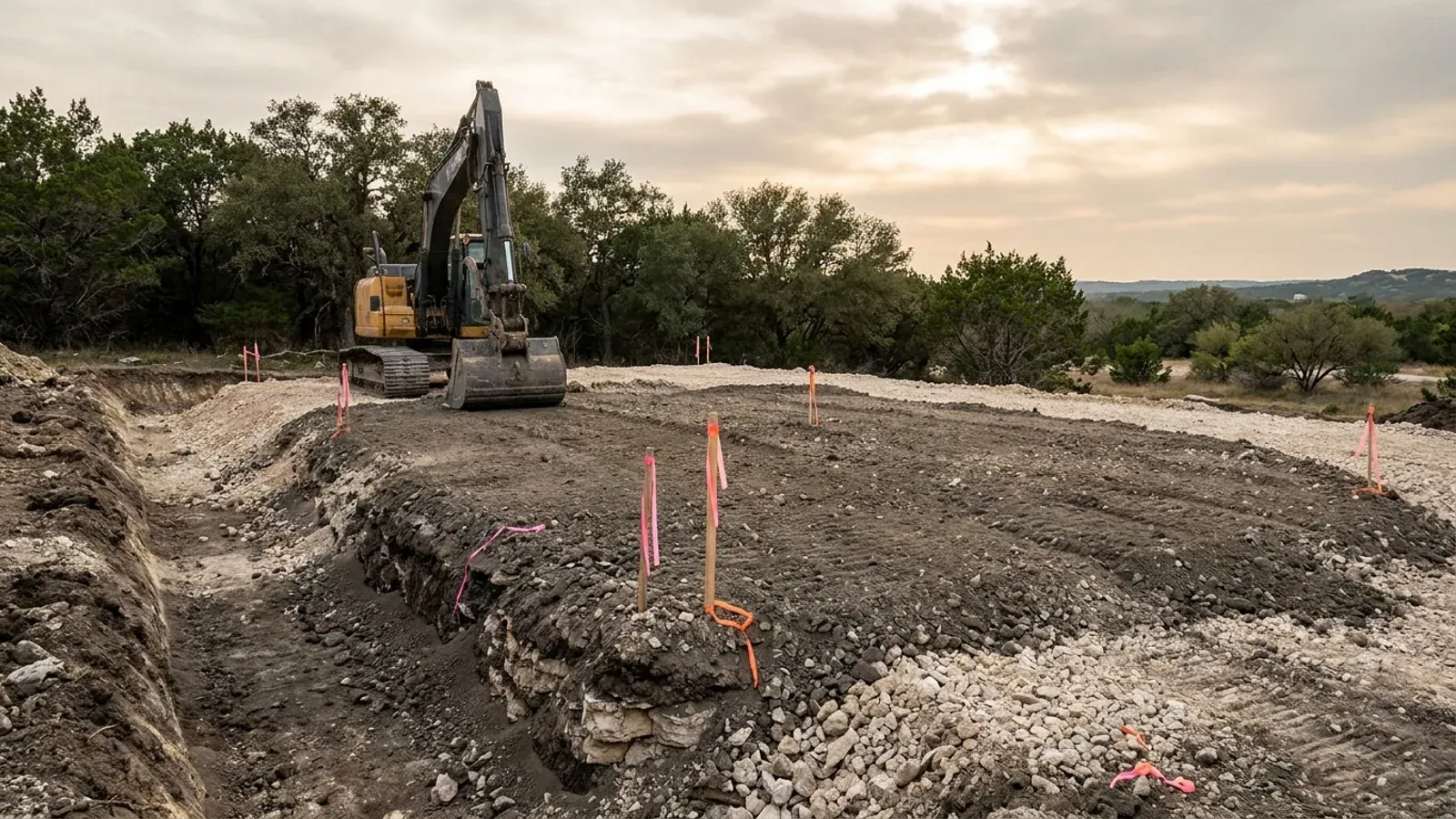
An excavator grading a compacted building pad on a cleared lot, with survey stakes and a drainage swale visible.
Below the slab

The expensive surprises are in the ground, not the building

What moves a Texas budget is usually below grade, and it is soil rather than rock: shrink-swell clay. The Blackland Prairie and the Gulf Coast clays move enough between a wet season and a dry one to drive the foundation design across the state's largest markets, which is why several DFW cities require an engineer's seal on the foundation of every new house. Those are the same conditions that decide whether a septic field passes its soil and site evaluation, so the grading plan, the foundation and the drainfield get resolved together rather than one at a time. We price the dirt before we price the building.

What we build in Ellis County

All nine of our services — kits, custom plans, post-frame and steel construction, site preparation, permitting and engineering, through to turnkey builds — are available across Ellis County. What a project costs depends far more on the parcel than on square footage, so we work from your land rather than from a rate card.

See what we build

What a build looks like

Three stages every Ellis County project passes through, from a raw parcel to a finished home. Site work first, because that is where the budget is decided.
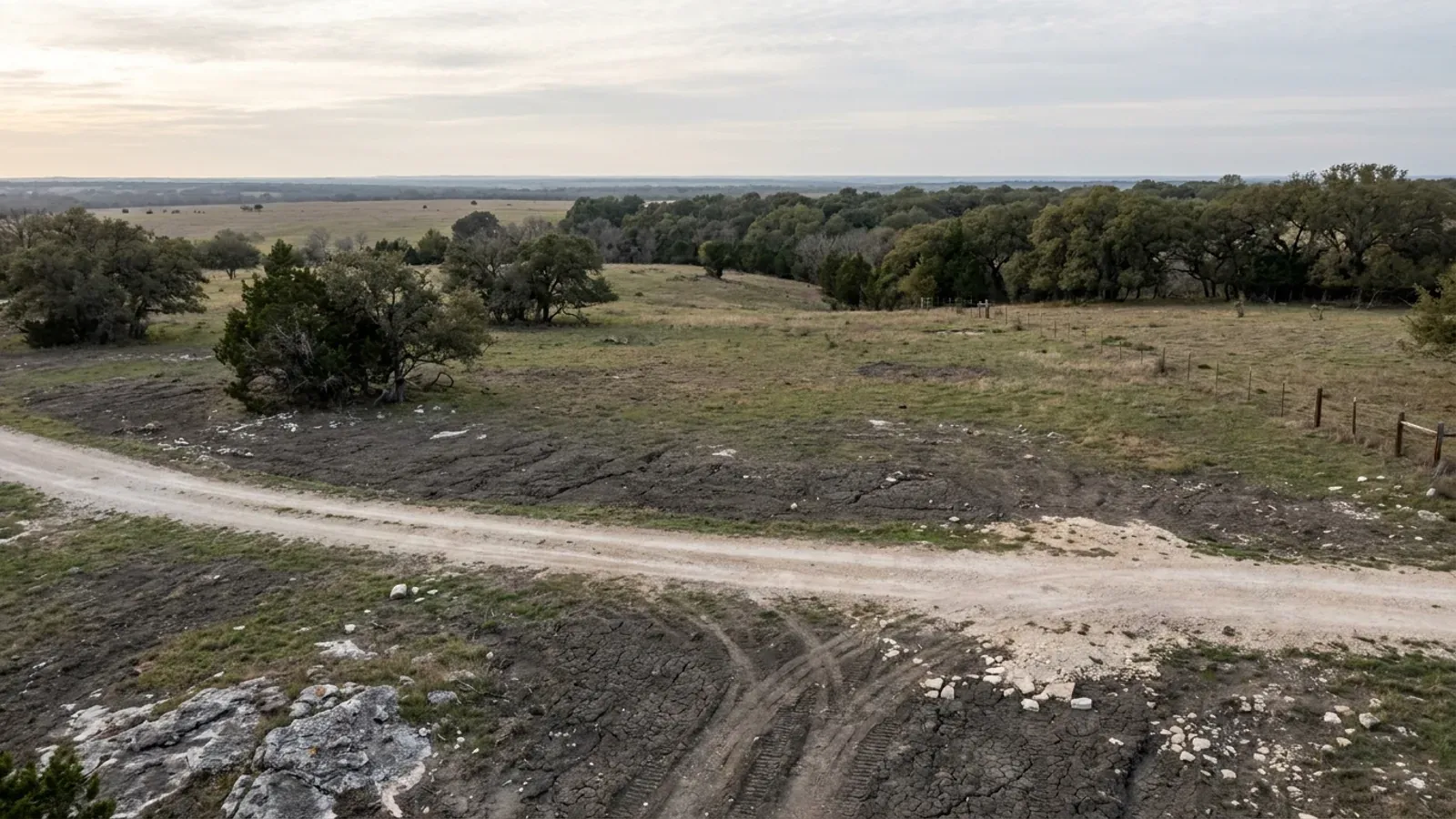
Aerial view of an undeveloped rural lot with cleared grass, a live oak and cedar elm treeline, and a pale gravel access track.
Stage one

The parcel

Zoning, setbacks, flood zone and utility access get checked before anything is drawn.

An excavator grading a compacted building pad on a cleared lot, with survey stakes and a drainage swale visible.
Stage two

Pad and permit

Clearing, grading and a compacted pad, while the submittal works through Ellis County.
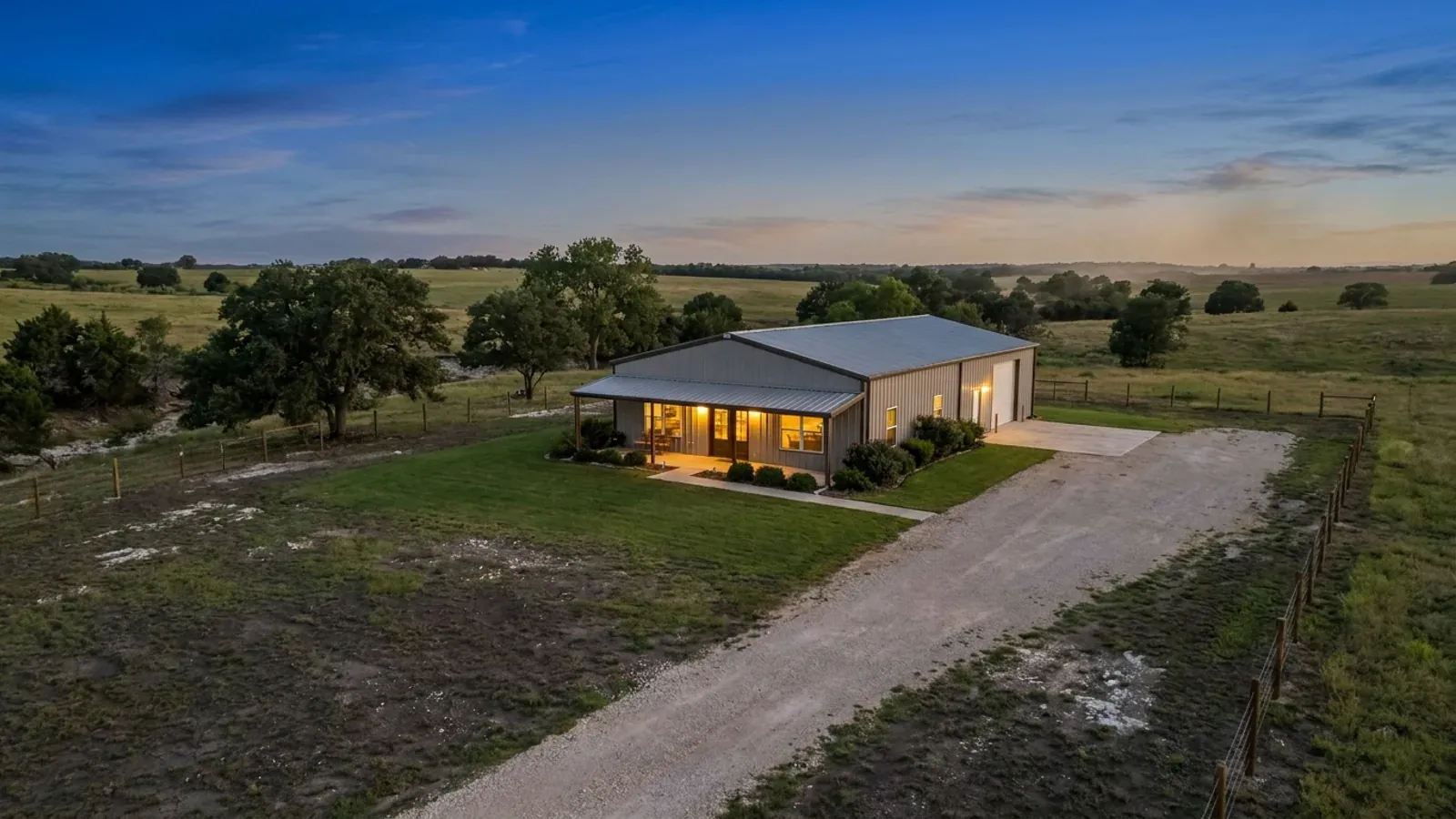
A finished barndominium at dusk with warm interior lighting glowing through its large windows.
Stage three

Frame to finish

Shell erected and dried in, then systems, insulation and interior finish through to CO.

Those are the rules for Ellis County. Tell us what you want to build and we will draw it to them.

Where we build around Ellis County

Ellis County and the rural land around it. The buildable acreage for a project this size usually sits outside the city limits, which is frequently what changes who issues your permit.

Our Ellis County service area, covering Ellis County and the surrounding rural acreage. This map marks the territory we serve, not a branch location.

Nearby areas we build in

Others we cover in this part of Texas. The permitting authority, the adopted design criteria and the zoning can all differ from one to the next.

Building in Ellis County: common questions

8 questions we get asked most often about building in Ellis County. If yours is not on the list, ask it directly.

Does Ellis County have a building code?
No, and you do not have to take our word for it. The Ellis County Department of Development publishes a standing letter saying the county has not adopted any resolution or order requiring the application of Subchapter F of Chapter 233 of the Local Government Code, and that it consequently has no legal authority to regulate residential construction to any building code, to run construction inspections, or to issue a residential certificate of occupancy outside a city limit. That is the whole answer for unincorporated land. A Texas county has no general building-code power to begin with; Chapter 233 is the entire grant and it contains no general building-code subchapter, only the opt-in Subchapter F that Ellis County has never opted into. Inside Waxahachie, Midlothian, Ennis, Red Oak or the Ellis County part of Grand Prairie, the city is the building authority and its own adopted edition applies.
Then why did the county still make me get a permit?
Because it is not a building permit. Ellis County requires a development permit for any structure erected or placed on a property and for any excavation or grading, and its fee schedule cites the Texas Water Code as the authority. It is a floodplain and drainage instrument, and the county dates that authority back to 1977. A habitable structure is a $350 Class III permit, an accessory building over 300 square feet is a $75 Class I permit, and anything in the 100-year floodplain adds $200. What you will not get with it is a structural plan review, a framing inspection or a certificate of occupancy, because the county has told you in writing it cannot provide them. The septic permit is separate, and it is the one that genuinely looks at your site.
Do I need an engineered foundation on Ellis County clay?
Read the statute carefully, because it is more interesting than the short version. Occupations Code sec. 1001.056(c)(2) removes the private-dwelling exemption from the Engineering Practice Act for a residential dwelling slab located on expansive soil, but both halves of the clause are tied to the code applied in the jurisdiction: the soil has to meet the expansive-soil classification provisions of the International Residential Code as applied in the jurisdiction, and the exemption comes back if the work meets the IRC requirements as applied in the jurisdiction. Inside a North Texas city that is straightforward, because the regional amendment package adopted across the metro requires an engineer-sealed foundation anyway. On unincorporated Ellis County land there is no locally applied IRC for either half of the clause to point at, and no Texas court decision or Attorney General opinion resolving how it operates in that situation was found. So the honest answer is that the statutory trigger is not clean out here, and it does not matter much in practice: this is Blackland Prairie clay, your lender and your insurer will ask, and the sensible route is a geotechnical report and a Texas-licensed engineer's design. We engage a Texas-licensed engineer for foundation work.
How do I find out what the soil is on my parcel?
Start with the USDA-NRCS Web Soil Survey, which will draw your boundary and name the soil series inside it, then get a geotechnical engineer to take borings. Do not accept a county-wide plasticity index or a single soil class for Ellis County from anyone, including us: no county-by-county expansive-soil list exists in Texas and the variation is parcel-level. What is established is the setting. NRCS puts Ellis County in Major Land Resource Area 86A, the Texas Blackland Prairie, running from the Red River to San Antonio, with soils characterised by their shrink-swell nature. The same clay that argues for a stiffened, engineered slab is also a Class IV soil for septic purposes, the class with the lowest loading rate and therefore the largest drainfield. It is worth knowing that the soil is working against you twice on the same acre.
What actually binds if there is no building code?
More than people expect. The septic permit, and Ellis County's own order is stricter than the state rule: at least one acre on a water supply, two acres on a private well, site evaluation only by a professional engineer or a registered sanitarian with a TCEQ site evaluator licence, and no property-owner installation unless the owner is a licensed installer. Floodplain regulation, which every Texas city and county must adopt to stay in the National Flood Insurance Program. County building set-back lines under Local Government Code sec. 233.032, at 25 feet from an ordinary road right-of-way and 50 feet from a thoroughfare or TxDOT road. A one-acre minimum lot and a 150-foot minimum width. A licensed plumber, because the rural exemption in Occupations Code sec. 1301.052 is expressly carved out for new construction. The state energy code, certified by the builder under Health and Safety Code sec. 388.004. Platting, where the tract is not exempt. And recorded deed restrictions, which the county says outright it cannot enforce, which means nobody is going to warn you about them either.
Is Ellis County climate zone 2A or 3A?
Both answers are in circulation and both are right somewhere, which is why this is worth getting straight. Ellis is one of only eight Texas counties that changed between the two national maps, moving from 3A to 2A. The zone therefore follows the code that governs your parcel, not the county line. On unincorporated land there is no building code, but there is a state energy code: Health and Safety Code sec. 388.003(a) adopts the energy chapter of the 2015 International Residential Code for single-family construction statewide, and the State Energy Conservation Office confirmed in an October 2025 Texas Register notice that it had only then begun taking comments on moving to the 2024 edition. The 2015 map puts Ellis County in zone 3A. A city inside the county that adopted the 2021 edition, as Grand Prairie did, is on the 2021 map at 2A. Same county, two zones, decided by the code and not the geography.
My land is in the ETJ of Waxahachie, Midlothian or Grand Prairie. Whose rules apply?
Not the city's building code. Texas courts have held that a city cannot enforce its building code beyond its corporate limits, first for general-law cities in Town of Lakewood Village v. Bizios in 2016 and then for home-rule cities in Collin County v. City of McKinney in 2018, decided by the Dallas Court of Appeals, which is the appellate district Ellis County sits in. A city cannot zone in its extraterritorial jurisdiction either. What a city genuinely can do is make you plat, and in McKinney the landowner lost on exactly that point. Ellis County and its cities divide plat authority by interlocal agreement, and Grand Prairie's arrangement for the Ellis County part of its ETJ goes back to a 2004 agreement, so the practical step is to ask both the city and the county which one takes your plat before you buy. Then read the title commitment, because a development agreement or a recorded covenant can bind land the building code cannot.
Where in the county should I be looking for land?
The pattern is a diagonal. The northern tier along the Dallas County line, Ovilla, Red Oak, Glenn Heights and the Midlothian corridor on US-67, is where the subdivision growth is heaviest and where a tract is most likely to be inside a city or its ETJ. The I-35E and I-45 spines through Waxahachie and Ennis carry the traffic and the commuter demand. The real acreage is west and south of those lines, out toward Maypearl, Italy, Milford, Forreston, Bardwell and Palmer, where the county's one-acre minimum and 150-foot lot width are the binding constraints rather than a city ordinance. The trade is straightforward. The further from the interstate, the more likely you are outside every city limit and every ETJ, which means no building code at all and a shorter list of people to satisfy, but also a longer drive and a septic system on clay that will need room.

Building in Ellis County?

Start with the plan. Tell us what you want to build and we will draw it, then confirm what Ellis County will actually let you put on the parcel and what wind load it has to meet. That conversation costs nothing.