
Barndominium Builders in Dallas, TX
Dallas is its own permitting authority, and a well-documented one. The city runs the 2021 International Residential Code as Chapter 57 of the Dallas City Code, deletes the IRC energy chapter and points it at the 2021 IECC in Chapter 59, and fills in Table R301.2 with its own numbers instead of leaving the cells blank. Where Dallas differs from most of North Texas is land. Only two of its residential districts are sized for acreage: the agricultural A(A) district at a three-acre minimum, and R-1ac(A) at one acre. The development code itself describes A(A) as a holding zone for fringe land awaiting urban zoning, and it caps structure height at 24 feet, which a steep barn-form roof clears easily. So we build inside the city where the site genuinely supports it, and we say plainly when the honest answer is Kaufman or Ellis County instead.
Dallas at a glance
- County
- Dallas County
- Population
- 1,329,491
- Where we build
- Dallas, Irving, Garland, Grand Prairie, Mesquite
- Site visits
- Site walks scheduled across the city and the wider Dallas County
ZIPs 75201, 75202, 75203, 75204, 75206, 75208, 75209, 75210 and more
Building conditions in Dallas
What actually changes from one Texas jurisdiction to the next: who issues the permit, whether the residential code is enforced there at all, what the structure has to be engineered to, and what the ground is like. These are the numbers your drawings have to satisfy.
City of Dallas Legistar legislative record, council file 23-973, City Council meeting of 12 April 2023; City of Dallas Permitting & Inspections, 'Current City Codes and Ordinances'
Table R301.2 'Climatic and Geographic Design Criteria' as amended by the Dallas ordinance adopting the 2021 IRC, Chapter 57 of the Dallas City Code
Table R301.2 as amended in Chapter 57 of the Dallas City Code; 2021 IRC §R318 termite protection, adopted by Dallas without amendment
Dallas City Code §51A-4.111(4), Dallas Development Code (Chapter 51A, Ordinance No. 19455, as amended)
City of Dallas Planning and Development Fee Guide, effective 1 July 2025 — 'Residential Plan Review Fee' and Table A-I, 'New Single-Family and Duplex Construction Permit Fee'
Dallas City Code Chapter 52 §306.1, exception limbs 1, 3 and 4; City of Dallas Permitting & Inspections, Certificate of Occupancy page
Also worth knowing before you build in Dallas
- The city registers contractors — and says that is not a licence
- Dallas requires a residential general contractor to hold a city registration before it can pull a permit, and its construction code says in the same breath that 'the city makes no statement of the technical competency of those so registered, and no manner of license is proffered.' Registration runs a year. Texas has no residential contractor licence to hold, and Dallas is explicit that its registration is not one.
- Application screen and permit life
- The building official reviews a permit application within 10 business days of receipt to determine completeness, and applications are taken in the order received. Once issued, a permit is void if no progress has been made toward completing the project before the second anniversary of issuance, unless extended.
- The acreage is over the county line
- Between 2020 and 2025 Dallas County grew 1.9 percent. Kaufman County, immediately east, grew 42.2 percent and Ellis County, to the south, 24.0 percent. That is where land is still being subdivided at a scale this building type needs.
- Frost line, snow and weathering
- Frost line depth 6 inches, ground snow load 5 lb/ft², weathering 'moderate', mean annual temperature 64.9°F. Dallas publishes all of these in its own adopted table rather than leaving them blank.
- Blackland Prairie clay means an engineer
- Dallas sits on the Blackland Prairie, whose soils the USDA describes by their shrink-swell nature. On expansive soil a Texas slab loses the private-dwelling exemption from engineering, and IRC R403.1.8 hands the same foundation to IBC §1808.6. Two separate routes, same answer: a Texas-licensed engineer designs the slab.
- Dallas did not amend the two sections that matter here
- The ordinance adopting the 2021 IRC leaves R403.1.8 (expansive soils) and R318 (termite protection) untouched. The model code text governs both, with the termite rating set to 'very heavy' by the city's own table.
- Climate zone 2A — and only on this edition
- Dallas County is climate zone 2A on the 2021 map and was 3A before it. Because Dallas runs the 2021 IRC and 2021 IECC, 2A is the right basis for the envelope. The energy requirements come from Chapter 59, not from the IRC, whose energy chapter Dallas deleted.
- Permitting authority
- Planning & Development, Permitting & Inspections, at the Oak Cliff Municipal Center, 320 E. Jefferson Blvd., Dallas, TX 75203. Phone 214-948-4480, Monday to Friday 8:00am to 4:30pm. Applications run through the DallasNow portal.
- A big city that is nearly built out
- Dallas reached 1,329,491 residents in 2025, up 2.0 percent from 2020 — a fraction of the growth in the counties on its eastern and southern edge. The land that fits this building type is mostly past the city line.
Dallas City Code Chapter 52, Subchapter 11 §§1101.1, 1102.1 and 1105.1 (Ord. 28096; 30320), from the city's published Chapter 52 booklet
Dallas City Code Chapter 52 §§302.1.1, 302.1.1.2 and 302.5.1 (Ord. 26029; 26170), from the city's published Chapter 52 booklet
U.S. Census Bureau, Vintage 2025 county population estimates (co-est2025-alldata), 1 July 2020 to 1 July 2025
Table R301.2 as amended in Chapter 57 of the Dallas City Code (2021 IRC as adopted)
Texas Occupations Code §1001.056(c)(2); IRC R403.1.8 and IBC §1808.6; USDA-NRCS Major Land Resource Area 86A
Search of the Dallas ordinance adopting the 2021 IRC, Chapter 57 of the Dallas City Code
City of Dallas Permitting & Inspections, 'Current City Codes and Ordinances' (Chapter 57 and Chapter 59, effective 12 May 2023); 2021 IECC climate zone assignment for Dallas County
City of Dallas Permitting & Inspections department pages, September 2026
U.S. Census Bureau, Vintage 2025 sub-county population estimates (sub-est2025), incorporated place totals
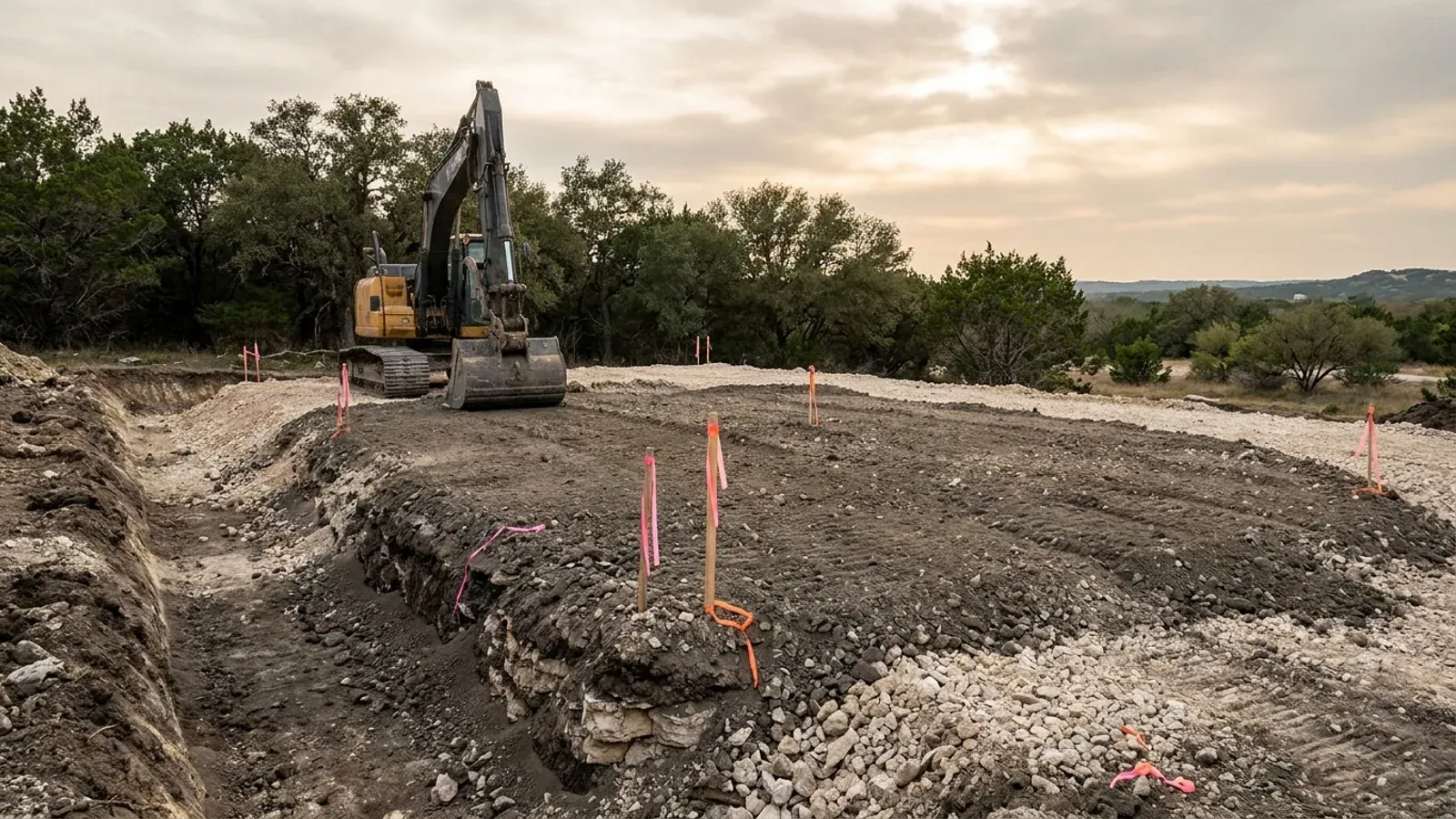
The expensive surprises are in the ground, not the building
What moves a Texas budget is usually below grade, and it is soil rather than rock: shrink-swell clay. The Blackland Prairie and the Gulf Coast clays move enough between a wet season and a dry one to drive the foundation design across the state's largest markets, which is why several DFW cities require an engineer's seal on the foundation of every new house. Those are the same conditions that decide whether a septic field passes its soil and site evaluation, so the grading plan, the foundation and the drainfield get resolved together rather than one at a time. We price the dirt before we price the building.
What we build in Dallas
All nine of our services — kits, custom plans, post-frame and steel construction, site preparation, permitting and engineering, through to turnkey builds — are available across Dallas County. What a project costs depends far more on the parcel than on square footage, so we work from your land rather than from a rate card.
See what we buildWhat a build looks like
Three stages every Dallas project passes through, from a raw parcel to a finished home. Site work first, because that is where the budget is decided.
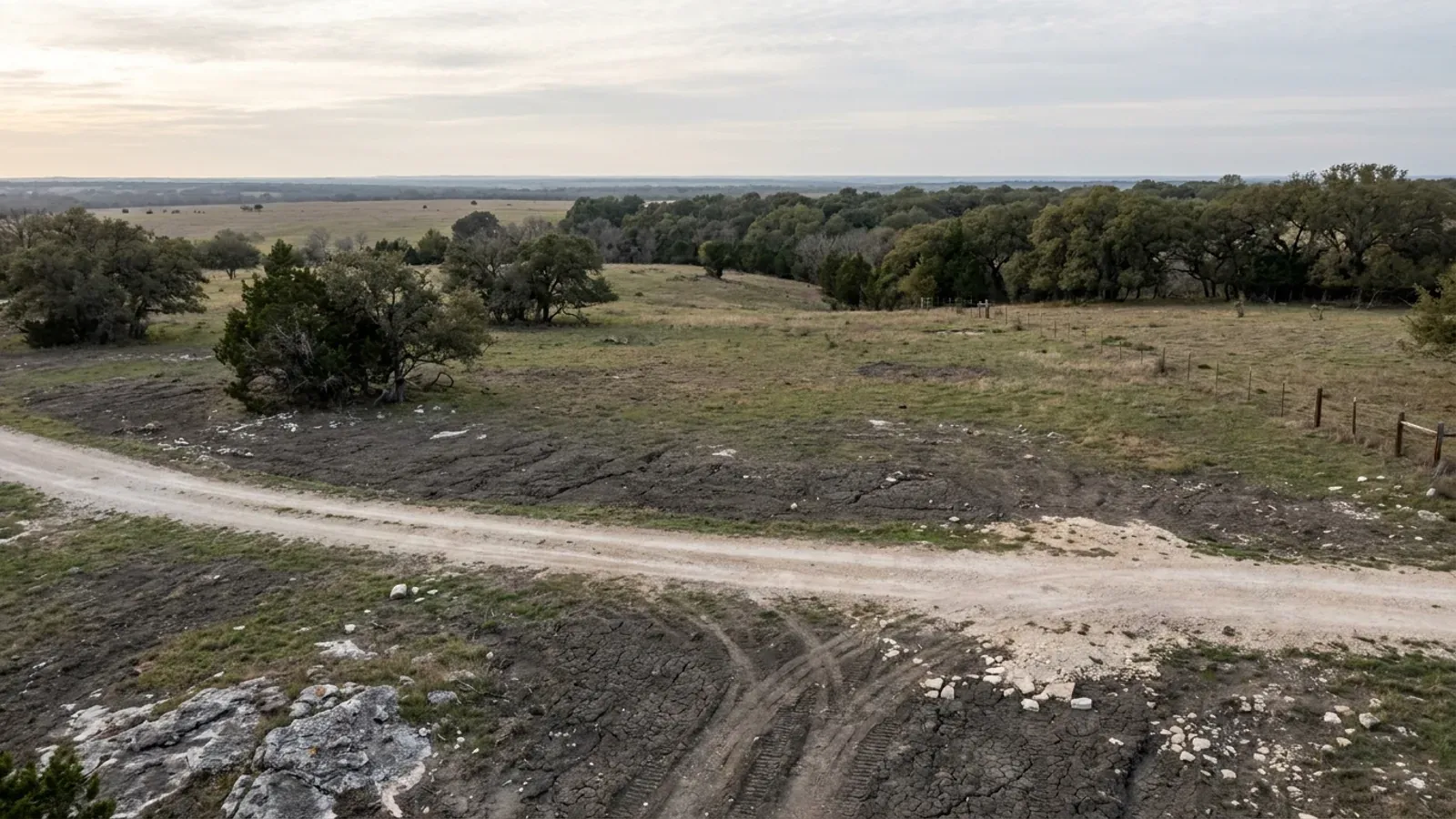
The parcel
Zoning, setbacks, flood zone and utility access get checked before anything is drawn.
Pad and permit
Clearing, grading and a compacted pad, while the submittal works through Dallas County.
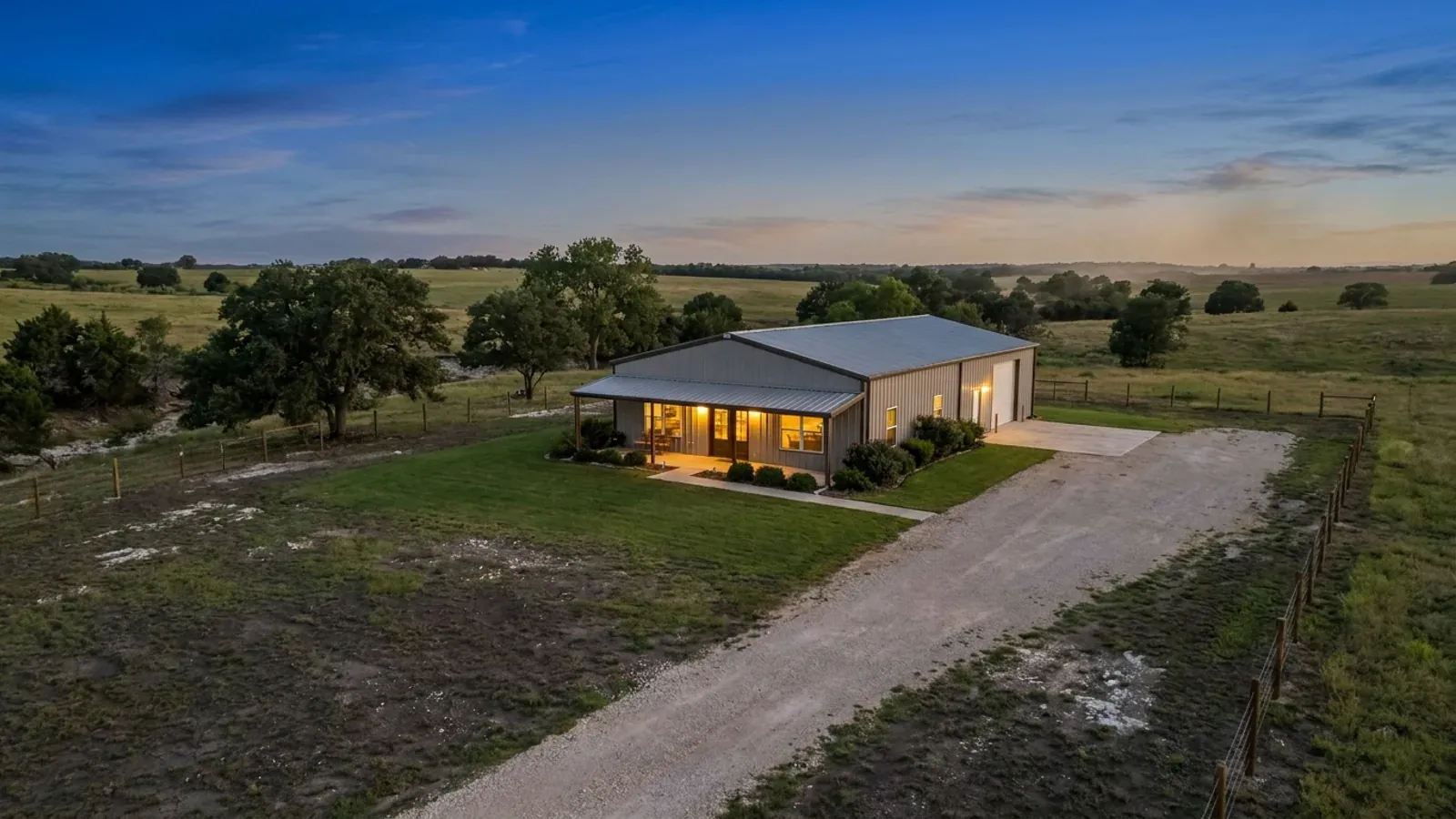
Frame to finish
Shell erected and dried in, then systems, insulation and interior finish through to CO.
Those are the rules for Dallas County. Tell us what you want to build and we will draw it to them.
Where we build around Dallas
Dallas County and the rural land around it. The buildable acreage for a project this size usually sits outside the city limits, which is frequently what changes who issues your permit.
Keep reading
The questions that usually come next once you know what Dallas allows.
Barndominium Cost Guide
Sourced per-square-foot ranges by tier and by size, with a calculator built on the same figures.
Read itIs It Legal in Texas?
Classification, zoning, the HOA gate, and why "nonresidential farm building" does not cover a home.
Read itHow Long Does It Take?
Census build-duration data, and what actually sets the permit clock where you are building.
Read itNearby areas we build in
Others we cover in this part of Texas. The permitting authority, the adopted design criteria and the zoning can all differ from one to the next.
Building in Dallas: common questions
10 questions we get asked most often about building in Dallas. If yours is not on the list, ask it directly.
Which building code applies to a barndominium inside Dallas city limits?
What design figures does Dallas actually publish?
What does the 'very heavy' termite rating change about the build?
Do I need an engineer for the foundation in Dallas?
Where inside Dallas can you actually put a building like this?
What does Dallas charge to permit a new house?
Does a barndominium in Dallas need a certificate of occupancy?
Does the City of Dallas require the builder to be registered?
How long does a Dallas permit take, and how long does it last?
Is seismic design a factor in Dallas?
Building in Dallas?
Start with the plan. Tell us what you want to build and we will draw it, then confirm what Dallas County will actually let you put on the parcel and what wind load it has to meet. That conversation costs nothing.