
Barndominium Builders in Allen, TX
Allen is a comprehensively master-planned Collin County suburb, and that shapes what a barndominium buyer is actually up against here. The city runs its own adopted code, publishes a fully filled-in set of design criteria, and requires a Texas-registered engineer to design and seal every foundation. Its zoning tops out at a 40,000 square foot estate lot with a 30 percent coverage cap and a 2,400 square foot minimum dwelling, and the residential schedule carries a 100 percent masonry exterior line. But the constraint most likely to sink a build in Allen and across the DFW ring is not in any ordinance. It is the recorded deed restriction on the lot: Texas courts enforce covenants on minimum size, exterior materials and living in a shop, and the legislature has left all three alone.
Allen at a glance
- County
- Collin County
- Population
- 113,447
- Where we build
- Allen, Plano, Frisco, McKinney
- Site visits
- We meet you on the parcel, anywhere in Allen or Collin County
ZIPs 75002, 75013
Building conditions in Allen
What actually changes from one Texas jurisdiction to the next: who issues the permit, whether the residential code is enforced there at all, what the structure has to be engineered to, and what the ground is like. These are the numbers your drawings have to satisfy.
City of Allen Land Development Code, Art. III, Sec. 3.01(1) and the editor's note to Art. III; City of Allen Building and Permitting Division page
City of Allen Land Development Code, Sec. 3.05(11), amending Table R301.2(1) of the 2021 IRC
City of Allen Land Development Code, Sec. 3.05(11), amended Table R301.2(1)
City of Allen Land Development Code, Sec. 3.05(19)
City of Allen Land Development Code, Sec. 4.15.2, Schedule of Residential Height and Area Regulations, and its footnote
Texas Property Code Chapter 202, section headings 202.007 to 202.024
Also worth knowing before you build in Allen
- What the Supreme Court of Texas quoted
- In Tarr v. Timberwood Park Owners Association (2018) the Supreme Court of Texas reproduced a subdivision covenant requiring a residence of 'not less than 1,750 square feet, exclusive of open porches, breezeways, carports and garages', 'having not less than 75% of its exterior ground floor walls constructed of masonry', and providing that 'no structures or house trailers of any kind may be moved on to the property'. The case itself was decided on short-term rentals, not on materials.
- Living in the shop, enjoined
- A 1953 Travis County deed restriction reading 'No garage or garage apartment or other facilities shall be used for residence purposes until the principal dwelling house is erected' — together with a 900 square foot minimum and a requirement that the house 'be of frame or better construction' — was enforced by permanent injunction, affirmed on appeal in August 2026. The 2022 purchaser had taken title subject to 'all presently recorded and validly existing restrictions'.
- Covenants can change after you buy
- In a rural subdivision case from Parker County, a covenant barring 'drilling ... for minerals of any kind' was amended by the developer after the lots were sold to add the words 'or water', and the court held the amendment effective as a matter of law because the original covenants reserved the right to amend and set out the method.
- Where the restrictions are written down
- Dedicatory instruments must be filed in the real property records of the county where the land sits, and have no effect until they are. For land in Allen that is the Collin County Clerk. The state-promulgated title commitment then lists them: Texas Department of Insurance Form T-7 reads 'SCHEDULE B — EXCEPTIONS FROM COVERAGE ... 1. The following restrictive covenants of record itemized below'.
- The 40-lot trap
- The architectural-review protections in the Texas Residential Property Owners Protection Act — the written denial, the reasons in detail, the right to a hearing — apply only to an association of more than 40 lots, and do not apply at all during the development period while the declarant controls the review authority. A small subdivision falls outside them entirely, leaving only the statutory presumption that the committee's decision was reasonable.
- No HOA is not no restrictions
- Chapter 209 reaches only subdivisions where an association collects assessments with mandatory membership. Chapter 202 reaches every restrictive covenant 'regardless of the date on which they were created', and a covenant recorded by a developer decades ago binds the land with no association in existence. Restrictive covenants are also to be 'liberally construed to give effect to their purposes and intent', and a court may assess civil damages up to $200 for each day of violation.
- What the legislature took from cities
- Texas Government Code Sec. 3000.002 bars a governmental entity from adopting or enforcing a regulation that limits a building product or material approved by a national model code, or that sets a materials or aesthetic standard more stringent than that code, and Sec. 3000.002(e) provides that a conflicting regulation 'is void'. Sec. 3000.004 expressly leaves untouched the enforcement of land use restrictions contained in plats and other recorded instruments.
- Lot sizes and minimum house size
- Allen's largest residential lot standard is 40,000 sq ft in R-1 and 30,000 sq ft in R-1.5, both with a 2,400 sq ft minimum dwelling unit size, 30 percent maximum lot coverage and a 35-foot height cap. The smallest, R-7, is a 5,000 sq ft lot with a 1,000 sq ft minimum dwelling.
- Accessory and shop buildings
- A building permit is required for any accessory structure over 120 square feet, and for one of any size that the adopted codes require to be built on a permanent or engineered foundation. An accessory structure over 400 square feet must meet the main house's side and rear setbacks, it may never be taller than the main house, and its area counts against the district's lot coverage cap.
- Contractor registration
- All contractors are required to register with the City of Allen for $50 annually, submitted through the Citizen Self-Service portal. There is no Texas state licence for a residential building contractor; Allen's registration is a city requirement, and separately the city registers state-licensed plumbers, electricians, HVAC and irrigation contractors.
- One climate zone, either edition
- Allen lies wholly in Collin County, which sits in climate zone 3A on both the pre-2021 and the 2021 IRC maps. Unlike Dallas, Fort Worth, Garland, Carrollton and Richardson, whose zone changed between editions, Allen's insulation zone does not depend on which edition is in force.
Tarr v. Timberwood Park Owners Association, Inc., No. 16-1005, Supreme Court of Texas, 25 May 2018
Cliffhanger Developments, LLC v. Lubitz, No. 03-24-00555-CV, Texas Court of Appeals, Third District at Austin, 14 August 2026
Dyegard Land Partnership v. Hoover, No. 2-99-361-CV, Texas Court of Appeals, Second District at Fort Worth, 11 January 2001
Texas Property Code Sec. 202.006; Texas Department of Insurance promulgated Form T-7, Commitment for Title Insurance, Schedule B
Texas Property Code Sec. 209.00505(b) and Sec. 209.003; Sec. 202.004(a)
Texas Property Code Sec. 202.002(a), Sec. 202.003(a), Sec. 202.004(c) and Sec. 209.003
Texas Government Code Sec. 3000.001 to 3000.004, added by Acts 2019, 86th Leg., Ch. 1289 (H.B. 2439)
City of Allen Land Development Code, Sec. 4.15.2
City of Allen Land Development Code, Sec. 4.10(2)
City of Allen Contractor Registration page; Land Development Code Sec. 3.12; Code of Ordinances Secs. 4-7 to 4-9
IRC climate zone assignments by county for the 2018 and 2024 editions, cross-checked against the DOE/PNNL climate zone dataset
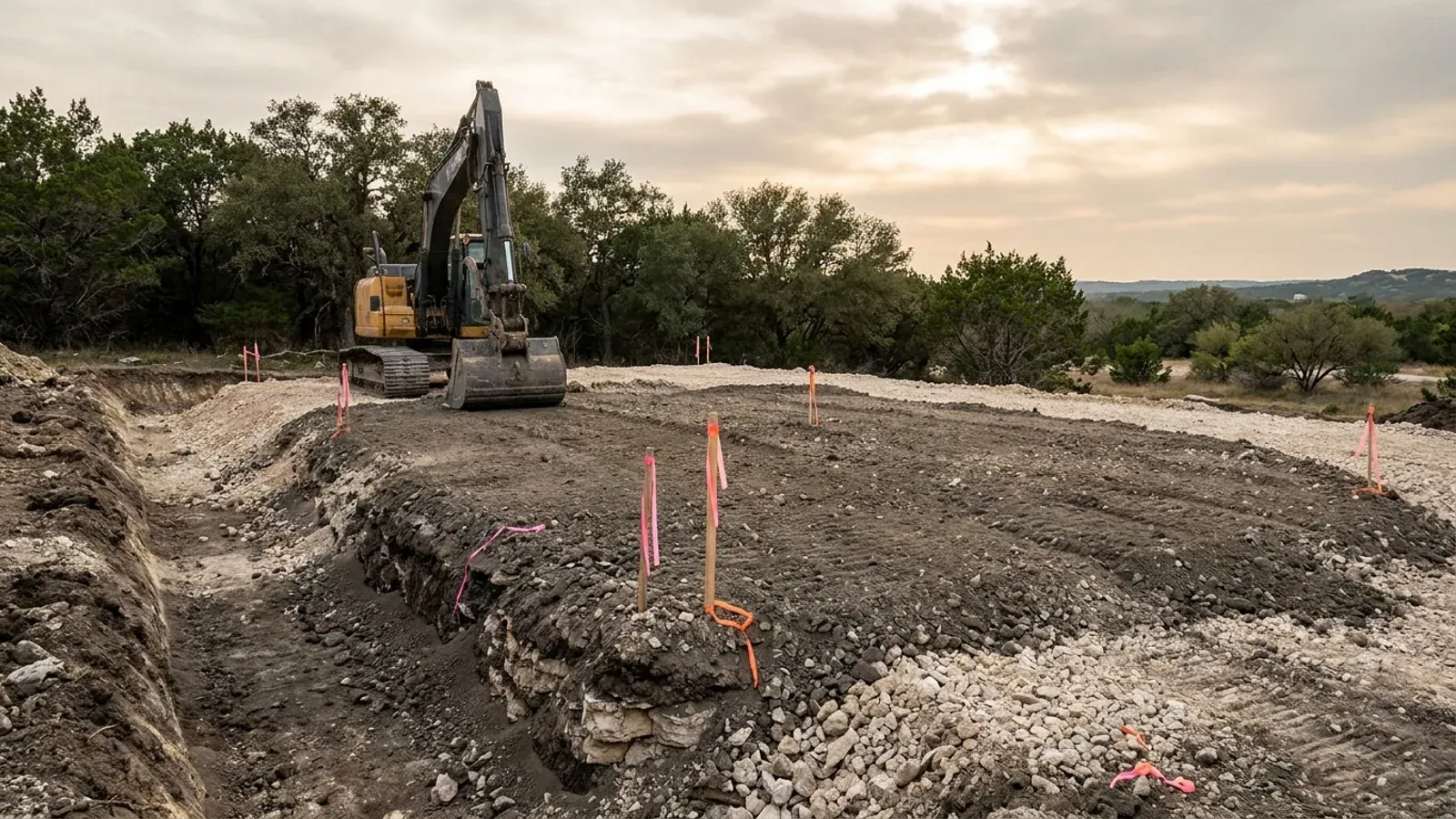
The expensive surprises are in the ground, not the building
What moves a Texas budget is usually below grade, and it is soil rather than rock: shrink-swell clay. The Blackland Prairie and the Gulf Coast clays move enough between a wet season and a dry one to drive the foundation design across the state's largest markets, which is why several DFW cities require an engineer's seal on the foundation of every new house. Those are the same conditions that decide whether a septic field passes its soil and site evaluation, so the grading plan, the foundation and the drainfield get resolved together rather than one at a time. We price the dirt before we price the building.
What we build in Allen
All nine of our services — kits, custom plans, post-frame and steel construction, site preparation, permitting and engineering, through to turnkey builds — are available across Collin County. What a project costs depends far more on the parcel than on square footage, so we work from your land rather than from a rate card.
See what we buildWhat a build looks like
Three stages every Allen project passes through, from a raw parcel to a finished home. Site work first, because that is where the budget is decided.
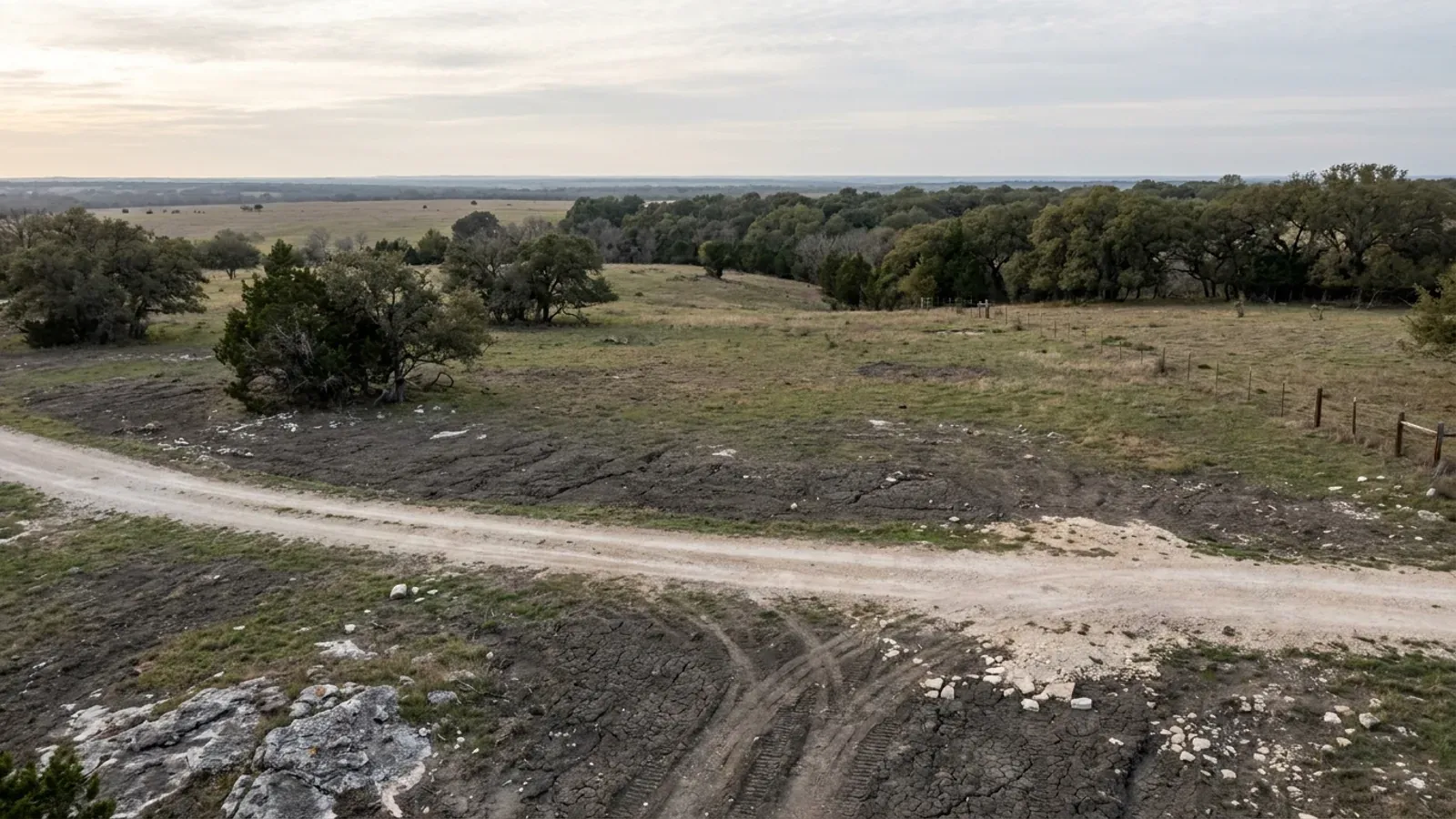
The parcel
Zoning, setbacks, flood zone and utility access get checked before anything is drawn.
Pad and permit
Clearing, grading and a compacted pad, while the submittal works through Collin County.
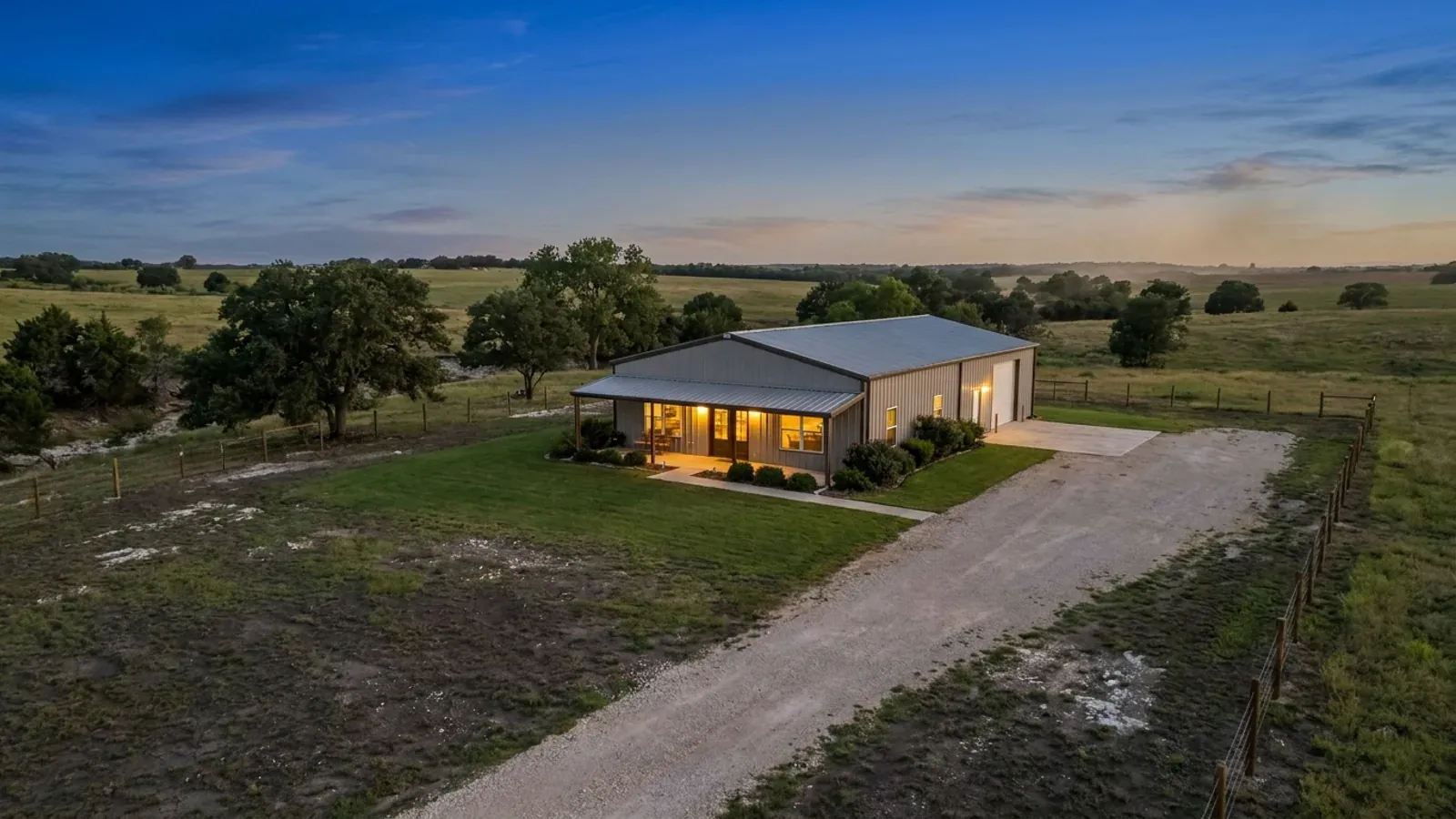
Frame to finish
Shell erected and dried in, then systems, insulation and interior finish through to CO.
Those are the rules for Collin County. Tell us what you want to build and we will draw it to them.
Where we build around Allen
Collin County and the rural land around it. The buildable acreage for a project this size usually sits outside the city limits, which is frequently what changes who issues your permit.
Keep reading
The questions that usually come next once you know what Allen allows.
Barndominium Cost Guide
Sourced per-square-foot ranges by tier and by size, with a calculator built on the same figures.
Read itIs It Legal in Texas?
Classification, zoning, the HOA gate, and why "nonresidential farm building" does not cover a home.
Read itHow Long Does It Take?
Census build-duration data, and what actually sets the permit clock where you are building.
Read itNearby areas we build in
Others we cover in this part of Texas. The permitting authority, the adopted design criteria and the zoning can all differ from one to the next.
Building in Allen: common questions
8 questions we get asked most often about building in Allen. If yours is not on the list, ask it directly.
Can I actually build a barndominium in Allen?
Which building code does Allen build to?
Does Allen really require an engineer for the foundation?
Allen's zoning says 100 percent masonry. Does that rule out a metal-clad barndominium?
How do I find out whether deed restrictions stop a barndominium on a piece of land?
The listing says no HOA. Does that mean no restrictions?
Can I live in the shop while the house goes up?
What design figures does Allen actually publish?
Building in Allen?
Start with the plan. Tell us what you want to build and we will draw it, then confirm what Collin County will actually let you put on the parcel and what wind load it has to meet. That conversation costs nothing.