Gently rolling Blackland Prairie grassland with deep dark cracking clay soil in the foreground and post oak along a fence line.
Collin County 2024 IRC as adopted here

Barndominium Builders in McKinney, TX

McKinney is the rare Texas city whose name sits on the leading case about what a city may do beyond its own boundary. In Collin County v. City of McKinney, decided by the Dallas Court of Appeals in 2018, a home-rule city was held to lack authority to enforce its building codes and inspections in its extraterritorial jurisdiction — but to have authority to make a landowner plat. Inside the city limits the picture is straightforward: the 2024 International Residential Code, adopted by ordinance and in force since 1 October 2025, with the North Central Texas Council of Governments regional amendments on top. Outside it, in a five-mile ring of Collin County farmland, the live questions are who approves the plat, who inspects the work, and what a previous owner may already have signed. That ring is where most of the barndominium acreage around McKinney actually sits.

McKinney at a glance

County
Collin County
Population
237,130
Where we build
McKinney, Plano, Frisco, Allen

ZIPs 75069, 75070, 75071, 75072

Site visits
Site visits set up in McKinney and out across Collin County

Building conditions in McKinney

What actually changes from one Texas jurisdiction to the next: who issues the permit, whether the residential code is enforced there at all, what the structure has to be engineered to, and what the ground is like. These are the numbers your drawings have to satisfy.

Build conditions for McKinney , Collin County, Texas : design wind speed 105 mph. BUILD CONDITIONS MCKINNEY, TXCollin County2024 IRCDESIGN WIND SPEED105 mphThree-second gust at 33 feet above ground, Exposure C, from Table R301.2 as filled in by the NorthCentral Texas Council of Governments Recommended Amendments to the 2024 IRC (March 2025), adopted…ZONING · AG — AGRICULTURE5 acresAG carries a five-acre minimum lot, 100-foot minimum width, 35-footfront and rear setbacks and a 35-foot height cap (UDC Table 2-21).…IMPACT AND PERMIT FEESRoadway and utility impact feesMcKinney assesses roadway and utility impact fees under LocalGovernment Code ch. 395; the current schedules were approved by Cit…WHO ISSUES THE PERMITCity of McKinney Building Inspections401 E. Virginia St., McKinney, TX 75069. Phone 469-617-4800, fax972-547-2605, Monday to Friday 8 a.m. to 5 p.m. Planning Department…
Build conditions for McKinney, drawn from the sourced facts on this page. Every figure above is cited in the quick-facts panel below, with its source and vintage.
A city's building code stops at the city line
The leading Texas authority on this is named for McKinney. In Collin County, Texas v. The City of McKinney, Texas and Custer Storage Center, LLC, the Dallas Court of Appeals held that the city "lacks authority to enforce its building codes and related building inspection requirements within its extraterritorial jurisdiction," reasoning that every municipality, including a home-rule municipality, needs legislative authorisation to enforce building codes beyond its corporate limits. The judgment is final — rehearing denied and mandate issued 22 August 2018, with no petition for review. It binds the Fifth District, which includes Collin County; the Texas Supreme Court has never decided the point for a home-rule city, so ask McKinney's development services office what applies to your particular tract.

Collin County, Texas v. The City of McKinney, Texas and Custer Storage Center, LLC, No. 05-17-00546-CV (Tex. App.—Dallas May 10, 2018); opinion and docket read from search.txcourts.gov

But the city can still make you plat — and that half is real
The same opinion went the other way on platting: McKinney "has authority to require a landowner to plat its property," and the city holds that authority in its ETJ to the exclusion of the county. The landowner lost on a detail worth remembering — it had built a twenty-four-foot access driveway under a TxDOT permit, and that alone was construction of an improvement that triggered the city's platting ordinance. Platting, street and drainage standards and stormwater rules do reach ETJ land even where building codes do not.

Collin County, Texas v. The City of McKinney, No. 05-17-00546-CV (Tex. App.—Dallas May 10, 2018), opinion at 9–11 and Conclusion

McKinney builds to the 2024 IRC
City Council adopted the 2024 International Residential Code, along with the 2024 IBC, IPC, IMC, IFGC, IECC, IPMC, ISPSC and IFC and IRC Appendix AQ for tiny houses, effective 1 October 2025. The adopting ordinance amends Chapter 122, Article II of the Code of Ordinances at §§ 122-25 and 122-26 and layers the North Central Texas Council of Governments Recommended Amendments of March 2025 on top. That is a newer edition than most of its neighbours were on, so anything written against a 2021-code checklist is already behind.

City of McKinney, Building Inspections — Current Adopted Codes, mckinneytexas.org/243/Building-Inspections; adopting ordinance amending ch. 122, art. II (agenda item 25-3063, McKinney City Council)

The design criteria McKinney publishes
Table R301.2 as McKinney adopted it gives a 105 mph three-second-gust design wind speed at 33 feet, Exposure C; ground snow load 9 lb/ft²; Seismic Design Category A; weathering moderate; frost line depth 6 inches; termite hazard very heavy; winter design temperature 22 °F; no ice barrier underlayment required; air freezing index 150; mean annual temperature 64.9 °F. Flood hazards are left to local code. Those are the numbers a McKinney plan reviewer works from, and the very heavy termite rating is the one people underestimate on a steel-and-slab build.

NCTCOG Recommended Amendments to the 2024 International Residential Code, Final — Approved March 2025, Table R301.2, adopted by McKinney at Code of Ordinances § 122-26(b)

The ETJ reaches five miles out
A Texas city's extraterritorial jurisdiction is set by its own population, and at 237,130 residents McKinney is well past the 100,000 threshold that carries a five-mile ETJ under Local Government Code § 42.021(a). That is a wide ring of unincorporated Collin County land on every side that is not in the city, cannot be zoned by the city, and is exactly where the acreage a barndominium needs still exists.

Tex. Loc. Gov't Code § 42.021(a); population from City of McKinney Demographics, Census & Reports (237,130 as of 1 January 2026), mckinneytexas.org/294/Demographics-Census-Reports

Platting in the ETJ costs double
McKinney's published plat submittal fee is $325 plus $10 per lot inside the city limits and $650 plus $10 per lot in the ETJ. Staff review is capped at 30 days for an initial submittal and 15 days for a resubmittal. Since platting is the one thing the city can require out there, that fee line is the one an ETJ buyer actually meets.

City of McKinney Development Guide (2026), Preliminary Plat and Final Plat pages, mckinneytexas.org/DocumentCenter/View/32679

Also worth knowing before you build in McKinney

One house and a barn in the ETJ may not need a plat at all
McKinney's Unified Development Code carries an exemption that matters more to a rural buyer than almost anything else in it: from and after 5 September 2017, a plat is not required before constructing, repairing, renovating or remodelling one existing or new single-family dwelling, private utility service lines, or accessory residential structures — the code names a barn, a storage shed, an arbor, a gazebo and a swimming pool — on a single, undivided tract in the ETJ that is not being conveyed or created out of a larger tract. Subdivide that tract, or run public improvements, and the exemption is gone.

City of McKinney Unified Development Code (3 March 2026), Article 3 § 301C, Plat or Replat Required — Exemption

McKinney's own code draws the same line the court did
The UDC's permit rule reads exactly as the case left it: inside the city limits a permit is required before commencing any construction or development activity, while in the ETJ a permit is required only before commencing construction activity associated with public improvements. The city's Land Use Assumptions report says the same thing about zoning — undeveloped ETJ land outside the city limits is not subject to the city's zoning regulations.

City of McKinney Unified Development Code (3 March 2026), Article 3 § 302, Permits Required; City of McKinney 2019-2029 Land Use Assumptions Report, Ultimate Buildout Projections

Who approves the plat out there was settled in 2002
Texas allows exactly one plat authority in a given ETJ, fixed by a written city-county agreement under Local Government Code § 242.001(c). McKinney and Collin County signed theirs in 2002, and it gives the city exclusive jurisdiction over subdivision plats and related permits in McKinney's ETJ. The appellate court modified the trial court's judgment to say the county ceded platting authority — and only platting authority — striking the words "inspection and building code" out of it. An agreement about plats does not carry building codes with it.

Collin County, Texas v. The City of McKinney, No. 05-17-00546-CV (Tex. App.—Dallas May 10, 2018), Background and Modification of Judgment; Tex. Loc. Gov't Code § 242.001(c)

McKinney does not register general contractors
The city states plainly that for a general contractor there is no fee and no form and that contractor registration is not required — the GC simply opens an account on the Citizen Self Service portal. The trades are different: electrical, plumbing and mechanical work needs the state licence on file before a permit is validated, and the city charges no registration fee for that either. It is a clean illustration of how Texas works — no state licence exists for a residential builder, while the trades are licensed at state level.

City of McKinney, Contractor Registration, mckinneytexas.org/257/Contractor-Registration

A detached shop over 120 square feet needs a permit
McKinney amended IRC section R105.2 so the permit exemption for one-story detached accessory structures stops at 120 square feet rather than the model code's larger allowance. Anything bigger — which is most workshops, equipment barns and hobby buildings — takes a permit inside the city limits.

McKinney ordinance amending Code of Ordinances ch. 122, art. II, § 122-26(b)(3) (2024 code adoption, effective 1 October 2025)

The city's published permit fee for a new house
McKinney's permit fee schedule prices a new single-family dwelling, detached or attached, at $0.68 per gross square foot, with additions and alterations at the same rate on the affected area, and a residential plan review fee of $200. Impact fees, water and sewer service fees and utility connection charges are separate line items.

City of McKinney Permit Fee Schedule for New Construction, Remodels and Repairs, mckinneytexas.org/DocumentCenter/View/358

There is still a frontier here, unlike the inner suburbs
McKinney covers 68.4 square miles of land and grew from roughly 206,700 residents in 2022 to 237,130 in 2026 on the city's own count. Its impact-fee study puts the ultimate buildout of the city and its ETJ at about 433,900 people and 158,100 dwelling units against a 2019 baseline of about 193,000 and 71,300 — roughly a doubling still to come. The city keeps an AG agricultural district with a five-acre minimum and treats AG-zoned land inside the limits as land that has not yet developed. This is not a built-out suburb.

U.S. Census Bureau 2024 Gazetteer, place 4845744 (68.362 sq mi land); City of McKinney Demographics, Census & Reports; City of McKinney 2019-2029 Land Use Assumptions Report, Baseline Conditions and Ultimate Buildout Projections
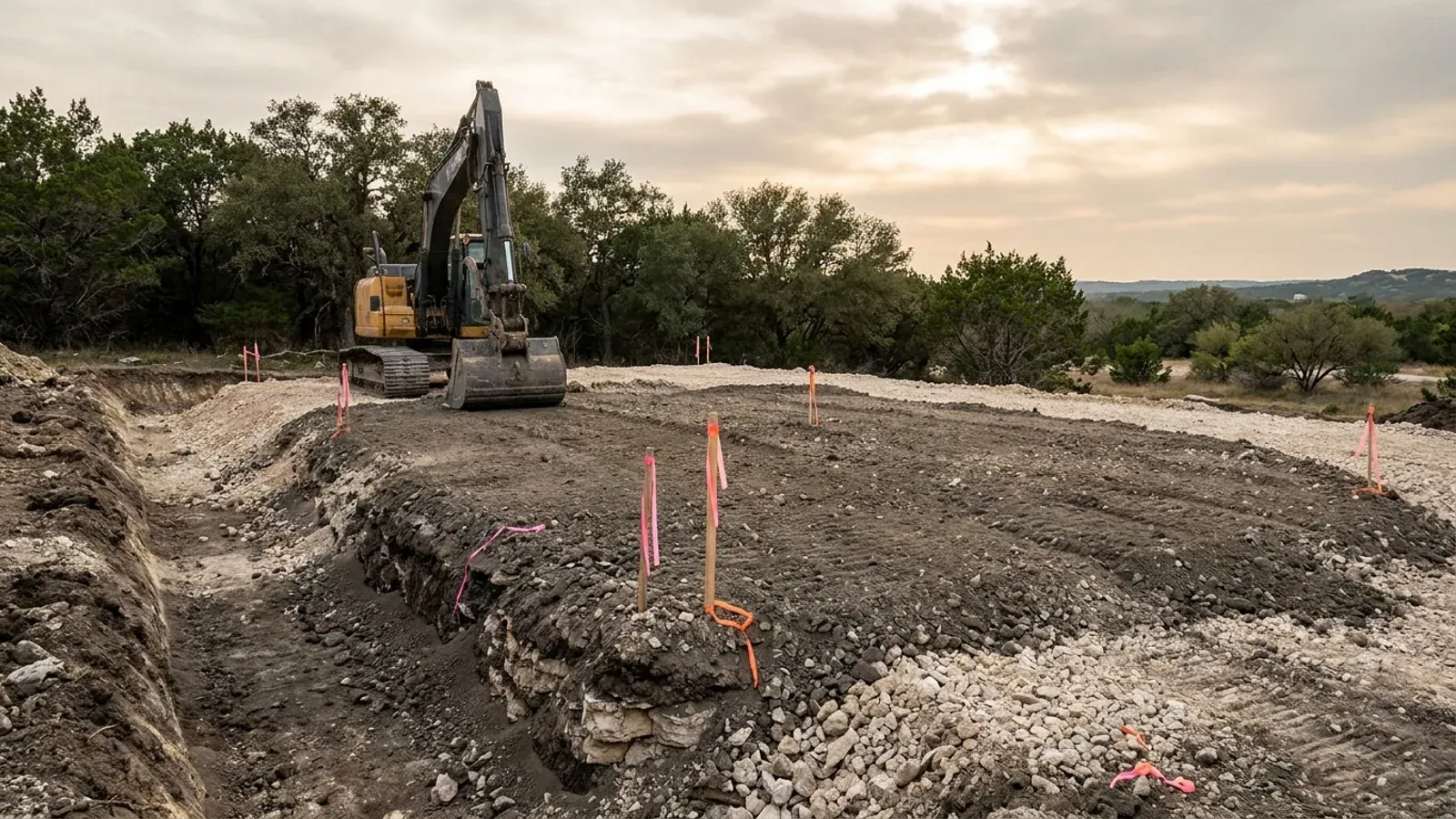
An excavator grading a compacted building pad on a cleared lot, with survey stakes and a drainage swale visible.
Below the slab

The expensive surprises are in the ground, not the building

What moves a Texas budget is usually below grade, and it is soil rather than rock: shrink-swell clay. The Blackland Prairie and the Gulf Coast clays move enough between a wet season and a dry one to drive the foundation design across the state's largest markets, which is why several DFW cities require an engineer's seal on the foundation of every new house. Those are the same conditions that decide whether a septic field passes its soil and site evaluation, so the grading plan, the foundation and the drainfield get resolved together rather than one at a time. We price the dirt before we price the building.

What we build in McKinney

All nine of our services — kits, custom plans, post-frame and steel construction, site preparation, permitting and engineering, through to turnkey builds — are available across Collin County. What a project costs depends far more on the parcel than on square footage, so we work from your land rather than from a rate card.

See what we build

What a build looks like

Three stages every McKinney project passes through, from a raw parcel to a finished home. Site work first, because that is where the budget is decided.
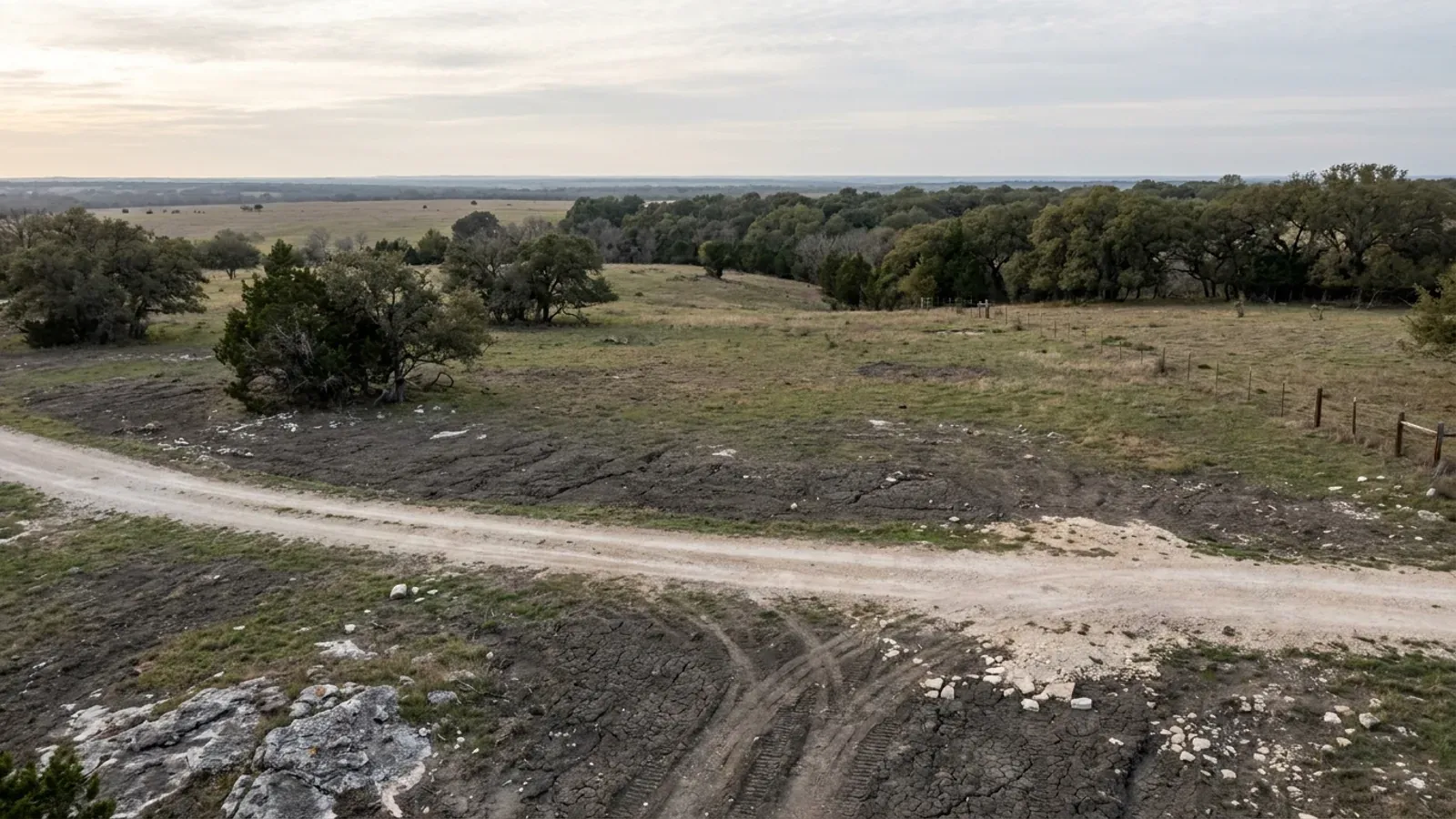
Aerial view of an undeveloped rural lot with cleared grass, a live oak and cedar elm treeline, and a pale gravel access track.
Stage one

The parcel

Zoning, setbacks, flood zone and utility access get checked before anything is drawn.

An excavator grading a compacted building pad on a cleared lot, with survey stakes and a drainage swale visible.
Stage two

Pad and permit

Clearing, grading and a compacted pad, while the submittal works through Collin County.
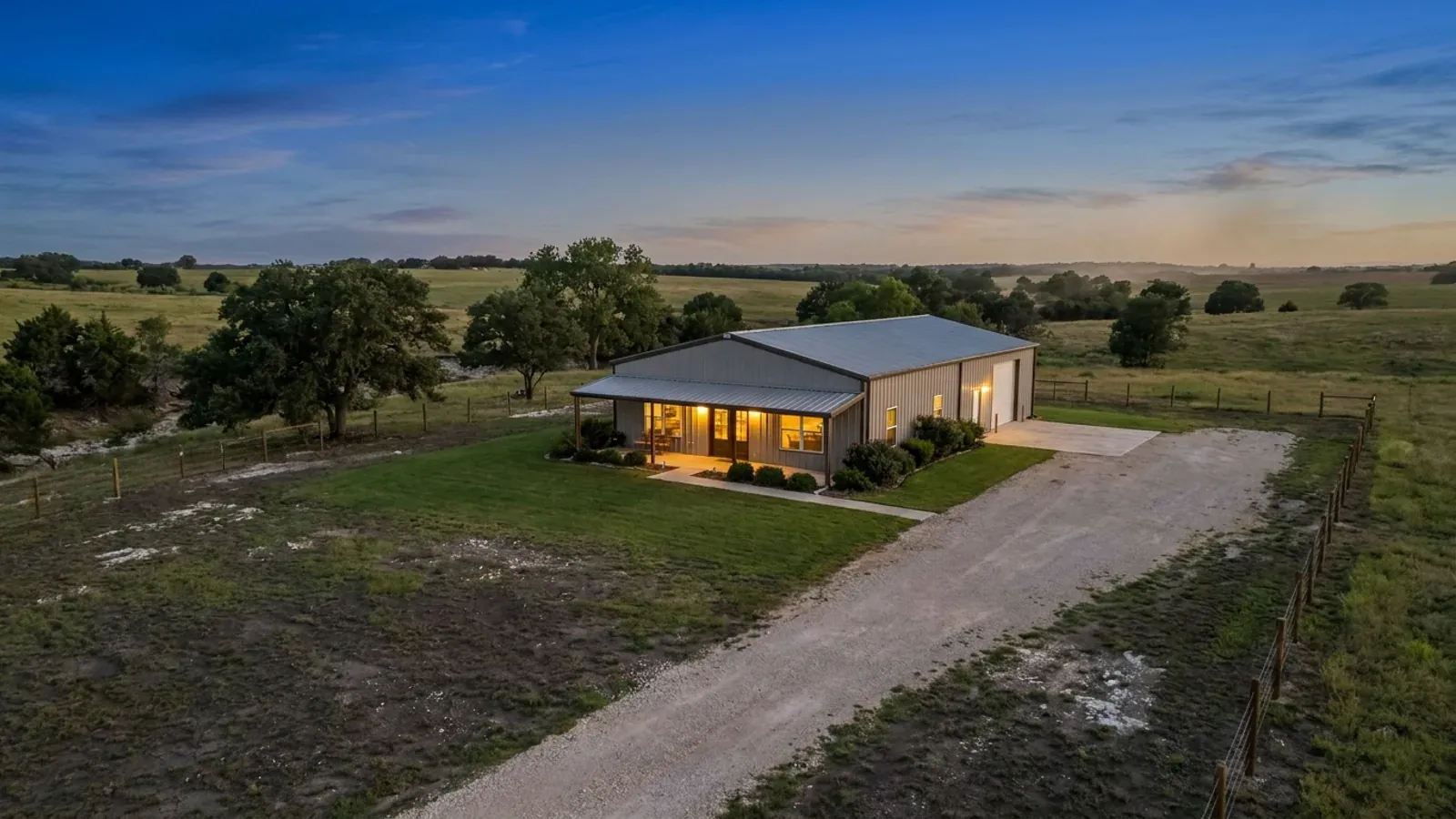
A finished barndominium at dusk with warm interior lighting glowing through its large windows.
Stage three

Frame to finish

Shell erected and dried in, then systems, insulation and interior finish through to CO.

Those are the rules for Collin County. Tell us what you want to build and we will draw it to them.

Where we build around McKinney

Collin County and the rural land around it. The buildable acreage for a project this size usually sits outside the city limits, which is frequently what changes who issues your permit.

Our McKinney service area, covering Collin County and the surrounding rural acreage. This map marks the territory we serve, not a branch location.

Nearby areas we build in

Others we cover in this part of Texas. The permitting authority, the adopted design criteria and the zoning can all differ from one to the next.

Building in McKinney: common questions

7 questions we get asked most often about building in McKinney. If yours is not on the list, ask it directly.

I am buying land outside McKinney's city limits but inside its ETJ. Does the city's building code apply to me?
Texas courts have held that it does not. In Collin County, Texas v. The City of McKinney — the case that carries this city's name — the Dallas Court of Appeals concluded in 2018 that McKinney lacks authority to enforce its building codes and related inspection requirements in its extraterritorial jurisdiction, because every municipality, home-rule included, needs legislative authorisation to enforce building codes beyond its corporate limits. Rehearing was denied and the mandate issued in August 2018 with no petition for review, so the judgment is final, and it binds the Fifth District, which includes Collin County. Two honest limits go with that. It is one of fifteen Texas intermediate appellate courts and the Texas Supreme Court has never decided the question for a home-rule city. And a previous owner can have signed a recorded development agreement that puts city rules on the land by consent and binds whoever buys it next. So: call McKinney's development services office about your specific tract, and have your title commitment read for a recorded agreement before you close.
So there is nothing to comply with out there?
That is the wrong conclusion to draw, and it is the expensive one. The city can still require a plat, and can enforce its subdivision, street, drainage and stormwater standards in the ETJ — in the McKinney case the landowner lost on exactly that, over a twenty-four-foot driveway built under a TxDOT permit. On unincorporated land the on-site sewage facility permit comes from the county or whichever authorised agent holds that job, and it is a real permit with a real inspection behind it. The state energy code still reaches rural Texas. Licensed trades are still licensed. Deed restrictions, a municipal utility district or a special district can each impose more than any code would. The question in the ETJ is never whether the land is regulated — it is which body regulates which part of the job.
How far does McKinney's ETJ reach?
Five miles from the city limits. Texas sets the distance by the city's own population, and any city of 100,000 or more carries a five-mile extraterritorial jurisdiction under Local Government Code § 42.021(a). McKinney's own count puts the population at 237,130 as of the start of 2026, so it sits at the top tier. In practice that means a wide ring of unincorporated Collin County on every side of the city — land the city cannot zone, since zoning power stops at the corporate limit, but where its platting and infrastructure standards do apply. Release from an ETJ became possible in 2023, but the routes carve out lots under 12 acres and single lots within subdivisions of 25 or more lots in the big metros, so it is largely a large-acreage remedy rather than something generally available. And release changes who regulates rather than whether: subdivision regulation passes to the county.
Which code does McKinney build to inside the city limits?
The 2024 International Residential Code, in force since 1 October 2025, adopted at Chapter 122, Article II of the Code of Ordinances alongside the 2024 IBC, IPC, IMC, IFGC, IECC, IPMC, ISPSC and IFC, plus IRC Appendix AQ for tiny houses. On top of the model code the city adopts the North Central Texas Council of Governments Recommended Amendments dated March 2025, and it makes its own changes as well — chapters 34 through 41 of the IRC are deleted in favour of the National Electrical Code edition the state mandates, and the permit exemption for a detached accessory building is cut to 120 square feet. Texas cities are free to amend what they adopt, including by deleting requirements, so the edition alone never tells the whole story. The design criteria the city works from are a 105 mph three-second-gust wind speed at Exposure C, Seismic Design Category A, a 6-inch frost line, a very heavy termite rating and climate zone 3A.
Does McKinney require a licensed contractor to build my barndominium?
There is no Texas licence for a residential contractor to hold, and McKinney's own page reflects that: for a general contractor there is no fee and no form, and registration is not required — the contractor opens an account on the city's Citizen Self Service portal and pulls permits through it. What the city does insist on is the state licences that genuinely exist. Electrical work needs the Texas electrical contractor and master licences on file, plumbing needs a Texas Responsible Master Plumber, and mechanical needs the state mechanical licence, each with no city registration fee. Separately, where a site sits on expansive soil Texas law removes the exemption that would otherwise let a private dwelling's foundation be designed without an engineer, and the residential code sends expansive-soil foundations to the engineered-design provisions as well. On this stretch of the Blackland Prairie that is the question to settle early, from a soil investigation of the actual lot rather than from a county-wide assumption.
Is there actually room to build acreage-style in McKinney, or should I be looking further out?
Both, and it depends how much land you want. McKinney still has a genuine frontier: 68.4 square miles of land area, a population that went from roughly 206,700 in 2022 to 237,130 in 2026, and an impact-fee study that projects the city and its ETJ roughly doubling to about 433,900 people at ultimate buildout. The zoning code still carries an AG agricultural district with a five-acre minimum lot and an R43 residential estate district at one acre, and the city treats AG-zoned land inside the limits as land that has not yet been developed. If you want five to fifty acres, though, the honest answer is that most of it is in the ETJ or further out toward Anna, Melissa, Princeton and Farmersville rather than inside the city — which is precisely why the question of whose rules apply out there matters so much here.
What will the city charge me, and how long does approval take?
McKinney publishes its own numbers. The building permit fee for a new single-family dwelling is $0.68 per gross square foot, with residential plan review at $200. A plat submittal is $325 plus $10 per lot inside the city limits and $650 plus $10 per lot in the ETJ — double, and that is the fee an ETJ buyer will actually meet. The city gives itself a maximum of 30 days to review an initial plat submittal and 15 days for a resubmittal. Roadway and utility impact fees are assessed separately under Chapter 395 of the Local Government Code on schedules approved in December 2020; the roadway amount turns on the service area and the utility amount on meter size, and the city's own guidance is that roadway impact fees may not be imposed in the ETJ while utility impact fees may be.

Building in McKinney?

Start with the plan. Tell us what you want to build and we will draw it, then confirm what Collin County will actually let you put on the parcel and what wind load it has to meet. That conversation costs nothing.