Barndominium Builders in Bexar County, TX
Bexar County wraps San Antonio in 1,240 square miles, and the buildable acreage is the unincorporated ring outside the city limits — north into the limestone above the Balcones Escarpment, south and east into the clay. The county is blunt about what it can and cannot do there. Its Fire Marshal permits commercial, publicly accessible and multi-family buildings under the county fire code, and the county states in writing that it has no legal authority to regulate residential construction, inspect it, or issue a residential certificate of occupancy. There is no zoning either. What is left is not nothing. The septic permit is the county's, and covers nearly the whole county. A state permit can sit on your parcel: the Edwards Aquifer recharge zone crosses the north. Disturbing an acre of soil costs $500. A well is permitted, not merely drilled. And in a city's ETJ you can be made to plat.
Bexar County at a glance
- County
- Bexar County
- Population
- 2,160,088
- Where we build
- San Antonio, Comal County, Guadalupe County, Bandera County
- Site visits
- Site walks arranged throughout Bexar County, San Antonio included
ZIPs 78002, 78006, 78023, 78073, 78101, 78109, 78112, 78152 and more
Building conditions in Bexar County
What actually changes from one Texas jurisdiction to the next: who issues the permit, whether the residential code is enforced there at all, what the structure has to be engineered to, and what the ground is like. These are the numbers your drawings have to satisfy.
Bexar County Fire Marshal's Office, New Construction FAQs, bexar.org, rendered and read 1 September 2026; Bexar County Public Works, Public Works Permits Verification Guidelines, page 2 item H, updated 6 October 2025
TCEQ, Edwards Aquifer: Private Residences, tceq.texas.gov/permitting/eapp/edwards-aquifer-private-residences, rendered 1 September 2026; 30 Texas Administrative Code ch. 213, subchapter titles read on the Texas Secretary of State TAC portal, 1 September 2026
TCEQ On-Site Sewage Facility Authorized Agent search (OARS), www6.tceq.texas.gov, Bexar County query run 1 September 2026; Order Adopting Regulations of Bexar County, Texas for On-Site Sewage Facilities, sec. 6, adopted 6 June 2006, TCEQ approval order 7 July 2006
Order Adopting Regulations of Bexar County, Texas for On-Site Sewage Facilities, sec. 10 paras. B, C, G, H and L — bexar.org/DocumentCenter/View/30421/OSSF, scanned original read page by page 1 September 2026; 30 Texas Administrative Code secs. 285.4(a)(1) and 285.5(a)(1)
Bexar County Public Works, Public Works Permits Verification Guidelines, page 2 items A and B, updated 6 October 2025; Bexar County StormWater Quality Site Development Permit page, bexar.org, rendered 1 September 2026
Trinity Glen Rose Groundwater Conservation District Rules as adopted 16 October 2025, rules 1.1, 5.1(a), 5.2 and 6.5(b), and District Fee Schedule adopted 16 November 2023 — trinityglenrose.com/rulesandforms; Edwards Aquifer Authority, Well Registration and Updates, edwardsaquifer.org, rendered 1 September 2026
Also worth knowing before you build in Bexar County
- In the ETJ a city can make you plat. Texas courts have held it cannot enforce its building code
- San Antonio's extraterritorial jurisdiction is the unincorporated land within five miles of the city boundary that is not in another city's limits or ETJ, and the city publishes a boundary map. Out there the Texas Supreme Court held in 2016 that a general-law city has no ETJ building-code authority, and the Dallas Court of Appeals held in 2018 that a home-rule city does not either, finding that every municipality needs legislative authorisation to enforce building codes beyond its corporate limits and that none exists. Local Government Code sec. 212.049 says the subdivision chapter does not authorise a city to require municipal building permits or enforce its building code in its ETJ. What the city does require out there is real but different: Bexar County's own permit guidance tells applicants in the San Antonio ETJ to get a platting determination or a Certificate of Determination from the city, a storm water review that can end in a fee in lieu of detention, and separate tree, outdoor sign and irrigation permits.
- A county order about your porch light, and the exemption that probably covers your tract
- Bexar County regulates outdoor lighting in the unincorporated county within five miles of Camp Bullis, the Lackland Training Annex and Martindale Army Airfield, under an amended court order passed 21 May 2019 that replaced a 2009 order. The authority is Subchapter B of Local Government Code Chapter 240, added in 2007, which lets a commissioners court adopt lighting orders at the request of a base commander. Inside a Military Lighting Region a residence — defined by the order as a single-family, duplex or three-family dwelling — must keep trespass lighting under one and a half foot-candles at the property line, and inside the second region every outdoor light source is capped at 4100K. But the order exempts outdoor lighting for "a tract of land that is maintained as a single-family residence and that is located outside the boundaries of a platted subdivision," and separately exempts agricultural use. So the same house is regulated inside a platted subdivision and exempt on unplatted acreage.
- Most of San Antonio's ETJ cannot be petitioned out of, and the reason is the military
- Senate Bill 2038 took effect on 1 September 2023 and lets a resident, or the owners of a majority in value of an area, petition a city to release land from its extraterritorial jurisdiction; San Antonio publishes guidelines and takes petitions at the City Clerk's office. But Local Government Code sec. 42.101 lists areas the route does not reach, and two of them land squarely here: anywhere within five miles of the boundary of a military base at which an active training program is conducted, and — for a city of more than 1.4 million in a county of more than two million — anywhere within fifteen miles of such a base. San Antonio and Bexar County both sit inside those population brackets. Release is also one-way when it does happen: land cannot be put back into an ETJ or annexed without the owner's own request.
- The floodplain permit is $50, and the freeboard is measured against the worse of two numbers
- Every Texas county must keep flood orders to stay in the National Flood Insurance Program, and Bexar County's flood damage prevention court order took effect 19 July 2023 and was amended 22 August 2023. A floodplain development permit is required for any property that is encumbered by, or within 100 feet of, the FEMA 1% annual chance floodplain — a wider trigger than most people assume — and the fee is $50 per activity. The standard is that new construction and substantial improvement of a residential structure must have the lowest floor "elevated to a minimum of one (1) foot above the current effective or ultimate base flood elevation, whichever is greater," with elevation certified by a licensed surveyor, engineer or architect. The county applies Atlas 14 precipitation and its own ultimate-conditions analysis, which is why the second of those two numbers is often the one that binds.
- The ground here is two different problems, and the soil named for the county describes one of them
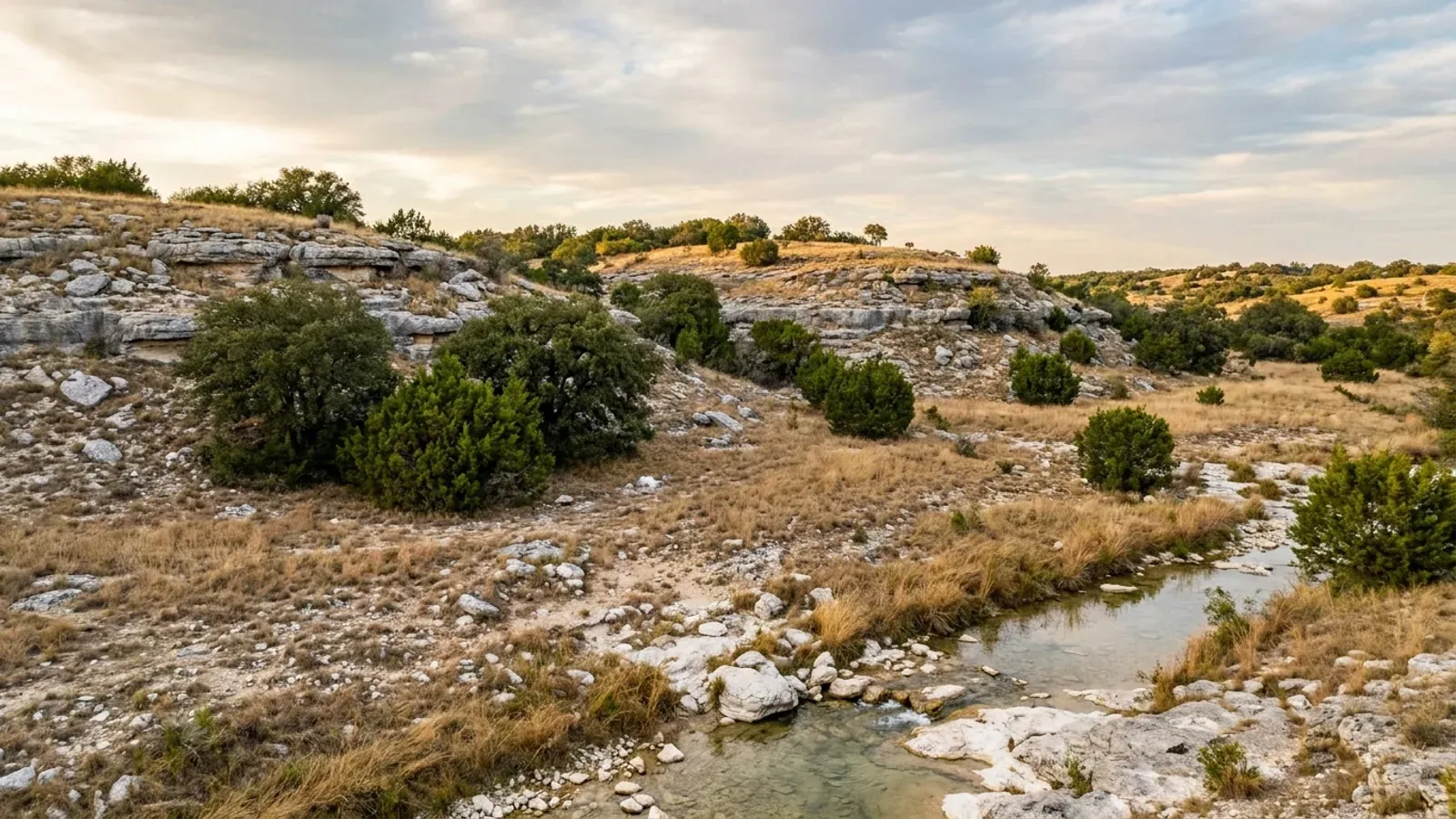
- The USDA's Bexar series is type-located in this county, in native pasture off Redland Road north of San Antonio: dark reddish brown cobbly clay loam over cobbly clay, "underlain by hard limestone at depths of 20 to 40 inches," formed in residuum from the Edwards Limestone on the Edwards Plateau. Its two named neighbours make the range plain — Tarrant soils are "skeletal and less than 20 inches thick" over fractured limestone, and Crawford soils are "clayey throughout and have intersecting slickensides." That is the north. South and east of the Balcones Escarpment the county runs into the Blackland Prairie clays, where the Houston Black series carries "high shrink-swell potential and cracks that are 1.3 to 10 cm (1/2 to 4 in) wide" at a foot down. Two feet of soil over rock and a deep swelling clay are different foundation problems and different drainfield problems, and which one you have is a question about your tract, not about the county.
- The shop bay does not enlarge your drainfield here
- TCEQ sizes a septic system on bedroom count or living area, whichever gives the higher figure, and its own application form asks for living area rather than total structure area. That matters on a barndominium, because a four-thousand-square-foot building with eighteen hundred square feet of three-bedroom living space and a twenty-two-hundred-square-foot shop is a 300 gallon-per-day house, not the 375 a whole-footprint reading would give. An authorised agent is free to write a stricter definition and some Texas counties have. Bexar County has not: section 10 of its order is an exhaustive list of its departures from the state rule, lettered A to P, and none of them touches lofts, attached garages or the meaning of living area.
- Nothing out here puts a design professional on your house — except the soil
- Inside San Antonio, the city's building code chapter requires a registered design professional on a building of 5,000 square feet or more, which two 2,600-square-foot halves under one roof would reach. Nothing equivalent applies to a single-family house in the unincorporated county, because there is no county residential code, no plan review and no permit to attach it to. The one route that still reaches a barndominium is the ground: the Texas Engineering Practice Act removes the private-dwelling exemption for the design of a foundation or slab located on expansive soil, so a tract that tests expansive brings a Texas-licensed engineer into the picture by statute rather than by ordinance. That is a live question in the southern and eastern parts of the county and a different question on the northern limestone, where the problem is depth to rock rather than movement.
- No septic approval, no electricity
- The quiet enforcement mechanism in a county with no building inspector is the meter. Bexar County's septic order provides that a release to the City Public Service Board is granted only after an on-site sewage facility has been installed and found compliant, under a Commissioners Court order dating to 13 April 1973 and amended 28 May 1981, and states that "Approval of a subdivision plat is not in itself the grant of a release." The county's own public works answers put it plainly: a temporary meter release for construction is sent to CPS Energy after the septic application is approved, and no meters are released for mobile homes until the system is installed. A building permit application also needs a CPS Energy address verification letter, because CPS Energy is the authorised addressing agent for Bexar County.
- 1,240 square miles, 2.16 million people, and the land is at the edges
- The Census Bureau puts Bexar County at 2,160,088 residents in its 2025 vintage estimate against a 2020 base of 2,009,323 — up 7.5 percent in five years — across 1,240.36 square miles of land. Density was 1,620 people per square mile in 2020, which is a city-county number rather than a rural one, and it is why the acreage question is a question about the ring. San Antonio dominates the middle; the buildable ground is north toward Helotes, Grey Forest and the Bulverde line, west toward Macdona and Lytle, south toward Somerset, Von Ormy and Elmendorf, and east toward Adkins and Saint Hedwig. The rural postcodes with the most Bexar County land in them are 78023, 78264, 78112, 78073 and 78002, and that list is a reasonable map of where a barndominium actually gets built here.
- The county will permit your house if you ask it to — and there are two reasons people do
- Bexar County publishes an unusual answer to the residential question. "The County may only conduct a plan review, issue a residential building permit, and issue a subsequent Certificate of Occupancy (Compliance) if the residential plans are submitted for permitting on a voluntary basis. There are two situations where the owner may voluntarily seek a residential building permit: (1) a homeowners association requires the building to be permitted through the Fire Marshal's Office, or (2) a lending institution will require a Certificate of Occupancy (Compliance) from the Authority Having Jurisdiction in order to finalize the loan process." The county also warns that because most unincorporated construction was never permitted, a residential certificate of occupancy simply does not exist for most houses out there, and that it will not inspect a finished building because of the damage that would take. If your lender is going to want that document, it is a question to settle before the slab goes down, not after.
Collin County v. City of McKinney, No. 05-17-00546-CV (Tex. App.—Dallas, 10 May 2018); Town of Lakewood Village v. Bizios, 493 S.W.3d 527 (Tex. 2016); Texas Local Government Code secs. 212.049 and 42.021(a); City of San Antonio Planning Department, Extraterritorial Jurisdiction, sa.gov; Bexar County Public Works Permits Verification Guidelines, page 1, updated 6 October 2025
Bexar County Commissioners Court, Amended Order for Regulation of Outdoor Lighting in the Unincorporated Areas of Bexar County, Texas Within 5 Miles of a Military Installation, passed 21 May 2019, secs. (7), (20)(J) and definitions — bexar.org/DocumentCenter/View/38849; Texas Local Government Code ch. 240 subch. B
Texas Local Government Code secs. 42.101, 42.102, 42.104 and 42.105, rendered from statutes.capitol.texas.gov 1 September 2026; City of San Antonio Planning Department, Extraterritorial Jurisdiction (ETJ) Release Petition Guidelines, sa.gov; U.S. Census Bureau QuickFacts, Bexar County, Texas, Vintage 2025
Bexar County Public Works, Floodplain Development Permit Requirements checklist and Floodplain Development Permits page, bexar.org, rendered and read 1 September 2026; Bexar County Flood Damage Prevention Court Order update briefing to Commissioners Court, 1 December 2023
USDA NRCS Official Series Descriptions, BEXAR (rev. 03/2003), TARRANT (rev. 10/2016) and HOUSTON BLACK — soilseries.sc.egov.usda.gov; USDA NRCS description of Major Land Resource Area 86A, Texas Blackland Prairie
30 Texas Administrative Code ch. 285 Table III and TCEQ form TCEQ-0235; agent stringency under 30 TAC sec. 285.10; Order Adopting Regulations of Bexar County, Texas for On-Site Sewage Facilities, sec. 10
Texas Occupations Code sec. 1001.056(c)(2); International Residential Code R403.1.8 referring expansive-soil foundations to International Building Code sec. 1808.6; City of San Antonio Code ch. 10 sec. 10-8(a)(5)
Order Adopting Regulations of Bexar County, Texas for On-Site Sewage Facilities, sec. 10 para. P; Bexar County Public Works Frequently Asked Questions, items 5 and 12, bexar.org, rendered 1 September 2026; Bexar County Public Works Permits Verification Guidelines, updated 6 October 2025
U.S. Census Bureau QuickFacts, Bexar County, Texas, Vintage 2025 estimates; U.S. Census Bureau 2024 Gazetteer county file (land area 1,240.36 sq mi, internal point 29.448671, -98.520147); U.S. Census Bureau 2020 ZCTA-to-county relationship file, tabulated for county GEOID 48029
Bexar County Fire Marshal's Office, New Construction FAQs, bexar.org, rendered and read 1 September 2026
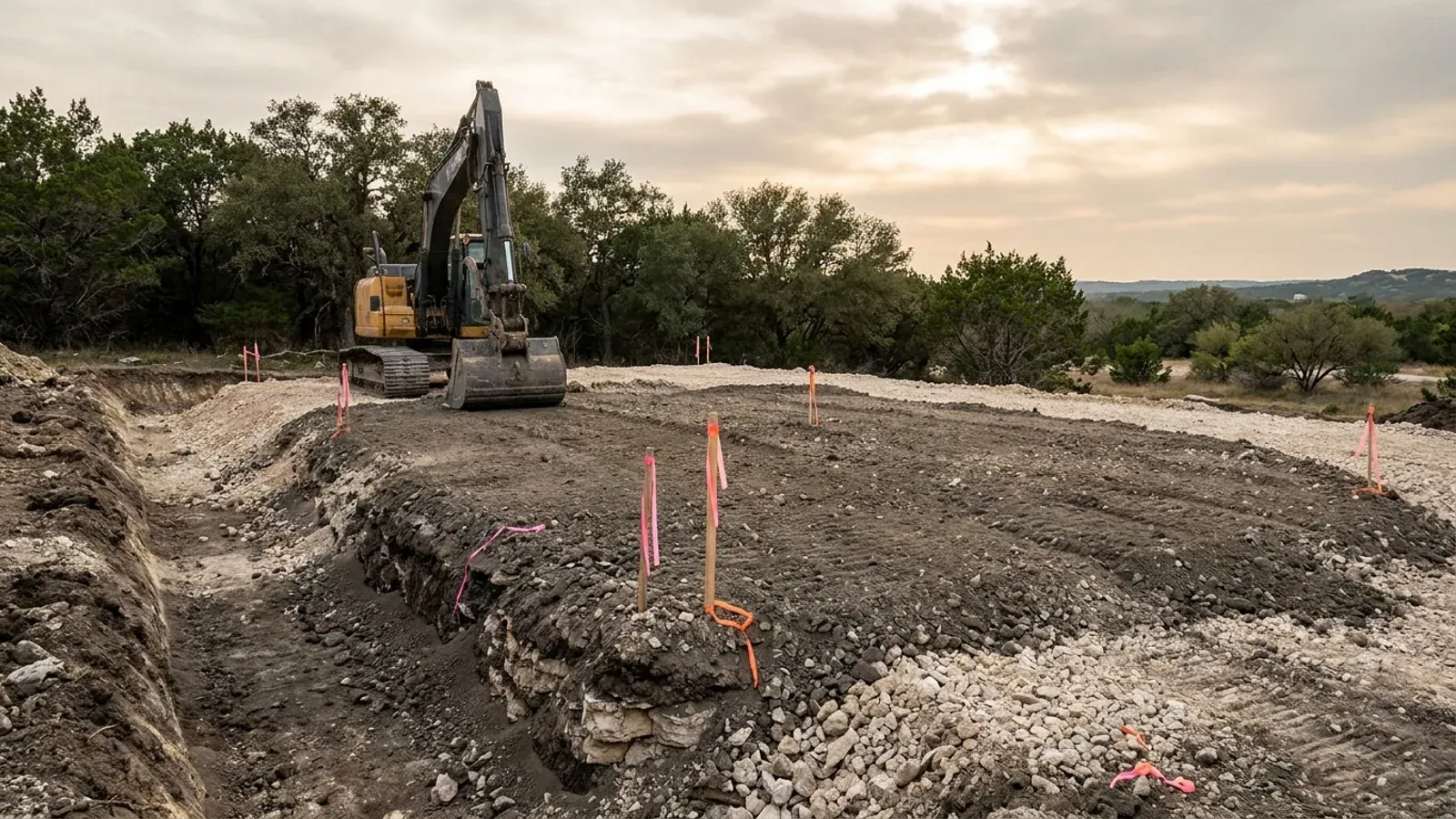
The expensive surprises are in the ground, not the building
What moves a Texas budget is usually below grade, and it is soil rather than rock: shrink-swell clay. The Blackland Prairie and the Gulf Coast clays move enough between a wet season and a dry one to drive the foundation design across the state's largest markets, which is why several DFW cities require an engineer's seal on the foundation of every new house. Those are the same conditions that decide whether a septic field passes its soil and site evaluation, so the grading plan, the foundation and the drainfield get resolved together rather than one at a time. We price the dirt before we price the building.
What we build in Bexar County
All nine of our services — kits, custom plans, post-frame and steel construction, site preparation, permitting and engineering, through to turnkey builds — are available across Bexar County. What a project costs depends far more on the parcel than on square footage, so we work from your land rather than from a rate card.
See what we buildWhat a build looks like
Three stages every Bexar County project passes through, from a raw parcel to a finished home. Site work first, because that is where the budget is decided.
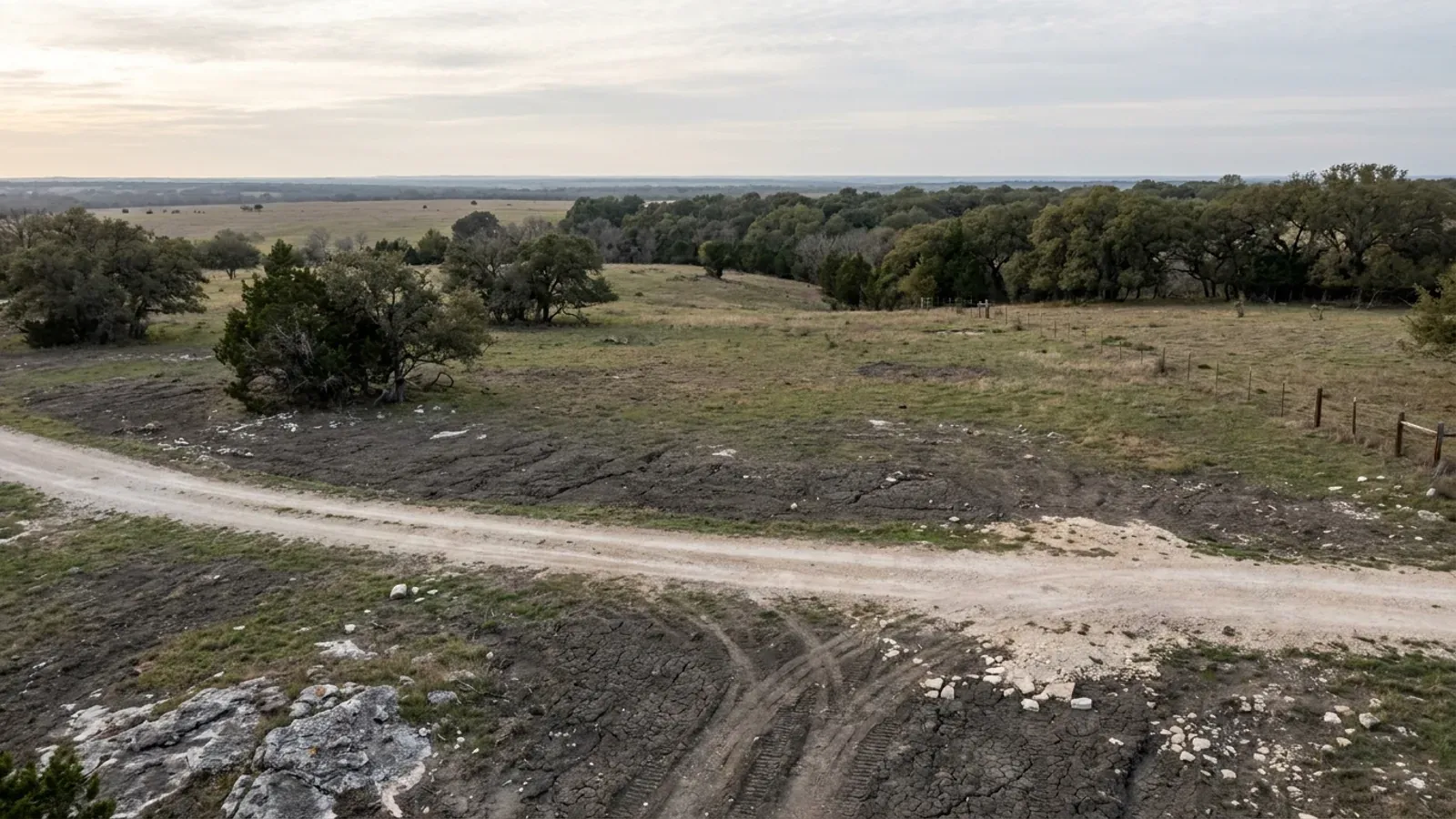
The parcel
Zoning, setbacks, flood zone and utility access get checked before anything is drawn.
Pad and permit
Clearing, grading and a compacted pad, while the submittal works through Bexar County.
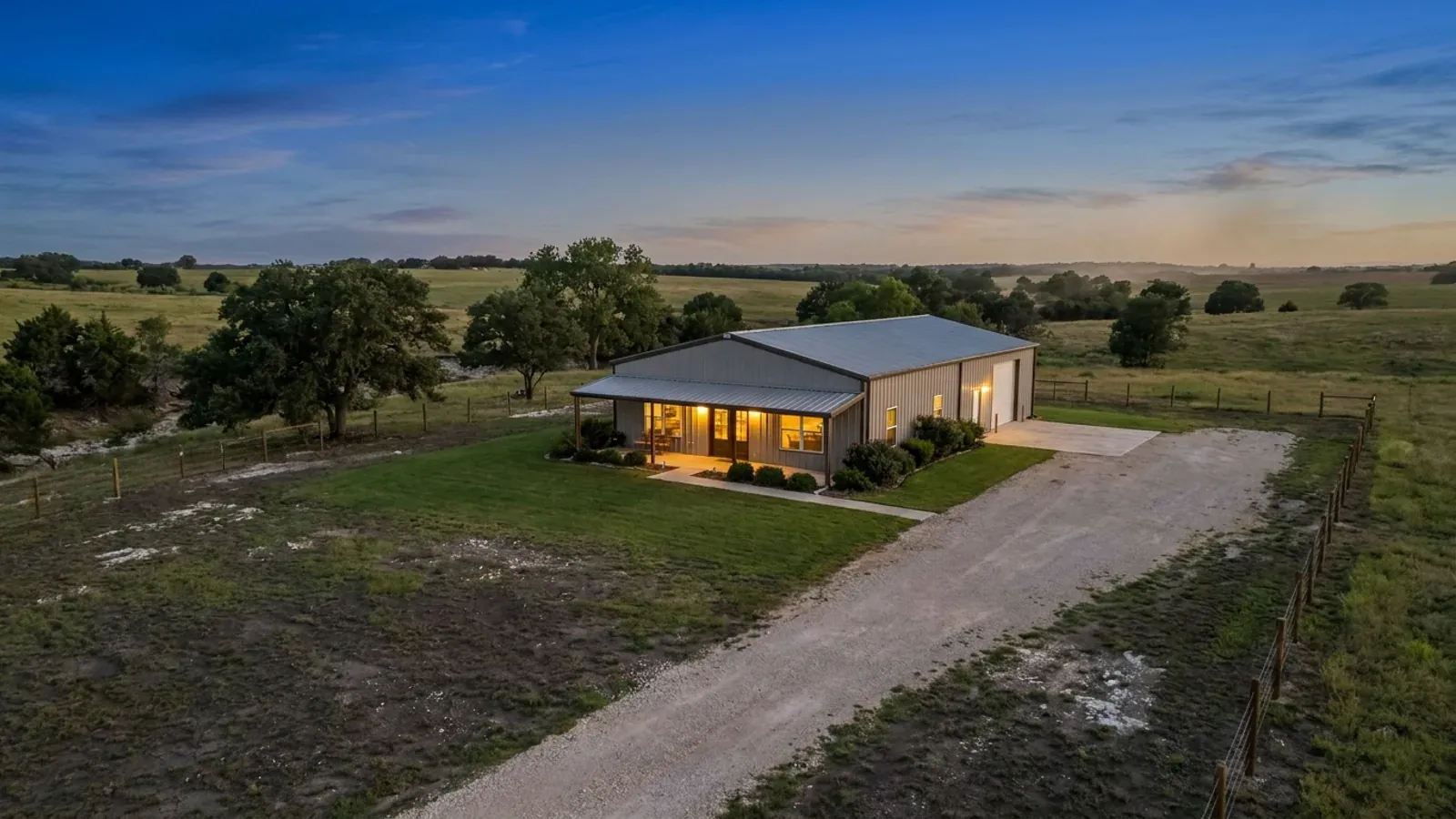
Frame to finish
Shell erected and dried in, then systems, insulation and interior finish through to CO.
Those are the rules for Bexar County. Tell us what you want to build and we will draw it to them.
Where we build around Bexar County
Bexar County and the rural land around it. The buildable acreage for a project this size usually sits outside the city limits, which is frequently what changes who issues your permit.
Keep reading
The questions that usually come next once you know what Bexar County allows.
Barndominium Cost Guide
Sourced per-square-foot ranges by tier and by size, with a calculator built on the same figures.
Read itIs It Legal in Texas?
Classification, zoning, the HOA gate, and why "nonresidential farm building" does not cover a home.
Read itHow Long Does It Take?
Census build-duration data, and what actually sets the permit clock where you are building.
Read itNearby areas we build in
Others we cover in this part of Texas. The permitting authority, the adopted design criteria and the zoning can all differ from one to the next.
Building in Bexar County: common questions
8 questions we get asked most often about building in Bexar County. If yours is not on the list, ask it directly.
Do I need a building permit to build a barndominium in unincorporated Bexar County?
So is there really nothing regulating a house out there?
My land is on the Edwards Aquifer recharge zone. What does that actually mean?
How does septic work here, and how much land do I need?
Do I need a permit to drill a water well?
My land is in San Antonio's extraterritorial jurisdiction. Does the city's code apply?
Can I get my land out of the ETJ?
What is the ground like, and will I need an engineer?
Building in Bexar County?
Start with the plan. Tell us what you want to build and we will draw it, then confirm what Bexar County will actually let you put on the parcel and what wind load it has to meet. That conversation costs nothing.