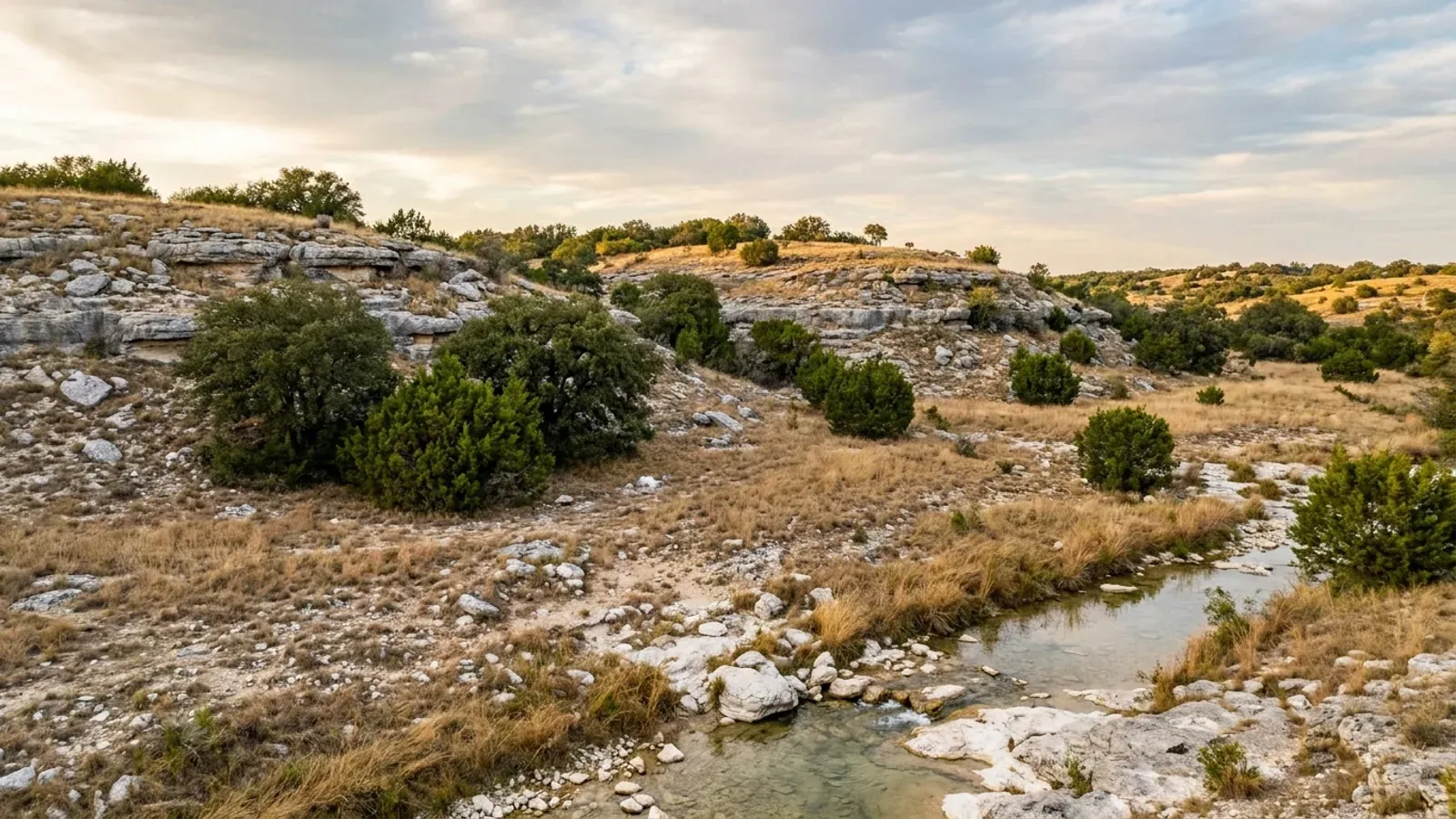
Rolling Texas Hill Country limestone hills with live oak motts, Ashe juniper, and a clear creek over white limestone cobble.
Comal County Edition set by the jurisdiction

Barndominium Builders in Comal County, TX

Comal County is 559 square miles between San Antonio and San Marcos, and the Balcones Escarpment runs through the middle of it. West of that line — Canyon Lake, Spring Branch, Fischer, Bulverde — is Edwards Plateau limestone, and the county's five largest soil map units are all shallow rock complexes with bedrock inches down. That is not the deep shrink-swell clay of the I-35 corridor, and it changes the foundation, the trenching and the drainfield at once. Chapter 233 of the Local Government Code is the whole of a Texas county's authority over structures, and the county's own list of what you need to build out here carries no building permit for a house. It carries a septic permit, a floodplain permit and a driveway permit — plus, over the Edwards Aquifer, a state review the county will not move without. Inside New Braunfels, Bulverde or Garden Ridge, that city's rules apply instead.

Comal County at a glance

County
Comal County
Population
209,166
Where we build
New Braunfels, Hays County, Guadalupe County, Bexar County

ZIPs 78130, 78132, 78133, 78070, 78163, 78266, 78623, 78015 and more

Site visits
Site walks booked county-wide, New Braunfels included

Building conditions in Comal County

What actually changes from one Texas jurisdiction to the next: who issues the permit, whether the residential code is enforced there at all, what the structure has to be engineered to, and what the ground is like. These are the numbers your drawings have to satisfy.

Build conditions for Comal County , Texas . BUILD CONDITIONS COMAL COUNTY, TXComal CountyEDITION PER JURISDI…ADOPTED RESIDENTIAL CODEEDITION PER JURISDI…This jurisdiction publishes no design wind speed. It is settled in writing with the authority overyour parcel before the frame is ordered.ZONING · UNDEFINED5.01 acres on a private well, 1 acre…Texas counties have no general zoning power, and Local GovernmentCode Sec. 233.153(d)(2) confirms that even an opted-in county may…WHO ISSUES THE PERMITComal County Engineer's Office195 David Jonas Drive, New Braunfels, TX 78132. (830) 608-2090, fax(830) 608-2078, Monday to Friday 8 am to 4:30 pm. It runs…
Build conditions for Comal County, drawn from the sourced facts on this page. Every figure above is cited in the quick-facts panel below, with its source and vintage.
The county lists every permit it requires, and a house is not on it
The Comal County Engineer's Office publishes a page headed "Required Permits when Building in the Unincorporated Areas of Comal County." The list is: on-site sewage facility, floodplain, a private improvement within the public right-of-way permit for a driveway, utility permits for work in a county road right-of-way, a Fire Marshal permit for commercial buildings, public buildings and multifamily dwellings of four or more units, and an outdoor lighting permit in the Camp Bullis Dark Skies Zone. No building permit for a one- or two-family house appears on it.

Comal County Engineer's Office, Permits, comalcounty.gov/286/Permits

A state permit on land with no building code
Comal County's own sewage order provides that a Contributing Zone Plan required by 30 TAC 213.21 must be approved by the appropriate TCEQ regional office before the county may issue an authorization to construct for a septic system over the Edwards Aquifer contributing zone. Its subdivision regulations go further on the recharge zone: written proof that TCEQ has accepted a Water Pollution Abatement Plan application must accompany the plat, and final plat approval is contingent on WPAP approval.

Order Adopting Rules of Comal County, Texas for On-Site Sewage Facilities, Sec. 10.10, adopted 24 October 2013; Comal County Subdivision Regulations Sec. 26, effective 11 June 2026 by Order #565

Above five acres, TCEQ may not need a plan from you at all
TCEQ's own page for private residences on the Edwards Aquifer says an individual plan may not be required where the homeowner can demonstrate that the residence is on a lot larger than five acres with no more than one single-family residence on that lot, or that impervious cover does not exceed 20 percent within the property's legal boundaries. TCEQ counts rooftops, driveways, concrete pads and sheds toward that figure, so a shop bay and its apron are in the calculation, and a second dwelling on the tract defeats the five-acre limb.

TCEQ, Edwards Aquifer: Private Residences, tceq.texas.gov/permitting/eapp/edwards-aquifer-private-residences

5.01 acres on a well, not the one acre the state sets
State rules set one acre per dwelling on a private well and half an acre on a public supply. Comal County's own order is stricter: a lot in a subdivision created after 1 January 1988 and not served by a TCEQ-approved public water supply must have at least 5.01 acres, and one served by a public supply at least 1.0 acre. The June 2026 subdivision regulations repeat both figures. Plats approved before the order was adopted are exempt from the lot-size requirement.

Comal County On-Site Sewage Facility Order Sec. 10.2 and 10.3, adopted 24 October 2013; Comal County Subdivision Regulations Sec. I.8, effective 11 June 2026

Acreage buys you out of platting, not out of the acreage
The county's sewage order requires a permit for all on-site sewage facilities within its jurisdiction regardless of acreage. And the subdivision regulations warn, at the head of the exemptions, that an owner using one of them may not have to prepare a plat but the division of property must still meet the minimum lot size requirements set out in the sewage order. So a division into lots all larger than ten acres can escape platting and remain entirely inside the septic rules.

Comal County On-Site Sewage Facility Order Sec. 10.4, adopted 24 October 2013; Comal County Subdivision Regulations, Exemptions to the Plat Requirement, effective 11 June 2026

A well here is applied for, not simply drilled
Two bodies split the county by aquifer. The Comal Trinity Groundwater Conservation District, whose rules took effect 1 January 2019, requires a Drilling Application submitted for approval before a new well, an alteration to an existing well or a test bore into the Trinity, signed by the property owner. The Edwards Aquifer Authority requires every well withdrawing from the Edwards to be registered, and recognises a well as exempt from a withdrawal permit only where it is incapable of producing more than 25,000 gallons a day, is used solely for domestic or livestock purposes, and does not serve more than three homes.

Comal Trinity Groundwater Conservation District, District Forms, comaltrinitygcd.com; Edwards Aquifer Authority, Well Registration and Updates, edwardsaquifer.org

Also worth knowing before you build in Comal County

The ground is limestone before it is clay
In USDA's soil survey the five largest soil map units in Comal County are all shallow limestone complexes of the Edwards Plateau, and three of the five carry Rock outcrop in their names. The first Blackland Prairie clay, Houston Black, ranks sixth. USDA's own series descriptions put depth to bedrock at 5 to 20 inches for Brackett, 10 to 20 inches for Comfort, 20 to 40 inches for Rumple and 4 to 20 inches for Eckrant.

USDA-NRCS Soil Data Access, survey area TX604 (Comal and Hays Counties, Texas); USDA-NRCS Official Series Descriptions for Brackett, Comfort, Rumple and Eckrant

Septic is the county's programme everywhere but one city
TCEQ's authorized agent lookup returns three records for Comal County: the Comal County authorized agent, serving the entire county except the City of New Braunfels; the City of New Braunfels authorized agent, serving its city limits; and TCEQ Region 13 in San Antonio. The county also publishes signed interlocal agreements covering Bulverde, Fair Oaks Ranch, Garden Ridge, Schertz and Spring Branch, and TCEQ's own rule on that results page is that if a city is not listed you contact the county.

TCEQ On-Site Sewage Facility authorized agent search, county code 46; Comal County Environmental Health, comalcounty.gov/274/Environmental-Health

The plat has to tell you about the aquifer
A Comal County plat must carry a statement that all or a portion of it lies within the Recharge Zone of the Edwards Aquifer, and where it does not, the plat must state that the subdivision does not lie in the Recharge Zone of the Edwards Aquifer. The same regulations require the plat to show a 25-foot minimum building setback line from road frontage and to delineate the FEMA 100-year floodplain.

Comal County Subdivision Regulations Sec. I.9, Sec. 20 and Sec. 21, effective 11 June 2026, adopted by Order #565

The floodplain rule: at the base flood elevation, plus an engineer's study
Comal County's Flood Damage Prevention Order, Order No. 517 of 2 May 2024, takes its authority from Texas Water Code Section 16.315. In a special flood hazard area a new house must have its lowest floor at or above the base flood elevation, certified to the Floodplain Administrator by a registered professional engineer, architect or land surveyor, and must also be supported by a study from a registered professional engineer. The order also requires on-site waste disposal systems to be sited to avoid impairment or contamination during flooding.

Comal County Flood Damage Prevention Order No. 517, Article I Section A and Article 5 Sections A and B, adopted 2 May 2024

Within three miles of Camp Bullis the county permits your yard light
Order No. 367, adopted 7 January 2016, regulates outdoor lighting in the unincorporated areas of Comal County within three miles of the Camp Bullis boundary. A permit from the County Engineer's Office is required before installing any outdoor lighting there, and fixtures must be International Dark-Sky Association products installed to specification. Decorative holiday lighting from 15 November to the following 15 January is exempt.

Comal County, Camp Bullis Dark Skies Zone and Order No. 367, comalcounty.gov/848/Camp-Bullis-Dark-Skies-Zone

Nearly a third more people in five years
Comal County went from a 2020 census base of 161,449 people to a Census Bureau estimate of 209,166 on 1 July 2025 — 47,717 more residents, or 29.6 percent, in five years. The county covers 559.5 square miles of land and 15.3 square miles of water. That growth is why the Commissioners Court rewrote the subdivision regulations in June 2026, and it is where the remaining acreage is being divided.

U.S. Census Bureau county population estimates (co-est2025-alldata) and 2024 Gazetteer Files; Comal County Order #565
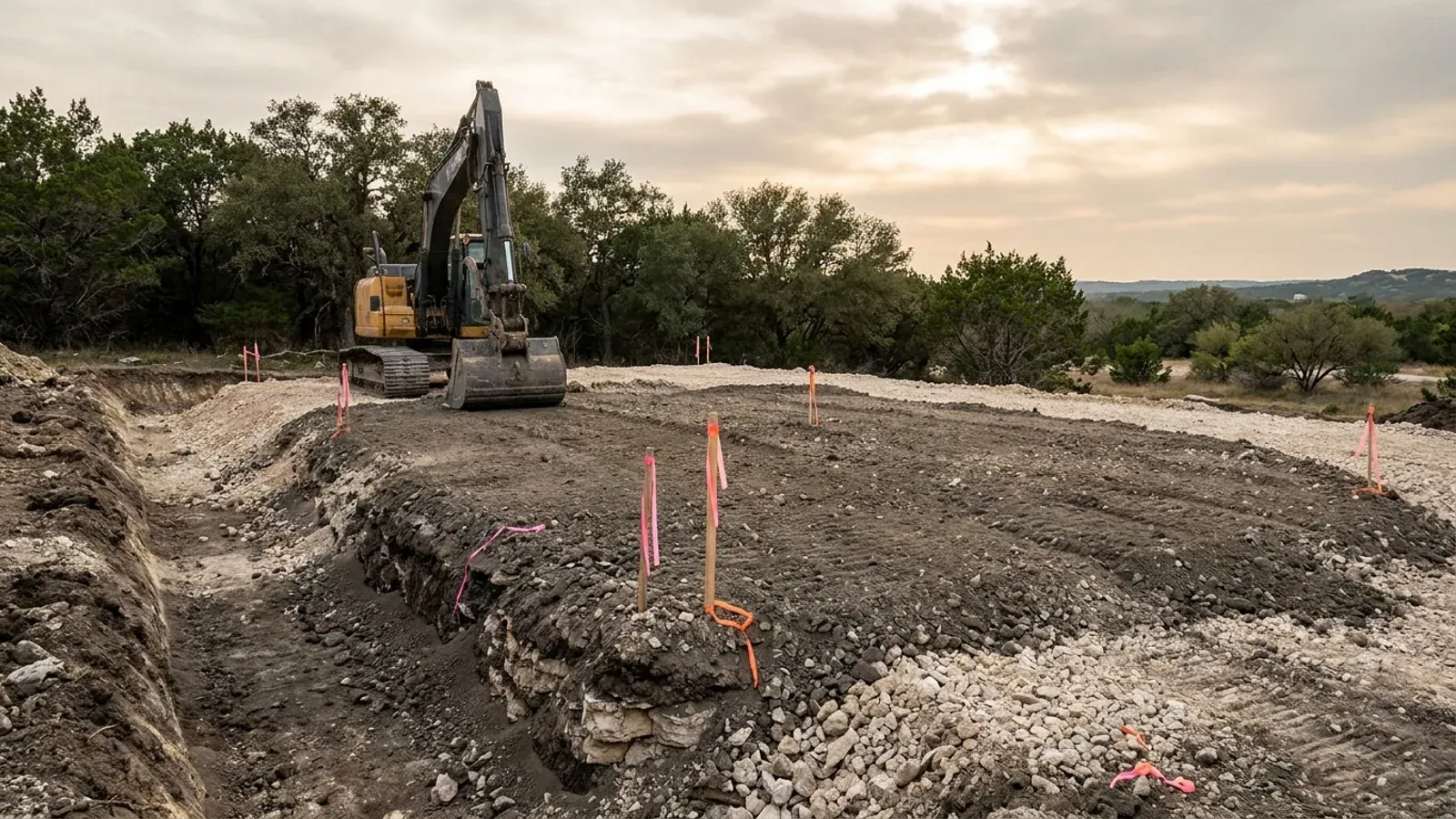
An excavator grading a compacted building pad on a cleared lot, with survey stakes and a drainage swale visible.
Below the slab

The expensive surprises are in the ground, not the building

What moves a Texas budget is usually below grade, and it is soil rather than rock: shrink-swell clay. The Blackland Prairie and the Gulf Coast clays move enough between a wet season and a dry one to drive the foundation design across the state's largest markets, which is why several DFW cities require an engineer's seal on the foundation of every new house. Those are the same conditions that decide whether a septic field passes its soil and site evaluation, so the grading plan, the foundation and the drainfield get resolved together rather than one at a time. We price the dirt before we price the building.

What we build in Comal County

All nine of our services — kits, custom plans, post-frame and steel construction, site preparation, permitting and engineering, through to turnkey builds — are available across Comal County. What a project costs depends far more on the parcel than on square footage, so we work from your land rather than from a rate card.

See what we build

What a build looks like

Three stages every Comal County project passes through, from a raw parcel to a finished home. Site work first, because that is where the budget is decided.
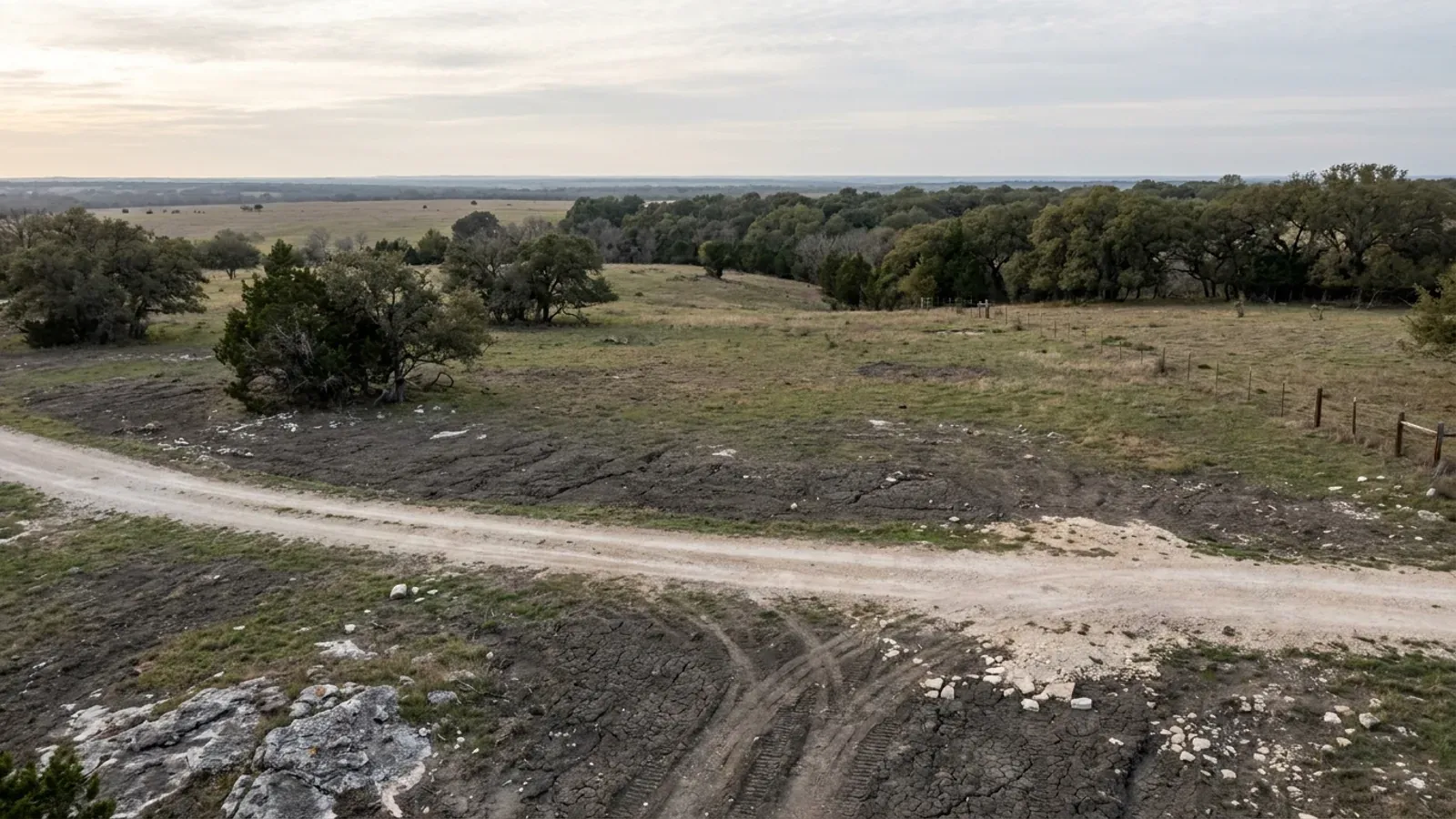
Aerial view of an undeveloped rural lot with cleared grass, a live oak and cedar elm treeline, and a pale gravel access track.
Stage one

The parcel

Zoning, setbacks, flood zone and utility access get checked before anything is drawn.

An excavator grading a compacted building pad on a cleared lot, with survey stakes and a drainage swale visible.
Stage two

Pad and permit

Clearing, grading and a compacted pad, while the submittal works through Comal County.
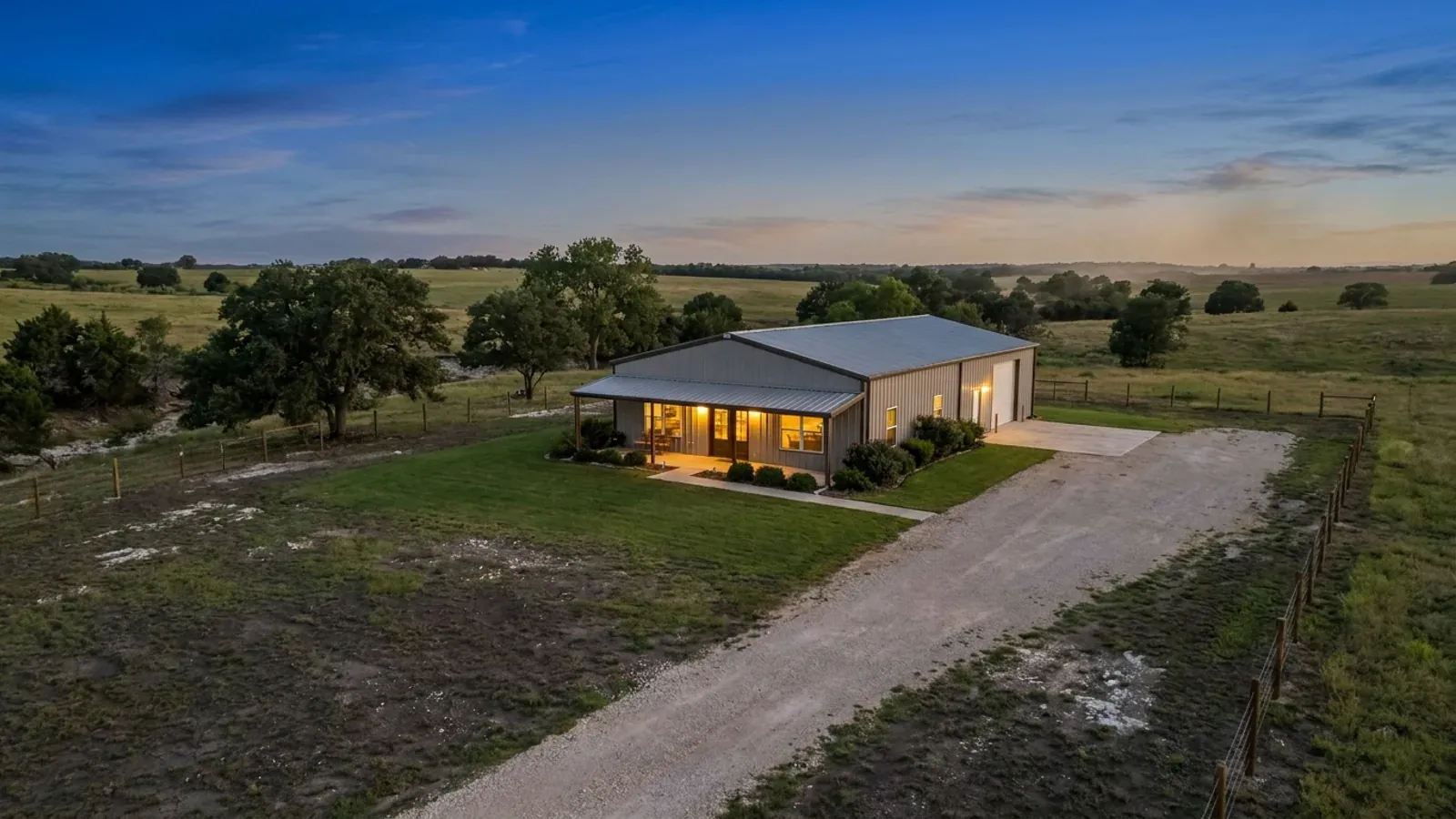
A finished barndominium at dusk with warm interior lighting glowing through its large windows.
Stage three

Frame to finish

Shell erected and dried in, then systems, insulation and interior finish through to CO.

Those are the rules for Comal County. Tell us what you want to build and we will draw it to them.

Where we build around Comal County

Comal County and the rural land around it. The buildable acreage for a project this size usually sits outside the city limits, which is frequently what changes who issues your permit.

Our Comal County service area, covering Comal County and the surrounding rural acreage. This map marks the territory we serve, not a branch location.

Nearby areas we build in

Others we cover in this part of Texas. The permitting authority, the adopted design criteria and the zoning can all differ from one to the next.

Building in Comal County: common questions

7 questions we get asked most often about building in Comal County. If yours is not on the list, ask it directly.

Does Comal County require a building permit for a barndominium?
Not for a one- or two-family house, on the county's own published list. The Engineer's Office sets out the permits required to build in the unincorporated county — septic, floodplain, driveway and right-of-way, utility, Fire Marshal, and dark-skies lighting — and none of them is a building permit for a dwelling. The county does issue a document called a Building Permit, but the Fire Marshal issues it, and only for a new commercial or public building, a remodel for a new type of business, or a multifamily dwelling of four or more units. Underneath that sits the state structure: Chapter 233 of the Local Government Code is the whole of a Texas county's authority over structures, and its residential building code subchapter applies only where a commissioners court has adopted an order bringing it in. Whether Comal's court ever adopted one is a question for the county itself — the Engineer's Office is on (830) 608-2090 and the County Clerk holds the recorded orders.
Is there really a state permit on my land if the county has no building code?
Over the Edwards Aquifer, yes, and Comal County is an Edwards county. TCEQ's rules in 30 TAC Chapter 213 reach construction at private residences on the recharge and contributing zones. On the recharge zone the instrument is a Water Pollution Abatement Plan and there is no acreage threshold — TCEQ states that all regulated activities on the recharge zone must have an approved plan before construction. On the contributing zone the instrument is a Contributing Zone Plan and the trigger is disturbing at least five acres or being part of a larger plan of development. If a site straddles both, TCEQ treats the whole site as recharge zone. Comal County then bolts its own approvals to that: no authorization to construct a septic system over the contributing zone until the TCEQ regional office has approved the plan, and no final plat over the recharge zone until the WPAP is approved.
How much land do I actually need in Comal County?
Two different thresholds, and it is worth clearing both. The county's own sewage order sets the septic floor: in a subdivision created after 1 January 1988, at least 5.01 acres on a private well, or 1.0 acre where a TCEQ-approved public water supply serves the lot. Plats approved before the order came in are exempt from that. Separately, TCEQ's private-residence guidance says an individual Edwards Aquifer plan may not be required where the lot is larger than five acres with only one single-family residence on it, or where impervious cover is 20 percent or less of the legal parcel. Since TCEQ counts rooftops, driveways, concrete pads and sheds, the sensible move on a smaller tract is to measure the impervious cover of the whole scheme — house, shop, apron and drive — against the parcel area before you commit to a footprint.
Do I need a permit to drill a well?
You need to deal with a district, and which one depends on the aquifer the bore enters. For the Trinity, the Comal Trinity Groundwater Conservation District requires a Drilling Application submitted for approval before drilling a new well, altering an existing one or drilling a test bore, and the property owner has to sign it. District rules took effect 1 January 2019 and its office is at 9850 FM 311, Spring Branch, on (830) 885-2130. It does not meter or charge production fees on a domestic or livestock well incapable of producing more than 25,000 gallons a day. For the Edwards, the Edwards Aquifer Authority requires registration of every well withdrawing from the aquifer, on (210) 222-2204; a well is exempt from a withdrawal permit only where it cannot produce more than 25,000 gallons a day, is used solely for domestic or livestock purposes, and serves no more than three homes.
Is the ground here the same shrink-swell clay as Waco and Dallas?
Mostly not, and that is the difference between the two halves of the county. The Balcones Escarpment runs through Comal County. West of it is Edwards Plateau limestone: in USDA's soil survey the five largest map units in the county are all shallow limestone complexes, three of them naming Rock outcrop, and USDA's series descriptions put bedrock between about four and twenty inches down for Brackett, Comfort and Eckrant. That is a thin-soil-over-rock problem — excavation, trenching and drainfield depth — rather than the deep expansive clay of the I-35 corridor. But the Blackland clays are here too, in the east: Houston Black is the sixth largest map unit in the county, with Heiden and Branyon behind it. Which problem you have is a parcel question, answered by a site evaluation and an NRCS Web Soil Survey lookup, not by a county-wide rule.
Does it change anything if I rent the barndominium out?
It can, and Comal decides it differently from some other Texas counties. The Comal County Fire Code takes its authority from Chapter 233, Subchapter C of the Local Government Code and applies to public buildings, commercial establishments, and multifamily residential dwellings of four or more units. A detached single-family house on a long lease is none of those. But the code's definition of public buildings and commercial establishments is expressly open-ended and names hotels, motels and dormitories, and a change in occupancy classification counts as a substantial improvement requiring a permit. So a guest-cabin or short-stay lodging operation, or a build of four or more units, lands inside the 2024 International Fire Code with a county permit, plans review and a Certificate of Compliance. The occupancy call belongs to the Fire Marshal: (830) 643-3748.
What if my land is inside New Braunfels, Bulverde or Garden Ridge?
Then the city's own adopted code and building official apply, and the county's answer is not yours. Septic is the clearest illustration: TCEQ's authorized agent lookup shows the county serving the entire county except the City of New Braunfels, which runs its own programme inside its city limits. Bulverde, Fair Oaks Ranch, Garden Ridge, Schertz and Spring Branch are not separately listed, and the county publishes signed interlocal agreements covering them. Extraterritorial jurisdiction matters as well: the county's subdivision regulations disapply its water-availability rules inside the ETJ of any municipality in the county, with the express exception of the City of San Antonio, whose ETJ reaches into Comal. Establish which city, if any, reaches the parcel before anything else.

Building in Comal County?

Start with the plan. Tell us what you want to build and we will draw it, then confirm what Comal County will actually let you put on the parcel and what wind load it has to meet. That conversation costs nothing.