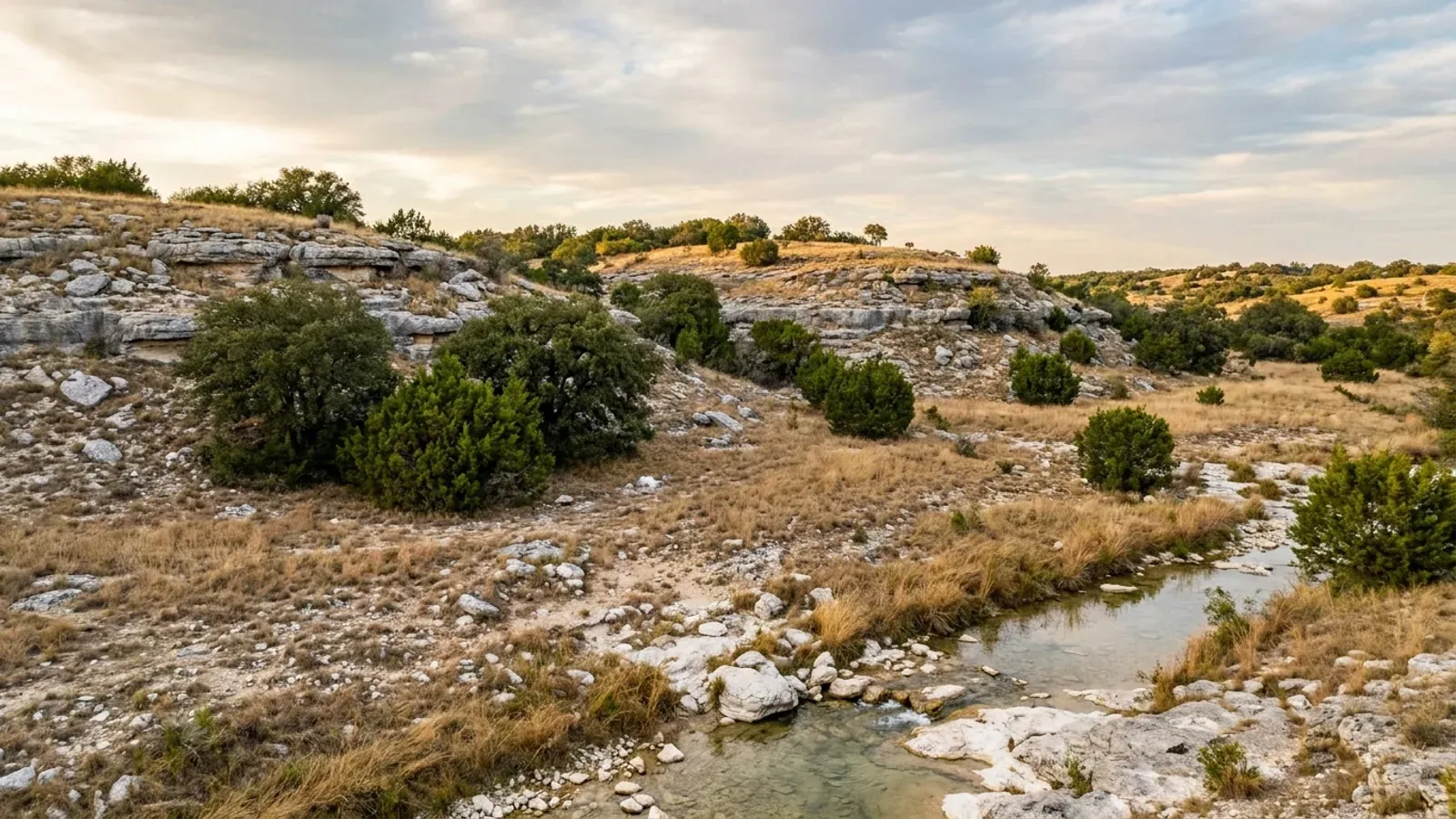
Barndominium Builders in San Antonio, TX
San Antonio is its own permitting authority and a well-documented one, but the honest answer about where a barndominium goes here is at the edge. The city runs the 2024 International Residential Code as Chapter 10 of the City Code, fills in Table R301.2 with its own figures, and deletes the model code's mandatory residential sprinkler outright. Only four zoning districts are sized for this building type: FR Farm and Ranch at a 25-acre minimum, RP Resource Protection at 10 acres, RE Residential Estate at one acre, and R-20 at 20,000 square feet. The city's own code says RP belongs where there is no central water and sewer. Nobody is putting a shop-house on an infill lot inside Loop 410, so we build inside the city where the site genuinely supports it, and we say plainly when the real answer is unincorporated Bexar County, Comal, Guadalupe or Bandera instead.
San Antonio at a glance
- County
- Bexar County
- Population
- 1,548,422
- Where we build
- San Antonio, Bexar County, New Braunfels, Comal County, Guadalupe County
- Site visits
- We meet you on the parcel, anywhere in San Antonio or Bexar County
ZIPs 78201, 78202, 78203, 78204, 78207, 78208, 78209, 78210 and more
Building conditions in San Antonio
What actually changes from one Texas jurisdiction to the next: who issues the permit, whether the residential code is enforced there at all, what the structure has to be engineered to, and what the ground is like. These are the numbers your drawings have to satisfy.
City of San Antonio Code of Ordinances, Chapter 10 'Building-Related Codes of the City of San Antonio', Sections 10-36, 10-37 and 10-91 (Ord. No. 2025-01-30-0075, Sec. 1(Att. 1), 30 Jan 2025)
Table R301.2 'Climatic and Geographic Design Criteria' as amended by City Code Section 10-37, adopting the 2024 IRC
City of San Antonio Code, Section 10-37, amendment to IRC Sections R309.2 and R309.2.1 (deletions shown as bracketed strikethroughs in the adopted text); Texas Local Government Code Section 214.212(c)(1)
San Antonio Unified Development Code, Article III Division 2, Section 35-310.01 Table 310-1 'Lot and Building Dimensions Table' (codified through Ord. No. 2026-04-16-0257, adopted 16 April 2026)
San Antonio Unified Development Code Section 35-521 'Edwards Aquifer Recharge Protection', subsections (b), (d)(1) and (g); TCEQ Edwards Aquifer Protection Program, 'Edwards Aquifer: Private Residences'
TCEQ Edwards Aquifer Protection Program, 'Edwards Aquifer: Private Residences' — 'When is a Plan NOT Required?' and 'When IS a Plan Required?'; 30 TAC Chapter 213; 30 TAC 213.5(h)(2); 30 TAC 213.21(b)
Also worth knowing before you build in San Antonio
- Published permit fees, banded by square footage
- San Antonio publishes its whole new-residential schedule in the City Code rather than in a separate document. A 2,001 to 2,250 square foot house carries an $850 building permit and a $200 plan review, $1,450 in total basic permit fees. Plan review steps to $400 at 3,001 square feet and to $600 at 6,001. Total basic permit fees run $1,762 in the 3,001 to 3,500 band, $1,936 at 4,001 to 5,000 and $2,542 at 6,001 to 6,500. For a barndominium the step at 3,000 square feet matters, because the shop bay is what carries the building over it.
- 5,000 square feet triggers a design professional
- Section 10-8(a) of the City Code requires construction documents to be prepared by a registered design professional for any building or structure of 5,000 square feet or more in area, and for anything three storeys or higher. A barndominium is the building type that crosses 5,000 square feet without feeling large, because the shop bay counts in the building's area. Two 2,600 square foot halves under one roof trip it. The same subsection lists a geotechnical report among the submittal documents the department can require.
- Plan review: three business days
- The city publishes a figure rather than leaving it open. New homes, room additions over 1,000 square feet, and any two-storey addition regardless of size go to the Plans Examiners, and Development Services says that review typically takes three business days. General repair and small remodel permits are issued over the counter at the One Stop.
- A certificate of occupancy is required here
- San Antonio requires a certificate of occupancy before a building is used or occupied, with an exception only for work that is exempt from permits altogether. Dallas takes the opposite approach and exempts single-family uses and the Group U structures accessory to them from the requirement entirely. Two Texas cities, two different answers, each written into its own code. San Antonio's certificate also has to state the edition of the IRC or IBC the permit was issued under.
- The design figures are nothing like North Texas
- San Antonio publishes frost line depth 0, weathering 'negligible', ground snow load 6, winter design temperature 30 degrees and mean annual temperature 68.7 degrees. Termite probability is 'moderate to heavy'. Dallas, on the same kind of table, publishes a 6-inch frost line and 'moderate' weathering. The flood cell reads 'Appendix F, UDC', because Section 10-37 repeals the IRC's flood-resistant construction section and replaces it with the city's own floodplain ordinance in the Unified Development Code.
- A shop over 300 square feet is permitted work
- Section 10-6(e)(1) exempts a one-storey detached accessory structure used as a tool or storage shed from permitting only where its floor area does not exceed 300 square feet. Any real workshop is over that line, so inside the city a shop is permitted, plan-reviewed and inspected like the house. There is no agricultural-building shortcut within the city limits, which is one of the sharper differences between the city and the unincorporated county around it.
- The city registers builders, and says so plainly
- Section 10-115 requires residential construction in San Antonio to be carried out under a contractor registered with the building official, holding a home builder registration card. There are exceptions: trade subcontractors working under the registered residential building contractor do not register separately, and an owner who will hold a detached single-family dwelling for twelve months after final inspection is exempt, expressly including the accessory building. Texas has no state licence for a residential contractor, so a city registration is a permitting prerequisite, not a substitute for one.
- Nearly 500 square miles, and still growing
- San Antonio covers 498.979 square miles of land, more than Dallas at 339.685 or Fort Worth at 352.011, and reached 1,548,422 residents in 2025, up 8.0 percent from a 2020 base of 1,433,348. It is not a city that ran out of room, and its zoning code carries a 25-acre district to prove it. But the land that is actually being subdivided is over the county line: Bexar County grew 7.5 percent from 2020 to 2025 while Comal grew 29.6 percent, Kendall 20.3 percent and Guadalupe 16.4 percent.
- Outside the line, the code stops but the plat does not
- Texas courts have held that a municipality cannot enforce its building code beyond its corporate limits. The Texas Supreme Court decided it for general-law cities in Town of Lakewood Village v. Bizios in 2016, and the Dallas Court of Appeals decided it for home-rule cities in Collin County v. City of McKinney in 2018, which also held the city could still require a landowner to plat. Local Government Code Section 212.049 says the same thing in statute. What does follow you out is platting: a tract escapes it above five acres in a city's extraterritorial jurisdiction, but needs more than ten acres to escape it in the county.
- The septic permit is the county's, not the city's
- On a San Antonio site with no SAWS sewer, the on-site sewage facility permit does not come from the city. TCEQ's register of authorized agents lists the Bexar County Authorized Agent as covering the entire county except the cities of Elmendorf, Hill Country Village and Shavano Park and the Town of Hollywood Park. San Antonio is not among the exceptions, so a septic system inside San Antonio city limits is permitted and inspected by Bexar County while the building itself is permitted and inspected by the city. Two authorities, one site, and the sequencing matters because the drainfield decides where the shop can go.
- Permitting authority
- Development Services Department, at the Cliff Morton Development and Business Services Center, 1901 S. Alamo St., San Antonio, TX 78204. Phone 210-207-1111, Monday to Friday 7:45am to 4:30pm. Appeals from the building official go to the Building-Related and Fire Codes Appeals and Advisory Board, filed within 21 calendar days of the notice, and the board meets within 14 calendar days of receiving one.
City of San Antonio Code, Section 10-39 'New residential construction fee schedule' (Ord. No. 2025-01-30-0075, Sec. 1(Att. 1), 30 Jan 2025)
City of San Antonio Code, Section 10-8(a) 'Submittal documents', limbs (4) and (5)
City of San Antonio Development Services, 'Residential Permits' page, sa.gov, September 2026
City of San Antonio Code, Sections 10-12(a) and 10-12(b)(7); Dallas City Code Chapter 52 Section 306.1 for the contrast
Table R301.2 as amended by City Code Section 10-37; Section 10-37 amendment repealing IRC Section R306; Unified Development Code Section 35-522
City of San Antonio Code, Section 10-6(e)(1)a 'Work exempt from permit'
City of San Antonio Code, Sections 10-115 and 10-116; Texas Occupations Code — no residential contractor licence exists
U.S. Census Bureau, 2025 Gazetteer place file for Texas (GEOID 4865000); Vintage 2025 sub-county population estimates (sub-est2025); Vintage 2025 county population estimates (co-est2025-alldata), 2020 estimates base to 1 July 2025
Town of Lakewood Village v. Bizios, 493 S.W.3d 527 (Tex. 2016); Collin County, Texas v. City of McKinney, No. 05-17-00546-CV (Tex. App.—Dallas, 10 May 2018); Texas Local Government Code Sections 212.049, 212.004(a) and 232.0015(f)
TCEQ On-site Sewage Facility Authorized Agent Register (OARS county search), Bexar County result, September 2026; Texas Health and Safety Code Section 366.051
City of San Antonio Development Services department pages, sa.gov, September 2026; City Code Sections 10-1, 10-4 and 10-14
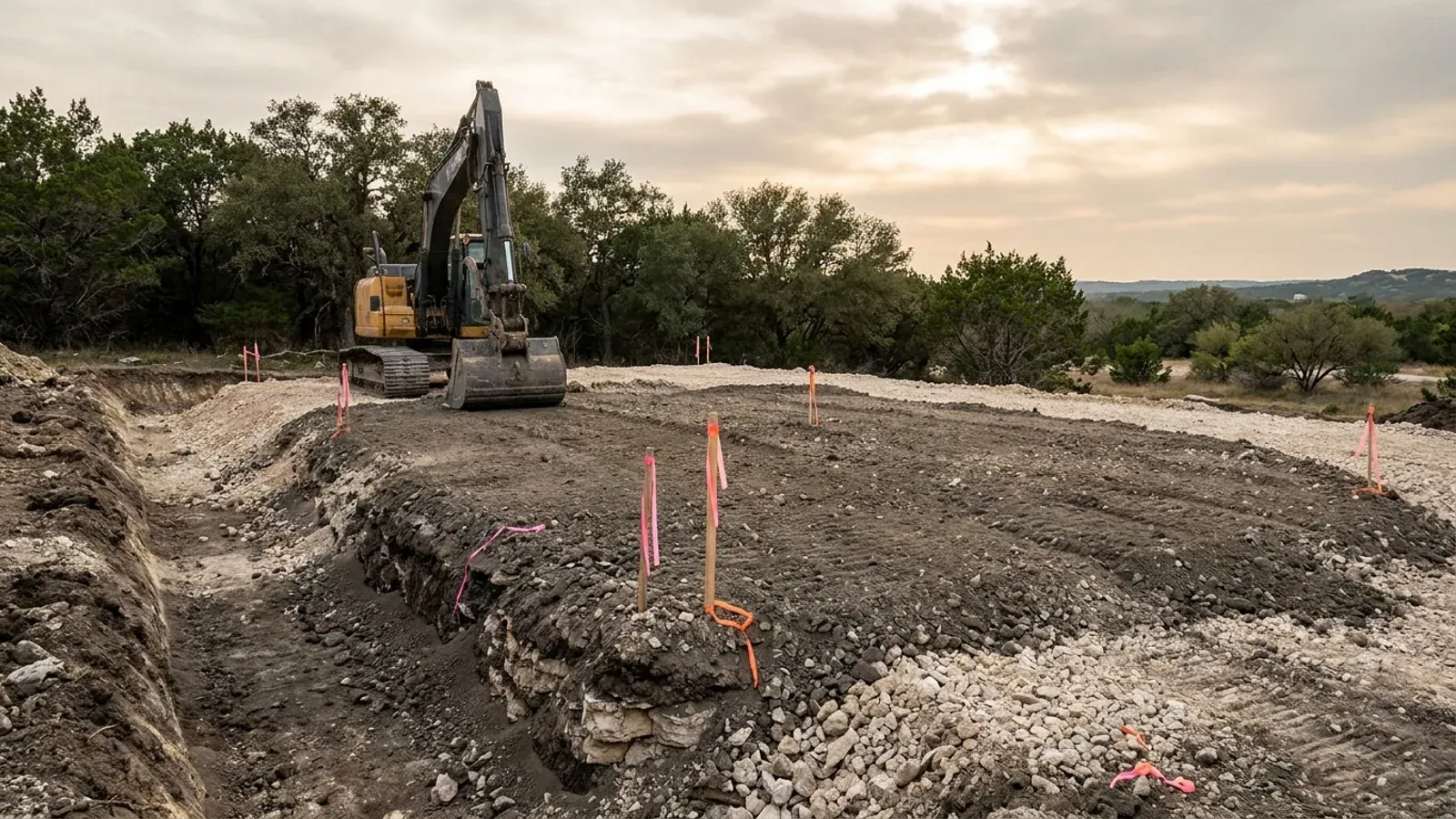
The expensive surprises are in the ground, not the building
What moves a Texas budget is usually below grade, and it is soil rather than rock: shrink-swell clay. The Blackland Prairie and the Gulf Coast clays move enough between a wet season and a dry one to drive the foundation design across the state's largest markets, which is why several DFW cities require an engineer's seal on the foundation of every new house. Those are the same conditions that decide whether a septic field passes its soil and site evaluation, so the grading plan, the foundation and the drainfield get resolved together rather than one at a time. We price the dirt before we price the building.
What we build in San Antonio
All nine of our services — kits, custom plans, post-frame and steel construction, site preparation, permitting and engineering, through to turnkey builds — are available across Bexar County. What a project costs depends far more on the parcel than on square footage, so we work from your land rather than from a rate card.
See what we buildWhat a build looks like
Three stages every San Antonio project passes through, from a raw parcel to a finished home. Site work first, because that is where the budget is decided.
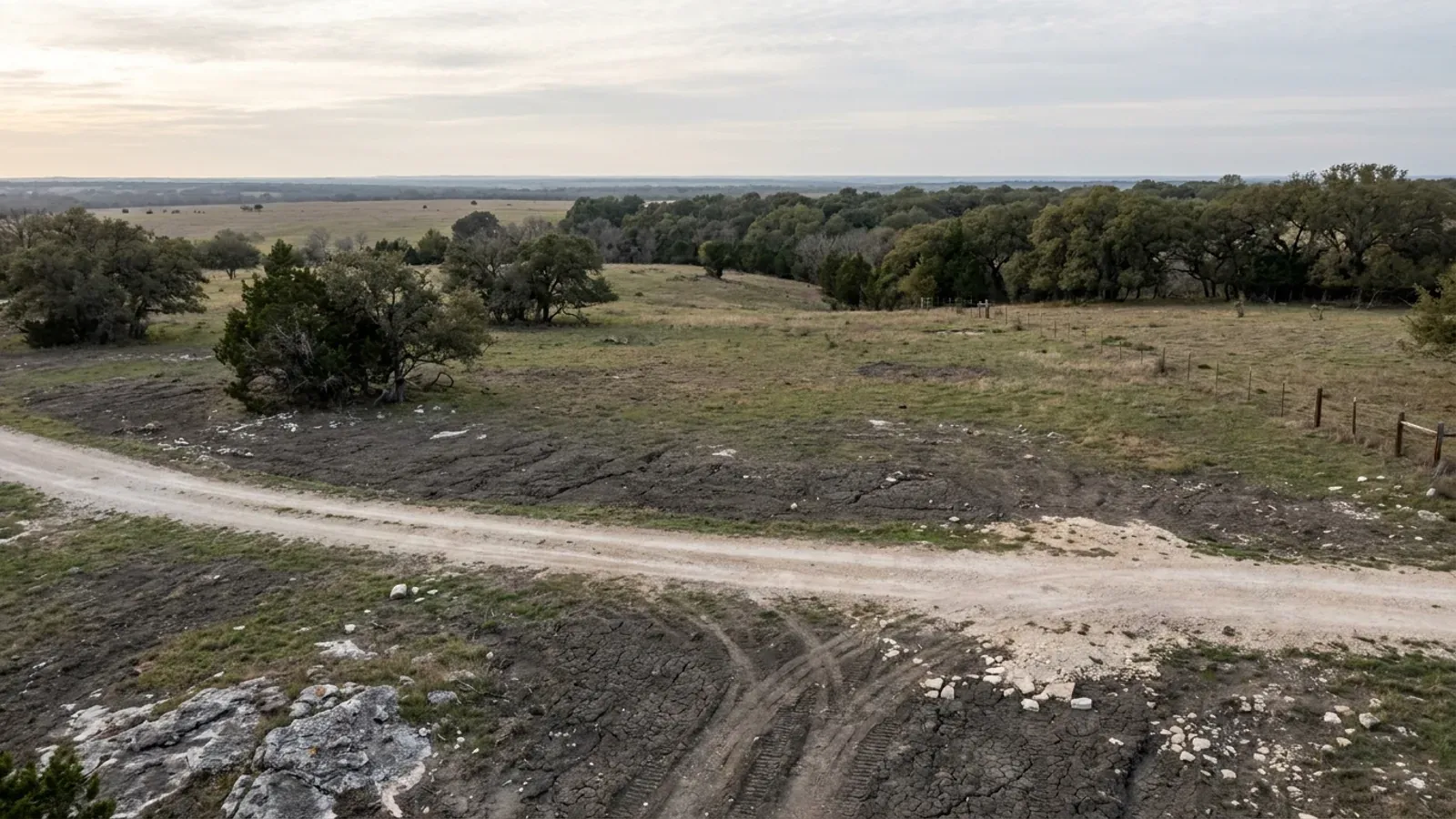
The parcel
Zoning, setbacks, flood zone and utility access get checked before anything is drawn.
Pad and permit
Clearing, grading and a compacted pad, while the submittal works through Bexar County.
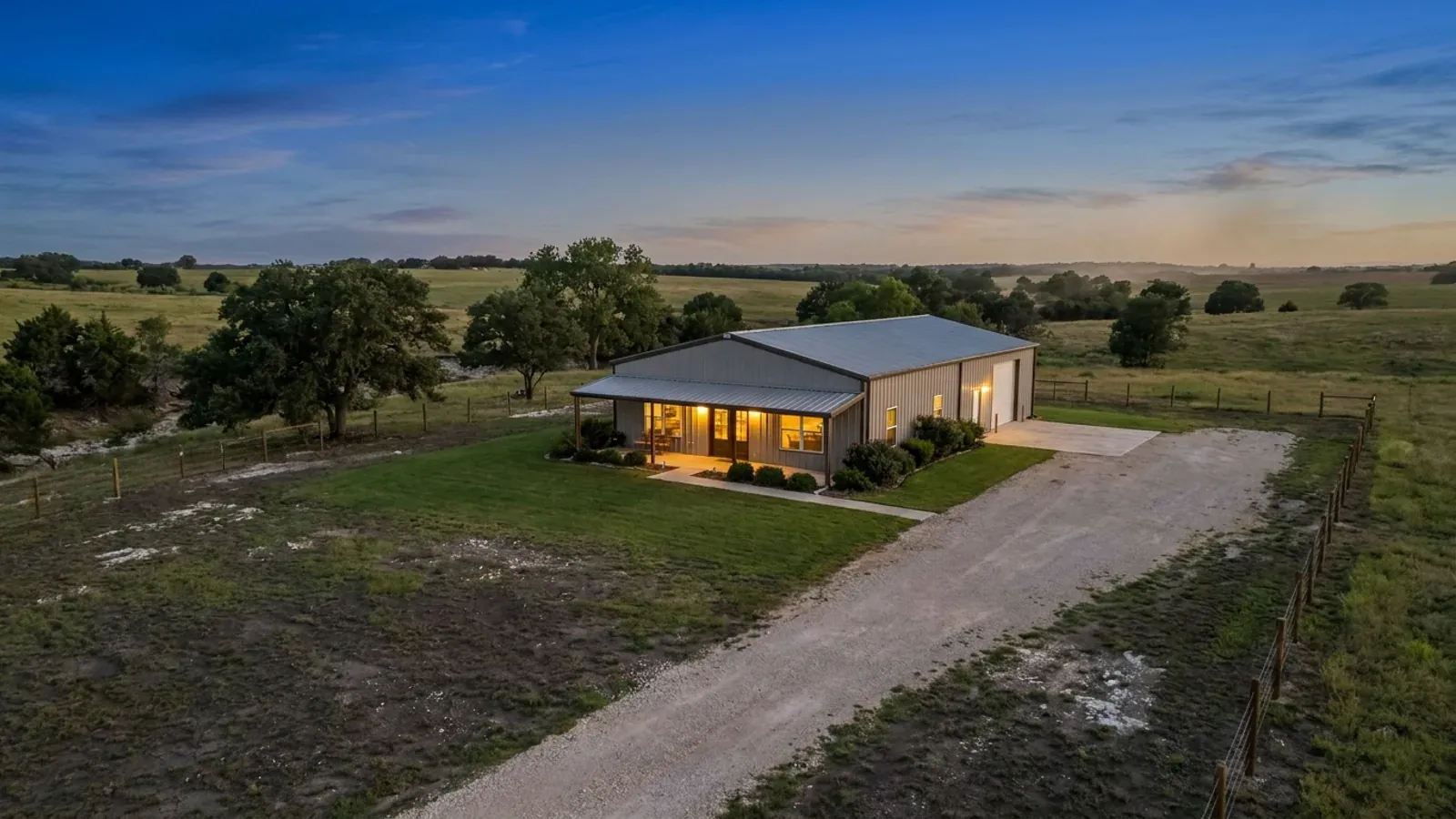
Frame to finish
Shell erected and dried in, then systems, insulation and interior finish through to CO.
Those are the rules for Bexar County. Tell us what you want to build and we will draw it to them.
Where we build around San Antonio
Bexar County and the rural land around it. The buildable acreage for a project this size usually sits outside the city limits, which is frequently what changes who issues your permit.
Keep reading
The questions that usually come next once you know what San Antonio allows.
Barndominium Cost Guide
Sourced per-square-foot ranges by tier and by size, with a calculator built on the same figures.
Read itIs It Legal in Texas?
Classification, zoning, the HOA gate, and why "nonresidential farm building" does not cover a home.
Read itHow Long Does It Take?
Census build-duration data, and what actually sets the permit clock where you are building.
Read itNearby areas we build in
Others we cover in this part of Texas. The permitting authority, the adopted design criteria and the zoning can all differ from one to the next.
Building in San Antonio: common questions
8 questions we get asked most often about building in San Antonio. If yours is not on the list, ask it directly.
Which building code applies to a barndominium inside San Antonio city limits?
Where inside San Antonio can you actually put a building like this?
What changes if the site sits over the Edwards Aquifer recharge zone?
Does San Antonio make you sprinkler a new house?
Do I need an engineer or a design professional for the plans?
What does San Antonio charge, and how long does review take?
If my land is just outside the city, do San Antonio's rules still apply?
Does the shop need its own permit in San Antonio?
Building in San Antonio?
Start with the plan. Tell us what you want to build and we will draw it, then confirm what Bexar County will actually let you put on the parcel and what wind load it has to meet. That conversation costs nothing.