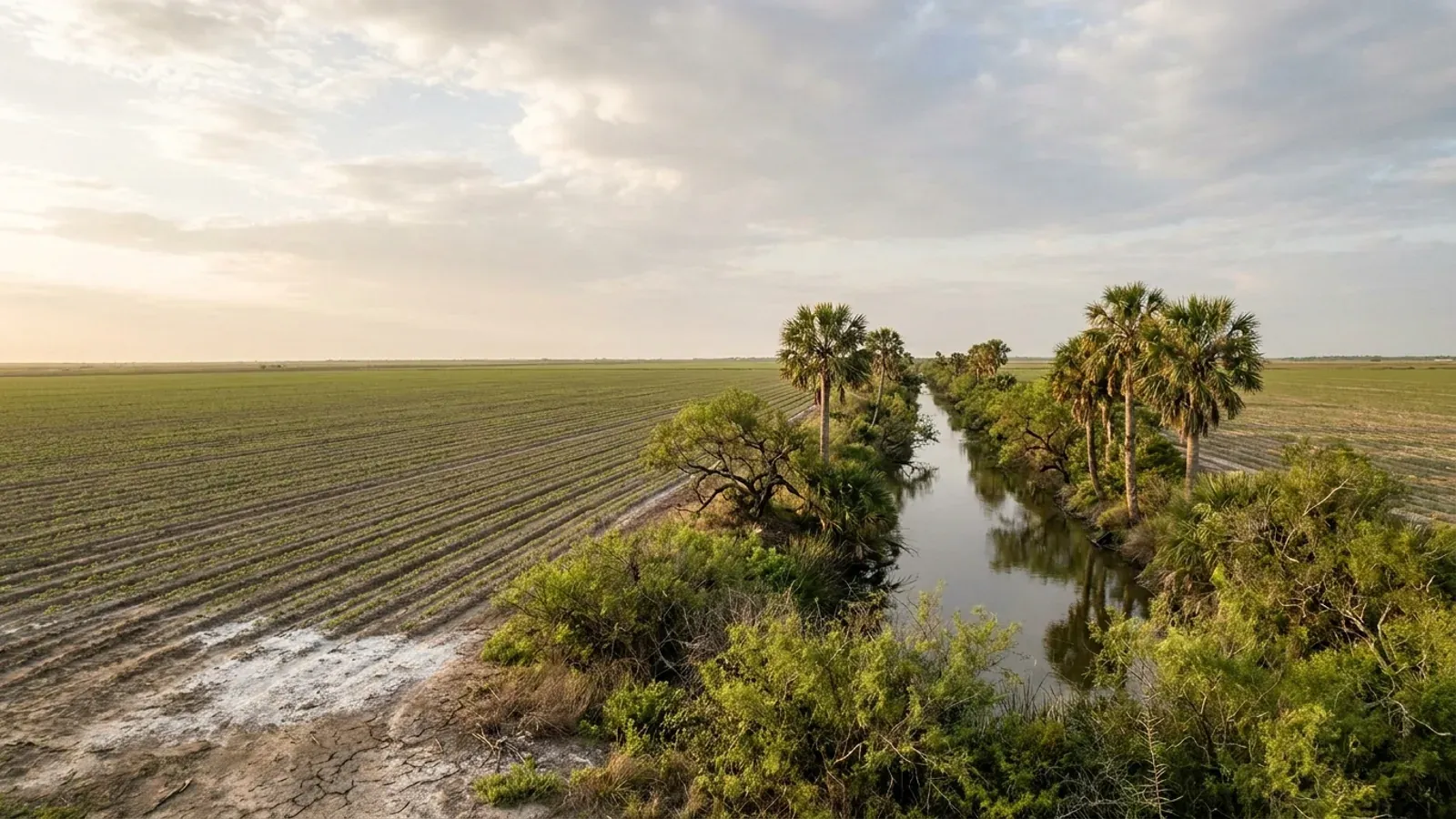
Barndominium Builders in Brownsville, TX
Two codes reach a Brownsville barndominium and they are six years apart. The city enforces the 2018 International Residential Code at Code section 18-116, adopted by Ordinance 2020-1485-E on 21 April 2020, and that is the edition the building permit and the city's sixteen inspections are measured against. Separately, because Cameron County lies wholly inside the designated catastrophe area, 28 TAC section 5.4013 requires work begun on or after 1 April 2026 to comply with the 2024 IRC or IBC to be eligible for catastrophe property insurance. A windstorm certificate filed here is certified to a newer edition than the city enforces, and the city's own submittal list never asks about it. The flood rule is the other surprise. Unified Development Code section 5.5.15 puts the lowest floor two feet above the base flood elevation, and two feet above the highest adjacent grade on every residential lot outside the flood zone as well.
Brownsville at a glance
- County
- Cameron County
- Population
- 192,957
- Where we build
- Brownsville, Cameron County, Corpus Christi, Nueces County
- Site visits
- Site visits arranged across Brownsville and out into Cameron County
ZIPs 78520, 78521, 78526
Building conditions in Brownsville
What actually changes from one Texas jurisdiction to the next: who issues the permit, whether the residential code is enforced there at all, what the structure has to be engineered to, and what the ground is like. These are the numbers your drawings have to satisfy.
Brownsville Code of Ordinances sec. 18-116; 28 Texas Administrative Code sec. 5.4013, adopted by TDI commissioner's order 2026-9774; TDI, Adopted Building Codes (tdi.texas.gov/wind/adopted-codes.html)
City of Brownsville, Required Documents for Residential Projects, rev. 02/12/2026 (brownsvilletx.gov); Cameron County, Requirements for Residential Construction Permit; Texas Insurance Code secs. 2210.2515 and 2210.258
Brownsville Unified Development Code secs. 5.5.11 and 5.5.15.B.1 (UDC adopted as Ordinance 2020-235.95, effective 31 March 2021); Cameron County Flood Damage Prevention and Building Regulations, Order No. 2022-006030
Brownsville Code of Ordinances ch. 18 art. III, read as codified 1 September 2026; TDI, Adopted Building Codes, last updated 23 April 2026
City of Brownsville, Residential Inspection Process, 05/29/25, and Building Permits FAQ (brownsvilletx.gov); Brownsville Code of Ordinances sec. 18-123(c)(1)
USDA-NRCS Soil Data Access, survey area TX061, spatial query over the City of Brownsville, September 2026; Texas Occupations Code sec. 1001.056(c)(2)
Also worth knowing before you build in Brownsville
- The city's own flood link is six years out of date
- The Adopted Codes and Ordinances page on brownsvilletx.gov still links a document called the Flood Prevention Ordinance, which is Ordinance 2013-1586. That document adopts the flood study for the City of Brownsville dated June 1978 with maps dated 1 December 1978, and its section 308-90(1) asks only that a residential lowest floor be elevated to or above the base flood elevation, which is zero freeboard. The live codified rule is Unified Development Code section 5.5, which adopts the Flood Insurance Study for Cameron County and Incorporated Areas dated 16 February 2018 and requires two feet. Anyone who follows the city's own link is reading a rule that understates the requirement by two feet and a map that is nearly fifty years old.
- Registering as a general contractor costs $250 and a photocopy
- The city's Contractor Registration Documents form, dated 5 February 2024, asks an electrical contractor for a current Texas State Master Electrician License, proof of insurance and identification, and charges no registration fee. A plumbing contractor needs the Texas State Master Plumbers License, an irrigation contractor the state irrigators licence, a mechanical contractor the state licence, each with proof of insurance and no fee. For general contractors, covering general, concrete, demolition and foundation work, the entire requirement is a copy of valid identification and a $250.00 fee. There is no state licence to show because Texas does not license residential contractors. That is why the trades on your job are licensed and the person coordinating them is not, and why you should be sceptical of anyone in Texas advertising a builder's licence.
- The design bonus pays for a metal roof and ignores a metal wall
- Unified Development Code section 4.6.1.B is a voluntary points system for single-family dwellings in the AG, RE, R-1, R-2 and R-3 districts among others. Sixty points buys ten extra feet of height, ten percent more building coverage and impervious cover and a ten percent cut in minimum lot size; eighty points doubles most of that. Using clay tile, slate or metal roof materials for the entire roof surface is worth ten points by name. Material points, at fifteen or twenty, require Class 1 or Class 2 Building Materials on the whole exterior facade, and Article 6 defines those as fired brick, veneer brick, natural and manufactured stone, granite and marble, plus three-step plaster stucco. Metal wall panel is in none of the three classes. The scheme rewards the roof of a barndominium and does not recognise its walls, and because it is voluntary it is a bonus rather than a bar.
- No mandatory exterior material rule reaches a house on a rural lot
- The mandatory design provisions in the Unified Development Code are scoped away from a single-family house on acreage. Section 4.6.1.C, the one that dictates four-sided finish and required design elements, applies to multi-family, mixed-use and nonresidential buildings in the R-3, CC, RC, LI and HI districts. Section 4.5.2.A confines the Building Types article, which is where permitted building materials by building type live, to the Traditional and Form-based districts in section 4.3.3. Neither reaches AG or Residential Estate. That is a real difference from the coast further north, where the City of Rockport prohibits exterior metal wall material on residential buildings outright and allows metal roof systems only.
- Cameron County issues the septic permit, even inside the city
- TCEQ's register of authorized agents for on-site sewage facilities lists eleven records for Cameron County. The county's own designation reads entire County except Town of Bayview. Harlingen, San Benito, Los Fresnos, La Feria, Primera, Combes and Santa Rosa each hold a designation marked administered by Cameron County; Bayview and the newly incorporated City of Starbase hold their own. Brownsville, the largest city in the county, appears nowhere on the list, so it falls inside the county's designation. If your lot has no city sewer, the permit comes from Cameron County Environmental Health while the building permit comes from the city, and the city's own submittal sheet makes you responsible for confirming that water and wastewater are available without extending public infrastructure.
- The extraterritorial jurisdiction runs five miles, by two separate routes
- Local Government Code section 42.021(a)(5) gives a municipality of 100,000 or more inhabitants an extraterritorial jurisdiction of five miles, and the Census Bureau puts Brownsville at 192,957 in 2025. Section 212.001(1) gets there a second way that is specific to the border: for a municipality of 5,000 or more located in a county bordering the Rio Grande, extraterritorial jurisdiction means the area outside the municipal limits but within five miles of those limits. Both give five miles here. What the city can do out there is subdivision review, and Unified Development Code section 3.1.2 says properties in the ETJ must also comply with the interlocal agreement between the city and Cameron County. What it cannot do is stated flatly in section 212.049: the subchapter does not authorise a municipality to require municipal building permits or otherwise enforce its building code in its extraterritorial jurisdiction.
- The border subdivision rules are inside the city's own code
- Unified Development Code section 3.1.1.B adopts the Model Subdivision Rules granted by Texas Water Code section 16.343 and 31 Texas Administrative Code Part 10 Chapter 364 into Brownsville's subdivision regulations by reference. Section 3.1.6.D applies them to any subdivision creating two or more lots of five acres or less intended for residential purposes, and presumes lots of five acres or less are residential unless the land is restricted to nonresidential use on the final plat and in every deed and contract for deed. Section 3.1.6.E stops the Planning Director approving such a plat without confirming connection to an adequate existing water facility. That is the same colonia-prevention machinery Cameron County carries as a border county, running inside a city building department and its ETJ.
- Two ways out of platting, and one of them turns on a 1971 deed
- Unified Development Code section 3.1.5.B lets the Planning Director issue a determination certificate exempting a property from platting. The first route follows Local Government Code section 212.004: a division of land into parts of five acres or greater where each part has access to an existing improved public road and no public improvements are being dedicated. The second is a grandfather clause under section 212.0045(a), and it turns on a date that appears nowhere else in Texas: the boundaries must have been fully described by title transfer instruments executed before 30 March 1971, with no boundary-altering transfers since, water and wastewater lines directly accessible without extending public infrastructure, at least twelve feet of frontage on a right-of-way at least thirty feet wide and improved enough for passenger vehicles, taxes current and no curative matters outstanding.
- The accessory-building permit exemption was raised, not deleted
- Code section 18-126, added by Ordinance 2020-1485-G on 20 October 2020, amends section 105.2 of the adopted building code and prints the change with the code's own strikethrough convention: one-story detached accessory structures used as tool and storage sheds, pergolas, trellises, arbors, gazebos, playhouses and similar uses need no permit provided the floor area is not greater than 200 square feet, up from 120, and are not to be enclosed in the future. Two things follow. A small unenclosed shed is genuinely outside the permit system here. And a shop bay that will be enclosed, or anything at barndominium scale, is nowhere near that exemption and needs the full permit and the full inspection sequence.
- There is a roadway capital recovery fee and it gates the permit
- Chapter 9 of the Code of Ordinances is the Brownsville Roadway Capital Recovery Fee Ordinance, adopted by Ordinance 2024-1739 under Local Government Code Chapter 395 with an effective date of 7 May 2024. Section 9-5 provides that no building permit or request for service shall be issued until the applicant has paid the capital recovery fee, and section 9-12 collects it when the permit issues. The amount depends on which of the city's roadway service areas the land sits in and on the service unit equivalency for the land use, and the schedules that set it are not in the codified text of the chapter. The city runs an online calculator but labels it as being for planning and informational purposes only and not an official statement of charges. Ask the city for the figure for your service area before you budget.
- The certificate that makes the building insurable, and the one that is still valid
- TWIA's current eligibility page states that properties must be certified by the Texas Department of Insurance on a WPI-8 or WPI-8-E, or by the Texas Windstorm Insurance Association on a WPI-8-C, as having been built to applicable building codes, with limited exceptions. Both halves matter. TWIA stopped issuing new WPI-8-C certificates on 31 May 2020, so nobody can obtain one now, but an existing WPI-8-C remains valid and is still listed as acceptable. New work runs the other route: a WPI-1 application, an inspection verification, and a WPI-8 issued by TDI. Insurance Code section 2210.2515(e) kills the certificate if the completed forms and all inspection fees have not reached the department within six months of the final inspection.
- The coast is carved out of the engineer exemption by name
- Almost everywhere in Texas a house needs no engineer, because Occupations Code section 1001.056(a) exempts anyone erecting or drawing plans for a private dwelling from the Engineering Practice Act. Section 1001.056(c)(1) switches that exemption off for a person providing engineering design or inspection services necessary to comply with windstorm certification standards for a residential dwelling under Subchapter F of Insurance Code Chapter 2210. Brownsville is inside that programme. The same section is worth reading for the shop as well: subsection (a)(2)(F) exempts a one-storey building of not more than 5,000 square feet that has no clear span greater than 24 feet on the narrow side, and subsection (b) says that where such a structure does have unsupported spans over 24 feet, only the trusses, beams or other roof supporting members must be engineered or pre-engineered.
- Flood insurance and wind insurance can collide on a coastal lot
- TWIA's eligibility page adds a condition that only bites near the water: properties located in flood zones V, VE or V1-30 that were constructed, altered, remodeled or enlarged on or after 1 September 2009, and that can obtain flood insurance through the National Flood Insurance Program, must provide proof of flood insurance coverage. Applicants must also have been denied coverage by at least one authorized insurer actively writing windstorm and hail coverage in the designated area, because TWIA is the insurer of last resort rather than a first stop. Separately, Brownsville's residential submittal list asks for a flood elevation certificate whenever the property is in a Special Flood Hazard Area.
- A licensed plumber and a licensed electrician are not optional
- The city answers this itself. Asked whether a licensed plumber is needed for plumbing repair in a house, the city's published FAQ says yes, as per state law and City ordinance, plumbing work must be done by a licensed plumber, and gives the identical answer for electrical work. That matches the registration form, which will not register an electrical or plumbing contractor without a current Texas state master licence and proof of insurance. This is the one part of Texas residential construction where a licence genuinely exists and is genuinely enforced, and it applies whether or not a building code reaches the parcel.
- Fill and compaction are specified, and the specification is the city's
- Unified Development Code section 5.5.15.B.6 governs raising a building pad with fill in the flood zones. Fill material must be compacted to at least ninety five percent of Standard Laboratory Maximum Density, Standard Proctor, according to ASTM D-698, and fill soils must be fine grained soils of low permeability such as those classified CH, CL, SC or ML under ASTM D-2487. Cameron County's order sends the same job to TxDOT Item 132, Embankment. Two authorities, two written specifications, and on a two-foot elevation requirement the pad is a real line on the job rather than an afterthought.
- There is still agricultural land inside the city limits
- Brownsville covers 133.4 square miles of land, which at a 2025 population of 192,957 works out at roughly 1,450 people per square mile of city land. The code keeps an Agriculture district inside those limits, described in section 4.3.1A as intended for the preservation of open space and as one that may include widely dispersed rural single-family homes but is primarily characterized by extensive, undisturbed landscapes and agricultural activity. Section 4.1.2.E provides that when land is annexed or otherwise brought into the jurisdiction of the city it may be classified in the Agriculture district. So acreage inside the city limits is real here rather than theoretical, which is not true of every Texas city this size.
- The adopted fire code is stated, and it is the 2012 edition
- Asked what fire code the city has adopted, the City of Brownsville answers International Fire Code 2012. The Fire Marshal's office reviews site development and fire department access, fire alarm systems, alternative agent fire suppression, automatic fire sprinkler systems, standpipes, fire pumps and water supply, and hazardous material storage and use, and publishes a standard plan review time of five to fourteen business days with a paid expedite option at one to two days. For a detached house most of that list is not in play, but access and address visibility are, and the inspection sheet requires the permit posted with the address visible at all times.
- Annexation no longer drags the ETJ outward with it
- Local Government Code section 42.021(e) provides that an annexation commenced after 1 January 2023 does not expand a municipality's extraterritorial jurisdiction unless, at the same time, the owners of the area that would be brought into the ETJ ask to be included. Brownsville is still annexing: the city's codifier lists Ordinance 2026-1800, adopted 5 May 2026, annexing described territory and extending the boundary limits. Under the current statute the city limit moved and the five-mile ring did not follow it on its own. Section 42.902 adds that being in an ETJ does not by itself authorise the city to tax the area.
City of Brownsville, Flood Prevention Ordinance 2013-1586 (brownsvilletx.gov Adopted Codes and Ordinances); Brownsville Unified Development Code secs. 5.5.5 and 5.5.15
City of Brownsville Planning and Redevelopment Department, Contractor Registration Documents, 02/05/24 (brownsvilletx.gov)
Brownsville Unified Development Code secs. 4.6.1.A.2, 4.6.1.B.1, 4.6.1.B.2, 4.6.1.B.3 and Article 6 definitions 29 to 31
Brownsville Unified Development Code secs. 4.5.2.A and 4.6.1.C.1; City of Rockport Ord. 1463, sec. 22-524
TCEQ On-Site Sewage Facility Authorized Agents register, county code 31, queried 1 September 2026; City of Brownsville, Required Documents for Residential Projects, rev. 02/12/2026
Texas Local Government Code secs. 42.021, 212.001, 212.049; Brownsville Unified Development Code secs. 1.5 and 3.1.2; Census Bureau Vintage 2025 subcounty population estimates
Brownsville Unified Development Code secs. 3.1.1.B, 3.1.6.B, 3.1.6.D and 3.1.6.E
Brownsville Unified Development Code sec. 3.1.5; Texas Local Government Code secs. 212.004 and 212.0045
Brownsville Code of Ordinances sec. 18-126, Ord. No. 2020-1485-G, sec. I, 20 October 2020
Brownsville Code of Ordinances secs. 9-1, 9-3, 9-5, 9-11 and 9-12, Ord. No. 2024-1739, 7 May 2024; City of Brownsville CRF Calculator page (brownsvilletx.gov)
TWIA, Coverage and Eligibility (twia.org/coverage-eligibility); Texas Insurance Code secs. 2210.2515 and 2210.258
Texas Occupations Code sec. 1001.056(a), (b) and (c)
TWIA, Coverage and Eligibility (twia.org/coverage-eligibility); City of Brownsville, Required Documents for Residential Projects, rev. 02/12/2026
City of Brownsville Building Permits FAQ (brownsvilletx.gov); City of Brownsville Contractor Registration Documents, 02/05/24
Brownsville Unified Development Code sec. 5.5.15.B.6; Cameron County Flood Damage Prevention and Building Regulations, Order No. 2022-006030, art. 5 sec. A.5
Census Bureau 2024 Gazetteer place file, GEOID 4810768, and Vintage 2025 subcounty population estimates; Brownsville Unified Development Code secs. 4.1.1, 4.1.2.E and 4.3.1A
City of Brownsville Fire Marshal FAQ (brownsvilletx.gov); City of Brownsville, Residential Inspection Process, 05/29/25
Texas Local Government Code secs. 42.021(e) and 42.902; Municode listing of Brownsville ordinances adopted and not yet codified, read 1 September 2026
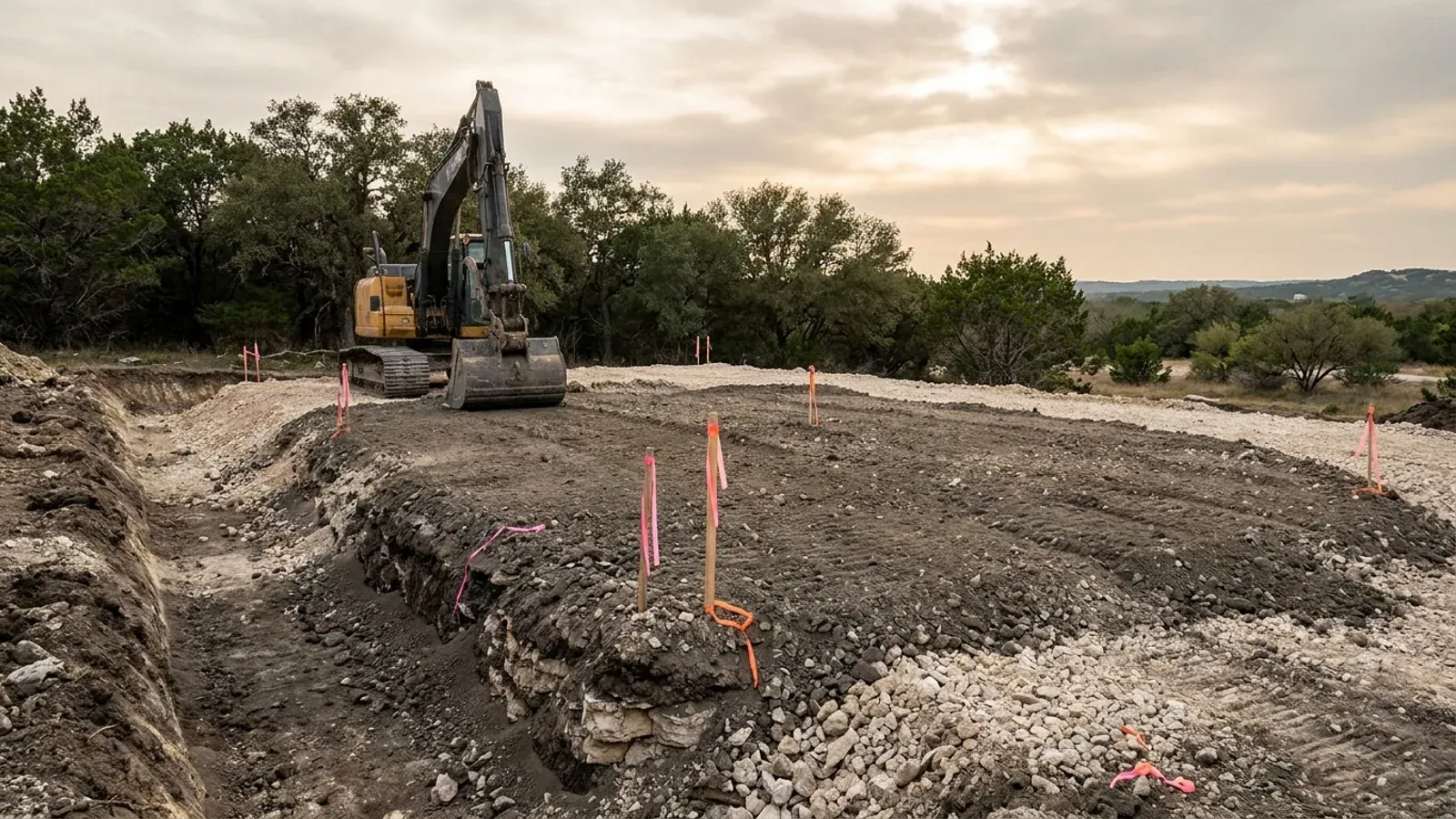
The expensive surprises are in the ground, not the building
What moves a Texas budget is usually below grade, and it is soil rather than rock: shrink-swell clay. The Blackland Prairie and the Gulf Coast clays move enough between a wet season and a dry one to drive the foundation design across the state's largest markets, which is why several DFW cities require an engineer's seal on the foundation of every new house. Those are the same conditions that decide whether a septic field passes its soil and site evaluation, so the grading plan, the foundation and the drainfield get resolved together rather than one at a time. We price the dirt before we price the building.
What we build in Brownsville
All nine of our services — kits, custom plans, post-frame and steel construction, site preparation, permitting and engineering, through to turnkey builds — are available across Cameron County. What a project costs depends far more on the parcel than on square footage, so we work from your land rather than from a rate card.
See what we buildWhat a build looks like
Three stages every Brownsville project passes through, from a raw parcel to a finished home. Site work first, because that is where the budget is decided.
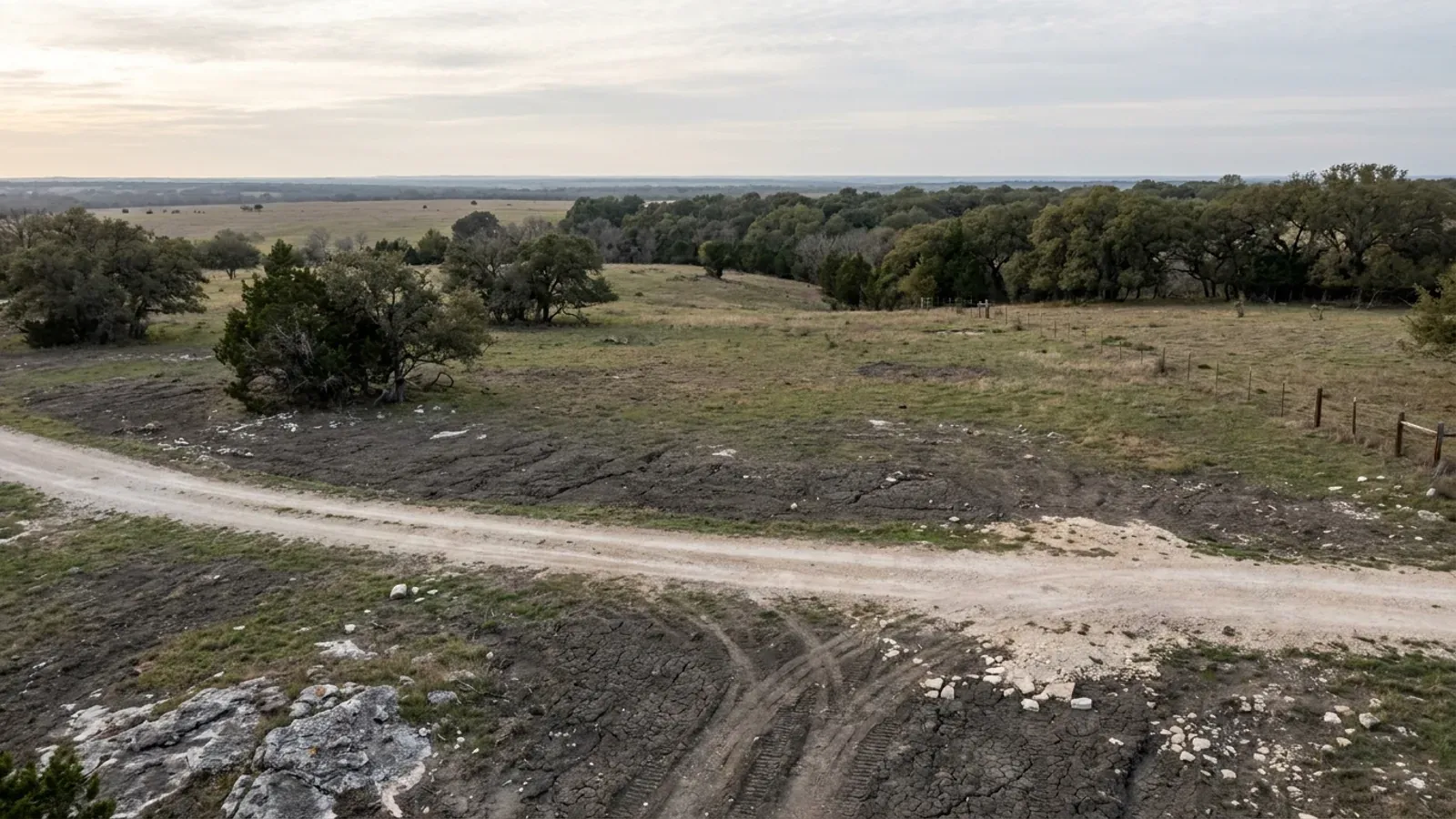
The parcel
Zoning, setbacks, flood zone and utility access get checked before anything is drawn.
Pad and permit
Clearing, grading and a compacted pad, while the submittal works through Cameron County.
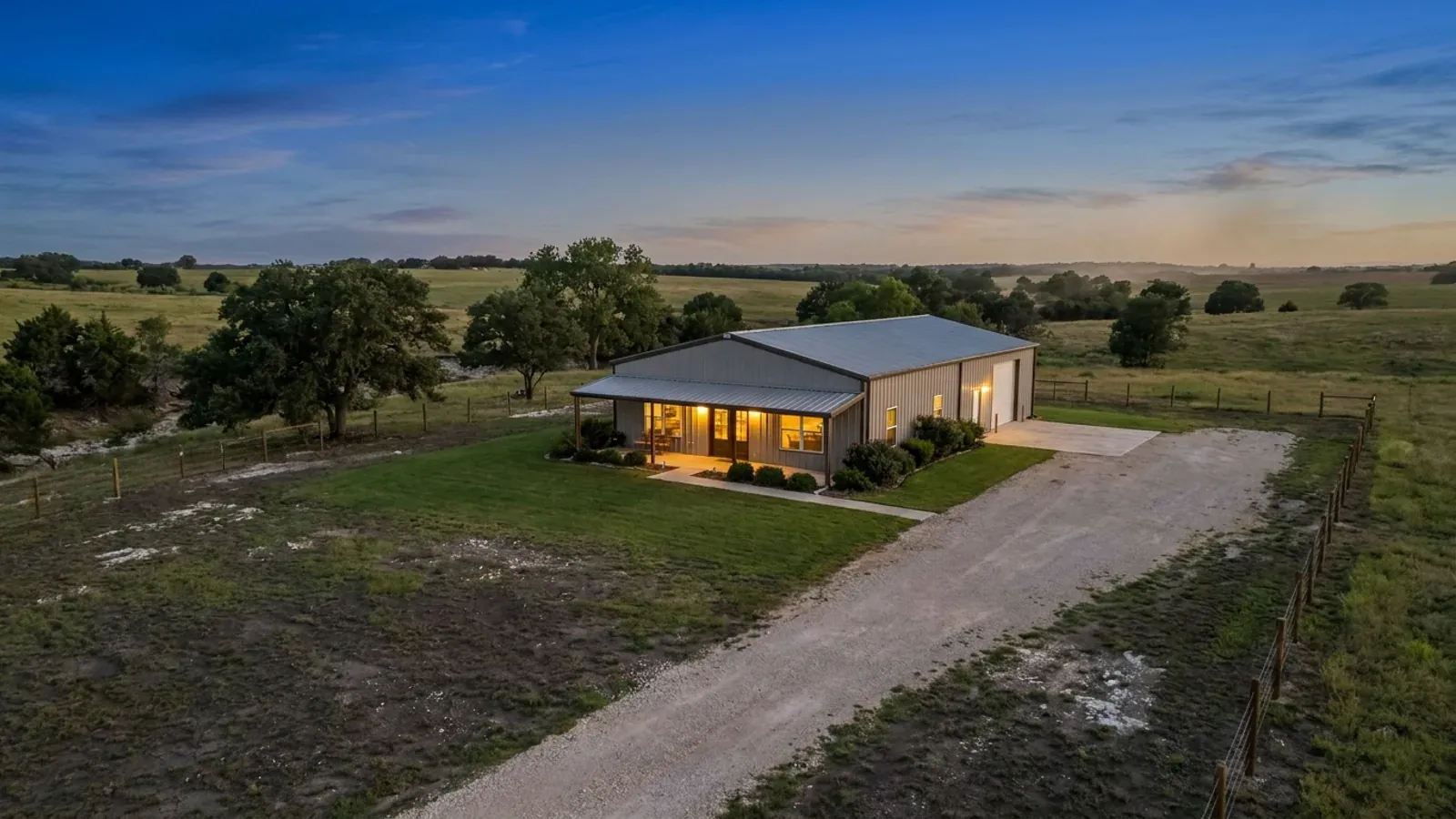
Frame to finish
Shell erected and dried in, then systems, insulation and interior finish through to CO.
Those are the rules for Cameron County. Tell us what you want to build and we will draw it to them.
Where we build around Brownsville
Cameron County and the rural land around it. The buildable acreage for a project this size usually sits outside the city limits, which is frequently what changes who issues your permit.
Keep reading
The questions that usually come next once you know what Brownsville allows.
Barndominium Cost Guide
Sourced per-square-foot ranges by tier and by size, with a calculator built on the same figures.
Read itIs It Legal in Texas?
Classification, zoning, the HOA gate, and why "nonresidential farm building" does not cover a home.
Read itHow Long Does It Take?
Census build-duration data, and what actually sets the permit clock where you are building.
Read itNearby areas we build in
Others we cover in this part of Texas. The permitting authority, the adopted design criteria and the zoning can all differ from one to the next.
Building in Brownsville: common questions
12 questions we get asked most often about building in Brownsville. If yours is not on the list, ask it directly.
Which building code does Brownsville actually enforce on a barndominium?
Does the 2024 code apply here from April 2026, and does it replace the city's?
Will the city catch it if I skip the windstorm certificate?
Can I still get a WPI-8-C?
Is windstorm insurance legally required in Brownsville?
How high does the floor have to be if my lot is not in a flood zone?
What does a Brownsville residential building permit cost, and how long is plan review?
What inspections does the city run on a new house?
Do I need an engineer?
Can Brownsville stop me cladding the building in metal?
Who issues the septic permit if the lot has no city sewer?
My land is outside the city limits but inside Brownsville's ETJ. What changes?
Building in Brownsville?
Start with the plan. Tell us what you want to build and we will draw it, then confirm what Cameron County will actually let you put on the parcel and what wind load it has to meet. That conversation costs nothing.