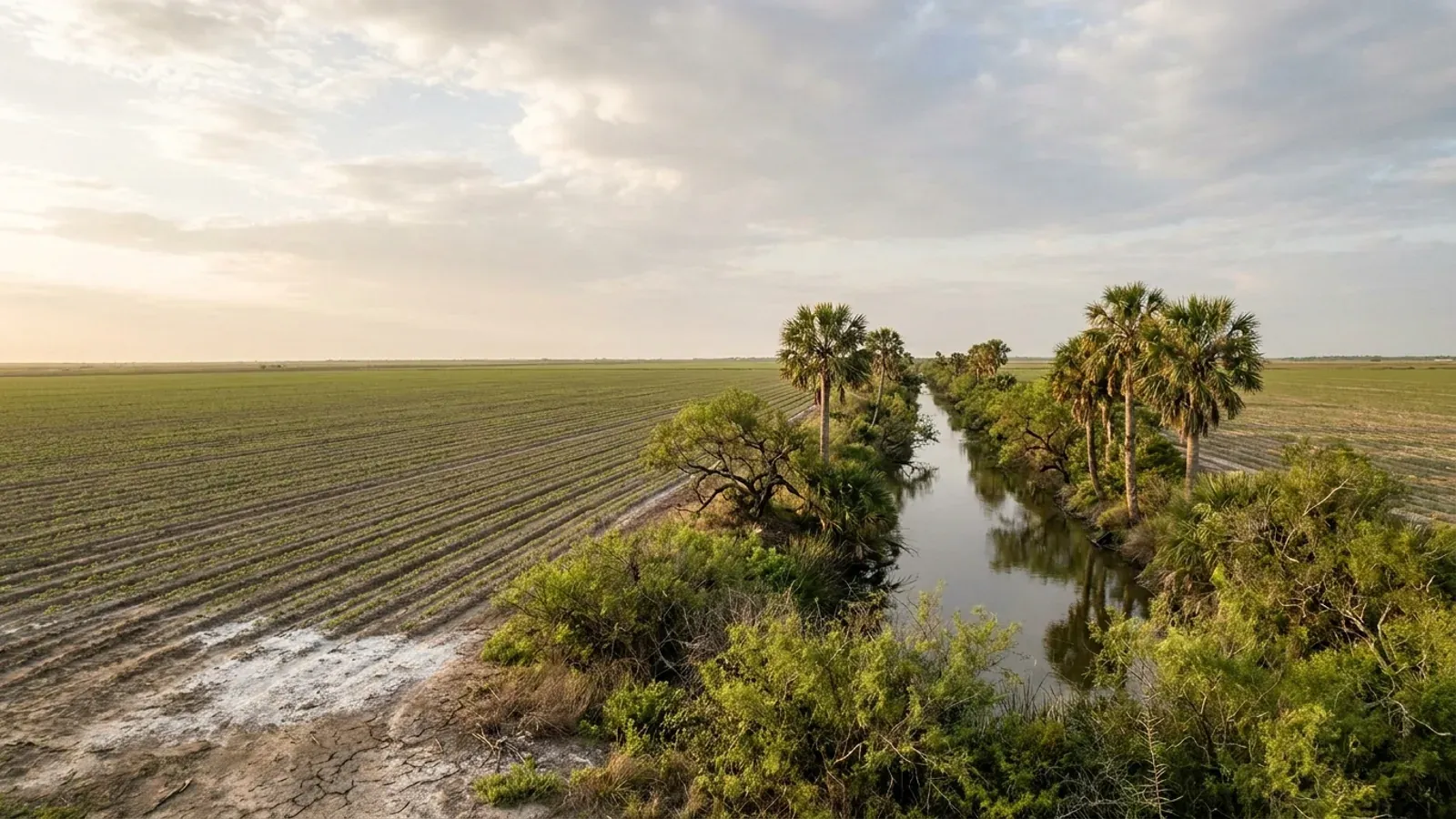
Flat irrigated farmland of the Lower Rio Grande Valley with sabal palms along a resaca and pale salt crust on bare ground.
Cameron County 2024 IRC as adopted here TDI windstorm area

Barndominium Builders in Cameron County, TX

Almost everywhere in Texas a county cannot touch your house. Cameron County is the exception, and it is the exception twice over. Its Flood Damage Prevention and Building Regulations require a building permit for any development anywhere in the unincorporated county, put a county Building Official and six inspections on the job, and say plainly that structures must comply with the minimum requirements of the ICC family of codes. And since 1 September 2025 it is the only county in Texas with a subdivision subchapter written for it alone, because it is the only one that borders both Mexico and the Gulf. On top of that it sits wholly inside the designated catastrophe area, so the certificate that makes a finished building insurable is issued against the 2024 International Residential Code. Three regimes reach one barndominium here, and no other page on this site has to say that.

Cameron County at a glance

County
Cameron County
Population
433,946
Where we build
San Benito, Brownsville, Nueces County, Aransas County

ZIPs 78520, 78521, 78526, 78535, 78550, 78552, 78559, 78566 and more

Site visits
We meet you on the tract, San Benito or anywhere else in Cameron County

Building conditions in Cameron County

What actually changes from one Texas jurisdiction to the next: who issues the permit, whether the residential code is enforced there at all, what the structure has to be engineered to, and what the ground is like. These are the numbers your drawings have to satisfy.

Build conditions for Cameron County , Texas . BUILD CONDITIONS CAMERON COUNTY, TXCameron County2024 IRCADOPTED RESIDENTIAL CODE2024 IRCThis jurisdiction publishes no design wind speed. It is settled in writing with the authority overyour parcel before the frame is ordered.COUNTY RESIDENTIAL BUILDING PERMIT$65.00 plus $0.13 per square foot fr…Cameron County's published Table J.1 for residential newconstruction: under 500 sq ft $65.00; 500 to 1,000 sq ft $0.195 per…WHO ISSUES THE PERMITCameron County Department of Transpo…1390 W. Expressway 83, San Benito, TX 78586, (956) 247-3500 press 1,Building@co.cameron.tx.us. The County Engineer is the Floodplain…
Build conditions for Cameron County, drawn from the sourced facts on this page. Every figure above is cited in the quick-facts panel below, with its source and vintage.
The only county in Texas with a subdivision subchapter of its own
Subchapter G of Local Government Code chapter 232 applies only to a county that borders both the United Mexican States and the Gulf of Mexico, and the Senate Research Center's analysis of the bill that created it says the changes are applicable only to Cameron County. The same act added section 232.022(a-1), which removes Cameron from Subchapter B, the fifty-mile border-county subchapter that still governs every other border county

Texas Local Government Code sections 232.202(a) and 232.022(a-1), added by Acts 2025, 89th Legislature, R.S., Ch. 526 (H.B. 3680), effective 1 September 2025; Senate Research Center Bill Analysis, H.B. 3680, Engrossed, 21 May 2025

That power reaches the land, not the house
Subchapter G applies only to land subdivided into two or more lots of which at least one is under five acres, and not at all if every lot is five acres or more. What the commissioners court must regulate is listed and closed: potable water, solid waste, roads, sewer facilities, electric and gas service, and flood management to FEMA's minimum standards. The whole of chapter 232 contains no reference to a building code or the International Residential Code

Texas Local Government Code sections 232.202(b), 232.202(e) and 232.212(c), read from the codified chapter text

But the county does permit and inspect a house, under its flood order
The Cameron County Flood Damage Prevention and Building Regulations apply to all unincorporated areas, require a building permit before any development, and set six inspections: plumbing rough-in, foundation, nail pattern at minimum 8D or 10D, frame, insulation and final. The order states that to reduce loss due to flooding, high winds and hurricanes it requires structures to comply with minimum requirements of the ICC family of codes and the National Electrical Code. It names no edition of the residential code anywhere

Cameron County Flood Damage Prevention and Building Regulations, Order No. 2022-006030 adopted 5 July 2022, Article 3 Sections A and C and Article 5 Section I

Freeboard here is twelve inches, and eighteen outside the flood zone
In a flood prone or flood hazard area the lowest finished floor must be 12 inches above the base flood elevation or the FIRM depth number, or 24 inches above the highest adjacent natural grade, whichever is higher. And where the tract lies in an area of minimal flood hazard, outside the special flood hazard area altogether, the finished floor must still be at least 18 inches above the street centreline or above natural grade, whichever is greater

Cameron County Flood Damage Prevention and Building Regulations, Article 5 Section A, paragraphs 1, 2 and 4

The whole county is inside the catastrophe area
Cameron is named at paragraph (4)(D) of the statutory list of first tier coastal counties, and structures in the designated catastrophe area must be certified to the 2024 International Residential Code or the 2024 International Building Code from 1 April 2026 to be eligible for windstorm coverage through the association. Hidalgo County next door is second tier and is not designated

Texas Insurance Code section 2210.003(4)(D) and (11)(G); 28 Texas Administrative Code section 5.4013; Texas Department of Insurance, Adopted Building Codes, page dated 23 April 2026

The clay flats are Vertisols and the slab needs an engineer
Harlingen clay covers 49,095 acres and is a smectitic Sodic Haplusterts running 55 percent clay at the surface and 68 percent below it, with linear extensibility of 17 through the profile. Lomalta clay covers 40,839 acres at 67.5 percent clay and the same extensibility. Vertisols account for 127,864 component-weighted acres of the survey. Willacy fine sandy loam, by contrast, reads 15 percent clay at the surface with extensibility of 1.5

USDA NRCS Soil Data Access, SSURGO survey area TX061, mapunit, component and chorizon tables

Also worth knowing before you build in Cameron County

The permit checklist asks for a windstorm engineer by name
Cameron County's requirements list for a residential construction permit, published in English and Spanish, calls for windstorm information provided by a windstorm state certified engineer, a REScheck from energycodes.org with the floor plans, two full sets of construction plans with a site plan, a water and sewer availability letter, and a septic permit or probe letter where sewer is unavailable

Cameron County Department of Transportation, Requirements for Residential Construction Permit, revised 5 May 2022

The coast is carved out of the engineer exemption by name
The private dwelling exemption from the Engineering Practice Act does not apply to a person providing engineering design or inspection services necessary to comply with windstorm certification standards for a residential dwelling. The same section's next paragraph is the one that reaches a slab on expansive soil, which on the Harlingen and Lomalta clays is most of this county

Texas Occupations Code section 1001.056(c)(1) and (c)(2)

Trade contractors must register with the county before the permit issues
Every plumbing, electrical and mechanical contractor on the job must hold a valid Texas licence from the appropriate board and be registered with the Cameron County Planning and Inspections Division before a building permit is issued, and the application must list them all. Failure to meet these requirements will result in denial of the building permit application. There is still no Texas licence for a residential general contractor

Cameron County Flood Damage Prevention and Building Regulations, Article 4 Section D; Texas Occupations Code section 1301.052

A utility may not connect the land until the court certifies the lot
A utility may not serve or connect subdivided land with water or sewer unless it receives a certificate from the commissioners court that the plat has been reviewed and approved. The route out for an existing lot is that it is a lot of record, meaning its boundaries were fixed by a plat or a recorded deed before 1 September 1989 and not subdivided since, and that operable sewer service has been installed as determined by the authorised on-site sewage agent

Texas Local Government Code sections 232.211(a), 232.211(b)(2) and 232.201(7)

Setbacks and a shop rule the county actually publishes
Building setback lines are a minimum of 25 feet from the edge of the right of way on public roads, 50 feet on major highways, and 5 feet from adjacent property lines, or whatever the recorded plat shows, whichever is stricter. Separately, a junkyard or salvage yard may not sit within 50 feet of a public street right of way and nothing may be stacked above eight feet, though the section does not apply to a yard used only for farm equipment

Cameron County Flood Damage Prevention and Building Regulations, Article 5 Sections P and Q

A second dwelling has to look like the first one
An accessory dwelling unit needs its own permit, is limited to one per lot, and on a lot under 10,000 square feet may not exceed half the principal dwelling's floor area or 1,000 square feet. The owner must occupy one of the two units, sign a notarised affidavit saying so, and record a covenant putting future owners on notice. The order also requires the accessory unit to have a roof pitch, siding and window proportions identical or similar to the principal residence

Cameron County Flood Damage Prevention and Building Regulations, Article 5 Section L

The septic permit comes before the building permit
A copy of a septic tank permit is required before a building permit, electrical permit or water meter permit will be approved by the Building Official, and the final inspection is not signed until the septic system has final approval from the health department and utility services are ready to connect

Cameron County Flood Damage Prevention and Building Regulations, Article 4 Section C and Article 5 Section I

Eleven septic records, one county, and a town that opted out
TCEQ's authorised agent search returns eleven records for Cameron County. The county is the agent for the entire county except the Town of Bayview, which holds its own designation for its town limits. Eight cities including Harlingen, San Benito, Los Fresnos and La Feria hold designations that TCEQ records as administered by Cameron County. The City of Starbase, incorporated in 2025, already holds its own

TCEQ On-Site Sewage Facility Authorized Agent search, county code 31, www6.tceq.texas.gov/oars

There is no percolation test in Texas
Soil is classified by texture class, Ia sandy and gravelly down to IV silty clay and clay, with loading rates from above 0.50 down to 0.10 gallons per square foot per day. The Harlingen and Lomalta clays sit at the bottom of that range, which is what makes drainfield area the constraint on this county's clay flats

30 Texas Administrative Code chapter 285, including section 285.33(b)(4)(D)

The state sets no zone wind speed any more
The Department of Insurance says the required wind speed must be determined for each structure based on the location of the structure, using web-based tools such as the ASCE 7 Hazard Tool, and that most of the designated catastrophe areas are now located within the windborne debris region. Cameron County adopts no code edition and publishes no design wind speed, and the department files its old per-county map sheets under legacy maps for the 2003 and 2006 building codes

Texas Department of Insurance, Adopted Building Codes and Legacy designated catastrophe area county maps

Nearly a hundred thousand people live outside every city limit
The balance of Cameron County held 96,331 residents in 2025 out of 433,946, which is 22.2 percent of the county. Those people are spread across roughly 662 square miles of unincorporated land, about 146 to the square mile, which is denser unincorporated country than Smith County and nearly three times Chambers

U.S. Census Bureau Vintage 2025 population estimates, co-est2025-alldata.csv and sub-est2025.csv, with 2024 Gazetteer county and place land areas

The barrier island and Boca Chica are federal barrier units
The Fish and Wildlife Service lists five Coastal Barrier Resources System areas touching Cameron County: T11 and T12, which are System Units at South Padre Island and Boca Chica, and T11P, T12P and TX-22P, which are Otherwise Protected Areas. A System Unit prohibits federal flood insurance outright; an Otherwise Protected Area prohibits only that. None of them reaches the mainland farmland between Harlingen, San Benito and Los Fresnos

U.S. Fish and Wildlife Service, Coastal Barrier Resources System Units by County, fws.gov

The flood order rests on one Water Code section
The Commissioners Court recites that the Legislature has in the Flood Control Insurance Act, Texas Water Code section 16.315, delegated the responsibility of local governmental units to adopt regulations designed to minimize flood losses. The order adopts the Flood Insurance Study for Cameron County, Texas, and Incorporated Areas dated 16 February 2018 by reference, and enforcement runs through the Commissioners Court's contempt power

Cameron County Flood Damage Prevention and Building Regulations, Article 1 Section A, Article 3 Section B and Article 4 Section K; Texas Local Government Code section 81.024

The county's own applicable-codes article points at the Fire Marshal
Article 6 of the building regulations says all building construction shall comply with the codes set forth by the Cameron County Fire Marshal, that right of way infrastructure follows the county subdivision rules, and that any required platting follows the same. Under state law the county fire marshal shall, if required, and may, if requested, review the plans of a single family residence for fire or life safety hazards, and in the absence of a county fire code may inspect against any nationally recognised code or standard adopted by the state

Cameron County Flood Damage Prevention and Building Regulations, Article 6 Section A; Texas Local Government Code section 352.016(b) and (b-1)

Selling a lot without water and sewer is a crime here
Under the county's subdivision rules, a subdivider who allows residences in a subdivision to be inhabited without the required utilities commits a state jail felony, and conveying a lot without the appropriate water and sewer utilities is a Class A misdemeanour with each lot a separate offence. The rules are written against the Model Subdivision Rules the Water Development Board adopts

Cameron County Subdivision Rules and Regulations, version 2025.09, Chapter 1; Texas Water Code section 16.343; 31 Texas Administrative Code chapter 364

The county code has no zoning power, whatever the order does
Subchapter F may not be construed to require prior approval by the county before new residential construction begins, to authorise a commissioners court to adopt or enforce zoning regulations, or to affect the application of Subchapter B or G of chapter 232 to land development, and where the two conflict the chapter 232 provisions control

Texas Local Government Code section 233.153(d) and (e), as amended by Acts 2025, 89th Legislature, R.S., Ch. 526

A licensed plumber is required even where no building code reaches
The rural plumbing exemption expressly excludes plumbing performed in conjunction with new construction, and a builder outside any municipality must certify energy code compliance and keep the certification for three years

Texas Occupations Code section 1301.052; Texas Health and Safety Code section 388.004
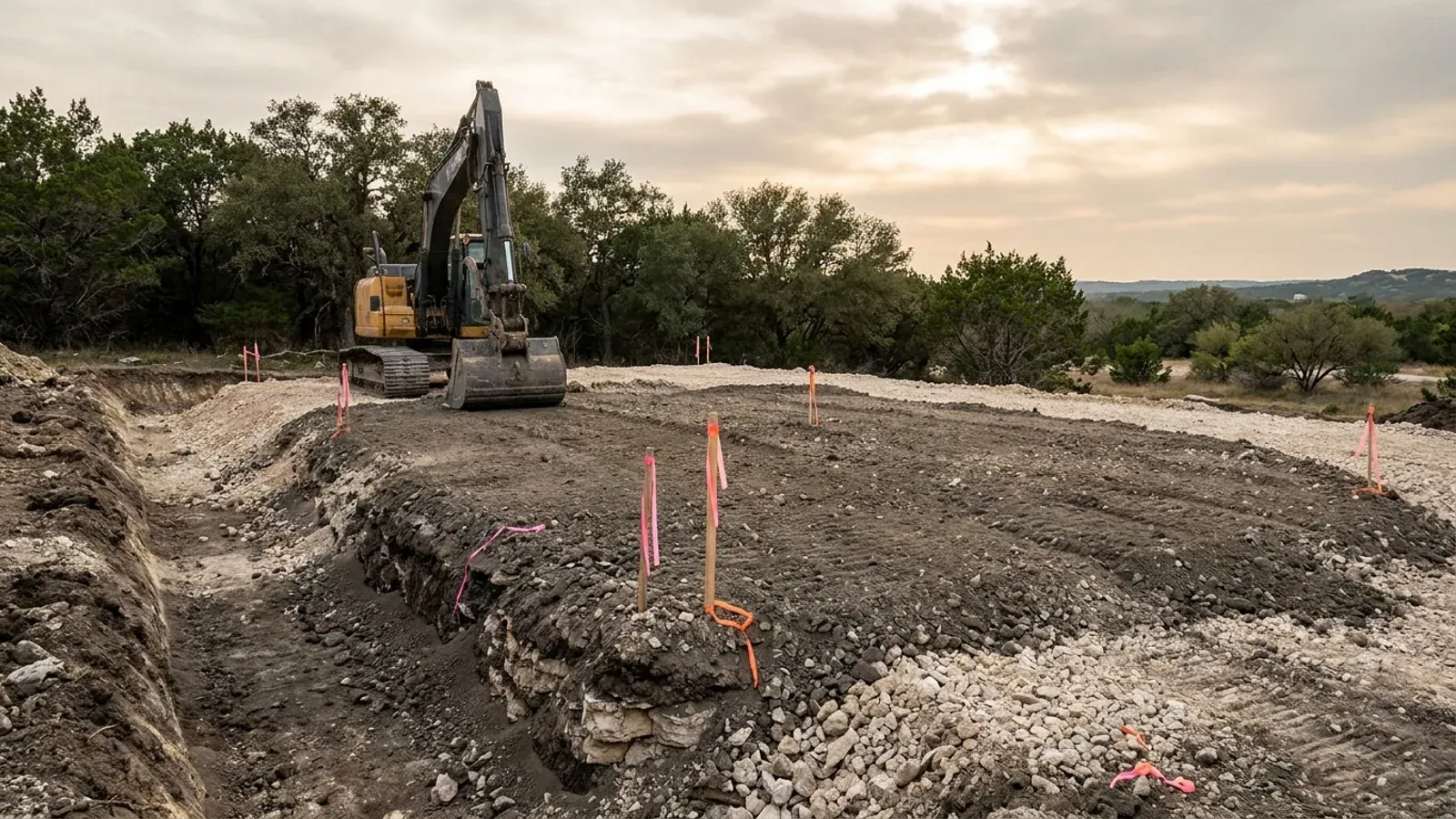
An excavator grading a compacted building pad on a cleared lot, with survey stakes and a drainage swale visible.
Below the slab

The expensive surprises are in the ground, not the building

What moves a Texas budget is usually below grade, and it is soil rather than rock: shrink-swell clay. The Blackland Prairie and the Gulf Coast clays move enough between a wet season and a dry one to drive the foundation design across the state's largest markets, which is why several DFW cities require an engineer's seal on the foundation of every new house. Those are the same conditions that decide whether a septic field passes its soil and site evaluation, so the grading plan, the foundation and the drainfield get resolved together rather than one at a time. We price the dirt before we price the building.

What we build in Cameron County

All nine of our services — kits, custom plans, post-frame and steel construction, site preparation, permitting and engineering, through to turnkey builds — are available across Cameron County. What a project costs depends far more on the parcel than on square footage, so we work from your land rather than from a rate card.

See what we build

What a build looks like

Three stages every Cameron County project passes through, from a raw parcel to a finished home. Site work first, because that is where the budget is decided.
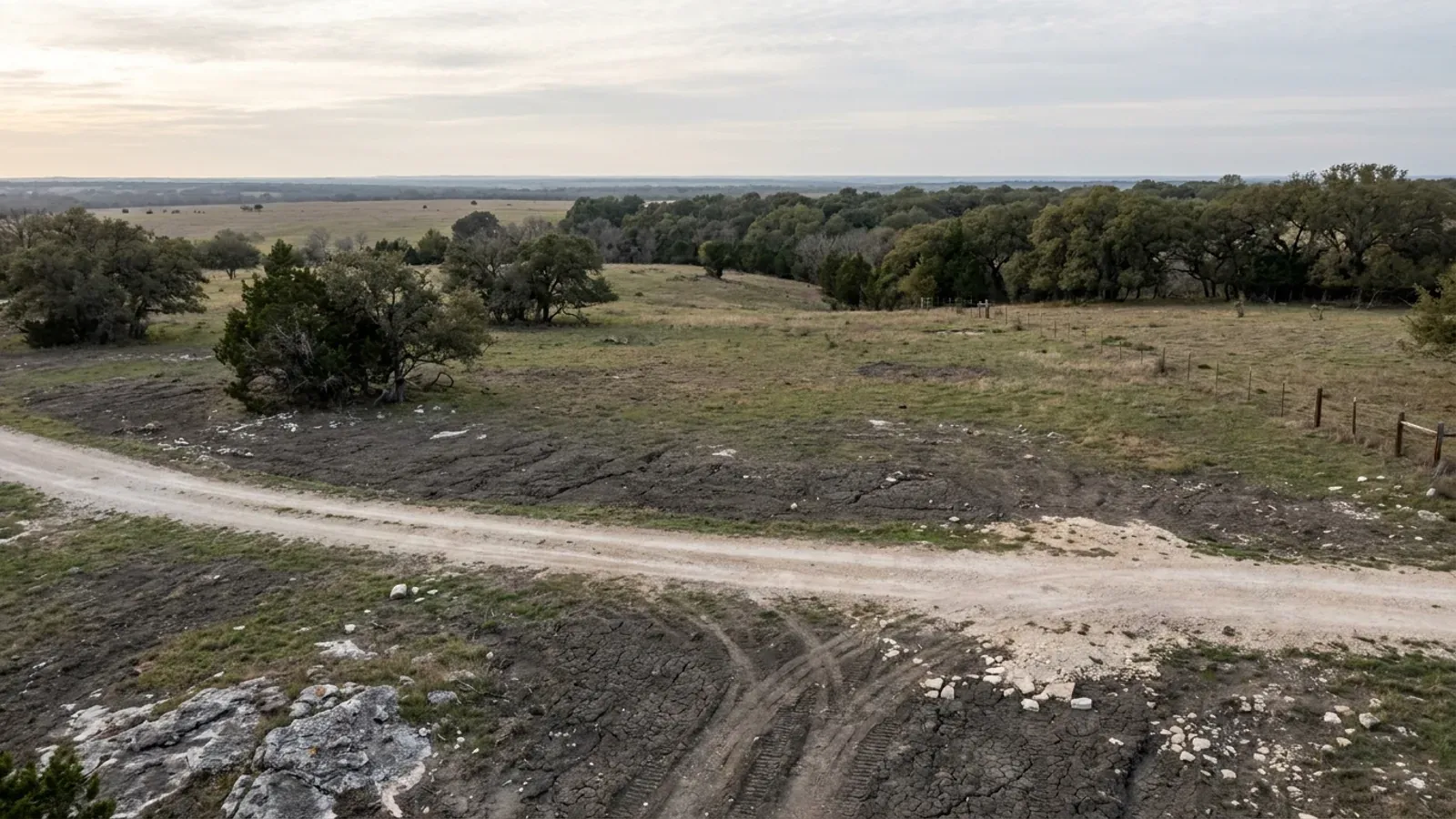
Aerial view of an undeveloped rural lot with cleared grass, a live oak and cedar elm treeline, and a pale gravel access track.
Stage one

The parcel

Zoning, setbacks, flood zone and utility access get checked before anything is drawn.

An excavator grading a compacted building pad on a cleared lot, with survey stakes and a drainage swale visible.
Stage two

Pad and permit

Clearing, grading and a compacted pad, while the submittal works through Cameron County.
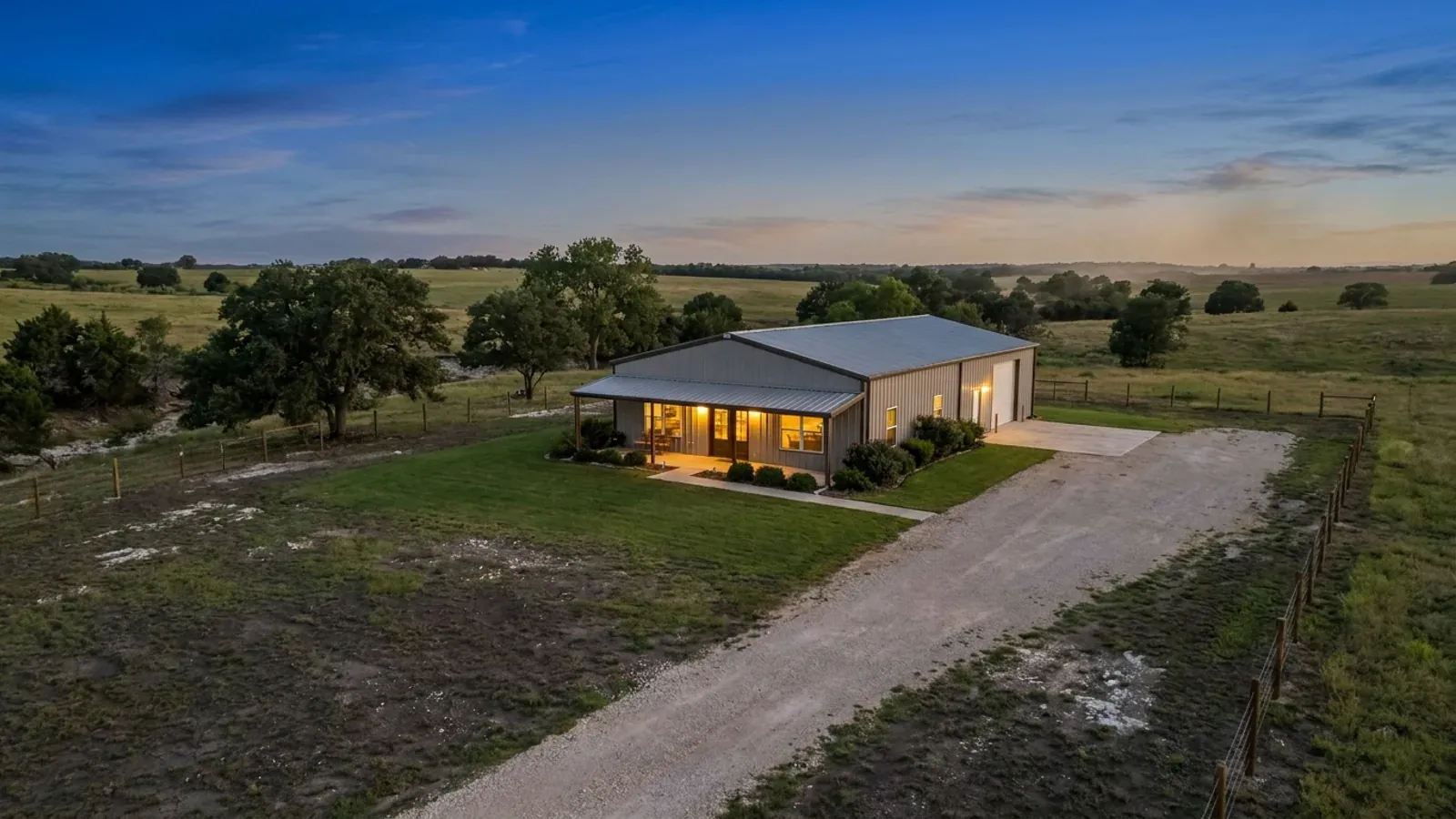
A finished barndominium at dusk with warm interior lighting glowing through its large windows.
Stage three

Frame to finish

Shell erected and dried in, then systems, insulation and interior finish through to CO.

Those are the rules for Cameron County. Tell us what you want to build and we will draw it to them.

Where we build around Cameron County

Cameron County and the rural land around it. The buildable acreage for a project this size usually sits outside the city limits, which is frequently what changes who issues your permit.

Our Cameron County service area, covering Cameron County and the surrounding rural acreage. This map marks the territory we serve, not a branch location.

Nearby areas we build in

Others we cover in this part of Texas. The permitting authority, the adopted design criteria and the zoning can all differ from one to the next.

Building in Cameron County: common questions

12 questions we get asked most often about building in Cameron County. If yours is not on the list, ask it directly.

Does Cameron County really inspect a house? Everywhere else in Texas the county cannot.
It does, and Cameron is the sharpest exception on this site. The Cameron County Flood Damage Prevention and Building Regulations, Order No. 2022-006030 adopted on 5 July 2022, apply to all unincorporated areas of the county, and Article 3 Section C requires a building permit in connection with any development in the area governed by the order. Article 5 Section I then sets six inspections carried out by a designee of the County Engineer: plumbing rough-in, foundation, nail pattern at a minimum 8D or 10D or per engineer design, frame, insulation, and final. The same section says that to assure the citizens of Cameron County the reduction of loss due to flooding, high winds and hurricanes, the order requires structures to be in compliance with minimum requirements of the ICC family of codes and the National Electrical Code. Be clear about what that last sentence does and does not say. It names no edition of the residential code, and the order's own applicable-codes article, Article 6, points at the Cameron County Fire Marshal rather than at a year. The only edition-specific adoption anywhere in the order is the 2015 International Fuel Gas Code. So there is a real permit, a real inspector and a real compliance sentence, and there is no published residential code edition behind it. Ask the Planning and Inspections Division at (956) 247-3500 what they inspect to before you draw.
Is this the Subchapter F county building code I have read about?
No, and the difference matters. Subchapter F of Local Government Code chapter 233 is the opt-in that lets a county apply a frozen 2006-era version of the residential code, and section 233.153 is explicit that even where a county has opted in there is no county permit, no county fee and no county inspector, because subsection (d)(1) forbids requiring prior approval, subsection (f) forbids charging a fee, and section 233.154(a)(3) leaves the inspections to be contracted by the person building. Cameron's order does all three of the things Subchapter F forbids: it requires a permit before you start, it charges by the square foot, and county staff do the inspecting. So whatever authority it rests on, it is not a Subchapter F order, and its stated authority is Texas Water Code section 16.315, the flood statute. Whether Cameron ever separately adopted a Subchapter F order in 2009 could not be established. The county keeps no codified county code, its agenda archive only begins in 2015, and it publishes agendas rather than minutes, so there is no deliberation record to search. Section 233.152 has no publication requirement, so an absence of documents proves nothing either way.
What is Subchapter G and why does only Cameron have it?
Since 1 September 2025 Cameron County has a subdivision subchapter written for it alone. Subchapter G of Local Government Code chapter 232 applies, in the statute's words, only to a county that borders the United Mexican States and the Gulf of Mexico. The same act added section 232.022(a-1), which says Subchapter B, the fifty-mile border-county subchapter, does not apply to a county to which Subchapter G applies. The Senate Research Center's analysis of the bill states that the changes are applicable only to Cameron County. In practice Subchapter G is the same colonias-prevention machinery Subchapter B carried, with limited local discretion added: it requires a surveyed and engineered plat where any lot is under five acres, requires the county to adopt and enforce the Water Development Board's Model Subdivision Rules for water and sewer, requires bonding or construction of those facilities before lots are sold, and carries criminal penalties for selling lots without them. What it does not do is regulate how a building is built. That is a separate question, answered by the county's building regulations and by the insurance rule.
Does any of that reach a single house on a lot I already own?
Subchapter G itself does not. It is triggered by dividing land into two or more lots where at least one is under five acres, and section 232.202(e) says it does not apply at all if every lot in the subdivision is five acres or more. One provision does reach an individual owner, though, and it is worth checking before you buy. Section 232.211(a) says a utility may not serve or connect subdivided land with water or sewer unless the commissioners court has issued a certificate or determined that the plat was reviewed and approved. The way out for an existing lot is section 232.211(b)(2): the land is a lot of record, meaning its boundaries were fixed by a recorded plat or a recorded deed before 1 September 1989 and it has not been subdivided since, and operable sewer service is installed as determined by the authorised on-site sewage agent. If the lot you are looking at was carved out by metes and bounds after 1989 and never platted, that is a water-meter problem, not a framing problem, and it is settled at the title company and the county rather than on site.
How much does the county building permit cost?
Cameron County publishes the schedule, so these are its figures rather than ours. Table J.1 of the building regulations prices residential new construction by floor area: under 500 square feet is $65.00; 500 to 1,000 square feet is $0.195 per square foot; 1,000 to 5,000 square feet is $65.00 plus $0.13 per square foot; 5,000 to 10,000 square feet is $390.00 plus $0.065 per square foot; and above 10,000 square feet it is $715.00 plus $0.0325 per square foot. On top of that Section J.3 lists a $25.00 application fee, a $75.00 plan review fee per plan set, $50.00 for a residential utility connection, $50.00 for a single trade permit and inspection, and $75.00 to re-inspect after a failed inspection. There is also a site development fee for developments exempt from platting, at $50.00 plus $0.075 per square foot of disturbed area under an acre. Starting work without a permit runs up to $100.00 a day to a $5,000.00 cap, and the Building Official may double the permit fee. Confirm current figures with the county before you budget.
What does being in the windstorm catastrophe area change?
It puts a second, newer code on the same building for a different purpose. Cameron is named in the statutory list of first tier coastal counties at Insurance Code section 2210.003(4)(D), and the Department of Insurance says that except for Harris County the entire county of each of the counties on its map is part of the windstorm program. Inside that boundary, 28 Texas Administrative Code section 5.4013 requires structures constructed, repaired or added to on and after 1 April 2026 to comply with the 2024 International Residential Code or the 2024 International Building Code in order to be eligible for catastrophe property insurance. That is not a building permit and it does not repeal anything a city adopted. Inside Brownsville or Harlingen both are live: the city's edition governs its permit, the 2024 edition governs whether the association will insure the finished building. In unincorporated Cameron County you now have three things reaching one house at once, which no other page on this site has to say: the county's own permit and inspections, the insurance rule's 2024 edition, and the subdivision rules on the land underneath. Worth noting that Hidalgo County next door is a second tier county and is not designated, so McAllen and Edinburg are outside a programme that Brownsville and Harlingen are inside.
How is the windstorm certificate obtained, and what if I skip the inspections?
In three steps, and the first comes before the slab. Insurance Code section 2210.2515(b) requires written notice to the Department of Insurance of an intent to construct before construction begins, which is the WPI-1 application. During the work an appointed qualified inspector or a department inspector files an inspection verification, and the department then issues the WPI-8 certificate of compliance. Cameron County's own residential permit checklist folds this into the local process by asking for windstorm information provided by a windstorm state certified engineer. If the inspections are missed, the completed-construction route is engineer-only: section 2210.2515(c) has the department issue a certificate for finished work only where a licensed professional engineer has sealed the design or a sealed post-construction evaluation report. There is a third certificate worth being precise about. The association's own WPI-8-C is still listed on its current eligibility page as an acceptable certificate, so an existing one has not stopped counting. What ended on 31 May 2020 is the association issuing new ones. Both halves of that are true and people get it wrong in both directions.
Is windstorm insurance legally required?
No. The Department of Insurance says plainly that windstorm insurance is not required by law in Texas, but that if you live near the coast and have a mortgage your lender will likely require it. The association is also a market of last resort: its own eligibility criteria require that you have been denied coverage by at least one authorised insurer actively writing wind and hail in the designated area. Insurance Code section 2210.258(b) then binds the association rather than you, saying it may not insure a structure until a certificate of compliance has been issued. There is one more condition that catches people out on this stretch of coast, and it is the single place the wind and flood regimes touch: property in flood zones V, VE or V1-30 constructed, altered, remodelled or enlarged on or after 1 September 2009 that can obtain flood insurance through the NFIP must provide proof of that flood coverage to be eligible.
How high does the floor have to be?
Higher than most people expect, and higher than the flood map alone implies. Article 5 Section A of the county's building regulations sets three cases. In a flood prone or flood hazard area the lowest finished floor must be 12 inches above the base flood elevation, an estimated BFE, or the depth number on the county's FIRM, or 24 inches above the highest adjacent natural grade, whichever is higher. Where no depth number is given and the tract is in a flood hazard area, it is at least 24 inches above the highest adjacent natural grade. And where the tract lies in an area of minimal flood hazard, which is outside the special flood hazard area altogether, the finished floor must still be at least 18 inches above the street centreline or above natural grade, whichever is greater. That third one is the trap. A reader who checks the flood map, sees an X zone and stops has the wrong answer in Cameron County. The order also asks for fill compaction to TxDOT Item 132 and for the bottom of all footings to reach at least 12 inches below undisturbed soil, and the map basis is the Flood Insurance Study for Cameron County dated 16 February 2018.
Does the ground here need an engineered foundation?
On much of it, yes, and it is statutory rather than a preference. Occupations Code section 1001.056 exempts a private dwelling from the Engineering Practice Act, but subsection (c)(2) switches that exemption off for a slab on expansive soil, and Cameron County is Vertisol country. SSURGO survey area TX061 puts Harlingen clay across 49,095 acres, a smectitic Sodic Haplusterts running 55 percent clay at the surface and 68 percent below it with linear extensibility of 17, and Lomalta clay across another 40,839 acres at 67.5 percent clay and the same extensibility. Vertisols total 127,864 component-weighted acres of the survey. Not all of the county is like that: Willacy fine sandy loam reads 15 percent clay at the surface with extensibility of 1.5, and the Laredo and Raymondville loams on the higher river terraces are milder. Which one you are on is a parcel-level question, and the answer changes what the foundation costs. The county's own permit checklist asks for a PSI reading, and the same section of the Occupations Code that reaches your slab also carves the coast out of the exemption for windstorm certification work.
Who handles septic, and does the shop bay enlarge the drainfield?
TCEQ's authorised agent search returns eleven records for Cameron County, and the shape is unusual. The county is the authorised agent for the entire county except the Town of Bayview, which holds its own designation for its town limits. Eight cities including Harlingen, San Benito, Los Fresnos, La Feria, Combes, Primera and Santa Rosa hold designations that TCEQ records as administered by Cameron County, and the City of Starbase, incorporated in 2025 at Boca Chica, already holds its own. TCEQ Region 15 in Harlingen rounds out the list. The county's Environmental Health Department at 1390 W. Expressway 83 in San Benito, (956) 247-3599, is where the permit starts, and it starts early: the building regulations say a copy of a septic tank permit is required before a building permit, electrical permit or water meter permit will be approved. On sizing, TCEQ sets design flow off the number of bedrooms or the living area of the home, whichever is higher, and living area is not total structure area, so an unconditioned shop bay does not by itself enlarge the system. Settle the design flow with the department before the footprint is fixed, because on the county's clay flats the loading rate is at the bottom of the state's range and drainfield area is the constraint.
Are there rules about how the building looks or where it sits?
Yes, which is genuinely unusual for a Texas county on unincorporated land, so read them before you finalise a site plan. Article 5 Section P sets building setback lines at a minimum of 25 feet from the edge of the right of way on public roads, 50 feet on major highways and roads, 5 feet from adjacent property lines, or whatever the recorded plat shows, whichever is stricter. Article 5 Section L governs a second habitable unit: one accessory dwelling per lot, only where the principal use is a single family detached dwelling, its own permit required, and on a lot under 10,000 square feet no more than half the principal dwelling's floor area and no more than 1,000 square feet. The owner must occupy one of the two units, sign a notarised affidavit saying so, and record a covenant putting future owners on notice, and the accessory unit must have a roof pitch, siding and window proportions identical or similar to the principal residence. Article 5 Section Q keeps a junkyard or salvage yard 50 feet off a public street right of way and caps stacking at eight feet, though it does not apply to a yard used only for farm equipment. Note that Local Government Code section 233.153(d)(2) denies a commissioners court zoning power, and none of this is a zoning ordinance; it is a flood and building order. Take the specifics to the county rather than to us.

Building in Cameron County?

Start with the plan. Tell us what you want to build and we will draw it, then confirm what Cameron County will actually let you put on the parcel and what wind load it has to meet. That conversation costs nothing.