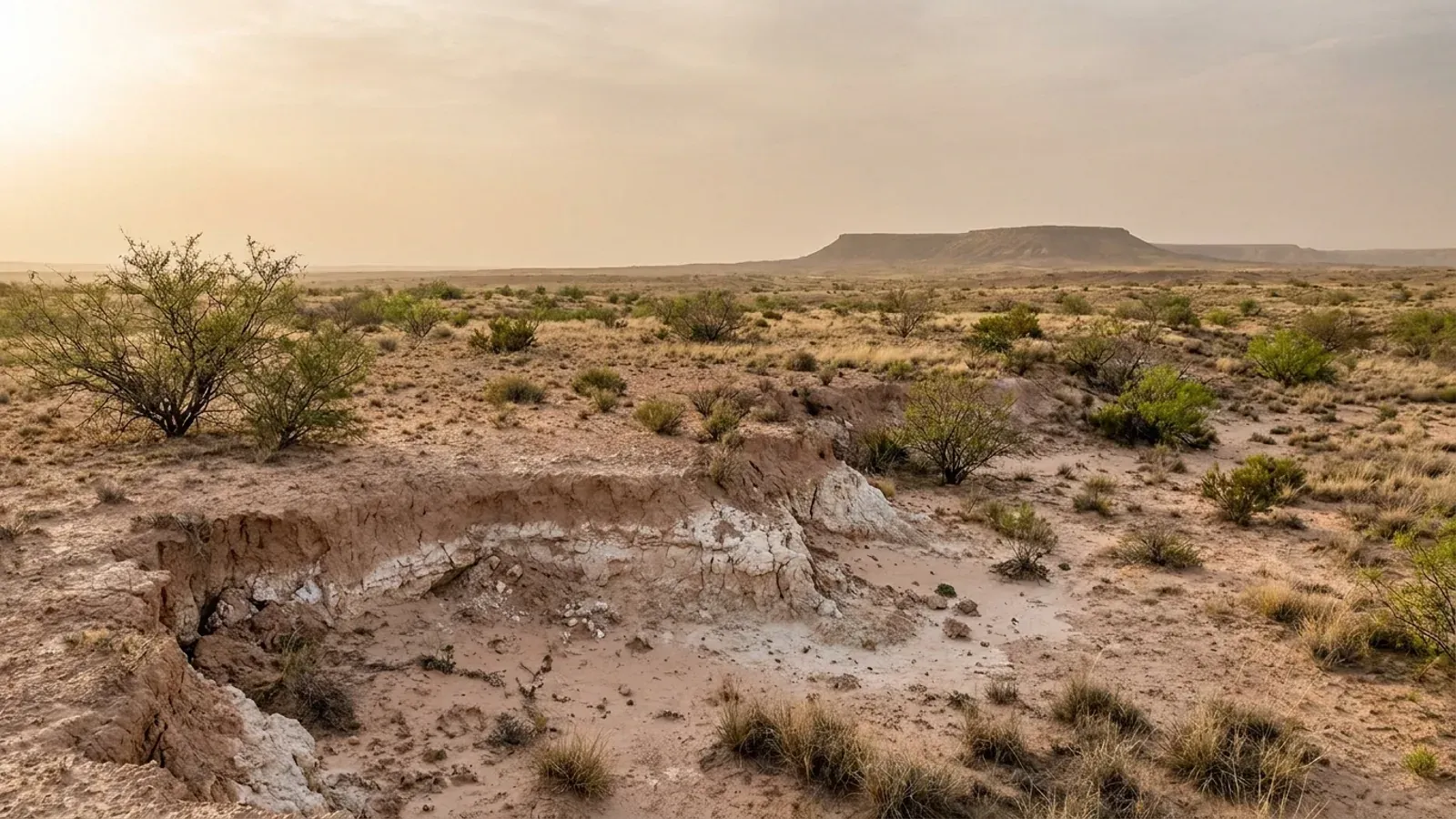
Open semi-arid West Texas rangeland with sparse mesquite and a hard white caliche layer breaking through a shallow cut bank.
Ector County No county building code

Barndominium Builders in Ector County, TX

Ector County is 898 square miles of Permian Basin holding 165,171 people, and its shape is unusual. There are only two incorporated towns, Odessa and Goldsmith, and the roughly 50,000 people outside them are not spread thin: West Odessa alone holds 33,340 of them on 62 square miles, a settlement the size of a small city with no city government, no zoning and no building code. The county does issue permits, which surprises people. A Development Structure Permit is required for every new structure and it costs nothing at all; its stated job is to put the finished floor at or one foot above the crown of the road, and it examines no plans. What really gates a build here is the septic authorisation, a floodplain determination that every septic application has to clear first, and the mineral estate underneath. There are 12,253 oil wells in this county, about fourteen to the square mile.

Ector County at a glance

County
Ector County
Population
165,171
Where we build
Odessa, Midland County, Midland

ZIPs 79741, 79758, 79759, 79761, 79762, 79763, 79764, 79765 and more

Site visits
Site visits scheduled across Ector County, Odessa out to the county line

Building conditions in Ector County

What actually changes from one Texas jurisdiction to the next: who issues the permit, whether the residential code is enforced there at all, what the structure has to be engineered to, and what the ground is like. These are the numbers your drawings have to satisfy.

Build conditions for Ector County , Texas . BUILD CONDITIONS ECTOR COUNTY, TXEctor CountyNO COUNTY BUILDING…ADOPTED RESIDENTIAL CODENO COUNTY BUILDING…This jurisdiction publishes no design wind speed. It is settled in writing with the authority overyour parcel before the frame is ordered.ZONING · NONE — A TEXAS COUNTY CANNOT ZONEHalf an acre on a public water suppl…Local Government Code Sec. 233.153(d)(2) does not authorise acommissioners court to adopt or enforce zoning, and Ector County ha…WHO ISSUES THE PERMITEctor County Development Services, w…Development Services (permits and septic): 1010 East 8th Street,Suite 114, Odessa, TX 79761, 432-498-4241,…
Build conditions for Ector County, drawn from the sourced facts on this page. Every figure above is cited in the quick-facts panel below, with its source and vintage.
The county issues a permit for every new structure, and it is free
Ector County Development Services lists five permits required for developments in the county, and the first is the Development Structure Permit. Its published purpose is narrow and specific: to ensure that the finished floor elevation is at or one foot above the crown of the road or top of curb. The page then says, in terms, that there is no cost to obtain a permit. The form is one page. It asks for a valid address, a site plan showing the structure, septic and water well within the property lines with dimensions from each other, a septic permit number, an Ector County Utility District number where you are connecting to ECUD, and an elevation certificate if the tract is in a flood zone. It is valid for six months and the county notes that an inspector will request proof of it at the job site. Nothing on it is a plan review. The word residential appears only as a tick box; only the commercial section demands professional design.

Ector County Development Services, Permitting — https://www.ectorcountytx.gov/265/Permitting; Development Structure Permit form and requirements page — https://www.ectorcountytx.gov/DocumentCenter/View/164

Every septic application clears a floodplain check first, even out of the floodplain
Step three of Ector County's own step-by-step septic instructions is a Development Permit Exemption Certificate, sent to the Ector County Engineering Department at 7613 W. Dunn. The county says the certificate serves two purposes: to validate the property address and to confirm the tract is not in a Special Flood Hazard Area. It has to be signed before an Authorization to Construct can be picked up. So the document certifying that you are outside the floodplain is itself a mandatory step on the way to a house, and its own text says it exempts the applicant from the development standards required by Ector County flood plain management regulations. Where the tract is in a flood hazard area the rule splits by zone, and the two halves are not the same rule. That is the county's own sequencing, and it is why the septic office and the floodplain office both have to be called early.

Ector County, Step by Step Instructions to Process an OSSF Application, revised 26 July 2018 — https://www.ectorcountytx.gov/DocumentCenter/View/374; Ector County Engineering Department Development Permit Exemption Certificate — https://www.ectorcountytx.gov/DocumentCenter/View/365

The septic site test here is a sieve test, and 30 percent gravel changes the system
Most of Texas argues about clay. Ector County publishes a threshold about stone. Its septic instructions require a TCEQ-licensed site evaluator to dig a minimum of two test pit holes five to seven feet deep and run a sieve test on one soil sample from each, to determine the gravel content of the soil. The county then states the consequence plainly: if the gravel content is less than 30 percent a standard system can be installed, otherwise a soil substitution drainfield will have to be installed. That is a different and more expensive build, and the county's own design sheet reflects it, dropping the 0.6 leaching chamber factor from the trench length formula for a soil substitution and requiring two feet of good soil on all sides and beneath the panels. On caliche ground this is the number that decides what the septic system costs, and it is decided before anything is designed.

Ector County, Step by Step Instructions to Process an OSSF Application, step 2, revised 26 July 2018 — https://www.ectorcountytx.gov/DocumentCenter/View/374; Ector County Application for On-Site Sewage Facility, technical information sheet — https://www.ectorcountytx.gov/DocumentCenter/View/167

12,253 oil wells in 898 square miles, and the mineral estate wins
The Railroad Commission's own county tables, as of February 2025, put 12,253 oil wells in Ector County: 5,287 regular producing, 1,320 shut in, 3,839 shut in under rule 14(b)(2) and 1,807 injection wells. There are a further 132 gas wells. That is about fourteen oil wells to every square mile of the county. It matters because in Texas the mineral estate is dominant over the surface. In Merriman v. XTO Energy the Supreme Court of Texas noted that the surface owner's home and a barn were on the tract and he still lost his challenge to a drilling site, and the accommodation doctrine that might have helped him protects an existing use. A house that has not been built yet is not an existing use. Whether the minerals under a particular tract were severed decades ago is a title question, not a county one, and it is answered by the County Clerk's records and the title commitment.

Railroad Commission of Texas, Oil Well Counts by County and Gas Well Counts by County, as of February 2025 — https://www.rrc.texas.gov/oil-and-gas/research-and-statistics/well-information/well-distribution-by-county/; Merriman v. XTO Energy, Inc., No. 11-0494 (Tex. 2013)

There is a Railroad Commission seismic response area with its western end in this county
The Railroad Commission's September 2021 Notice to Oil and Gas Operators describes the Gardendale Seismic Response Area as an area of the Midland Basin from northeast Ector County to southwest Martin County, and names two magnitude 3.6 earthquakes northeast of Odessa, in February 2020 and May 2021, among the six felt events that prompted it. The Commission identified 76 permitted saltwater disposal wells inside it, capped injection at 10,000 barrels a day per well, stopped issuing new permits there, and in December 2021 suspended all 33 deep disposal permits within the boundaries. The honest counterweight belongs here too: inside Ector County's own bounds the reviewed TexNet and USGS catalogue records 48 events at magnitude 2.5 or above, 15 at 3.0 or above, three at 3.5 or above and none at all at 4.0 or above, the largest being a magnitude 3.6 on 26 October 2021, nine kilometres north-northeast of Odessa.

Railroad Commission of Texas, Notice to Oil and Gas Operators, Gardendale Seismic Response Action, September 2021 — https://www.rrc.texas.gov/media/4ryp5kqr/nto-gardendale-seismic-response-action_9-22-2021.pdf; RRC Seismicity Response page, December 2021 action; USGS/TexNet reviewed earthquake catalogue, Ector County bounds, queried 1 September 2026 — https://earthquake.usgs.gov/fdsnws/event/1/query

There is no groundwater conservation district here, and the aquifer is not the Ogallala
West Texas is usually the part of the state that has groundwater districts, so this is worth stating plainly: Ector County has none. The Texas Water Development Board's 2021 joint planning summary for Groundwater Management Area 7 lists every district in the management area, eighteen of them from Coke County to Uvalde County, and Ector County appears in none. The district whose name suggests otherwise, the Permian Basin Underground Water Conservation District, is described by the Water Development Board itself as formerly the Martin County Underground Water Conservation District, and it does not reach here. The aquifer is also not the one people expect. The Board's county table files Ector under the Edwards-Trinity Plateau, Pecos Valley and Trinity system, not the Ogallala, at 4,925 acre-feet a year in the Colorado basin and 617 in the Rio Grande basin. So no district permits your well, none registers it, and none holds data on what is happening under your tract.

Texas Water Development Board, Groundwater Management Area 7, Modeled Available Groundwater by County and by Groundwater Conservation District, 2021 Joint Planning (GAM Run 21-012 MAG) — https://www.twdb.texas.gov/groundwater/dfc/docs/summary/GMA7_MAGsbyCounty_2021.pdf; TWDB Groundwater Conservation District information — https://www.twdb.texas.gov/groundwater/conservation_districts/gcdinfo3.asp

Also worth knowing before you build in Ector County

Zone AE and Zone A get different rules, and a private firm administers both
Ector County's Engineer of Record and Floodplain Administrator is a private engineering firm, Landgraf Crutcher & Associates. Its notice, issued jointly with the Health Department and Public Works, sets two different standards. In Zone AE the owner must obtain an Elevation Certificate proving the finished floor of the lowest level and all associated appliances, air conditioning condensers included, are at or above the Base Flood Elevation, signed by a licensed professional engineer, architect or land surveyor. In Zone A there is no Base Flood Elevation to work from, so the county uses its own form and requires the lowest level to be at least two feet above the natural grade, certified by the builder or the installer rather than by an engineer. Two zones, two elevations, two different people signing. Nothing about either rule can be carried over from another Texas county.

Ector County notice, Ector County Health Department, Public Works and Engineer of Record and Floodplain Administrator (Landgraf Crutcher & Associates) — https://www.ectorcountytx.gov/DocumentCenter/View/708; Elevation Certification in Zone A Areas in Ector County form — https://www.ectorcountytx.gov/DocumentCenter/View/363

The county is its own septic agent for the whole county, with nothing carved out
TCEQ's authorised agent register returns two records for Ector County: the Ector County Authorized Agent, area served entire County, and TCEQ Region 07 in Midland as the overseeing regional office. There is no city carve-out, no carve-in, no river authority and no separate health district holding its own designation, which is the plainest of the nine arrangements found across Texas on this build. The published fee is 250 dollars for a single-family residence and 450 dollars for a commercial or institutional system, non-refundable, and the county allows itself the full 30 days the state gives to approve or deny. One caution: two current county forms give two different offices, Development Services at 1010 East 8th Street and the Health Department at 221 N. Texas Avenue. The fees agree; call 432-498-4241 before you post anything.

TCEQ On-Site Sewage Facility authorised agent search, Ector County (county code 68), queried 1 September 2026 — https://www6.tceq.texas.gov/oars/index.cfm?fuseaction=search.county; Ector County Application for On-Site Sewage Facility — https://www.ectorcountytx.gov/DocumentCenter/View/167 and OSSF Application Packet — https://www.ectorcountytx.gov/DocumentCenter/View/371

Land that was not legally subdivided cannot get a septic permit
The sharpest sentence in Ector County's published material is not in an order, it is in the county's subdivision answers: if the land was not legally subdivided, we are not able to permit a septic system. That is the real gate. No plat means no septic permit, no septic permit number means no Development Structure Permit, and no Development Structure Permit means no house. The county's Subdivision and Manufactured Home Rental Community Regulations, effective 28 December 2022, adopt the statutory plat exceptions in Local Government Code sec. 232.0015 whole and add only two local ones. The second is a Permian speciality: a division for oil, gas or mineral production, or for generating or transmitting electricity including wind farms, is exempt from platting, but only while no buildings on the land are constructed to be occupied on a continuous basis, and the platting requirement snaps back the moment the land passes to someone who does not qualify.

Subdivision and MHRC Regulations for Ector County, Texas, effective 28 December 2022, secs. 4.1(A)–(C) — https://www.ectorcountytx.gov/DocumentCenter/View/679; Ector County Subdivision Frequently Asked Questions — https://www.ectorcountytx.gov/DocumentCenter/View/713

Two towns, and a suburb of 33,000 people that is not one of them
Ector County has exactly two incorporated places. Odessa, 114,428 people at the 2020 census, and Goldsmith, 236. Everything else is unincorporated, and the biggest piece of it is not empty ranch country. West Odessa, a census designated place of 33,340 people spread over 62 square miles immediately west of the city, has no city government at all: no zoning, no municipal building code, no city inspector. Gardendale, north of town, adds another 2,020. Netting the two towns out leaves roughly 50,000 people on about 846 square miles, near enough 60 to the square mile, which puts Ector in the genuinely rural band of the Texas counties on this site. But the average conceals the shape. Two thirds of the county's unincorporated population lives at about 537 people to the square mile in one settlement.

U.S. Census Bureau, 2020 Census population and land area for Ector County, Odessa city, Goldsmith city, West Odessa CDP and Gardendale CDP, via TIGERweb Census2020 — https://tigerweb.geo.census.gov/arcgis/rest/services/Census2020/tigerWMS_Census2020/MapServer

A licensed plumber is required even where nobody inspects the house
The rural exemption in the Texas Plumbing License Law does not extend to plumbing performed in conjunction with new construction. So a Texas-licensed plumber is required on a new house on unincorporated Ector County land whatever the county's position on building codes turns out to be, and whatever inspections nobody is carrying out. The same pattern runs through the other trades and services that do carry a state licence here: the septic site evaluator and installer must be licensed by TCEQ, the water well driller must be licensed, and the Zone AE elevation certificate has to be signed by a licensed professional engineer, architect or land surveyor. No county building code does not mean no rules; it means the rules come from the state and from the people whose signatures the county's own forms demand.

Texas Occupations Code sec. 1301.052 — https://statutes.capitol.texas.gov/Docs/OC/htm/OC.1301.htm; Ector County Step by Step Instructions to Process an OSSF Application — https://www.ectorcountytx.gov/DocumentCenter/View/374

The state energy code reaches this land whatever the county does
Health and Safety Code sec. 388.004 obliges a builder outside any municipality to certify that a new single-family house complies with the state energy standard and to keep that certification for three years. It applies on unincorporated Ector County land regardless of whether the county has ever adopted anything. Ector County is climate zone 3B, hot-dry, on both the pre-2021 and the 2021 county assignments, so unlike the counties around Dallas and Fort Worth the answer here does not shift with the edition being quoted. 3B is a genuinely different envelope from the humid 2A and 3A zones that cover most of the Texas markets on this site: the cooling load dominates, the humidity load does not, and a metal-clad building's air sealing and radiant control matter more here than its vapour strategy.

Texas Health and Safety Code ch. 388 secs. 388.003 and 388.004 — https://statutes.capitol.texas.gov/Docs/HS/htm/HS.388.htm; DOE/PNNL-33270 county climate zone assignments and the published IRC county tables for the 2018 and 2024 editions, Texas FIPS 48135
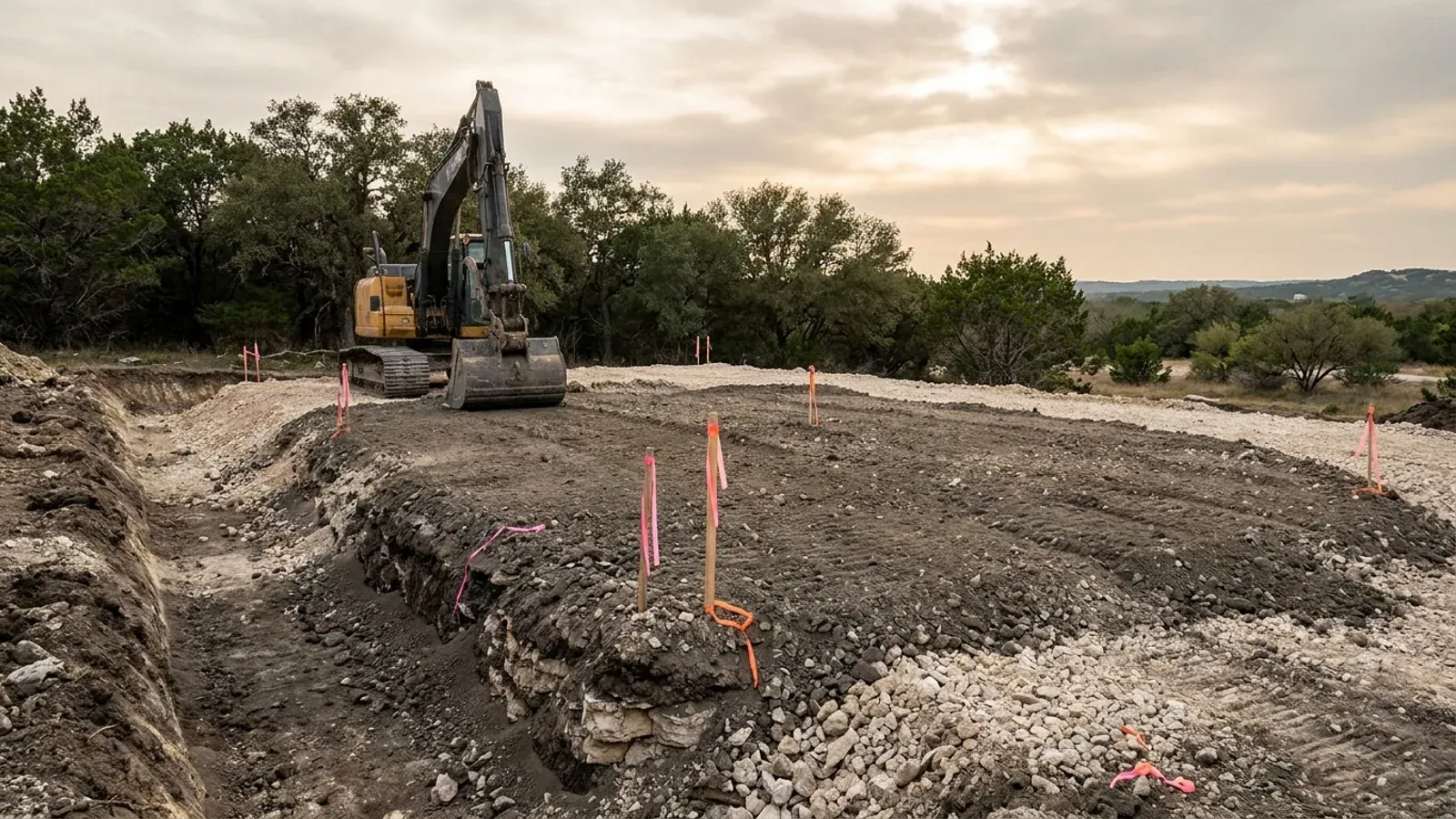
An excavator grading a compacted building pad on a cleared lot, with survey stakes and a drainage swale visible.
Below the slab

The expensive surprises are in the ground, not the building

What moves a Texas budget is usually below grade, and it is soil rather than rock: shrink-swell clay. The Blackland Prairie and the Gulf Coast clays move enough between a wet season and a dry one to drive the foundation design across the state's largest markets, which is why several DFW cities require an engineer's seal on the foundation of every new house. Those are the same conditions that decide whether a septic field passes its soil and site evaluation, so the grading plan, the foundation and the drainfield get resolved together rather than one at a time. We price the dirt before we price the building.

What we build in Ector County

All nine of our services — kits, custom plans, post-frame and steel construction, site preparation, permitting and engineering, through to turnkey builds — are available across Ector County. What a project costs depends far more on the parcel than on square footage, so we work from your land rather than from a rate card.

See what we build

What a build looks like

Three stages every Ector County project passes through, from a raw parcel to a finished home. Site work first, because that is where the budget is decided.
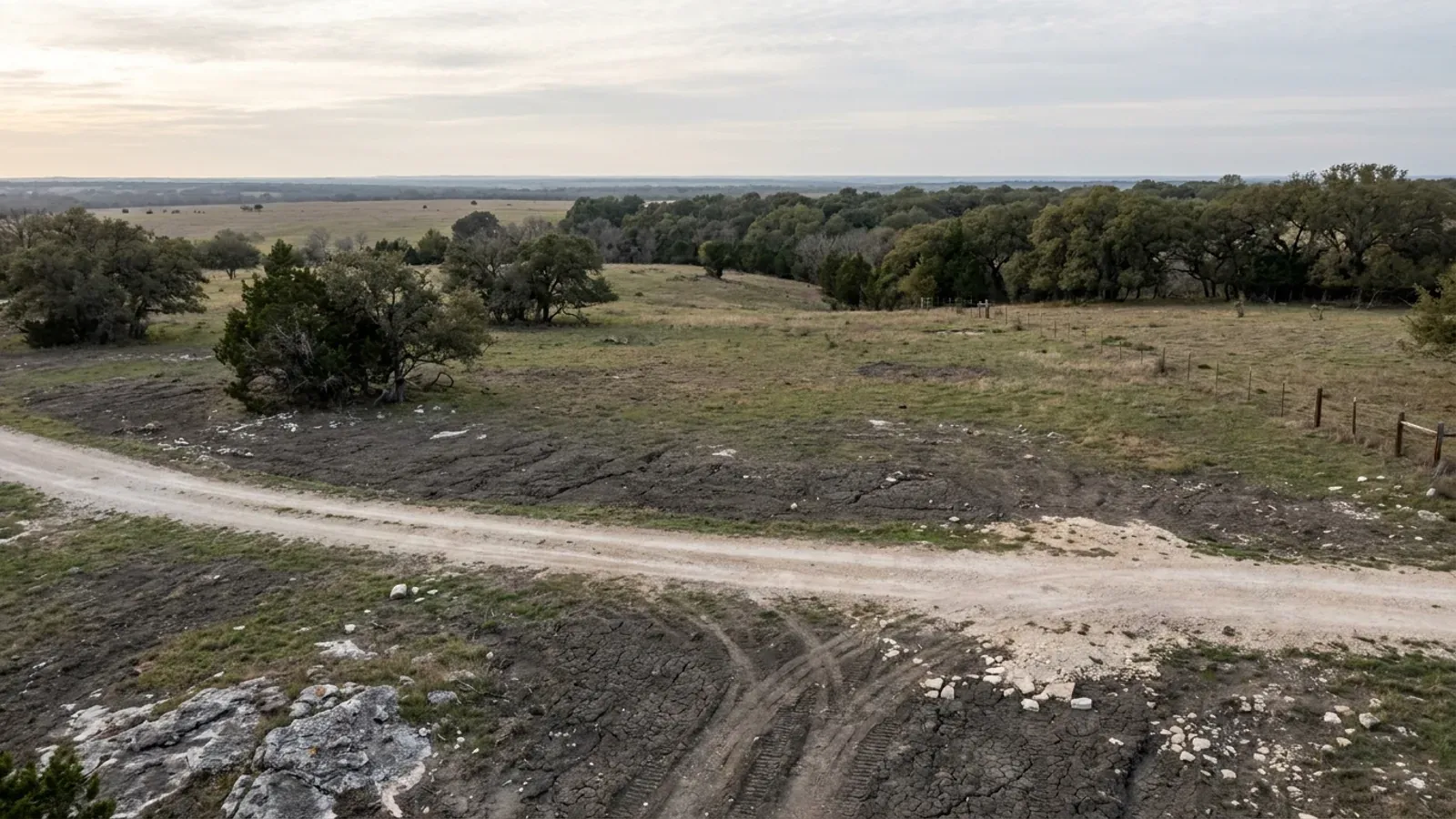
Aerial view of an undeveloped rural lot with cleared grass, a live oak and cedar elm treeline, and a pale gravel access track.
Stage one

The parcel

Zoning, setbacks, flood zone and utility access get checked before anything is drawn.

An excavator grading a compacted building pad on a cleared lot, with survey stakes and a drainage swale visible.
Stage two

Pad and permit

Clearing, grading and a compacted pad, while the submittal works through Ector County.
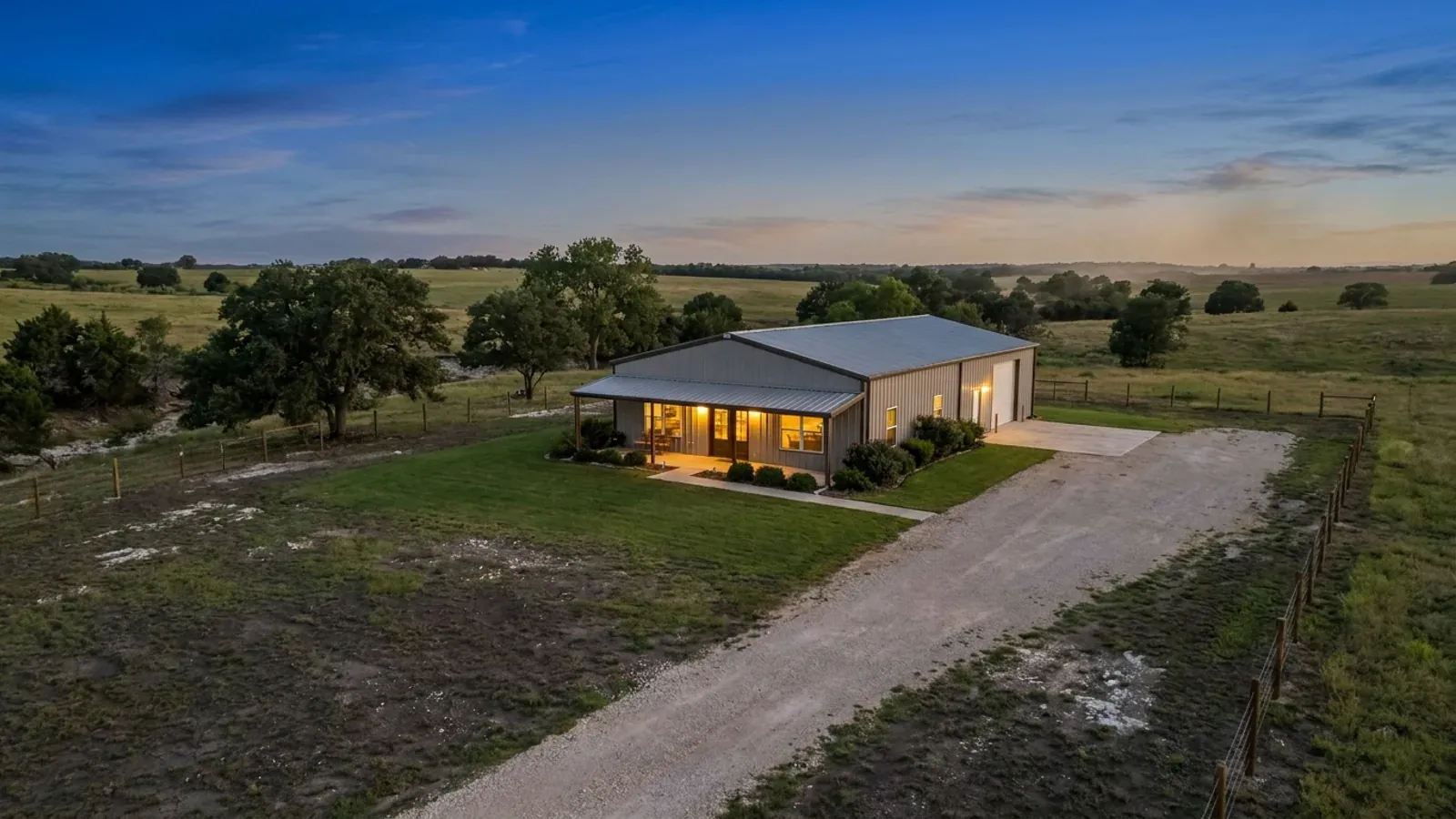
A finished barndominium at dusk with warm interior lighting glowing through its large windows.
Stage three

Frame to finish

Shell erected and dried in, then systems, insulation and interior finish through to CO.

Those are the rules for Ector County. Tell us what you want to build and we will draw it to them.

Where we build around Ector County

Ector County and the rural land around it. The buildable acreage for a project this size usually sits outside the city limits, which is frequently what changes who issues your permit.

Our Ector County service area, covering Ector County and the surrounding rural acreage. This map marks the territory we serve, not a branch location.

Nearby areas we build in

Others we cover in this part of Texas. The permitting authority, the adopted design criteria and the zoning can all differ from one to the next.

Building in Ector County: common questions

12 questions we get asked most often about building in Ector County. If yours is not on the list, ask it directly.

Does Ector County have a building code, and will anyone inspect my house?
No, and the court recorded the decision. On 24 August 2009 the Commissioners' Court took up item 7, “To consider and discuss House Bill 2833 and take any action necessary regarding Residential Building Code Standards in Ector County”, and Commissioner Gardner moved “to not consider local adoption of House Bill 2833 at this time”. The motion was seconded and passed four votes to none, and the county's own agenda item request form filed behind that minute records “Previous Court Action: None”. The only route by which a Texas county can have a residential building code at all is an order or resolution adopted under Local Government Code Chapter 233, Subchapter F, and this court declined it on the record. Every meeting from September 2009 through December 2010 has since been read as well, and House Bill 2833 appears nowhere in them. So nothing the county publishes mentions the International Residential Code, plan review, a framing inspection or a building inspector; its own development permit is free and examines no plans; and there is no county building inspector for a house. Inside the Odessa city limits the city's adopted code and its own building official apply instead. The Ector County Clerk, 432-498-4130, holds the originals.
So what permits do I actually need out here?
More than people expect, and none of them is a building permit. Ector County Development Services lists five: a Development Structure Permit, a Drive Approach permit for connecting to a county road, a septic permit, a Right-of-Way permit for work in a county right of way, and a cell tower permit. The Development Structure Permit is required for every new structure, and the county says plainly that there is no cost to obtain a permit. What it wants is a valid address, a site plan showing the structure, the septic system and the water well inside your property lines with the dimensions between them, your septic permit number, an Ector County Utility District number if you are connecting to ECUD, and an elevation certificate if the tract sits in a flood zone. It lasts six months and an inspector will ask to see it at the job site. Behind those sits the sequence that actually controls your programme: the land has to have been legally subdivided before the county will permit a septic system, and the septic application will not be accepted until a floodplain determination has come back. Start with Development Services on 432-498-4241, and start early.
What is this rule about the finished floor being a foot above the road?
It is the stated purpose of the Development Structure Permit, and it is the most unusual requirement in the county. The permitting page says the permit exists to ensure that the finished floor elevation is at or one foot above the crown of the road or top of curb. Note what that is measured from. It is not a Base Flood Elevation and it is not natural grade; it is the road surface in front of you, and it applies whether or not your tract is anywhere near a flood zone. Practically it means the pad has to be worked out against the road before the slab is set out, which on a long rural approach with a fall towards the house is a real piece of earthwork and a real cost, and it is much cheaper to design for than to fix. The rule is published on the county's own permitting page in the county's own words. It is not restated in a numbered ordinance that this page can point you to, so if the number matters to your engineer, get it in writing from Development Services on 432-498-4241 rather than relying on a web page.
How much land do I need, and what will the septic system involve?
The lot minimum is the state's: half an acre if you are on a public water supply such as the Ector County Utility District or the Greater Gardendale Water Supply Corporation, and one acre if you are on a private well. The septic process itself is more specific here than in most of Texas. You hire a TCEQ-licensed site evaluator, who digs a minimum of two test pit holes five to seven feet deep and runs a sieve test on a soil sample from each to establish the gravel content. The county states the threshold and the consequence: under 30 percent gravel and a standard system can be installed; at or above it, a soil substitution drainfield is required instead, which means imported soil, two feet of good soil on all sides and beneath the panels, and a different and larger design. On caliche and coarse ground that test is the single biggest variable in what your system costs, and it happens before anything is drawn. The county's published fee is 250 dollars for a single-family residence and 450 dollars for a commercial system, non-refundable under 30 Texas Administrative Code sec. 285.21(e), and the county allows itself the full 30 days the state permits to approve or deny.
Does the shop bay count towards the size of the drainfield?
On the record the county publishes, no, and the reason is worth understanding because it varies enormously across Texas. The state rule in 30 Texas Administrative Code Chapter 285 sizes a system from the number of bedrooms or the living area, whichever gives the larger figure, and a shop bay is not living area. Both of Ector County's current septic forms capture bedrooms and living area in square feet for a single-family residence and neither defines living area differently from the state, adds a loft rule, or counts an attached garage. That is not universal: some Texas counties and health districts do pull a loft or an attached garage into the calculation, which on a barndominium can enlarge the drainfield substantially. There is one qualification this page will not paper over. The Health Department's own description of its programme names an Ector County ordinance alongside the state statute and the state rule, and that ordinance's text is not published on the county's website. It is possible it says something about living area. Ask on 432-498-4241 before your designer sizes the field, because the answer moves money.
I have more than ten acres. Am I exempt from the septic permit?
Do not assume it, and be careful not to mix up two different ten-acre rules. The one that is established here is about platting, not septic: the county's Subdivision and MHRC Regulations adopt the statutory exceptions in Local Government Code sec. 232.0015 whole, and the county's own answers confirm that platting is not required where tracts larger than ten acres are created so long as no infrastructure is created with them and each tract has legal access to a public road. That is a plat exemption. It says nothing about whether you need a septic permit. The separate state exemption for a single-family dwelling on ten acres or more lives in Health and Safety Code sec. 366.032 and 30 Texas Administrative Code sec. 285.3, and whether it survives in Ector County depends on the county's own on-site sewage order, whose text is not published on the county's website. Across Texas this genuinely goes both ways. Smith County publishes the exemption and honours it with four conditions attached; Grayson and McLennan kill it in their own text, requiring a permit regardless of the size of the tract. Ector has to be asked, not assumed: 432-498-4241.
What about the water well?
This is where West Texas surprises people, because the region is known for groundwater districts and Ector County does not have one. The Texas Water Development Board's 2021 joint planning summary for Groundwater Management Area 7 lists all eighteen conservation districts in the management area and Ector County appears in none of them. The district whose name sounds like it should cover you, the Permian Basin Underground Water Conservation District, is described by the Board itself as formerly the Martin County Underground Water Conservation District, and it stops well short. The aquifer is not what most people assume either: the Board files Ector under the Edwards-Trinity Plateau, Pecos Valley and Trinity system rather than the Ogallala. So there is no district permit, no district spacing rule to constrain where the well sits relative to the house, and no district registration. Read that in both directions. It also means nobody is collecting data on what the aquifer is doing under your tract and there is no district to call if a neighbour's well starts drawing yours down. Get a licensed water well driller's opinion on depth and yield before you commit to a site, and note that Ector County's own permit form asks whether a private well is pressure cemented and wants the documentation if it is.
Should I be worried about earthquakes here?
This page will give you the two published facts and stop, because the step past them is engineering advice and we do not give it. First, the Railroad Commission of Texas runs an active Gardendale Seismic Response Area, which its own September 2021 notice describes as an area of the Midland Basin from northeast Ector County to southwest Martin County. That notice names two magnitude 3.6 earthquakes northeast of Odessa, in February 2020 and May 2021, among the six felt events of magnitude 3.5 or greater that prompted it, identifies 76 permitted saltwater disposal wells inside the area, caps injection at 10,000 barrels per day per well and stops new permits; in December 2021 the Commission suspended all 33 deep disposal permits inside the boundaries. Second, and separately, the model code figure: the United States Geological Survey seismic design service returns Seismic Design Category A for Odessa at Site Class D and B at Site Class E, both below Category D-zero, which is the level at which the IRC's seismic provisions start to apply to a detached one- or two-family dwelling. And the counterweight, which belongs here too: inside Ector County's own bounds the reviewed catalogue holds 48 events at magnitude 2.5 or above since the record begins in February 2019, 15 at 3.0 or above, three at 3.5 or above and none at all at 4.0 or above. The larger events are in the counties to the north and east. What to do about any of that on a specific foundation on a specific tract is a question for a Texas-licensed professional engineer, and it is a good reason to have one.
Who owns the minerals under my land, and can they drill next to my house?
In Texas the mineral estate is the dominant estate, and in the Permian Basin that is not an abstraction. The Railroad Commission's own county tables as of February 2025 put 12,253 oil wells in Ector County, of which 5,287 are regular producing and 1,807 are injection wells, plus 132 gas wells, in 898 square miles. That is roughly fourteen oil wells to the square mile. The leading case is Merriman v. XTO Energy, decided by the Supreme Court of Texas in 2013. The court recorded that the surface owner's home and a barn were on the tract, and he still lost his attempt to move a drilling site. The accommodation doctrine that surface owners rely on protects an existing surface use, which means a house you have not built yet is not protected at all. Whether the minerals under a particular tract were severed from the surface, and on what terms, is a title question that this or any other website cannot answer for you. It is answered by a search of the Ector County Clerk's records, on 432-498-4130, and by the title commitment your closing produces. Read the commitment before you close, not after, and if the tract has an existing lease read that too.
My tract is in a flood zone. What does the county require?
It depends which zone, and the two answers are genuinely different. Ector County's Engineer of Record and Floodplain Administrator is a private engineering firm, Landgraf Crutcher & Associates, and its notice with the Health Department and Public Works sets out both. In Zone AE the structure has to be placed and then an Elevation Certificate obtained proving the finished floor of the lowest level, and all associated appliances including air conditioning condensers, are at or above the Base Flood Elevation; that certificate must be signed by a licensed professional engineer, architect or land surveyor. In Zone A there is no published Base Flood Elevation, so the county uses its own Elevation Certification in Zone A Areas in Ector County form and requires the lowest level to be at least two feet above the natural grade, certified by the builder of the structure or the installer rather than by a design professional. Send the certification and a scaled development plan showing existing structures and the proposed septic system to Jonathan Cullor at LCA on 432-332-5058. And note that this is checked whether or not you think you are in a flood zone, because the Development Permit Exemption Certificate that confirms you are outside a Special Flood Hazard Area is itself a required step in every septic application.
What changes inside Odessa or Goldsmith, or in Odessa's ETJ?
Almost everything changes inside a city limit. A Texas municipality enforces its own adopted edition of the International Residential Code, issues a real permit, reviews plans, charges a fee and sends inspectors, none of which happens at county level. Cities also amend what they adopt, sometimes deleting requirements and sometimes adding them, including restrictions on exterior cladding that matter a great deal to a metal building, so confirm the edition and the local amendments with the city itself rather than assuming a regional answer. The extraterritorial jurisdiction is the part people get wrong. Ector County's own subdivision answers say that where a property is inside the City of Odessa's ETJ the plat review begins with the city's planning department rather than with the county, and the county's 2022 regulations make its own authority in any ETJ subject to an interlocal agreement under Chapter 242. That document also states a mileage for Odessa's ETJ, but it is dated May 2015 and Odessa's population has moved since, so this page will not repeat the figure. Establish which side of the line your tract is on with the City of Odessa Planning and Zoning department on 432-335-3211 before you make an offer, because it decides who reviews your plat and it can change what else applies.
Does anything change if I rent the barndominium out?
Less than in some Texas counties, and for a structural reason. Ector County issues no county building permit for a house and runs no commercial building track of its own, so there is no county office for a rental to be routed into and no county fire code to pick it up on the way. Compare Montgomery County, where letting a house moves it to the commercial office and a fire code applies with a much larger fee, or McLennan County, where letting costs the owner an exemption instead. Neither mechanism exists here in the form those counties have it. Two qualifications. First, the county's own Development Structure Permit does distinguish residential from commercial, and only the commercial side requires professional design, so a change of use is not invisible to the county. Second, whether a county fire marshal or one of the Ector County emergency services districts inspects commercial or multi-unit buildings is something to establish before you plan an income property; note that Local Government Code sec. 233.062(a) caps any county fire code at commercial establishments, public buildings and multifamily of four units or more, so it cannot reach a single house in any event. If the plan is a guest unit, a short-term let or a second dwelling, ask Development Services on 432-498-4241 while it is still a plan.

Building in Ector County?

Start with the plan. Tell us what you want to build and we will draw it, then confirm what Ector County will actually let you put on the parcel and what wind load it has to meet. That conversation costs nothing.