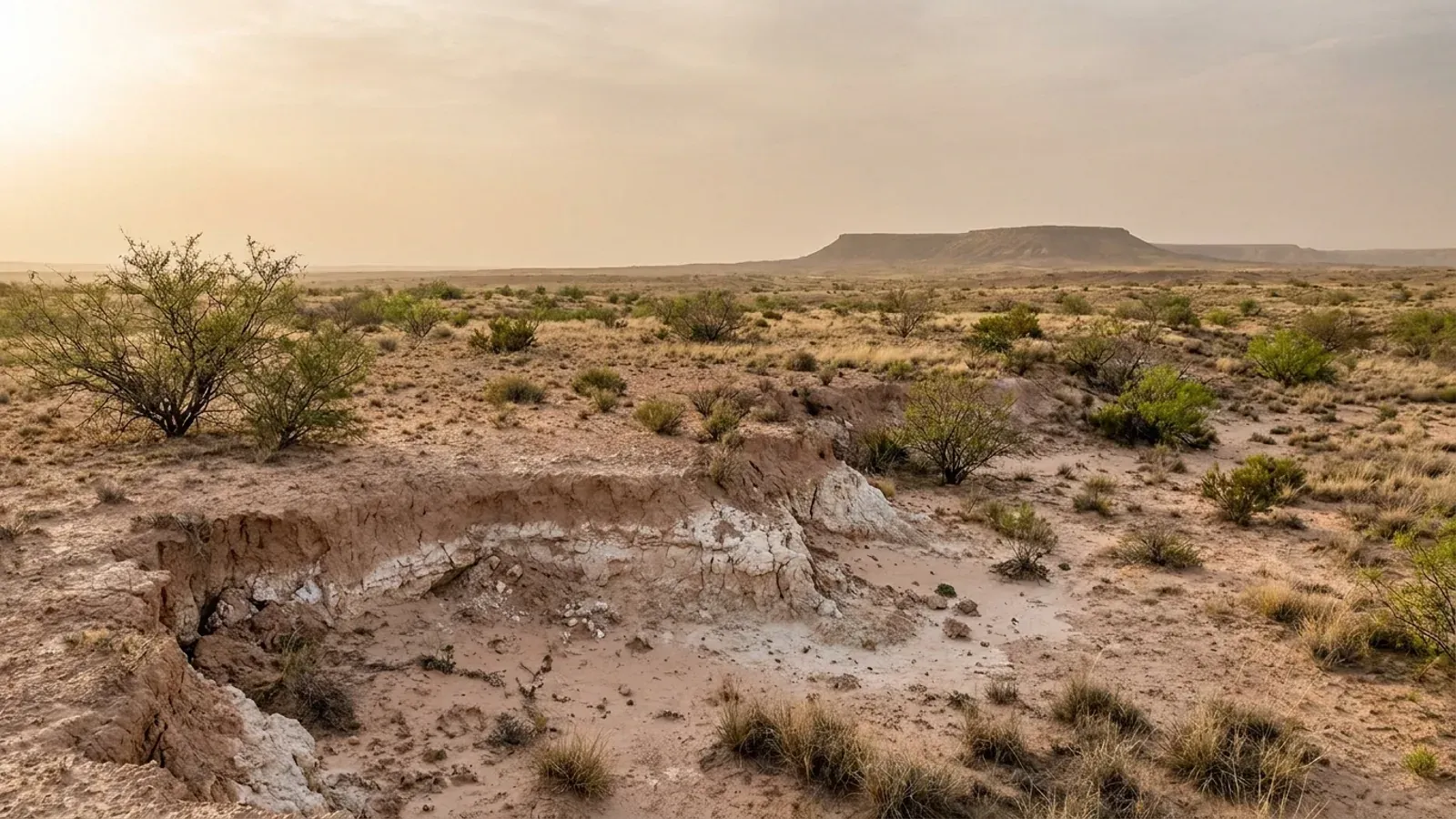
Open semi-arid West Texas rangeland with sparse mesquite and a hard white caliche layer breaking through a shallow cut bank.
Midland County 2018 IRC as adopted here

Barndominium Builders in Midland, TX

Midland is a city of 147,615 people on 76 square miles of the southern Llano Estacado, up 11.1 percent since 2020 and still building outward. Two things decide a barndominium here before anything is drawn. The first is material. The zoning ordinance requires the exterior facades of a single-family main building to be 85 percent Class 1 masonry — fired brick, natural or manufactured stone, granite, marble, or fiber cement siding — with no individual exterior wall below 50 percent. Metal wall cladding appears in no residential masonry class. The second is acreage. A detached accessory building on a lot greater than five acres is released from that material requirement outright, and on those lots a single equipment building may stand 40 feet tall. So inside the city limits the workable shape is usually a masonry house with a tall metal shop beside it, on more than five acres. Outside the limits several of those answers change.

Midland at a glance

County
Midland County
Population
147,615
Where we build
Midland, Midland County, Odessa, Ector County

ZIPs 79701, 79703, 79705, 79706, 79707

Site visits
Site walks booked in the city and out across Midland County

Building conditions in Midland

What actually changes from one Texas jurisdiction to the next: who issues the permit, whether the residential code is enforced there at all, what the structure has to be engineered to, and what the ground is like. These are the numbers your drawings have to satisfy.

Build conditions for Midland , Midland County, Texas : design wind speed 115 mph. BUILD CONDITIONS MIDLAND, TXMidland County2018 IRCDESIGN WIND SPEED115 mphMidland rewrote Table R301.2(1) into the adopting ordinance itself and filled every cell, which isnot the usual Texas answer. The city labels this row Basic Wind Speed rather than the 2018…ZONING · AE AGRICULTURAL ESTATE, AND CE COUNT…AE: 2 acres (87,120 sq ft), 150 ft m…AE and CE are the only two Midland districts measured in acres; thecode describes AE as a rural setting on lots of not less than two…PERMIT REVIEW CLOCK5 business daysPublished review target of the issuing authorityWATER, WASTEWATER AND ROADWAY IMPACT FEES, OR…Roadway, single-family detached, per…Chapter 11-14 of the City Code adopts all three, at a pre-creditrate of $3,312.24 per service unit for water and $1,676.82 for…WHO ISSUES THE PERMITCity of Midland Development Services…City Hall, 300 N. Loraine Street, Midland, TX 79701, mailing addressP.O. Box 1152, Midland, TX 79702; city switchboard (432) 685-7100,…
Build conditions for Midland, drawn from the sourced facts on this page. Every figure above is cited in the quick-facts panel below, with its source and vintage.
Adopted residential code, and the sprinkler section
The 2018 International Residential Code with appendices A, B, C, D, E, J, N, P and Q, adopted at Title IV Chapter 4-11 by Ordinance No. 9925 on 28 May 2019, effective 1 July 2019. Section R313, automatic fire sprinkler systems, is deleted in its entirety — that is the 2018 edition's numbering, which is what Midland is on

Midland City Code Title IV, Ch. 4-11, Secs. 4-11-2 and 4-11-3 (Ordinance 9925, sec. 1, adopted 5/28/2019); City of Midland, Building Codes page

Midland publishes a filled-in Table R301.2(1) — all of it
Most Texas cities publish no design criteria at all. Midland rewrote the whole table into the adopting ordinance: basic wind speed 115 mph in the city's own wording, ground snow load 3.5 psf, seismic design category A, frost line depth 12 inches, termite moderate to heavy, decay slight to moderate, weathering moderate, winter design temperature 21 degrees, summer cooling 103 degrees, elevation 2,851 feet, altitude correction factor 0.901, no ice barrier underlayment and no topographic effects

Midland City Code Title IV, Ch. 4-11, Sec. 4-11-3, TABLE R301.2(1) as adopted (Ordinance 9925, sec. 1, adopted 5/28/2019)

The Permian shakes, and the code table does not
The Railroad Commission of Texas names Gardendale (Midland-Odessa) as one of three Seismic Response Areas where it has acted, describing it as an area of the Midland Basin from northeast Ector County to southwest Martin County, and recording four earthquakes in northwest Midland County in December 2021. Its 19 December 2022 action reports an earthquake at the northern edge of that area in southwestern Martin County, approximately 13 miles north of Midland; TexNet at the Bureau of Economic Geology and the USGS catalogue that event at magnitude 5.2. Midland's adopted code separately sets the seismic design category at A. Both are true, they answer different questions, and what a foundation should be designed for is a matter for a Texas-licensed engineer

Railroad Commission of Texas, Seismicity Response page, September 2021, December 2021 and 19 December 2022 actions; TexNet / USGS earthquake catalogue, event tx2022yplg, 16 December 2022; Midland City Code Sec. 4-11-3, TABLE R301.2(1)

The house must be 85 percent masonry
Zoning Ordinance Sec. 11-1-6.04(B) requires the exterior facades of a single-family main building to be 85 percent Class 1 Masonry Construction, with no individual exterior wall below 50 percent. Class 1 is fired brick, natural and manufactured stone, granite and marble, and the section expressly adds fiber cement siding as Class 1 for single-family. Metal appears in no residential class — architectural metal panels are named only for the Light and Heavy Industrial districts. Texas Government Code Sec. 3000.002 separately provides that a governmental entity may not set a material or aesthetic standard more stringent than a national model code published in the last three code cycles, and that a conflicting regulation is void. Midland's code carries no clause conceding the point either way, so ask the Planning Department how the two are applied to your drawings

Midland Zoning Ordinance, Title XI Ch. 11-1, Sec. 11-1-6.04 (Ordinance 9920, sec. 1 Exh. A, adopted 5/28/2019); Texas Government Code Ch. 3000, Secs. 3000.002(a), (c), (e), added by H.B. 2439 (2019) and amended 2021 and 2025

Five acres is the line the shop turns on
Sec. 11-1-4.09(D)(1) requires a detached accessory building of 400 square feet or more to meet the masonry standards — and then says a building on a lot greater than five acres is not subject to them. Read the two thresholds carefully, because they are not the same number: the accessory building table gives its most generous allowances, 15 percent combined coverage, four buildings and a single 40-foot equipment building, to lots of five acres or greater, while the material exemption reaches only lots greater than five acres. A tract of exactly 5.00 acres gets the height and the count and not the exemption

Midland Zoning Ordinance, Sec. 11-1-4.09, Table 5 and subsection (D)(1) (Ordinance 9920, sec. 1 Exh. A, adopted 5/28/2019)

No Texas builder's licence — but Midland wants a $10,000 bond
Texas issues no licence to a residential builder, so there is nothing statewide to check. Midland answers that locally: its Contractor Registration page states that contractors must be registered with the City and that prior to issuing any permits a bond of ten thousand dollars must be provided and approved by the City Attorney. The same requirement is codified at Sec. 4-11-3, amending IRC R105.8: no building permit shall be issued unless and until the bond has been tendered to and approved by the Building Official. Ask any builder working in Midland to show you both

City of Midland, Contractor Registration page, Development Services; Midland City Code Sec. 4-11-3, IRC R105.8 as amended, and Sec. 4-1-3, IBC 105.8 as amended

Also worth knowing before you build in Midland

Caliche is the excavation story, and it is measurable
Upton loam is the largest single soil in Midland County at 98,573 acres, and USDA soil survey data put a strongly coherent petrocalcic horizon under it at 38 centimetres, with calcium carbonate at 50 to 58 percent from the surface down. Kimbrough loam, 32,796 acres, is harder: an indurated petrocalcic layer beginning at 25 centimetres and running 178 centimetres thick, 82 to 89 percent calcium carbonate. Slaughter, Sharvana, Simona, Stegall and Arvana all carry an indurated pan between 38 and 71 centimetres. This is not the shrink-swell problem of the eastern half of the state — the highest linear extensibility across the county's five largest soils is 4.5, on Reagan. It is a bearing surface you have to cut through

USDA-NRCS Soil Data Access (SSURGO), survey area TX329 Midland County, corestrictions and chorizon tables, queried 1 September 2026

The city health department writes the septic permit for the whole county
Midland's arrangement is unusual. The City of Midland Health Department states that it is the local health entity for both the city and the county, and that a septic permit must be applied for through it, with an application required for all installations and for modifications to an existing system. So the same office issues the permit inside the city limits and out on unincorporated county land. Its phone is (432) 681-7613

City of Midland Health Services, Environmental Services page and Environmental Services FAQ; Midland City Code Sec. 11-2-1(E)(9)

A septic permit in the ETJ needs a city plat first
Sec. 11-2-1(E)(9) provides that the Health and Senior Services Administrator shall not issue a septic permit for a new or expanded septic system within the city limits or within the city's extraterritorial jurisdiction for property for which a plat has not been approved and recorded, that the Administrator must obtain written confirmation from the City Manager first, and that a permit issued without compliance is void at inception. The same chapter excludes from city plat approval the division of land into parts of five acres or larger for agricultural use where no new street is involved, which is a different question from whether the tract you are buying already has a recorded plat

Midland City Code Title XI, Ch. 11-2, Sec. 11-2-1(E)(2)(a) and (E)(9)

No groundwater district — and a city casing rule instead
Midland County lies in no groundwater conservation district. The Permian Basin Underground Water Conservation District, formerly the Martin County district and the nearest one, states in its state-approved management plan that it is bordered on the south by Midland and Glasscock Counties. The Texas Water Development Board records 98 confirmed districts covering 173 of the 254 counties. Inside the city limits, though, Midland has its own well rules: Ch. 4-6 requires an application with a plat showing the exact well location, portable slush pits, and casing from at least one foot above the ground to at least 30 feet below it with the whole annulus cemented, and makes it unlawful to drill a new water well through a sub-irrigated septic drainfield

Permian Basin UWCD 2022 Groundwater Management Plan, p. 5, hosted by the Texas Water Development Board; TWDB Groundwater Conservation District Facts page; Midland City Code Title IV, Ch. 4-6, Secs. 4-6-2 to 4-6-5

Impact fees arrive at the permit counter
Ordinance 9960 established water, wastewater and roadway impact fees effective 1 October 2019. After the 50 percent general credit, a single-family detached dwelling unit carries a roadway fee of $3,020.49 in Service Area A, $2,319.57 in B, $2,093.85 in C, $3,047.22 in D and nothing in E, plus water of $1,656.12 and wastewater of $838.41 on a one-inch meter. Sec. 11-14-9(A) collects them at the issuance of the building permit. A further 25 percent housing credit is still printed at Sec. 11-14-8(B), but by its own terms it expired on the fifth anniversary of 1 October 2019

Midland City Code Title XI, Ch. 11-14, Secs. 11-14-5, 11-14-6, 11-14-8 and 11-14-9 (Ordinance 9960, sec. 2, adopted 8/13/2019)

Permit fees, and what the city measures
The city's published permit fee schedule prices a residential construction permit at 31.5 cents per square foot, with a residential street improvement fee of 23 cents per square foot alongside it. A detached accessory structure is $50 up to 120 square feet and $100 from 120 to 200 square feet; over 200 square feet it is priced on valuation instead. A fence permit is $50, a certificate of occupancy $50, a water well drilling permit $50 and a reinspection $50 on every permit type. The schedule itself is dated effective 1 May 2019, two months before the codes it serves took effect, so confirm the current numbers before you budget

City of Midland, Building Permit Fee Schedule (2019 Permit Fee Schedule, effective 1 May 2019), Document Center

Freeboard here is one foot
Midland's Flood Damage Prevention Code requires new residential construction in a special flood hazard area to have the lowest floor, including any basement, elevated to at least one foot above the base flood elevation, with the elevation certified by a registered professional engineer, architect or land surveyor. The city's own adopted Table R301.2(1) records the NFIP adoption date as 27 September 1991 and the current FIRM as 15 September 2005. Freeboard is a local choice and Texas cities do not agree on it, so this figure is Midland's and does not travel

Midland City Code Title XI, Ch. 11-3, Flood Damage Prevention Code; Midland City Code Sec. 4-11-3, TABLE R301.2(1)

You may not rent the second dwelling
Sec. 11-1-4.09(C) provides that an accessory dwelling unit shall not be leased or rented, caps its living area at 1,000 square feet or 30 percent of the principal residence, whichever is less, allows only one on any individual tract, and bars a mobile home, travel trailer or recreational vehicle from serving as a detached accessory dwelling unit. Separately, Sec. 11-1-4.09(B)(2) provides that an accessory building serving several dwelling units shall not be occupied as a place of abode in the AE, CE, SF-1, SF-2, SF-3 and MH districts. If the plan is a guest suite over the shop that eventually earns its keep, settle it with the Planning Department before the slab goes in

Midland Zoning Ordinance, Sec. 11-1-4.09(B)(2) and (C) (Ordinance 9920, sec. 1 Exh. A, adopted 5/28/2019)

Third-party inspection exists in Midland, at the zoo
Chapter 4-14, added by Ordinance 10631 on 27 May 2025, sets up an Authorized Third-Party Organization regime for plan review and inspection — and then limits it to a single tract, described in the chapter as Lot 1, Block 1, Zoo Midland, recorded at Instrument Number 2025-10114 in the Midland County plat records. Everywhere else in the city, plan review and inspection are the Building Official's

Midland City Code Title IV, Ch. 4-14, Secs. 4-14-1 and 4-14-2 (Ordinance 10631, sec. 1, adopted 5/27/2025)

Ten thousand wells under one county
The Railroad Commission's February 2025 county well counts record 10,343 oil wells and 238 gas wells in Midland County, across 900 square miles of land. Texas law treats the mineral estate as dominant over the surface, and in Merriman v. XTO Energy the Texas Supreme Court held against a landowner who already had a house on his 40 acres — the accommodation doctrine protects an existing use, so a house that has not been built yet is not an existing use at all. Whether the minerals under your tract were severed is a question for the County Clerk's records and your title commitment, not for a general rule

Railroad Commission of Texas, Oil Well Counts by County and Gas Well Counts by County, as of February 2025; Merriman v. XTO Energy, Inc., No. 11-0494 (Tex. 2013); U.S. Census Bureau 2025 Gazetteer county file, GEOID 48329

How much city there is
76.19 square miles of land and 147,615 people at the 2025 estimate, about 1,940 to the square mile, up 11.1 percent from the 132,866 counted in 2020. Midland County as a whole holds 187,855, of which 35,973 are outside any incorporated place. The city limits also spill north across the county line — 50 of those residents are counted in Martin County

U.S. Census Bureau, Vintage 2025 subcounty population estimates (sub-est2025_48) and 2025 Gazetteer place file, GEOID 4848072
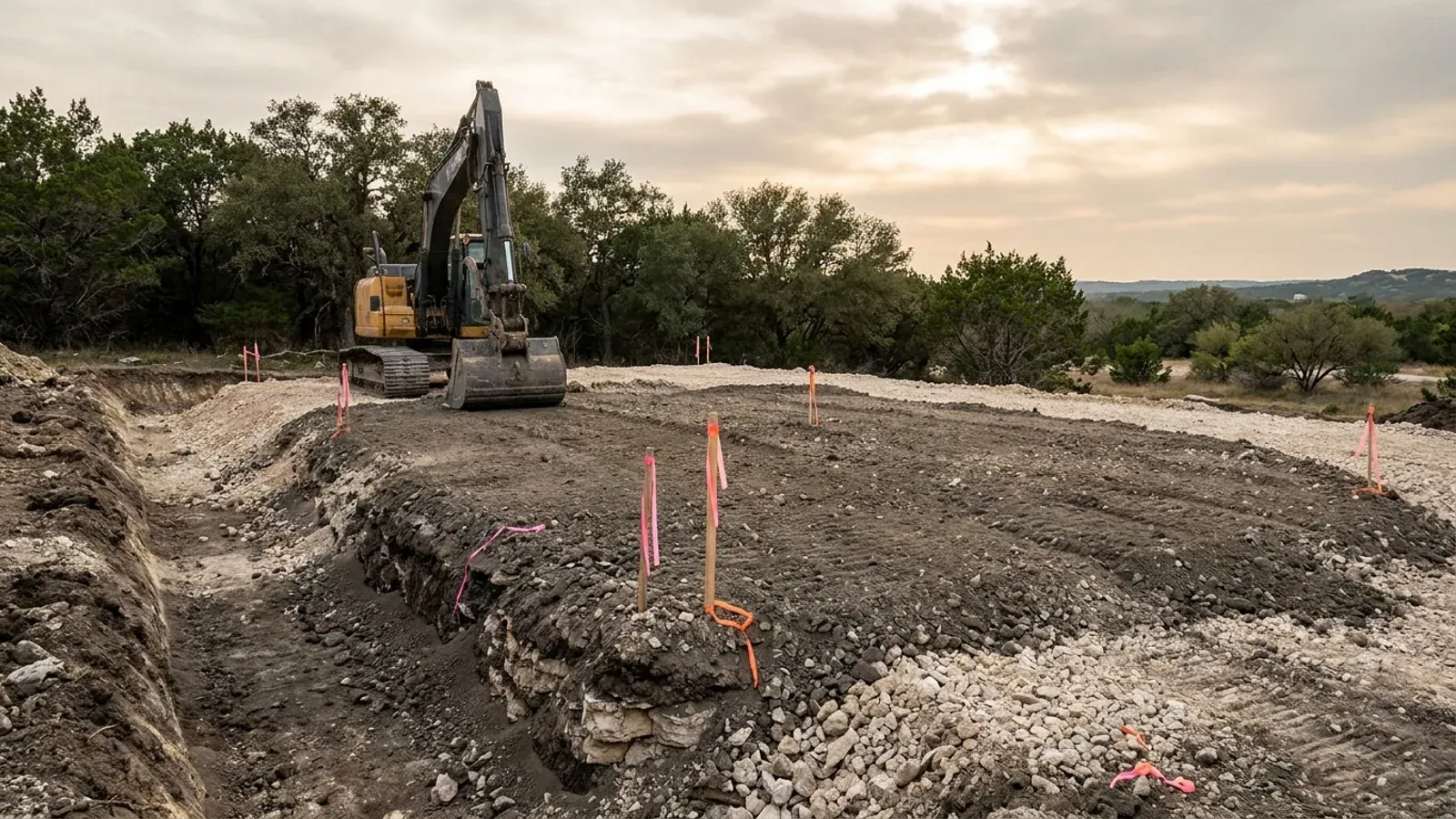
An excavator grading a compacted building pad on a cleared lot, with survey stakes and a drainage swale visible.
Below the slab

The expensive surprises are in the ground, not the building

What moves a Texas budget is usually below grade, and it is soil rather than rock: shrink-swell clay. The Blackland Prairie and the Gulf Coast clays move enough between a wet season and a dry one to drive the foundation design across the state's largest markets, which is why several DFW cities require an engineer's seal on the foundation of every new house. Those are the same conditions that decide whether a septic field passes its soil and site evaluation, so the grading plan, the foundation and the drainfield get resolved together rather than one at a time. We price the dirt before we price the building.

What we build in Midland

All nine of our services — kits, custom plans, post-frame and steel construction, site preparation, permitting and engineering, through to turnkey builds — are available across Midland County. What a project costs depends far more on the parcel than on square footage, so we work from your land rather than from a rate card.

See what we build

What a build looks like

Three stages every Midland project passes through, from a raw parcel to a finished home. Site work first, because that is where the budget is decided.
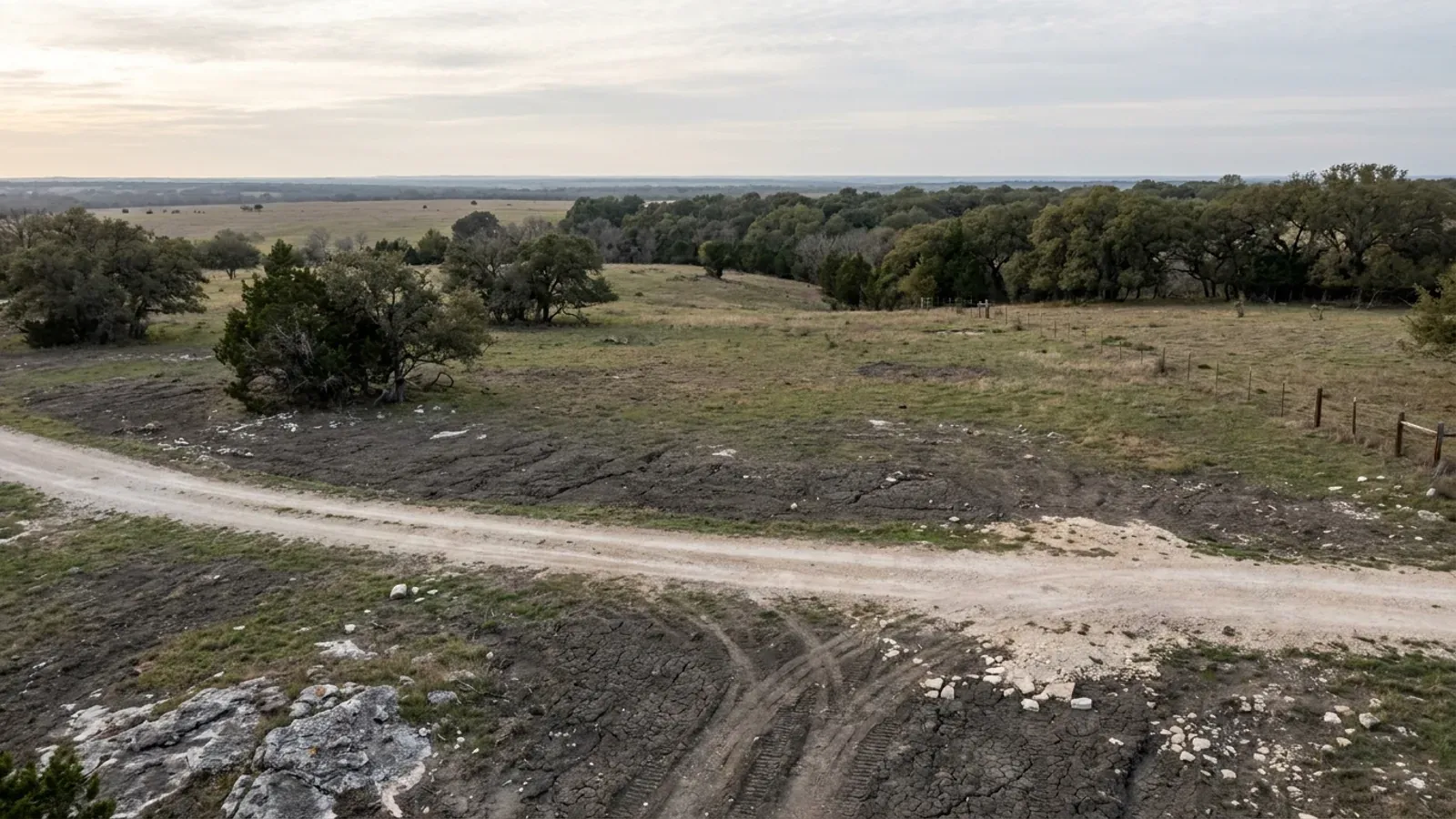
Aerial view of an undeveloped rural lot with cleared grass, a live oak and cedar elm treeline, and a pale gravel access track.
Stage one

The parcel

Zoning, setbacks, flood zone and utility access get checked before anything is drawn.

An excavator grading a compacted building pad on a cleared lot, with survey stakes and a drainage swale visible.
Stage two

Pad and permit

Clearing, grading and a compacted pad, while the submittal works through Midland County.
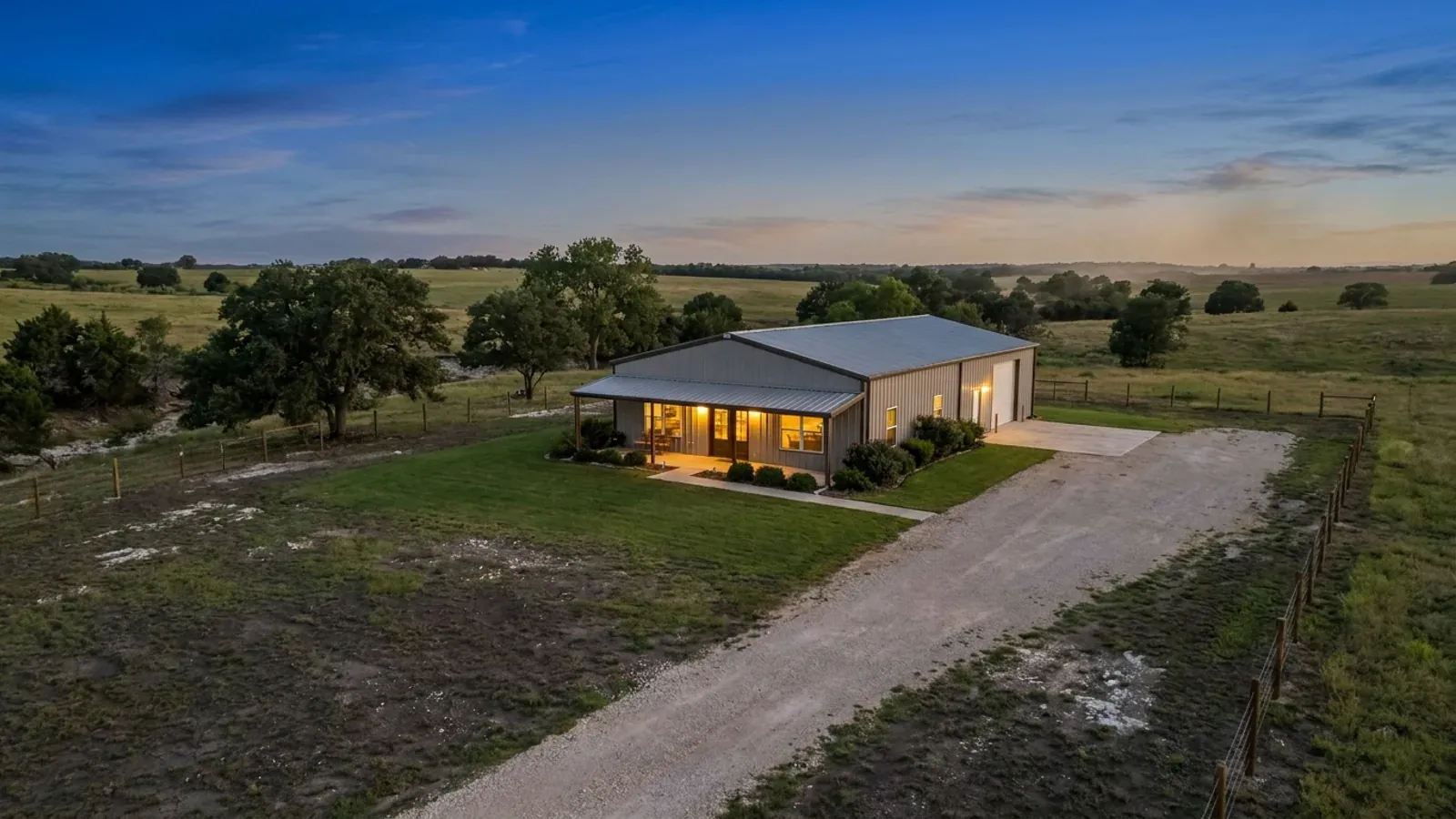
A finished barndominium at dusk with warm interior lighting glowing through its large windows.
Stage three

Frame to finish

Shell erected and dried in, then systems, insulation and interior finish through to CO.

Those are the rules for Midland County. Tell us what you want to build and we will draw it to them.

Where we build around Midland

Midland County and the rural land around it. The buildable acreage for a project this size usually sits outside the city limits, which is frequently what changes who issues your permit.

Our Midland service area, covering Midland County and the surrounding rural acreage. This map marks the territory we serve, not a branch location.

Nearby areas we build in

Others we cover in this part of Texas. The permitting authority, the adopted design criteria and the zoning can all differ from one to the next.

Building in Midland: common questions

12 questions we get asked most often about building in Midland. If yours is not on the list, ask it directly.

Can I build a metal barndominium inside the Midland city limits?
Not with metal walls on the house. Zoning Ordinance Sec. 11-1-6.04(B) requires the exterior facades of a single-family main building to be 85 percent Class 1 Masonry Construction, and adds that no individual exterior wall may be less than 50 percent Class 1. Class 1 means fired brick, natural and manufactured stone, granite and marble, and the section expressly adds fiber cement siding to that list for single-family construction. Metal wall cladding is in none of the three masonry classes for a house — architectural metal panels are named in the ordinance only for the Light and Heavy Industrial districts. There is one further instrument you should raise with the city yourself: Texas Government Code Sec. 3000.002 provides that a governmental entity may not establish a material or aesthetic standard more stringent than a national model code published within the last three code cycles, and Sec. 3000.002(e) says a conflicting regulation is void. Midland's code contains no clause conceding or denying the point. That is a question for the Planning Department at (432) 685-7100, and it is worth asking before you commission drawings, because the city issues the permit either way.
What changes if my lot is bigger than five acres?
The shop changes completely. Sec. 11-1-4.09(D)(1) requires a detached accessory building of 400 square feet or more to meet the same masonry standards as the house, and then says that an accessory building located on a lot greater than five acres is not subject to those requirements. That is the sentence that makes a metal shop workable inside the city. The accessory-building table adds the rest: on lots of five acres or greater the combined footprint of accessory buildings may reach 15 percent of the property rather than 10, up to four accessory buildings are allowed rather than two or three, and a single structure kept for storing equipment, materials or agricultural products necessary to maintaining the property may stand 40 feet tall. Read the two thresholds carefully, because the ordinance does not use the same one twice: the table says five acres or greater, and the material exemption says greater than five acres. A tract of exactly 5.00 acres gets the height and the building count but not the release from the masonry rule.
What code does Midland build to, and has the city changed it?
The 2018 International Residential Code with appendices A, B, C, D, E, J, N, P and Q, adopted at Chapter 4-11 of the City Code by Ordinance No. 9925 on 28 May 2019, with the city's building codes page giving 1 July 2019 as the effective date for the adopted set. Yes, the city has changed it. Section R313, automatic fire sprinkler systems, is deleted in its entirety. R105.2 loses its second exempt item and gains an eleventh for tree forts. R105.8 is added to require a $10,000 contractor bond before any permit issues, along with a construction site debris containment plan specified before the permit is granted. R112.2 through R112.4 are deleted and appeals routed to the building code's board of appeals on a 20-day clock. Table R301.2(1) is rewritten in full. On the plumbing and gas side the city adds an above-ground exterior shutoff valve on all new gas service lines, requires Type L copper for the last 36 inches of water service to the meter, and sets its own test pressures. Two later ordinances, 10597 of February 2025 and 10677 of October 2025, amended the amendment list. Ask Development Services for the current list before drawings are finalised.
Does Midland publish design criteria, or do I have to get them from an engineer?
Midland publishes them, which is unusual in Texas — most cities on this side of the state publish nothing and leave the whole table to the engineer of record. When Midland adopted the 2018 IRC it rewrote Table R301.2(1) into the ordinance and filled every cell. It gives a basic wind speed of 115 mph in the city's own wording, a ground snow load of 3.5 psf, no topographic effects, seismic design category A, moderate weathering, a frost line depth of 12 inches, a termite rating of moderate to heavy, decay slight to moderate, a winter design temperature of 21 degrees, no ice barrier underlayment requirement, an air freezing index of 1500 or less, a mean annual temperature of 65 degrees, an elevation of 2,851 feet and an altitude correction factor of 0.901. Two notes on reading it. The city labels the wind row Basic Wind Speed rather than the 2018 edition's Ultimate Design Wind Speed, so quote it as Midland writes it and let your engineer handle the distinction. And these are Midland's figures for Midland — a neighbouring city's table is not a substitute, and this one should not be carried anywhere else.
There are earthquakes around Midland. What does that mean for my build?
Two separate things are true and it is worth keeping them apart. The first: the Railroad Commission of Texas publishes a Seismicity Response List of areas where it has taken regulatory action against saltwater disposal wells, and one of the three is named Gardendale (Midland-Odessa). The Commission describes it as an area of the Midland Basin running from northeast Ector County to southwest Martin County; its December 2021 action records four earthquakes in northwest Midland County and suspends deep disposal permits across the area; and its 19 December 2022 action reports an earthquake at the northern edge of that area in southwestern Martin County, approximately 13 miles north of Midland, which TexNet at the Bureau of Economic Geology and the USGS catalogue at magnitude 5.2. The second: the seismic design category in Midland's own adopted code table is A. Both statements are accurate and they answer different questions. We are builders, not engineers, and we will not tell you what your foundation should be designed for. That belongs to a Texas-licensed engineer looking at your parcel, and it is a fair thing to raise with them early.
Does Midland make me put fire sprinklers in a new house?
No. Chapter 4-11 of the City Code, at the section amending the adopted residential code, states plainly that Section R313, Automatic Fire Sprinkler Systems, is deleted in its entirety. R313 is the correct section number for the 2018 edition Midland adopted — the model code renumbered it in a later edition, so a section number quoted from elsewhere may not match Midland's book. The state statute points the same way for one- and two-family dwellings: Occupations Code Sec. 1301.551(i) provides that after 1 January 2009 a municipality may not enact an ordinance, bylaw, order, building code or rule requiring the installation of a fire sprinkler protection system in a new or existing one- or two-family dwelling, while allowing a city to let a contractor offer one for a fee. If you want sprinklers, that is a design decision and not a code obligation.
Who is allowed to pull the permit, and what is the bond about?
Texas issues no state licence to a residential builder — there is no such credential to hold or to check, and you should be sceptical of anyone who advertises one. Midland fills part of that gap locally. Its Contractor Registration page states that to build or renovate property in the city, contractors must be registered with the City, and that prior to issuing any permits a bond of ten thousand dollars must be provided and approved by the City Attorney. The same requirement sits in the code: the amendment to IRC R105.8 says no building permit shall be issued by the Building Official unless and until the bond has been tendered to and approved. The Building Permits page adds that a bonded contractor must be listed on the permit for it to issue. There is also a homeowner route — R105.8(c) preserves the right to maintain, alter or add to your own home where the work is done by you for your family — and it expressly does not waive the permit or the fees. When you are choosing a builder in Midland, asking to see the City registration and the approved bond is a concrete, checkable question.
What will the city charge, and how long does review take?
Review of a residential submission usually takes about five to seven business days, on the city's own published permitting process. Commercial work runs longer — 20 business days for new buildings and additions, seven to ten for alterations, accessory structures and pools. The fee is split: 25 percent is paid at submission with the application, and the remaining 75 percent when the plan reviewer approves. The published fee schedule prices a residential construction permit at 31.5 cents per square foot with a residential street improvement fee of 23 cents per square foot, a detached accessory structure at $50 up to 120 square feet and $100 from 120 to 200, and over 200 square feet on valuation instead. Reinspections are $50 on every permit type. Separately, impact fees under Ordinance 9960 are collected at permit issuance. Applications and payments are not accepted after 4 p.m. Once issued, work must start within 180 days and must not stop for more than 180 days or the permit expires. One caution: the published fee schedule is itself dated effective 1 May 2019, so confirm the current figures with the permitting clerk at (432) 685-7390 before you budget.
What is the ground actually like out here?
Hard, shallow and full of carbonate — the opposite of the problem the eastern half of Texas has. Upton loam is the largest single soil in Midland County at 98,573 acres, and USDA soil survey data put a strongly coherent petrocalcic horizon under it at 38 centimetres, with calcium carbonate running 50 to 58 percent from the surface down. Kimbrough loam, another 32,796 acres, is harder still: an indurated petrocalcic layer starting at 25 centimetres and 178 centimetres thick, measured at 82 to 89 percent calcium carbonate. Slaughter, Sharvana, Simona, Stegall and Arvana all carry an indurated pan somewhere between 38 and 71 centimetres. That is caliche, and it is a real line on a budget — it usually bears well and it is slow and expensive to cut through for footings, trenches and a septic drainfield. Shrink-swell is not the headline here: the highest linear extensibility across the county's five largest soils is 4.5, on Reagan silty clay loam. What your parcel actually holds is a question for a soil report on your parcel, because these are survey averages and caliche depth varies over short distances.
Who issues the septic permit, and does it change outside the city?
It does not change, and that is unusual. The City of Midland Health Department states that it is the local health entity for both the city and the county, and that you apply to it for a septic permit, with an application required for all installations and for any modification to an existing system. So the same office at 3303 W. Illinois, Suite 22, on (432) 681-7613, handles the permit inside the city limits and out on unincorporated county land. What does change is a gate the city keeps on the paperwork. Sec. 11-2-1(E)(9) of the subdivision regulations provides that the Health and Senior Services Administrator shall not issue a septic permit for a new or expanded system within the city limits or within the city's extraterritorial jurisdiction for property for which a plat has not been approved and recorded, that written confirmation must come from the City Manager first, and that a permit issued without that is void at inception. The same chapter excludes from city plat approval a division of land into parts of five acres or larger for agricultural use with no new street — which is a different question from whether the tract you are buying already carries a recorded plat. Establish that before you sign.
Is there a groundwater district here, and what does a well involve?
There is no groundwater conservation district over Midland County. The nearest one, the Permian Basin Underground Water Conservation District — formerly the Martin County district — states in its state-approved management plan that it is bordered on the south by Midland and Glasscock Counties. So the district registration and well-spacing machinery that governs much of the High Plains does not reach you here. That does not make a well unregulated. A water well driller and pump installer must hold a state licence, and the driller must make and keep a well log and deliver a copy to the state, to the Texas Commission on Environmental Quality and to you within 60 days of completing the well, under Occupations Code Sec. 1901.251. And inside the city limits Midland has its own rules where no district exists: Chapter 4-6 requires an application with a plat showing the exact location of the proposed well, portable slush pits so nothing drains to a street or a sewer, and casing from at least one foot above the ground to at least 30 feet below it with the entire annulus cemented. It also makes it unlawful to drill a new water well through a sub-irrigated septic drainfield — which is a siting question you want settled before either goes in.
Which Midland zoning districts still take real acreage?
Two. AE, Agricultural Estate, is described in the ordinance as providing for single-family detached dwellings in a rural setting on lots of not less than two acres, or 87,120 square feet, with a 150-foot minimum lot width and depth, a 40-foot front setback, 15-foot interior sides, a 42-foot height limit and 50 percent maximum building coverage. CE, Country Estate, is a semi-rural setting on lots of not less than 43,560 square feet — one acre — with 100 feet of width, 120 feet of depth, a 35-foot front setback, 10-foot interior sides and the same 42-foot height and 50 percent coverage. Neither sets a minimum floor area, which is worth knowing if the plan is a modest house and a large shop. Everything else in the residential table drops quickly: SF-1 at 9,000 square feet, SF-2 at 7,000, SF-3 at 5,500 and MH at 5,000. CE also carries a driveway standard of its own — residential lots must have at minimum an all-weather surfaced driveway, designed and maintained so the surfacing is not washed onto the public street. And the Building Permits page adds the precondition that catches people out: the property must be platted and zoned for residential use before a permit can issue.

Building in Midland?

Start with the plan. Tell us what you want to build and we will draw it, then confirm what Midland County will actually let you put on the parcel and what wind load it has to meet. That conversation costs nothing.