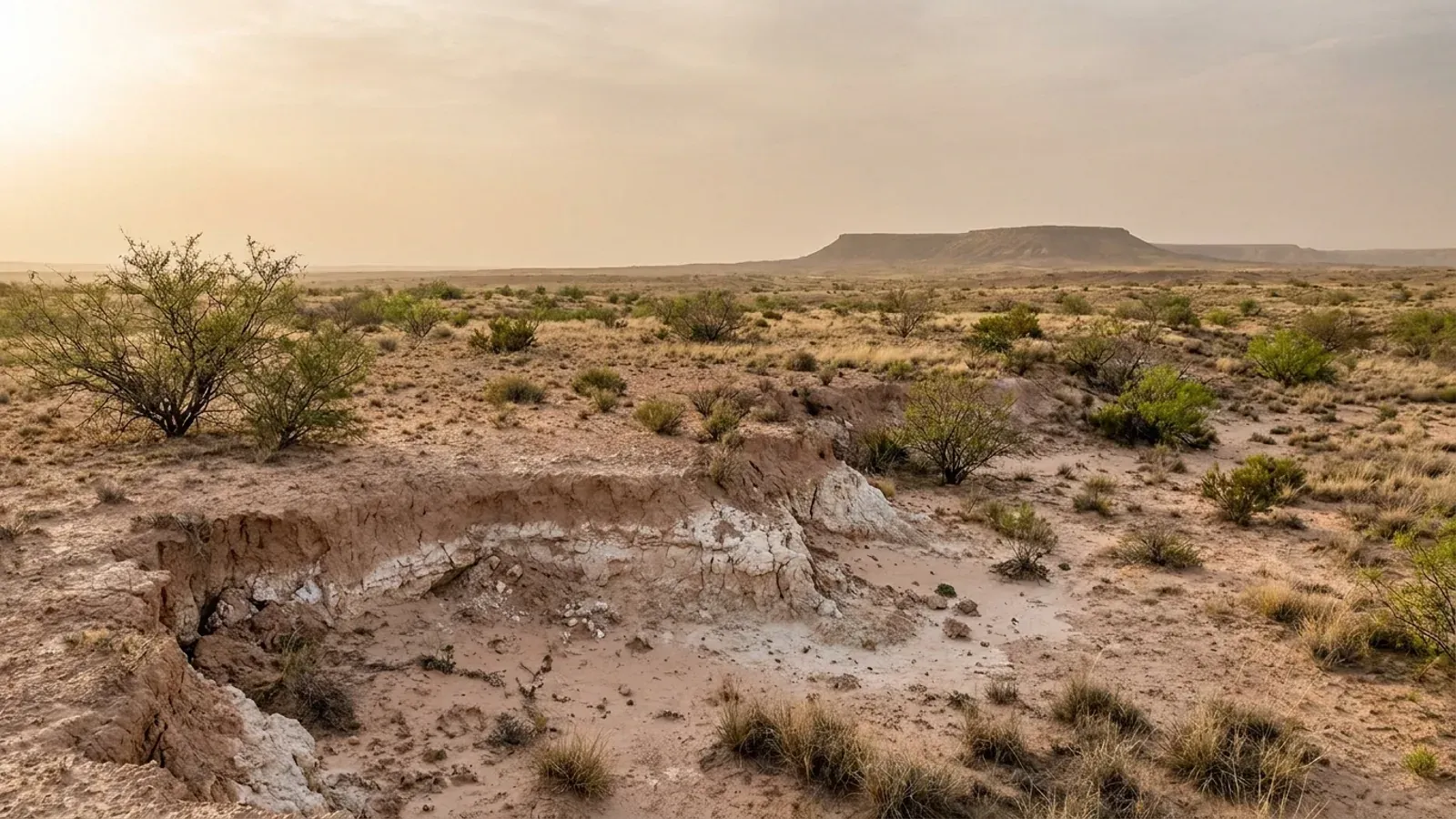
Open semi-arid West Texas rangeland with sparse mesquite and a hard white caliche layer breaking through a shallow cut bank.
Ector County 2018 IRC as adopted here

Barndominium Builders in Odessa, TX

Odessa is the Ector County seat and the western half of the Midland-Odessa metro — 122,707 people at the Census Bureau's 2025 estimate, against a 2020 base of 114,444, across 52.0 square miles. Two things shape a build here, and neither is what a page written for East Texas would tell you. First, Odessa fills in Table R301.2(1) inside its own ordinance, which a good many Texas cities never do: 115 mph wind speed, seismic design category B, a 12-inch frost line, 5 psf ground snow load and a moderate-to-heavy termite rating. Second, the ground is caliche. Nearly half the mapped acreage in the Ector and Crane Counties soil survey carries an indurated petrocalcic horizon, and under the survey area's second-largest map unit it begins about seven inches down. That is good bearing and hard digging — a line on the excavation quote rather than a foundation problem. Odessa runs the 2018 IRC, and it has amended it in both directions.

Odessa at a glance

County
Ector County
Population
122,707
Where we build
Odessa, Ector County, Midland, Midland County

ZIPs 79761, 79762, 79763, 79764, 79765, 79766

Site visits
Site walks scheduled throughout Odessa and Ector County

Building conditions in Odessa

What actually changes from one Texas jurisdiction to the next: who issues the permit, whether the residential code is enforced there at all, what the structure has to be engineered to, and what the ground is like. These are the numbers your drawings have to satisfy.

Build conditions for Odessa , Ector County, Texas : design wind speed 115 mph. BUILD CONDITIONS ODESSA, TXEctor County2018 IRCDESIGN WIND SPEED115 mphOdessa amends Table R301.2(1) of the 2018 IRC and fills it in, which puts it in a minority ofTexas cities. The amendment reads WIND SPEED: 115 MPH. It does not say whether that is the…ZONING · THIRTY-TWO DISTRICTS, ESTABLISHED BY…Minimum residential lot depth 80 fee…The rule that decides where a shop can go is Sec. 14-7-13. Adetached accessory building must sit in the area defined as the rea…WATER, WASTEWATER AND ROADWAY IMPACT FEES, AD…On a 3/4-inch meter the single-famil…The city adopted an impact fee study dated July 2021 by Ordinance2021-27 (10 August 2021), amended by Ordinance 2022-12 (24 May…WHO ISSUES THE PERMITCity of Odessa Building Inspection D…City of Odessa, 411 W. 8th Street, Odessa, TX 79761, main line432-335-3200. Permit applications and plans are submitted through…
Build conditions for Odessa, drawn from the sourced facts on this page. Every figure above is cited in the quick-facts panel below, with its source and vintage.
Adopted residential code
The 2018 International Residential Code, along with all appendices, adopted at Sec. 3-5-1 by Ordinance 2017-57 on 12 December 2017 and amended at Sec. 3-5-2. The codification is current through Ordinance No. 2026-22 adopted 11 August 2026 and still shows the 2018 edition, alongside the 2021 International Fire Code and the 2017 National Electrical Code

Odessa Code of Ordinances Ch. 3, Art. 3-5, Secs. 3-5-1 and 3-5-2, eCode360 (custId OD6428); City of Odessa, Process of obtaining a Residential Building Permit for New Construction, Remodels & Additions

Odessa fills in its own design table
The city's amendment to Table R301.2(1) publishes wind speed 115 mph, ground snow load 5 psf, seismic design category B, weathering moderate, frost line depth 12 inches, termite moderate to heavy, winter design temperature 20-32, no ice barrier underlayment, flood hazards yes, air freezing index 250 and mean annual temperature 64 degrees F. The amendment writes WIND SPEED without saying ultimate or nominal, so it is quoted as written

Odessa Code of Ordinances Ch. 3 attachment, International Residential Code Amendments, Sec. R301 (Publication, Dec 2022); the same amendment text published by the city as 2018 International Residential Code for One- and Two-Family Dwellings Amendment

The seismic answer is two facts, not one
The adopted code's seismic design category for Odessa is B. Separately, the Railroad Commission of Texas maintains a Seismic Response Area it names Gardendale (Midland-Odessa), described in its September 2021 action as running from northeast Ector County to southwest Martin County, and 21 of the 100 saltwater disposal wells on the Commission's Gardendale list carry Ector County numbers. What the USGS and TexNet catalogue actually records inside Ector County is smaller: 48 events at magnitude 2.5 or above since 2017, 15 at 3.0 or above, three at 3.5 or above and none at 4.0. The largest is a magnitude 3.6 on 26 October 2021, placed 9 km north-northeast of Odessa

Odessa's amended IRC Table R301.2(1); Railroad Commission of Texas, Seismicity Response, Gardendale (Midland-Odessa) actions of September 2021 and December 2022, and its published Gardendale SRA well list; USGS FDSN earthquake catalog, Ector County bounding box, queried 1 September 2026

Caliche is the excavation story here
In the Ector and Crane Counties soil survey, 14 map units covering 502,544 of 1,080,877 acres have a major component with a petrocalcic restriction — cemented caliche. The shallowest is Kimbrough, a shallow Petrocalcic Calciustoll and the survey area's second-largest map unit at 127,476 acres, where USDA records the indurated horizon starting at 18 centimetres, about seven inches. Tencee starts at 38 cm, Conger and Upton at 41 cm, Wickett and Stegall at 71 to 76 cm

USDA-NRCS Soil Data Access (SSURGO), survey area TX606 Ector and Crane Counties, corestrictions and chorizon tables, version 24 of 5 September 2025, queried 1 September 2026

The 24-foot span rule — the one that catches a shop bay
The city's residential construction handout requires that structural spans in excess of 24 feet have an engineer's seal affixed to a drawing showing all designs and details of the truss or beam, and that truss designs for beams, floor and roof components carry an engineer's seal. It also requires an engineer's stamp on the plan of all post-tension foundations, with a certification letter attached under the same stamp. Most clear-span shop bays are well past 24 feet

City of Odessa, Process of obtaining a Residential Building Permit for New Construction, Remodels & Additions, Architectural and Structural and Foundation sections

A floor-height rule that applies on dry ground too
Amendment R109.1.3.1 adds a floor height verification inspection and sets the minimum finished floor three ways. Beside an 8-inch city curb the finished floor sits at least 12 inches above the top of the highest adjacent curb; beside a 2-inch curb, at least 18 inches. In a designated flood zone it is at least 12 inches above the 100-year storm elevation as determined by the floodplain manager in the city's Engineering Division. The city also adds a flat exception at R322.1: no construction is allowed in an identified floodway

Odessa Code of Ordinances Ch. 3 attachment, International Residential Code Amendments, Secs. R109.1.3.1, R322.1 and R322.1.5

Also worth knowing before you build in Odessa

Appendix Q is deleted
Odessa adopts the 2018 IRC with all appendices and then removes one: the amendment schedule reads APPENDIX Q. TINY HOUSES. Delete appendix and reserve. Appendix Q is the part of the model code that relaxes ceiling height, loft dimensions and stair and ladder geometry for a dwelling of 400 square feet or less, so a very small build in Odessa gets none of that relief and is designed to the body of the code

Odessa Code of Ordinances Ch. 3 attachment, International Residential Code Amendments, Appendix Q

Contractor registration, and who is exempt
Amendment R105.1.1 requires any person, firm or company in the business of offering services as a general contractor, or offering to perform alterations, repairs, construction, demolition or moving of any structure regulated by the city's codes, to register first with the building official in the Building Inspection Office. The single exception is homeowners acting as their own contractor on the home in which they currently live and occupy as a legal homestead. That exception is personal to the owner-occupier and licenses nobody else

Odessa Code of Ordinances Ch. 3 attachment, International Residential Code Amendments, Sec. R105.1.1

Septic is an Ector County permit
TCEQ's authorized agent search returns exactly one record for Ector County: the Ector County Authorized Agent, area served entire County, TCEQ Region 07 Midland. There is no city carve-out, no health district, no river authority and no water district in the record. TCEQ's own printed instruction on that page is that if your city is not listed under the Authorized Agent column, you contact the county — and Odessa is not listed

TCEQ On-Site Activity Reporting System, authorized agent search, Ector County (county code 68), run 1 September 2026

Ector County has no groundwater conservation district
Tested against the Texas Water Development Board's own groundwater conservation district boundaries: no district polygon contains Odessa, the Ector County centroid, Goldsmith in the north of the county or Penwell in the south. The same test returns High Plains Underground Water Conservation District No. 1 for Lubbock and Permian Basin Underground Water Conservation District for Stanton, so the method works. Permian Basin UWCD is a Martin County district, one county to the north-east; it does not reach Ector or Midland

Texas Water Development Board, Groundwater Conservation Districts GIS dataset (TWDB_GCD_NOV2019), point-in-polygon test with two positive controls, run 1 September 2026; TWDB Groundwater Conservation Districts index

What the city charges in impact fees
Sec. 10-4-33 adopts water, wastewater and roadway impact fees from a July 2021 study. On a 3/4-inch meter the maximum is $778.00 water and $1,662.00 wastewater, with the single-family, townhome and duplex collection rate set at half of each — $389.01 and $831.01. Roadway fees run per service unit: $599.32 for single family in Service Areas One and Three and $262.62 in Service Area Two, with the number of service units taken from a table inside the adopted study rather than from the code

Odessa Code of Ordinances Ch. 10, Art. 10-4, Secs. 10-4-31 to 10-4-33, Ordinance 2021-27 adopted 10 August 2021 and Ordinance 2022-12 adopted 24 May 2022

How long review takes, and what stops the clock
The city's own handout tells applicants to plan on an average of 15 to 20 business days from the date a completed application is processed to permit issuance for new construction, and 3 to 10 business days for additions, remodels and accessory structures. Drawings labelled NOT FOR CONSTRUCTION or FOR PRICING ONLY are not accepted for a permit application, and permit fees are not taken until the permit has been approved by every reviewing department and invoiced

City of Odessa, Process of obtaining a Residential Building Permit for New Construction, Remodels & Additions, and Process of obtaining a Residential Building Permit for Accessory Structures

How much city is in the city
52.045 square miles of land and 122,707 people at the Census Bureau's 2025 estimate, about 2,360 to the square mile, against a 2020 estimates base of 114,444. Ector County itself is 897.9 square miles of land, so the city occupies under six percent of it

U.S. Census Bureau, Vintage 2025 subcounty population estimates (GEOID 4853388) and 2024 Gazetteer place file; U.S. Census Bureau TIGERweb county file, Ector County land area
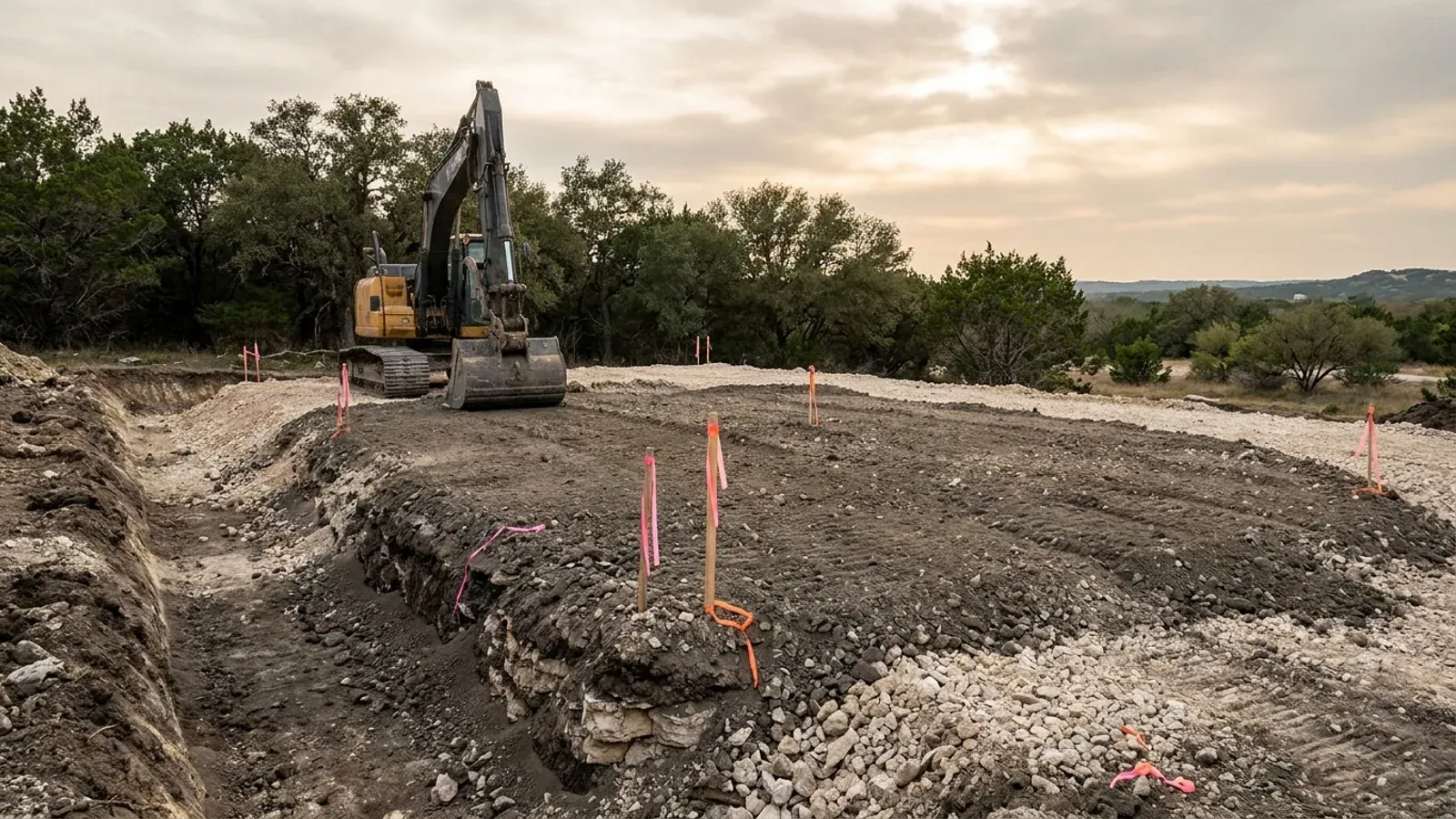
An excavator grading a compacted building pad on a cleared lot, with survey stakes and a drainage swale visible.
Below the slab

The expensive surprises are in the ground, not the building

What moves a Texas budget is usually below grade, and it is soil rather than rock: shrink-swell clay. The Blackland Prairie and the Gulf Coast clays move enough between a wet season and a dry one to drive the foundation design across the state's largest markets, which is why several DFW cities require an engineer's seal on the foundation of every new house. Those are the same conditions that decide whether a septic field passes its soil and site evaluation, so the grading plan, the foundation and the drainfield get resolved together rather than one at a time. We price the dirt before we price the building.

What we build in Odessa

All nine of our services — kits, custom plans, post-frame and steel construction, site preparation, permitting and engineering, through to turnkey builds — are available across Ector County. What a project costs depends far more on the parcel than on square footage, so we work from your land rather than from a rate card.

See what we build

What a build looks like

Three stages every Odessa project passes through, from a raw parcel to a finished home. Site work first, because that is where the budget is decided.
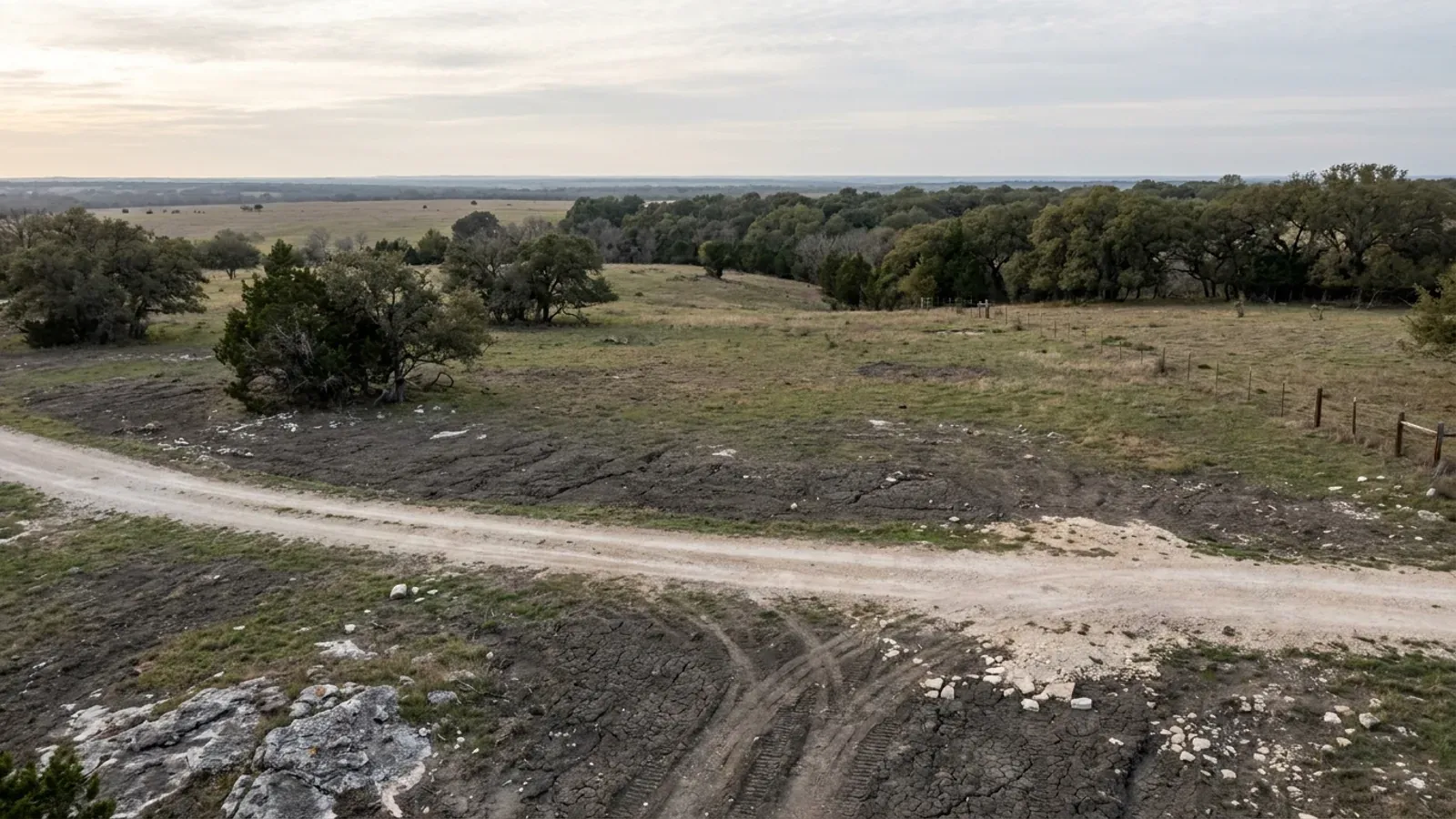
Aerial view of an undeveloped rural lot with cleared grass, a live oak and cedar elm treeline, and a pale gravel access track.
Stage one

The parcel

Zoning, setbacks, flood zone and utility access get checked before anything is drawn.

An excavator grading a compacted building pad on a cleared lot, with survey stakes and a drainage swale visible.
Stage two

Pad and permit

Clearing, grading and a compacted pad, while the submittal works through Ector County.
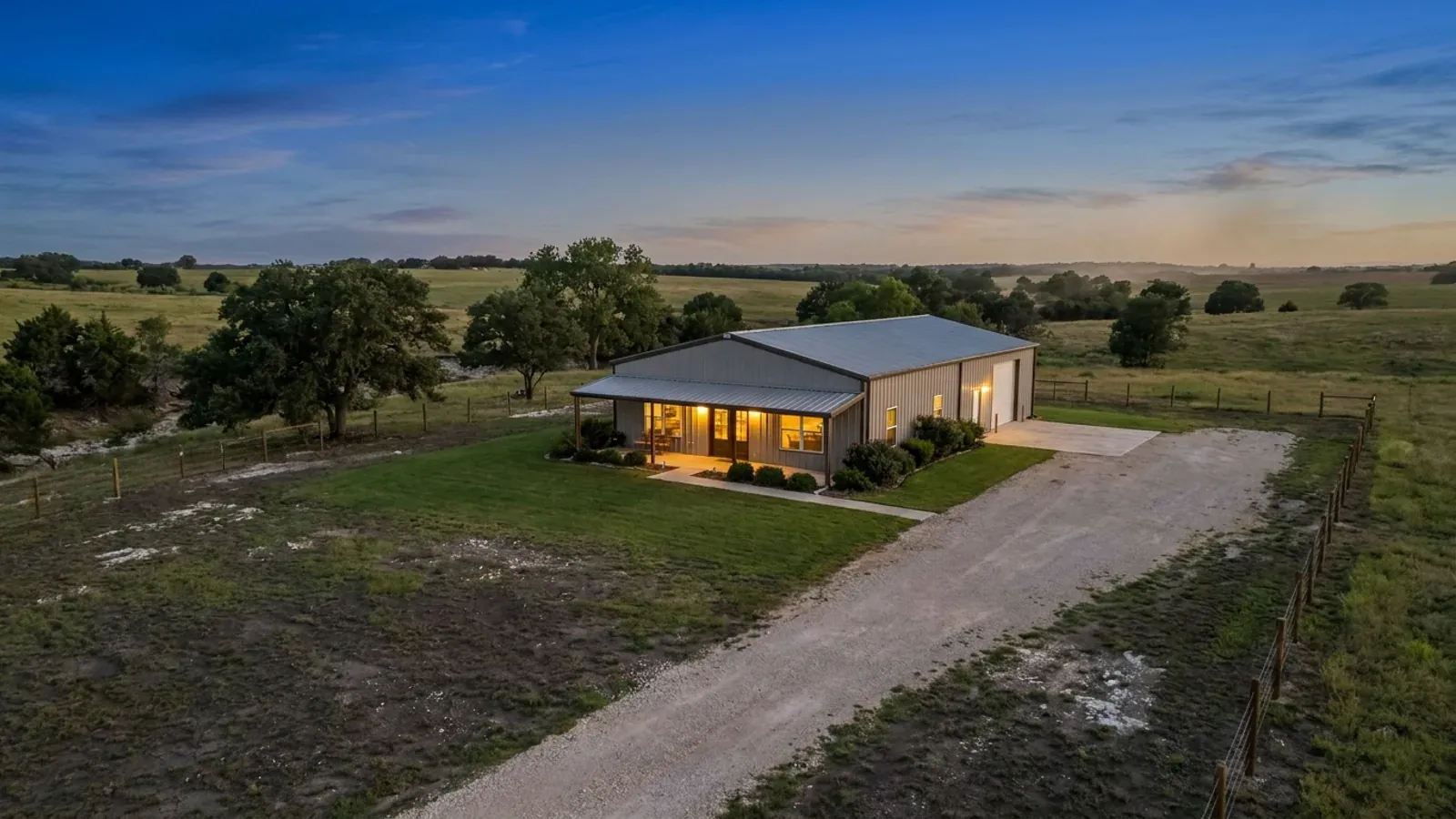
A finished barndominium at dusk with warm interior lighting glowing through its large windows.
Stage three

Frame to finish

Shell erected and dried in, then systems, insulation and interior finish through to CO.

Those are the rules for Ector County. Tell us what you want to build and we will draw it to them.

Where we build around Odessa

Ector County and the rural land around it. The buildable acreage for a project this size usually sits outside the city limits, which is frequently what changes who issues your permit.

Our Odessa service area, covering Ector County and the surrounding rural acreage. This map marks the territory we serve, not a branch location.

Nearby areas we build in

Others we cover in this part of Texas. The permitting authority, the adopted design criteria and the zoning can all differ from one to the next.

Building in Odessa: common questions

12 questions we get asked most often about building in Odessa. If yours is not on the list, ask it directly.

Is there really a barndominium market in Odessa?
Being straight with you: when we measured search demand across West Texas, Odessa returned nothing on every explicit barndominium phrase we tried, while Midland twenty miles away returned a small but real number. Twenty miles is not a difference in how people build, so we read that as the measurement sitting below its own reporting floor rather than as evidence nobody in Ector County wants one. What we will not do is dress this page up as a booming market. This page exists because the regulatory answer here is genuinely different from Midland's and genuinely different from anywhere east of the Pecos — a city that fills in its own design table, an amendment schedule that cuts both ways, caliche instead of clay, and no groundwater district at all. If you are building here, those are the facts you need.
What code does Odessa build to, and has the city changed it?
The 2018 International Residential Code, with all appendices, adopted at Sec. 3-5-1 of the Code of Ordinances by Ordinance 2017-57 on 12 December 2017. The codification is current through Ordinance No. 2026-22 of 11 August 2026 and still shows the 2018 edition — Texas does not oblige a city to move to a newer book, and Odessa has not. The city has changed it in both directions. Against you: Appendix Q on tiny houses is deleted and reserved; contractor registration is required by amendment; a floor height verification inspection is added; no construction is allowed in an identified floodway; and starting work before the permit issues draws double permit fees. For you: the prescriptive footing rule at R403.1.4.2 carries an explicit exception for foundations and footings designed by a Texas licensed engineer. Ask Building Inspection for the current amendment schedule before you finalise drawings.
Does Odessa publish a wind speed and a seismic category?
Yes, and that puts it in a minority of Texas cities — plenty of them adopt a code and never fill in Table R301.2(1) at all. Odessa's amendment to that table reads: ground snow load 5 psf, wind speed 115 mph, seismic design category B, weathering moderate, frost line depth 12 inches, termite moderate to heavy, winter design temperature 20-32, ice barrier underlayment not required, flood hazards yes, air freezing index 250, mean annual temperature 64 degrees F. The amendment says WIND SPEED without labelling it ultimate or nominal, so we quote it exactly as the city wrote it and leave the interpretation to the engineer of record. Separately, the city's residential handout asks for a Manual J worked to a maximum wintertime temperature of 24 degrees Fahrenheit and a summertime temperature between 98 and 102 degrees.
There are earthquakes out here. Does that change how my house is designed?
That is an engineer's question and not ours, so here are the two facts, kept apart. Fact one: the seismic design category in Odessa's own adopted table is B. Fact two: the Railroad Commission of Texas maintains a Seismic Response Area it names Gardendale (Midland-Odessa), which its September 2021 action describes as running from northeast Ector County to southwest Martin County, monitored by TexNet at the University of Texas Bureau of Economic Geology; 21 of the 100 saltwater disposal wells on the Commission's Gardendale list carry Ector County numbers, and in December 2021 the Commission suspended all 33 deep disposal permits inside that area. What the catalogue actually records inside Ector County is more modest than the headlines: since 2017, 48 events at magnitude 2.5 or above, 15 at 3.0 or above, three at 3.5 or above and none at all at 4.0, the largest a magnitude 3.6 placed nine kilometres north-northeast of Odessa. The bigger Permian events are elsewhere — the magnitude 5.2 of 16 December 2022 was in Martin County and the magnitude 5.4 of 16 November 2022 was in Reeves County, about 155 miles west. If any of that matters to your foundation, that determination belongs to a Texas-licensed engineer, and we will route you to one.
What is the ground actually like under Odessa?
Caliche, mostly. In the USDA soil survey covering Ector and Crane counties, 14 map units totalling 502,544 of 1,080,877 acres have a major component with a petrocalcic restriction — a cemented carbonate layer the survey describes as indurated or strongly coherent. The shallowest is Kimbrough, the survey area's second-largest map unit at 127,476 acres, where that layer begins at 18 centimetres, about seven inches down. Tencee starts at 38 centimetres, Conger and Upton at 41. The other extreme is Penwell, the single largest map unit at 141,216 acres, which is 92 percent sand to two metres with no caliche at all. So the ground here is either hard to dig and excellent to bear on, or deep loose sand — and which one you have is an excavation cost question that a soil report answers and a map does not.
Is there expansive clay here, and will my slab need an engineer?
Expansive clay is the exception around Odessa rather than the rule, which inverts the Central Texas story. Nearly everything in the survey has a linear extensibility of 1.5 percent, which is low. The exceptions are real though: Lipan clay, mapped as depressional and covering 2,267 acres, runs 50 percent clay from the surface down to 140 centimetres with a linear extensibility of 7.5 percent, and Patrole and Pecos reach the same figure. Those are playa basins and old floodplains. Why it matters legally: Texas Occupations Code Sec. 1001.056(c)(2) removes the private-dwelling exemption from the Engineering Practice Act for a residential dwelling slab located on expansive soil unless the slab meets the expansive-soil provisions of the IRC as applied in the jurisdiction. Inside Odessa an IRC genuinely is applied, so that trigger has something local to refer to — which is not true on unincorporated land in a county that never adopted a code. That provision is about a slab on expansive soil. It is not a seismic provision and should not be read as one. Whether your parcel reaches the trigger is a soil report question, and the answer comes from a Texas-licensed engineer.
Can I put a big detached shop beside the house?
Yes, within the yard rules, and one of them decides the design. Sec. 14-7-13 puts a detached accessory building in the area defined as the rear yard. It needs no side yard at all if it sits behind the front-yard building setback and meets the building code — but it must keep six feet of separation from any other structure, and if it does not, the code treats it as an integral part of that structure and makes it observe the main building's side yard instead. Where there is no alley the rear yard is at least five feet from the rear lot line, and next to a side street the building observes whichever setback is most restrictive: the platted one, the one set by the main structure, or one set by ordinance. The permit exemption is almost no help: amendment R105.2 exempts a detached accessory structure only if its finished wall height is under seven feet, its roof area is 100 square feet or less, it is not on a concrete slab, and it has no plumbing or electrical. Every real shop bay in Odessa is permitted.
Do I need an engineer's seal on the plans?
For part of them, almost certainly. The city's residential construction handout is explicit on two points: truss designs for beams, floor and roof components must carry an engineer's seal, and structural spans in excess of 24 feet must have an engineer's seal affixed to a drawing showing all designs and details of the truss or beam. A clear-span shop bay is normally well beyond 24 feet, so that rule lands on most barndominiums here. Post-tension foundations need an engineer's stamp on the plan plus a certification letter under the same stamp. On the full plan set the position is less tidy than it looks: amendment R106.1 deletes the model code's conditional sentence and replaces it with a flat requirement that construction documents be prepared by a registered design professional under Occupations Code Chapters 1051 and 1001, while R106.3 says structural plans may be approved without detailed plan review when they carry the affixed seal of a state-licensed professional engineer or registered architect. Those read differently, and the sensible move is to ask Building Inspection how they apply it to your plan set before you draw.
How high does my finished floor have to sit?
Higher than you would guess, and the rule bites on ordinary dry lots as well as in the flood zone. Amendment R109.1.3.1 adds a floor height verification inspection with three cases. Beside an 8-inch city curb, the finished floor is set at least 12 inches above the top of the highest adjacent curb. Beside a 2-inch curb, at least 18 inches — the shallower curb gives you the taller requirement. And on property in a designated flood zone, the finished floor is at least 12 inches above the 100-year storm elevation as determined by the floodplain manager in the city's Engineering Division. Odessa also adds a flat exception at R322.1: no construction is allowed in an identified floodway. Get the curb height and the elevation reference settled at site plan stage, because it drives the fill, the drive approach and the drainage.
Who permits the septic system, and is there a groundwater district?
Septic is an Ector County permit. TCEQ's authorized agent search returns exactly one record for the county — the Ector County Authorized Agent, area served entire County, under TCEQ Region 07 Midland. No city carve-out, no health district, no river authority. TCEQ's own instruction on that page is that if your city is not listed under the Authorized Agent column you contact the county, and Odessa is not listed. Groundwater is the surprise: there is no groundwater conservation district here at all. We tested four points spread across Ector County against the Texas Water Development Board's own district boundaries and none of them falls inside a district, while the same test correctly returns High Plains Underground Water Conservation District No. 1 for Lubbock and Permian Basin Underground Water Conservation District for Stanton. Permian Basin UWCD covers Martin County, one county north-east; it does not reach Ector or Midland. A well driller still has to be licensed by the Texas Department of Licensing and Regulation wherever you are.
Does the Gulf Coast windstorm regime apply in Odessa?
No. Ector County is not one of the fourteen counties on the Texas Department of Insurance list of designated catastrophe area counties, and it is not the included part of Harris County. So none of the coastal machinery reaches here: no TDI windstorm inspection, no WPI certificate chain, and none of the state rule that puts the 2024 IRC on coastal construction regardless of what a city adopted. In Odessa the city's own adopted 2018 edition and its own amendment schedule are the whole answer, which is exactly why the amendments matter as much as the edition name does.
What changes if my land is outside the city limits?
A great deal. Odessa's population puts its extraterritorial jurisdiction at five miles under Local Government Code Sec. 42.021(a), and inside that ring the city reaches subdivision platting and public improvements — it does not reach your house. Past that it is unincorporated Ector County, and a Texas county has no general building-code authority over structures in its unincorporated area unless the legislature has handed it one under Local Government Code Chapter 233 Subchapter F. So the design table, the amendments, the floor-height rule and the impact fees all stop at the city line, while three state requirements do not: the plumbing has to be done by a licensed plumber, the well driller has to be licensed, and Health and Safety Code Sec. 388.004 obliges a builder outside any municipality to certify energy compliance and keep the certification for three years. Septic stays an Ector County permit either way. Our Ector County page covers the unincorporated side properly.

Building in Odessa?

Start with the plan. Tell us what you want to build and we will draw it, then confirm what Ector County will actually let you put on the parcel and what wind load it has to meet. That conversation costs nothing.