
Barndominium Builders in Garland, TX
Garland is 56.9 square miles of Dallas County that filled in decades ago — about 4,400 people to the square mile, an industrial base, its own electric utility, and a street grid with very little left to subdivide. Almost nobody puts a barndominium on a Garland lot, and the honest answer is that the acreage a barndominium wants starts east of here: Rockwall County across Lake Ray Hubbard, Kaufman County about fifteen miles southeast down Highway 80, Hunt County beyond Rowlett. What makes Garland worth reading anyway is that it is a working reference point. It publishes a full, completed Table R301.2 — 115 mph wind, 6-inch frost line, a "Very Heavy" termite rating — and it sits on the 2015 IRC, which puts it in climate zone 3A while the City of Dallas next door is 2A. Cross the county line and the whole permitting picture changes again.
Garland at a glance
- County
- Dallas County
- Population
- 249,625
- Where we build
- Garland, Dallas, Irving, Grand Prairie, Mesquite
- Site visits
- On-site visits across Garland and the wider Dallas County
ZIPs 75040, 75041, 75042, 75043, 75044
Building conditions in Garland
What actually changes from one Texas jurisdiction to the next: who issues the permit, whether the residential code is enforced there at all, what the structure has to be engineered to, and what the ground is like. These are the numbers your drawings have to satisfy.
City of Garland Code of Ordinances § 30.225 (Chapter 30, Article XIII); City of Garland, Building Inspection — Current Model Codes
City of Garland Code of Ordinances § 30.225 and Building Inspection — Current Model Codes; U.S. Department of Energy / PNNL-33270 climate-zone maps
City of Garland, 2015 International Residential Code Amendments, Table R301.2(1) as completed by the City
City of Garland, 2015 International Residential Code Amendments, Table R301.2(1)
City of Garland, 2015 International Residential Code Amendments, § R313.2
Garland Development Code, Chapter 2, Attachment 2, Table 2-3 (Single-Family Residential District Standards) and § 2.35
Also worth knowing before you build in Garland
- The rest of Garland's Table R301.2(1)
- Ground snow load 5 lb/ft². Frost line depth 6 inches. Weathering moderate. Seismic design category A. Winter design temperature 22°F. Ice barrier underlayment: no. Air freezing index 69. Mean annual temperature 64.6°F. Flood hazards: local code. These are Garland's own numbers — the air freezing index and mean annual temperature differ from the City of Dallas's published values.
- Published permit fee
- A new single-family permit is charged at $0.52 per square foot of roofed area with an $800 minimum, and that figure already includes the mechanical, electrical and plumbing fees. Foundation-only is $140 per building, a residential grading permit $70 per lot, a reinspection $70, and plan revision or restamping $44 an hour. Because the fee keys off roofed area, a large shop bay is charged the same way as living space.
- A bare metal skin is not permitted
- Garland's building chapter states that unpainted materials such as wood, tin, plain concrete block or similar materials shall not be used as exterior wall or roof covering on residential or commercial buildings. A mill-finish metal exterior does not comply; a finished, coated panel system does.
- Contractor registration is a precondition of the permit
- Garland makes it unlawful for anyone not registered with the City as a general contractor to obtain a building permit, and separately requires building, electrical, mechanical, roofing, irrigation, fire sprinkler and plumbing contractors to register with the Building Inspection Department. A homeowner may pull permits for work on a residence they own without hiring a registered general contractor.
- Engineered foundations — where Garland actually requires one
- Garland does not require an engineer for every foundation. Its amendments require a Texas-licensed professional structural engineer to design any post-tensioned foundation, and any foundation repair, with construction certified by a special inspector or the designing engineer. The Building Official may also accept an engineer-designed alternative in place of the prescriptive rules. Separately, Texas law removes the engineering exemption for a slab on expansive soil, and Garland sits on Blackland Prairie clay.
- Kaufman County is the fastest-growing county in the DFW ring
- Kaufman County, roughly fifteen miles southeast of Garland, grew from 147,165 in 2020 to 209,235 in 2025 — up 42.2%. Rockwall County, immediately east across Lake Ray Hubbard, rose 28.9% to 140,738 and Hunt County to the northeast 23.0% to 123,336. Dallas County over the same five years grew 1.9%, and Garland itself 1.3%.
- Cross into unincorporated Kaufman County and the regime changes
- Kaufman County's Commissioners Court adopted an order requiring Subchapter F of Chapter 233 of the Local Government Code in its unincorporated area, recorded 24 March 2022, with new residential construction to comply with the International Residential Code in use by the City of Kaufman. Subchapter F is a code without a counter: no county building permit, no county fee and no county inspector. The builder arranges the three required inspections privately, from a licensed engineer, registered architect, TREC professional inspector, municipal plumbing inspector, political-subdivision building inspector or ICC residential combination inspector.
- Garland is built out, and the numbers say so
- 56.857 square miles of land and 249,625 people — about 4,390 to the square mile — with population up 1.3% over five years. Garland also crosses into Collin and Rockwall counties, not just Dallas County.
City of Garland, 2015 International Residential Code Amendments, Table R301.2(1)
City of Garland Master Fee and Rate Schedule, Code of Ordinances § 10.85, Chapter 30 building inspection schedule
City of Garland Code of Ordinances § 30.05 (Exterior materials)
City of Garland Code of Ordinances § 30.07; City of Garland, 2015 IRC Amendments, § R105.10
City of Garland, 2015 IRC Amendments, §§ R401.1, 401.2.1 and R401.2.2; Texas Occupations Code § 1001.056(c)(2)
U.S. Census Bureau, Vintage 2025 county and sub-county population estimates
Order of the Commissioners Court of Kaufman County requiring the application of Subchapter F of Chapter 233, Kaufman County Clerk instrument 2022-0011386, filed 24 March 2022; Texas Local Government Code §§ 233.153 and 233.154
U.S. Census Bureau 2025 Gazetteer place file and Vintage 2025 population estimates; U.S. Census Bureau 2020 place-by-county reference file
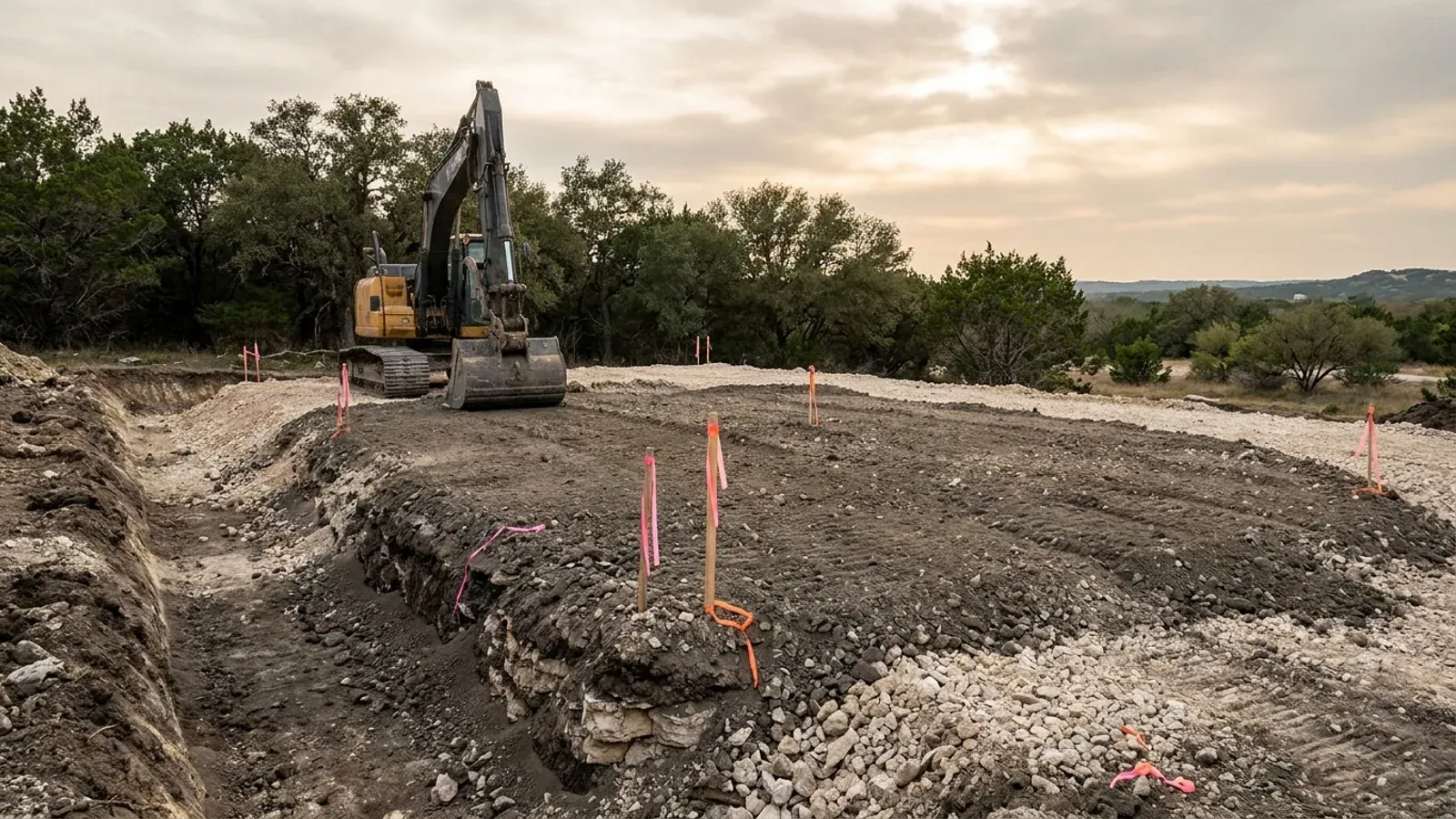
The expensive surprises are in the ground, not the building
What moves a Texas budget is usually below grade, and it is soil rather than rock: shrink-swell clay. The Blackland Prairie and the Gulf Coast clays move enough between a wet season and a dry one to drive the foundation design across the state's largest markets, which is why several DFW cities require an engineer's seal on the foundation of every new house. Those are the same conditions that decide whether a septic field passes its soil and site evaluation, so the grading plan, the foundation and the drainfield get resolved together rather than one at a time. We price the dirt before we price the building.
What we build in Garland
All nine of our services — kits, custom plans, post-frame and steel construction, site preparation, permitting and engineering, through to turnkey builds — are available across Dallas County. What a project costs depends far more on the parcel than on square footage, so we work from your land rather than from a rate card.
See what we buildWhat a build looks like
Three stages every Garland project passes through, from a raw parcel to a finished home. Site work first, because that is where the budget is decided.
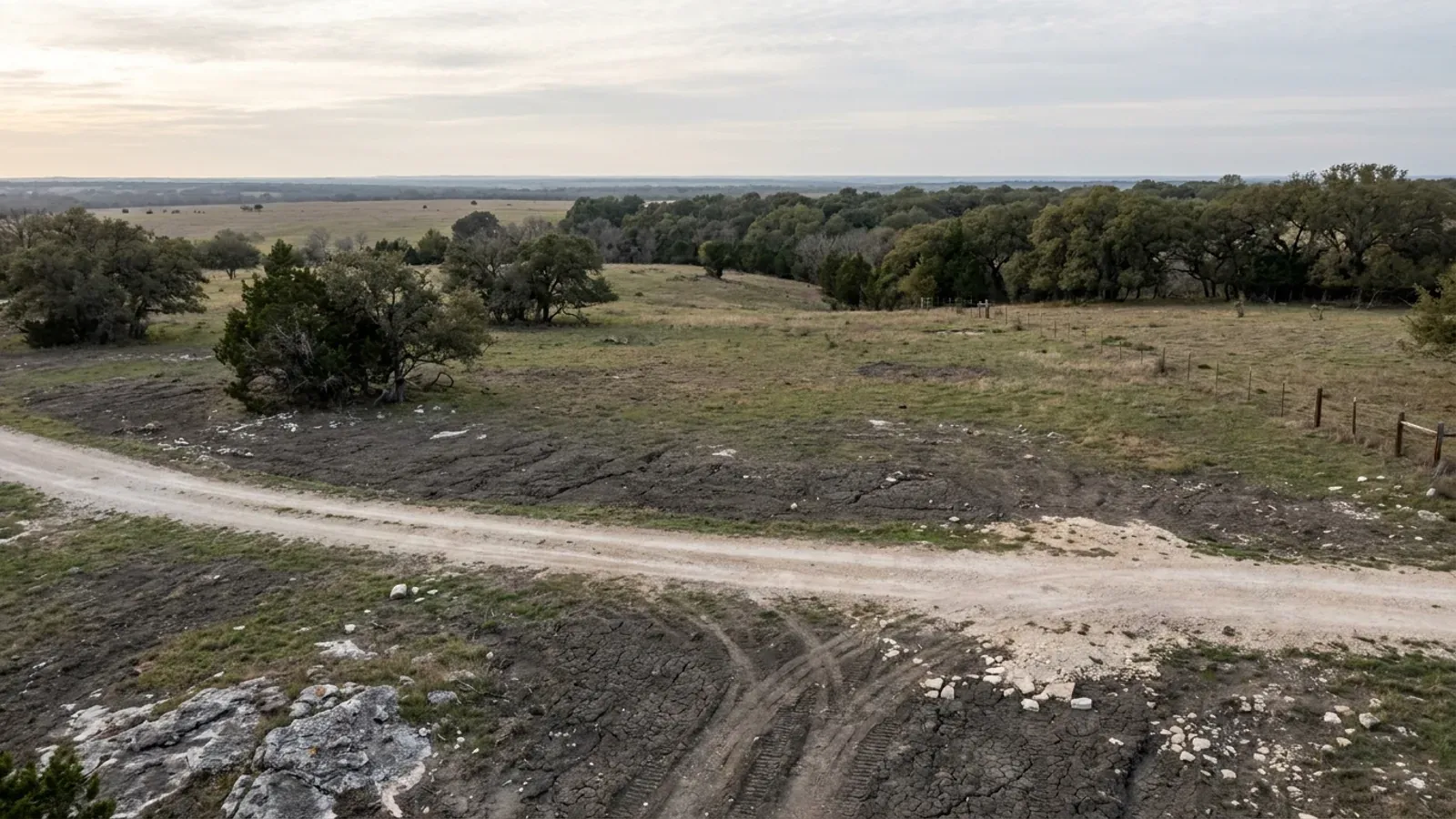
The parcel
Zoning, setbacks, flood zone and utility access get checked before anything is drawn.
Pad and permit
Clearing, grading and a compacted pad, while the submittal works through Dallas County.
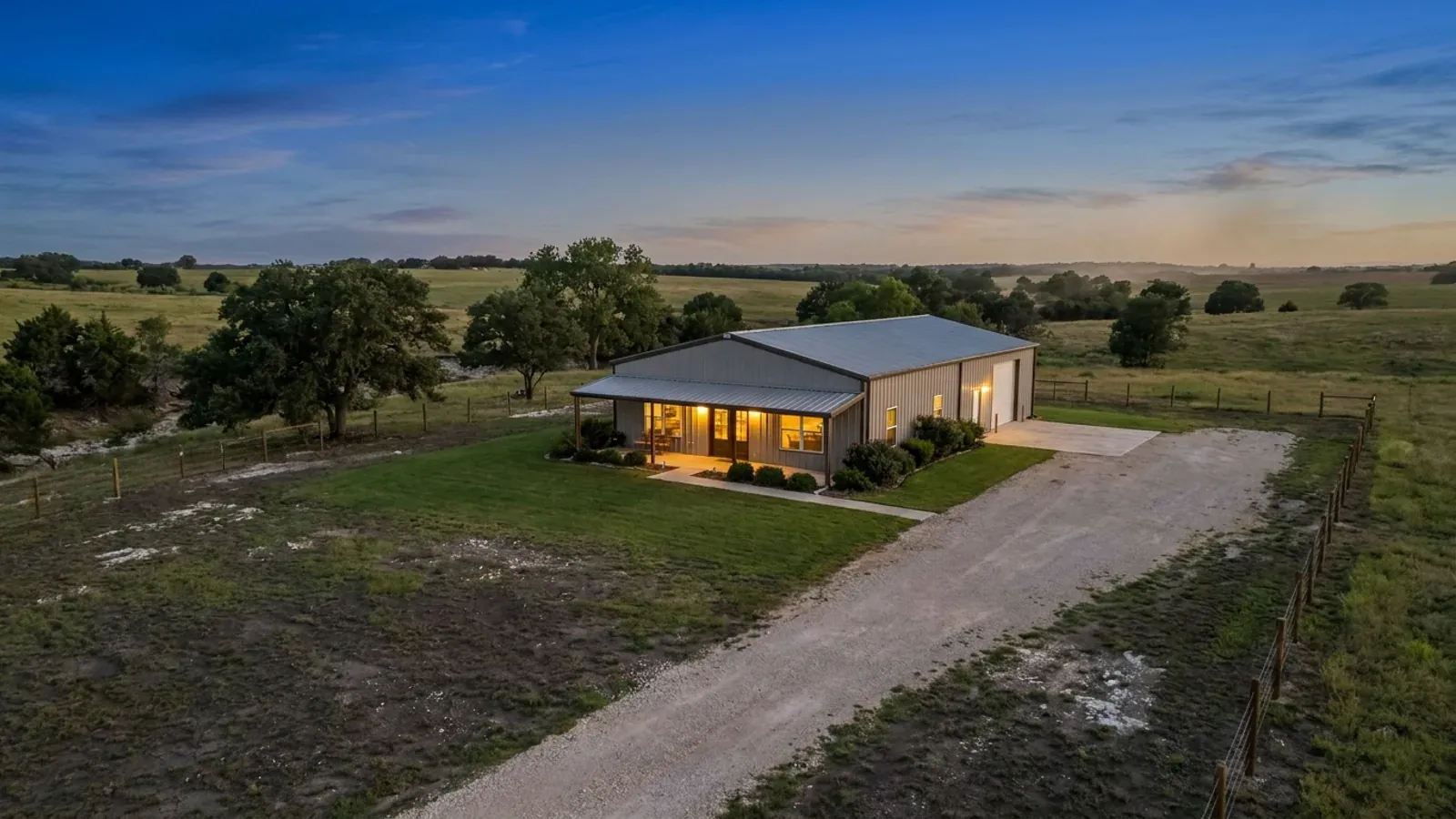
Frame to finish
Shell erected and dried in, then systems, insulation and interior finish through to CO.
Those are the rules for Dallas County. Tell us what you want to build and we will draw it to them.
Where we build around Garland
Dallas County and the rural land around it. The buildable acreage for a project this size usually sits outside the city limits, which is frequently what changes who issues your permit.
Keep reading
The questions that usually come next once you know what Garland allows.
Barndominium Cost Guide
Sourced per-square-foot ranges by tier and by size, with a calculator built on the same figures.
Read itIs It Legal in Texas?
Classification, zoning, the HOA gate, and why "nonresidential farm building" does not cover a home.
Read itHow Long Does It Take?
Census build-duration data, and what actually sets the permit clock where you are building.
Read itNearby areas we build in
Others we cover in this part of Texas. The permitting authority, the adopted design criteria and the zoning can all differ from one to the next.
Building in Garland: common questions
8 questions we get asked most often about building in Garland. If yours is not on the list, ask it directly.
Can you actually build a barndominium in Garland?
Which code does Garland enforce, and what climate zone does that put me in?
Will my building need fire sprinklers?
What changes if I buy land in unincorporated Kaufman County instead?
So outside a city there are no rules?
Does Garland require an engineer for the foundation?
Can the building have a bare galvanized metal exterior?
Who issues the permit in Garland and what does it cost?
Building in Garland?
Start with the plan. Tell us what you want to build and we will draw it, then confirm what Dallas County will actually let you put on the parcel and what wind load it has to meet. That conversation costs nothing.