Barndominium Builders in Gillespie County, TX
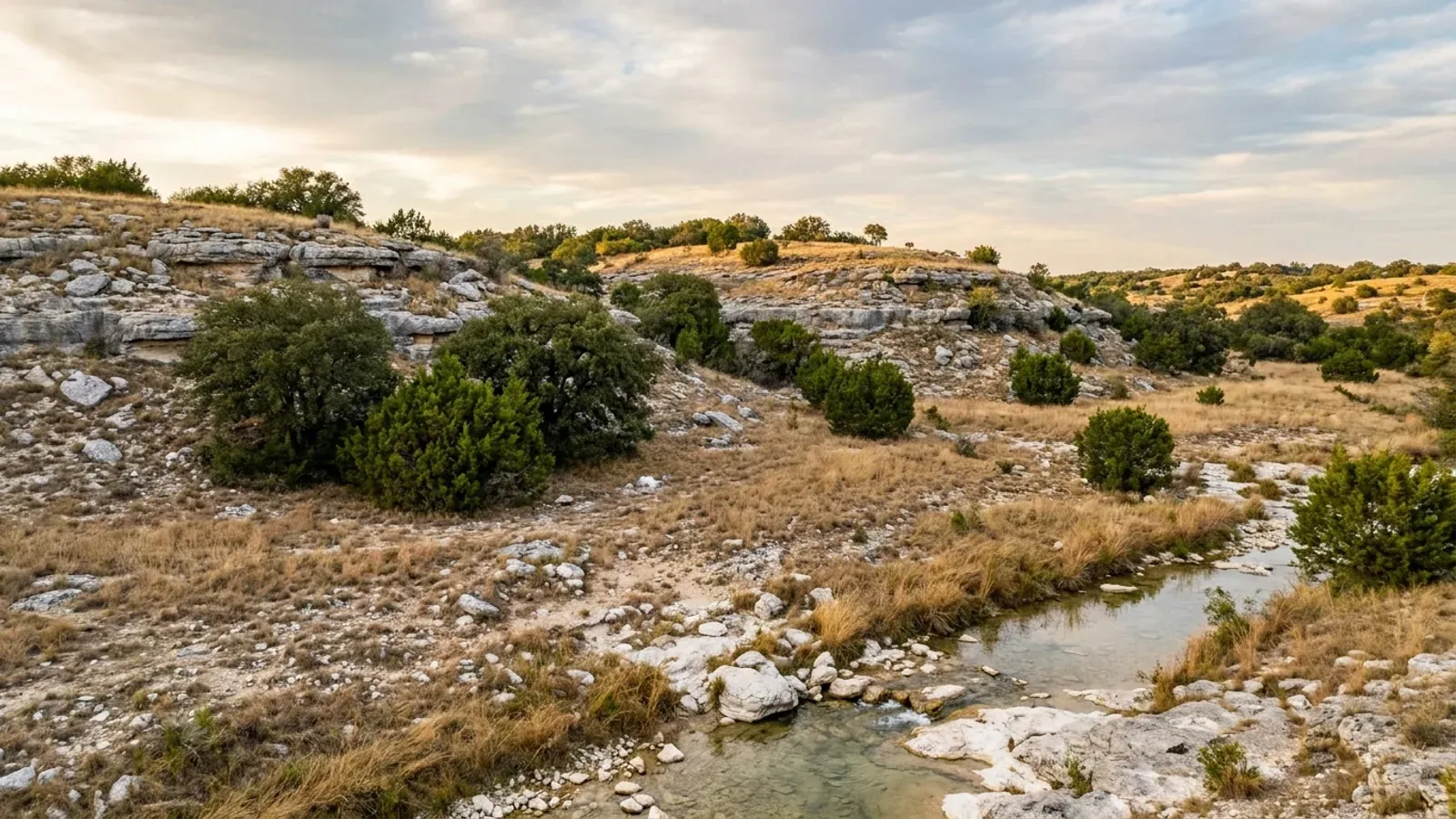
Gillespie County is 1,058 square miles of Edwards Plateau limestone with one incorporated city in it. Fredericksburg holds 11,893 people; the other 16,634 live outside any city limit, which is where nearly every barndominium here goes. Out there Chapter 233 of the Local Government Code is the whole of a Texas county's authority over structures and it carries no general building-code subchapter, so no county plan review touches the house. That is not the same as no rules. The county gates development behind a free determination form, permits and inspects every septic system on any size tract, sets a six-acre floor on new well-served lots because the Hill Country is a Priority Groundwater Management Area, and regulates the floodplain. The ground is rock, not Blackland clay, so the foundation and the drainfield are different problems from the ones the I-35 corridor has.
Gillespie County at a glance
- County
- Gillespie County
- Population
- 28,527
- Where we build
- Fredericksburg, Kerr County, Burnet County, Bandera County
- Site visits
- We meet you on the tract, Fredericksburg or anywhere else in Gillespie County
ZIPs 78624, 78631, 78618, 78671, 78675
Building conditions in Gillespie County
What actually changes from one Texas jurisdiction to the next: who issues the permit, whether the residential code is enforced there at all, what the structure has to be engineered to, and what the ground is like. These are the numbers your drawings have to satisfy.
Gillespie County Engineering Department, Subdivision Regulations; and Subdivision and Manufactured Home Rental Community Regulations adopted 19 December 2022, Exhibit 1 amendment effective 23 December 2024, revising Art. 4 Sec. 4.1(L)(4)(d)
Gillespie County Engineering Department, Floodplain Development Regulations; and Gillespie County Development Determination Form
Order Adopting Rules of Gillespie County, Texas for On-Site Sewage Facilities, effective 14 October 2025, Sec. 9(A), certified copy of the Gillespie County Clerk
TCEQ form TCEQ-0235 item 8 and 30 TAC Ch. 285 Table II, read with the Gillespie County OSSF Order effective 14 October 2025, Secs. 8 and 9
TCEQ, Edwards Aquifer Protection Program, and TCEQ, What is a Priority Groundwater Management Area; with the Gillespie County Engineering Department page
Gillespie County Treasurer, County Hotel Occupancy Tax; City of Fredericksburg Short-Term Rental Permit FAQ and Zoning Ordinance Sec. 20.222; Gillespie County Subdivision and MHRC Regulations Art. 5
Also worth knowing before you build in Gillespie County
- Fredericksburg is the county's only city, and 58 percent of people live outside it
- Gillespie County's 2025 population estimate is 28,527 across 1,058 square miles. Fredericksburg accounts for 11,893 of that; the balance of the county is 16,634. It is the only incorporated place in the county, so beyond a one-mile extraterritorial ring there is no municipal building official anywhere in Gillespie County at all.
- Inside the city it is the 2021 codes
- The City of Fredericksburg publishes its currently adopted building codes as the 2021 International Building Code, 2021 International Residential Code, 2021 International Plumbing Code, 2021 International Mechanical Code, 2020 National Electric Code and 2021 International Energy Conservation Code. The city's Building Division reviews plans for all properties within the city and performs the inspections. There is no statewide answer in Texas, and a tract a mile outside that line is under none of it.
- Forty percent hard surface can put an engineer on a tract with no building code
- Gillespie County's flood ordinance regulates outside the flood hazard area as well as inside it. Development of a tract wholly within Zone X with total impervious cover of 40 percent or greater must reduce post-development peak flows, water surface elevations and flow velocity to pre-development rates for the 5, 10, 50 and 100-year storm events at all points of discharge, with an engineer providing construction plans and a drainage study certifying it. A house within 100 feet of the flood hazard area needs an elevation certificate even in Zone X.
- One foot above the flood elevation, and double the fee if you start early
- In Zone A or AE, new construction and substantial improvement of a residential structure must have the lowest floor elevated to at least one foot above the base flood elevation. The county's administrative fee for a floodplain development permit is $100 plus actual third-party review cost — and if construction has started before the permit is approved, the applicant pays the calculated fee twice over. The County Engineer is the Floodplain Administrator.
- The county has no fire code, and says so in its own regulations
- County fire-code power in Texas exists only for a county over 250,000 people or one adjacent to such a county, and Gillespie is neither. Its subdivision regulations legislate around the gap in terms: in areas that lack a nationally recognized fire code as described in Secs. 233.061 to .062 of the Texas Local Government Code, and that also lack water lines sized for fire protection, set-backs from roads and rights-of-way shall be a minimum of 10 feet and set-backs from adjacent property lines a minimum of 5 feet.
- You may not service your own aerobic system
- Where thin soil over rock pushes a site to an aerobic or spray system, Gillespie adds a running cost the state rule does not. Its order requires maintenance for the systems identified in Sec. 285.91(12) to be performed by a TCEQ registered maintenance technician or licensed maintenance provider and not the homeowner, and requires each maintenance report to include sludge levels in the pump tank and condition of the spray area.
- A household well is registered; an irrigation or commercial well is permitted
- The Hill Country Underground Water Conservation District covers Gillespie County from 508 South Washington Street in Fredericksburg. The district registers wells used solely for domestic and livestock purposes, and separately permits wells used for commercial, irrigation or municipal purposes, which are subject to district requirements on spacing and production limits. The county's own guidance adds that permitted wells must be set back from property lines and from other permitted wells.
- The plat, not the county, sets your setbacks
- Gillespie County has no zoning, but it does impose building lines through platting. Pursuant to Sections 232.104 and 233.032 of the Texas Local Government Code, and for the promotion of the general welfare and safety of the public, its regulations require every plat to describe and depict a 20-foot building and set-back line on the front, sides, and rear of all lots in the subdivision. On a platted lot that is a real constraint on where a long metal building can sit.
- The utility connection is a gate of its own
- Gillespie County has adopted the utility connection provisions of the Local Government Code. A utility may not serve or connect subdivided land with electricity or gas unless it receives a determination from the Commissioners Court that adequate water and sewer services, including septic or OSSF facilities, have been installed to service the lot or subdivision. On land with no building permit to withhold, that is where the practical leverage sits.
- The driveway is two different permits depending on the road
- A permit is required to perform any construction in the right-of-way of a county road, including any driveway, construction entrance or other improvement, and it is issued by the County Commissioner or County Engineer. Where the property fronts a state highway the application goes to the TxDOT Fredericksburg office instead, at 1623 East Main Street — and the county notes that while there is no fee for the TxDOT permit, a permit is still required.
- Two statewide rules survive the absence of a county code
- A licensed plumber is required on new construction even where nothing else is, because the rural exemption in the Texas plumbing licence law expressly excludes plumbing performed in conjunction with new construction. And a builder working outside the limits of any municipality must certify that the house complies with the state energy code and keep that certification for three years. Both apply on land with no permit and no inspector.
U.S. Census Bureau sub-county population estimates sub-est2025 and county estimates co-est2025-alldata, with the 2024 Census Gazetteer county file; ETJ distance per Texas Local Government Code Sec. 42.021(a)
City of Fredericksburg Development Services, Building Division, Adopted Codes and Ordinances
Gillespie County Flood Damage Prevention Ordinance effective 28 July 2025, Sec. 3.3.1 and 3.3.5
Gillespie County Flood Damage Prevention Ordinance effective 28 July 2025, Secs. 2.8, 2.11 Table 2-1 and 3.4.3
Texas Local Government Code Sec. 233.061(a), and Gillespie County Subdivision and MHRC Regulations, road and utility standards item 18
Order Adopting Rules of Gillespie County, Texas for On-Site Sewage Facilities, effective 14 October 2025, Secs. 9(B) and 9(C)
Hill Country Underground Water Conservation District, Gillespie County Water Wells; and Gillespie County Development Requirement Information, revised September 2025
Gillespie County Subdivision and MHRC Regulations Art. 4, Sec. 4.1(L)(N)
Gillespie County Subdivision and MHRC Regulations, Exhibit F, adopting Texas Local Government Code Secs. 232.028, 232.029, 232.101 and 232.106 to .107
Gillespie County Development Requirement Information, revised September 2025; and Gillespie County Right-of-Way Regulations adopted 28 May 2024, amended 15 June 2026
Texas Occupations Code Sec. 1301.052, and Texas Health and Safety Code Secs. 388.003(a) and 388.004
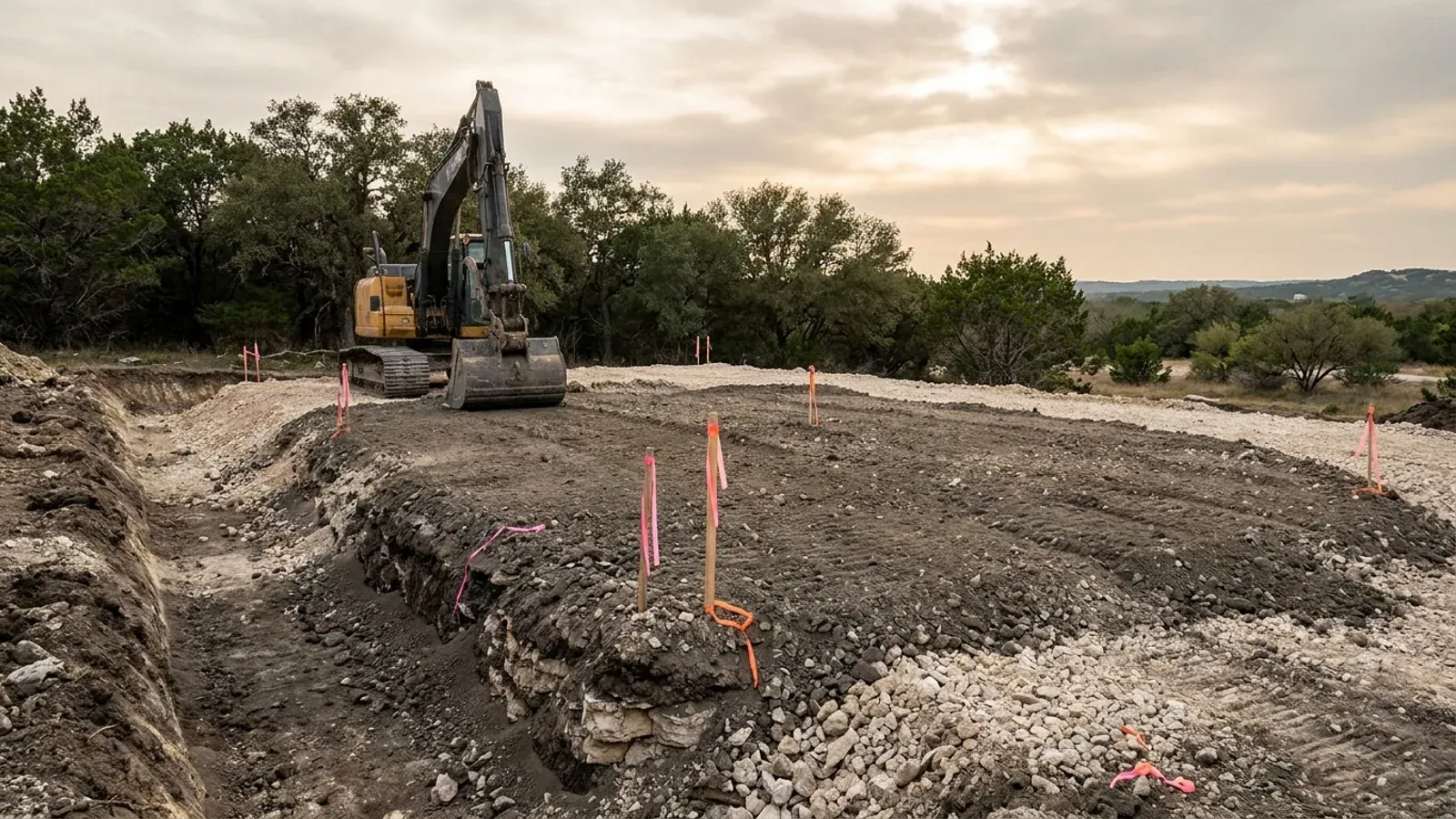
The expensive surprises are in the ground, not the building
What moves a Texas budget is usually below grade, and it is soil rather than rock: shrink-swell clay. The Blackland Prairie and the Gulf Coast clays move enough between a wet season and a dry one to drive the foundation design across the state's largest markets, which is why several DFW cities require an engineer's seal on the foundation of every new house. Those are the same conditions that decide whether a septic field passes its soil and site evaluation, so the grading plan, the foundation and the drainfield get resolved together rather than one at a time. We price the dirt before we price the building.
What we build in Gillespie County
All nine of our services — kits, custom plans, post-frame and steel construction, site preparation, permitting and engineering, through to turnkey builds — are available across Gillespie County. What a project costs depends far more on the parcel than on square footage, so we work from your land rather than from a rate card.
See what we buildWhat a build looks like
Three stages every Gillespie County project passes through, from a raw parcel to a finished home. Site work first, because that is where the budget is decided.
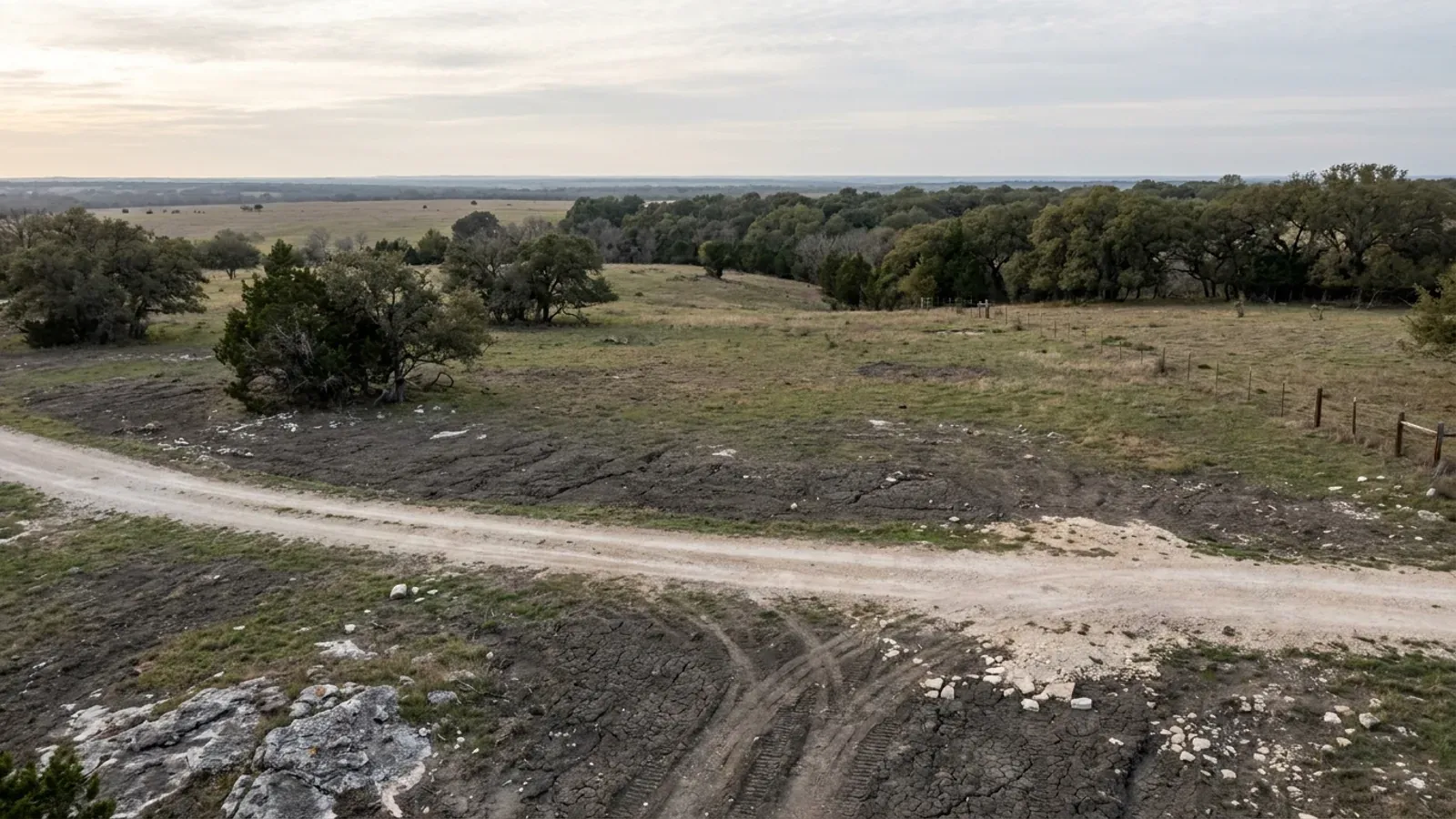
The parcel
Zoning, setbacks, flood zone and utility access get checked before anything is drawn.
Pad and permit
Clearing, grading and a compacted pad, while the submittal works through Gillespie County.
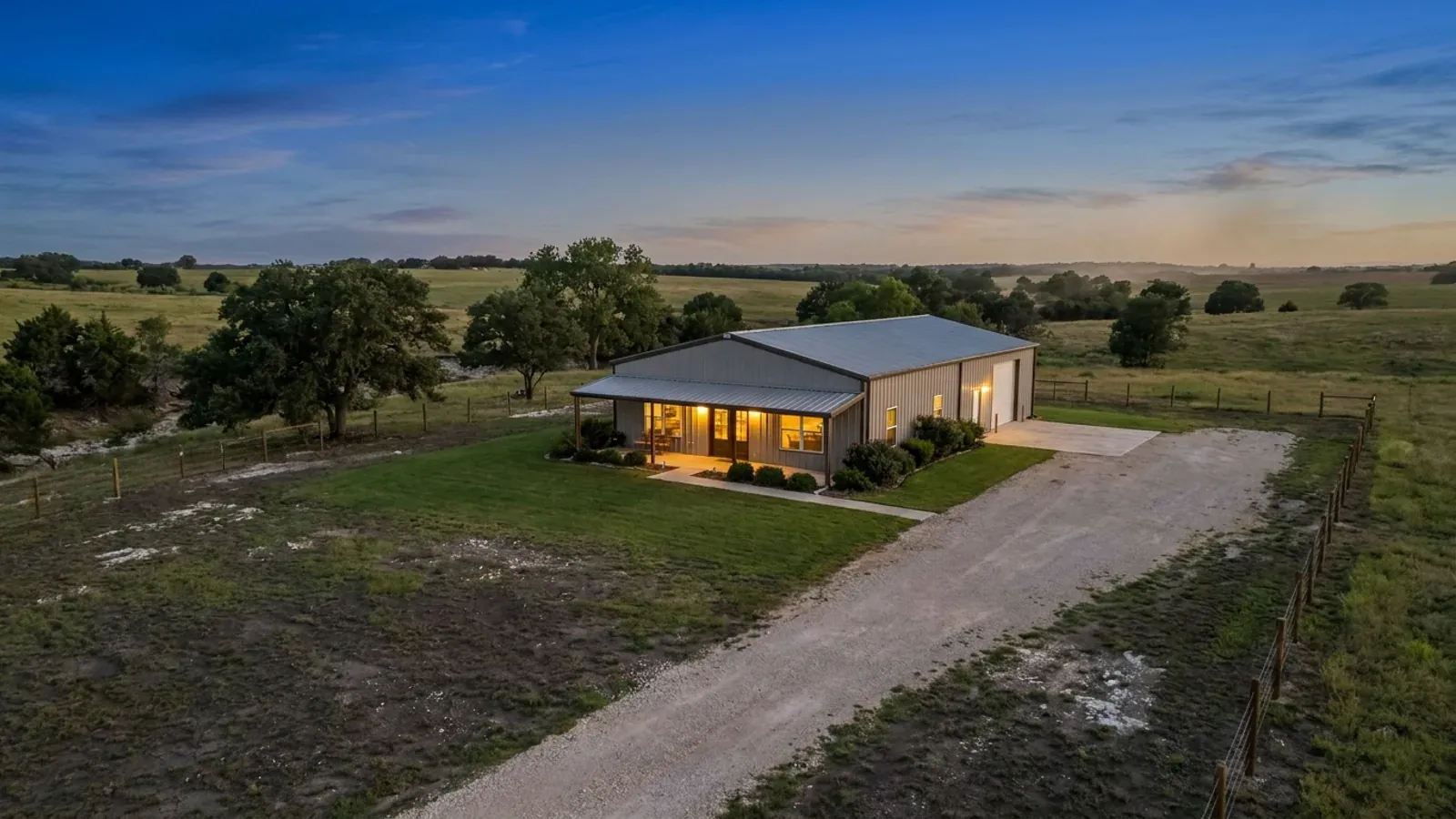
Frame to finish
Shell erected and dried in, then systems, insulation and interior finish through to CO.
Those are the rules for Gillespie County. Tell us what you want to build and we will draw it to them.
Where we build around Gillespie County
Gillespie County and the rural land around it. The buildable acreage for a project this size usually sits outside the city limits, which is frequently what changes who issues your permit.
Keep reading
The questions that usually come next once you know what Gillespie County allows.
Barndominium Cost Guide
Sourced per-square-foot ranges by tier and by size, with a calculator built on the same figures.
Read itIs It Legal in Texas?
Classification, zoning, the HOA gate, and why "nonresidential farm building" does not cover a home.
Read itHow Long Does It Take?
Census build-duration data, and what actually sets the permit clock where you are building.
Read itNearby areas we build in
Others we cover in this part of Texas. The permitting authority, the adopted design criteria and the zoning can all differ from one to the next.
Building in Gillespie County: common questions
7 questions we get asked most often about building in Gillespie County. If yours is not on the list, ask it directly.
Do I need a building permit for a barndominium on unincorporated land in Gillespie County?
How much land do I actually need in Gillespie County?
Is the ground here really different from the rest of Texas?
Is my land over the Edwards Aquifer recharge zone?
I want to rent it out on weekends. Does that change anything?
What is the actual order of operations?
Everyone says the Hill Country has no rules. Is that right?
Building in Gillespie County?
Start with the plan. Tell us what you want to build and we will draw it, then confirm what Gillespie County will actually let you put on the parcel and what wind load it has to meet. That conversation costs nothing.