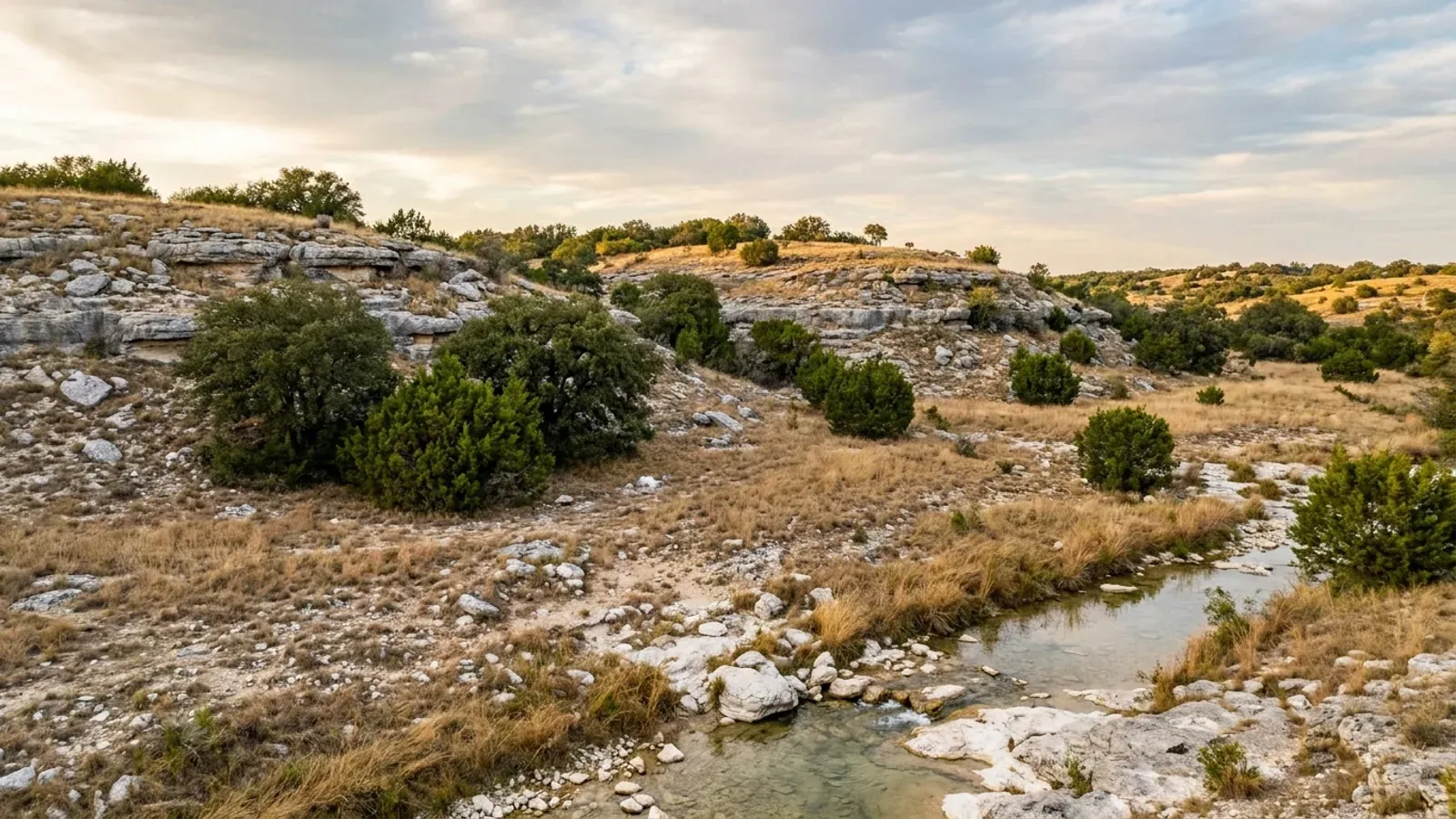
Barndominium Builders in Burnet County, TX
Burnet County is Highland Lakes country and the eastern edge of the Llano Uplift — granite and limestone rather than the shrink-swell clay of the I-35 corridor, over ground the county itself describes as running from 700 to 1,700 feet above sea level. About 57,000 people live here and nearly half of them, 27,531, live outside every city limit. Marble Falls is the largest town and has grown by more than a third since 2020; Burnet is the county seat. What makes building here genuinely different is not the county. It is that within 2,200 feet of Lakes Buchanan, Inks, Lyndon B. Johnson and Marble Falls the Lower Colorado River Authority, not Burnet County, is the authority that permits and inspects the septic system, under rules of its own that are stricter than the state's. Move a few hundred feet inland and the answer changes.
Burnet County at a glance
- County
- Burnet County
- Population
- 57,015
- Where we build
- Burnet, Gillespie County, Williamson County, Travis County, Georgetown
- Site visits
- Site visits across Burnet County, from the county seat to the county line
ZIPs 78611, 78654, 78605, 78657, 78608, 78669, 78639, 76550
Building conditions in Burnet County
What actually changes from one Texas jurisdiction to the next: who issues the permit, whether the residential code is enforced there at all, what the structure has to be engineered to, and what the ground is like. These are the numbers your drawings have to satisfy.
TCEQ On-site Sewage Facility Authorized Agent search (OARS), county record for Burnet, run 1 September 2026 — https://www.tceq.texas.gov/permitting/ossf/aa_search.html
LCRA On-Site Sewage Facilities Rules, effective 5 April 2010, Section 6; and the LCRA On-Site Sewage Facilities Program page — https://www.lcra.org/water/permits-contracts/on-site-sewage/
Burnet County Development Services, On-Site Sewage Facilities (OSSF) and Development Permits — https://www.burnetcountytexas.org/1239/On-Site-Sewage-Facilities-OSSF-Developme
TCEQ Edwards Aquifer Protection Program — https://www.tceq.texas.gov/permitting/eapp; and TCEQ's Edwards Aquifer GIS metadata quoting 30 Texas Administrative Code secs. 213.3(8) and 213.22(2) — https://www.tceq.texas.gov/gis/metadata/edwards_met.html
Burnet County Emergency Services District No. 2, Ordinance No. 05-15-2025-01, published by the county — https://www.burnetcountytexas.org/DocumentCenter/View/2348
Central Texas Groundwater Conservation District, District Rules as revised 25 August 2026, Appendix A — https://centraltexasgcd.org/groundwater-management/district-rules/
Also worth knowing before you build in Burnet County
- Ten acres buys you nothing here, and the county explains why
- Burnet County's On-Site Sewage Facility Order lists its stricter-than-state rules and the first one is this: Burnet County will permit and inspect all on-site systems regardless of the size of the tract of land the on-site system is situated upon. The order gives its own reason — with the rapid development of property occurring in the county and the abundance of streams, creeks and ponds, it is in the best interest for public health. The LCRA rules say the same thing for their own band: regardless of the lot or tract size, a permit is required prior to construction or installation.
- Inside the LCRA band, a heated loft is a bedroom
- TCEQ sizes a system off bedrooms or living area, whichever gives the higher figure. The LCRA's own order then defines the word: a bedroom is a room which serves, or could serve, for overnight sleeping and which is heated and/or cooled and has adequate size, privacy, and a closet — and a room that serves for overnight sleeping or contains a bed is a bedroom regardless of the presence or absence of a closet. On a barndominium that reaches a conditioned bonus room over the shop bay whether or not anyone calls it a bedroom. Burnet County's own order does not carry that definition, so the answer differs on either side of the line.
- Thin soil over rock is what forces the aerobic system
- There is no percolation test in Texas; soil is classified by texture. What decides the system here is depth to rock. The LCRA's rules say that in the Restricted Zones of Buchanan, Inks, Lyndon B. Johnson and Marble Falls a discharge more than 75 feet from the top of the normal operating range is lawful only into a facility generating secondary quality effluent — an aerobic treatment unit, an intermittently pressure dosed sand filter or another TCEQ approved method — and that three feet of suitable soil may be substituted with a low pressure dosing system. Its published guidance is blunter: where the evaluator finds a restrictive horizon less than 2 feet below the bottom of the proposed drain field, a conventional soil absorption system cannot be used.
- A second LCRA permit covers the Colorado River watershed in this county
- The Highland Lakes Watershed Ordinance is a stormwater and land-disturbance instrument, separate from the septic programme, and the LCRA states that it applies to land modification activity within the Colorado River watershed in Burnet County. Anyone doing development, quarry or mine activity, or utility construction must notify the LCRA before beginning work. A development permit is required if impervious cover will exceed 10,000 square feet or land disturbance will exceed 1 acre. Buffer zones along creeks must stay free of development. The LCRA has interlocal agreements with the City of Burnet, Marble Falls, Horseshoe Bay and Sunrise Beach Village among others, so check with the local government first. Ask the LCRA where the boundary runs on your tract.
- One foot above the base flood elevation, and the order cites the Water Code
- The Burnet County Flood Damage Prevention Order was passed and became effective on 8 October 2019. Its opening section names its authority: the Flood Control Insurance Act, Texas Water Code, Section 16.315. For residential construction it requires the lowest floor, including any basement, to be elevated to a minimum of one foot above the base flood elevation, with a certification submitted to the Floodplain Administrator by a registered professional engineer, architect or land surveyor. Service equipment must sit one foot above the base flood elevation in an AE Zone and two feet in an A Zone. Repairs or improvements worth 50 percent or more of market value are treated as new construction.
- Nearly half the county lives outside every city limit
- The Census Bureau's Vintage 2025 estimates put Burnet County at 57,015, against a 2020 base of 49,125 — a gain of 7,890, or about 16 percent, in five years. The balance of the county, meaning everything outside the nine incorporated places, holds 27,531 of that, or 48 percent. Marble Falls is the largest city at 9,633 and has grown more than a third since 2020; Burnet, the county seat, is 6,939, Granite Shoals 5,498 and Bertram 2,142. The county covers 995 square miles of land, so the unincorporated half is where the acreage is.
- A permitted septic system dies with a change of use
- Inside the LCRA band, a permit to operate terminates automatically if the system is not inspected and approved for continued use when the property changes hands, if the structure is enlarged over the size for which the system was approved, if the property is subdivided, or if the property is used for a purpose other than that described in the original application. At transfer of ownership, and regardless of location, the facility must undergo an approval for continued use inspection — and the LCRA inspects the interior as needed to confirm the floor plan is the same as was previously approved. That last clause is worth reading twice if a guest suite or a let is anywhere in your plans.
- The county taxes short-term lets in the unincorporated area
- Burnet County collects a hotel occupancy tax on short-term rentals in the unincorporated area, filed quarterly with payment due by 30 April, 31 July, 31 October and 31 January. The county's own compliance sheet carries the warning that catches people out: AirBnB and VRBO collect state taxes, but not county or city taxes. This is a tax obligation, not a building code — the county was not found to route rental or income-producing residential through any commercial construction track — but it is a real filing that arrives with the first booking.
- Ten acres is the line for the well too, but not the way people think
- The Central Texas Groundwater Conservation District requires every well in the county to be registered. A new house well on more than ten acres is exempt from permitting, provided it is equipped so that it cannot produce more than 25,000 gallons in 24 hours and it meets the spacing rules. On ten acres or less, the well is not exempt — but the district permits it by rule, so no individual permit is needed, provided it meets spacing, is not part of an aggregate system, and, for a well drilled after 27 March 2024, is equipped so that it cannot produce more than 10,000 gallons a day. The cap on the smaller tract is less than half.
- The northeast corner of the county has its own well rules since January 2026
- The district created the Northeast Burnet County Trinity Aquifer Management Zone under Water Code sec. 36.116(d), running from the county line along US 281 and Ranch to Market Road 2340 to the North Fork of the San Gabriel River. It reaches only wells completed in the Trinity Aquifer, expressly not the Hickory, Ellenburger-San Saba, Marble Falls, Welge-Lion Mountain or Granite aquifers. Since 23 January 2026 a tract of ten acres or less in the zone may have no more than one Trinity well on it, regardless of when the tract was created. The district's stated reason is low transmissivity, modest to low well productivity, minimal available drawdown and, in places, water quality that may degrade further under increased drawdown.
- More than ten acres and no streets means no plat
- Burnet County adopted Local Government Code Chapter 232, Subchapter E for its unincorporated area by order of the Commissioners Court on 11 January 2011. Its regulations then carry the statutory exemptions: a division of land outside a municipality is exempt from platting if all the lots are more than 10 acres and the owner lays out no streets, alleys, squares or parks for public or purchaser use. Transfers among people related within the third degree by consanguinity or affinity are also exempt — but the regulations state the clawback plainly, that if any lot goes to someone unrelated, the platting requirements apply.
- A licensed plumber is required whatever the county does
- The rural exemption in the Plumbing License Law expressly does not reach plumbing performed in conjunction with new construction. A Texas-licensed plumber is required on a new house on unincorporated land regardless of the county's building-code position, and regardless of the fact that no county inspector is coming to look at the frame. Inside the LCRA band there is a related trap: the LCRA's rules require low-flow fixtures in all new building construction as part of the on-site sewage facility design, so the plumbing specification is enforced through the septic permit.
- The state energy code reaches this land anyway
- Health and Safety Code sec. 388.004 obliges a builder outside any municipality to certify that a new single-family house complies with the energy standard and to keep that certification for three years. It applies to unincorporated Burnet County whether or not the county has a building code. Burnet County is climate zone 3A on both the pre-2021 and the 2021 International Residential Code county tables, so the insulation zone here does not depend on which edition anyone adopted — unlike Travis and Williamson Counties next door, which are 2A.
- A culvert is a site meeting with your county commissioner
- Burnet County's Road Access Permit Application does not let you pick a pipe. Culvert location, length and diameter will be specified by the precinct commissioner or their designee during a site meeting. The applicant supplies all materials, labour, equipment and installation to county specification, maintains the culvert afterwards, and may not erect any sign or permanent structure on the right of way — the mail receptacle location is decided at the same meeting. The building permit application asks twice whether the property needs an entrance onto a county road.
Order Adopting Rules of Burnet County, Texas for On-Site Sewage Facilities, sec. 10(A) — https://www.burnetcountytexas.org/DocumentCenter/View/1151; LCRA On-Site Sewage Facilities Rules sec. 10.05(b)
LCRA On-Site Sewage Facilities Rules, effective 5 April 2010, sec. 10.16 — https://www.lcra.org/water/permits-contracts/on-site-sewage/
LCRA On-Site Sewage Facilities Rules secs. 10.02(a)(1) and 10.15(b)(1)(B); LCRA on-site sewage frequently asked questions — https://www.lcra.org/water/permits-contracts/on-site-sewage/faqs/
LCRA Highland Lakes Watershed Ordinance — https://www.lcra.org/water/permits-contracts/watershed-management-ordinance/
Burnet County Flood Damage Prevention Order, Articles I and 5, adopted 8 October 2019 — https://www.burnetcountytexas.org/DocumentCenter/View/2009
U.S. Census Bureau, Vintage 2025 county and sub-county population estimates (co-est2025-alldata and sub-est2025); 2025 Census Gazetteer counties file
LCRA On-Site Sewage Facilities Rules secs. 10.08, 10.09 and 10.10 — https://www.lcra.org/water/permits-contracts/on-site-sewage/
Burnet County Tourism, Short-Term Rental HOT Compliance Overview — https://www.burnetcountytexas.org/DocumentCenter/View/2431
Central Texas Groundwater Conservation District, District Rules as revised 25 August 2026, secs. 3.40 and 3.67 — https://centraltexasgcd.org/groundwater-management/district-rules/
Central Texas Groundwater Conservation District, District Rules as revised 25 August 2026, Rule 4.05 — https://centraltexasgcd.org/groundwater-management/district-rules/
Burnet County Subdivision Regulations, order adopting Chapter 232 Subchapter E dated 11 January 2011, and the platting exemptions article — https://www.burnetcountytexas.org/DocumentCenter/View/430
Texas Occupations Code sec. 1301.052 — https://statutes.capitol.texas.gov/Docs/OC/htm/OC.1301.htm; LCRA On-Site Sewage Facilities Rules sec. 10.13(a)
Texas Health and Safety Code ch. 388 secs. 388.003 and 388.004 — https://statutes.capitol.texas.gov/Docs/HS/htm/HS.388.htm; International Residential Code Chapter 11 [RE] Texas county tables, compared across editions; Burnet County FIPS 48053
Burnet County Road Access Permit Application — https://www.burnetcountytexas.org/DocumentCenter/View/2282; Burnet County Building Permit Application — https://www.burnetcountytexas.org/DocumentCenter/View/1150
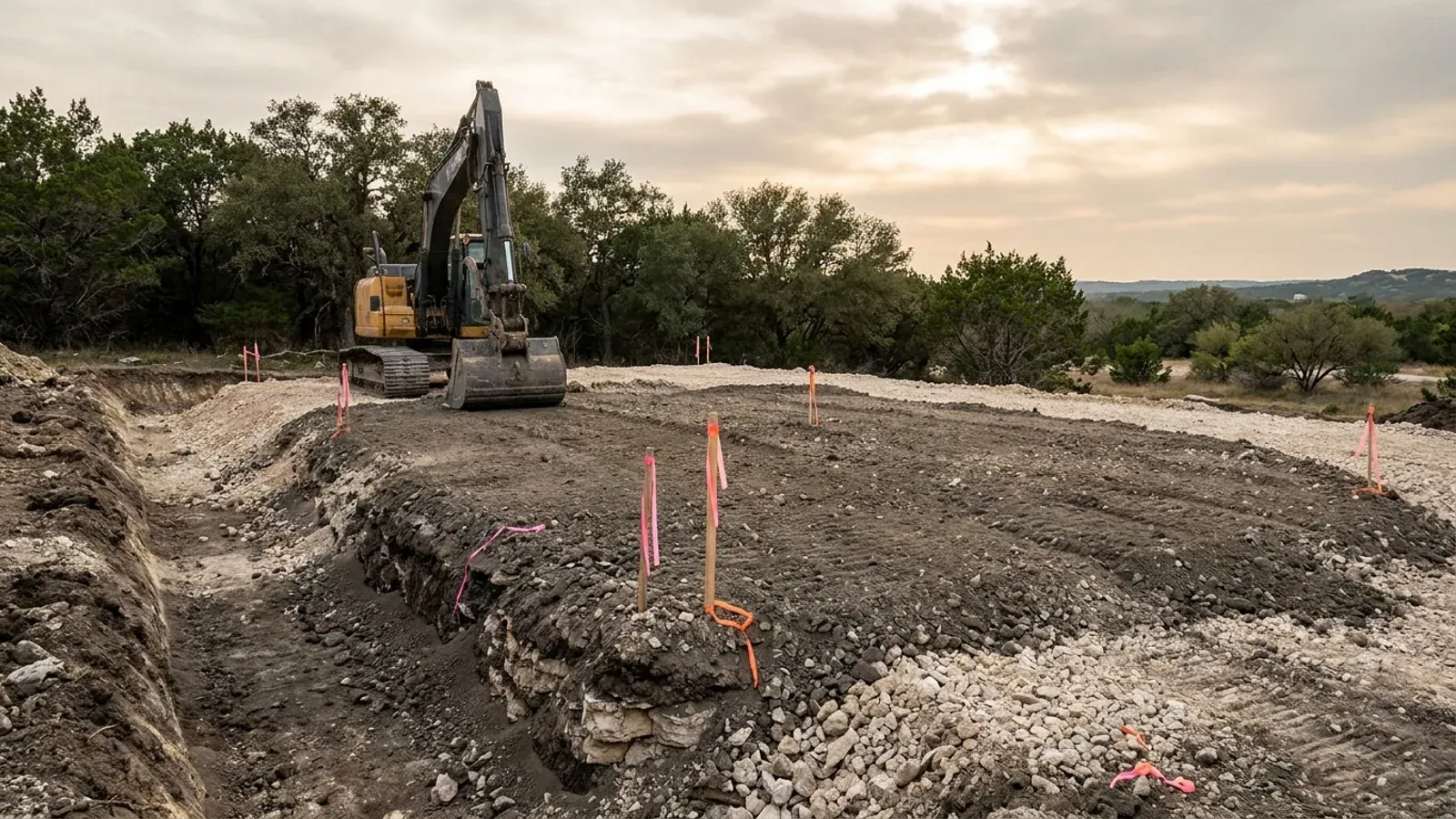
The expensive surprises are in the ground, not the building
What moves a Texas budget is usually below grade, and it is soil rather than rock: shrink-swell clay. The Blackland Prairie and the Gulf Coast clays move enough between a wet season and a dry one to drive the foundation design across the state's largest markets, which is why several DFW cities require an engineer's seal on the foundation of every new house. Those are the same conditions that decide whether a septic field passes its soil and site evaluation, so the grading plan, the foundation and the drainfield get resolved together rather than one at a time. We price the dirt before we price the building.
What we build in Burnet County
All nine of our services — kits, custom plans, post-frame and steel construction, site preparation, permitting and engineering, through to turnkey builds — are available across Burnet County. What a project costs depends far more on the parcel than on square footage, so we work from your land rather than from a rate card.
See what we buildWhat a build looks like
Three stages every Burnet County project passes through, from a raw parcel to a finished home. Site work first, because that is where the budget is decided.
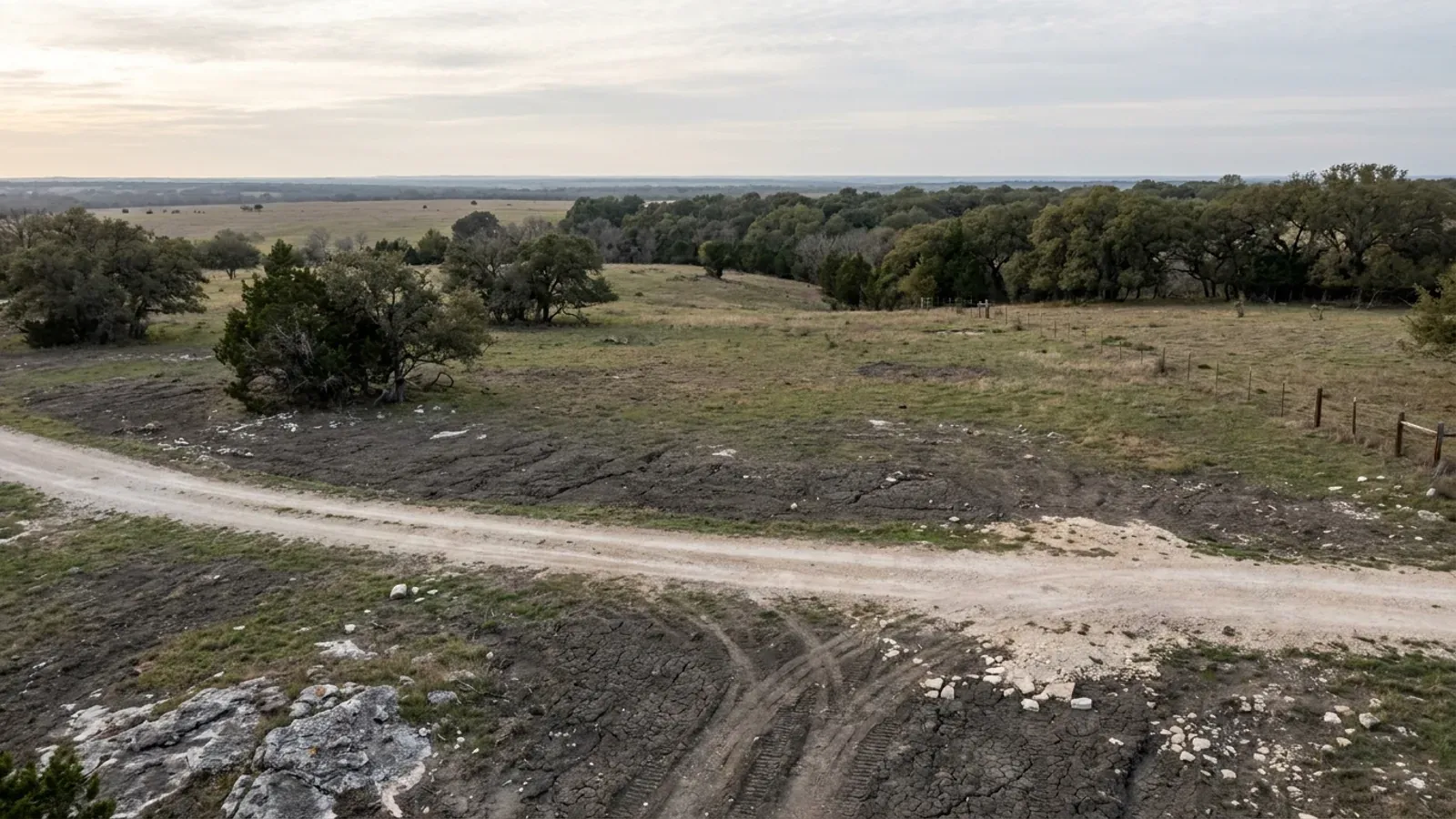
The parcel
Zoning, setbacks, flood zone and utility access get checked before anything is drawn.
Pad and permit
Clearing, grading and a compacted pad, while the submittal works through Burnet County.
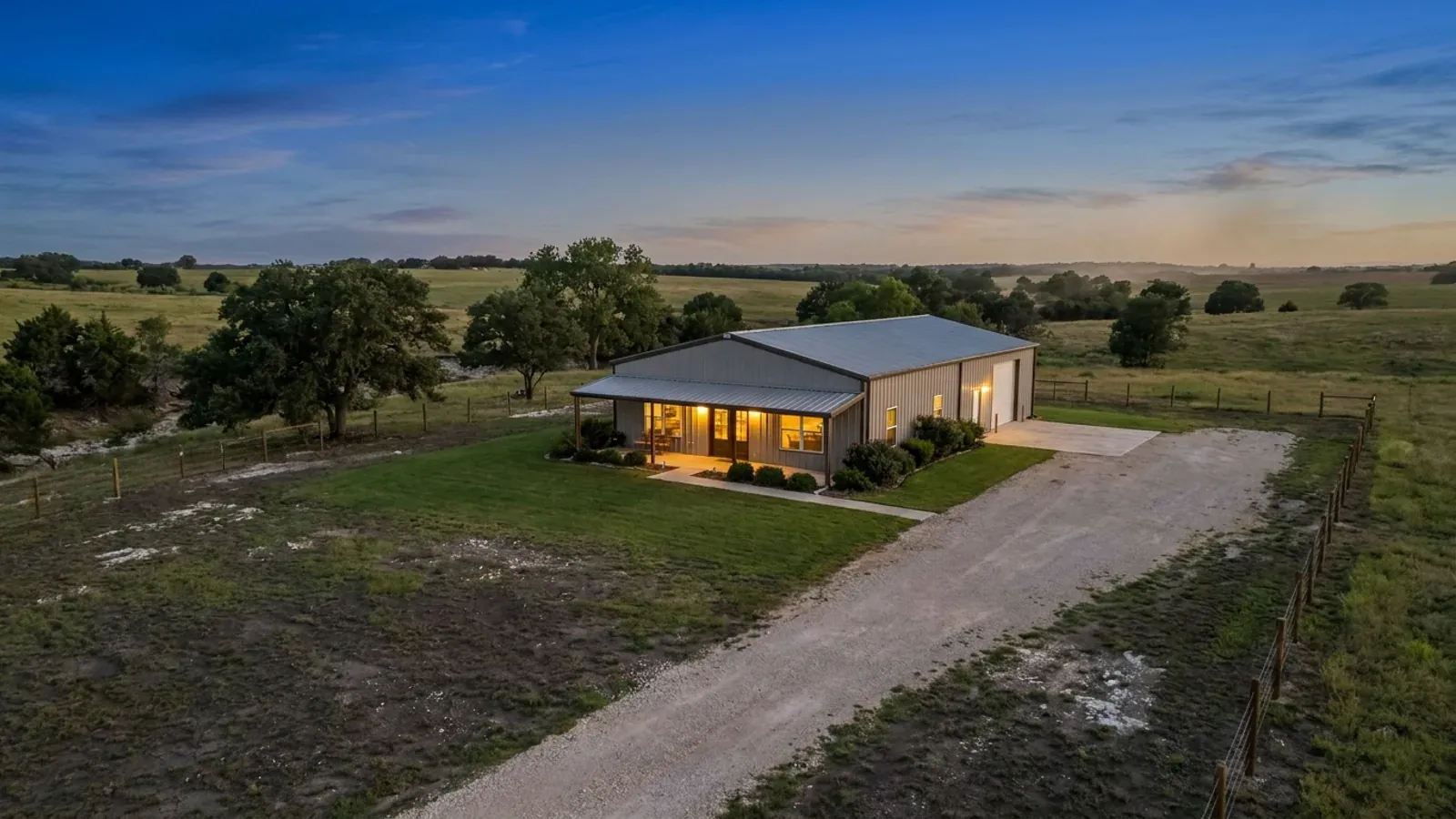
Frame to finish
Shell erected and dried in, then systems, insulation and interior finish through to CO.
Those are the rules for Burnet County. Tell us what you want to build and we will draw it to them.
Where we build around Burnet County
Burnet County and the rural land around it. The buildable acreage for a project this size usually sits outside the city limits, which is frequently what changes who issues your permit.
Keep reading
The questions that usually come next once you know what Burnet County allows.
Barndominium Cost Guide
Sourced per-square-foot ranges by tier and by size, with a calculator built on the same figures.
Read itIs It Legal in Texas?
Classification, zoning, the HOA gate, and why "nonresidential farm building" does not cover a home.
Read itHow Long Does It Take?
Census build-duration data, and what actually sets the permit clock where you are building.
Read itNearby areas we build in
Others we cover in this part of Texas. The permitting authority, the adopted design criteria and the zoning can all differ from one to the next.
Building in Burnet County: common questions
10 questions we get asked most often about building in Burnet County. If yours is not on the list, ask it directly.
Does Burnet County have a building code, and do I need a permit?
Who permits my septic system — the county or the LCRA?
Does having more than ten acres get me out of the septic permit?
The ground here is rock, not clay. What does that do to the septic system?
I want the shop bay conditioned. Does that make my drainfield bigger?
Is Burnet County over the Edwards Aquifer? Do I need a TCEQ plan?
What about the water well?
So if there is no building code, is there anything that inspects the build?
Does renting it out change anything?
Is this the shrink-swell clay everyone warns about around Waco and Dallas?
Building in Burnet County?
Start with the plan. Tell us what you want to build and we will draw it, then confirm what Burnet County will actually let you put on the parcel and what wind load it has to meet. That conversation costs nothing.