Barndominium Builders in Kerr County, TX
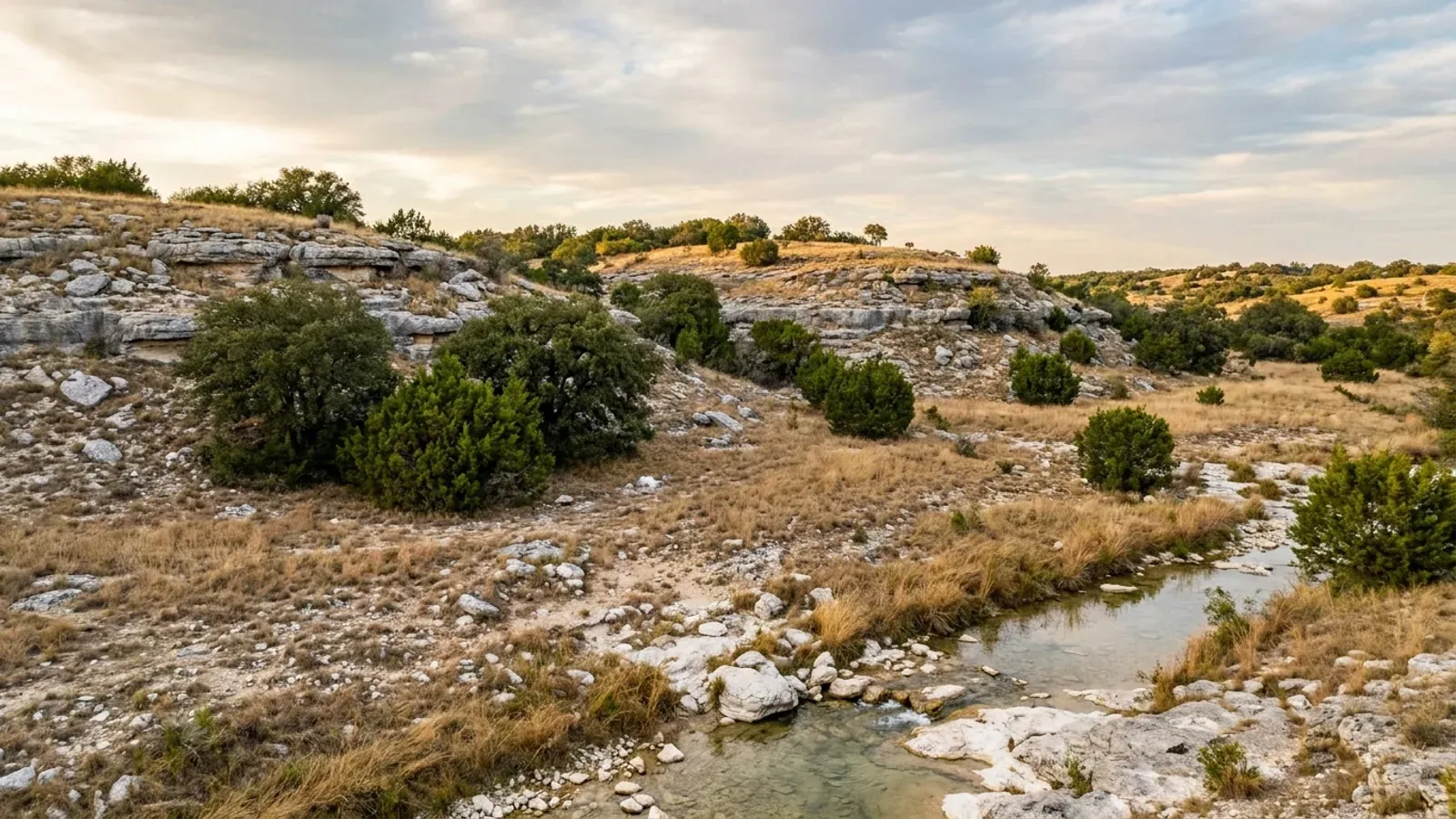
Kerr County is the Hill Country as people picture it — 1,103 square miles of limestone, cedar and spring-fed river around Kerrville, with about half the population outside any city limit. What applies here is not what applies on the prairie soils east of I-35. Chapter 233 of the Local Government Code is the whole of a Texas county's authority over structures, and Kerr County has never adopted its residential subchapter, so no county official examines the building. The ground and the water regulate instead. Nine acres in ten carry limestone, weathered rock or caliche as a mapped restrictive layer. The county rewrote its septic order in July 2026 and now permits every system regardless of tract size. And the groundwater district will not allow a well on a tract platted since August 2023 unless it runs to ten acres — the number that decides whether a listing is buildable at all. Inside Kerrville or Ingram, that city's code applies instead.
Kerr County at a glance
- County
- Kerr County
- Population
- 54,037
- Where we build
- Kerrville, Gillespie County, Bandera County, Comal County
- Site visits
- On-site visits across Kerr County, Kerrville and the land beyond it
ZIPs 78028, 78029, 78025, 78010, 78024, 78058, 78013, 78631 and more
Building conditions in Kerr County
What actually changes from one Texas jurisdiction to the next: who issues the permit, whether the residential code is enforced there at all, what the structure has to be engineered to, and what the ground is like. These are the numbers your drawings have to satisfy.
Headwaters Groundwater Conservation District Rules, adopted by the Board of Directors 14 May 2025, Rule 4 Sections 3.A and 4 (exempt wells) and Rule 5 Sections 1 and 2 (permitted wells)
Kerr County On-Site Sewage Facilities Order, passed and approved 13 July 2026, Sections 3, 6 and 9, with the TCEQ executive director's Health and Safety Code Sec. 366.031 order issued 7 August 2026
Exhibit B to the Kerr County OSSF Order, letter of the Kerr County Environmental Health Director dated 11 May 2026, justification item (iii)
TCEQ form TCEQ-0235 item 8 and 30 TAC Ch. 285 Table II, with the Kerr County OSSF Order Sections 8 and 9
Kerr County Commissioners' Court verbatim minutes, 24 August 2009, Item 6, and the county's published minutes archive 2001 to 2026
30 TAC Ch. 213, Subchapters A and B; TCEQ Edwards Aquifer Protection Program; Kerr County Subdivision Regulations Secs. 1.08 and 5.08, citing Texas Water Code Sec. 35.019
Also worth knowing before you build in Kerr County
- One dwelling per lot, on the plat and in the deed
- Kerr County's subdivision regulations state that no more than one single-family detached dwelling shall be located on each lot, that the restriction must be placed on the face of the final plat, and that it must be placed in all deeds and contracts for deeds for real estate sold within the subdivision. A main house now and a guest barndominium later is foreclosed on a lot platted under these rules, and it is foreclosed in two places, so it survives resale.
- There are setbacks precisely because there is no fire code
- The county's subdivision regulations set a minimum 50-foot setback from roads and rights-of-way and a minimum 10-foot setback from adjacent property lines in areas that lack a nationally recognised fire code and lack water lines sized for fire protection. They add that setbacks required elsewhere in the county's orders control wherever they are greater — which in practice means the septic separations decide where the shop can go.
- Nine acres in ten sit on rock or caliche
- In the USDA soil survey of Kerr County, 90 percent of the mapped acreage carries a root-restrictive layer — limestone bedrock on 70 percent, a petrocalcic caliche hardpan on 12 percent, weathered bedrock on 8 percent — and on roughly a third of the county that layer is within two feet of the surface. The largest single map unit is the Eckrant-Harper complex at 102,890 acres; the Eckrant series is described as 4 to 20 inches to lithic bedrock over Lower Cretaceous limestone. Depth to a restrictive layer is one of six site limitations the county's own septic site evaluation form asks the evaluator to score.
- Much of the county's floodplain has no published flood elevation
- The county engineer's office states that much of Kerr County's floodplain on the FEMA maps is in Zone A, meaning the area lacks a detailed engineering study and the resulting flood elevations, and points to FEMA's Base Level Engineering studies as an estimating tool rather than a substitute for an engineering study. A floodplain determination or permit is required for any work in the floodplain, no work may start until the permit issues, and the development may not be used or occupied until a certificate of compliance is issued.
- What the county's own permits cost
- Kerr County publishes $200 for a residential floodplain development permit, $400 for the commercial equivalent, $75 for a septic-only floodplain permit, $75 for a Zone AE determination and $25 for a driveway permit, adopted by the Commissioners' Court on 11 September 2023 by Court Order No. 40214. The septic schedule the Environmental Health Department publishes carries its own revision date of 23 October 2013 and shows $240 plus a $10 state fee for a new system under 500 gallons per day, or $290 plus $10 where a maintenance contract is required, as with an aerobic system.
- Climate zone 3B, and the B is the point
- Kerr County is climate zone 3B on the pre-2021 map and on the 2021 and 2024 map alike, with a Building America designation of Hot-Dry. It is one of the few counties in the Hill Country on the dry side of the line: neighbouring Gillespie, Kendall and Blanco are 3A. Because the assignment does not change between editions, the insulation specification does not depend on which code edition reaches the parcel.
- Inside Kerrville the answer changes completely
- The City of Kerrville publishes adoption of the 2018 International Residential Code and 2018 International Building Code, together with the 2018 IEBC, 2017 National Electrical Code, 2018 IPC, 2018 IFGC, 2018 IMC, 2018 IECC and 2018 International Fire Code. Inside the city limits that code and the city's own building official apply, and the county's no-code position is irrelevant. Kerrville is a home-rule city — its charter says so in terms — and the Texas Supreme Court held in Town of Lakewood Village v. Bizios that a home-rule municipality may not enforce its building codes in its extraterritorial jurisdiction.
- A water tank instead of a fire hydrant
- Where a subdivision is not served by fire hydrants on a certified centralised water system, Kerr County requires the developer to build and maintain a fire suppression system: a minimum 2,500 gallons of storage with a 2.5-inch connection for 11 to 49 houses, and 5,000 gallons for 50 or more without a centralised system. Subdivisions of 200 lots or more need two means of ingress and egress shown on the plat for emergency vehicles and evacuation. The groundwater district exempts the well that fills such a tank from permitting.
- Every plat has to prove the water is there
- Because Kerr County lies in the Hill Country Priority Groundwater Management Area, the Commissioners' Court has adopted water availability requirements as platting conditions. Where the supply is groundwater, the plat must carry a statement from a Texas-licensed engineer or geoscientist certifying adequate groundwater for a minimum of thirty years, and the developer must transmit the data to the Texas Water Development Board and the groundwater district. Every plat must also show compliance with the district's current rules — and even a subdivision exempt from the rest of the water availability requirements is not exempt from that.
- Ten acres shows up in the road standards too
- The county's cheapest road classifications, country lane and unpaved country lane, may serve eight lots or fewer at 60 vehicles a day or less, and carry the condition that all lots must be a minimum of ten acres, with a table footnote adding that no further subdividing is allowed on the plat. It is the third independent place the ten-acre figure appears in Kerr County, after the groundwater rules and the septic order's justification.
- Letting the place out changes the water, not the code
- The groundwater district allocates each stand-alone housing connection a livable minimum standard of 432 gallons per day, but transient lodging — any facility for occupancy by guests who pay rent, fees or other consideration for temporary lodging — is instead capped by production, at 80,000 gallons per year per acre, or 65,000 in the East Kerr Management Zone. A single domestic-exempt well may serve no more than three residences or rental units on a tract. There is no commercial building track in the county to move into, because there is no building department at all.
- The well is registered, not permitted — but it is not unregulated
- A house well on its own tract producing no more than 25,000 gallons a day is exempt from the district's permitting requirement, which means registered rather than permitted. Registration is still mandatory: the owner must file a form with a fee, a survey and proof of ownership at least ten days before drilling, and the district's rules state that drilling is prohibited until a signed registration form has been submitted. Spacing rules apply to an exempt well as well as a permitted one, and a state-licensed water well driller is required either way.
- Two state requirements survive the absence of a county code
- The rural exemption in the Texas plumbing licence law expressly excludes plumbing performed in conjunction with new construction, so a licensed plumber is required on land with no permit and no inspector. And a builder working outside the limits of any municipality must certify that the house complies with the state energy code and keep that certification for three years. Texas houses run on the energy chapter of the residential code as it existed on 1 May 2015.
- The population, and why the lot count is the better number
- The Census Bureau puts Kerr County at 54,037 residents in 2025, against a 2020 base of 52,595 — a gain of 2.7 percent in five years, spread across 1,103 square miles, or about 49 people per square mile. Kerrville is 25,578 and Ingram 1,846, which leaves roughly 26,600 people, just under half the county, outside any city limit. Population is not what is moving here: the county's own septic filing describes an influx of subdivisions, so lots are being created faster than people are arriving.
Kerr County Subdivision and Manufactured Home Rental Community Regulations Sec. 5.01.F.3.g, approved 28 November 2022, Commissioners Court Order No. 39679, effective 1 January 2023
Kerr County Subdivision Regulations Sec. 5.01.F.3.f, referring to Local Government Code Sec. 233.062(c)
USDA-NRCS SSURGO via Soil Data Access, survey area TX265; NRCS Official Series Description, Eckrant series; Kerr County Environmental Health Site Evaluation form
Kerr County Engineer, Floodplain Management; Application for Kerr County Floodplain Determination and/or Permit; Kerr County Flood Damage Prevention Order Nos. 37967 and 38000, February and March 2020
Kerr County Engineering Department Fee Schedule 2023-24, Court Order No. 40214; Kerr County Environmental Health OSSF Fee Schedule, rev. 23 October 2013
U.S. Department of Energy / Pacific Northwest National Laboratory PNNL-33270 climate zone data files, county record for Kerr County, FIPS 48265
City of Kerrville, Code Information, kerrvilletx.gov; Kerrville City Charter Sec. 1.01, Ord. No. 2024-14, adopted at special election 4 May 2024; Town of Lakewood Village v. Bizios, 493 S.W.3d 527 (Tex. 2016)
Kerr County Subdivision Regulations Sec. 5.07, under Local Government Code Secs. 232.101, 232.107 and 232.109; Headwaters GCD Rules Rule 4 Sec. 1.A(3)
Kerr County Subdivision Regulations Sec. 5.08, under Local Government Code Sec. 232.0032 and Texas Water Code Sec. 35.019, with 30 TAC Secs. 230.1-230.11
Kerr County Subdivision Regulations Sec. 7, road classifications and Table 7.00
Headwaters GCD Rules, Rule 7.E and Rule 4 Sec. 1.A(4), adopted 14 May 2025
Headwaters GCD Rules, Rule 4 Secs. 1, 2 and 3, adopted 14 May 2025; Texas Water Code Sec. 36.117
Texas Occupations Code Sec. 1301.052; Texas Health and Safety Code Secs. 388.003(a) and 388.004
U.S. Census Bureau county and sub-county population estimates, vintage 2025; 2024 Census Gazetteer county file (land area 1,103.333 sq mi); Exhibit B to the Kerr County OSSF Order, 11 May 2026
The expensive surprises are in the ground, not the building
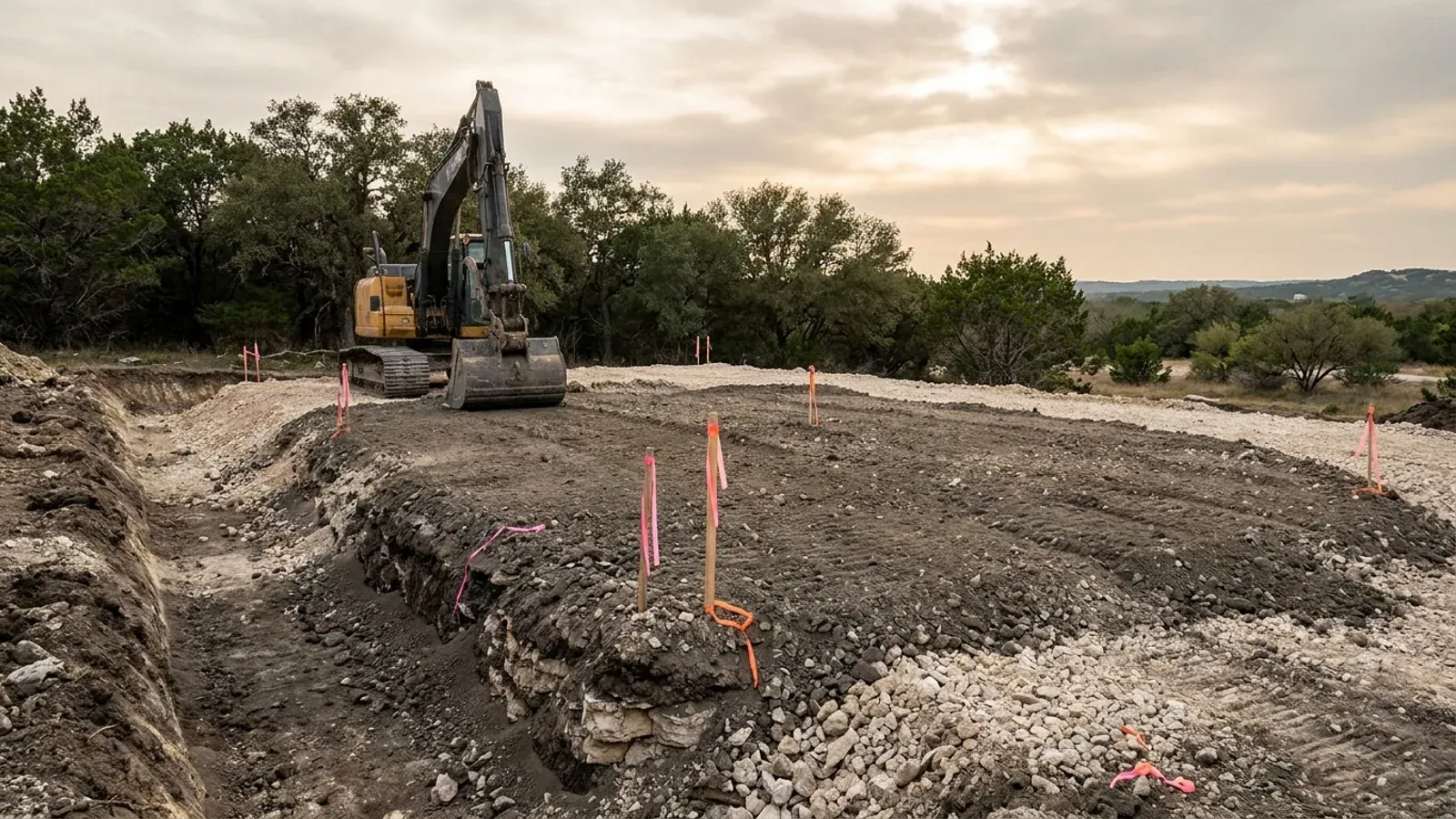
What moves a Texas budget is usually below grade, and it is soil rather than rock: shrink-swell clay. The Blackland Prairie and the Gulf Coast clays move enough between a wet season and a dry one to drive the foundation design across the state's largest markets, which is why several DFW cities require an engineer's seal on the foundation of every new house. Those are the same conditions that decide whether a septic field passes its soil and site evaluation, so the grading plan, the foundation and the drainfield get resolved together rather than one at a time. We price the dirt before we price the building.
What we build in Kerr County
All nine of our services — kits, custom plans, post-frame and steel construction, site preparation, permitting and engineering, through to turnkey builds — are available across Kerr County. What a project costs depends far more on the parcel than on square footage, so we work from your land rather than from a rate card.
See what we buildWhat a build looks like
Three stages every Kerr County project passes through, from a raw parcel to a finished home. Site work first, because that is where the budget is decided.
The parcel
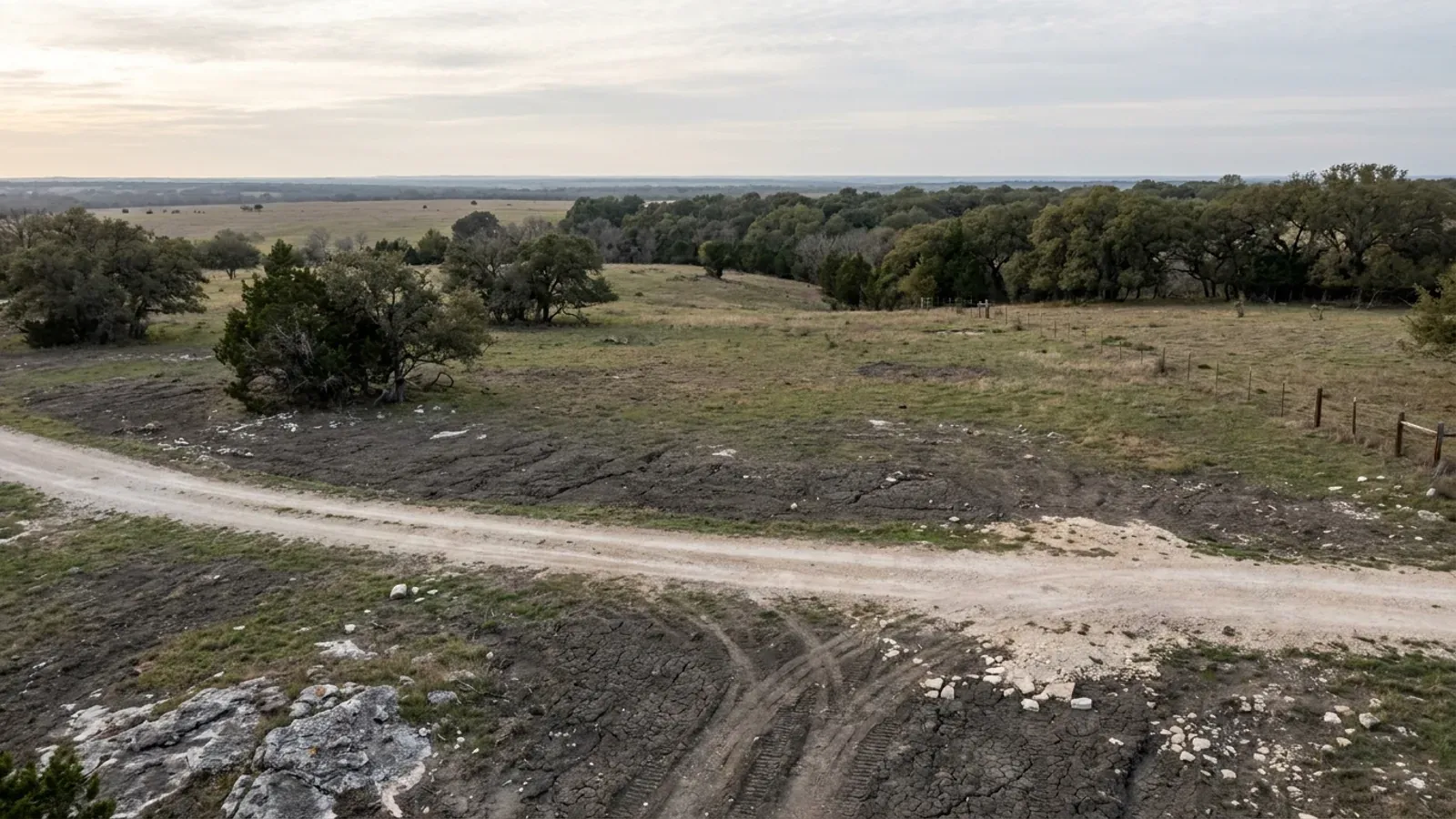
Zoning, setbacks, flood zone and utility access get checked before anything is drawn.
Pad and permit
Clearing, grading and a compacted pad, while the submittal works through Kerr County.
Frame to finish
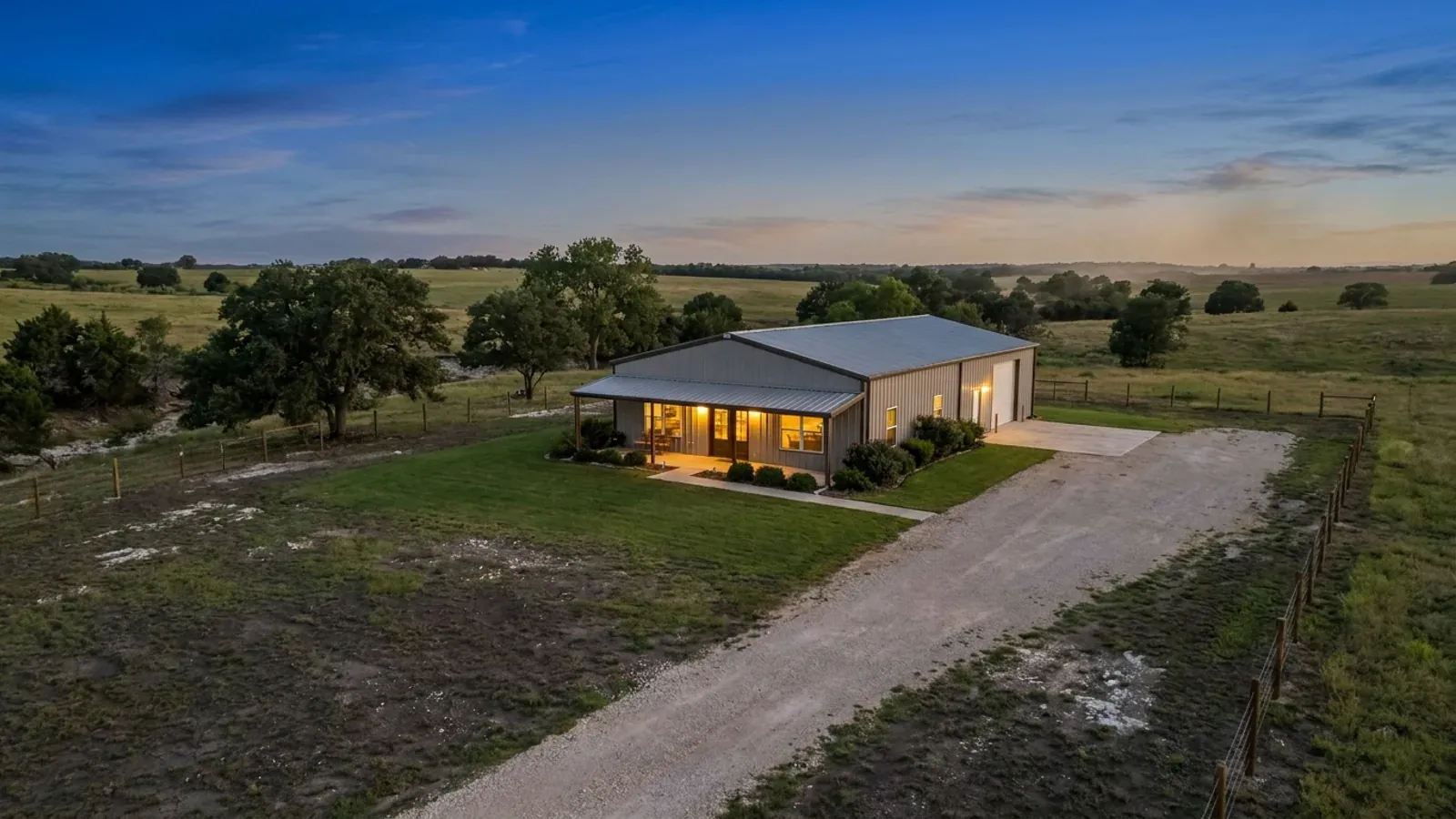
Shell erected and dried in, then systems, insulation and interior finish through to CO.
Those are the rules for Kerr County. Tell us what you want to build and we will draw it to them.
Where we build around Kerr County
Kerr County and the rural land around it. The buildable acreage for a project this size usually sits outside the city limits, which is frequently what changes who issues your permit.
Keep reading
The questions that usually come next once you know what Kerr County allows.
Barndominium Cost Guide
Sourced per-square-foot ranges by tier and by size, with a calculator built on the same figures.
Read itIs It Legal in Texas?
Classification, zoning, the HOA gate, and why "nonresidential farm building" does not cover a home.
Read itHow Long Does It Take?
Census build-duration data, and what actually sets the permit clock where you are building.
Read itNearby areas we build in
Others we cover in this part of Texas. The permitting authority, the adopted design criteria and the zoning can all differ from one to the next.
Building in Kerr County: common questions
8 questions we get asked most often about building in Kerr County. If yours is not on the list, ask it directly.
Do I need a building permit for a barndominium on unincorporated land in Kerr County?
I found five acres near Hunt. Can I build on it?
How is this different from building on clay east of I-35?
Do I need a Water Pollution Abatement Plan from the state?
Does my shop bay make the septic system bigger?
Everyone told me ten acres means no septic permit. Is that true here?
Can I put a second dwelling or a guest barndominium on the land later?
The tract touches the river. What should I be asking?
Building in Kerr County?
Start with the plan. Tell us what you want to build and we will draw it, then confirm what Kerr County will actually let you put on the parcel and what wind load it has to meet. That conversation costs nothing.