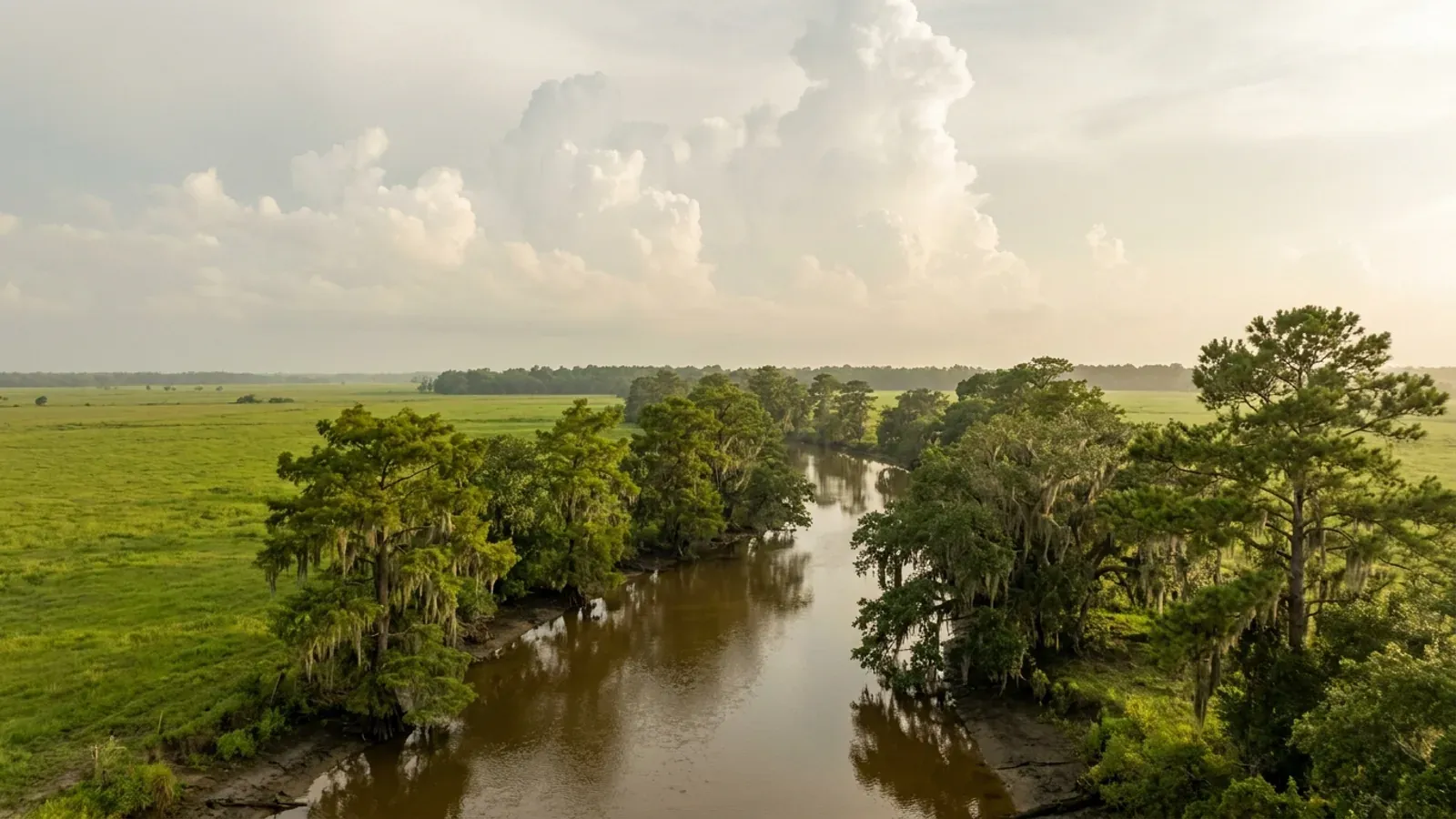
Barndominium Builders in Grimes County, TX
Grimes County is the most genuinely rural place we build. Anderson is the county seat, Navasota the largest town, and the ground between them is post oak savannah rather than the black shrink-swell clay of the I-35 corridor. Around 34,000 people live here, five thousand more than in 2020, as Houston buyers push north-west up Highway 6 for acreage. Grimes has also done the unusual thing: its Commissioners Court adopted the 2021 International Residential Code in December 2024 under Local Government Code Chapter 233, Subchapter F. That does not mean here what it would mean in a city. There is still no county building permit, no county fee and no county inspector — the builder files two notice forms and hires the three required inspections privately. What actually gates the build is the septic permit, the development permit, and a county order withholding permanent electric service until Grimes issues a Certificate of Compliance.
Grimes County at a glance
- County
- Grimes County
- Population
- 34,252
- Where we build
- Anderson, Montgomery County, Waller County
- Site visits
- Site walks booked county-wide, Anderson included
ZIPs 77830, 77831, 77861, 77868, 77873, 77875, 77876, 77363
Building conditions in Grimes County
What actually changes from one Texas jurisdiction to the next: who issues the permit, whether the residential code is enforced there at all, what the structure has to be engineered to, and what the ground is like. These are the numbers your drawings have to satisfy.
Grimes County Development Services, and the county's Guidelines for Residential Construction and Inspection flyer — https://grimescountytexas.gov/development
Grimes County Residential Construction FAQ and Guidelines for Residential Construction and Inspection flyer, published at https://grimescountytexas.gov/development
Grimes County Floodplain Administrator — https://grimescountytexas.gov/floodplain_administrator; Grimes County Permits Fee Schedule, revised 7 January 2026
Order of the Grimes County Commissioners' Court Establishing Procedure for Connection of Electric Utilities in the Unincorporated Areas of Grimes County, 21 January 2026, reproduced on the county's OSSF application and Floodplain Administrator page
Grimes County Infrastructure Regulations, adopted 23 June 2025, Section XII — https://grimescountytexas.gov/development; compare 30 Texas Administrative Code sec. 285.4(a)(1)
Texas Occupations Code sec. 1301.052 — https://statutes.capitol.texas.gov/Docs/OC/htm/OC.1301.htm
Also worth knowing before you build in Grimes County
- Grimes County's septic application asks for living area
- TCEQ sizes a system off bedrooms or living area, whichever gives the higher figure, and Grimes County Environmental's own residential OSSF application asks for number of bedrooms, living area in square feet and acreage. The shop bay of a barndominium is not living area. The published residential permit fee is 420 dollars, with commercial at 624 and a modification at 307.
- There is no percolation test in Texas
- Texas does not use the percolation method at all. Chapter 285 classifies soil by texture class — sandy, loamy, silty, clay — and assigns a loading rate to each. A site can fail at both ends: clay needs a very large drainfield, and Class Ia gravelly sand is expressly stated not to provide adequate treatment through soil contact, requiring imported soil or secondary treatment with disinfection.
- The ten-acre rule does not do what people think
- TCEQ said in its own 2023 rulemaking that the old wording had been misinterpreted by homeowners, installers, authorised agents and other stakeholders as meaning that single-family dwellings on ten acres or more were exempt from the entirety of Chapter 285. Ten acres relieves a qualifying tract of the permit and the inspection. It does not relieve it of the standards.
- The whole county sits in a groundwater district
- The Bluebonnet Groundwater Conservation District covers Austin, Grimes, Walker and Waller Counties, and is based in Navasota. Groundwater district coverage is not statewide in Texas, so this is a real local fact rather than a given. The domestic exemption at Water Code Sec. 36.117(b)(1) is conjunctive — more than ten acres and a well incapable of producing more than 25,000 gallons a day — and Sec. 36.117(h) still requires the owner to register the well and case it to district rules. Exempt is not unregistered.
- The state energy code reaches this land anyway
- Health and Safety Code Sec. 388.004 obliges a builder outside any municipality to certify that a new single-family house complies with the energy standard and to keep that certification for three years. It applies to unincorporated Grimes County whether or not the county has a building code, and nothing about the county's Subchapter F adoption changes it.
- Fifty percent is the line for an addition
- The county's FAQ sets a clear test for existing homes: if the cost of an addition is less than or equal to fifty percent of the current year's appraisal district taxable value of the structure, compliance with the 2021 IRC is not required. Above that, the code applies and both the construction and inspection notices must be filed. The land value is not counted in the calculation.
- Climate zone 2A, and it did not move
- Grimes County is climate zone 2A, moist, Hot-Humid, on both the pre-2021 and the 2021 International Residential Code county tables. Eight Texas counties changed between those two maps and Grimes is not one of them, so the county's move to the 2021 IRC did not change the insulation zone.
- Plat setbacks, measured from the ultimate right-of-way
- The Infrastructure Regulations require building setback lines on all plats: 25 feet from a local road, 30 feet from a collector or arterial, and 10 feet from every other lot boundary — measured from the ultimate right-of-way boundary in the Grimes County Mobility Plan, not from the pavement you can see today.
- The county seat's code rolls forward on its own
- Anderson, the county seat, adopted the 2015 International Residential Code by Ordinance 119-17 — passed 14 March 2017 and amended 23 June 2017 — and did so together with a clause taking in any future amendments, editions or derivatives sixty days after printing. Under Chapter 233 a county's unincorporated construction is measured against the 2006 IRC or the version applicable in the county seat, so which edition Anderson is on is not a purely local question.
- Navasota, the largest town, is on an older edition than the county
- The City of Navasota's own development guide lists the codes regulating building construction inside the city: the 2012 International Building, Residential, Fire, Plumbing, Mechanical and Energy Conservation Codes, and the 2011 National Electrical Code with amendments. That is an older residential edition than the county adopted for its unincorporated area, which is a useful reminder that the city limit changes the answer rather than tightening it.
- About five thousand more people in five years
- Grimes County counted 29,268 residents at the 2020 census and 34,252 in the Census Bureau's 2025 estimate — a gain on a base small enough that the growth arrives as acreage cut out of ranch and timber land rather than as tract subdivisions.
Grimes County Environmental on-site sewage facility licence application, residential — https://grimescountytexas.gov/permits; Grimes County Permits Fee Schedule, revised 7 January 2026
30 Texas Administrative Code ch. 285, secs. 285.30 and 285.33(b)(4)(D)
TCEQ rulemaking preamble amending 30 Texas Administrative Code sec. 285.3(f)(2), 2023
Bluebonnet Groundwater Conservation District — https://www.bluebonnetgroundwater.org/; Grimes County Infrastructure Regulations Section VI; Texas Water Code sec. 36.117
Texas Health and Safety Code ch. 388 secs. 388.003 and 388.004 — https://statutes.capitol.texas.gov/Docs/HS/htm/HS.388.htm
Grimes County Residential Construction FAQ, published at https://grimescountytexas.gov/development
IRC Chapter 11 [RE] Texas county table, compared county by county across editions; Grimes County FIPS 48185
Grimes County Infrastructure Regulations, adopted 23 June 2025, Section XII item 7 — https://grimescountytexas.gov/development
Town of Anderson Ordinance 119-17, Building Codes — https://andersontx.gov/ordinances/ordinance-119-17-building-codes/; Texas Local Government Code sec. 233.153(a)
City of Navasota Development Guide, Building Permit Information — https://cms3.revize.com/revize/navasotacity/Document%20Center/How%20Do%20I/Navasota%20Development%20Guide/city_of_navasota_development_guide.pdf
U.S. Census Bureau, 2020 Census and Vintage 2025 county population estimates
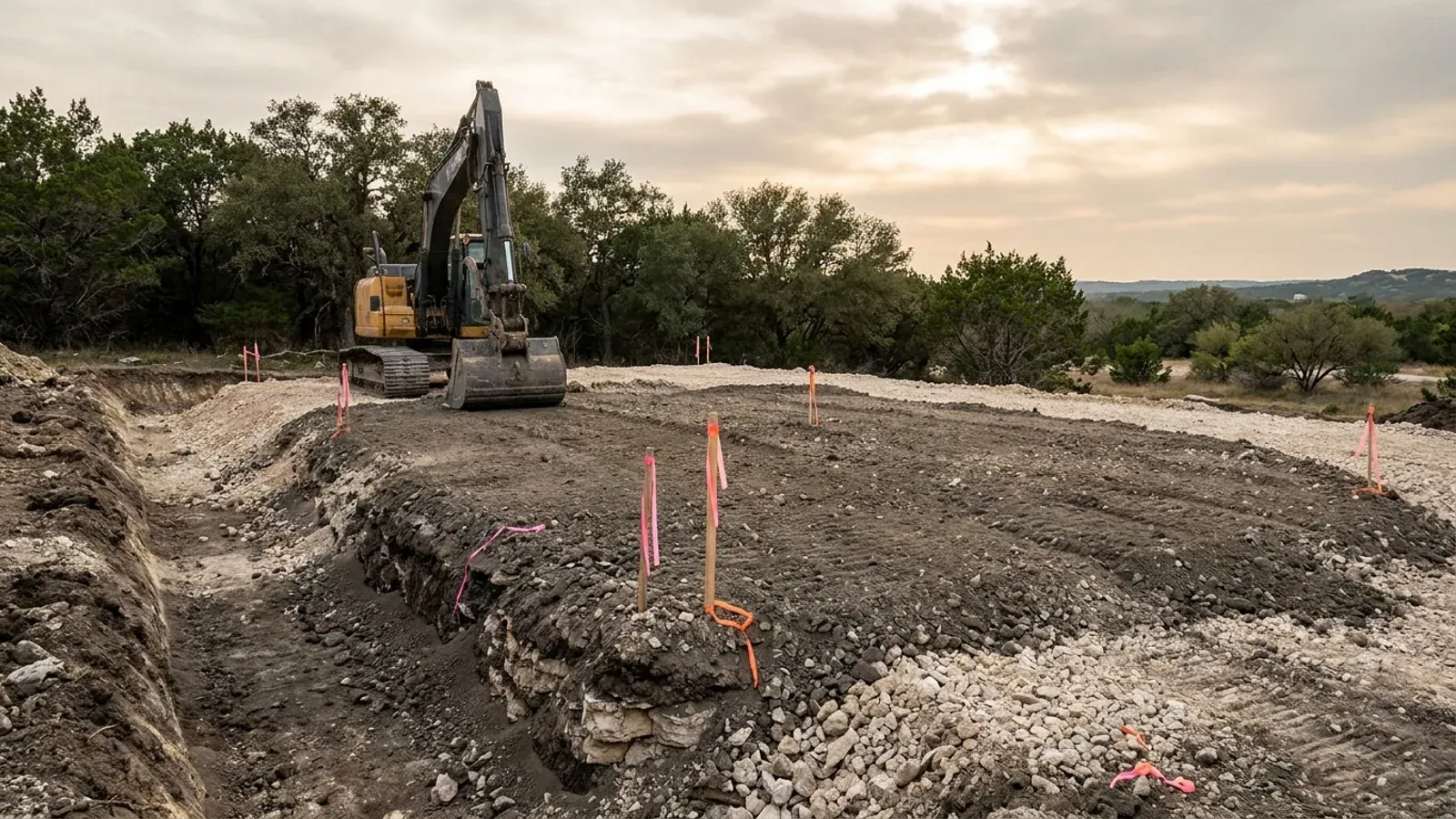
The expensive surprises are in the ground, not the building
What moves a Texas budget is usually below grade, and it is soil rather than rock: shrink-swell clay. The Blackland Prairie and the Gulf Coast clays move enough between a wet season and a dry one to drive the foundation design across the state's largest markets, which is why several DFW cities require an engineer's seal on the foundation of every new house. Those are the same conditions that decide whether a septic field passes its soil and site evaluation, so the grading plan, the foundation and the drainfield get resolved together rather than one at a time. We price the dirt before we price the building.
What we build in Grimes County
All nine of our services — kits, custom plans, post-frame and steel construction, site preparation, permitting and engineering, through to turnkey builds — are available across Grimes County. What a project costs depends far more on the parcel than on square footage, so we work from your land rather than from a rate card.
See what we buildWhat a build looks like
Three stages every Grimes County project passes through, from a raw parcel to a finished home. Site work first, because that is where the budget is decided.
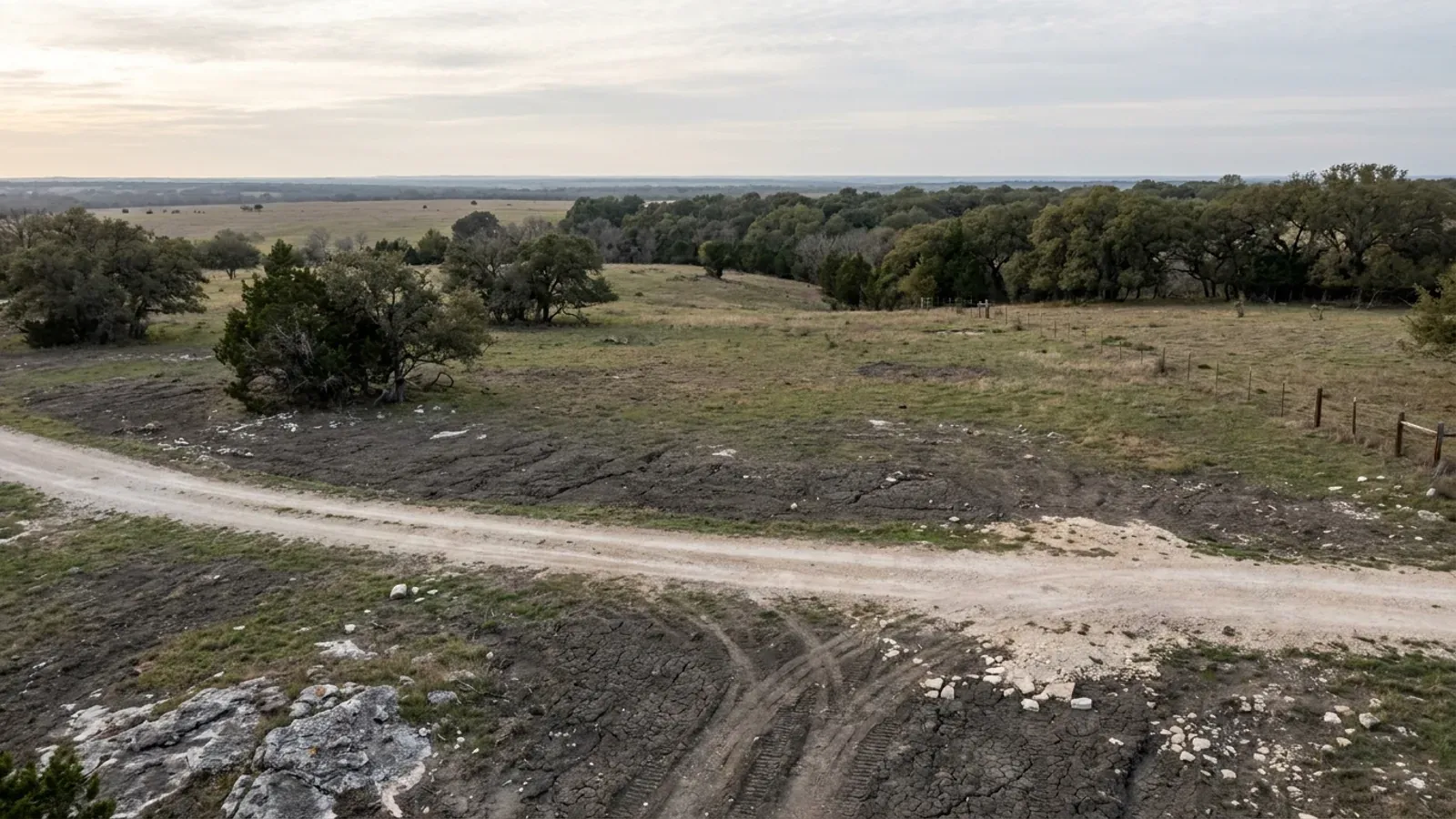
The parcel
Zoning, setbacks, flood zone and utility access get checked before anything is drawn.
Pad and permit
Clearing, grading and a compacted pad, while the submittal works through Grimes County.
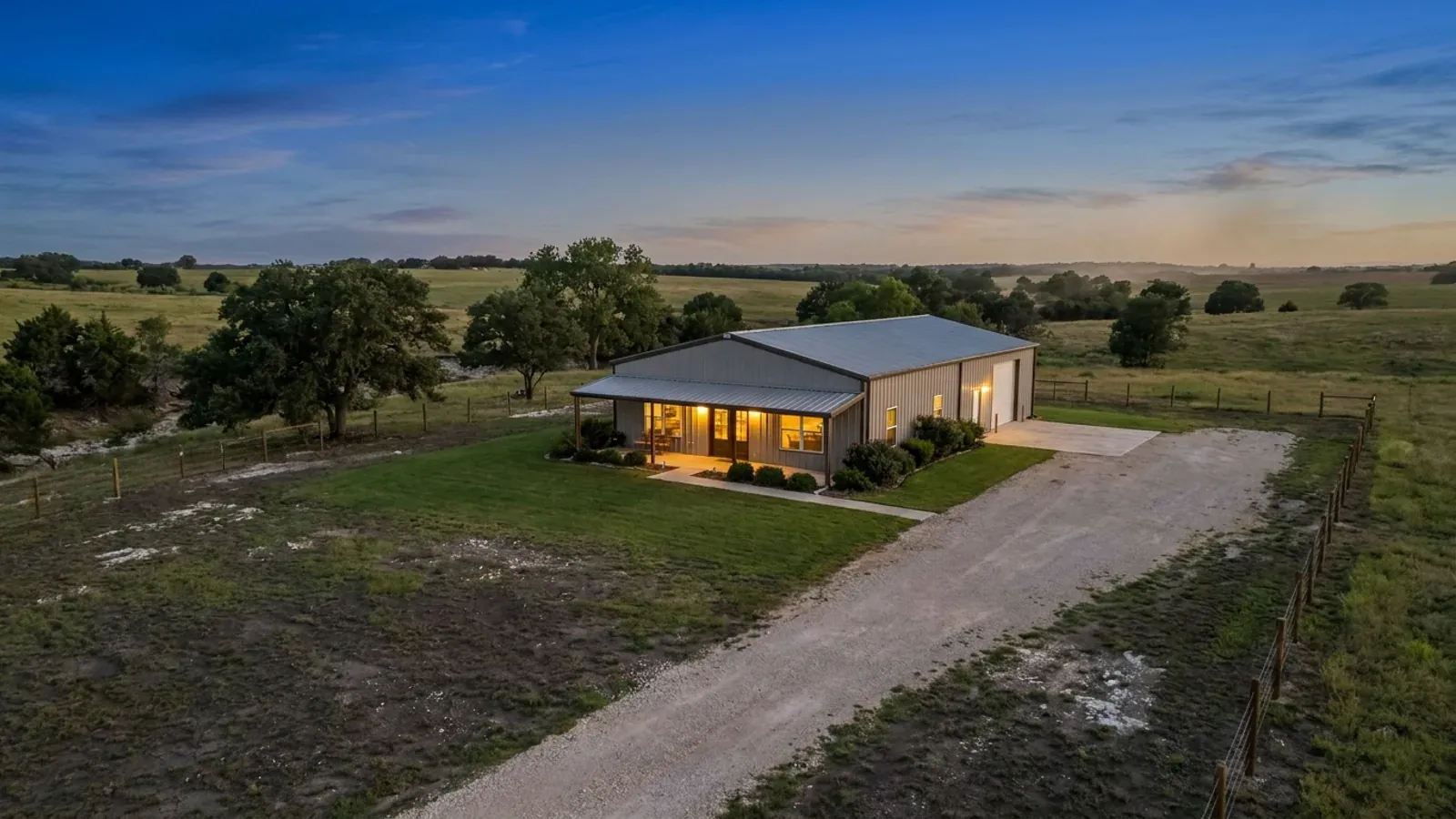
Frame to finish
Shell erected and dried in, then systems, insulation and interior finish through to CO.
Those are the rules for Grimes County. Tell us what you want to build and we will draw it to them.
Where we build around Grimes County
Grimes County and the rural land around it. The buildable acreage for a project this size usually sits outside the city limits, which is frequently what changes who issues your permit.
Keep reading
The questions that usually come next once you know what Grimes County allows.
Barndominium Cost Guide
Sourced per-square-foot ranges by tier and by size, with a calculator built on the same figures.
Read itIs It Legal in Texas?
Classification, zoning, the HOA gate, and why "nonresidential farm building" does not cover a home.
Read itHow Long Does It Take?
Census build-duration data, and what actually sets the permit clock where you are building.
Read itNearby areas we build in
Others we cover in this part of Texas. The permitting authority, the adopted design criteria and the zoning can all differ from one to the next.
Building in Grimes County: common questions
8 questions we get asked most often about building in Grimes County. If yours is not on the list, ask it directly.
Does Grimes County have a building code, and do I need a permit?
If nobody from the county inspects, who does?
So what actually stops a build going wrong out here?
How much land do I need for a septic system here?
I have more than ten acres. Doesn't that exempt me from the septic rules?
What about the water well — is it regulated?
What about Navasota, Anderson and the other towns?
Is the ground here the expansive clay everyone warns about in Dallas?
Building in Grimes County?
Start with the plan. Tell us what you want to build and we will draw it, then confirm what Grimes County will actually let you put on the parcel and what wind load it has to meet. That conversation costs nothing.