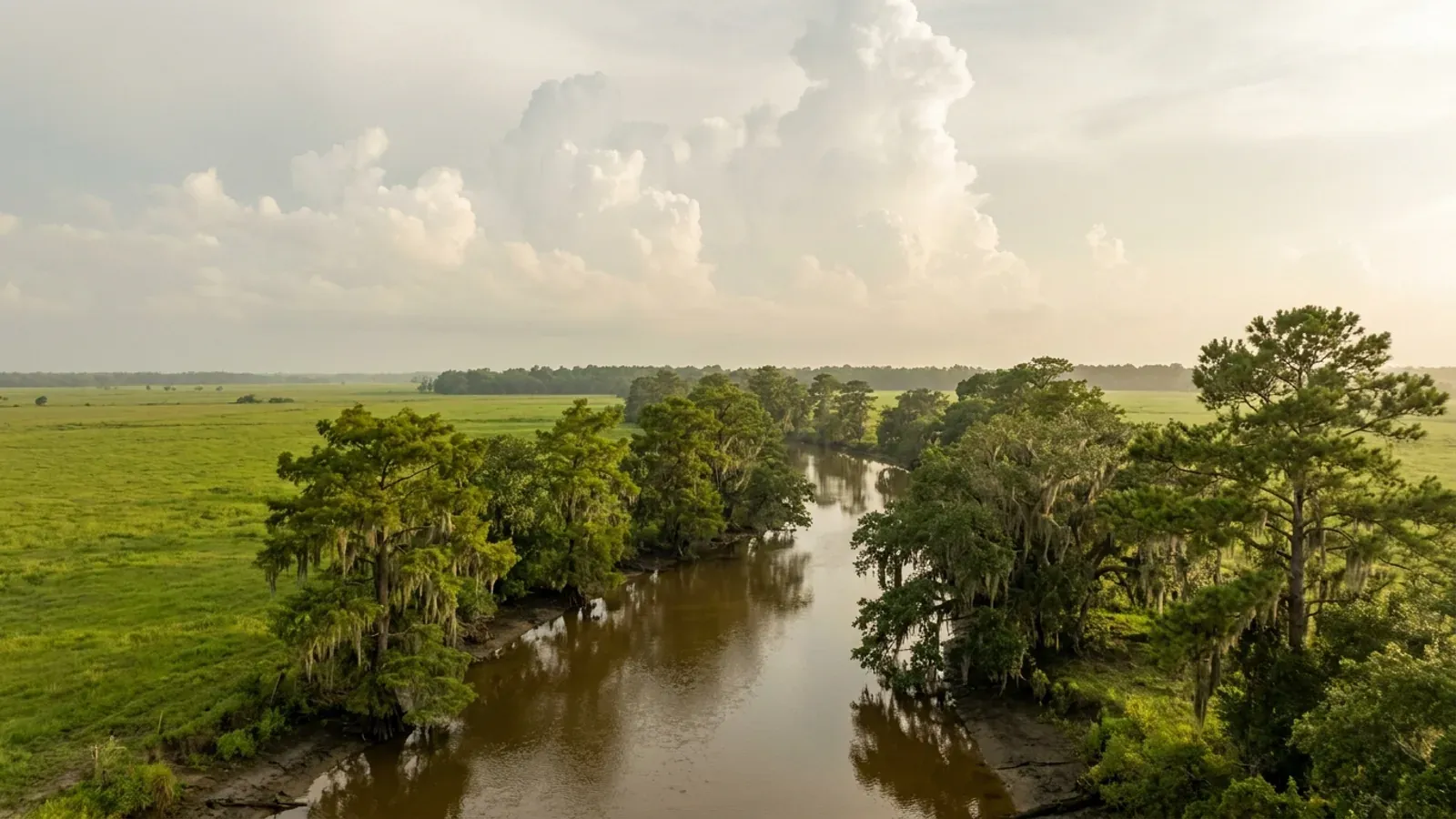
Barndominium Builders in Waller County, TX
Waller County is where the US 290 corridor leaves Houston for open prairie, and on unincorporated acreage the house makes its own water. That puts a buyer under a body of law most never meet: chapter 36 of the Texas Water Code, administered locally by the Bluebonnet Groundwater Conservation District, which covers Waller alongside Austin, Grimes and Walker counties. Coverage like that is not statewide, so it matters that Waller has one. The statutory domestic exemption has two limbs and both have to be true, while Bluebonnet's own rule is wider than the statute requires. Neither means there is nothing to do: an exempt well still has to be registered, still needs district authorization before a rig turns, and still has to be cased to district rules. Septic is a separate permit from a separate county office, and being on a well is itself what pushes the minimum land area to a full acre.
Waller County at a glance
- County
- Waller County
- Population
- 69,858
- Where we build
- Hempstead, Houston, Fort Bend County, Grimes County
- Site visits
- Site visits scheduled across Waller County, Hempstead out to the county line
ZIPs 77445, 77484, 77446, 77423, 77466, 77493
Building conditions in Waller County
What actually changes from one Texas jurisdiction to the next: who issues the permit, whether the residential code is enforced there at all, what the structure has to be engineered to, and what the ground is like. These are the numbers your drawings have to satisfy.
Bluebonnet Groundwater Conservation District; district Rules, preamble, citing House Bill 3655, 77th Legislature, codified as chapter 8825, Special District Local Laws Code
Texas Water Code section 36.117(b)(1)(A) and (B)
Texas Water Code section 36.117(h)
Bluebonnet Groundwater Conservation District Rules, Rule 8.3.B.1, effective 11 September 2025
Bluebonnet Groundwater Conservation District Rules, Rules 8.3.A and 8.1.E
Bluebonnet Groundwater Conservation District Rules, Rules 8.1.F and 8.1.G
Also worth knowing before you build in Waller County
- A district may not cap an exempt well's production
- A district may not restrict the production of water from any well described by section 36.117(b)(1)
- Spacing rules do reach an exempt well
- A district may require compliance with its well spacing rules for the drilling of any well except one exempted for mining, and Bluebonnet requires all new wells to meet the spacing and location requirements of 16 Texas Administrative Code chapter 76
- Domestic use stops where the money starts
- The district defines domestic use to exclude water used to support activities for which consideration is given or received, or for which the product of the activity is sold
- The well has to be drilled by a licensed driller
- Any activity related to drilling, completion and equipping of wells must be performed by TDLR-licensed water well drillers and pump installers
- Being on a well doubles the minimum land area
- A septic system needs half an acre where the house is on a public water supply, and a full acre where it is on a private well
- Septic capacity keys off living area, not the whole building
- The usage rate is set by bedrooms or the living area of the home, so a shop bay does not count against you at state level
- Texas does not use a percolation test
- Soil is classified by texture class and a loading rate is read from it; a site can fail for draining too fast as well as too slow
- Ten acres is not a septic exemption
- TCEQ said in its own 2023 rulemaking that the old wording had been misinterpreted as meaning dwellings on ten acres or more were exempt from the entirety of chapter 285
- Who issues the septic permit here
- The Waller County Environmental Division, and the application goes through MGO Connect using the R number or Property ID from the Waller County Appraisal District
- A licensed plumber is required even with no county permit
- The rural plumbing exemption expressly excludes plumbing performed in conjunction with new construction
- Energy certification applies outside any city
- A single-family home built outside a municipality still requires energy certification
- Every Texas county regulates its floodplain
- The governing body of each city and county shall adopt ordinances or orders necessary to be eligible to participate in the National Flood Insurance Program
- No county zoning on unincorporated land
- Subchapter F does not authorise a commissioners court to adopt or enforce zoning, so recorded deed restrictions do that work instead
- The county's own population figure
- 69,858 residents, a figure the County Clerk publishes on its own eRecording page to explain why the 500,000-population threshold does not apply here
- How much room there is
- 513.3 square miles of land, with Hempstead as the county seat and US 290 running the length of the growth corridor
- Climate zone
- Climate zone 2A, hot-humid, the same zone on both the structural and the energy map, so insulation and everything else follow one zone here
Texas Water Code section 36.117(c)
Texas Water Code section 36.117(f); Bluebonnet Groundwater Conservation District Rules, Rule 5.1.B
Bluebonnet Groundwater Conservation District Rules, Rule 1.1, definition of Domestic Purposes (Use)
Bluebonnet Groundwater Conservation District Rules, Rule 8.2, citing Texas Occupations Code chapters 1901 and 1902
30 Texas Administrative Code section 285.4(a)(1)
30 Texas Administrative Code chapter 285 and TCEQ form TCEQ-0235, item 8
30 Texas Administrative Code sections 285.30 and 285.33(b)(4)(D)
TCEQ, 2023 amendment of 30 Texas Administrative Code section 285.3(f)(2)
Waller County Environmental Division
Texas Occupations Code section 1301.052
Texas Health and Safety Code section 388.004
Texas Water Code section 16.3145
Texas Local Government Code section 233.153(d)(2)
Waller County Clerk, Real Property Records page
U.S. Census Bureau 2024 Gazetteer county file, GEOID 48473
IECC and IRC climate zone maps for Texas, Waller County FIPS 48473
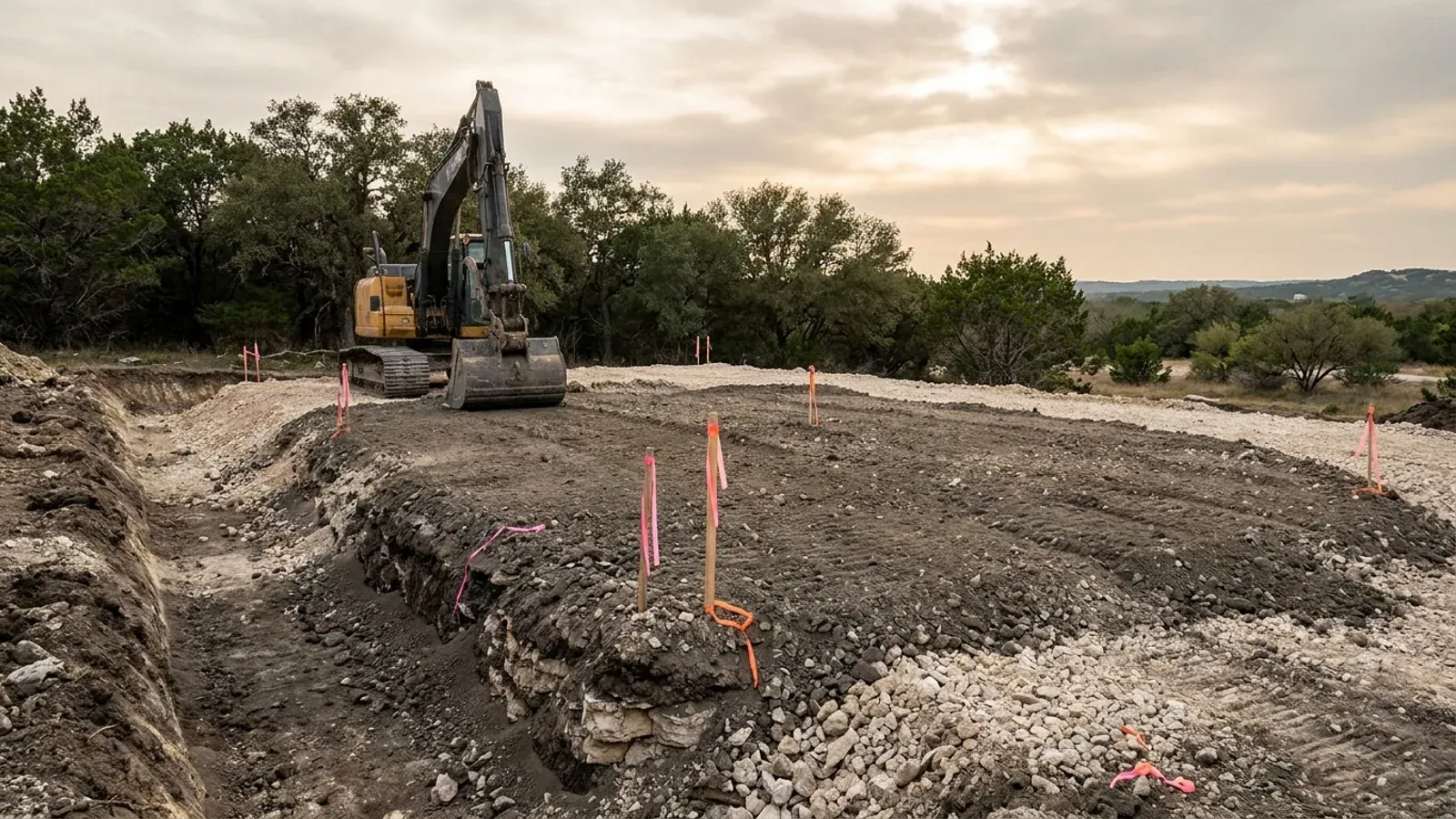
The expensive surprises are in the ground, not the building
What moves a Texas budget is usually below grade, and it is soil rather than rock: shrink-swell clay. The Blackland Prairie and the Gulf Coast clays move enough between a wet season and a dry one to drive the foundation design across the state's largest markets, which is why several DFW cities require an engineer's seal on the foundation of every new house. Those are the same conditions that decide whether a septic field passes its soil and site evaluation, so the grading plan, the foundation and the drainfield get resolved together rather than one at a time. We price the dirt before we price the building.
What we build in Waller County
All nine of our services — kits, custom plans, post-frame and steel construction, site preparation, permitting and engineering, through to turnkey builds — are available across Waller County. What a project costs depends far more on the parcel than on square footage, so we work from your land rather than from a rate card.
See what we buildWhat a build looks like
Three stages every Waller County project passes through, from a raw parcel to a finished home. Site work first, because that is where the budget is decided.
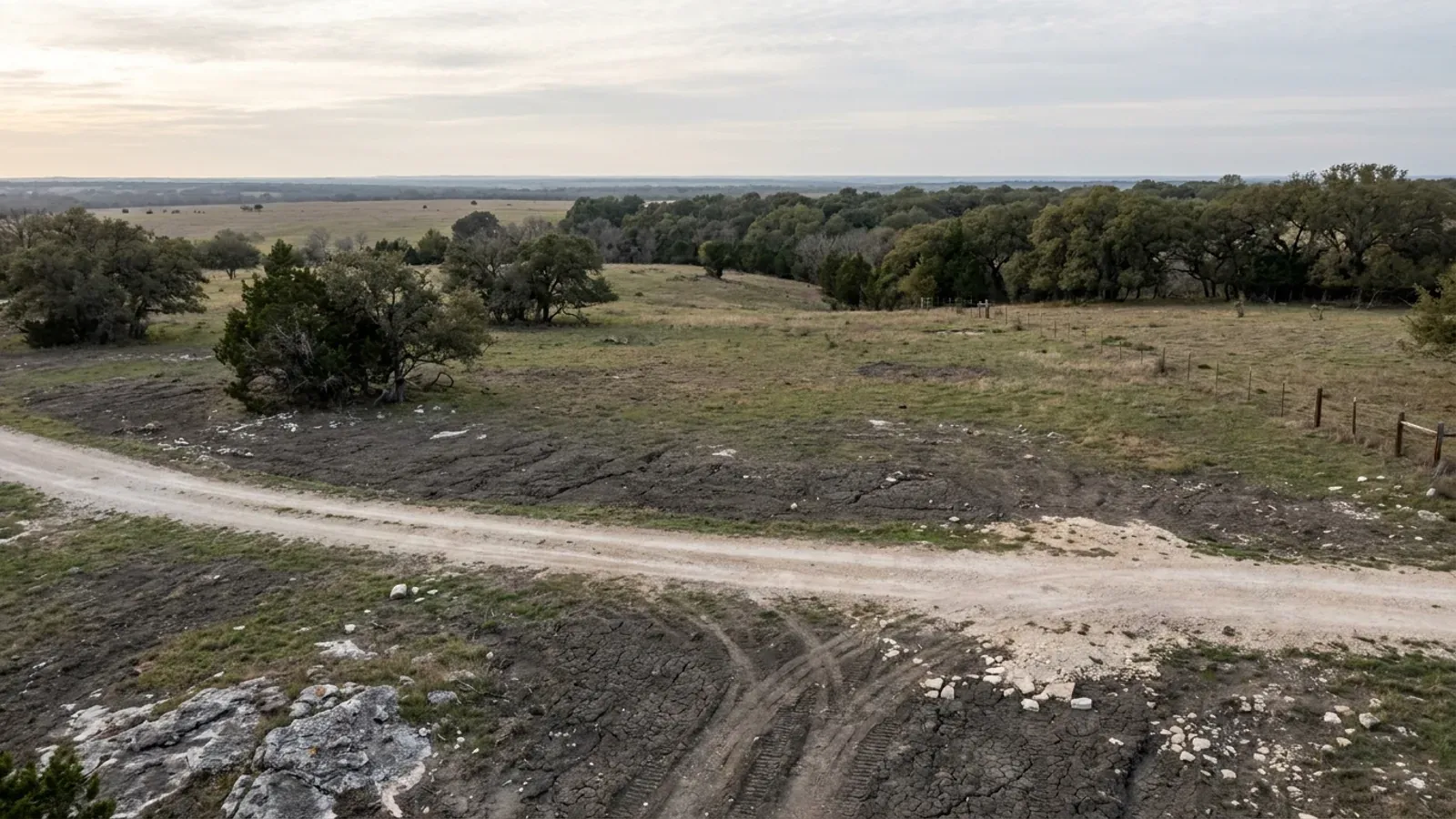
The parcel
Zoning, setbacks, flood zone and utility access get checked before anything is drawn.
Pad and permit
Clearing, grading and a compacted pad, while the submittal works through Waller County.
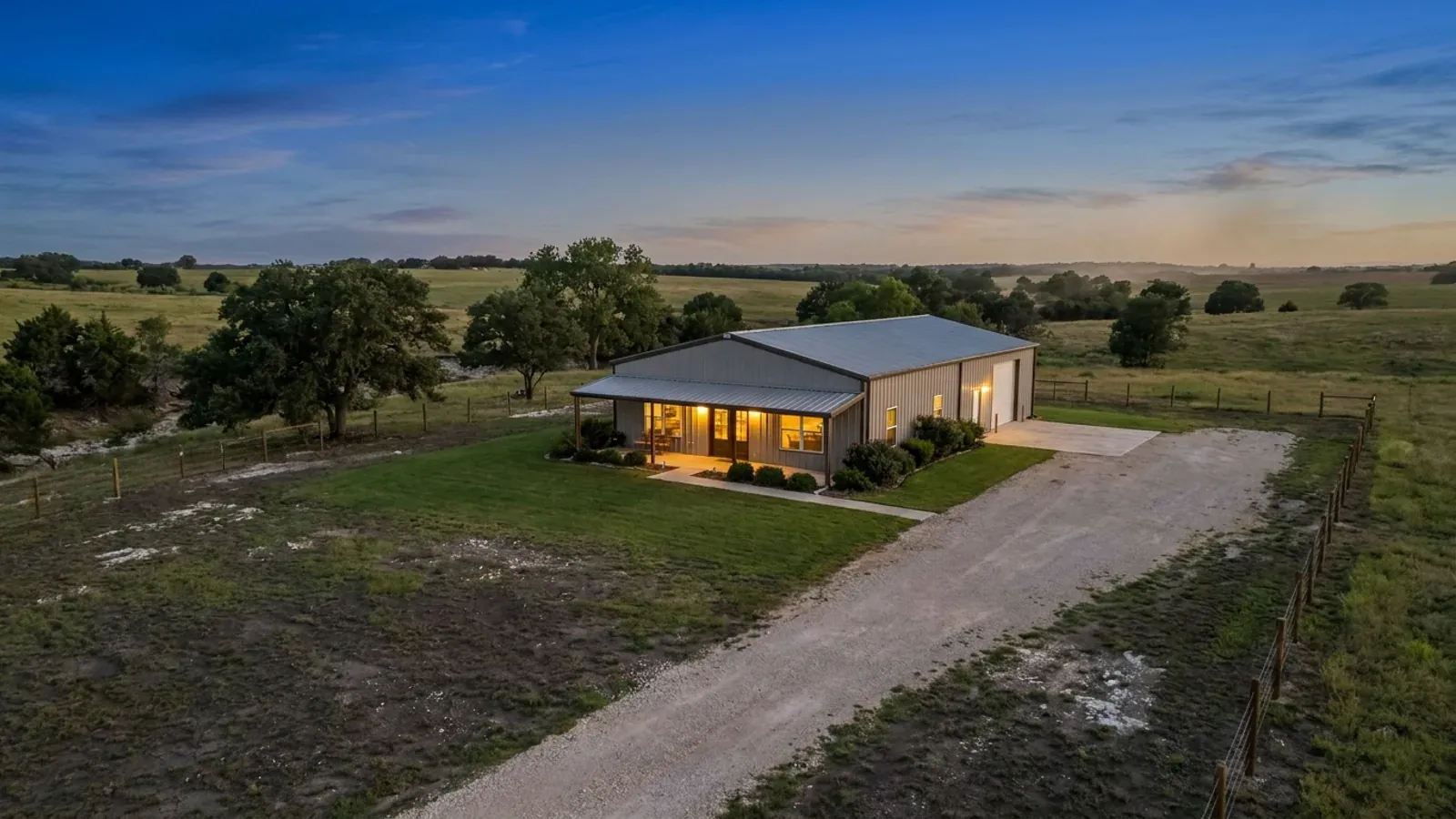
Frame to finish
Shell erected and dried in, then systems, insulation and interior finish through to CO.
Those are the rules for Waller County. Tell us what you want to build and we will draw it to them.
Where we build around Waller County
Waller County and the rural land around it. The buildable acreage for a project this size usually sits outside the city limits, which is frequently what changes who issues your permit.
Keep reading
The questions that usually come next once you know what Waller County allows.
Barndominium Cost Guide
Sourced per-square-foot ranges by tier and by size, with a calculator built on the same figures.
Read itIs It Legal in Texas?
Classification, zoning, the HOA gate, and why "nonresidential farm building" does not cover a home.
Read itHow Long Does It Take?
Census build-duration data, and what actually sets the permit clock where you are building.
Read itNearby areas we build in
Others we cover in this part of Texas. The permitting authority, the adopted design criteria and the zoning can all differ from one to the next.
Building in Waller County: common questions
11 questions we get asked most often about building in Waller County. If yours is not on the list, ask it directly.
Will I be on a well on unincorporated Waller County land?
Which groundwater district covers Waller County?
Is my domestic well exempt from needing a permit?
If the well is exempt, is there nothing to do?
When in the build does the well paperwork have to happen?
Can the district limit how much water I pull, or where I put the well?
Does a shop or a business on the property change anything?
How does the septic permit work in Waller County?
Does ten acres get me out of the septic rules?
Does a building code apply on unincorporated Waller County land?
So what does bind a rural build here?
Building in Waller County?
Start with the plan. Tell us what you want to build and we will draw it, then confirm what Waller County will actually let you put on the parcel and what wind load it has to meet. That conversation costs nothing.