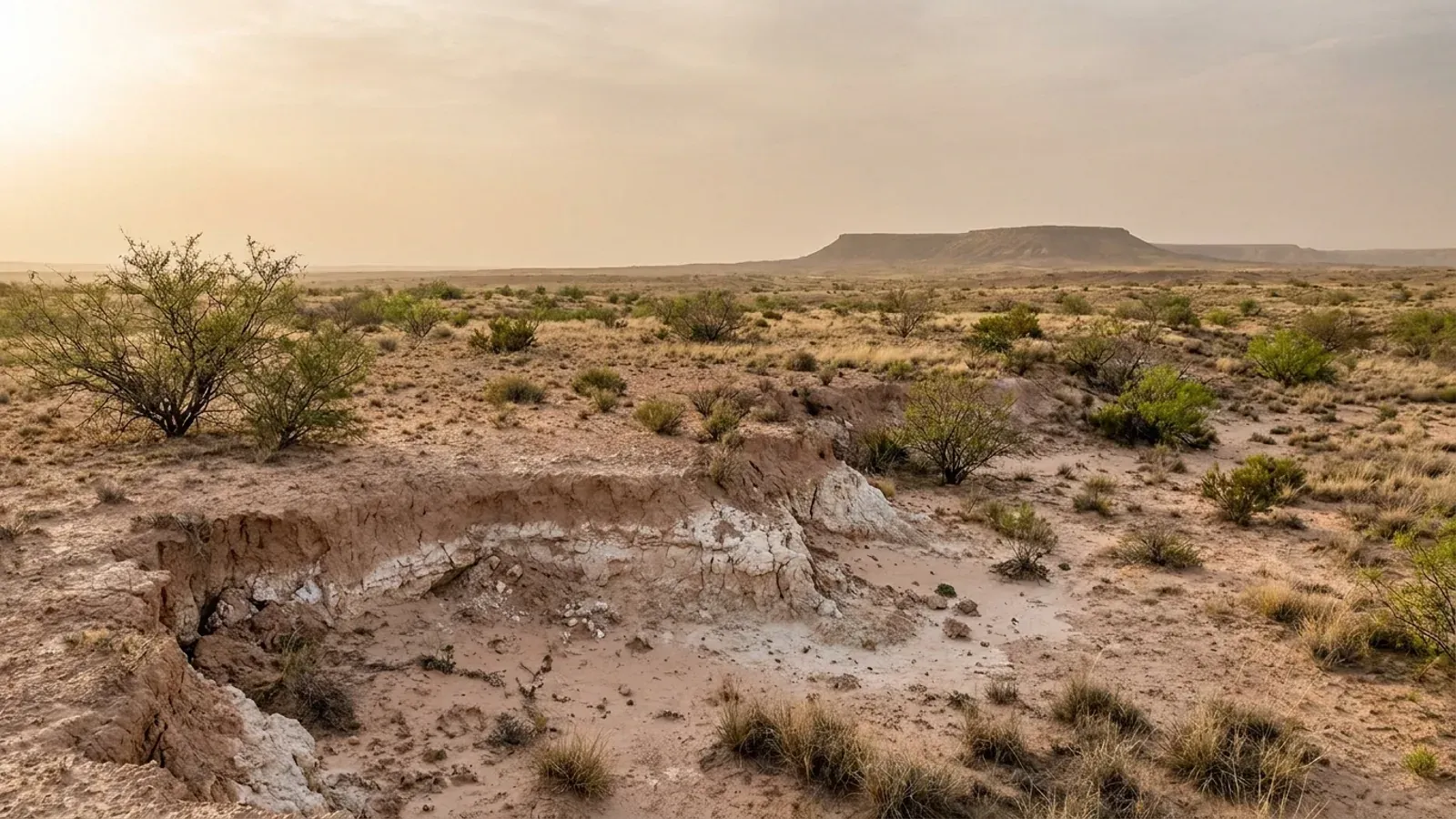
Open semi-arid West Texas rangeland with sparse mesquite and a hard white caliche layer breaking through a shallow cut bank.
Lubbock County 2021 IRC, or the version published as of 1 May 2008 as adopted here

Barndominium Builders in Lubbock County, TX

Lubbock County is one of the few places on this site where a Texas county genuinely did adopt a residential building code. On 12 October 2009 the Commissioners' Court voted unanimously to apply Subchapter F of Chapter 233 of the Local Government Code to new houses on unincorporated land, six weeks after the statute allowing it took effect. What that means in practice surprises people. There is still no county building permit, no county fee and no county inspector: the builder contracts the three required inspections and files two notices with the County Clerk. Outside the city limits the ground is genuinely rural - 734 of the county's 896 square miles, holding about 33,300 people, roughly 45 to the square mile, and that balance has shrunk slightly since 2020 while the county as a whole added more than 18,000. The soils are Acuff, Olton and Amarillo over a hard carbonate horizon, and every playa is floodplain.

Lubbock County at a glance

County
Lubbock County
Population
328,906
Where we build
Lubbock, Amarillo

ZIPs 79329, 79350, 79363, 79364, 79366, 79382, 79401, 79402 and more

Site visits
Site walks arranged throughout Lubbock County, Lubbock included

Building conditions in Lubbock County

What actually changes from one Texas jurisdiction to the next: who issues the permit, whether the residential code is enforced there at all, what the structure has to be engineered to, and what the ground is like. These are the numbers your drawings have to satisfy.

Build conditions for Lubbock County , Texas . BUILD CONDITIONS LUBBOCK COUNTY, TXLubbock County2021 IRCADOPTED RESIDENTIAL CODE2021 IRCThis jurisdiction publishes no design wind speed. It is settled in writing with the authority overyour parcel before the frame is ordered.ZONING · NONE - A TEXAS COUNTY CANNOT ZONENo county minimum. Lot size is drive…Local Government Code sec. 233.153(d)(2) says in terms thatSubchapter F does not authorise a commissioners court to adopt or…WHO ISSUES THE PERMITLubbock County Commissioners' Court…Lubbock County, 904 Broadway, Lubbock, TX 79401, Commissioners'Court (806) 775-1335, main switchboard (806) 775-1000. Public Works…
Build conditions for Lubbock County, drawn from the sourced facts on this page. Every figure above is cited in the quick-facts panel below, with its source and vintage.
Lubbock County actually opted in - unanimously, on 12 October 2009
Most Texas counties never adopted a residential building code and could not have one. Lubbock County did. The minutes of the Commissioners' Court for 12 October 2009 record that on a motion by Bill McCay, seconded by Mark Heinrich, the court unanimously voted to approve a resolution applying Subchapter F, Chapter 233 of the Texas Local Government Code to certain residential construction begun after September 1, 2009, adopting Option B and designating the County Clerk as the office to file. The resolution itself, signed by County Judge Tom Head and all four commissioners and attested by County Clerk Kelly Pinion, is dated the 12th day of October, 2009 and is still published on the county's Public Works page. It came six weeks after House Bill 2833 took effect, and the West Texas Home Builders Association's letter attached to the county's own copy says Lubbock County commissioners were among the first in Texas to enact the powers given them by HB 2833. An order search alone would have found nothing: this lives in a resolution, not in a codified county code.

Minutes of the Lubbock County Commissioners' Court, 12 October 2009, page 2; and Lubbock County Resolution Applying Subchapter F, Chapter 233, Texas Local Government Code, to Certain Residential Construction Begun After September 1, 2009, adopted 12 October 2009 - https://www.lubbockcounty.gov/egov/apps/document/center.egov?view=item&id=2797

Opting in still means no county permit, no county fee and no county inspector
This is the part that catches people out, and it is written into the statute rather than left to practice. Local Government Code sec. 233.153(d)(1) says Subchapter F may not be construed to require prior approval by the county before new residential construction begins, and sec. 233.153(f) says a county may not charge a fee to defray the cost of enforcing the standards. So Lubbock County issues no building permit for a house, reviews no plans and employs no building inspector. What the county's own resolution does require is this: a minimum of three inspections, at the foundation stage before concrete is placed, at the framing and mechanical systems stage before drywall or other interior wall covering, and on completion; the builder contracts them with a licensed engineer, a registered architect, a professional inspector licensed by the Texas Real Estate Commission, a plumbing inspector employed by a municipality and licensed by the Texas State Board of Plumbing Examiners, a building inspector employed by a political subdivision, or an individual certified as a residential combination inspector by the International Code Council. Before starting, the builder gives the County Clerk notice of the location, the approximate start date and the edition of the code being used. Within ten days of the final inspection, notice goes to the County Clerk saying whether the inspection showed compliance.

Lubbock County Resolution Applying Subchapter F, adopted 12 October 2009, resolving clauses tracking Local Government Code secs. 233.153, 233.154(a), 233.154(b) and 233.154(c); Local Government Code ch. 233 Subchapter F - https://tcss.legis.texas.gov/resources/LG/htm/lg.233.htm

The county's own building-code PDF ends with a statute that no longer exists
The document the county publishes under Development and Construction is titled Texas Residential Construction Code. Its first two pages are the live 2009 Subchapter F resolution. The nine pages after it are not. Page three is a Texas Residential Construction Commission press advisory dated 25 July 2008 announcing a county inspection programme, pointing readers to texasrcc.org and a commission phone number. Pages five to eleven are a printout of Property Code Title 16, the Texas Residential Construction Commission Act. The commission went through Sunset review in the 81st Legislature and was not continued: the Property Code chapters that carried it, 401 and 430, are simply gone from the code today, while neighbouring chapters in the same title are still served. A reader who works through the county's file from the front gets the right answer and then nine pages of a repealed regime and a dead agency. Read the first two pages; ignore the rest.

Lubbock County document PW/SN - Texas Residential Construction Code, pages 3 and 5 to 11 - https://www.lubbockcounty.gov/egov/apps/document/center.egov?view=item&id=2797; Property Code chapters 401 and 430 return HTTP 404 on the Legislature's own text server while chapters 5, 27, 53 and 202 return whole - https://tcss.legis.texas.gov/resources/PR/htm/pr.5.htm

The ten-acre septic exemption is dead here, and killed by an unusual method
Some Texas counties kill the ten-acre idea with a sentence saying permits are required regardless of lot size. Lubbock County did something cleaner: section 10 of its On-Site Sewage Facility order excludes a statute from adoption by section number. In the order's own words, Lubbock County, Texas does hereby exclude from adoption under Section 8 of this Order, Section 366.052 of the Texas Health and Safety Code, and then, regardless of the acreage, a permit is required for all on-site sewage facilities. That exclusion is the whole of the county's stringency list. The order otherwise adopts 30 Texas Administrative Code 285.1 to 285.91 whole and incorporates future amendments by reference, and it defines no living area, no loft rule and no attached-garage rule of its own. So the state rule stands unmodified, the state rule sizes a system off bedrooms or living area, and the shop bay of a barndominium is not living area. Some Texas counties and health districts count a loft or an attached garage; Lubbock County does not.

Order Adopting Rules of Lubbock County, Texas for On-Site Sewage Facilities, sections 8, 9, 10 and 11, adopted 28 February 2001 and approved by the TNRCC on 19 June 2001, published as the county's current order in TCEQ's authorised agent register (account 620129) - https://www.lubbockcounty.gov/egov/documents/1311779425_879486.pdf

The house well: a capacity test, not a ten-acre test, and spacing does not reach it
Lubbock County sits inside High Plains Underground Water Conservation District No. 1, the oldest groundwater conservation district in Texas, created in 1951 and covering sixteen counties and about 11,940 square miles. People arrive expecting Water Code sec. 36.117's exemption, which asks for a tract of ten acres or more. The district's own rules do not restate it. Rule 4.1(b)(1) exempts drilling or operating a well that is completed or equipped to produce less than 25,000 gallons of groundwater per day, or 17.5 gpm - a pure capacity test with no tract-size condition at all, which is broader than the statutory floor. Two consequences follow. The district's spacing table in Rule 4.9 starts at 17.5 gpm and applies by its terms to wells that are permitted, so an exempt house well carries no spacing duty of its own. And registering that well is optional: Rules 4.1(d) and 4.2(b) both say may, there is no deadline, and it is free. Registering is still worth doing, because the district defines a valid well to include a registered one, so a registered well makes later permitted wells space away from yours. Rule 6.2(b) applies the state driller and pump-installer rules to all wells regardless of whether the well is required to obtain a permit.

Rules of the High Plains Water District, adopted 14 November 2023, effective 1 December 2023, Rules 4.1(b)(1), 4.1(d), 4.2(b), 4.9 and 6.2(b) - https://www.hpwd.org/rules; district extent confirmed against TCEQ's groundwater conservation district GIS layer - https://gisweb.tceq.texas.gov/arcgis/rest/services/Public/GCDs/MapServer/0/query

Every playa is a floodplain, and the county says so in print
The South Plains does not have rivers so much as it has playas - shallow closed basins that fill, spread far wider than they look, and overflow to the next one. The county publishes a page headed Some Things to Consider When Building on the South Plains that opens: there are many playa lakes on the South Plains, most are easily identifiable, some are not, all are floodplains. It warns that the special flood hazard area will be much larger than would be apparent to most observers and that overflow routes between playas are floodplain too. The county's Flood Damage Prevention Order, passed 10 September 2007 and effective 28 September 2007, applies only to areas of special flood hazard in unincorporated Lubbock County, adopts the Flood Insurance Study and Flood Insurance Rate Maps for Lubbock County dated 28 September 2007, requires a Floodplain Development Permit, and sets the lowest floor of a new residential structure at or above one foot above the base flood elevation, certified by a registered professional engineer, architect or land surveyor. It cites Texas Water Code Title 2, Chapter 16, Section 16.3145, and it makes the County Judge the Floodplain Administrator. Outside the mapped hazard area the order says nothing, so the county's advice about building a foot above the crown of the street is guidance rather than a rule.

Lubbock County Flood Damage Prevention Order, Article 1 Section A, Article 3 Sections A to C, Article 4 Section A, Article 5 Section B(1) and Section G, passed 10 September 2007 - https://www.lubbockcounty.gov/egov/documents/1288387396_209075.pdf; Some Things to Consider When Building on the South Plains, Lubbock County Public Works - https://www.lubbockcounty.gov/egov/apps/document/center.egov?view=item&id=2796

Also worth knowing before you build in Lubbock County

A 25-foot county building setback that people miss, cited to a section number that moved
Section 7.2 of the Lubbock County Subdivision Regulations provides that building and setback lines shall be a minimum of twenty-five feet from the edge of the right-of-way on all public roads other than major highways and roads as designated by the Commissioners' Court. That is a real county power that reaches a house, and it is not a building code: it comes from Chapter 233 Subchapter B of the Local Government Code, which caps such a line at 25 feet from the right-of-way on ordinary public roads and 50 feet on designated major highways. The regulations, approved 12 June 2000, cite it as section 233.002(b) and section 233.004, which was correct when they were written. Fifteen months later the Legislature renumbered the subchapter: those provisions are now sections 233.032(b) and 233.034, and a reader who looks up section 233.002 today lands in Subchapter A on dangerous substances instead. Section 233.034 also requires the Commissioners' Court to show each line on a map filed with the County Clerk, and voids a line if road construction has not begun within four years.

Subdivision Regulations of Lubbock County, Texas, approved by the Commissioners' Court 12 June 2000, sections 5.3.8 and 7.2 - https://www.lubbockcounty.gov/egov/apps/document/center.egov?view=item&id=1508; Local Government Code secs. 233.031 to 233.037, with the source note recording the renumbering from secs. 233.001 to 233.007 by Acts 2001, 77th Leg., ch. 1420, sec. 12.002(3), effective 1 September 2001 - https://tcss.legis.texas.gov/resources/LG/htm/lg.233.htm

The ten-acre number that is alive here is the platting one, not the septic one
It is worth holding the two apart, because the same figure does opposite work in the two instruments. Section 1.2 of the Subdivision Regulations lists what Lubbock County will not require a plat for, and the third item is a division that consists of lots more than ten acres in area. Other listed exceptions include a division into four or fewer lots sold to someone related to the owner within the third degree by consanguinity or affinity, land used primarily for agricultural, farm, ranch, wildlife management or timber production, and a division into two parts where one is retained by the original owner. Meanwhile the county's septic order deliberately excludes the ten-acre statute from adoption, so no tract in Lubbock County is too large to need a septic permit. Ten acres may take you out of platting. It does not take you out of the septic permit.

Subdivision Regulations of Lubbock County, Texas, section 1.2 - https://www.lubbockcounty.gov/egov/apps/document/center.egov?view=item&id=1508; Order Adopting Rules of Lubbock County, Texas for On-Site Sewage Facilities, section 10

One septic office for the whole county, including the state's eleventh-largest city
TCEQ's authorised agent register returns three records for Lubbock County and two of them are agent records. Lubbock County Authorized Agent serves the entire County, including City of Lubbock. City of Lubbock Authorized Agent holds its own designation but its area served reads administered by Lubbock County, and both records carry the same county web address. The third row, Region 02 - Lubbock, is TCEQ's own regional office and appears on every county in the region; it is not a third agent. So one office runs on-site sewage facilities across all 896 square miles. The mechanism is section 6(b) of the county's own order, which applies the order to incorporated cities or towns that have executed intergovernmental contracts with Lubbock County. The office is at 916 Main Street, Suite 1220, Lubbock, open Monday to Friday 8am to 5pm, and the county publishes its fees: residential OSSF application review and permit 360 dollars, commercial the same, an aerated treatment unit with a maintenance contract 600 dollars, a residential or construction reinspection 180 dollars, and an ATU reinspection 300 dollars.

TCEQ On-Site Sewage Facility Authorized Agent search, Lubbock County (county code 152), records 620129 and 620369 - https://www.tceq.texas.gov/permitting/ossf/aa_search.html; Lubbock County Public Works, Septic System Permitting fee schedule - https://www.lubbockcounty.gov/department/index.php?structureid=33

Caliche is real here, but not the way people say it
Two different things get called caliche in Lubbock County and they behave differently on a backhoe. Across the dominant soils - Acuff at about 23 percent of the county, Olton at about 22 percent and Amarillo at about 20 percent, roughly 65 percent of the county between them - the soil survey shows a strongly calcareous but uncemented horizon, 30 to 52 percent calcium carbonate, beginning at roughly 31 to 41 inches. None of those three carries a cemented restriction. Genuinely indurated petrocalcic rock is mapped where other series dominate: Kimbrough at 10 inches, Friona at 31 inches, and as minor inclusions of Sharvana at 16 inches and Arvana at 26 inches scattered through the Amarillo and Acuff units. So a footing trench in the dominant soils usually stops above the hard layer; a footing trench on Kimbrough ground starts in it. None of this is a substitute for a soils report on the actual tract.

USDA-NRCS Soil Data Access, SSURGO survey area TX303 Lubbock County, mapunit, component, corestrictions and chorizon tables, survey-area version 4 September 2025 - https://sdmdataaccess.sc.egov.usda.gov/

The expansive clay is in the playas, and it is severe where it is
Lubbock County is not Blackland country and the shrink-swell risk is not countywide. In the soil survey the two dominant series by area are benign: Acuff peaks at a linear extensibility of 3.8 percent and Amarillo at 3.1. The clay problem is concentrated in the playa basins. Randall clay, occasionally ponded, covers 15,421 acres - about 2.7 percent of the county - and reaches a linear extensibility of 12.6 percent with clay content of 62 to 63 percent through the profile; it is a true Vertisol with slickensides, mapped on playa floors with gilgai microrelief. Lofton clay loam, occasionally ponded, adds another 8,351 acres at 7.4 percent. In between, the Olton and Pullman clay loam uplands sit at about 6 percent across roughly 177,000 acres. Occasionally-ponded map units total 24,367 acres, 4.2 percent of the county. A steel-frame house is unusually sensitive to differential foundation movement, so which of those three bands a tract falls in is a question for a Texas-licensed engineer before the slab is designed.

USDA-NRCS Soil Data Access, SSURGO survey area TX303, chorizon.lep_r and cogeomordesc landform data for map units RaA, RvA, LoA, PuA, OcA, AcA and AfA - https://sdmdataaccess.sc.egov.usda.gov/

The county has the population to adopt a fire code but publishes no fire marshal
Two separate powers get confused here. Local Government Code sec. 233.061(a) lets a commissioners court in a county over 250,000 adopt a fire code, and Lubbock County clears that comfortably - Census Vintage 2025 puts it at 328,906 on a 2020 base of 310,646. But sec. 233.062(a) limits any such code to commercial establishments, public buildings and multifamily dwellings of four or more units, so it could never reach a single-family house anyway. Separately, sec. 352.016 gives a county fire marshal an unbracketed power to inspect any structure for fire or life safety hazards, and subsection (b-1) lets a marshal review the plans of a single-family residence - with subsection (d) allowing a fee for that only if the owner requested it. Lubbock County lists no fire marshal's office among its departments, none in its staff directory, and the phrase returns nothing on its own site; the county's Local Emergency Planning Committee is a hazardous-chemical reporting body under the federal right-to-know act, not a building authority. Rural fire response comes from volunteer and district departments. Confirm current arrangements with the county at (806) 775-1000.

Local Government Code secs. 233.061, 233.062 and 352.016 - https://tcss.legis.texas.gov/resources/LG/htm/lg.233.htm and https://tcss.legis.texas.gov/resources/LG/htm/lg.352.htm; Lubbock County departments list and Local Emergency Planning Committee page - https://www.lubbockcounty.gov/departments; U.S. Census Bureau Vintage 2025 county population estimates, co-est2025-alldata.csv, FIPS 48303

Ten percent of the county lives on eighty-two percent of the land, and that share is falling
Lubbock County covers 895.6 square miles. Adding up the land area of Lubbock, Wolfforth, Slaton, Shallowater, Idalou, New Deal, Ransom Canyon, Buffalo Springs Lake and the Lubbock County part of Abernathy leaves about 734 square miles unincorporated - 82 percent of the county. About 33,295 people live there, 10.1 percent of the county's 328,906, which works out at roughly 45 people per square mile of unincorporated land. That is close to McLennan County's 43 and far below Smith County's 129: real ranch-scale country, not exurb. The direction of travel is the interesting part. Between the 2020 base and the 2025 estimate the county added 18,260 people while the unincorporated balance fell by 458. The City of Lubbock took 15,831 of the gain and Wolfforth grew by 58 percent. So the buildable rural ground is not filling up; if anything the cities are advancing across it.

U.S. Census Bureau Vintage 2025 estimates, co-est2025-alldata.csv and sub-est2025.csv, FIPS 48303; U.S. Census Bureau 2025 Gazetteer files, counties and places national - https://www2.census.gov/geo/docs/maps-data/data/gazetteer/2025_Gazetteer/

The mineral estate is dominant here too, though Lubbock is a cotton county with oil at its edges
Texas splits the surface from the minerals, and where they are severed the mineral estate is the dominant one. In Merriman v. XTO Energy, No. 11-0494 (Tex. 2013), the surface owner had a house on his forty acres and still lost; the accommodation doctrine protects an existing use, so a house that has not been built yet is not protected by it. That matters less in Lubbock County than in the Permian proper but it is not nothing. The Railroad Commission's Oil Well Counts by County report, as of February 2025, gives Lubbock County 391 producing oil wells, 27 shut-in, 71 shut-in under rule 14(b)(2) and 154 injection wells - 643 in all - and its Gas Well Counts by County report for the same date shows a blank row for Lubbock, that is, no gas wells. Lubbock sits in Railroad Commission District 8A. Whether the minerals under a particular tract are severed is answered only by a title search at the County Clerk and by the title commitment, never by a map.

Railroad Commission of Texas, Oil Well Counts by County and Gas Well Counts by County, report ROGPWCT, as of February 2025 - https://www.rrc.texas.gov/media/043piafg/oilwellct-021225.pdf and https://www.rrc.texas.gov/media/hplfnrhd/gaswellct-021225.pdf; RRC Oil & Gas Counties and Associated Districts; Merriman v. XTO Energy, Inc., 407 S.W.3d 244 (Tex. 2013)

Climate zone 3B, and it is the dry, cold-winter corner of Texas
Lubbock County is in IECC and ASHRAE climate zone 3B, the hot-dry designation, under the 2021 International Energy Conservation Code and identically under the 2015 and 2018 editions - it is not one of the Texas counties that moved between the pre-2021 and 2021 maps. The practical point for a metal-clad building is that 3B is a dry zone with real winters rather than a humid one: the City of Lubbock's adopted design table gives a winter design temperature of 15 degrees, an air freezing index of 172 and a mean annual temperature of 59.9 degrees, and specifies that no ice barrier underlayment is required. Vapour control and insulation strategies that suit East Texas do not transfer. On unincorporated land there is no county energy-code enforcement at all, so this is a matter of building well rather than of passing an inspection.

Pacific Northwest National Laboratory, Guide to Determining Climate Zones by County: Building America and IECC 2021 Updates, PNNL-33270 (2022), Texas county table - https://www.pnnl.gov/main/publications/external/technical_reports/PNNL-33270.pdf; Building America Best Practices Series Volume 7.3, Guide to Determining Climate Regions by County, PNNL, August 2015; City of Lubbock Ordinance 2024-O0029, Table R301.2 - https://www.mylubbock.us/DocumentCenter/View/7658

Stormwater: one acre of disturbance and the county wants a copy
Separate from anything to do with a building code, Lubbock County runs a regulated small municipal separate storm sewer system and publishes what it expects. Construction projects in the county are subject to TCEQ's general permit for stormwater discharges associated with construction activities, TXR150000, and the county asks that anyone whose project disturbs one acre or more and drains into unincorporated Lubbock County mail a copy of the Construction Site Notice or Notice of Intent to Lubbock County Public Works, 916 Main Street, Suite 1220, Lubbock, TX 79401. A barndominium site with a long drive, a pad and a shop apron can cross an acre of disturbance more easily than owners expect. The county also publishes guidance on grass buffers for playas in agricultural landscapes, which is the local face of the same drainage question.

Lubbock County Public Works, Stormwater Compliance and Stormwater Management Program - https://www.lubbockcounty.gov/department/index.php?structureid=33; TCEQ general permit TXR150000
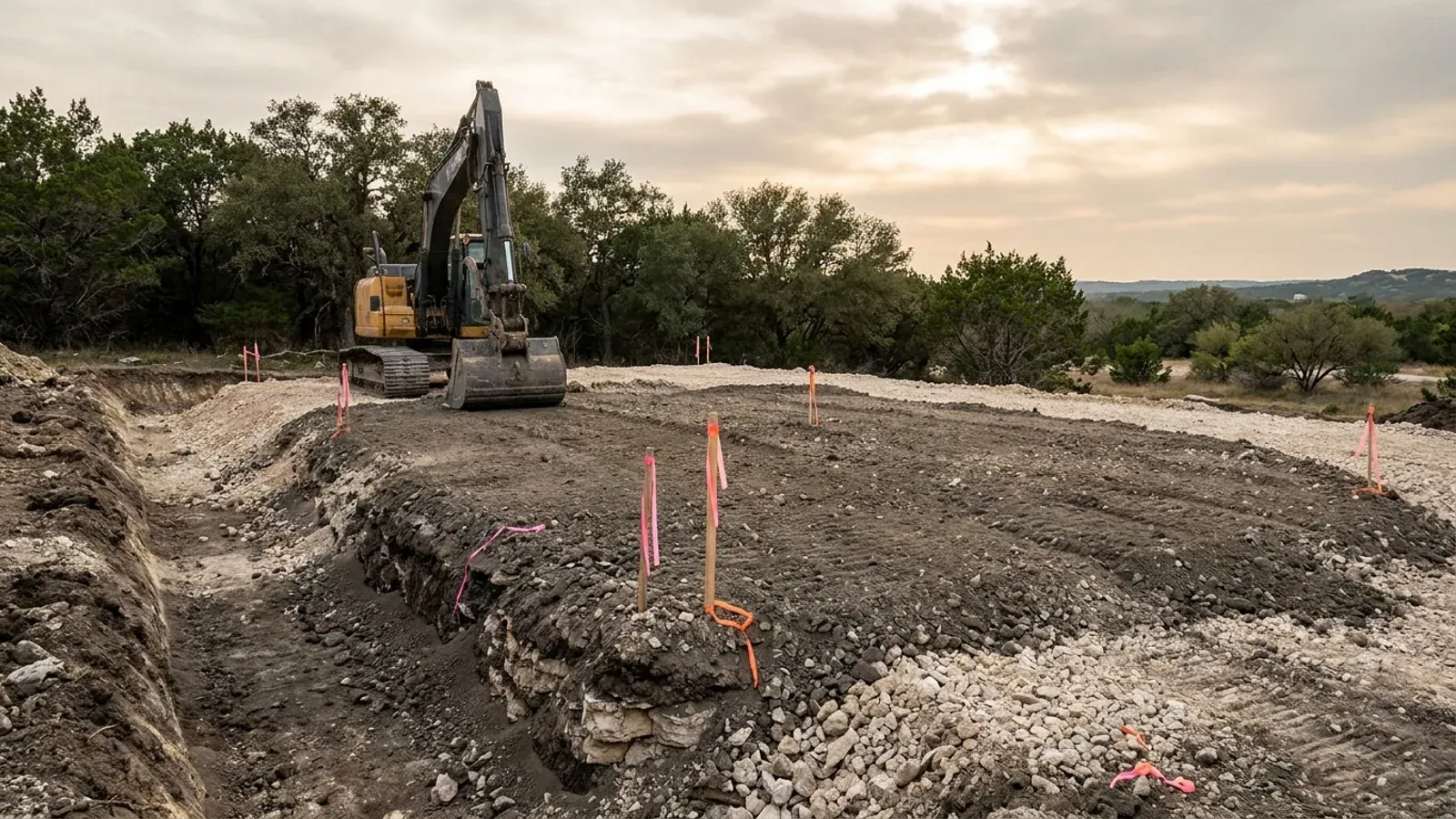
An excavator grading a compacted building pad on a cleared lot, with survey stakes and a drainage swale visible.
Below the slab

The expensive surprises are in the ground, not the building

What moves a Texas budget is usually below grade, and it is soil rather than rock: shrink-swell clay. The Blackland Prairie and the Gulf Coast clays move enough between a wet season and a dry one to drive the foundation design across the state's largest markets, which is why several DFW cities require an engineer's seal on the foundation of every new house. Those are the same conditions that decide whether a septic field passes its soil and site evaluation, so the grading plan, the foundation and the drainfield get resolved together rather than one at a time. We price the dirt before we price the building.

What we build in Lubbock County

All nine of our services — kits, custom plans, post-frame and steel construction, site preparation, permitting and engineering, through to turnkey builds — are available across Lubbock County. What a project costs depends far more on the parcel than on square footage, so we work from your land rather than from a rate card.

See what we build

What a build looks like

Three stages every Lubbock County project passes through, from a raw parcel to a finished home. Site work first, because that is where the budget is decided.
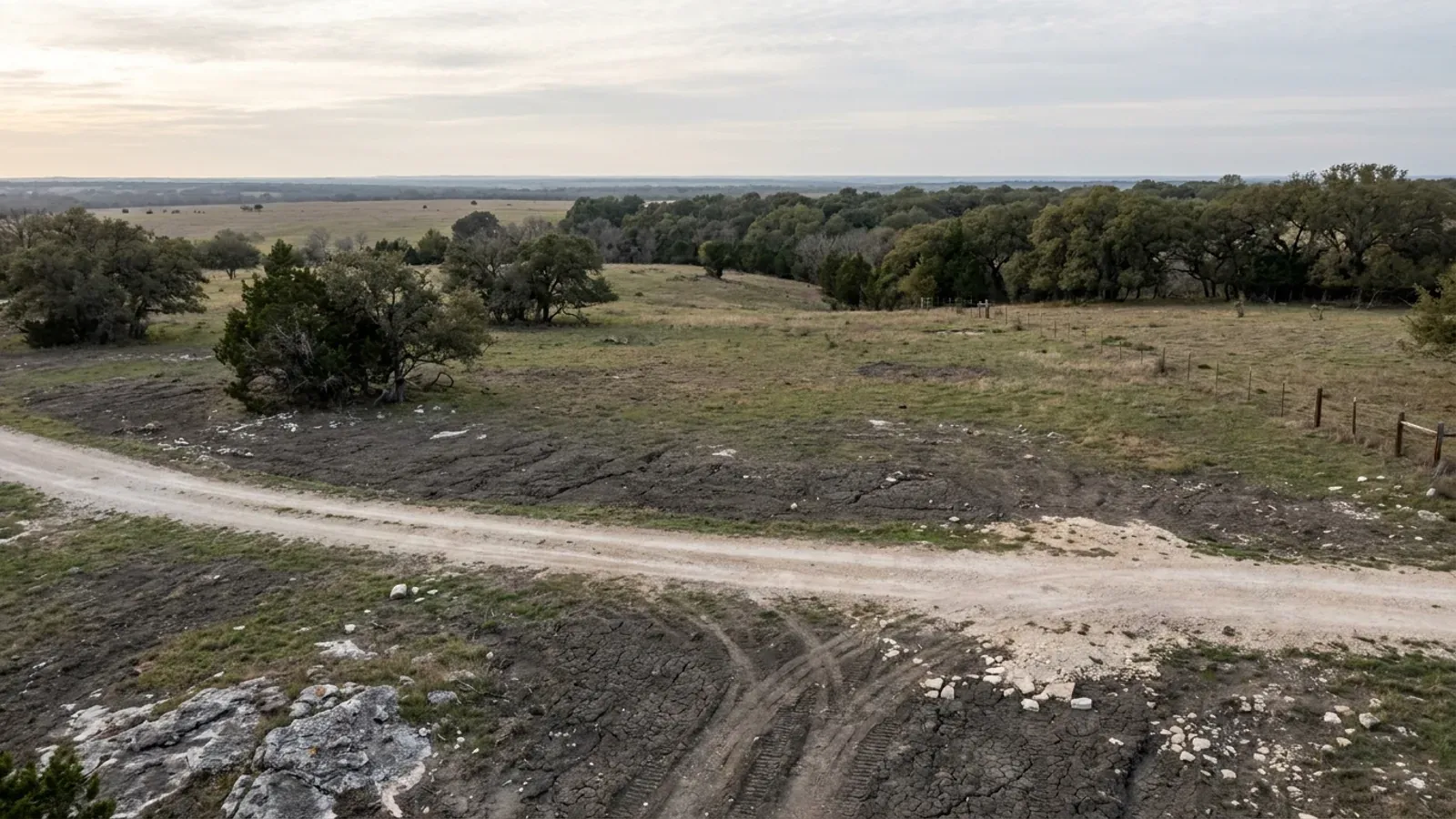
Aerial view of an undeveloped rural lot with cleared grass, a live oak and cedar elm treeline, and a pale gravel access track.
Stage one

The parcel

Zoning, setbacks, flood zone and utility access get checked before anything is drawn.

An excavator grading a compacted building pad on a cleared lot, with survey stakes and a drainage swale visible.
Stage two

Pad and permit

Clearing, grading and a compacted pad, while the submittal works through Lubbock County.
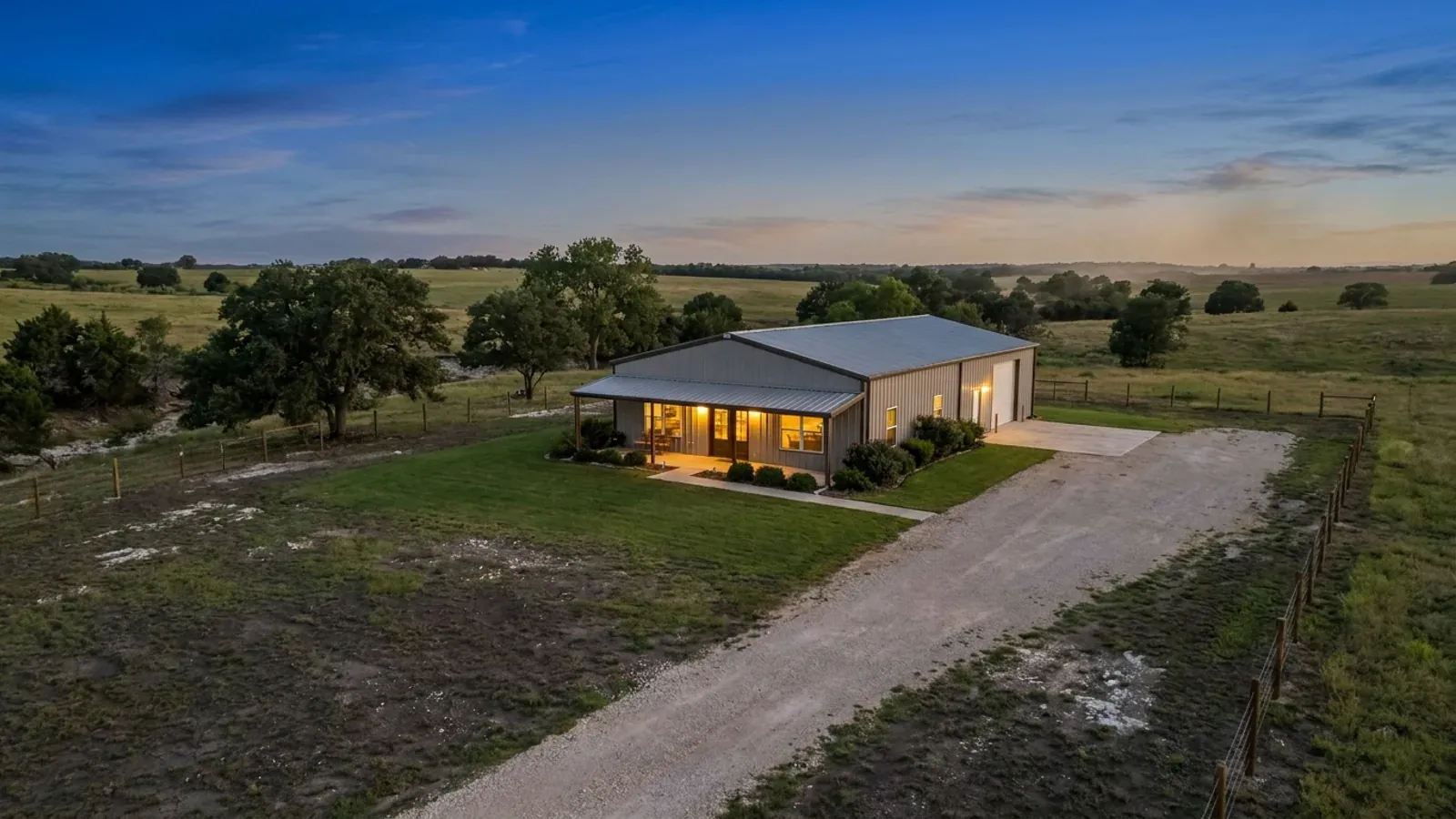
A finished barndominium at dusk with warm interior lighting glowing through its large windows.
Stage three

Frame to finish

Shell erected and dried in, then systems, insulation and interior finish through to CO.

Those are the rules for Lubbock County. Tell us what you want to build and we will draw it to them.

Where we build around Lubbock County

Lubbock County and the rural land around it. The buildable acreage for a project this size usually sits outside the city limits, which is frequently what changes who issues your permit.

Our Lubbock County service area, covering Lubbock County and the surrounding rural acreage. This map marks the territory we serve, not a branch location.

Nearby areas we build in

Others we cover in this part of Texas. The permitting authority, the adopted design criteria and the zoning can all differ from one to the next.

Building in Lubbock County: common questions

12 questions we get asked most often about building in Lubbock County. If yours is not on the list, ask it directly.

Does Lubbock County have a building code for a house on unincorporated land?
Yes - and that makes it unusual. Most Texas counties have no residential building code and no lawful way to get one. Lubbock County took the one route the Legislature opened. The Commissioners' Court adopted a resolution applying Subchapter F of Chapter 233 of the Local Government Code on 12 October 2009, unanimously, six weeks after House Bill 2833 made that possible. Under the resolution a new single-family house or duplex on unincorporated land, and an addition that increases an existing house's square footage or value by more than fifty percent, must substantially conform to either the version of the International Residential Code published as of 1 May 2008 or the version applicable in the county seat. The county seat is the City of Lubbock, which adopted the 2021 International Residential Code on 26 March 2024. Inside any city limit the answer is different again: the city enforces its own adopted edition, issues permits, reviews plans and inspects.
So who inspects my barndominium, and what does the county charge?
The county charges nothing for it, because it is forbidden to. Local Government Code sec. 233.153(f) says a county may not charge a fee to defray the cost of enforcing these standards, and sec. 233.153(d)(1) says the subchapter may not be read to require prior county approval before construction begins. There is no county building permit and no county building inspector. You hire the inspector. The county's resolution requires a minimum of three inspections - at the foundation stage before concrete is placed, at the framing and mechanical systems stage before drywall goes on, and on completion - and lists who may perform them: a licensed engineer, a registered architect, a professional inspector licensed by the Texas Real Estate Commission, a plumbing inspector employed by a municipality and licensed by the Texas State Board of Plumbing Examiners, a building inspector employed by a political subdivision, or an individual certified as a residential combination inspector by the International Code Council. You may use one inspector for all three or a different one for each. On a steel-frame build the foundation and the frame-to-foundation connection are where the money and the risk sit, so an engineer of record is the sensible default whether or not anyone requires it.
What paperwork do I actually file, and where?
Two notices, both with the County Clerk - that is the office the Commissioners' Court designated in the 12 October 2009 resolution. Before you begin, the builder gives the county notice on a form the county prescribes, stating the location of the new residential construction, the approximate date construction will commence, and the version of the International Residential Code that will be used. Then, not later than the tenth day after the date of the final inspection, the builder submits notice stating whether or not the inspection showed the construction complied with the applicable building code standards - to the County Clerk, and to the person the house is being built for if that is not the builder. If the notices are not filed, Local Government Code sec. 233.155 lets the county refer the inspector to their regulatory authority, seek an injunction, or refer the builder for prosecution; sec. 233.157 makes it a Class C misdemeanour. Call Lubbock County on (806) 775-1000 for the current form before you start, because the resolution says the form is prescribed by the county rather than setting one out.
I am building it myself, to live in. Does that change anything?
It changes the penalty, not the standard. Local Government Code sec. 233.157(c) says an individual who fails to give proper notice is not subject to the penalty if the construction is built by that individual, or that individual acts as their own contractor, and the individual intends to use the residence as their own primary residence. Both limbs have to hold. Read it the other way round and the point sharpens: if you build the same barndominium to let out, or as a short-term rental, or to sell on, that defence is simply not available to you and the notice duties and the Class C misdemeanour apply in full. The code standard itself does not move - the house is meant to conform either way. It is worth deciding what the building is for before you start, because the answer changes your exposure and it is awkward to change later.
Do I need a septic permit if my tract is more than ten acres?
Yes. Lubbock County closed that door in its own text, and it did it more cleanly than most. Section 10 of the county's On-Site Sewage Facility order excludes Section 366.052 of the Texas Health and Safety Code - the ten-acre exemption - from adoption by section number, and then states the consequence: regardless of the acreage, a permit is required for all on-site sewage facilities. The permit comes from the county office at 916 Main Street, Suite 1220, Lubbock, open Monday to Friday 8am to 5pm, on (806) 775-1337 or (806) 549-8178, or by email to septic@lubbockcounty.gov. The county publishes its charges: 360 dollars for a residential OSSF application review and permit, 600 dollars for an aerated treatment unit with a maintenance contract, 180 dollars for a residential or construction reinspection and 300 dollars for an ATU reinspection. Note that the ten-acre figure is alive elsewhere in the county's rules - section 1.2 of the Subdivision Regulations says no plat is required for a division into lots of more than ten acres. Two rules, same number, opposite effect.
Does the shop bay count towards the size of the drainfield?
In Lubbock County, no. This varies genuinely between Texas counties and it is worth knowing before the system is designed. Some counties, and some health districts acting as authorised agent, publish their own definition of living area that pulls in a loft or an attached garage and enlarges the system accordingly. Lubbock County does not. Its order adopts 30 Texas Administrative Code 285.1 to 285.91 whole and incorporates future amendments by reference, and its stringency list at section 10 is exhaustive and contains exactly one item - the exclusion of the ten-acre statute. Across the order there is no definition of living area, no loft rule, no attached-garage rule and no lot-size or setback schedule of the county's own. So the state rule stands unmodified: sizing keys off bedrooms or living area, whichever gives the higher figure, and an unconditioned workshop bay is not living area. Confirm the design with the county office before you build, because section 9 of the order pulls in future amendments to the state rule, so the live text is today's Chapter 285 rather than the 2001 version.
What about a water well - is there a district, and does it restrict where I can build?
There is a district, and it is one of the oldest in Texas: High Plains Underground Water Conservation District No. 1, created in 1951, covering sixteen counties and all of Lubbock County, offices at 2930 Avenue Q, Lubbock, (806) 762-0181. Its spacing rules do not bite on an ordinary house well. The district's Rule 4.1(b)(1) exempts a well completed or equipped to produce less than 25,000 gallons a day, or 17.5 gallons a minute, from permitting - and note that unlike the state statute, the district's exemption asks nothing about tract size, so it does not depend on having ten acres. The spacing table in Rule 4.9 starts at 17.5 gpm and applies to permitted wells, so an exempt house well has no spacing obligation of its own. Registering the well is voluntary and free, and worth doing anyway: the district counts a registered well as a valid well, which means later permitted wells have to space away from yours. What is not optional is construction: Rule 6.2(b) applies the state driller and pump-installer rules to all wells regardless of whether a permit is required, so use a licensed water well driller.
My land looks flat and dry. Can it really be in a floodplain?
Yes, and this is the single most local risk on the South Plains. The county publishes a page on building here whose first lines are that there are many playa lakes on the South Plains, that most are easily identifiable and some are not, and that all of them are floodplains. It warns that the special flood hazard area will be much larger than would be apparent to most observers, that playas fill and spread far wider than expected, and that many overflow and flow down to the next playa - so the overflow routes are floodplain too. The soil survey backs this up: Randall clay on playa floors covers 15,421 acres of the county and occasionally-ponded map units total more than 24,000 acres. The county's Flood Damage Prevention Order requires a Floodplain Development Permit in the mapped hazard area, sets the lowest floor of a new house at or above one foot above the base flood elevation with certification by a registered professional engineer, architect or land surveyor, and makes the County Judge the Floodplain Administrator. Ask Public Works on (806) 775-1664 to look at the maps for your tract before you buy, not after.
Are there setbacks on a county road, given the county cannot zone?
Yes, and the two things are genuinely different. Subchapter F expressly does not give a commissioners court zoning power - Local Government Code sec. 233.153(d)(2) says so - and no Texas county can zone. But a separate power in Chapter 233 Subchapter B lets a commissioners court establish building and setback lines on public roads, and Lubbock County has used it. Section 7.2 of the Subdivision Regulations sets building and setback lines at a minimum of twenty-five feet from the edge of the right-of-way on public roads other than those the Commissioners' Court has designated as major highways. Twenty-five feet is the statutory ceiling for an ordinary road; the ceiling on designated major highways is fifty. One warning if you look this up yourself: the county's regulations, approved in June 2000, cite the provisions as sections 233.002 and 233.004, and the Legislature renumbered them to 233.032 and 233.034 with effect from 1 September 2001. Look up the old numbers today and you land in an unrelated subchapter.
The county's building-code document mentions the Texas Residential Construction Commission. Is that still a thing?
No, and it is worth saying plainly because the county's own file will lead you there. The document Lubbock County publishes under Development and Construction runs to eleven pages. The first two are the live 2009 Subchapter F resolution and they are the part that matters. Page three is a Texas Residential Construction Commission advisory dated 25 July 2008 announcing a county inspection programme and pointing readers at texasrcc.org and a commission phone number. Pages five to eleven are a printout of Property Code Title 16, the commission's own act. The commission went through Sunset review in the 81st Legislature and was not continued, and the Property Code chapters that carried it are no longer in the statutes at all - the Legislature's own text server serves neighbouring chapters in that title and returns nothing for those. Nobody is going to call you about your inspections from a state commission. The inspections are yours to arrange and the notices are yours to file with the County Clerk.
What is the ground actually like to build on out here?
Two answers, and which one applies depends on where the tract sits. Across roughly two thirds of the county - Acuff, Olton and Amarillo soils - the profile is a loam or clay loam over a strongly calcareous but uncemented horizon, thirty to fifty percent calcium carbonate, starting somewhere around thirty-one to forty-one inches. That is the caliche people talk about, and in those soils it is hard digging rather than rock. Genuinely cemented petrocalcic rock sits much shallower where other series are mapped - about ten inches on Kimbrough, thirty-one on Friona - and turns up as inclusions inside the big map units, so it can appear on one corner of a tract and not another. Shrink-swell is the other half. Acuff and Amarillo are benign, at linear extensibilities under four percent. Randall clay in the playa bottoms reaches 12.6 percent with sixty-plus percent clay, and Lofton 7.4. A steel-framed building is unusually sensitive to differential foundation movement, so on or near a playa this is an engineering question, not a rule-of-thumb one. Get a soils investigation on the actual parcel and a Texas-licensed engineer on the foundation.
Is there any chance the city rules reach my land outside the city limits?
Possibly, and it is the one thing here worth a phone call before you commit. Local Government Code sec. 233.153(c) says that if a municipality in the county has adopted a building code in its extraterritorial jurisdiction, the city's code controls there and the Subchapter F standards have no effect. Whether the City of Lubbock has done that is not something its published material settles, and the general rule cuts the other way: sec. 212.003(a) says that unless otherwise authorised by state law, a municipality in its extraterritorial jurisdiction shall not regulate the use of a building, the bulk, height or number of buildings on a tract, or the size of a building. Subdivision and platting rules in the extraterritorial jurisdiction are a separate matter and do apply. Ask City of Lubbock Building Safety on (806) 775-2087 whether the parcel is in the city's extraterritorial jurisdiction and whether the city enforces a building code there, and ask Lubbock County on (806) 775-1000 the same question from its side. The answers determine which of two regimes you are in.

Building in Lubbock County?

Start with the plan. Tell us what you want to build and we will draw it, then confirm what Lubbock County will actually let you put on the parcel and what wind load it has to meet. That conversation costs nothing.