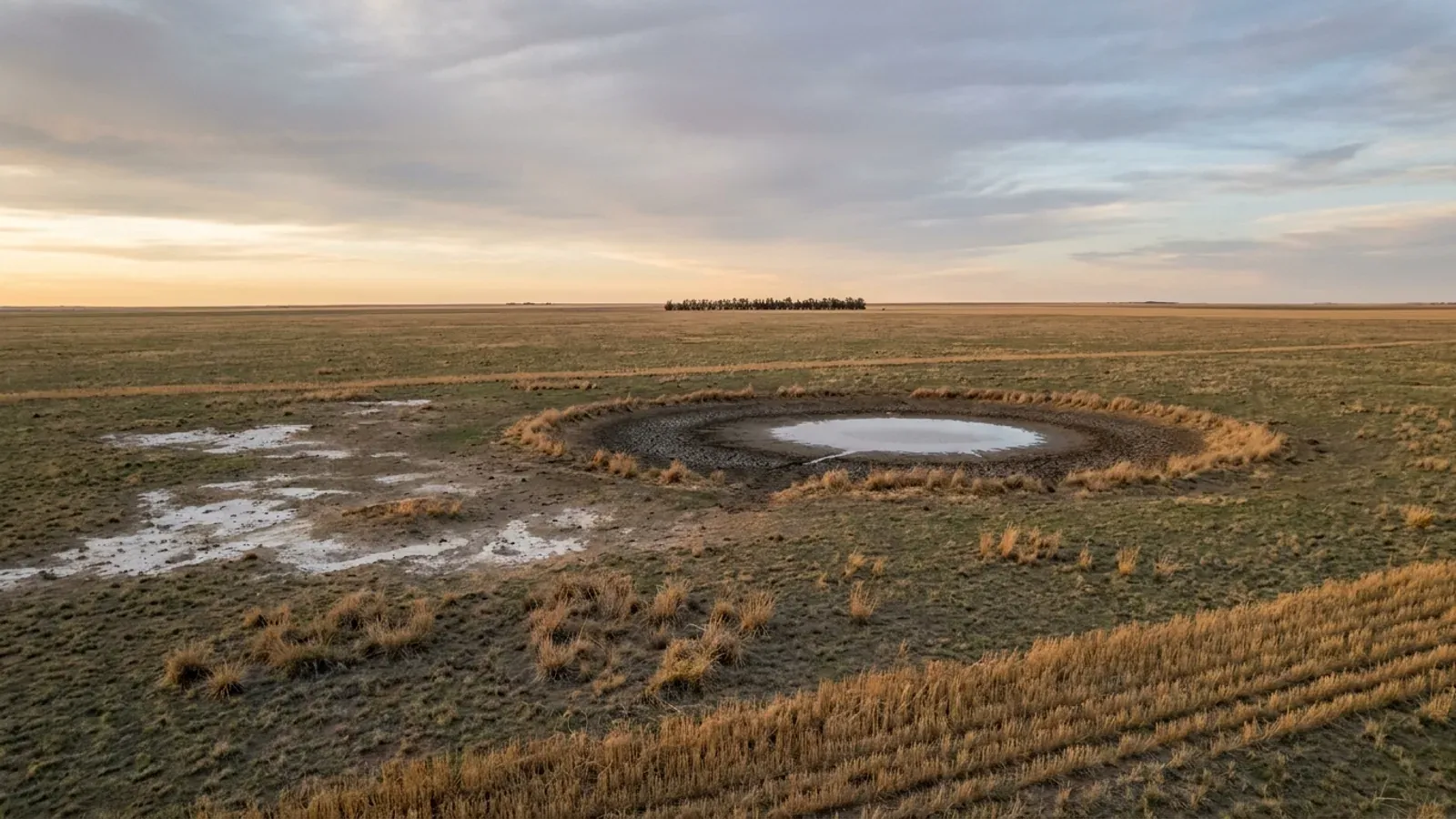
The flat short-grass High Plains of the Texas Panhandle, with a shallow playa basin holding water and pale caliche showing on a low rise.
Potter County 2021 IRC as adopted here

Barndominium Builders in Amarillo, TX

Amarillo is the one city on this site whose limits straddle two counties in a way that changes the answer. The Census Bureau's 2025 estimate puts 98,509 of its 205,130 people in Potter County and 106,621 in Randall, and the Randall half overtook the Potter half in 2021. Inside the limits none of that alters the code: the city runs the 2021 International Residential Code city-wide and publishes a filled-in Table R301.2(1) — 115 mph, 20 psf of ground snow, an 18-inch frost line and Seismic Design Category B. Those are the deepest frost line and heaviest snow load published anywhere on this site. Amarillo has also answered the foundation question inside its own ordinance: a concrete foundation is either designed by a Texas-licensed professional or built to the 2017 Panhandle Residential Foundation Manual. Step past the city limit and the county line begins to matter — for drainage, for septic and for which groundwater district you are in.

Amarillo at a glance

County
Potter County
Population
205,130
Where we build
Amarillo, Potter County, Randall County, Lubbock

ZIPs 79101, 79102, 79106, 79107, 79109, 79110, 79118, 79119 and more

Site visits
Site walks booked across Amarillo and the Potter County land around it

Building conditions in Amarillo

What actually changes from one Texas jurisdiction to the next: who issues the permit, whether the residential code is enforced there at all, what the structure has to be engineered to, and what the ground is like. These are the numbers your drawings have to satisfy.

Build conditions for Amarillo , Potter County, Texas : design wind speed 115 mph. BUILD CONDITIONS AMARILLO, TXPotter County2021 IRCDESIGN WIND SPEED115 mphAmarillo publishes Table R301.2(1) filled in, in its own codified ordinance, and amends it only todelete the Manual J design criteria and footnote N. The full published row is 20 psf ground snow…ZONING · A AGRICULTURAL, AND R-1 RESIDENTIALA: one acre, 150 ft minimum lot widt…Amarillo divides itself into nineteen zoning districts at Section4-10-61, and A Agricultural is the only one measured in acres. Two…NO DEVELOPMENT IMPACT FEE — AMARILLO CHARGES…$450 administrative fee for a wastew…Amarillo's Code of Ordinances has no impact-fee chapter and no LocalGovernment Code Chapter 395 roadway, water or wastewater impact fee…WHO ISSUES THE PERMITCity of Amarillo Department of Build…Created by the city's own adopted residential code — Section4-3-31's amendment to IRC R103.1 states that the City of Amarillo…
Build conditions for Amarillo, drawn from the sourced facts on this page. Every figure above is cited in the quick-facts panel below, with its source and vintage.
Amarillo is two counties, and Randall is now the bigger half
The Census Bureau splits Amarillo's 205,130 people at the 2025 estimate into 98,509 in Potter County and 106,621 in Randall County. Randall overtook Potter in 2021 and has kept going: since the 2020 base the Potter part has fallen by 3,154 people while the Randall part has risen by 7,873. South Amarillo is the Randall half. The city's own flood chapter proves the split from the other direction — it adopts the Flood Insurance Studies for Randall County and for Potter County, both dated 4 June 2010, as two separate documents

U.S. Census Bureau, Vintage 2025 subcounty population estimates, sub-est2025_48.csv, place 03000 with county parts 48375 and 48381; Amarillo Municipal Code Sec. 4-8-2

Adopted residential code, and what the city did to it
The 2021 International Residential Code, adopted at Sec. 4-3-31(b) and credited to Ord. No. 8086, § 1, of 24 October 2023, excluding Part VIII Electrical and including Appendices A through J. Section R313, automatic fire sprinkler systems, is deleted in its entirety. Chapter 11, the energy chapter, is also deleted in its entirety and pointed at the 2015 IECC. Running the other way, a new R306.5 requires 2x6 framing in any wall carrying drain, waste or vent piping

Amarillo Municipal Code Sec. 4-3-31, read from api.municode.com, Supplement 81, codified through Ord. No. 8226 of 9 December 2025

Amarillo publishes Table R301.2(1) filled in
Ground snow load 20 psf; ultimate design wind speed 115 mph with no topographic effects, no special wind region and no wind-borne debris zone; Seismic Design Category B; moderate weathering; frost line depth 18 inches; termite moderate to heavy; winter design temperature 20 degrees; no ice barrier underlayment required; air freezing index 311; mean annual temperature 57.2 degrees. The 18-inch frost line and the 20 psf snow load are the deepest and heaviest figures any jurisdiction on this site publishes

Amarillo Municipal Code Sec. 4-3-31, amendment to Table R301.2(1), read cell by cell from the section's own table markup on api.municode.com

The foundation question is already answered in the ordinance
Amarillo amends IRC R401.2 to read that concrete foundations will be designed by a registered design professional licensed in the State of Texas, or constructed in compliance with the 2017 Panhandle Residential Foundation Manual. The amendment to R405.1 names the same 2017 manual as an alternative in its foundation-drainage exception. Both places previously named older editions — 2015 and 2012 — and the codified text carries those as struck through

Amarillo Municipal Code Sec. 4-3-31, amendments to IRC R401.2 and R405.1, strikethrough markup read from the section's own HTML

Playa lakes are written into the city's flood rules
Chapter 4-8 defines a playa as a naturally occurring or constructed drainage basin that functions as terminal storage for stormwater, flowing radially inward with no natural outlet, emptied only by evaporation and seepage. In a playa lake and its watershed, the area encompassing the base flood is a Special Flood Hazard Area. Freeboard is not one number: a new residential structure takes its lowest floor at least one foot above base flood elevation, but in the floodway fringe of a natural water course Sec. 4-8-12(c)(2) requires two feet. Excavating in a playa needs the City Engineer's approval and an excavation plan, and moving stormwater from one playa to another needs an engineer's certification and a recorded agreement

Amarillo Municipal Code Ch. 4-8, Secs. 4-8-2, 4-8-5, 4-8-8(d)(1) and 4-8-12(c)(2), Ord. No. 7217 of 1 June 2010

The ground under the two halves is not the same ground
USDA soil survey data make the county line a soil line. In Randall County the dominant soil is Pullman clay loam, about 227,000 estimated acres, with 32.2 percent clay and a plasticity index of 23 in the top 13 centimetres and 38.9 percent clay at a plasticity index of 28 below it. Potter County's largest components are Mobeetie, Pullman, Veal and Tascosa. The caliche is real and it is shallow: the Potter series carries a very strongly coherent petrocalcic horizon beginning at 38 centimetres, about 15 inches, and the Kimberson series at 28 centimetres. The playa floors are different again — the Randall series is a 60 percent clay Vertisol with a plasticity index of 46

USDA-NRCS Soil Data Access (SSURGO), survey areas TX375 Potter County and TX381 Randall County, component, chorizon and corestrictions tables, queried 1 September 2026

Also worth knowing before you build in Amarillo

There is no size cap on a detached shop
Sec. 4-10-191 regulates accessory buildings by setback alone. A residential accessory building takes a front yard no less than the main building's, a side yard of not less than three feet — or no side yard requirement at all if it is 200 square feet or less — and no rear yard requirement, except that where no alley exists a building larger than 200 square feet takes a ten-foot rear yard. There is no percentage-of-the-house cap and no separate height cap; height comes from the district's storey limit in Table 1, which is three storeys in A Agricultural and two in R-1 and R-2

Amarillo Municipal Code Secs. 4-10-191, 4-10-174 Table 1 and 4-10-194

The only Amarillo district measured in acres
A Agricultural takes a one-acre minimum lot with 150 feet of width and 150 feet of depth, a 50-foot front setback, 15-foot interior side yards, 10 feet on a side street and 20 feet to a side or rear garage entrance. Its maximum lot coverage cell reads none and its height allowance is three storeys. Every other single-family district is measured in square feet and drops fast — R-1 at 7,500, R-2 at 6,000, R-3 at 5,000, MH at 6,000, and R-1 caps lot coverage at 45 percent

Amarillo Municipal Code Sec. 4-10-174, Table 1 Summary of Development Standards, and Sec. 4-10-61

The permit fee is measured under the whole roof
A new single-family dwelling, townhome or duplex permit is $0.52 per square foot of all floor area under roof. A detached residential garage, carport, residential alteration or storage building over 200 square feet is $0.33 per square foot of all floor area under roof, with a $139 minimum. Minimum permit fees for new construction are $139 plus $70 times the number of other permits required for electrical, plumbing and HVAC work. A one-storey detached storage shed of 200 square feet or less needs no building permit at all

Amarillo Municipal Code Secs. 4-1-20(a)(3) and 4-1-21(b), credited to Ord. No. 8218 of 16 September 2025; Sec. 4-3-31 amendment to IRC R105.2

Amarillo registers residential builders, and the state does not licence them
Sec. 4-1-110 requires a New Residential Contractor — anyone who builds a new one- or two-family residence for which a building permit is required — to register with the City. Table 4-1-110 gives that category a $66 annual city registration fee and, in its own columns, a State License or Registration Required entry of no, no surety bond and no general liability insurance requirement. A homeowner is exempt for a dwelling they live in or intend to live in, but must sign an affidavit of ownership and residency, and a person who applies as a homeowner at three different addresses within two years is refused at the third

Amarillo Municipal Code Sec. 4-1-110(b), (c), (d)(9), (f) and Table 4-1-110

Which groundwater district you are in is not answered by the county name
Two districts reach these counties and neither covers either county whole. Panhandle GCD's own management plan says the district consists of all of Carson, Donley, Gray, Roberts and Wheeler counties along with parts of Armstrong, Hutchinson and Potter — Randall County is not in it at all. High Plains Underground Water Conservation District No. 1's 2024 management plan says it now consists of eight whole counties and portions of eight more, including portions of Potter and Randall. Panhandle GCD Rule 5.1(a) exempts a well used solely for domestic use or for livestock if it cannot produce more than 17.5 gallons per minute or is completed with production pipe under two inches, and Rule 5.1(b) requires registration before drilling and provides that all registered wells must meet the spacing requirements in Rule 8, with the District confirming spacing before drilling

Panhandle Groundwater Conservation District Management Plan 2024-2029 and District Rules approved 9 July 2026; High Plains Underground Water Conservation District No. 1 Management Plan 2024, filed with the Texas Water Development Board

Septic is a county permit, run by a city-scale health district
TCEQ's authorized-agent record returns, for Potter County, an authorized agent for the entire County administered by the Amarillo Area Public Health District, and the identical entry for Randall County. Region 01 Amarillo is listed alongside each. There is no city carve-out on either record, so a barndominium on a septic system inside or outside the Amarillo limits is permitted through the same district either way — and the state capacity table keys off living area, not total structure area, so a shop bay under the same roof does not by itself enlarge the drainfield

TCEQ On-Site Activity Reporting System authorized agent search, county codes 188 Potter and 191 Randall, run 1 September 2026; 30 TAC Sec. 285.91(3) and TCEQ form TCEQ-0235

What the city does and does not do outside the limits
Sec. 4-6-1(a) expressly extends the subdivision chapter to all areas inside the city limits and the city's extraterritorial jurisdiction. Sec. 4-3-31(a) applies the residential code to structures within the City, and the zoning chapter is city-only. So in the ETJ the city reaches the plat, not the house: Sec. 4-6-54(c) requires that lots to be served with a well and septic system meet the size requirements set by TCEQ, Sec. 4-6-54(h) sets a 150-foot minimum lot width for ETJ lots fronting an arterial, and Sec. 4-6-53(a)(16) requires a 60-foot minimum street right-of-way for ETJ lots without alley access. Sec. 4-6-7 exempts the initial creation by plat of a lot from an unplatted tract where the single remainder tract is over five acres, under single ownership, fronts a dedicated street and needs no public improvements

Amarillo Municipal Code Secs. 4-6-1, 4-6-7, 4-6-53 and 4-6-54; Texas Local Government Code Secs. 212.001 et seq. and 42.021(a)(5)

Amarillo is not on the coast, and the difference is total
The Texas Department of Insurance publishes a designated catastrophe area map for Aransas, Brazoria, Calhoun, Cameron, Chambers, Galveston, Harris, Jefferson, Kenedy, Kleberg, Matagorda, Nueces, Refugio, San Patricio and Willacy counties. There is no Potter map and no Randall map. None of the seacoast apparatus applies here — no TDI windstorm inspection, no WPI certificate chain, and none of the state rule that sets a code edition for catastrophe-insurance eligibility on the coast

Texas Department of Insurance, Windstorm Inspection Program Topics A-Z and designated catastrophe area county maps index

How much city there is
106.09 square miles of land and 205,130 people at the 2025 estimate, about 1,930 to the square mile — roughly the density of Tyler, and about a third of Plano's. The city added 4,719 people between the 2020 base and 2025, a rise of 2.4 percent, and its land area grew from 103.618 square miles in the 2024 Gazetteer to 106.09 in the 2025 one

U.S. Census Bureau, 2025 and 2024 Gazetteer place files for Texas, GEOID 4803000, and Vintage 2025 subcounty population estimates
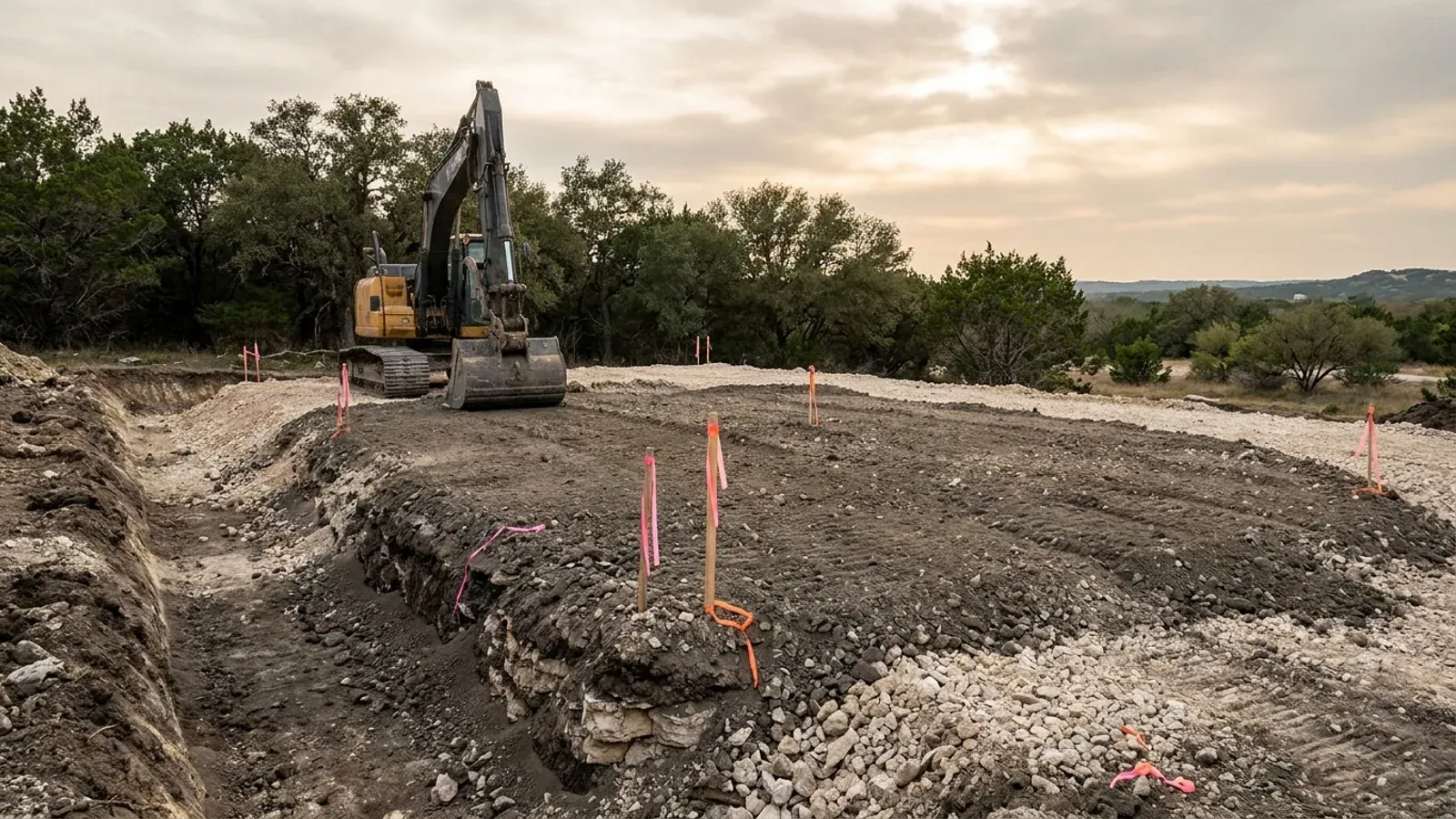
An excavator grading a compacted building pad on a cleared lot, with survey stakes and a drainage swale visible.
Below the slab

The expensive surprises are in the ground, not the building

What moves a Texas budget is usually below grade, and it is soil rather than rock: shrink-swell clay. The Blackland Prairie and the Gulf Coast clays move enough between a wet season and a dry one to drive the foundation design across the state's largest markets, which is why several DFW cities require an engineer's seal on the foundation of every new house. Those are the same conditions that decide whether a septic field passes its soil and site evaluation, so the grading plan, the foundation and the drainfield get resolved together rather than one at a time. We price the dirt before we price the building.

What we build in Amarillo

All nine of our services — kits, custom plans, post-frame and steel construction, site preparation, permitting and engineering, through to turnkey builds — are available across Potter County. What a project costs depends far more on the parcel than on square footage, so we work from your land rather than from a rate card.

See what we build

What a build looks like

Three stages every Amarillo project passes through, from a raw parcel to a finished home. Site work first, because that is where the budget is decided.
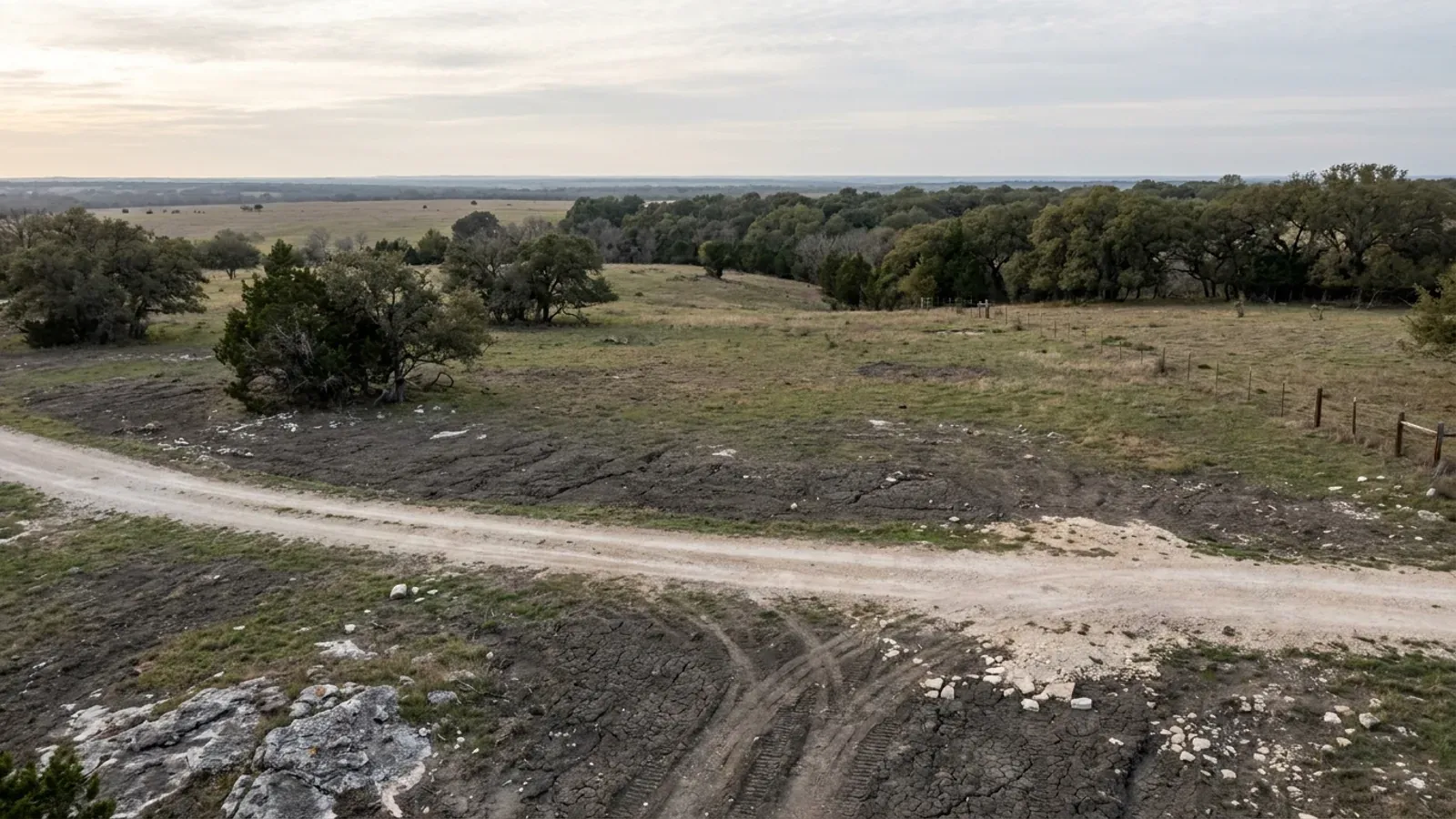
Aerial view of an undeveloped rural lot with cleared grass, a live oak and cedar elm treeline, and a pale gravel access track.
Stage one

The parcel

Zoning, setbacks, flood zone and utility access get checked before anything is drawn.

An excavator grading a compacted building pad on a cleared lot, with survey stakes and a drainage swale visible.
Stage two

Pad and permit

Clearing, grading and a compacted pad, while the submittal works through Potter County.
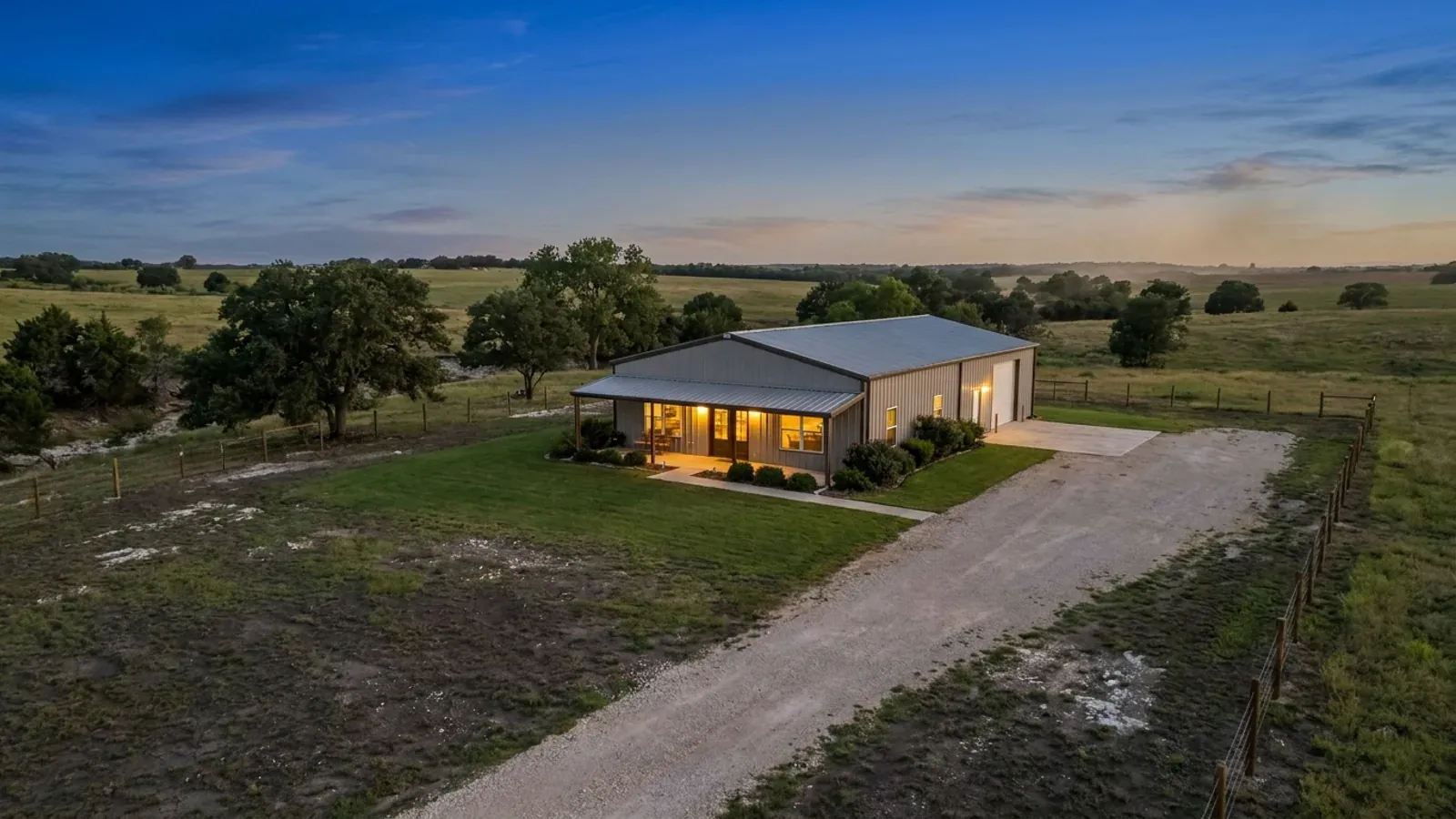
A finished barndominium at dusk with warm interior lighting glowing through its large windows.
Stage three

Frame to finish

Shell erected and dried in, then systems, insulation and interior finish through to CO.

Those are the rules for Potter County. Tell us what you want to build and we will draw it to them.

Where we build around Amarillo

Potter County and the rural land around it. The buildable acreage for a project this size usually sits outside the city limits, which is frequently what changes who issues your permit.

Our Amarillo service area, covering Potter County and the surrounding rural acreage. This map marks the territory we serve, not a branch location.

Nearby areas we build in

Others we cover in this part of Texas. The permitting authority, the adopted design criteria and the zoning can all differ from one to the next.

Building in Amarillo: common questions

12 questions we get asked most often about building in Amarillo. If yours is not on the list, ask it directly.

Which county am I actually in — Potter or Randall?
Both are Amarillo. The city limits genuinely straddle the line, and the Census Bureau reports the two halves separately: 98,509 people in the Potter County part and 106,621 in the Randall County part at the 2025 estimate, out of 205,130 city-wide. Broadly, south Amarillo is Randall and north Amarillo is Potter. Inside the limits the answer usually does not matter, because the city's own adopted code, zoning and permit apply city-wide regardless. It starts to matter the moment something is a county function: the flood insurance studies Amarillo adopts are two separate documents, one for Randall County and one for Potter County, both dated 4 June 2010; the septic authorized agent is designated county by county; and the groundwater district boundaries do not follow county lines at all. Outside the city limits it matters for everything. Check the county on the appraisal district record for the parcel before you assume.
What code does Amarillo build to, and has the city changed it?
The 2021 International Residential Code, adopted at Section 4-3-31(b) of the Municipal Code and credited to Ordinance No. 8086 of 24 October 2023, excluding Part VIII Electrical — Amarillo adopts the electrical code separately — and including Appendices A through J. Yes, the city has changed it, in both directions. Section R313, the automatic fire sprinkler section, is deleted entirely. Chapter 11, the energy chapter, is also deleted entirely and pointed at the 2015 IECC. The storm shelter and mechanical basement exception at R310.1 rises from 200 to 400 square feet. Against you: a new R306.5 requires 2x6 framing in any wall containing drain, waste or vent piping; R315.2.2 loses its exception for non-fuel-fired mechanical work, so more jobs trigger carbon monoxide alarms; the permit exemption for sidewalks on private property is struck; and a new R322 provision requires a finished floor elevation certificate sealed by a Texas-licensed engineer for a dwelling in a flood zone. Ask Building Safety for the current amendment list before drawings are final.
Does the slab need an engineer in Amarillo?
Amarillo has answered that in its own ordinance rather than leaving it to the general statute. Its amendment to IRC R401.2 reads that concrete foundations will be designed by a registered design professional licensed in the State of Texas, or constructed in compliance with the 2017 Panhandle Residential Foundation Manual. That is a genuine either-or written into the adopted code, and it is unusual — most Texas cities leave the question to the soil report and to Occupations Code Section 1001.056(c)(2), whose object is a slab on expansive soil and whose triggers are both defined by reference to the IRC as applied in the jurisdiction. The soil data explain why Amarillo bothered. USDA survey data give Pullman clay loam, the dominant soil across Randall County, a plasticity index of 23 in the top 13 centimetres and 28 below, and give the Randall series on the playa floors 60 percent clay at a plasticity index of 46. Whether a given parcel reaches the code's expansive-soil trigger is a question for its own soil report, not for a map.
Can I put a big detached shop next to the house?
Inside the Amarillo city limits, the zoning ordinance does not stop you on size. Section 4-10-191 regulates accessory buildings by setback and nothing else: a three-foot side yard, or none at all if the building is 200 square feet or less; no rear yard requirement unless there is no alley and the building is over 200 square feet, in which case ten feet; and a front yard no less than the main building's. There is no cap expressed as a percentage of the house and no separate accessory-building height cap — height comes from the district's storey limit, which is three storeys in A Agricultural and two in R-1 and R-2. That is the opposite of what several Texas cities do; Tyler, for example, caps a detached accessory building at half the house and 16 feet. What you should still check is lot coverage: A Agricultural has no maximum, but R-1 and R-2 cap it at 45 percent and R-3 at 65.
What will the building permit cost, and how is the barndominium measured?
Amarillo measures the whole roof. Section 4-1-20(a)(3) sets a new single-family dwelling, townhome or duplex permit at $0.52 per square foot of all floor area under roof, and a residential alteration, detached garage, carport or storage building over 200 square feet at $0.33 per square foot of all floor area under roof with a $139 minimum. Minimum permit fees for new construction are $139 plus $70 for each additional electrical, plumbing or HVAC permit required. Non-residential plan review runs on valuation instead. Note the contrast that matters for this building type: the permit fee counts the shop bay because it is under the roof, while the septic capacity table keys off living area and does not. A one-storey detached shed of 200 square feet or less needs no building permit at all — that exemption survives in Amarillo's amended R105.2.
Do I need to be registered with the city to build here?
The builder does. Section 4-1-110(d)(9) makes anyone who builds a new one- or two-family residence for which a permit is required register with the City as a New Residential Contractor, and the amended R105.1 says a building permit shall only be issued to a registered residential building contractor or to a homeowner acting as their own contractor. Table 4-1-110 sets that registration at $66 a year and — in the city's own columns — records no state licence or registration requirement, no surety bond and no general liability insurance requirement for the category. That last part is worth reading carefully, because it is the city confirming something this site says on every page: Texas has no licence for a residential contractor, so anyone advertising one is describing something that does not exist. Ask any builder for the specific registration, insurance certificate and references, and verify them yourself.
What does the 18-inch frost line mean for footings here?
Amarillo publishes an 18-inch frost line depth in its own filled-in Table R301.2(1), alongside a 20 psf ground snow load, a 20 degree winter design temperature and an air freezing index of 311. That is the deepest published frost line and the heaviest published snow load of any jurisdiction researched for this site — Lubbock, 120 miles south, publishes 12 inches and 15 psf, and San Antonio publishes zero. Footings have to reach that depth, and out here the excavation can meet something. USDA survey data put a very strongly coherent petrocalcic horizon — caliche — starting at 38 centimetres, about 15 inches, in the Potter soil series, and at 28 centimetres in Kimberson. Whether your parcel has that horizon and at what depth is a soil-report question, and it is worth asking before the excavation is priced rather than after.
There is a playa lake on the property. What does that change?
Quite a lot, and Amarillo is the only city on this site whose ordinances address it directly. Chapter 4-8 defines a playa as a drainage basin that functions as terminal storage for stormwater, with runoff flowing radially inward and no natural outlet, emptied only by evaporation and seepage — and it provides that in a playa lake and its watershed the area encompassing the base flood is a Special Flood Hazard Area. That means the same permit machinery applies: no building permit issues until the floodplain development permit does, and a new residential structure takes its lowest floor at least one foot above base flood elevation, certified by a registered engineer, architect or land surveyor. Watch the second number, because it is different: in the floodway fringe of a natural water course Section 4-8-12(c)(2) requires two feet, not one. Excavating in a playa needs the City Engineer's approval on an excavation plan, and transferring stormwater from one playa to another needs an engineer's certification plus a recorded agreement between the owners.
Which groundwater district covers my land, and can I just drill a well?
The county name does not answer it. Panhandle GCD's own management plan says the district consists of all of Carson, Donley, Gray, Roberts and Wheeler counties plus parts of Armstrong, Hutchinson and Potter — Randall County is not in it at all. High Plains Underground Water Conservation District No. 1's 2024 plan says it includes portions of both Potter and Randall. So two districts reach these two counties and neither covers either one whole. Ring the district before you site anything. In Panhandle GCD, Rule 5.1(a) exempts a well used solely for domestic use or for livestock or poultry if it cannot produce more than 17.5 gallons per minute, or is completed with production pipe under two inches, or is a windmill or solar well at 17.5 gallons per minute or less. Exempt does not mean unregulated: Rule 5.1(b) requires registration before drilling and provides that all registered wells must meet the spacing requirements of Rule 8, with the District confirming spacing before the rig turns. The driller must also hold a TDLR licence.
Is Amarillo colder than the rest of Texas, and does the code notice?
Yes to both. Potter and Randall counties are climate zone 4B, and they hold that assignment on both the pre-2021 and the 2021 maps, so unlike Dallas or Brownsville the answer here does not depend on which edition you quote. 4B is a materially colder envelope than anything else this site covers — Waco and Bellmead are 2A, Lubbock is 3B. The code notices in its published numbers: a 20 degree winter design temperature, an air freezing index of 311 and a 20 psf ground snow load, none of which any warmer Texas market carries. The energy code that actually governs is not the one you would guess. Section 4-3-31 deletes Chapter 11 of the 2021 IRC in its entirety and directs the reader to the 2015 IECC, which Amarillo adopts separately at Section 4-3-41. That happens to sit on the same vintage as the state baseline at Health and Safety Code Section 388.003(a), which puts single-family construction on the IRC energy chapter as it existed on 1 May 2015.
What changes once I am outside the city limits?
The building code stops. Section 4-3-31(a) applies Amarillo's residential code to structures within the City, and Chapter 4-10 zoning is city-only, so neither follows you into the extraterritorial jurisdiction. Platting does: Section 4-6-1(a) expressly extends the subdivision chapter to the city limits and the ETJ, and Amarillo's population puts that ring at five miles under Local Government Code Section 42.021(a)(5). In the ETJ the city reaches the plat rather than the house — lots to be served by a well and septic must meet the size requirements set by TCEQ, ETJ lots fronting an arterial take a 150-foot minimum width, and ETJ lots without alley access need a 60-foot street right-of-way. Section 4-6-7 exempts the initial creation by plat of a lot from an unplatted tract where the single remainder is over five acres, under single ownership, fronts a dedicated street and requires no public improvements. Beyond the ETJ the parcel is unincorporated Potter or Randall County, and those are separate answers with a separate page each.
Do I have to sprinkler a new house in Amarillo?
No. Amarillo's adopted code deals with it in one line: its amendments to the 2021 IRC state that Section R313, Automatic Fire Sprinkler Systems, is deleted in its entirety. Note the section number, because it moved — R313 is the 2021 edition's numbering, which is the edition Amarillo adopted; in the 2024 IRC the same subject sits at R309, and quoting a 2024 section number at an Amarillo plan reviewer will not match the book on the counter. The state statute points the same way: Occupations Code Section 1301.551(i) provides that after 1 January 2009 a municipality may not enact an ordinance, building code or rule requiring a fire sprinkler system in a new or existing one- or two-family dwelling, while allowing a city to let a contractor offer one for a fee.

Building in Amarillo?

Start with the plan. Tell us what you want to build and we will draw it, then confirm what Potter County will actually let you put on the parcel and what wind load it has to meet. That conversation costs nothing.