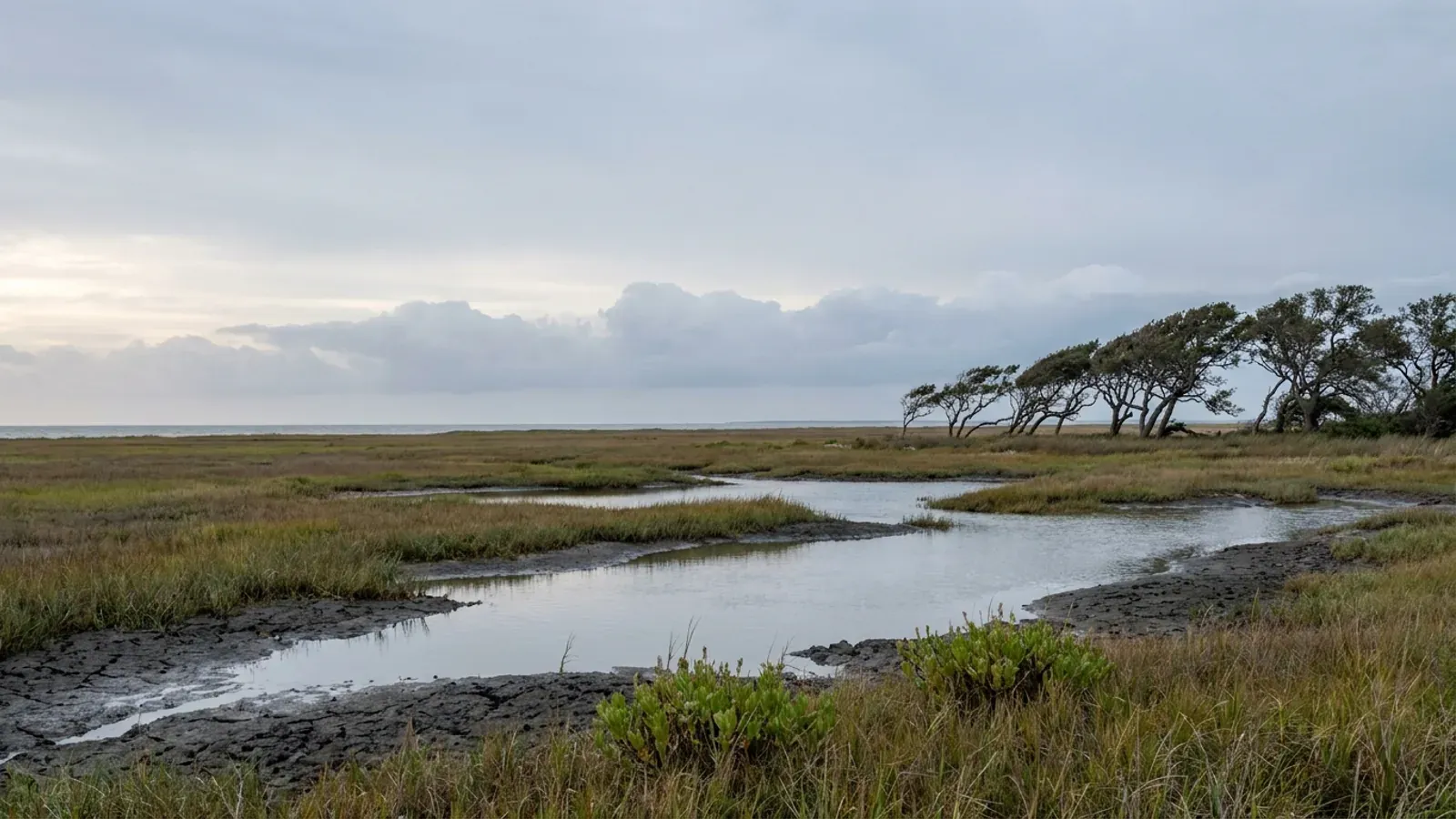
Flat Texas Gulf coastal prairie with brackish sloughs, cordgrass, and wind-shaped live oaks leaning inland.
Orange County 2006 IRC, or the county seat's 2021 IRC as adopted here

Barndominium Builders in Orange County, TX

Orange County is where the Texas coastal regime stops. It fronts Sabine Lake, the Insurance Code names it a coastal county, and it has taken Rita, Ike, Harvey, Imelda and Laura. Yet it sits outside the designated catastrophe area, so the windstorm certificate that governs a build in Jefferson County, just across the Neches, does not apply on this side of the river. What does apply is a county residential code: the Commissioners Court adopted House Bill 2833 on 26 April 2010. That brings three third-party inspections but no county permit, no county fee and no county inspector, and Orange County gets compliance a different way, by holding back permanent electricity until the framing inspection is filed. Almost half the county lives outside any city, and the unincorporated balance accounted for 1,345 of the county's 1,454 net growth since 2020. That is where the land is.

Orange County at a glance

County
Orange County
Population
86,266
Where we build
Orange, Beaumont, Jefferson County, Hardin County

ZIPs 77630, 77632, 77611, 77662, 77639, 77626, 77670

Site visits
We meet you on the tract, the city of Orange or anywhere else in the county

Building conditions in Orange County

What actually changes from one Texas jurisdiction to the next: who issues the permit, whether the residential code is enforced there at all, what the structure has to be engineered to, and what the ground is like. These are the numbers your drawings have to satisfy.

Build conditions for Orange County , Texas . BUILD CONDITIONS ORANGE COUNTY, TXOrange County2006 IRCADOPTED RESIDENTIAL CODE2006 IRCThis jurisdiction publishes no design wind speed. It is settled in writing with the authority overyour parcel before the frame is ordered.ZONING · NO COUNTY ZONINGSection 233.153(d)(2) does not authorise a commissioners court toadopt or enforce zoning, and adopting House Bill 2833 did not chang…IMPACT AND PERMIT FEESCounty development permitA development permit is required for any building constructed ormoved onto a property, valid one year. The county says the fee for…WHO ISSUES THE PERMITOrange County Environmental Health a…11475 FM 1442, Orange, TX 77630, (409) 745-1463, Monday to Friday8:00am to 5:00pm. Permit applications are filed through…
Build conditions for Orange County, drawn from the sourced facts on this page. Every figure above is cited in the quick-facts panel below, with its source and vintage.
Coastal in the statute, outside the windstorm programme
Orange County is a second tier coastal county in the Insurance Code, but designation as a catastrophe area is a separate act of the Commissioner of Insurance and Orange County has never been designated, so no windstorm certificate of compliance is required here

Texas Insurance Code sections 2210.003(3), 2210.003(11)(L) and 2210.005, read from the rendered chapter text, with the Texas Department of Insurance designated catastrophe area county list

The county adopted a residential code in 2010
The Commissioners Court moved to adopt House Bill 2833, applying Subchapter F of chapter 233 to the unincorporated areas of Orange County, all voted aye, and set the order effective 26 April 2010

Orange County Commissioners Court, Special Court Session minutes and agenda, 26 April 2010, items 13 and the following effective-date motion

Three inspections, and the county does none of them
Any building with living quarters needs three inspections, at foundation before concrete, at framing and mechanical before covering, and on completion, performed by a licensed engineer, a registered architect, a professional inspector licensed by the Texas Real Estate Commission, a plumbing inspector employed by a municipality, a building inspector employed by a political subdivision, or an ICC residential combination inspector

Orange County Environmental Health and Code Compliance, Development and Floodplain page, tracking Local Government Code section 233.154(a)(1) and (a)(3)(A)

The lever is the electricity, not an inspector
Third party inspections are required before permanent power can be released, and permanent power will not be released until the third party framing inspection has been submitted with an energy release form; temporary power is available on request

Orange County, General Permitting Requirements for Orange County, 2026 edition

The county floodplain order adds no freeboard
New residential construction must have the lowest floor elevated to or above the base flood elevation, certified by a registered professional engineer, architect or land surveyor; the word freeboard does not appear in the order, and neighbouring Liberty County requires two feet above the base flood elevation

Orange County Flood Damage Prevention Order, article 4 section B(1), effective 16 December 2021, with the Liberty County Flood Damage Prevention Ordinance article 5 section B(1)

Barely any of the county drains well
Of the Orange County acreage the soil survey assigns a drainage class, 7,282 acres are well drained and 465,883 acres are poorly, somewhat poorly or very poorly drained

USDA NRCS Soil Data Access, SSURGO survey area TX623, component acreage weighted by component percentage and filtered to the Orange County overlap area

Also worth knowing before you build in Orange County

The surface lies about the clay
In the Orcadia soils the top six inches read 10 to 20 percent clay with a linear extensibility near 1, while the layer from about a foot down is more than 53 percent clay with a linear extensibility above 7; the Beaumont series runs 52 percent clay at the surface and 57 percent at depth

USDA NRCS Soil Data Access, SSURGO survey area TX623 horizon data for the Orcadia and Beaumont components in Orange County

There is no Orange County soil survey
Orange County has no soil survey of its own; it shares a single 877,876 acre joint survey with Jefferson County, and the county sits across four major land resource areas including the Gulf Coast Marsh and the Western Gulf Coast Flatwoods

USDA NRCS Soil Data Access, legend and area overlap tables for survey area TX623, Jefferson and Orange Counties, Texas

Every new septic system needs a night timer
Effective 1 October 2010 Orange County requires a night timer on all new installation or construction of on-site sewage facilities within its jurisdiction, one of only three requirements the county adopted as stricter than the state rule

Order Adopting Rules of Orange County, Texas for On-Site Sewage Facilities, section 10(B), passed and approved 27 September 2010

Acreage buys you nothing here
The county requires an application, permit and inspection for construction, alteration, extension or repair of a residential or commercial on-site sewage facility regardless of the size of the tract of land

Order Adopting Rules of Orange County, Texas for On-Site Sewage Facilities, section 10(A), passed and approved 27 September 2010

The county is its own septic authority
The state authorised agent search returns a single agent for Orange County, the Orange County Authorized Agent, serving the unincorporated county, with no city listed; inside a city the route is the city or the Beaumont regional office

TCEQ On-site Sewage Facility Authorized Agent search by county, county code 181

A permit for any building, anywhere in the county
A development permit is required for any building constructed or moved onto a property or any improvement over half the value of the building, and the order applies to all areas outside of and inside of the special flood hazard areas; agriculture buildings are on the county's own list of examples

Orange County Flood Damage Prevention Order article 3 section A, with the county's Development and Floodplain page and General Permitting Requirements

The permit fee follows living area, not the whole slab
The county's development permit form asks for house square footage, living only, and the permitting guide says new home permit fees are based on the square footage of living area, so a large shop bay does not by itself raise the fee

Orange County Floodplain Development Permit form and General Permitting Requirements for Orange County, 2026 edition

Four more approvals before the permit issues
A valid 911 address with confirmation documentation is required, permits will not be issued until written approval is received from the Orange County Drainage District, an elevation certificate is required in flood zone A or AE, and in the floodway a licensed engineer must show the work causes no rise upstream or downstream in the one percent flood

Orange County, General Permitting Requirements for Orange County, 2026 edition

The growth is all outside the cities
The balance of Orange County outside every city grew from 39,730 in 2020 to 41,075 in 2025, which is 1,345 of the county's 1,454 net gain, while Vidor, West Orange and Pinehurst all lost population

U.S. Census Bureau Vintage 2025 sub-county population estimates, sub-est2025.csv

A twelfth of the county is water
Orange County covers 333.795 square miles of land and 45.69 square miles of water, so water is about 12 percent of its area

U.S. Census Bureau 2024 Gazetteer file for counties, 2024_Gaz_counties_national.txt

Climate zone 2A, on both maps
Orange County is climate zone 2A, hot-humid, and did not move between the pre-2021 and the 2021 county climate zone maps

U.S. Department of Energy and Pacific Northwest National Laboratory PNNL-33270 county climate zone data files

A licensed plumber is required even on rural land
The rural plumbing exemption expressly excludes plumbing performed in conjunction with new construction

Texas Occupations Code section 1301.052
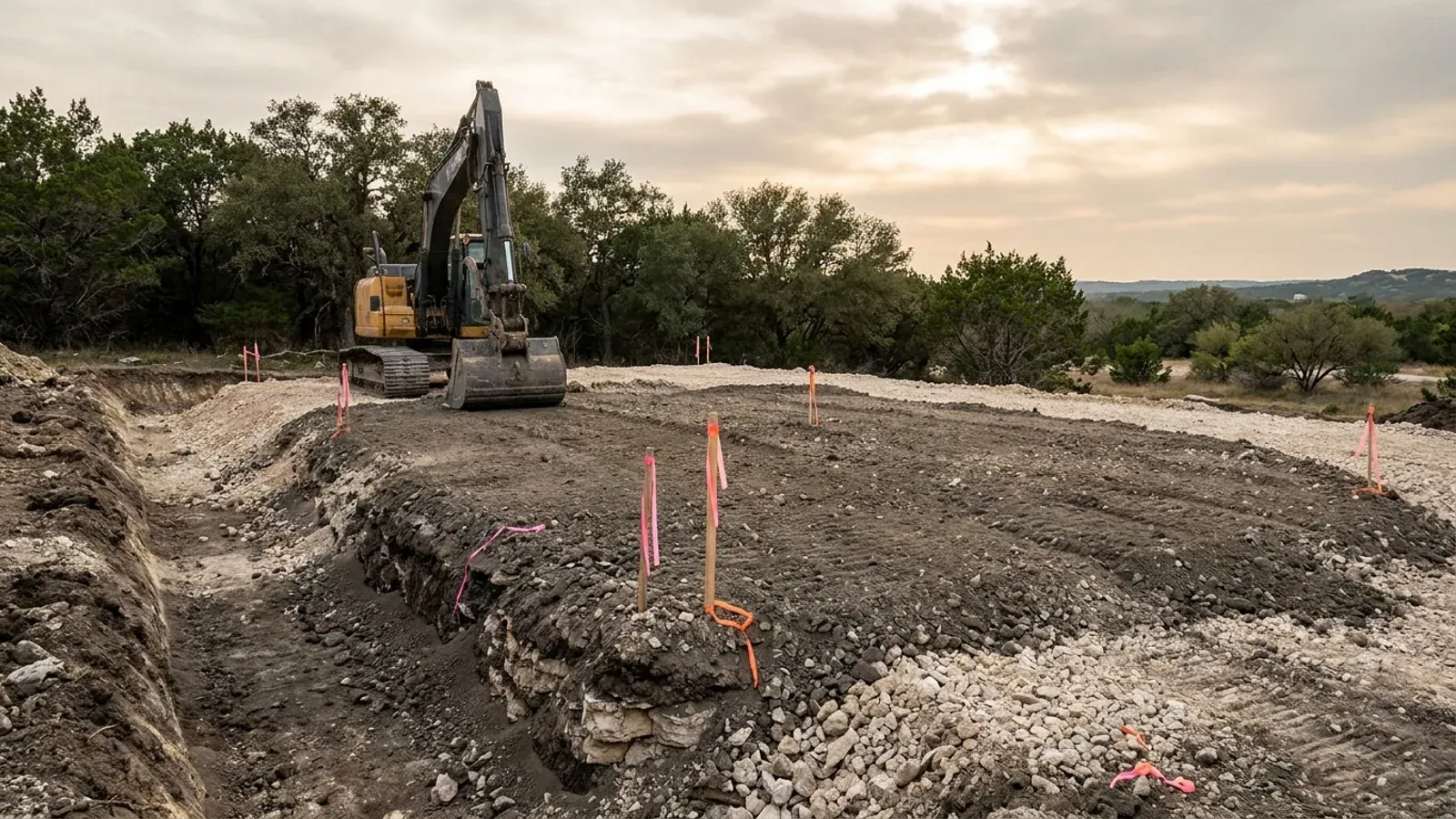
An excavator grading a compacted building pad on a cleared lot, with survey stakes and a drainage swale visible.
Below the slab

The expensive surprises are in the ground, not the building

What moves a Texas budget is usually below grade, and it is soil rather than rock: shrink-swell clay. The Blackland Prairie and the Gulf Coast clays move enough between a wet season and a dry one to drive the foundation design across the state's largest markets, which is why several DFW cities require an engineer's seal on the foundation of every new house. Those are the same conditions that decide whether a septic field passes its soil and site evaluation, so the grading plan, the foundation and the drainfield get resolved together rather than one at a time. We price the dirt before we price the building.

What we build in Orange County

All nine of our services — kits, custom plans, post-frame and steel construction, site preparation, permitting and engineering, through to turnkey builds — are available across Orange County. What a project costs depends far more on the parcel than on square footage, so we work from your land rather than from a rate card.

See what we build

What a build looks like

Three stages every Orange County project passes through, from a raw parcel to a finished home. Site work first, because that is where the budget is decided.
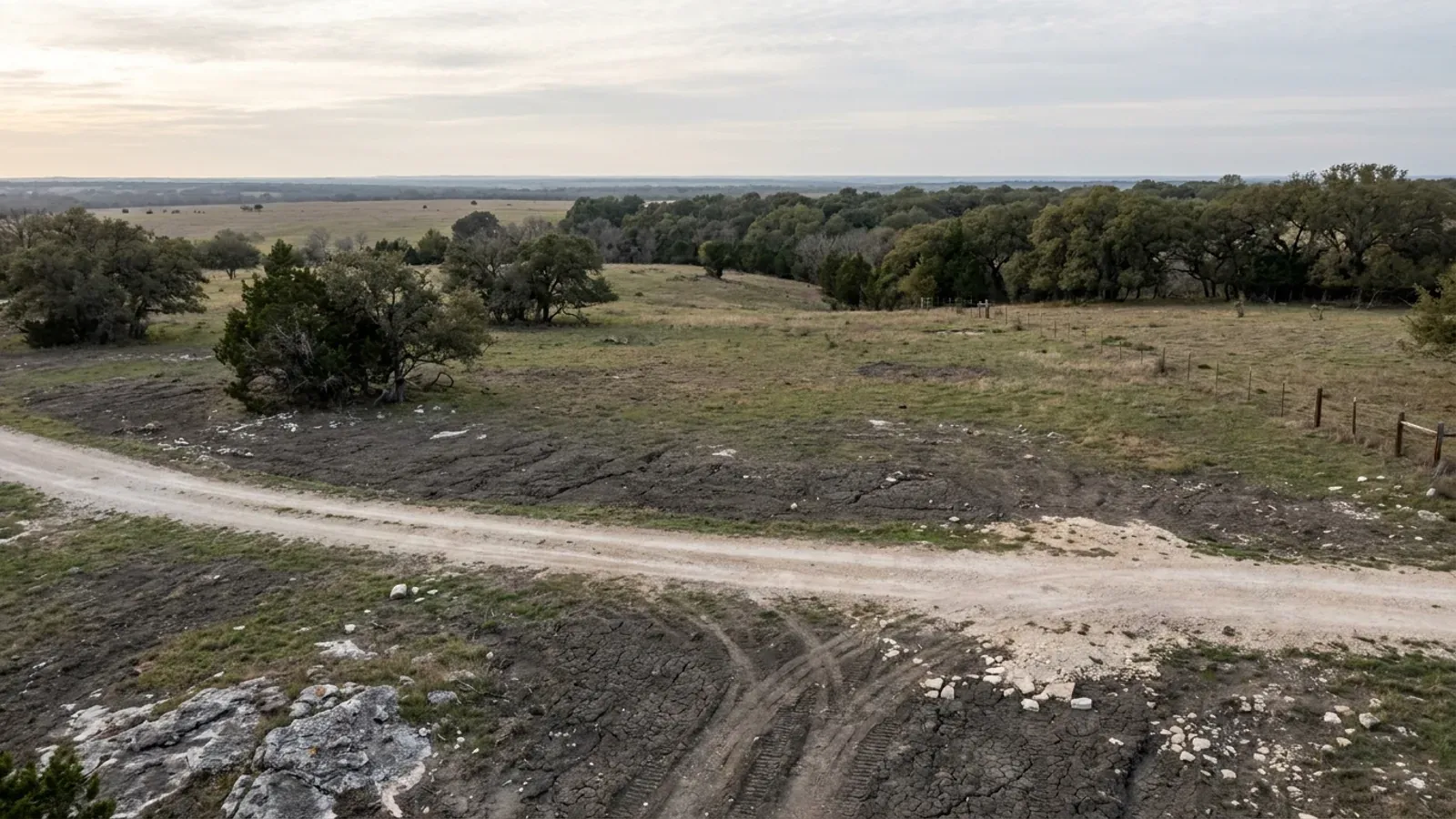
Aerial view of an undeveloped rural lot with cleared grass, a live oak and cedar elm treeline, and a pale gravel access track.
Stage one

The parcel

Zoning, setbacks, flood zone and utility access get checked before anything is drawn.

An excavator grading a compacted building pad on a cleared lot, with survey stakes and a drainage swale visible.
Stage two

Pad and permit

Clearing, grading and a compacted pad, while the submittal works through Orange County.
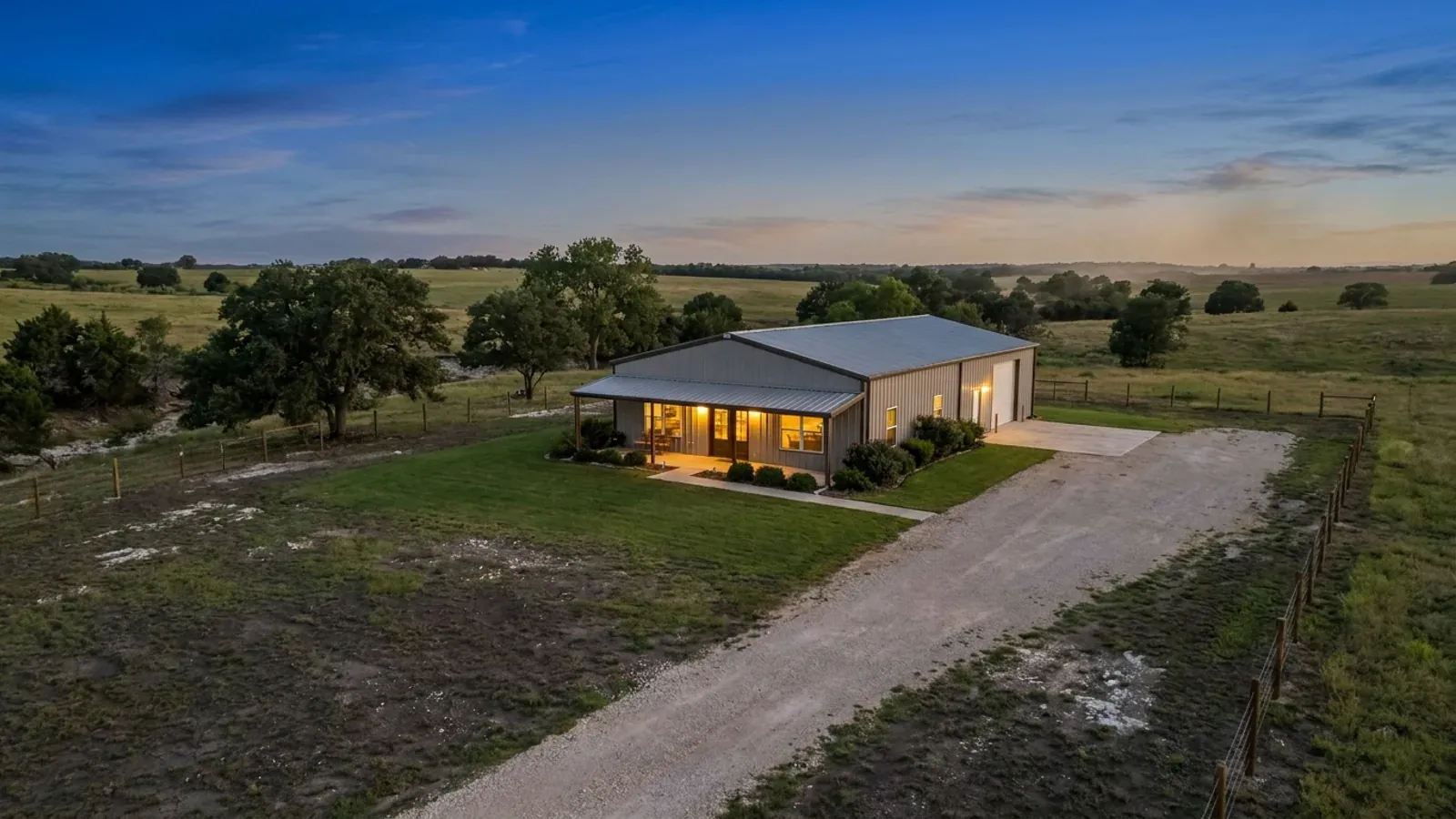
A finished barndominium at dusk with warm interior lighting glowing through its large windows.
Stage three

Frame to finish

Shell erected and dried in, then systems, insulation and interior finish through to CO.

Those are the rules for Orange County. Tell us what you want to build and we will draw it to them.

Where we build around Orange County

Orange County and the rural land around it. The buildable acreage for a project this size usually sits outside the city limits, which is frequently what changes who issues your permit.

Our Orange County service area, covering Orange County and the surrounding rural acreage. This map marks the territory we serve, not a branch location.

Nearby areas we build in

Others we cover in this part of Texas. The permitting authority, the adopted design criteria and the zoning can all differ from one to the next.

Building in Orange County: common questions

11 questions we get asked most often about building in Orange County. If yours is not on the list, ask it directly.

Do I need a windstorm certificate to build in Orange County?
No. This is the single most common misunderstanding here and it costs people money in both directions. Orange County is named in the Insurance Code as a second tier coastal county, which sounds decisive, but the certificate requirement attaches only to a structure located in a designated catastrophe area, and designation is a separate act of the Commissioner of Insurance under section 2210.005 that Orange County has never received. The Department of Insurance lists fourteen counties plus part of Harris County; Orange is not among them. It publishes a catastrophe area map for Jefferson County next door and has never published one for Orange. So there is no WPI-1 to file, no WPI-2 inspection verification and no WPI-8 certificate on this side of the Neches River. Cross the river into Port Arthur or Beaumont and the answer reverses completely.
So what is different about building in Jefferson County across the river?
Two things, and they are separate. First, inside the designated catastrophe area the Department of Insurance sets an insurance eligibility standard by rule, currently the 2024 International Residential Code or International Building Code for work begun on or after 1 April 2026. That does not replace the city's building code; the local code still governs the permit, and the state rule governs whether the structure can be insured. Second, the certificate chain applies: an application before construction begins, an inspection verification during the work, then the certificate itself. TWIA puts it that without a certificate of compliance it lacks evidence the structure conforms to applicable building codes, and it may be considered uninsurable and ineligible for coverage with TWIA. None of that reaches Orange County, because TWIA's service area is the designated catastrophe area.
Does Orange County have a building code?
Yes, and that is unusual for a Texas county. Most have no residential building code at all in their unincorporated area. On 26 April 2010 the Orange County Commissioners Court moved to adopt House Bill 2833, applying Subchapter F of chapter 233 of the Local Government Code, and set the order effective the same day. But read what that actually buys. Section 233.153(d)(1) says it may not be construed to require prior approval by the county before construction begins. Section 233.153(f) says the county may not charge a fee to enforce the standards. Section 233.154(a)(3) leaves the builder to contract the inspections privately. And section 233.153(d)(2) gives no zoning power. So there is a code, and there is no county plan review, no county code fee and no county building inspector to go with it.
Which edition of the code applies to my build?
The statute gives two answers and does not say which wins. Section 233.153(a) says construction must conform to the International Residential Code published as of 1 May 2008, which was the 2006 edition, or to the version applicable in the county seat. The county seat is the City of Orange, which adopted the 2021 International Residential Code by Ordinance 2025-02 on 25 February 2025. Those two are fifteen years apart and the statute joins them with or. There is no Texas court decision or attorney general opinion settling the choice. The most useful clue is section 233.154(b)(3), which requires the notice filed before construction begins to state the version of the International Residential Code that will be used, so in practice the builder names the edition. Settle that in writing before anything is poured, and call Environmental Health and Code Compliance on (409) 745-1463 if you want the county's own view.
Who does the three inspections, and when?
Not the county. The three stages are foundation before the concrete is placed, framing and mechanical before drywall or other interior covering goes on, and completion. Six kinds of inspector may perform them: a licensed engineer, a registered architect, a professional inspector licensed by the Texas Real Estate Commission, a plumbing inspector employed by a municipality and licensed by the state plumbing board, a building inspector employed by a political subdivision, or an individual certified as a residential combination inspector by the International Code Council. The same person may do all three or you may use a different one each time. What makes this real in Orange County is where it bites: the county's permitting guide says permanent power will not be released until the third party framing inspection has been submitted along with an energy release form. Temporary power comes on request; permanent power waits on the paperwork.
How high does the county make me build in the floodplain?
To the base flood elevation and no higher. Article 4 section B(1) of the county's flood damage prevention order, effective 16 December 2021, requires new residential construction to have the lowest floor elevated to or above the base flood elevation, with a registered professional engineer, architect or land surveyor certifying it. The word freeboard does not appear anywhere in the order. That is worth knowing because it is the federal minimum and neighbouring counties go further: Liberty County requires two feet above the base flood elevation, as do Montgomery and Parker. Orange County requires none. Your lender and your insurer will each have their own view, the flood maps and study in force here are dated 16 December 2021, and in the floodway you will additionally need a licensed engineer to show the work causes no rise upstream or downstream in the one percent flood.
What do I have to clear before the county will issue a permit?
More than most people expect, and none of it is a structural plan review. A development permit is required for any building constructed or moved onto a property, and the order applies to all areas of the county, inside and outside the flood hazard areas; the county's own list of examples includes agriculture buildings. Before it issues you need a valid 911 address with confirmation documentation, written approval from the Orange County Drainage District in the areas where that applies, an elevation certificate if you are in flood zone A or AE, and a hydraulic and hydrostatic study from a licensed engineer if you are in the floodway. Septic has to be settled too, and the county is blunt about it: conventional septic tanks need inspection before any electricity is released for any reason, and failing that inspection means installing a new system. The permit runs for one year.
Does my shop bay make the septic system bigger?
Not in Orange County. The state rule sizes an on-site sewage facility off the number of bedrooms or the living area of the home, whichever gives the larger result, and living area is not total structure area. Some Texas counties override that through their authorised agent, but Orange County does not. Its septic order lists exactly three requirements it adopted as stricter than the state rule, and the words living, loft, garage and setback appear nowhere in the document. The three are: a permit and inspection regardless of the size of the tract of land, a night timer on every new system from 1 October 2010, and the right to withhold an authorisation to construct from an installer carrying fifteen or more permits without a final inspection. The county's development permit fee also keys off living area only, so the shop does not drive that either.
What is the ground actually like out here?
Wet, and clayier than it looks. Orange County has no soil survey of its own; it shares one with Jefferson County. Of the acreage that survey assigns a drainage class, 7,282 acres are well drained and 465,883 acres are poorly, somewhat poorly or very poorly drained. Most of the county's major soils are smectitic, the shrink-swell clay mineralogy, and along the Sabine and Neches there are Hydraquents, permanently saturated marsh sediments. The trap is the profile. In the Orcadia soils the top six inches read 10 to 20 percent clay and feel like a loam, then the layer from about a foot down runs over 53 percent clay with a linear extensibility above 7. The Beaumont series is 52 percent clay at the surface and 57 percent at depth. A hand augered look at the topsoil will tell you the wrong thing about what your footing is sitting on, so get the site investigated properly and let a Texas licensed engineer size the foundation.
If I rent the barndominium out, does anything change?
The code does not change, but a protection does. Orange County has no separate commercial route for a rented house and no county fire code, so letting the building does not move it onto a different standard the way it does in some Texas counties. What it costs you is section 233.157(c), which withholds the penalty only where the individual builds the house themselves or acts as their own contractor and intends to use it as their primary residence. Both limbs are required, so a build intended from the start as a let or a short term rental simply cannot rely on it, and a violation of the standards is a Class C misdemeanour. Separately, the flood damage prevention order makes a violation of its terms a misdemeanour carrying a fine of up to 500 dollars for each violation plus costs. Decide the use before you build, not after.
Is there really that much land left in Orange County?
Yes, and it is where all the growth is. 41,075 of the county's 86,266 residents, just under half, live outside every incorporated city. Between 2020 and 2025 that unincorporated balance grew by 1,345 people while the county as a whole grew by 1,454, so roughly nine tenths of the county's growth landed outside the cities. Vidor, West Orange and Pinehurst each lost population over the same period. So the pattern here is the opposite of a built-out suburb: the cities are flat or shrinking and the acreage around Mauriceville, Orangefield and Little Cypress is where people are actually going. Bear in mind roughly a twelfth of the county's area is open water, and that the drainage and flood questions above decide a lot of what is left.

Building in Orange County?

Start with the plan. Tell us what you want to build and we will draw it, then confirm what Orange County will actually let you put on the parcel and what wind load it has to meet. That conversation costs nothing.