
Barndominium Builders in Parker County, TX
Parker County is where Fort Worth buyers go when they want land. It runs west from the Tarrant County line along I-20 to Weatherford across 903.7 square miles, and it added 24.6 percent to its population between 2020 and 2025 — mostly as acreage cut out of ranch land rather than as tract housing. The regulatory answer on that land is genuinely different from anything inside a city limit, and the county says so itself: it does not issue building permits or certificates of occupancy, and there are no zoning requirements in the unincorporated area. That is not the same as nothing applying. The septic permit is real and the county issues it. The floodplain permit is real. A state-licensed plumber is required on new construction whether or not anyone inspects it, the state energy code reaches a builder working outside any municipality, you need the groundwater district's approval before a drill rig turns, and the restrictions recorded against your own tract are enforceable in court. The useful question here is not whether rules exist. It is which ones, and who holds them.
Parker County at a glance
- County
- Parker County
- Population
- 184,767
- Where we build
- Weatherford, Fort Worth, Johnson County, Denton
- Site visits
- Site walks arranged throughout Parker County, Weatherford included
ZIPs 76008, 76020, 76035, 76066, 76082, 76085, 76086, 76087 and more
Building conditions in Parker County
What actually changes from one Texas jurisdiction to the next: who issues the permit, whether the residential code is enforced there at all, what the structure has to be engineered to, and what the ground is like. These are the numbers your drawings have to satisfy.
Parker County Permitting Department, parkercountytx.gov/130/Permitting, rendered and read 1 September 2026
Texas Local Government Code ch. 233, secs. 233.152, 233.153 and 233.154, Texas Legislature Online — https://statutes.capitol.texas.gov/Docs/LG/htm/LG.233.htm
Order Adopting Rules of Parker County, Texas for On-Site Sewage Facilities, passed 27 Aug. 2007, with the TCEQ Health and Safety Code sec. 366.031 approval order dated 5 Oct. 2007 — parkercountytx.gov DocumentCenter, "Parker County Order 2007"; fee and timing from the department's Permitting Procedures for Your On-Site Sewage Facility sheet
Upper Trinity Groundwater Conservation District, District Rules for Water Wells in Hood, Montague, Parker, and Wise Counties, Texas, as adopted 22 February 2021, Rules 2.2, 2.3, 3.1 and 4.3 — https://uppertrinitygcd.com/pdf/UTGCD-RULES.pdf
Texas Occupations Code sec. 1301.052 — https://statutes.capitol.texas.gov/Docs/OC/htm/OC.1301.htm
Parker County Flood Plain Development Permit Instructions, Parker County Permitting, Rusty Brawner CFM, Floodplain Administrator — parkercountytx.gov DocumentCenter; Texas Water Code sec. 16.3145
Also worth knowing before you build in Parker County
- Weatherford runs the 2021 IRC — and it is the county seat, which matters
- The City of Weatherford adopted the 2021 editions of the International Residential, Building, Fire, Mechanical, Plumbing, Fuel Gas, Energy Conservation and Property Maintenance Codes, plus the 2020 National Electrical Code, by Ordinance No. O2025-22 on 10 June 2025, expressly repealing every prior edition. That is worth knowing beyond the city limit, because Sec. 233.153(a) sets the standard in an opted-in county as either the version of the International Residential Code published as of 1 May 2008 or the version applicable in the county seat — and Weatherford is the county seat.
- The state energy code follows you out of town
- Health and Safety Code Sec. 388.004 obliges a builder working outside any municipality to certify that a new single-family house complies with the energy standard and to keep that certification for three years. Parker County is also one of the counties named in Sec. 386.001(2) as an air-quality affected county, where local energy amendments may not be less stringent than the model code — a list Dallas and Tarrant are not on, because they are covered by the separate nonattainment limb instead.
- Fort Worth's five-mile ring reaches in here — for platting, not for code
- A city over 100,000 carries a five-mile extraterritorial jurisdiction, and Fort Worth publishes interlocal agreements covering that ring with five counties including Parker. Out there the city can require you to plat and can set street and drainage specifications. Texas courts have held it cannot enforce its building codes: the Texas Supreme Court said so for a general-law city in 2016, and the Dallas Court of Appeals said so for a home-rule city in 2018, holding that every municipality needs legislative authorisation to enforce building codes beyond its corporate limits. Parker County's own subdivision rules confirm the platting half — a plat inside a city's ETJ has to be approved by the city before the Commissioners Court will grant final approval.
- The shop bay does not count against your drainfield here
- TCEQ sizes a septic system on bedrooms or living area, whichever gives the higher figure, and its own form asks for living area rather than total structure area. A four-thousand-square-foot barndominium with eighteen hundred square feet of three-bedroom living space and a twenty-two-hundred-square-foot shop is a 300 gallon-per-day house, not the 375 a whole-footprint reading would give. An authorised agent is free to adopt a stricter definition, and some Texas counties have — Parker County has not. Section 10 of its order is an exhaustive list of where it goes beyond the state, and it says nothing about lofts, attached garages or living structures.
- There is no percolation test in Texas
- Texas does not use the percolation method — there is no band, no range and no unit for it in the rules. Chapter 285 classifies soil by texture class instead and gives each class a loading rate, and the absorptive area you need is the daily flow divided by that rate. A site can fail at both ends: heavy clay needs a very large drainfield, while gravelly sand is expressly stated not to provide adequate treatment through soil contact, requiring imported soil or secondary treatment with disinfection. The evaluation is done by a site evaluator or a professional engineer, and Parker County's order limits it to professional engineers, professional sanitarians and designated representatives holding a site evaluator certification.
- Two soils were named from ground near the Weatherford courthouse
- The USDA's Aledo series is type-located about four miles southeast of the Parker County Courthouse: nine to twenty inches of gravelly clay loam over coarsely fractured limestone that a backhoe can dig. The Windthorst series is type-located 5.2 miles southwest of the same courthouse: very deep, a sandy surface over a red clay subsoil, thirty-five to forty-five percent clay in the control section. Neither is a Vertisol. The high shrink-swell clays that define the I-35 corridor are a different group — the Sanger series that runs through the eastern prairie is a smectitic Haplustert with slickensides and cracks one to three inches wide. Parker County's foundation problem is not one soil, it is two very different ones within a few miles of each other.
- Climate zone 3A, and it did not move
- Parker County is climate zone 3A, moist, on the county table in both the pre-2021 and the 2021 editions of the International Residential Code. Eight Texas counties changed between those two maps and Parker is not one of them — but Tarrant next door is, moving from 3A to 2A. That is why a house on the Fort Worth side of the county line and a house on the Parker side can end up insulated to different targets.
- The county does regulate how land is cut up
- Parker County's Subdivision Regulations and Construction Standards, revised December 2025, apply only outside the boundaries of any incorporated city. They require every un-sewered subdivision lot to be at least one acre, exclude running streams, steep-banked channels, ponds and slopes over fifteen percent from the acreage that counts toward that minimum, and require a groundwater availability certification reviewed by the Upper Trinity Groundwater Conservation District under Order OR07-05 of 26 February 2007 — with exemptions including subdivisions of not more than five lots where every lot is at least two acres.
- A covenant fight from this county that shows what really binds rural land
- In a rural Parker County subdivision, lot owners sued to establish that their restrictive covenants did not stop them drilling water wells. The Fort Worth Court of Appeals agreed the original covenant against drilling for minerals did not reach water — then held that the developer's later amendment adding the words "or water" was effective as a matter of law, because the original instrument reserved the right to amend and set out the method. No county and no groundwater district had imposed that restriction. A private document did, and it changed after the lots were sold.
- 903.7 square miles and a quarter more people than in 2020
- The Census Bureau puts Parker County at 184,767 residents in its 2025 vintage estimate, against a 2020 base of 148,241 — a rise of 24.6 percent in five years — across 903.7 square miles of land and 62,324 housing units. Density was 164 people per square mile at the 2020 census. The incorporated share of that is small: Weatherford, Aledo, Willow Park, Hudson Oaks, Annetta, Springtown, Reno, Cool, Millsap and Sanctuary between them leave most of the county unincorporated, and the acreage is out along the FM roads north toward Springtown, Poolville and Whitt, west toward Millsap and Lipan, and south toward Brock, Dennis and Cresson. That is the profile of a county where ranch land is still being cut into homesites rather than one filling in its last platted lots.
Weatherford Code of Ordinances Title IV ch. 1 sec. 4-1-1 and sec. 4-1-3 (Ord. No. O2025-22, § 1, 6-10-25), Municode Library, rendered and read 1 September 2026
Texas Health and Safety Code secs. 388.003, 388.004 and 386.001(2) — https://statutes.capitol.texas.gov/Docs/HS/htm/HS.388.htm and .../HS.386.htm
Collin County v. City of McKinney, No. 05-17-00546-CV (Tex. App.—Dallas, 10 May 2018); Town of Lakewood Village v. Bizios, 493 S.W.3d 527 (Tex. 2016); Parker County Subdivision Regulations and Construction Standards, December 2025, sec. 3.04(z)
30 Texas Administrative Code ch. 285 Table III and TCEQ form TCEQ-0235; agent stringency under 30 TAC sec. 285.10; Order Adopting Rules of Parker County, Texas for On-Site Sewage Facilities, sec. 10
30 Texas Administrative Code ch. 285, secs. 285.30 and 285.33(b)(4)(D); Order Adopting Rules of Parker County, Texas for On-Site Sewage Facilities, sec. 10(C)
USDA NRCS Official Series Descriptions, ALEDO (rev. 3/92), WINDTHORST (rev. 09/2020) and SANGER (rev. 02/97) — https://soilseries.sc.egov.usda.gov/; NRCS General Soil Map of Texas, Cross Timbers and Grand Prairie descriptions
International Residential Code Chapter 11 [RE] Texas county table, 2018 and 2024 editions, compared county by county; U.S. Department of Energy county climate zone dataset
Parker County Subdivision Regulations and Construction Standards, December 2025, secs. 2.01, 4.12 and 8.02 — parkercountytx.gov DocumentCenter
Dyegard Land Partnership v. Hoover, No. 2-99-361-CV, Tex. App.—Fort Worth, 11 Jan. 2001, appeal from the 43rd District Court of Parker County — https://txcourts.gov/All_Archived_Documents/2ndCOA/case/opinions/ops2001/299361CV.pdf
U.S. Census Bureau QuickFacts, Parker County, Texas, Vintage 2025 estimates; U.S. Census Bureau 2024 Gazetteer county file (land area 903.719 sq mi)
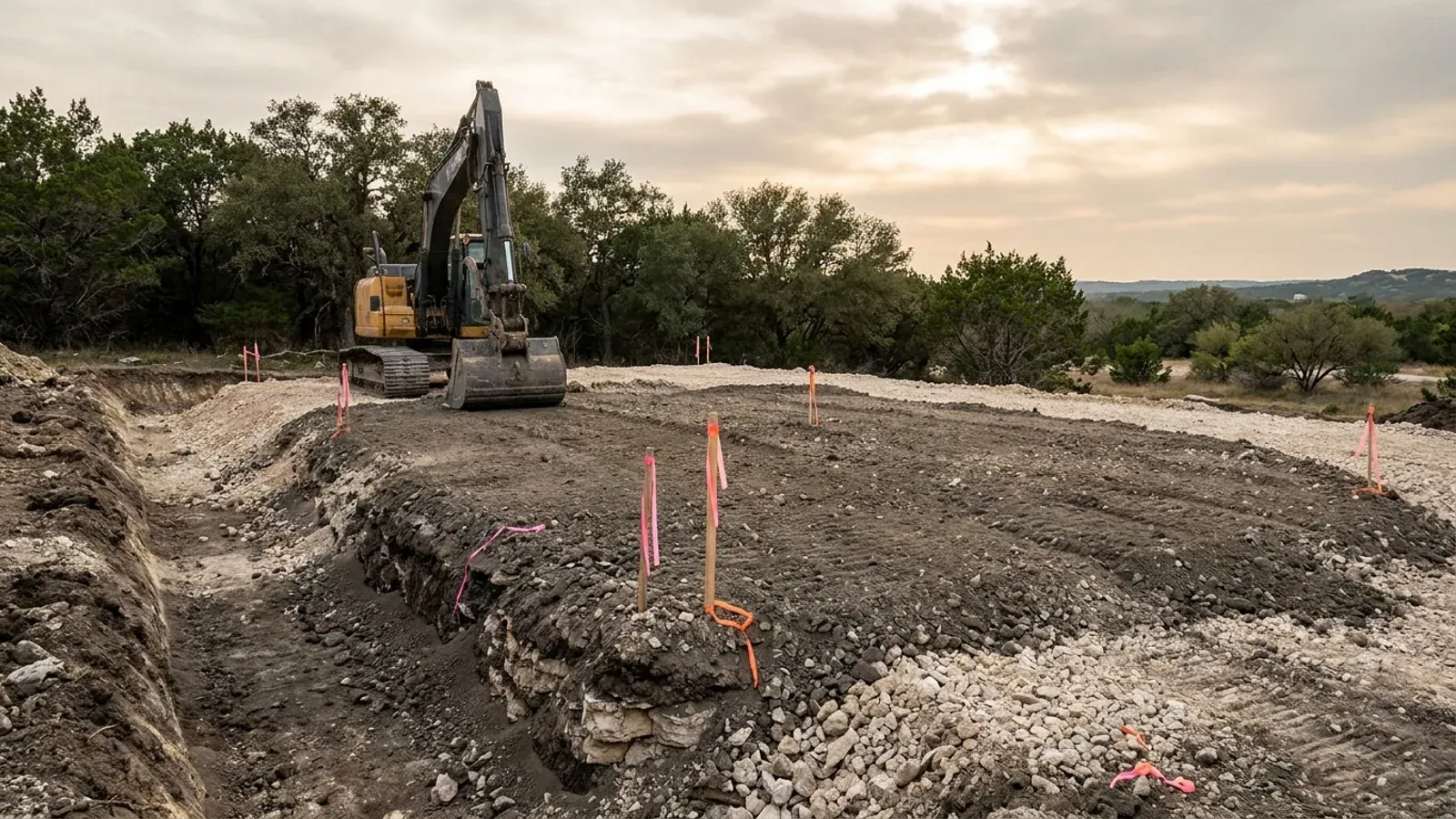
The expensive surprises are in the ground, not the building
What moves a Texas budget is usually below grade, and it is soil rather than rock: shrink-swell clay. The Blackland Prairie and the Gulf Coast clays move enough between a wet season and a dry one to drive the foundation design across the state's largest markets, which is why several DFW cities require an engineer's seal on the foundation of every new house. Those are the same conditions that decide whether a septic field passes its soil and site evaluation, so the grading plan, the foundation and the drainfield get resolved together rather than one at a time. We price the dirt before we price the building.
What we build in Parker County
All nine of our services — kits, custom plans, post-frame and steel construction, site preparation, permitting and engineering, through to turnkey builds — are available across Parker County. What a project costs depends far more on the parcel than on square footage, so we work from your land rather than from a rate card.
See what we buildWhat a build looks like
Three stages every Parker County project passes through, from a raw parcel to a finished home. Site work first, because that is where the budget is decided.
The parcel
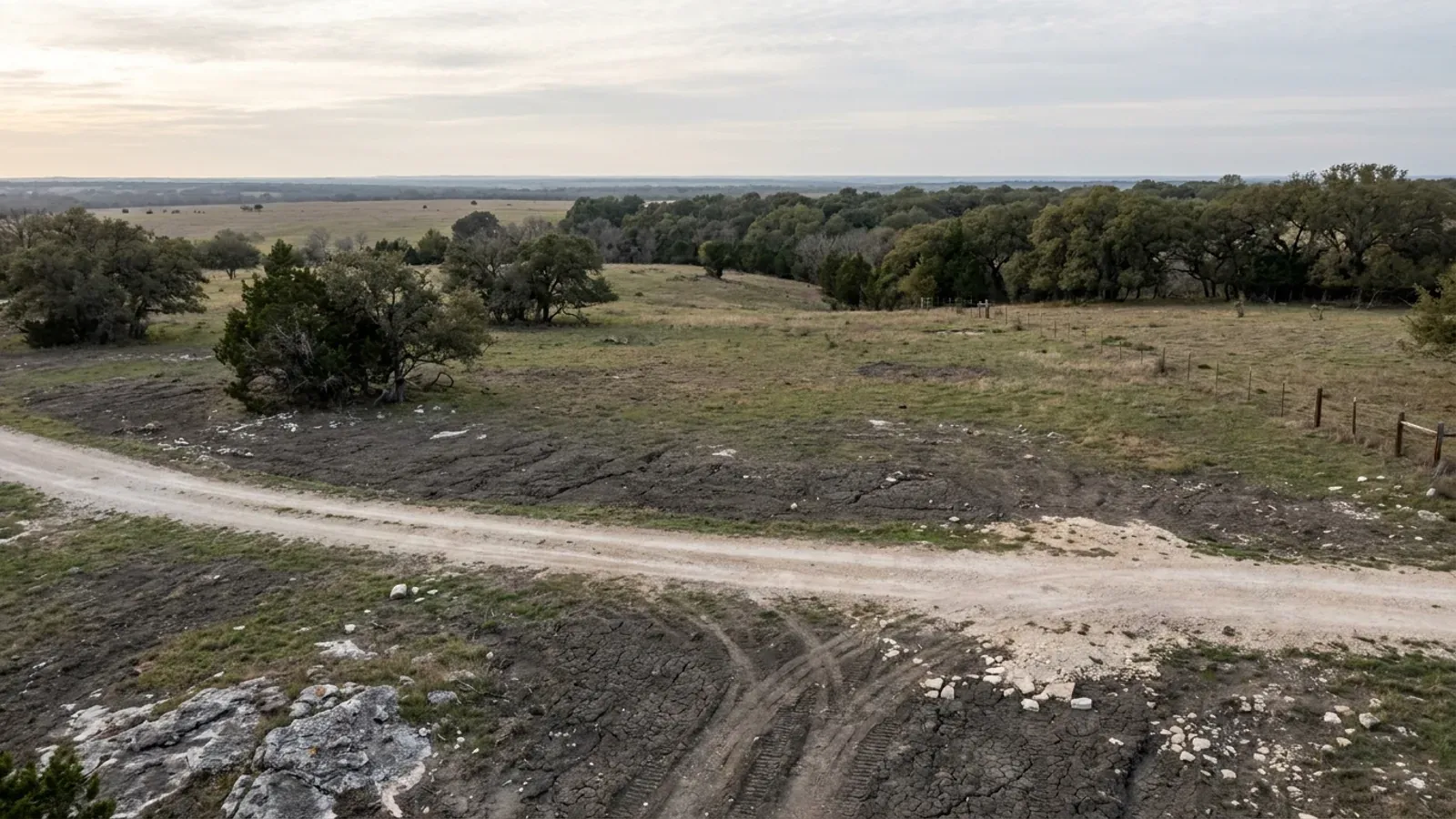
Zoning, setbacks, flood zone and utility access get checked before anything is drawn.
Pad and permit
Clearing, grading and a compacted pad, while the submittal works through Parker County.
Frame to finish
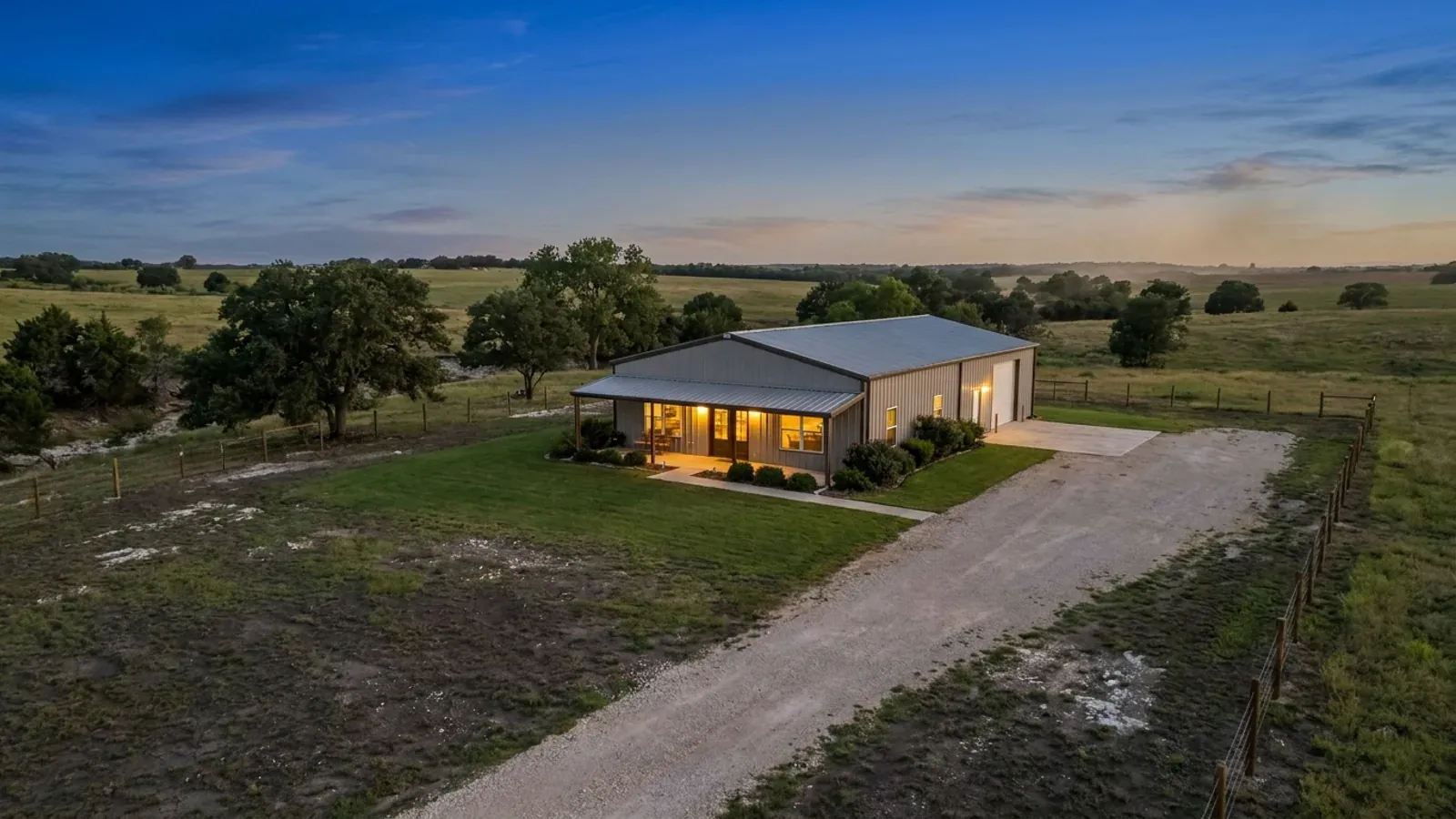
Shell erected and dried in, then systems, insulation and interior finish through to CO.
Those are the rules for Parker County. Tell us what you want to build and we will draw it to them.
Where we build around Parker County
Parker County and the rural land around it. The buildable acreage for a project this size usually sits outside the city limits, which is frequently what changes who issues your permit.
Keep reading
The questions that usually come next once you know what Parker County allows.
Barndominium Cost Guide
Sourced per-square-foot ranges by tier and by size, with a calculator built on the same figures.
Read itIs It Legal in Texas?
Classification, zoning, the HOA gate, and why "nonresidential farm building" does not cover a home.
Read itHow Long Does It Take?
Census build-duration data, and what actually sets the permit clock where you are building.
Read itNearby areas we build in
Others we cover in this part of Texas. The permitting authority, the adopted design criteria and the zoning can all differ from one to the next.
Building in Parker County: common questions
7 questions we get asked most often about building in Parker County. If yours is not on the list, ask it directly.
Do I need a building permit to build a barndominium in unincorporated Parker County?
So is there really nothing regulating a house out there?
What changes if my land is inside Weatherford, Aledo, Springtown or Willow Park?
Fort Worth's extraterritorial jurisdiction reaches into Parker County. Does that mean Fort Worth's code applies?
How does septic work here, and do I need a percolation test?
Is the soil out here the expansive clay everyone warns about in Dallas?
How much land do I actually need?
Building in Parker County?
Start with the plan. Tell us what you want to build and we will draw it, then confirm what Parker County will actually let you put on the parcel and what wind load it has to meet. That conversation costs nothing.