
Barndominium Builders in Fort Worth, TX
In Fort Worth the question "which code applies" has two answers. Ordinance 25383-03-2022 adopted the 2021 International Residential Code, effective 1 April 2022 — then the city cut that code's energy chapter down to a single pointer and aimed the pointer at the 2015 International Energy Conservation Code, adopted six years earlier by Ordinance 22520-12-2016. Framing, foundations and termite protection follow the 2021 book and climate zone 2A; insulation and envelope follow the 2015 book and climate zone 3A. Fort Worth is also the fastest-growing Texas city over a million, up 11.3% since 2020, and its zoning ordinance still keeps one-family districts at one acre and two and a half acres for what it calls rural-style development. A split code, real acreage inside the limits and a five-mile ETJ reaching into five counties make this a different build from Arlington's, twelve miles east.
Fort Worth at a glance
- County
- Tarrant County
- Population
- 1,028,117
- Where we build
- Fort Worth, Arlington, Parker County, Johnson County, Dallas
- Site visits
- We come to the land — Fort Worth and the rest of Tarrant County alike
ZIPs 76102, 76103, 76104, 76105, 76106, 76107, 76108, 76109 and more
Building conditions in Fort Worth
What actually changes from one Texas jurisdiction to the next: who issues the permit, whether the residential code is enforced there at all, what the structure has to be engineered to, and what the ground is like. These are the numbers your drawings have to satisfy.
City of Fort Worth Code of Ordinances ch. 7 art. IIIA §§ 7-61 and 7-62, read 1 September 2026 — https://codelibrary.amlegal.com/codes/ftworth/latest/ftworth_tx/0-0-0-8127
City of Fort Worth Code of Ordinances §§ 7-41 and 7-62, read 1 September 2026 — https://codelibrary.amlegal.com/codes/ftworth/latest/ftworth_tx/0-0-0-5698
City of Fort Worth Code of Ordinances § 7-62, IRC Table R301.2(1) as filled in, read 1 September 2026 — https://codelibrary.amlegal.com/codes/ftworth/latest/ftworth_tx/0-0-0-8127
City of Fort Worth Code of Ordinances § 7-62, IRC §§ R318.1 and R401.3 as amended and Figure R401.3 as added, read 1 September 2026 — https://codelibrary.amlegal.com/codes/ftworth/latest/ftworth_tx/0-0-0-8127
City of Fort Worth Code of Ordinances § 7-62, IRC §§ R401.2 and R403.1.1 as amended, read 1 September 2026 — https://codelibrary.amlegal.com/codes/ftworth/latest/ftworth_tx/0-0-0-8127
City of Fort Worth Building Administrative Code §§ 118.1, 118.2.1 and 118.3 (https://codelibrary.amlegal.com/codes/ftworth/latest/ftworth_tx/0-0-0-5697) and the city's Contractor Registration page (https://www.fortworthtexas.gov/departments/development-services/permits/contractor-registration), both read 1 September 2026
Also worth knowing before you build in Fort Worth
- The rest of the city's Table R301.2(1)
- Ground snow load 5 lb/ft². Frost line depth 6 inches. Seismic design category A. Weathering moderate. No wind-borne debris zone, no special wind region, no topographic effects. Air freezing index 150 and mean annual temperature 64.9 °F. Fort Worth also fills in the Manual J block Arlington deletes: elevation 686 feet, outdoor winter design 25 °F, outdoor summer design 99 °F.
- The blower-door test cannot be run by your builder
- Fort Worth's energy article requires every one- and two-family dwelling to be tested for air and duct leakage whatever compliance path it took, and adds that the tester must be certified, must be an independent third-party entity, and may not be employed by or hold any financial interest in the company that built the house. A trade-off table lets a house under 6,000 square feet with two to six bedrooms sit at four air changes per hour instead — but that table's first line specifies conventional wood framing.
- Five miles out, and into five counties
- The city puts it plainly: its extraterritorial jurisdiction is the unincorporated land within five miles of the city limits, and its Subdivision Ordinance applies out there. Fort Worth publishes interlocal agreements with five counties for that ring — Tarrant, Denton, Parker, Wise and Johnson. Platting reaches into all five. Building codes do not: Texas courts have held that a home-rule city lacks authority to enforce its building codes beyond its corporate limits, while confirming it can make a landowner plat.
- A big city that still zones for acreage
- Fort Worth's zoning ordinance keeps two large-lot one-family districts and describes both in its own words as being for rural-style development of a one-family dwelling on each lot: A-2.5A at a minimum lot size of two and one-half acres, and A-43 at one acre. The Agricultural (AG) district is not the same thing — a dwelling there has to be clearly incidental to the operation of a farm, ranch, orchard, truck garden or nursery, so AG acreage generally needs rezoning before it becomes a homesite.
- Water and wastewater impact fees
- On a standard 5/8-inch residential meter the city charges $2,824 in water impact fees and $2,680 in wastewater impact fees for a building permit issued between 1 October 2025 and 30 September 2026, rising to $2,990 and $2,838 for permits issued on or after 1 October 2026. Council adopted the schedule by Ordinance 27745-06-2025 on 10 June 2025. A tract on a private well and a septic system does not meet these at all.
- The fastest-growing million-person city in Texas
- 1,028,117 people as of 1 July 2025, up 11.3% from 923,653 in 2020. Of the four Texas cities over a million, the next fastest is San Antonio at 7.7%; Houston grew 4.3%, Austin 4.2% and Dallas 2.0%. Fort Worth's growth is going somewhere, and on the western and northern edges it is going onto land.
City of Fort Worth Code of Ordinances § 7-62, IRC Table R301.2(1) and the Manual J design criteria table as filled in, read 1 September 2026 — https://codelibrary.amlegal.com/codes/ftworth/latest/ftworth_tx/0-0-0-8127
City of Fort Worth Code of Ordinances § 7-42, IECC §§ R102.1.2, R402.4.1.2 and R403.3.3 as amended and Table R402.4.1.2 as added, read 1 September 2026 — https://codelibrary.amlegal.com/codes/ftworth/latest/ftworth_tx/0-0-0-5698
City of Fort Worth Extraterritorial Jurisdiction page, read 1 September 2026 (https://www.fortworthtexas.gov/departments/development-services/etj); Collin County v. City of McKinney, No. 05-17-00546-CV (Tex. App.—Dallas, 10 May 2018); Town of Lakewood Village v. Bizios, 493 S.W.3d 527 (Tex. 2016)
City of Fort Worth Zoning Ordinance (Code of Ordinances Appendix A) §§ 4.700, 4.701 and 4.200, read 1 September 2026 — https://codelibrary.amlegal.com/codes/ftworth/latest/ftworth_tx/0-0-0-34935 and https://codelibrary.amlegal.com/codes/ftworth/latest/ftworth_tx/0-0-0-33459
City of Fort Worth, Current Impact Fees, read 1 September 2026 — https://www.fortworthtexas.gov/impact-fees/water-impact-fees/current-fees
U.S. Census Bureau, Vintage 2025 sub-county population estimates, sub-est2025.csv — https://www2.census.gov/programs-surveys/popest/datasets/2020-2025/cities/totals/sub-est2025.csv
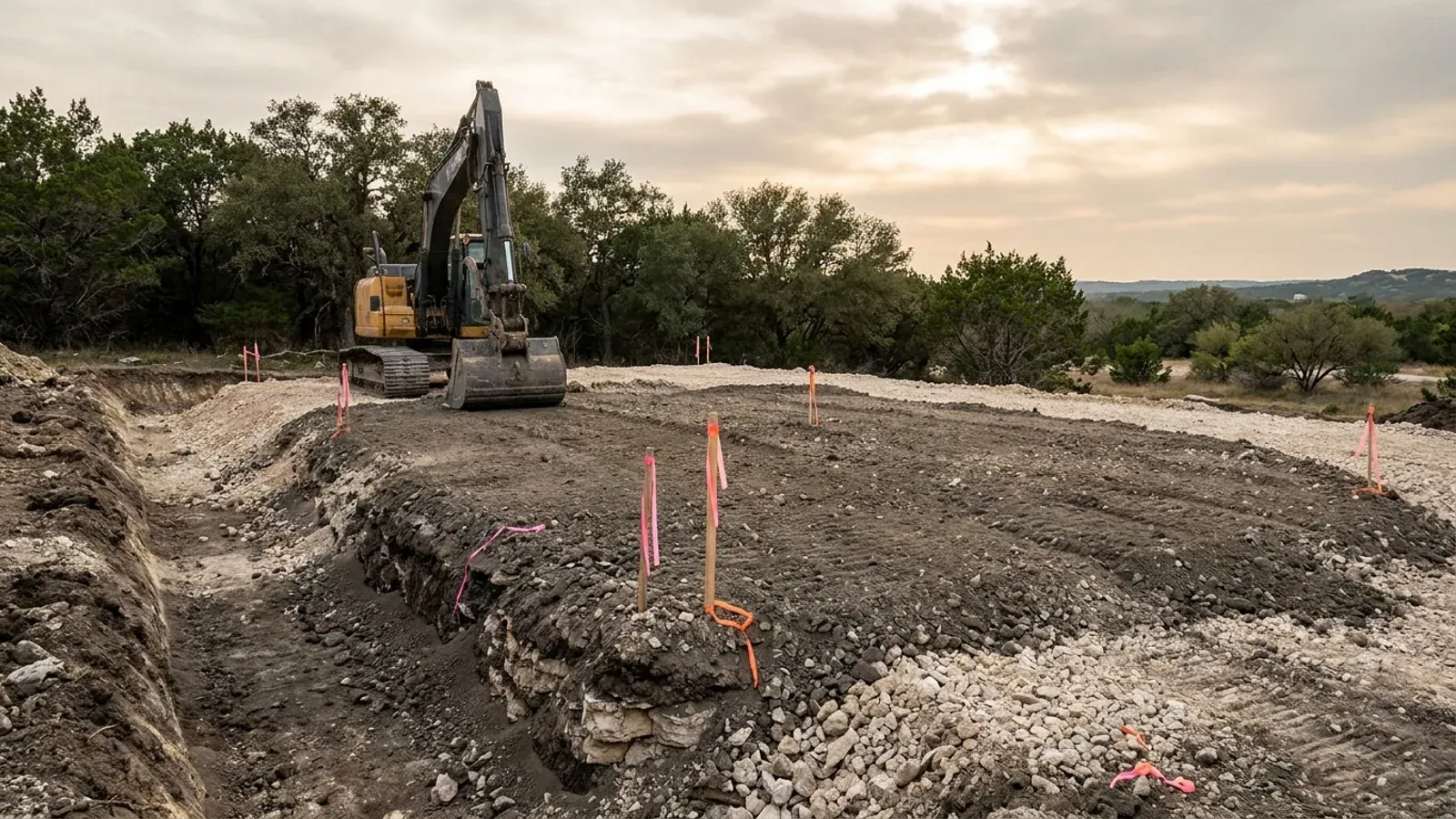
The expensive surprises are in the ground, not the building
What moves a Texas budget is usually below grade, and it is soil rather than rock: shrink-swell clay. The Blackland Prairie and the Gulf Coast clays move enough between a wet season and a dry one to drive the foundation design across the state's largest markets, which is why several DFW cities require an engineer's seal on the foundation of every new house. Those are the same conditions that decide whether a septic field passes its soil and site evaluation, so the grading plan, the foundation and the drainfield get resolved together rather than one at a time. We price the dirt before we price the building.
What we build in Fort Worth
All nine of our services — kits, custom plans, post-frame and steel construction, site preparation, permitting and engineering, through to turnkey builds — are available across Tarrant County. What a project costs depends far more on the parcel than on square footage, so we work from your land rather than from a rate card.
See what we buildWhat a build looks like
Three stages every Fort Worth project passes through, from a raw parcel to a finished home. Site work first, because that is where the budget is decided.
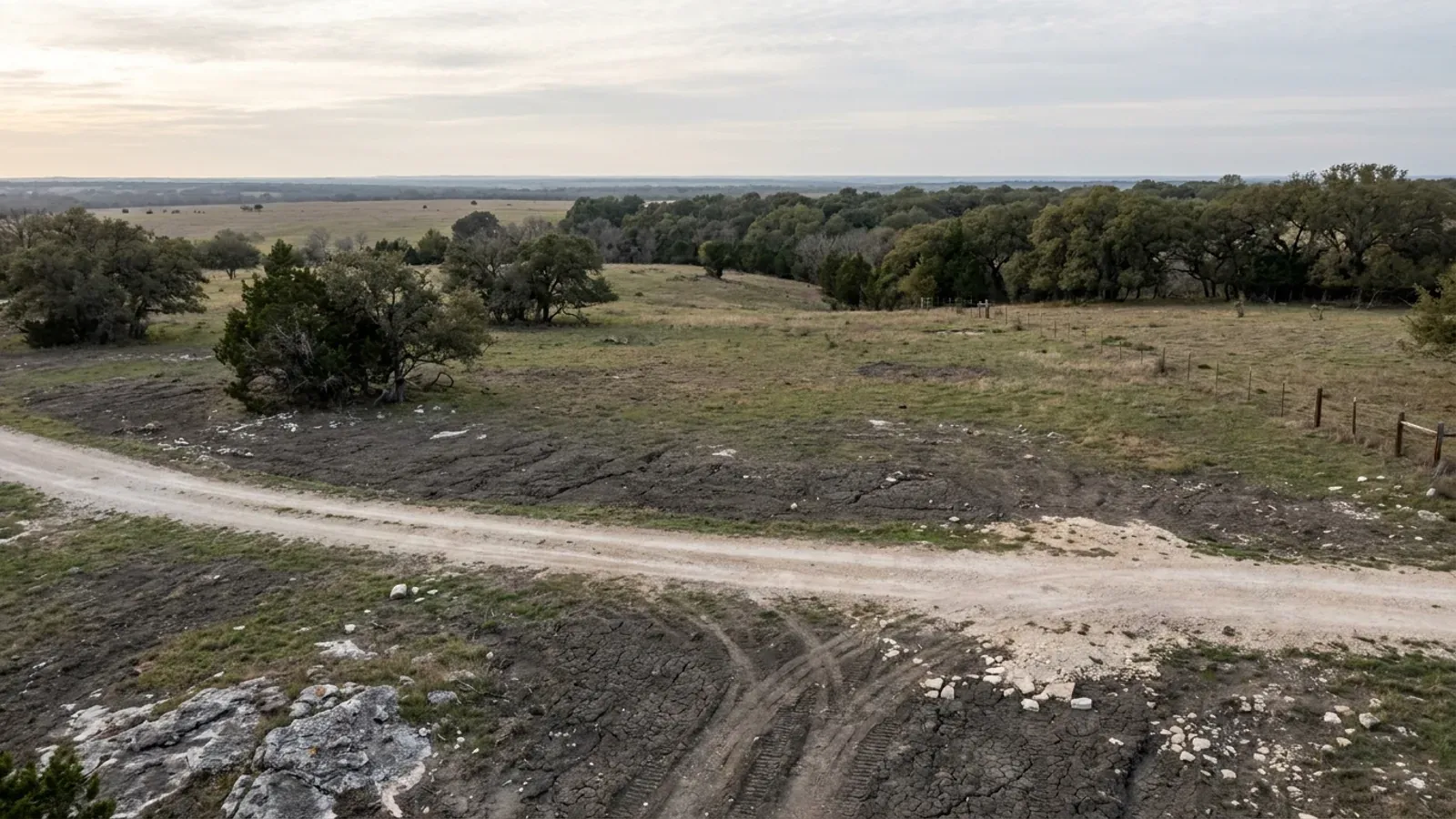
The parcel
Zoning, setbacks, flood zone and utility access get checked before anything is drawn.
Pad and permit
Clearing, grading and a compacted pad, while the submittal works through Tarrant County.
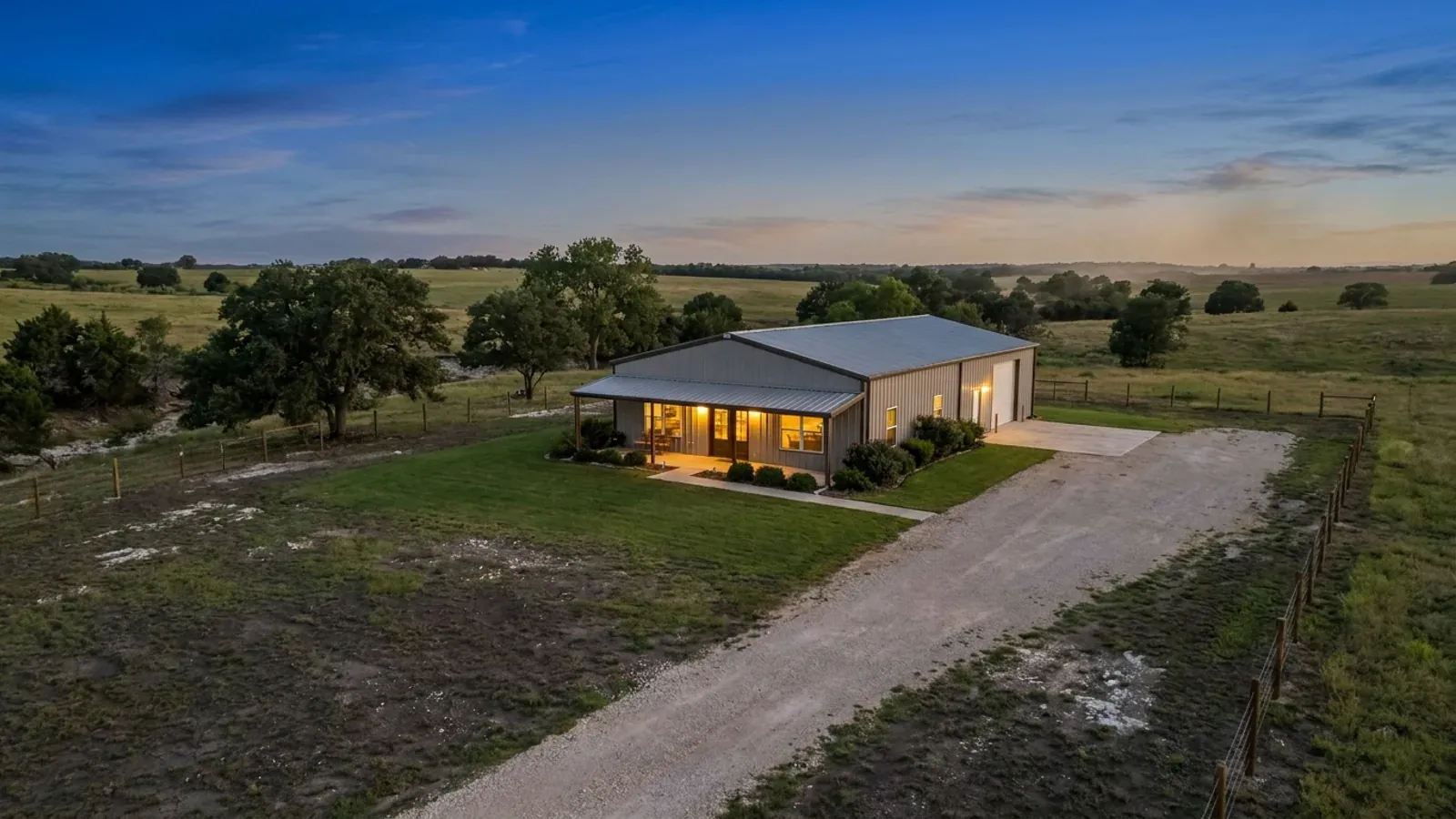
Frame to finish
Shell erected and dried in, then systems, insulation and interior finish through to CO.
Those are the rules for Tarrant County. Tell us what you want to build and we will draw it to them.
Where we build around Fort Worth
Tarrant County and the rural land around it. The buildable acreage for a project this size usually sits outside the city limits, which is frequently what changes who issues your permit.
Keep reading
The questions that usually come next once you know what Fort Worth allows.
Barndominium Cost Guide
Sourced per-square-foot ranges by tier and by size, with a calculator built on the same figures.
Read itIs It Legal in Texas?
Classification, zoning, the HOA gate, and why "nonresidential farm building" does not cover a home.
Read itHow Long Does It Take?
Census build-duration data, and what actually sets the permit clock where you are building.
Read itNearby areas we build in
Others we cover in this part of Texas. The permitting authority, the adopted design criteria and the zoning can all differ from one to the next.
Building in Fort Worth: common questions
8 questions we get asked most often about building in Fort Worth. If yours is not on the list, ask it directly.
Which building code applies to a barndominium in Fort Worth?
Is Fort Worth climate zone 2A or 3A?
Do I need an engineer for the foundation?
Does Fort Worth require chemical termite treatment?
I am buying land in Fort Worth's ETJ. Whose rules apply?
Does a builder need a licence in Fort Worth?
Is there anywhere in Fort Worth you can actually build a barndominium on land?
Who tests the house at the end, and what will it be tested against?
Building in Fort Worth?
Start with the plan. Tell us what you want to build and we will draw it, then confirm what Tarrant County will actually let you put on the parcel and what wind load it has to meet. That conversation costs nothing.