Barndominium Builders in Taylor County, TX
Taylor County is the anchor of the Big Country and the thinnest county on this site. Abilene holds 125,818 of its 150,077 people on about an eighth of its land, and 18,334 people live outside every city limit, spread over roughly 797 square miles. That is around 23 people to the square mile of unincorporated ground, thinner than any other county page here. The county has never adopted a residential building code, and its Commissioners Court is on record declining to adopt one: on 1 September 2009, the day House Bill 2833 took effect, the court heard the local homebuilders association ask it to require inspections and decided to take no action. What actually gates a build here is the septic authorisation, a flood plain development permit where the tract sits in a mapped hazard area, the plat, and, inside an existing platted subdivision, a county rule that a new house be substantially similar to the ones already standing in it.
Taylor County at a glance
- County
- Taylor County
- Population
- 150,077
- Where we build
- Abilene, Tom Green County
- Site visits
- On-site visits across Taylor County, Abilene and the land beyond it
ZIPs 79601, 79602, 79603, 79605, 79606, 79607, 79508, 79530 and more
Building conditions in Taylor County
What actually changes from one Texas jurisdiction to the next: who issues the permit, whether the residential code is enforced there at all, what the structure has to be engineered to, and what the ground is like. These are the numbers your drawings have to satisfy.
Taylor County Commissioners Court minutes, 1 September 2009, item 13, published by the County Clerk at taylorcountytexas.org and preserved in the Internet Archive; Local Government Code ch. 233 subch. F, added by Acts 2009, 81st Leg., ch. 1318 (H.B. 2833)
Taylor County Development Procedures and Regulations, revised 10 March 2026, Article XVI sec. 16.03, page 35 — https://www.taylorcounty.texas.gov/DocumentCenter/View/5033
Taylor County Development Procedures and Regulations, revised 10 March 2026, Article XIV secs. 14.1 and 14.2, pages 25 to 28 — https://www.taylorcounty.texas.gov/DocumentCenter/View/5033; Local Government Code sec. 232.007
Order Adopting Rules of Taylor County, Texas for On-Site Sewage Facilities, adopted 13 October 1998 and approved by the TNRCC 6 November 1998, secs. 8, 9 and 10(a), from the TCEQ authorized agent register; Taylor County Environmental Department — https://www.taylorcounty.texas.gov/142/Environmental-Department
Taylor County Development Procedures and Regulations, revised 10 March 2026, sec. 6.03(4) page 12, Article VIII opening paragraph page 19, and sec. 9.03 page 20 — https://www.taylorcounty.texas.gov/DocumentCenter/View/5033
Local Government Code secs. 241.013, 241.014, 241.901, 241.902, 42.021(a)(5), 42.101(1) and 42.151(1); Taylor County Development Procedures and Regulations sec. 2.04, page 7; City of Abilene Land Development Code sec. 2.3.5.1, Ord. No. 8-2010 as amended by Ord. No. 61-2024
Also worth knowing before you build in Taylor County
- No groundwater conservation district covers Taylor County, and the state says so in writing
- Much of West Texas sits inside a groundwater conservation district with well spacing rules and production limits. Taylor County does not. The Texas Commission on Environmental Quality's January 2025 report to the 89th Legislature says it evaluated the 78 counties in Texas that are not part of a confirmed groundwater conservation district nor within the boundaries of a priority groundwater management area, and it names Taylor among seven of those counties where pumping from at least one aquifer exceeds that aquifer's availability, adding that most groundwater use in them is agricultural while municipal water is nearly all surface water. So there is no district permit, no district spacing rule and no district registration for a well on a rural tract here. A domestic well is still registered rather than permitted, and the driller still holds a state licence.
- Caliche on the divides, a genuine shrink-swell clay in the flats
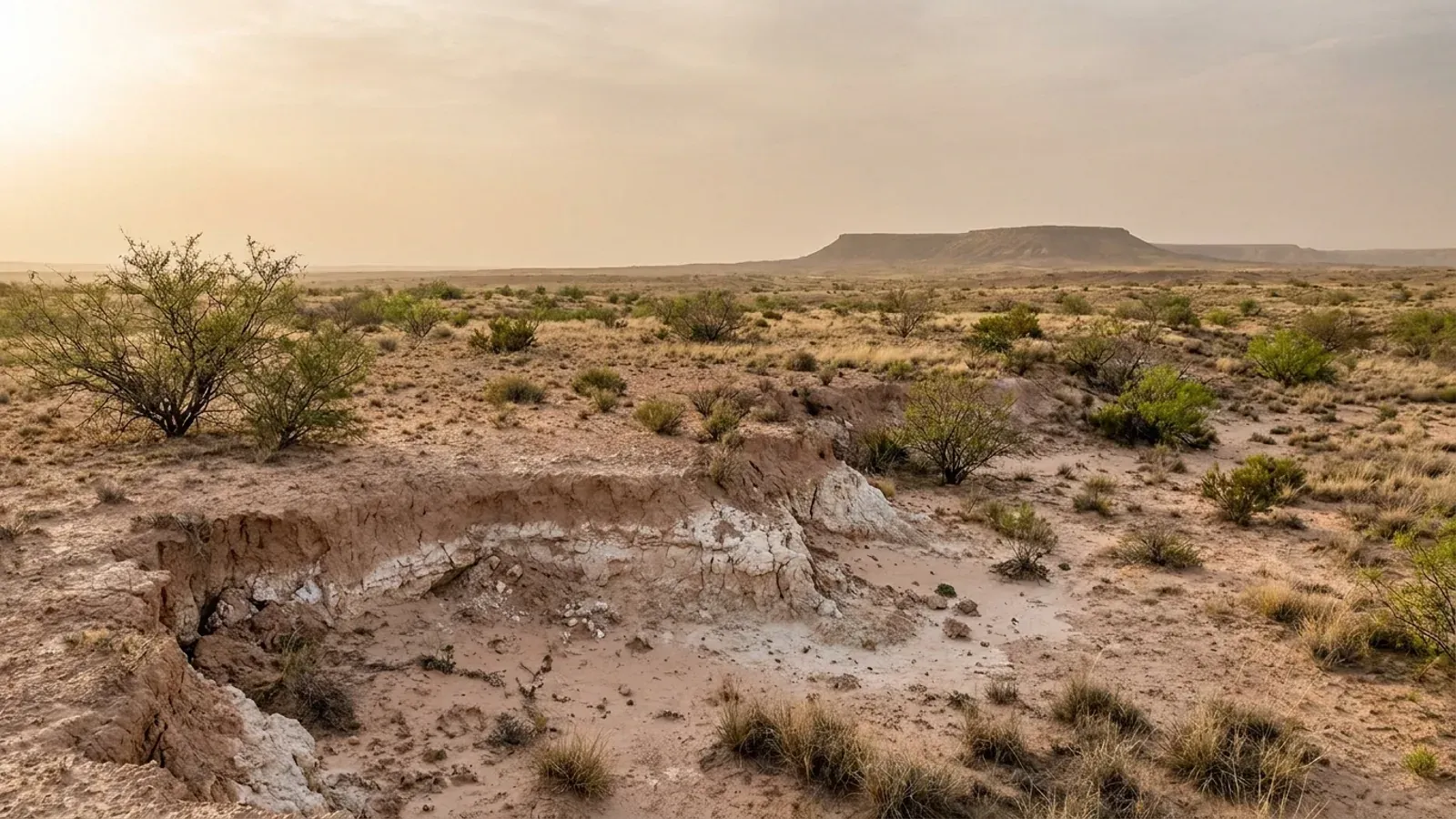
- The soil survey splits this county into two very different excavation problems. About 37,400 acres carry soils whose taxonomy names a petrocalcic horizon, a cemented caliche pan, and the survey puts the top of that pan at about 8 inches in Pitzer, 17 inches in Kavett and 18 inches in Mereta, while Oplin hits limestone bedrock at about 12 inches. Good bearing, hard digging, and a real line in a trenching quote. In the flats the opposite problem shows up: Tobosa is a true Vertisol covering nearly 28,000 acres, with about 50 percent clay and a linear extensibility of 17, and counting the vertic intergrades Tillman, Rowena and Mangum alongside it, roughly 99,000 acres, about 17 percent of the county, is shrink-swell ground. These are Rolling Plains and Edwards Plateau margin soils, not Blackland prairie, and which one a tract has decides the foundation conversation.
- Only about 23 people per square mile live outside the city limits
- This is a genuinely rural county with one large city in it. The Census Bureau publishes the split directly: of Taylor County's 150,077 people in 2025, the City of Abilene's Taylor County portion holds 125,818, seven small towns hold 5,925 between them, and the balance of the county, meaning everyone outside every city limit, is 18,334. The county covers 915.5 square miles of land and no more than about 119 of those are inside a city, so the unincorporated part is at least 797 square miles and works out at roughly 23 people to the square mile. For comparison, this site's other county pages run from about 43 in McLennan up past 590 in Montgomery. Land is not the constraint here.
- The mineral estate is dominant, and 648 wells are on record
- In Texas the mineral estate is the dominant estate, and where the minerals have been severed the mineral owner and lessee have the right to use as much of the surface as is reasonably necessary. The Supreme Court of Texas made the limits of the surface owner's protection plain in Merriman v. XTO Energy, No. 11-0494 (2013): Merriman had a house and a barn on his 40 acres and still lost, and the accommodation doctrine protects an existing use, so a house that has not been built yet is not protected by it at all. The scale here is moderate rather than Permian: the Railroad Commission's February 2025 well counts give Taylor County 640 oil wells, 339 of them regular producing, and 8 gas wells. Whether the minerals under a particular tract were severed is a title question, answered by the County Clerk's records and the title commitment, not by anything on a plat.
- The county has no fire marshal, and no power to adopt a fire code either
- Two separate statutes give Texas counties fire authority and neither produces anything here. Local Government Code sec. 233.061(a) lets a county adopt a fire code only if it has a population over 250,000 or is next to one that does; Taylor County is 150,077 and its neighbours are Jones at 20,861, Callahan at 14,491 and Nolan at 14,117, so it has no such power. Sec. 352.016 has no population bracket at all and would let a county fire marshal review the plans of a single-family residence, but Taylor County's own directory of government offices lists no fire marshal. Emergency Management and Environmental Enforcement is the nearest office. Some Texas counties do publish a building permit fee schedule under their fire authority, and readers who find one elsewhere should know sec. 233.062(a) caps it at commercial buildings, public buildings and multifamily of four units or more, so it cannot reach a house.
- The county septic office also runs Abilene's programme, including the part in Jones County
- The state's authorised agent register returns three records for Taylor County. The Taylor County Authorized Agent covers the entire county except the City of Tye and the Town of Impact. A second record, in the City of Abilene's name, is marked as administered by Taylor County and expressly includes city limits in Jones County. The third is the state's own Abilene regional office. Both the county and city records give the same office, the same director and the same telephone number, so one county department handles septic authorisations for the unincorporated county, for the City of Abilene, and for the slice of Abilene that lies over the county line. Anyone building inside Tye or Impact should ask who authorises there before assuming, because neither appears as an agent in its own right and the county's stated area excludes them.
- A plat is not always required, and over ten acres is one reason why
- The county's platting rules bite when a tract outside a city is divided into two or more parts, but the exemptions are wide and they matter to anyone buying acreage. The county may not require a plat where the land is used primarily for agricultural, farm, ranch, wildlife management or timber production use, and the regulation warns that if the tract ceases to be used that way the platting requirements apply. It also may not require one where all of the lots of the subdivision are more than ten acres in area, where the parts are four or fewer and go to relatives within the third degree, or where the lots are sold to veterans through the Veterans Land Board programme. Buying a single existing tract and building one house on it is not a subdivision at all.
- A groundwater certification can be required before a plat is approved
- Where a proposed subdivision is to be served by groundwater rather than a public water supply, the county requires the owner to submit a certification that adequate groundwater is available for the subdivision, prepared by a licensed professional engineer or another professional designated by state law and registered in Texas, on the form and content promulgated by the state environmental agency. The regulation says lack of that certification is grounds for denial of plat approval. Three exceptions are published: conveyance of a parcel to an adjoining property owner not for resale; subdivisions of not more than five lots where all lots are at least two acres in size; and a revised plat that does not exceed the original number of lots by more than twenty per cent. That two-acre, five-lot exception is the one that catches most family land divisions.
- Climate zone 3B, and the energy code still applies where the building code does not
- Taylor County is in climate zone 3B, hot-dry, and it is one of the counties whose assignment is the same on the older map and on the 2021 and 2024 maps, so the answer does not change with the edition the way it does in a handful of Texas counties. That matters more here than it looks, because the state energy code is the one construction standard that does reach unincorporated Texas where no county building code applies: Health and Safety Code sec. 388.003 puts single-family residential construction on the energy chapter of the International Residential Code, and hot-dry is a different insulation and duct answer from the hot-humid zones that cover most of the state's population.
- Every subdivision here has to file its restrictions, and they can set a minimum house size
- Because a Texas county cannot zone, the rules that most often decide what a barndominium may look like are private, recorded and enforced by neighbours. Taylor County's regulations make that explicit: each subdivision must have an approved list of restrictions, if any, to include minimum size homes, minimum lot size, whether mobile homes are allowed or not, and who is to enforce the restriction, and the Commissioners Court must be given a copy in the supporting documents. The county separately states that it has no authority over deed restrictions or homeowner association rules, so it will not enforce them and it will not waive them. Read the recorded restrictions on any platted lot before committing to a design.
- The county issues no certificate of occupancy, and that is not the same as having no rules
- Taylor County publishes three plain statements about the limits of its own authority on its development page: it does not issue certificates of occupancy, it does not have the authority to implement or enforce zoning, and it does not have authority over deed restrictions and homeowner association rules. All three are accurate. None of them means a rural build here is unregulated. The septic authorisation is a real permit with a real inspection. The flood plain development permit is a real gate on a mapped tract. The plat, the driveway culvert permit and the right-of-way permit are all county approvals. And inside a platted subdivision the similarity rule and the recorded restrictions both apply. The difference is that nobody from the county checks the framing.
TCEQ, SFR-53/24, Priority Groundwater Management Areas and Groundwater Conservation Districts: Report to the 89th Texas Legislature, January 2025, pages 10 and 11 — https://www.tceq.texas.gov/downloads/groundwater/publications/sfr-53-24-pgma-gcd-report-89th-legislature.pdf
USDA NRCS Soil Survey Geographic Database, survey area TX441, component, corestrictions and chorizon tables queried 1 September 2026 via sdmdataaccess.sc.egov.usda.gov
U.S. Census Bureau Vintage 2025 population estimates, sub-est2025.csv rows for county 48441 including Balance of Taylor County, and co-est2025-alldata.csv; 2025 Census Gazetteer county and place land areas
Merriman v. XTO Energy, Inc., No. 11-0494 (Tex. 2013); Railroad Commission of Texas, Oil Well Counts by County and Gas Well Counts by County as of February 2025 — https://www.rrc.texas.gov/oil-and-gas/research-and-statistics/well-information/well-distribution-by-county/
Local Government Code secs. 233.061, 233.062 and 352.016; Taylor County Government Offices directory — https://www.taylorcounty.texas.gov/31/Government-Offices; U.S. Census Bureau Vintage 2025 county population estimates
TCEQ On-Site Sewage Facility Authorized Agent register, county code 221, retrieved 1 September 2026 — https://www.tceq.texas.gov/permitting/ossf/aa_search.html
Taylor County Development Procedures and Regulations, revised 10 March 2026, sec. 2.02 and the Exemptions to Platting Requirements, pages 6 and 7 — https://www.taylorcounty.texas.gov/DocumentCenter/View/5033
Taylor County Development Procedures and Regulations, revised 10 March 2026, sec. 10.02 and Exhibit G, page 21 — https://www.taylorcounty.texas.gov/DocumentCenter/View/5033
DOE/PNNL-33270 climate zone assignments cross-checked against the published IRC county tables, as compiled in the project build-conditions appendix; Health and Safety Code sec. 388.003
Taylor County Development Procedures and Regulations, revised 10 March 2026, sec. 16.04, page 35; Taylor County Development and Permitting — https://www.taylorcounty.texas.gov/723/Development-Permitting
Taylor County Development and Permitting page — https://www.taylorcounty.texas.gov/723/Development-Permitting; Taylor County Development Procedures and Regulations, revised 10 March 2026
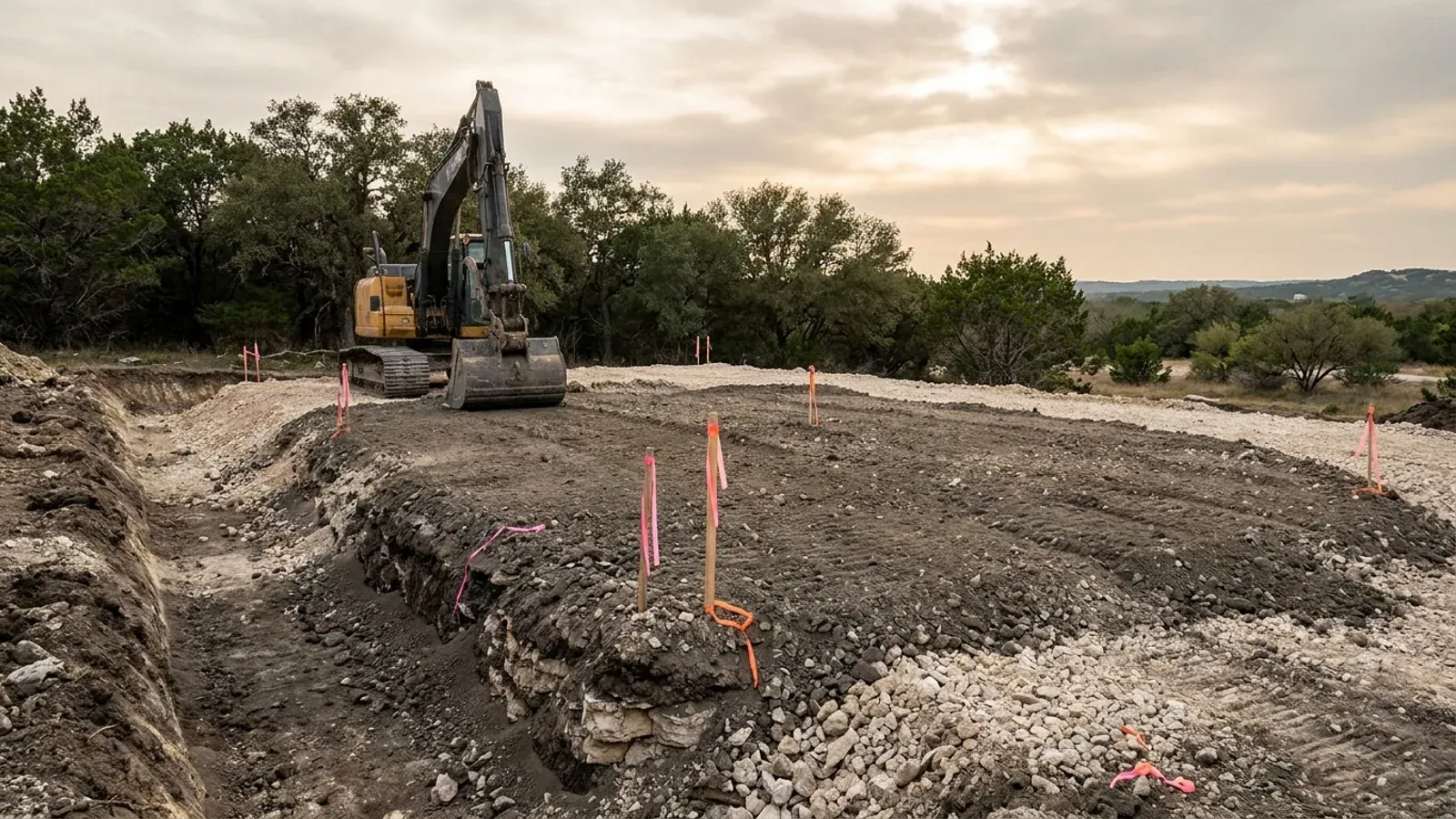
The expensive surprises are in the ground, not the building
What moves a Texas budget is usually below grade, and it is soil rather than rock: shrink-swell clay. The Blackland Prairie and the Gulf Coast clays move enough between a wet season and a dry one to drive the foundation design across the state's largest markets, which is why several DFW cities require an engineer's seal on the foundation of every new house. Those are the same conditions that decide whether a septic field passes its soil and site evaluation, so the grading plan, the foundation and the drainfield get resolved together rather than one at a time. We price the dirt before we price the building.
What we build in Taylor County
All nine of our services — kits, custom plans, post-frame and steel construction, site preparation, permitting and engineering, through to turnkey builds — are available across Taylor County. What a project costs depends far more on the parcel than on square footage, so we work from your land rather than from a rate card.
See what we buildWhat a build looks like
Three stages every Taylor County project passes through, from a raw parcel to a finished home. Site work first, because that is where the budget is decided.
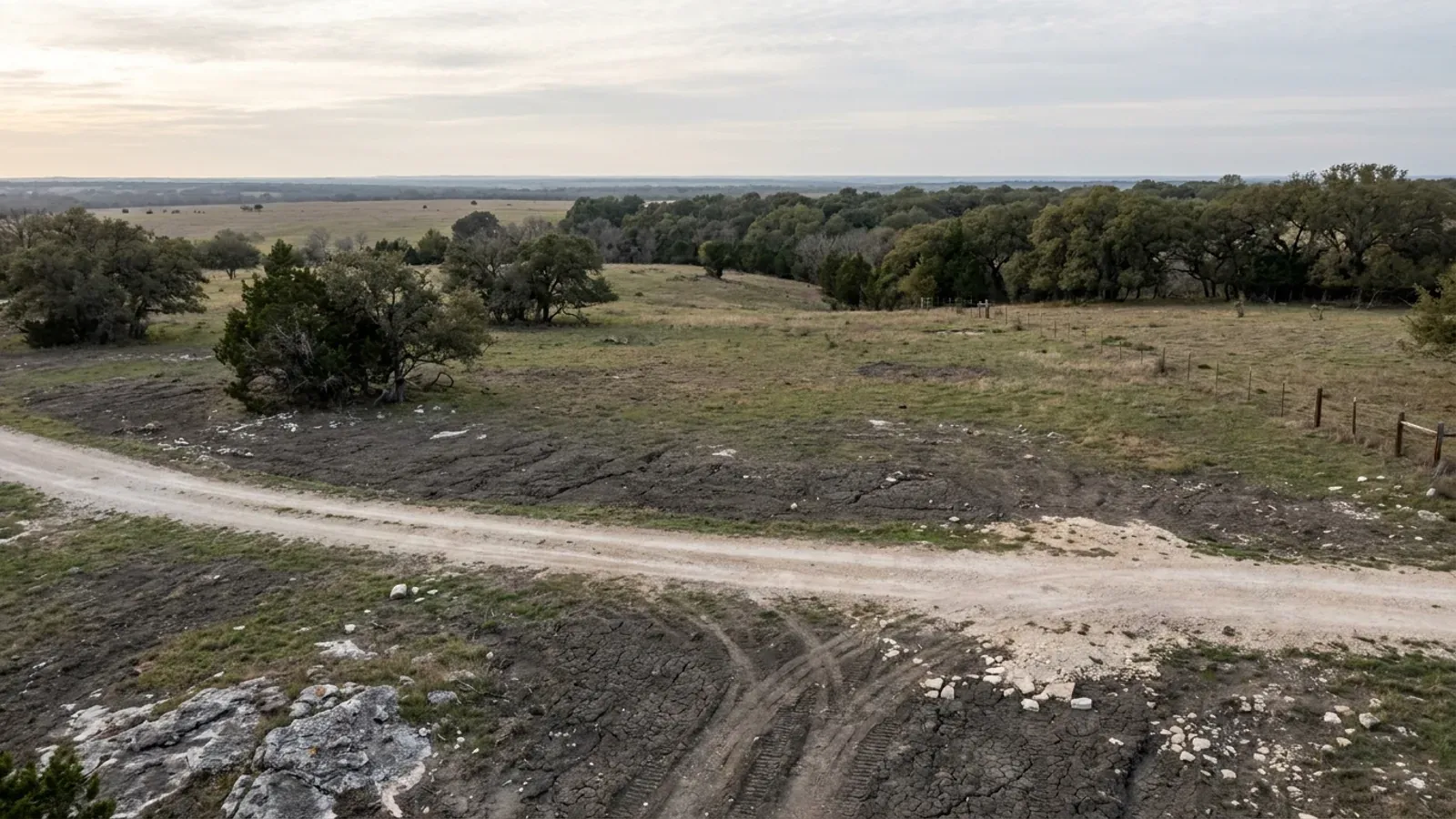
The parcel
Zoning, setbacks, flood zone and utility access get checked before anything is drawn.
Pad and permit
Clearing, grading and a compacted pad, while the submittal works through Taylor County.
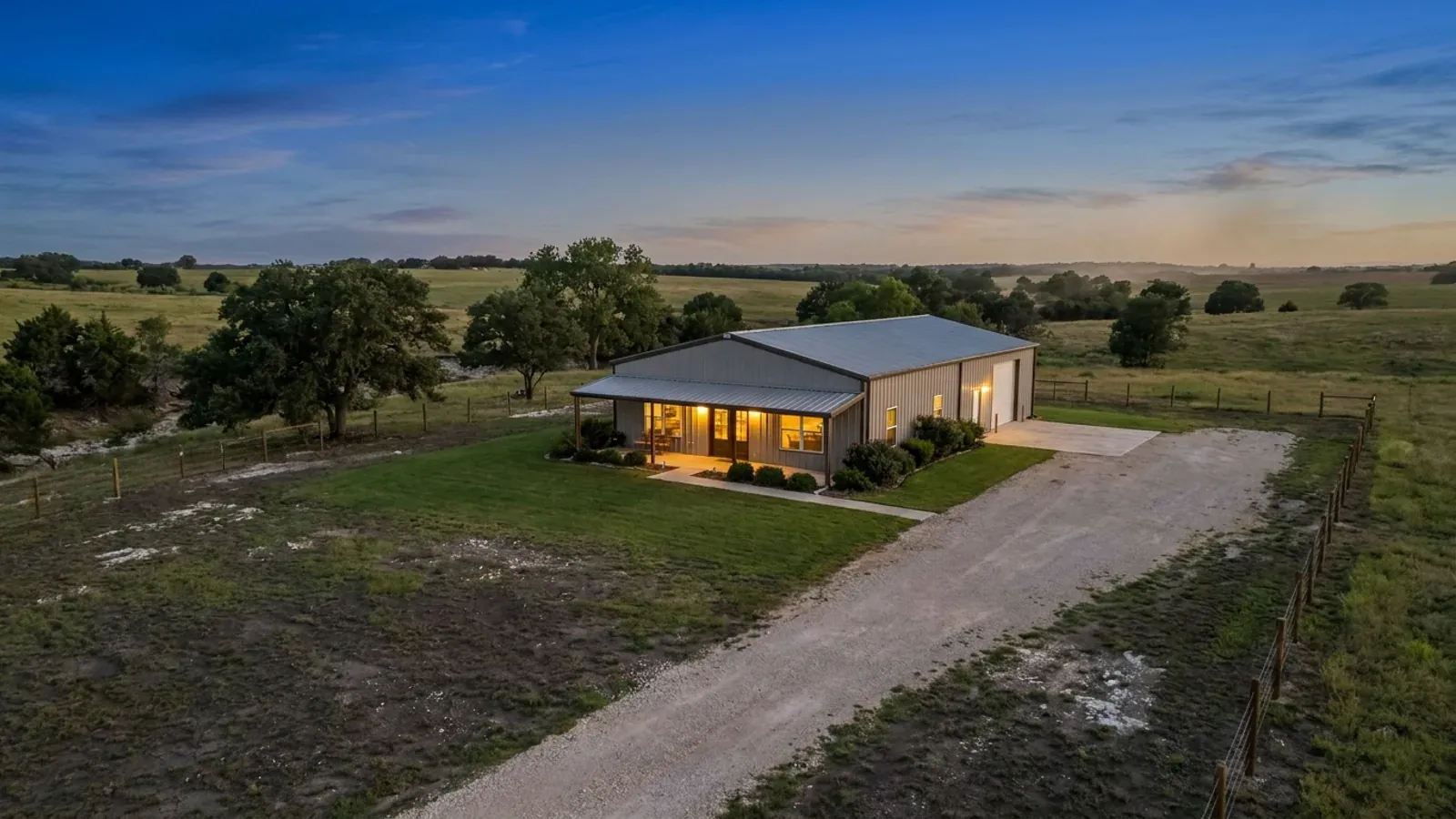
Frame to finish
Shell erected and dried in, then systems, insulation and interior finish through to CO.
Those are the rules for Taylor County. Tell us what you want to build and we will draw it to them.
Where we build around Taylor County
Taylor County and the rural land around it. The buildable acreage for a project this size usually sits outside the city limits, which is frequently what changes who issues your permit.
Keep reading
The questions that usually come next once you know what Taylor County allows.
Barndominium Cost Guide
Sourced per-square-foot ranges by tier and by size, with a calculator built on the same figures.
Read itIs It Legal in Texas?
Classification, zoning, the HOA gate, and why "nonresidential farm building" does not cover a home.
Read itHow Long Does It Take?
Census build-duration data, and what actually sets the permit clock where you are building.
Read itNearby areas we build in
Others we cover in this part of Texas. The permitting authority, the adopted design criteria and the zoning can all differ from one to the next.
Building in Taylor County: common questions
12 questions we get asked most often about building in Taylor County. If yours is not on the list, ask it directly.
Does Taylor County require a building permit for a barndominium?
How do you know the county never adopted the residential code option?
Is there anything stopping me building a metal barndominium in Taylor County?
I want to build three units and rent them out. Does that change anything?
How high does the finished floor have to be if the land floods?
Is a septic permit really needed even on a big tract?
Does the shop bay count when the septic system is sized?
Do I need a groundwater district permit for a well?
Dyess Air Force Base is here. Does the military regulate what I build?
What is the ground like to build on out here?
Who owns the minerals under the land, and can that affect where the house goes?
Does a Taylor County address always mean county rules apply?
Building in Taylor County?
Start with the plan. Tell us what you want to build and we will draw it, then confirm what Taylor County will actually let you put on the parcel and what wind load it has to meet. That conversation costs nothing.