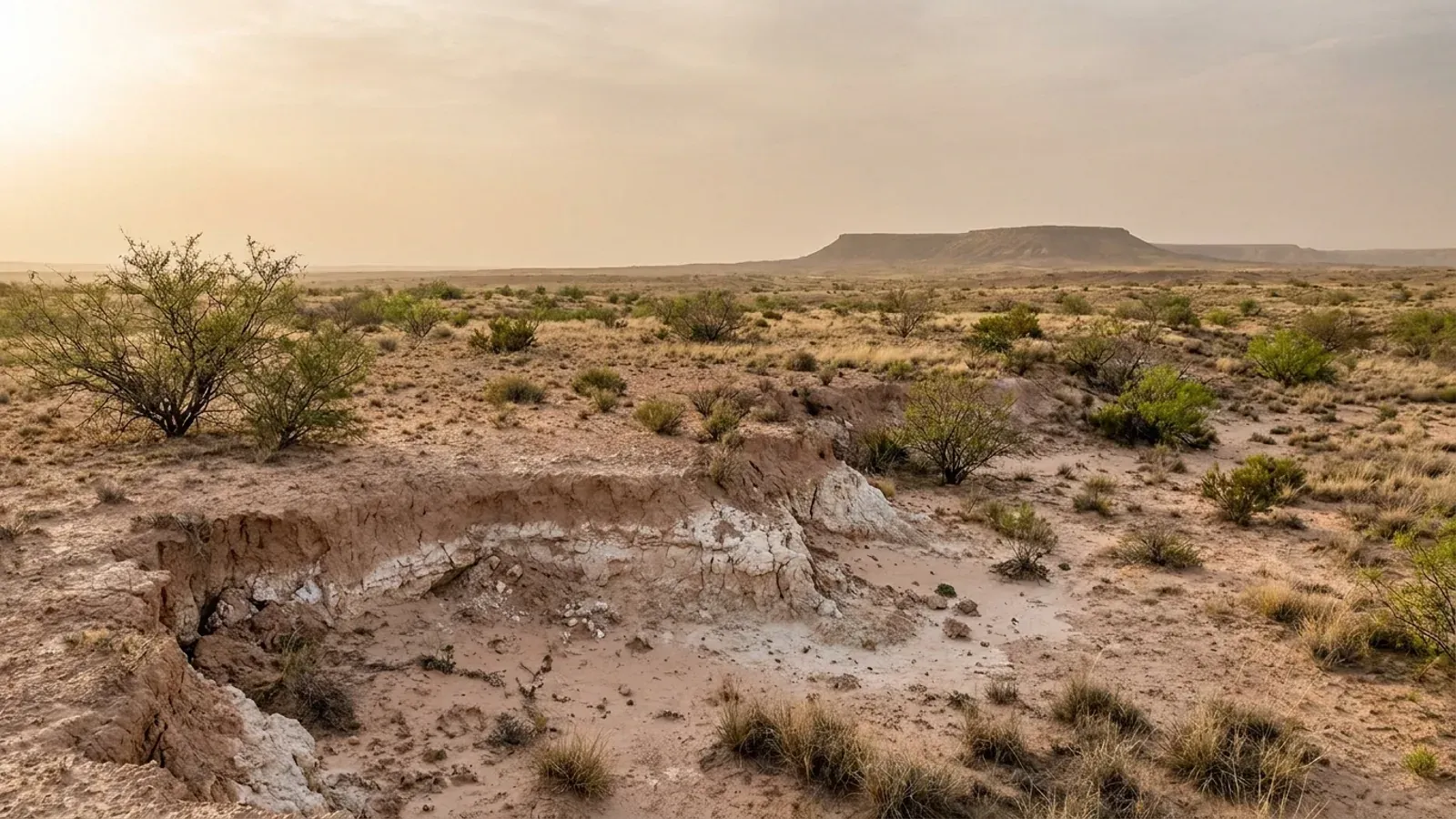
Open semi-arid West Texas rangeland with sparse mesquite and a hard white caliche layer breaking through a shallow cut bank.
Taylor County 2021 IRC as adopted here

Barndominium Builders in Abilene, TX

Abilene is a low-density city that still zones land in acres inside its limits: 131,588 people across 106.7 square miles, about 1,230 to the square mile. Table 2-2 of the Land Development Code gives the Agricultural Open Space district a five-acre minimum lot and no maximum building height at all, only an extra foot of setback for every foot above 45. Rural Residential takes five acres or one. Table 2-13 caps accessory-building floor area at ten percent of the lot in the single-family districts and sets no cap at all in AO. So a tall shop bay, attached or detached, is a live option here in a way it is not in most Texas cities. Two local rules then decide the drawings. Abilene amends the 2021 International Residential Code to require a professional engineer on the foundation and structural members of any building with a clear span over 24 feet, and it publishes its own foundation figure for what it calls this area of high PI soils.

Abilene at a glance

County
Taylor County
Population
131,588
Where we build
Abilene, Taylor County, San Angelo, Lubbock

ZIPs 79601, 79602, 79603, 79605, 79606, 79607

Site visits
Site visits scheduled across Abilene and the rest of Taylor County

Building conditions in Abilene

What actually changes from one Texas jurisdiction to the next: who issues the permit, whether the residential code is enforced there at all, what the structure has to be engineered to, and what the ground is like. These are the numbers your drawings have to satisfy.

Build conditions for Abilene , Taylor County, Texas : design wind speed 105 mph. BUILD CONDITIONS ABILENE, TXTaylor County2021 IRCDESIGN WIND SPEED105 mphAbilene fills in IRC Table R301.2(1) rather than leaving it blank, and the entry is 105 mphthree-second gust, with no topographic effect, no special wind region and no windborne debris…ZONING · AO AGRICULTURAL OPEN SPACE, RR-5 AND…AO: 217,800 sq ft (five acres), 200…A single-family detached dwelling and an accessory structure areboth permitted by right in AO and RR on the Land Use Matrix. The…PUBLISHED CITY PERMIT AND TAP FEES — ABILENE…$0.50 per square foot for new single…From the City of Abilene fee schedule. The residential fee coversbuilding, electrical, plumbing, roofing and mechanical in one…WHO ISSUES THE PERMITCity of Abilene Building Inspections…555 Walnut Street, Abilene, TX 79601, in City Hall by the northeastentrance. Building Inspections (325) 676-6273; the fee schedule als…
Build conditions for Abilene, drawn from the sourced facts on this page. Every figure above is cited in the quick-facts panel below, with its source and vintage.
Adopted residential code, and where the amendments actually live
The 2021 International Residential Code, adopted at Sec. 8-581 by Ordinance No. 03-2023 on 12 January 2023, together with the 2021 IBC, IECC, IPC, IMC, IFGC, Existing Building, Property Maintenance and Swimming Pool and Spa codes and the 2020 National Electrical Code. The section adopts the model code plus a residential code pamphlet held on file in the Building Official's and City Secretary's offices, so the codified chapter shows none of the forty-odd local amendments. The city publishes the pamphlet as a PDF from its own Adopted Codes page

Abilene Code of Ordinances Ch. 8, Art. VI, Div. 7, Sec. 8-581 (codified through Ord. No. 47-2026, 28 May 2026); City of Abilene, Adopted Codes — Amendments to the 2021 International Residential Code

A clear span over 24 feet puts an engineer on the building
Abilene's amendment to IRC Sec. R106.1 requires construction documents prepared by a registered design professional where the Texas Engineering Practice Act requires it, and then adds that buildings with a clear span exceeding 24 feet shall have the foundation and structural members designed by a professional engineer. A clear-span frame is what a barndominium is for, so on most of these the engineer is not a judgement call

City of Abilene, Amendments to the 2021 International Residential Code, R106.1 Submittal documents

The design criteria Abilene actually publishes
The city fills in IRC Table R301.2(1) rather than leaving it blank: 105 mph three-second-gust wind speed with no topographic effect, no special wind region and no windborne debris zone; ground snow load 5 lb per sq ft; seismic design category A; weathering moderate; frost line depth 6 inches; termite moderate to heavy; winter design temperature 20 degrees F; air freezing index 86; mean annual temperature 64.5 degrees F; flood hazards Ordinance No. 43-1992. The remainder of the table, including the Manual J criteria, is then deleted

City of Abilene, Amendments to the 2021 International Residential Code, Table R301.2(1) as filled in

The city wrote its own foundation figure for high-PI soils
Amended IRC Sec. R401.1 provides that a standard foundation acceptable for one- and two-storey buildings exempt from engineer design shall be designed in accordance with the city's design figure 18-1-E, and the published reason is that the figure came out of a study for this area of high PI soils. Added Sec. R403.1.8.1.2 requires post-tension slabs to be designed by a professional engineer licensed by the State of Texas under IBC Sec. 1808.6.2, the stated reason being an engineer's design on highly expansive soils. The city's residential submittal checklist wants the engineer's stamp on the plan and a stamped certification letter

City of Abilene, Amendments to the 2021 International Residential Code, R401.1 and R403.1.8.1.2; City of Abilene, Submittal Requirements — New One or Two-Family Dwellings

What the ground does under a Taylor County slab
USDA soil survey data for Taylor County split two ways. Sagerton clay loam is the county's largest soil at 68,174 and 36,192 acres across two slope phases, running 29 percent clay and a plasticity index of 18 for the first 28 centimetres and then 42 percent clay with a plasticity index of 27; Tobosa clay is 50 percent clay throughout with a plasticity index of 38 to 42. Against that, Kavett carries an indurated petrocalcic horizon at 46 centimetres and Pitzer at 23 centimetres, while Oplin meets indurated bedrock at 25 to 38 centimetres. Caliche and expansive clay are both here, and which one you have decides the excavation

USDA-NRCS Soil Data Access (SSURGO), survey area TX441 Taylor County, map units 391548, 391564, 391558 and 391537, queried 1 September 2026

Dyess Air Force Base reaches past the city limits
Land Development Code Sec. 2.3.5.1 adopts airport zoning under Local Government Code Ch. 241 for both Abilene Regional Airport and Dyess AFB, and applies it inside the corporate limits and in the unincorporated area of the city's extraterritorial jurisdiction. A single-family house is permitted on a lot of one acre or larger outside the Dyess Clear Zone, and no house or other building may exceed 35 feet in height where it penetrates an established Military Imaginary Surface. An Airport Zone Development Permit is required, with no separate permit fee, though a primary or accessory structure under 50 feet in APZ I or under 150 feet in APZ II and beyond is exempt from it outside the Clear Zone

Abilene Land Development Code Sec. 2.3.5.1(b), (e)(2)d–e and (j)(1), as amended by Ord. No. 61-2024 (5 December 2024); Texas Local Government Code Secs. 241.011–241.014

Also worth knowing before you build in Abilene

Finished floor 18 inches above the gutter, flood zone or not
Added text at IRC Sec. R401.2 requires that all structures be built so the finish floor elevation meets the city's Storm Water Ordinance, and that structures lying outside the flood plain or floodway have a finish floor elevation 18 inches above the highest point of the gutter, measured perpendicular to the footprint. The residential submittal checklist repeats it and adds that finish grades must sit 12 inches below the foundation at all four corners, falling away to the points of discharge. This is a drainage rule, not a floodplain freeboard, and it applies to lots that are nowhere near a flood zone

City of Abilene, Amendments to the 2021 International Residential Code, R401.2 Requirements; City of Abilene, Submittal Requirements — New One or Two-Family Dwellings

When a detached shop needs a permit
Land Development Code Sec. 2.4.4.1(a)(4) exempts accessory buildings of 200 square feet or less from a building permit, and Sec. 2.4.4.1(a)(5) exempts those of 400 square feet or less from the site plan requirement. The city's own published answer is narrower than the square footage alone: building permits are required for any structures that will have electricity, and where there is no electricity a permit is only required if the building will be over 200 square feet. Sec. 8-7 of the Code of Ordinances separately makes anyone selling a shed or storage building in Abilene tell the buyer in writing to ask the Building Official whether a permit is needed

Abilene Land Development Code Sec. 2.4.4.1(a); City of Abilene FAQ, When do I need to apply for a building permit?; Abilene Code of Ordinances Sec. 8-7

Residential fire sprinklers
Abilene deletes IRC Sec. R313.2 and its subsections in their entirety, and the amendment gives its own reason: in 2009 the legislature enacted S.B. 1410, amending Occupations Code Sec. 1301.551(i), prohibiting cities from mandating fire sprinklers in one- and two-family dwellings, while jurisdictions that required and enforced them before 1 January 2009 may keep those rules in place

City of Abilene, Amendments to the 2021 International Residential Code, Section R313.2 deletion; Texas Occupations Code Sec. 1301.551(i)

Septic is a city ordinance the county administers
TCEQ's authorized agent record for Taylor County returns three rows: the Taylor County authorized agent for the entire county except the City of Tye and the Town of Impact; a City of Abilene authorized agent whose area served is recorded as administered by Taylor County, including the city limits that lie in Jones County; and TCEQ Region 03 Abilene. Chapter 13, Article V of the city code adopts Health and Safety Code Ch. 366 and 30 TAC Ch. 285 for the incorporated limits with a single local amendment: all on-site sewage facilities within the city must be permitted regardless of lot size or acreage

TCEQ On-Site Activity Reporting System, authorized agent search, Taylor County, run 1 September 2026; Abilene Code of Ordinances Secs. 13-72, 13-73 and 13-74 (Ord. No. 4-2003, 13 February 2003)

No groundwater conservation district covers Taylor County
A point-in-polygon query of TCEQ's published groundwater conservation district boundaries returned no district at thirty points spread across Taylor County. The same query returns Wes-Tex Groundwater Conservation District at Sweetwater in Nolan County immediately west and Clear Fork Groundwater Conservation District in Fisher County, so the layer is live in this corner of the state. Without a district there are no district spacing rules, no production limits and no district registration — but a water well driller and pump installer licensed by TDLR is still required, and the district-free answer says nothing about the well's yield

TCEQ ArcGIS, Public/GCDs map service, layer 0, point queries run 1 September 2026 with positive controls at Lubbock, Burnet, Bandera and Fredericksburg

The energy chapter Abilene deleted, and the one it wrote
Chapter 11 of the adopted IRC is deleted in its entirety and residential energy is pointed at the 2021 IECC. The city then amends that: Tables R402.1.2 and R402.1.3 are deleted and replaced by the city's Table R402.1.4 at fenestration U-0.30, skylight U-0.55, SHGC 0.30, ceiling R-38, wood frame wall R-13, pier and beam floor R-19 and slab on grade zero, with envelope airtightness accepted below seven air changes per hour at 50 pascals or by a visual inspection option. The residential submittal checklist requires a third-party certified plans examiner's report showing the design meets the current energy code

City of Abilene, Amendments to the 2021 International Energy Conservation Code, Residential Provisions R402 and R402.4.1.2; City of Abilene, Submittal Requirements — New One or Two-Family Dwellings

Where a metal wall is actually restricted
The Land Development Code's only exterior building material standard is Sec. 4.2.6.1(c), and it applies only within the Central Business District and along Enhancement Corridors designated in the Comprehensive Plan, where metal siding and standard concrete block are prohibited on facades visible from a street or parking lot except in Industrial or Heavy Commercial districts, subject to a waiver from the Planning Director. No masonry percentage or material standard applies in AO, RR or the single-family districts. Texas Government Code Sec. 3000.002 separately bars a governmental entity from setting a material standard more stringent than the national model code on a residential building, and Sec. 3000.004 leaves recorded deed restrictions untouched

Abilene Land Development Code Sec. 4.2.6.1; Texas Government Code Secs. 3000.002 and 3000.004

How much city is in the city
106.671 square miles of land and 131,588 people at the 2025 estimate, about 1,230 to the square mile, up 5.3 percent from the 124,970 estimates base for 2020. The city straddles a county line: 125,818 of those people are in Taylor County and 5,770 in Jones County. Taylor County itself is 150,077

U.S. Census Bureau, Vintage 2025 subcounty and county population estimates and 2025 Gazetteer place file, GEOID 4801000
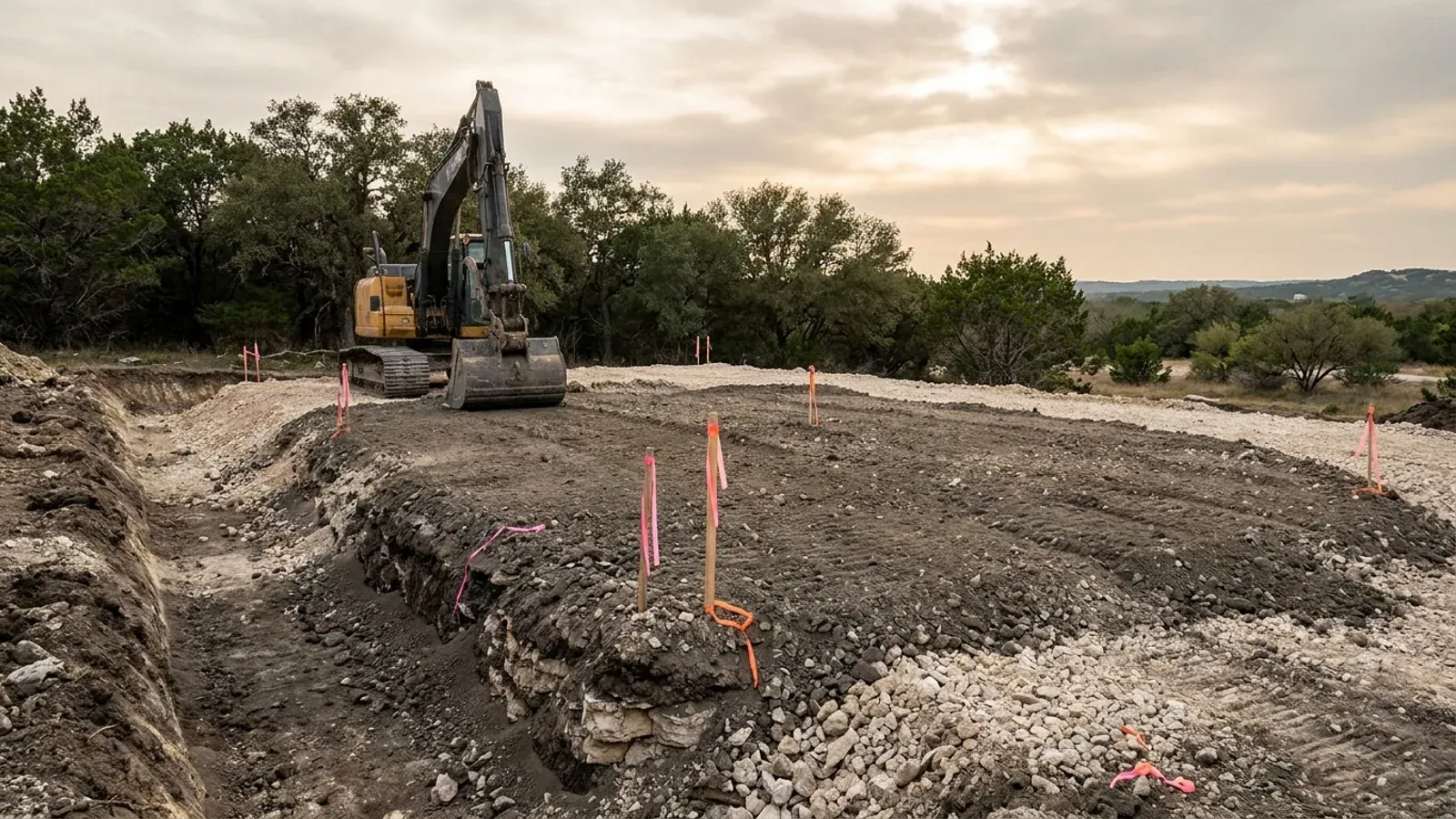
An excavator grading a compacted building pad on a cleared lot, with survey stakes and a drainage swale visible.
Below the slab

The expensive surprises are in the ground, not the building

What moves a Texas budget is usually below grade, and it is soil rather than rock: shrink-swell clay. The Blackland Prairie and the Gulf Coast clays move enough between a wet season and a dry one to drive the foundation design across the state's largest markets, which is why several DFW cities require an engineer's seal on the foundation of every new house. Those are the same conditions that decide whether a septic field passes its soil and site evaluation, so the grading plan, the foundation and the drainfield get resolved together rather than one at a time. We price the dirt before we price the building.

What we build in Abilene

All nine of our services — kits, custom plans, post-frame and steel construction, site preparation, permitting and engineering, through to turnkey builds — are available across Taylor County. What a project costs depends far more on the parcel than on square footage, so we work from your land rather than from a rate card.

See what we build

What a build looks like

Three stages every Abilene project passes through, from a raw parcel to a finished home. Site work first, because that is where the budget is decided.
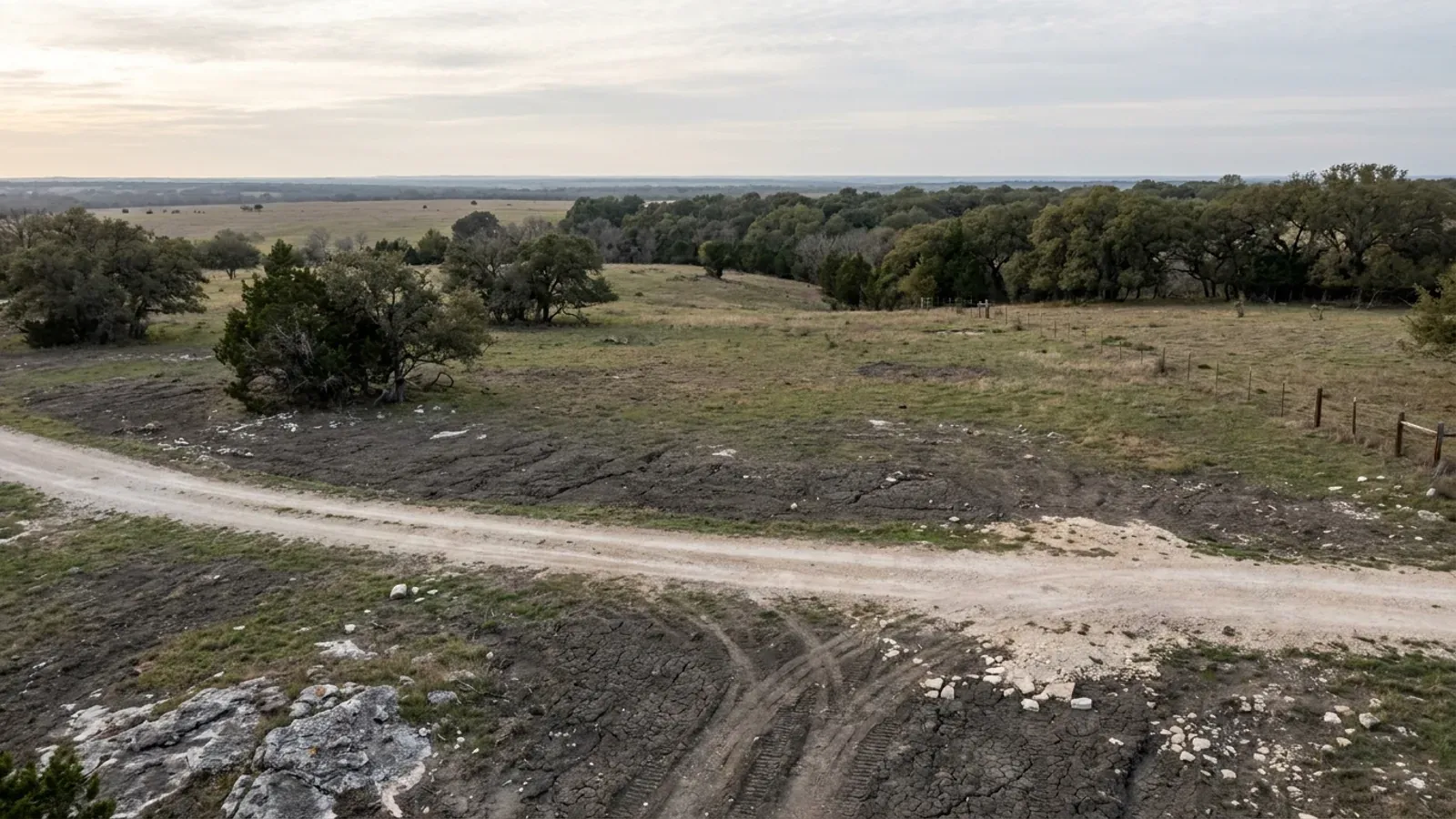
Aerial view of an undeveloped rural lot with cleared grass, a live oak and cedar elm treeline, and a pale gravel access track.
Stage one

The parcel

Zoning, setbacks, flood zone and utility access get checked before anything is drawn.

An excavator grading a compacted building pad on a cleared lot, with survey stakes and a drainage swale visible.
Stage two

Pad and permit

Clearing, grading and a compacted pad, while the submittal works through Taylor County.
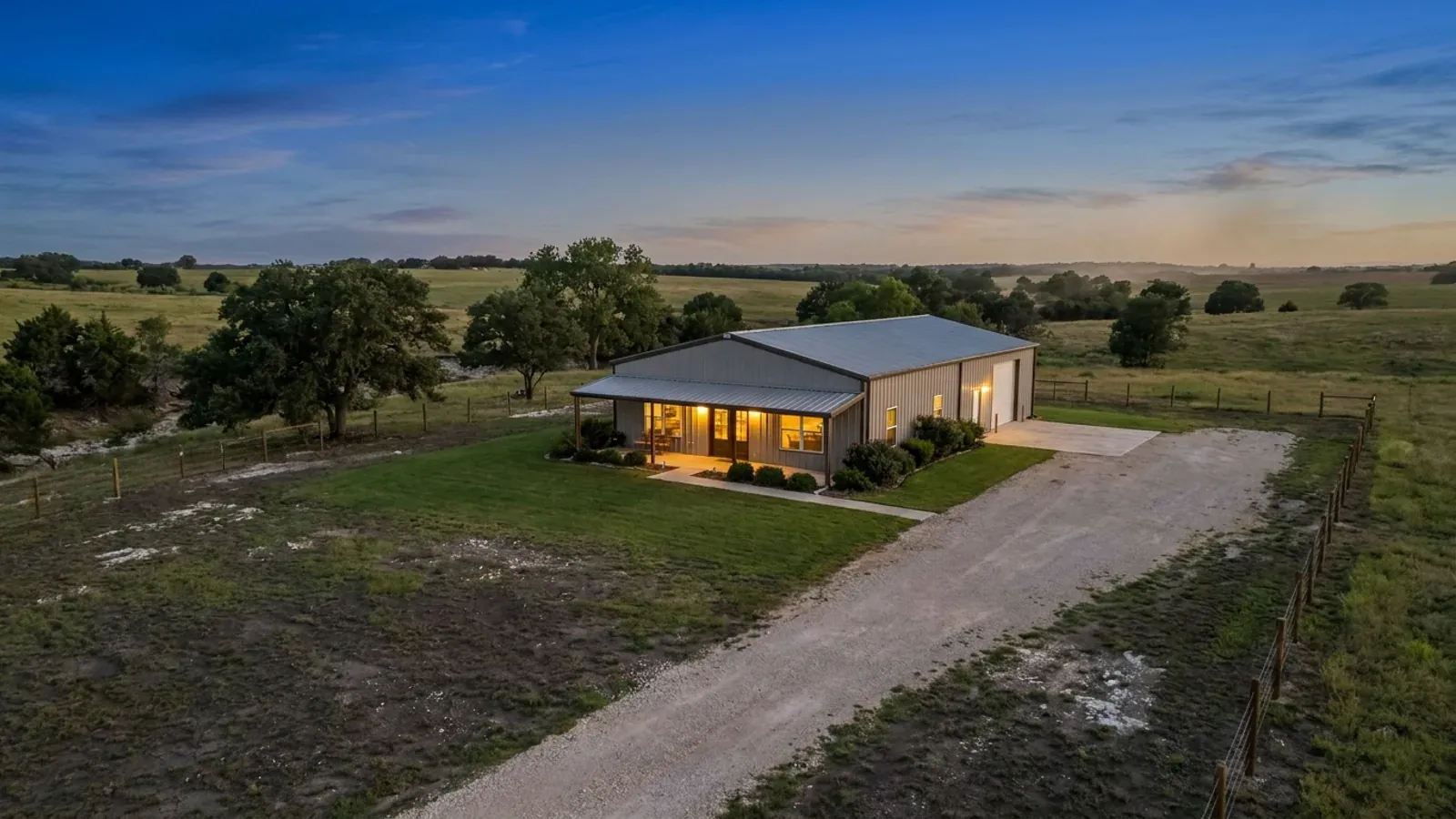
A finished barndominium at dusk with warm interior lighting glowing through its large windows.
Stage three

Frame to finish

Shell erected and dried in, then systems, insulation and interior finish through to CO.

Those are the rules for Taylor County. Tell us what you want to build and we will draw it to them.

Where we build around Abilene

Taylor County and the rural land around it. The buildable acreage for a project this size usually sits outside the city limits, which is frequently what changes who issues your permit.

Our Abilene service area, covering Taylor County and the surrounding rural acreage. This map marks the territory we serve, not a branch location.

Nearby areas we build in

Others we cover in this part of Texas. The permitting authority, the adopted design criteria and the zoning can all differ from one to the next.

Building in Abilene: common questions

12 questions we get asked most often about building in Abilene. If yours is not on the list, ask it directly.

Does Abilene make me put an engineer on a barndominium?
On most of them, yes, and the trigger is the span rather than the material. The city's amendment to IRC Sec. R106.1 says construction documents shall be prepared by a registered design professional when the Texas Engineering Practice Act requires it, and adds that buildings with a clear span exceeding 24 feet shall have the foundation and structural members designed by a professional engineer. A clear-span frame is the whole point of this building type, so plan for a Texas-licensed engineer on the structure. The foundation has its own route to the same place: amended Sec. R401.1 says a standard foundation exempt from engineer design must follow the city's own design figure 18-1-E, whose published reason is a study for this area of high PI soils, and added Sec. R403.1.8.1.2 requires a post-tension slab to be designed by a professional engineer licensed in Texas. The residential submittal checklist asks for the engineer's stamp on the plan plus a stamped certification letter, and it also requires the site plan itself to be drawn by a professional engineer or a registered surveyor.
What wind speed and design values does Abilene publish?
Abilene is one of the Texas cities that fills in IRC Table R301.2(1) instead of leaving it blank, which means you do not have to guess. The published row is 105 mph ultimate design wind speed as a three-second gust, with no topographic effect, no special wind region and no windborne debris zone; a ground snow load of 5 lb per square foot; seismic design category A; moderate weathering; a 6 inch frost line depth; a moderate to heavy termite rating; a 20 degree F winter design temperature; an air freezing index of 86; a mean annual temperature of 64.5 degrees F; and Ordinance No. 43-1992 for flood hazards. The amendment then deletes the rest of the table, including the Manual J design criteria, on the stated ground that Manual J is produced by a third party and is not part of plan review. Those are Abilene's numbers for Abilene. A neighbouring city's table is not a substitute, and neither is a state figure, because Texas has none.
Can I build a big detached shop inside Abilene city limits?
In the Agricultural Open Space district there is no square-footage cap on it. Table 2-13 of the Land Development Code lists a maximum accessory-building size for AO of none, ten percent of the entire lot area in RS-6, RS-8 and RS-12, and half the principal building in MF. AO also carries no maximum building height in Table 2-2, only a requirement to add one foot of setback for every foot of height above 45 feet, and accessory buildings take the height limit of their district. What binds instead is placement and cover. Accessory buildings are allowed only in side and rear yards and may not extend beyond the front building line, although barns and related structures necessary for farming and ranching are exempt from that on tracts of ten acres or more. A detached accessory building up to 10 feet tall sits 3 feet off an interior side or rear line, and above 10 feet it gains a foot of setback for every foot of height, capped at whatever the principal building would need. Total coverage of principal and accessory buildings together still has to fit the district's maximum, which is 15 percent in AO and RR-5 and 40 percent in RR-1.
Which Abilene districts still take acreage?
Three. Agricultural Open Space takes a 217,800 square foot lot, five acres, with a 200 foot minimum width and 500 foot depth, a 40 foot rear yard, a 25 foot side yard, 15 percent maximum lot coverage and no stated height limit. RR-5 Rural Residential also takes five acres, with 150 foot width, 400 foot depth, a 50 foot rear yard, a 30 foot side yard, a 35 foot height limit and 15 percent coverage. RR-1 takes one acre, with 100 foot width, 200 foot depth, a 50 foot rear yard, a 25 foot side yard, 35 feet of height and 40 percent coverage. A single-family detached dwelling and an accessory structure are both permitted by right in AO and RR on the Land Use Matrix. The code describes AO as unsubdivided land inside the corporate limits that is vacant or in agricultural use, held as a holding zone for land annexed to the city, which is exactly the ground a barndominium buyer is usually looking for.
Does Dyess Air Force Base affect what I can build?
It can, and the instrument is airport zoning rather than a building code. Land Development Code Sec. 2.3.5.1 was adopted under Local Government Code Ch. 241 and covers both Abilene Regional Airport and Dyess AFB, applying inside the corporate limits and in the unincorporated area of the city's extraterritorial jurisdiction. The concrete rules for a house are these: a single-family residential structure is permitted on a lot of one acre or larger, except within the Dyess Clear Zone; an existing legally platted lot, or one subdivided before 1984, is allowed a house even if it is under an acre, again except in the Clear Zone; and no house or other building may exceed 35 feet in height where it penetrates an established Military Imaginary Surface. Clear Zones run 3,000 feet by 3,000 feet from each runway end, APZ I is 3,000 by 5,000 feet beyond that and APZ II 3,000 by 7,000 feet. In APZ I and APZ II a detached single-family dwelling and an accessory structure are both listed as allowed, at a maximum density of one dwelling unit per acre. An Airport Zone Development Permit is required for development in the regulated area, with no separate fee, but a primary or accessory structure under 50 feet in APZ I, or under 150 feet in APZ II and beyond, is exempt from it outside the Clear Zone.
Is there a joint airport zoning board, and does Taylor County regulate lighting near the base?
No to both, and the two answers come from different places. Local Government Code Sec. 241.014 lets political subdivisions create a joint airport zoning board, but that is permissive and Abilene has not used it. The city acts on its own under Sec. 241.013, which lets a political subdivision with a population over 45,000 adopt and enforce airport zoning outside its own boundaries, and its ordinance names the City of Abilene Board of Adjustment as the appeal body and the Airport Development Board for Abilene Regional matters. Special exceptions in the Dyess accident potential zones go to the Board of Adjustment after review by Dyess AFB. On lighting, Local Government Code Ch. 240 Subchapter B does give some counties power over outdoor lighting near military installations, but Sec. 240.032(b-1) limits it to a county with a population of more than one million that has at least five United States military bases, and to an adjacent county within five miles of a United States Army installation. Taylor County was 150,077 at the 2025 estimate and Dyess is an Air Force base, so neither limb reaches it. What does apply is the city's own rule: Sec. 2.3.5.1(h)(1) forbids any use of land in the airport zones that would make it hard for flyers to tell airport lights from others, result in glare in pilots' eyes or impair visibility.
What will the city charge for a permit, and what does it cover?
The published residential building permit fee is $0.50 per square foot of new single-family construction or enclosed addition, with a $550 minimum, and that one fee covers building, electrical, plumbing, roofing and mechanical rather than splitting them into separate trade permits. Residential plan review is $35 and is non-refundable. Detached work is priced flat: a residential carport or storage building of 201 square feet and up with no utilities is $100, a residential storage building with utilities is $350, and an accessory dwelling or pool house is $500. The minimum fee for any building permit in Abilene is $75. Re-inspection is $75, releasing a stop work order is $200, and starting work without a permit doubles the fee. Water taps are separate at $500 for a three-quarter inch, $550 for a one inch and $775 for an inch and a half, and a plumbing permit has to be issued before the tap fee is paid. There is no development impact fee in the code of ordinances or on the fee schedule. Contractor registration with the Building Official is required before a permit can be pulled, and the city charges nothing for it; a homeowner may pull a permit for work at the residence they own and live in without registering.
What is the ground actually like here?
It is two different problems, sometimes on the same tract. USDA soil survey data for Taylor County make Sagerton clay loam the largest soil in the county at 68,174 and 36,192 acres across two slope phases, running 29 percent clay with a plasticity index of 18 in the top 28 centimetres and then 42 percent clay with a plasticity index of 27 beneath. Tobosa clay is 50 percent clay all the way down with a plasticity index of 38 to 42, and Vernon clay is 50 percent clay with a plasticity index in the high twenties to low thirties. That is expansive ground, and it is why the city wrote its own foundation figure and why it names high PI soils in the reason. The other half of the county is the opposite problem: Kavett carries an indurated petrocalcic horizon, caliche, at about 46 centimetres and Pitzer at about 23, while Oplin meets indurated bedrock between 25 and 38 centimetres, and Oplin map units cover tens of thousands of acres. One kind of ground moves under a slab and the other is hard to dig. Which one you have is a parcel question for the soil report, not a map question.
Who issues the septic permit, and does the lot size matter?
TCEQ's authorized agent record for Taylor County returns three entries. The Taylor County authorized agent covers the entire county except the City of Tye and the Town of Impact. A City of Abilene authorized agent exists but its area served is recorded as administered by Taylor County, and that includes the part of the Abilene city limits lying in Jones County. TCEQ Region 03 Abilene is listed alongside them. So the city holds a designation while the county runs the programme, and the number to call is the county's. Lot size does not get you out of it: Chapter 13, Article V of the Abilene code adopts Health and Safety Code Ch. 366 and 30 TAC Ch. 285 for the incorporated limits with one local amendment, which is that all on-site sewage facilities within the city must be permitted regardless of lot size or acreage. There is no percolation test anywhere in Texas; soil is classified by texture, and system capacity is sized off living area rather than total footprint, which is worth knowing before you draw a large shop bay.
Do I need a well, and is there a groundwater district?
There is no groundwater conservation district covering Taylor County. Point queries against TCEQ's published district boundaries returned no district at thirty points spread across the county, while the same query returned Wes-Tex Groundwater Conservation District at Sweetwater in Nolan County immediately to the west and Clear Fork Groundwater Conservation District in Fisher County, which shows the data is live in this area. That means no district spacing rule, no production limit and no district registration to satisfy. It does not mean the well is unregulated: a water well driller and pump installer licensed by the Texas Department of Licensing and Regulation is required, state well construction standards still apply, and where the tract is served by city water the utility rates outside the city limits are double the in-city rates for consumption. Nothing about the absence of a district tells you what the well will yield on a given tract, which is a question for a driller who works that ground.
Can Abilene stop me building in metal?
Not in the districts where acreage is. The Land Development Code's only exterior material standard is Sec. 4.2.6.1(c), and it applies solely within the Central Business District and along Enhancement Corridors designated in the Comprehensive Plan, where metal siding and standard concrete block are prohibited on facades visible from a street or a parking lot, except in Industrial or Heavy Commercial districts and subject to a waiver from the Planning Director. There is no masonry percentage and no material standard in AO, RR or the single-family districts. Two other things are worth reading alongside it. Texas Government Code Sec. 3000.002 bars a governmental entity from setting a material or aesthetic-method standard more stringent than the national model code on a residential building, and Sec. 3000.004 expressly leaves recorded land-use restrictions untouched. And the city's residential submittal checklist still asks for a masonry calculation to be noted on the elevation sheet, so ask Building Inspections how that is applied to a lot outside the corridors before you finalise elevations. On private land the deed restrictions are the ones to read, because the statute does nothing to them.
What changes if my land is just outside the city limits?
Quite a lot, and the line is not where people expect. Land Development Code Sec. 4.1.3.3 requires a building permit within the city limits, or in the extraterritorial jurisdiction only where a development agreement provides for one, so ordinarily the city's building code does not follow you out. Three things do. A Site Preparation Permit is required before non-exempt development in the city limits or the ETJ, though construction of a single-family dwelling on a legally platted lot is exempt from it except for landscaping, open space and tree preservation standards, subsurface sewage disposal, and floodplain improvement standards. The airport zoning of Sec. 2.3.5.1 applies in the ETJ as well as inside the limits, and in the ETJ an Airport Zone Development Permit is the vehicle for the noise-attenuation requirement where the noise contours map calls for it. Subdivision platting also reaches into the ETJ. Because Abilene's population passed 100,000, Local Government Code Sec. 42.021(a)(5) puts its extraterritorial jurisdiction at five miles from the corporate boundary. Beyond that you are in unincorporated Taylor County, which is a different regime again, and part of the city itself sits in Jones County.

Building in Abilene?

Start with the plan. Tell us what you want to build and we will draw it, then confirm what Taylor County will actually let you put on the parcel and what wind load it has to meet. That conversation costs nothing.