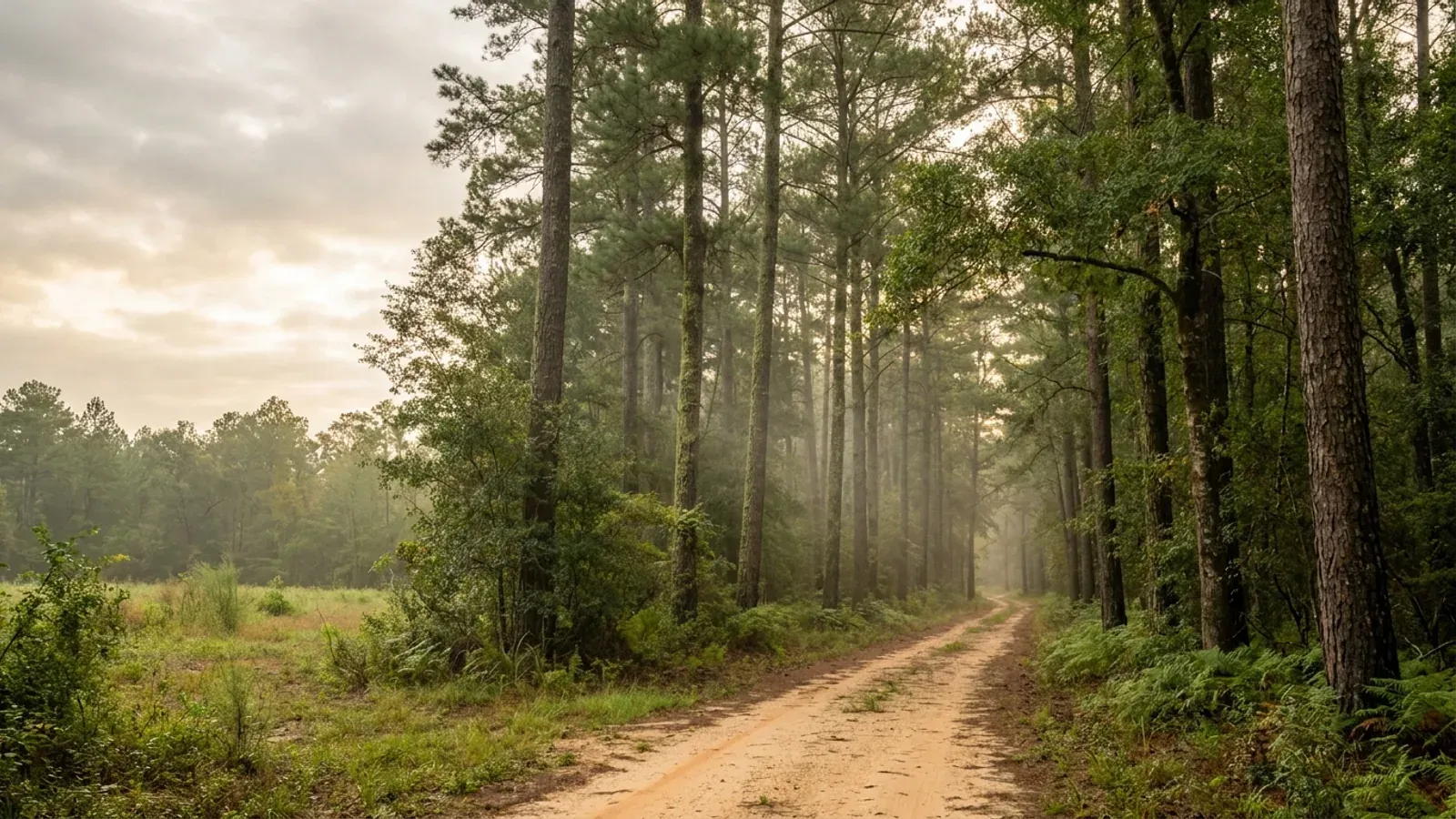
Tall pines in the East Texas Piney Woods with a sandy track cutting through green understorey.
Van Zandt County Edition set by the jurisdiction

Barndominium Builders in Van Zandt County, TX

Van Zandt County is the bridge between two markets. I-20 crosses it end to end, Dallas is an hour west and Tyler forty minutes east, and 48,062 of its 66,130 residents live outside every city limit, on roughly 820 square miles of unincorporated land at about 58 people per square mile. That is where the county is growing: 4,678 of the 6,594 people added since 2020 went to the unincorporated balance rather than to Canton, Wills Point, Grand Saline or Van. Cross into Kaufman County to the west and a residential building code applies by order of that commissioners court. Nothing of the kind has been found on the Van Zandt side, and the county lists no building or development office among its departments. What the county does publish is worth reading: a one-acre minimum lot for any septic system, a set-back line keeping a new building 50 feet off a county-maintained road, two feet of freeboard in the floodplain, and a utility rule that reaches the electric meter.

Van Zandt County at a glance

County
Van Zandt County
Population
66,130
Where we build
Canton, Smith County, Henderson County, Wood County, Kaufman County

ZIPs 75103, 75169, 75754, 75140, 75117, 75147, 75790, 75127 and more

Site visits
Site walks arranged throughout Van Zandt County, Canton included

Building conditions in Van Zandt County

What actually changes from one Texas jurisdiction to the next: who issues the permit, whether the residential code is enforced there at all, what the structure has to be engineered to, and what the ground is like. These are the numbers your drawings have to satisfy.

Build conditions for Van Zandt County , Texas . BUILD CONDITIONS VAN ZANDT COUNTY…Van Zandt CountyEDITION PER JURISDI…ADOPTED RESIDENTIAL CODEEDITION PER JURISDI…This jurisdiction publishes no design wind speed. It is settled in writing with the authority overyour parcel before the frame is ordered.ZONING · UNDEFINED1 acre for any single-family residen…Local Government Code section 233.153(d)(2) does not authorise acommissioners court to adopt or enforce zoning, and there is none…PERMIT REVIEW CLOCK30 business daysPublished review target of the issuing authorityWHO ISSUES THE PERMITVan Zandt County Fire Marshal's Offi…24634 State Highway 64, Canton, TX 75103, (903) 567-6026,ossf@vanzandtcounty.org, Monday to Friday 8am to noon and 1pm to…
Build conditions for Van Zandt County, drawn from the sourced facts on this page. Every figure above is cited in the quick-facts panel below, with its source and vintage.
Septic needs an acre, whatever the tract size
The county's septic order requires a permit and inspection regardless of the size of the tract, and puts every single-family residence on a minimum one-acre lot unless it was platted before December 2008

Order Adopting Rules of Van Zandt County, Texas for On-Site Sewage Facilities, sec. 10(A) and 10(C), passed 23 December 2008, approved by TCEQ 2 February 2009

The county tells you where the building may not go
No new building may stand closer than 25 feet from the right-of-way of any public road, or 50 feet from a state or federal highway or any county-maintained road

Van Zandt County Subdivision Regulations adopted 14 January 2026, sec. 3.10(b) and 3.10(c), under Texas Local Government Code sec. 233.032

Two feet above the base flood elevation
In a special flood hazard area the lowest floor of a new residential structure must sit two feet above the base flood elevation, certified by an engineer, architect or land surveyor, and a Floodplain Development Permit is required

Van Zandt County Flood Damage Prevention Ordinance, art. 5 sec. B(1) and art. 3 sec. C, passed 27 July 2010, effective 17 December 2010

A county building permit that cannot reach a house
The Fire Marshal publishes a New Construction Permit with plan review and at least three site inspections, on a facility application. A county building permit under chapter 233 applies only to a commercial establishment, a public building, or a multifamily dwelling of four or more units

2026 Van Zandt County Fire Marshal Office Fee Schedule, Building Permit Fee Schedule; Texas Local Government Code secs. 233.062(a) and 233.063(a)

The growth is on the land, not in the towns
48,062 of the county's 66,130 residents live outside every city limit, and 4,678 of the 6,594 people added since 2020 went to that unincorporated balance

U.S. Census Bureau Vintage 2025 estimates, co-est2025-alldata.csv and sub-est2025.csv

Four soil regions inside one county
The county's soil survey overlaps the Texas Blackland Prairie, both halves of the Texas Claypan Area, and the Western Coastal Plain

USDA-NRCS Soil Data Access, SSURGO survey area TX467, laoverlap table (MLRA 86A, 87A, 87B, 133B)

Also worth knowing before you build in Van Zandt County

The surface lies on a quarter of the county
Woodtell and Crockett soils cover about 143,700 acres and read as a 12.5 percent clay loam for the first seven inches, then run 47 to 50 percent clay through the next foot and a half

USDA-NRCS Soil Data Access, SSURGO TX467, chorizon representative clay values for the Woodtell and Crockett major components

And it fails at the other end too
Pickton fine sand holds 5.5 to 7.5 percent clay to five feet at 91 to 93 percent sand, and TCEQ's own rule says Class Ia soils do not provide adequate treatment of wastewater through soil contact

USDA-NRCS SSURGO TX467, Pickton chorizon values; 30 Texas Administrative Code sec. 285.33(b)(4)(D)

Published septic fees
$400 for a single-family residential system, $650 commercial or multifamily, $200 for a repair or modification, $200 for a re-inspection and $30 a year to register a maintenance contract

2026 Van Zandt County Fire Marshal Office Fee Schedule; Van Zandt County OSSF Application fee page

Who the septic authority actually is
TCEQ lists the Van Zandt County Authorized Agent as covering the unincorporated county plus the City of Canton, with the Sabine River Authority taking over within 2,000 feet of the Lake Tawakoni project boundary

TCEQ On-site Sewage Facility Authorized Agent Records Search (OARS), county code 234, retrieved 1 September 2026

No groundwater district
Van Zandt County is in Groundwater Management Area 11, whose four groundwater conservation districts are Neches and Trinity Valleys, Panola County, Pineywoods and Rusk County. None of them covers Van Zandt

Texas Water Development Board, GMA 11 Desired Future Condition Explanatory Report (Final), pp. 4

The smallest ETJ rings in the phase
Canton at 5,070 residents and Mabank at 7,294 project a one-mile extraterritorial jurisdiction; every other town in the county projects half a mile

Texas Local Government Code sec. 42.021(a); U.S. Census Bureau Vintage 2025 subcounty estimates

The warning the county makes sellers print
Every conveyance of a septic-served lot in a subdivision must carry, in bold 14-point type, that Van Zandt County makes no representation that adequate sewerage facilities will be legally feasible within this subdivision

Van Zandt County Subdivision Regulations adopted 14 January 2026, sec. 12.2(b)

Utilities are the enforcement point
A utility may not supply water, sewer, gas or electric service to a structure in a subdivision unless the owner produces a certificate of county approval or a certificate of exemption from the Commissioners Court

Van Zandt County Subdivision Regulations adopted 14 January 2026, secs. 1.3(c) and 12.1(b)

Climate zone does not move with the edition
Van Zandt County is climate zone 3A on both the pre-2021 and the 2021 IECC and IRC county maps

U.S. Department of Energy / PNNL-33270, Guide to Determining Climate Zones by County, September 2022
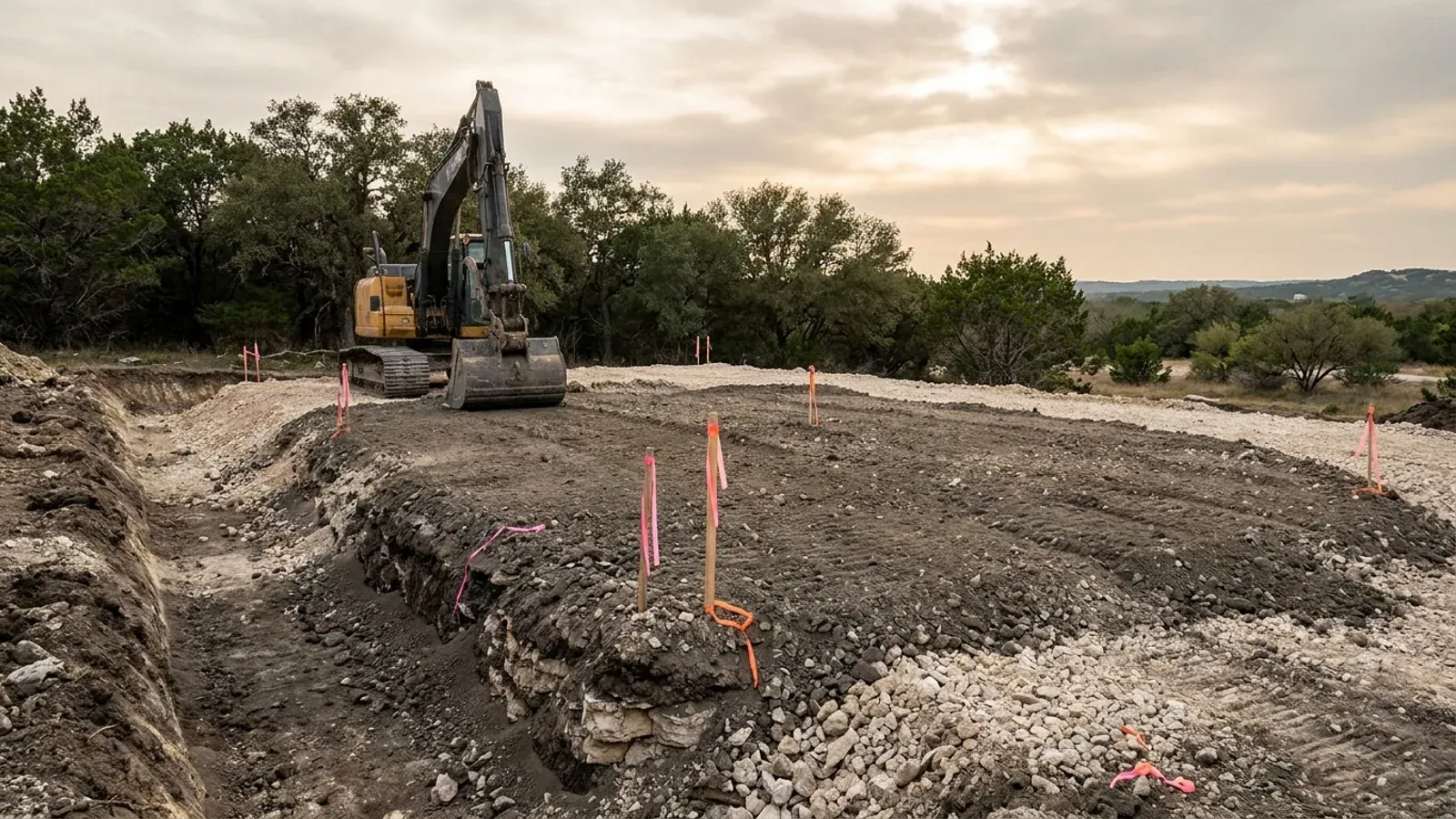
An excavator grading a compacted building pad on a cleared lot, with survey stakes and a drainage swale visible.
Below the slab

The expensive surprises are in the ground, not the building

What moves a Texas budget is usually below grade, and it is soil rather than rock: shrink-swell clay. The Blackland Prairie and the Gulf Coast clays move enough between a wet season and a dry one to drive the foundation design across the state's largest markets, which is why several DFW cities require an engineer's seal on the foundation of every new house. Those are the same conditions that decide whether a septic field passes its soil and site evaluation, so the grading plan, the foundation and the drainfield get resolved together rather than one at a time. We price the dirt before we price the building.

What we build in Van Zandt County

All nine of our services — kits, custom plans, post-frame and steel construction, site preparation, permitting and engineering, through to turnkey builds — are available across Van Zandt County. What a project costs depends far more on the parcel than on square footage, so we work from your land rather than from a rate card.

See what we build

What a build looks like

Three stages every Van Zandt County project passes through, from a raw parcel to a finished home. Site work first, because that is where the budget is decided.
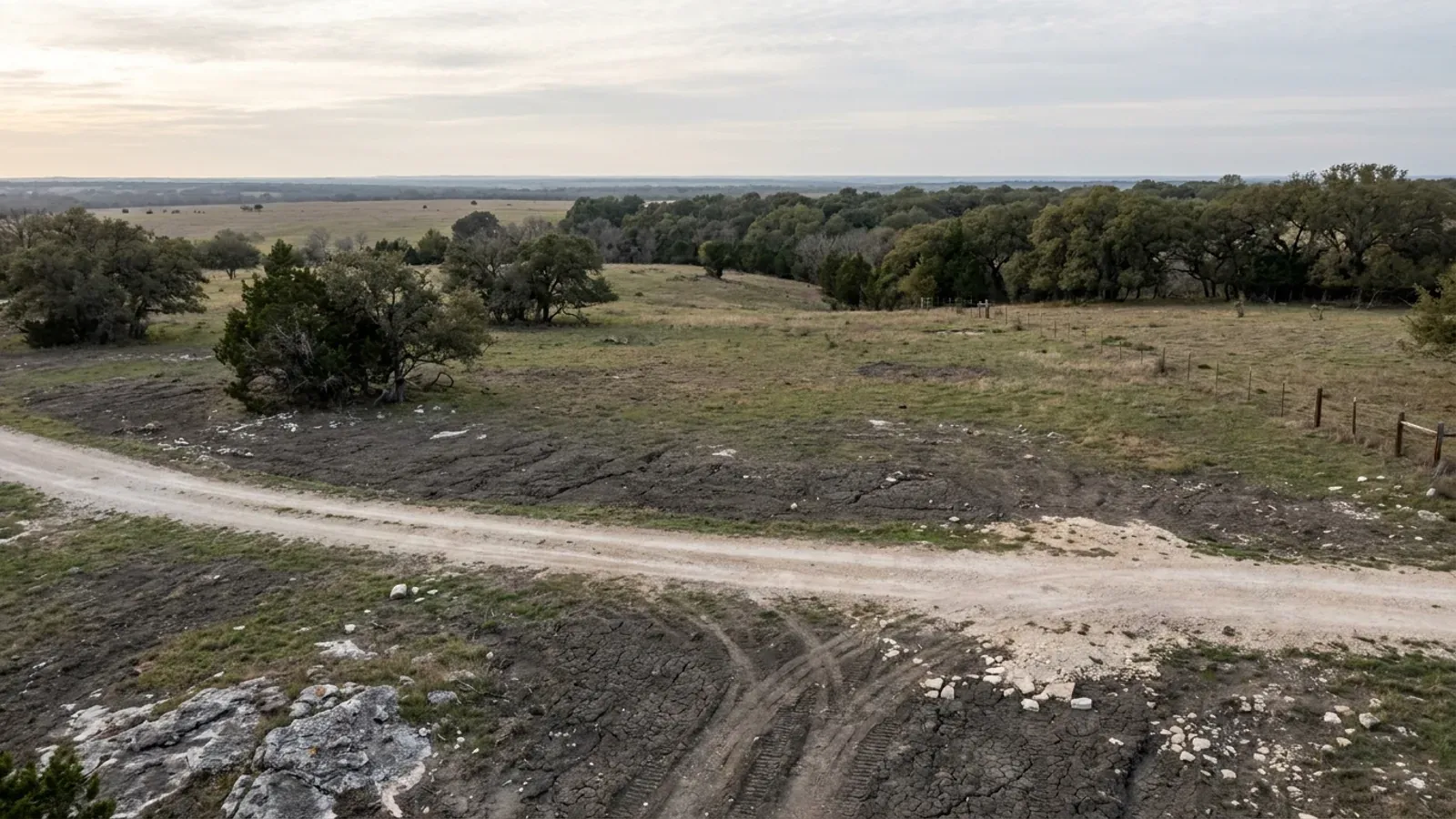
Aerial view of an undeveloped rural lot with cleared grass, a live oak and cedar elm treeline, and a pale gravel access track.
Stage one

The parcel

Zoning, setbacks, flood zone and utility access get checked before anything is drawn.

An excavator grading a compacted building pad on a cleared lot, with survey stakes and a drainage swale visible.
Stage two

Pad and permit

Clearing, grading and a compacted pad, while the submittal works through Van Zandt County.
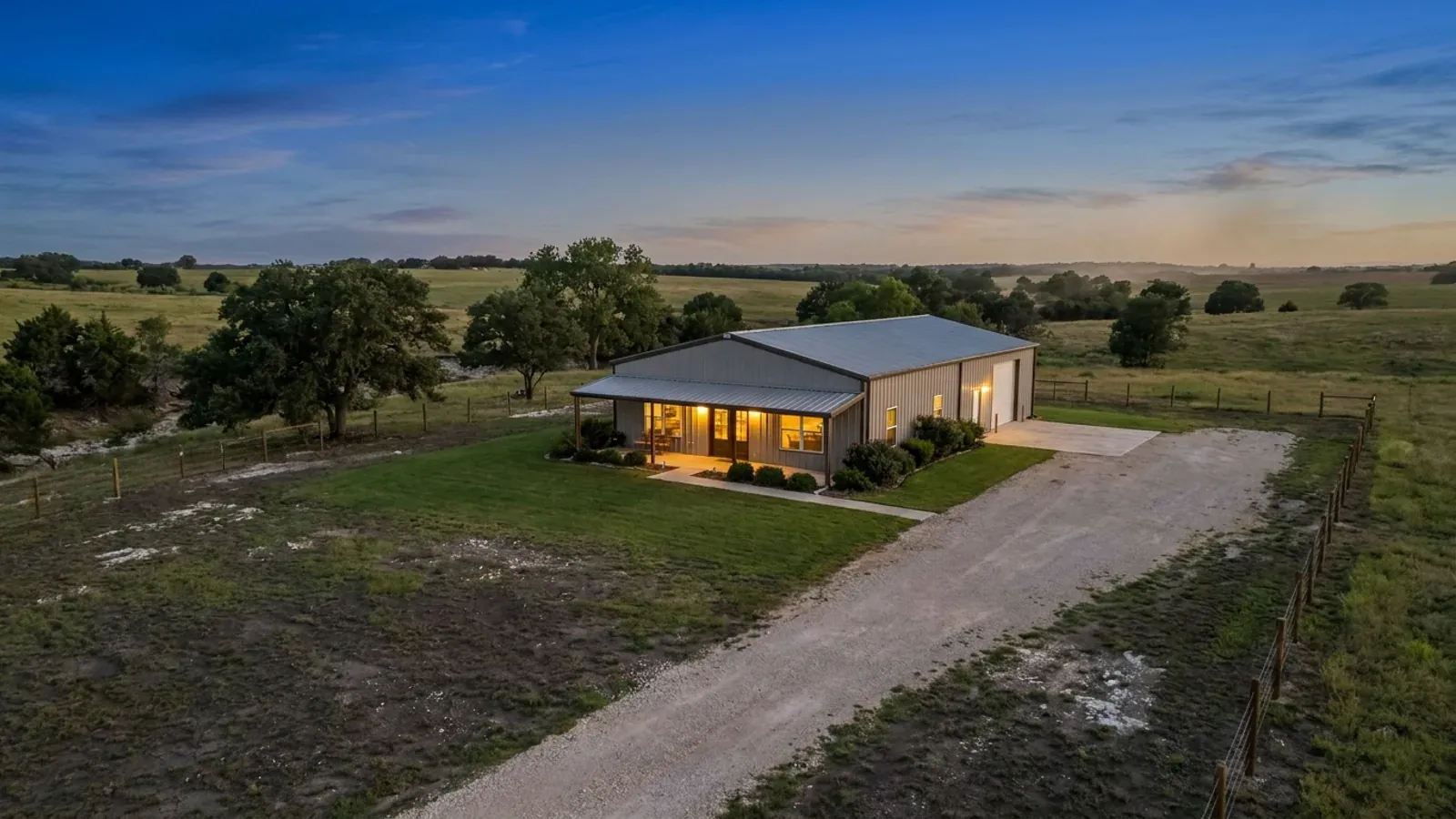
A finished barndominium at dusk with warm interior lighting glowing through its large windows.
Stage three

Frame to finish

Shell erected and dried in, then systems, insulation and interior finish through to CO.

Those are the rules for Van Zandt County. Tell us what you want to build and we will draw it to them.

Where we build around Van Zandt County

Van Zandt County and the rural land around it. The buildable acreage for a project this size usually sits outside the city limits, which is frequently what changes who issues your permit.

Our Van Zandt County service area, covering Van Zandt County and the surrounding rural acreage. This map marks the territory we serve, not a branch location.

Nearby areas we build in

Others we cover in this part of Texas. The permitting authority, the adopted design criteria and the zoning can all differ from one to the next.

Building in Van Zandt County: common questions

12 questions we get asked most often about building in Van Zandt County. If yours is not on the list, ask it directly.

Does a building code apply on unincorporated land in Van Zandt County?
It has not been possible to establish that one does, and it has not been possible to rule it out. A Texas county has no general building-code authority in its unincorporated area unless its commissioners court has adopted an order under Subchapter F of Local Government Code chapter 233, which took effect on 1 September 2009. No such Van Zandt order has been found. The county's online commissioners court archive only goes back to 2024 and its minutes are scanned images that cannot be searched, so the 2009 window is out of reach from the web. What the county's own subdivision regulations do is instructive: they recite the statutes the Commissioners Court is exercising and name chapter 233 Subchapter B, the road set-back subchapter, without naming Subchapter F. Ring the County Clerk on (903) 567-7555 and ask for a records search before you rely on either answer.
Does that uncertainty change what I actually have to do?
Barely, and that is the point. Subchapter F is deliberately toothless. Section 233.153(d)(1) says it may not be read to require prior county approval before construction starts, section 233.153(f) forbids the county from charging a fee to enforce it, and section 233.154(a)(3) makes the builder contract the inspections privately. So an opted-in county and a county that never opted in look identical from the outside: no county building permit, no fee, no county inspector either way. The difference is a standard that would apply on paper and three privately contracted inspections. Everything else on this page applies regardless.
Kaufman County next door has a code. Why is that different?
Because Kaufman's commissioners court took the step and recorded it. Its order applying Subchapter F was passed on 22 March 2022 and recorded with the Kaufman County Clerk as instrument 2022-0011386, and paragraph 4 points at the International Residential Code in use by the City of Kaufman, which is the 2021 edition. Forty minutes east, on the Van Zandt side of the same interstate, no equivalent instrument has been found. This is the single clearest illustration of the Texas arrangement: whether a residential code applies to your build can change at a county line, and nothing about the land, the climate or the soil changes with it.
So which permits does Van Zandt County actually issue?
Four gates, and only one of them looks at the house. The septic permit comes from the Fire Marshal's Office, which holds the county's TCEQ authorised-agent designation. A Floodplain Development Permit is required for any development in a special flood hazard area, and the County Judge is the floodplain administrator. A culvert or driveway permit is required for construction in a county road right-of-way. And a subdivision certificate of approval or exemption is what a utility needs before it will connect water, sewer, gas or electricity. The Fire Marshal also publishes a New Construction Permit with plan review and at least three site inspections, but it is a facility permit: the county building permit created by Local Government Code section 233.063 exists only for the buildings listed at section 233.062(a), which are commercial establishments, public buildings and multifamily dwellings of four or more units. A one or two family house is outside that list. In March 2025 the county used exactly that power against a commercial battery storage project, citing chapter 233 and NFPA 855.
How big does the lot have to be for a septic system?
One acre, whatever your water source. The county's own septic order, section 10(C), requires each single-family residence using an on-site sewage facility to sit on a minimum one-acre lot or tract, unless the lot was platted and recorded before the order was adopted on 23 December 2008. That doubles the state floor of half an acre on a public water supply at 30 Texas Administrative Code section 285.4(a)(1). Section 10(A) also kills the ten-acre myth in the county's own words, requiring a permit and inspection regardless of the size of the tract of land. The Fire Marshal's application repeats the rule and says a lot under one acre needs a variance with the plat date.
Does the shop bay make my drainfield bigger?
Van Zandt has not answered that in writing, and it is worth a phone call before you size anything. At state level, 30 Texas Administrative Code chapter 285 keys the design flow to living area rather than total footprint, and Van Zandt adopted chapter 285 whole with a short list of local departures that never touches the definition. But the county's own application form asks simply for bedrooms, bathrooms and Square Feet, which is ambiguous where other Texas counties say living area or heated square feet, and the site drawing must label every structure including shops with its area. Ask the OSSF desk on (903) 567-6026 how they read it for your plan.
Who is my septic authority if I am near a lake?
Usually the county, but not always. TCEQ's authorised agent records list the Van Zandt County Authorized Agent as covering the unincorporated county plus the City of Canton. Separately, the Sabine River Authority holds the designation within 2,000 feet of the project boundary of Lake Tawakoni, which reaches into the north-west corner of the county. TCEQ prints the tie-breaker itself: if you are in a subdivision within 2,000 feet of a listed lake, the lake's agent applies; otherwise contact the county.
What does the ground do here?
Two different things, and the difference is not visible from the road. The county's soil survey overlaps four major land resource areas at once: the Texas Blackland Prairie, both halves of the Texas Claypan Area, and the Western Coastal Plain. Woodtell and Crockett soils cover roughly 143,700 acres and read as a 12.5 percent clay loam for the first seven inches, then run 47 to 50 percent clay through the next foot and a half, with linear extensibility values in the shrink-swell range. Gladewater clay is 50 percent clay at the surface. Meanwhile Wolfpen and Pickton cover about 80,600 acres of deep sand, Pickton holding under 8 percent clay to five feet. A site here can fail for draining too fast as easily as too slow. Get a soil evaluation before you choose a system or a foundation.
Do I need an engineer for the foundation?
Plan on a geotechnical report and a Texas-licensed engineer on the claypan side of the county, and understand why the answer is not automatic. The Texas Engineering Practice Act removes the private-dwelling exemption for a residential slab on expansive soil, but section 1001.056(c)(2) defines both the trigger and the escape by reference to the IRC as applied in the jurisdiction, and on unincorporated land where no code is confirmed to apply there is no local IRC to refer to. So the statute does not resolve itself out here. The soil does. Fifty percent smectitic clay under a shallow sandy loam is exactly the ground that moves, and a designed and sealed slab is the right answer whether or not a statute compels one.
Is there zoning, and what about a well?
There is no county zoning. Local Government Code section 233.153(d)(2) withholds it even from a county that has opted into Subchapter F, and no Texas county has general zoning power. What controls land use out here is recorded deed restrictions, which Texas courts enforce, so read the title commitment before you buy. On water, Van Zandt County sits in Groundwater Management Area 11 but inside none of that area's four groundwater conservation districts, so there is no district permit and no district registration for a domestic well. A licensed water well driller and a state well report are still required. And the county makes developers print a warning in bold 14-point type that it makes no representation that adequate water suitable for human consumption will be available within a subdivision.
What if I want to rent the place out?
Check the platting side before the building side, because that is where Van Zandt draws the line. Section 1.3(e) of the county's subdivision regulations says a subdivision intended for rental or short-term rental property is subject to the regulations and is treated as a Tier One subdivision, which is the heavy track: full road, drainage and financial-guarantee compliance rather than the four-lot certificate route. There is no county commercial track that would put a code on a single house, because the county's fire-code permit cannot reach a one or two family dwelling. But the septic order's homeowner concession does not survive a let either: section 10(E) only lets an owner maintain an aerobic system if they are certified and the property is their personal residence.
What if my land is inside a town or its ETJ?
Then the town's own code, permit and inspector apply inside the limits, and you should settle which side of the line you are on first. Canton, Wills Point, Grand Saline, Van, Edgewood, Fruitvale, Edom and part of Mabank all hold territory in the county. The extraterritorial rings here are unusually small: under Local Government Code section 42.021(a) a city's ETJ keys off its own population, and Canton at 5,070 and Mabank at 7,294 project one mile while every other town projects half a mile. That is a long way from the five-mile rings the big Dallas cities throw. In the ETJ itself, Texas courts have held that a city cannot enforce its building code, most recently in Collin County v. City of McKinney in 2018, though a city can still require you to plat.

Building in Van Zandt County?

Start with the plan. Tell us what you want to build and we will draw it, then confirm what Van Zandt County will actually let you put on the parcel and what wind load it has to meet. That conversation costs nothing.