Barndominium Builders in Wood County, TX
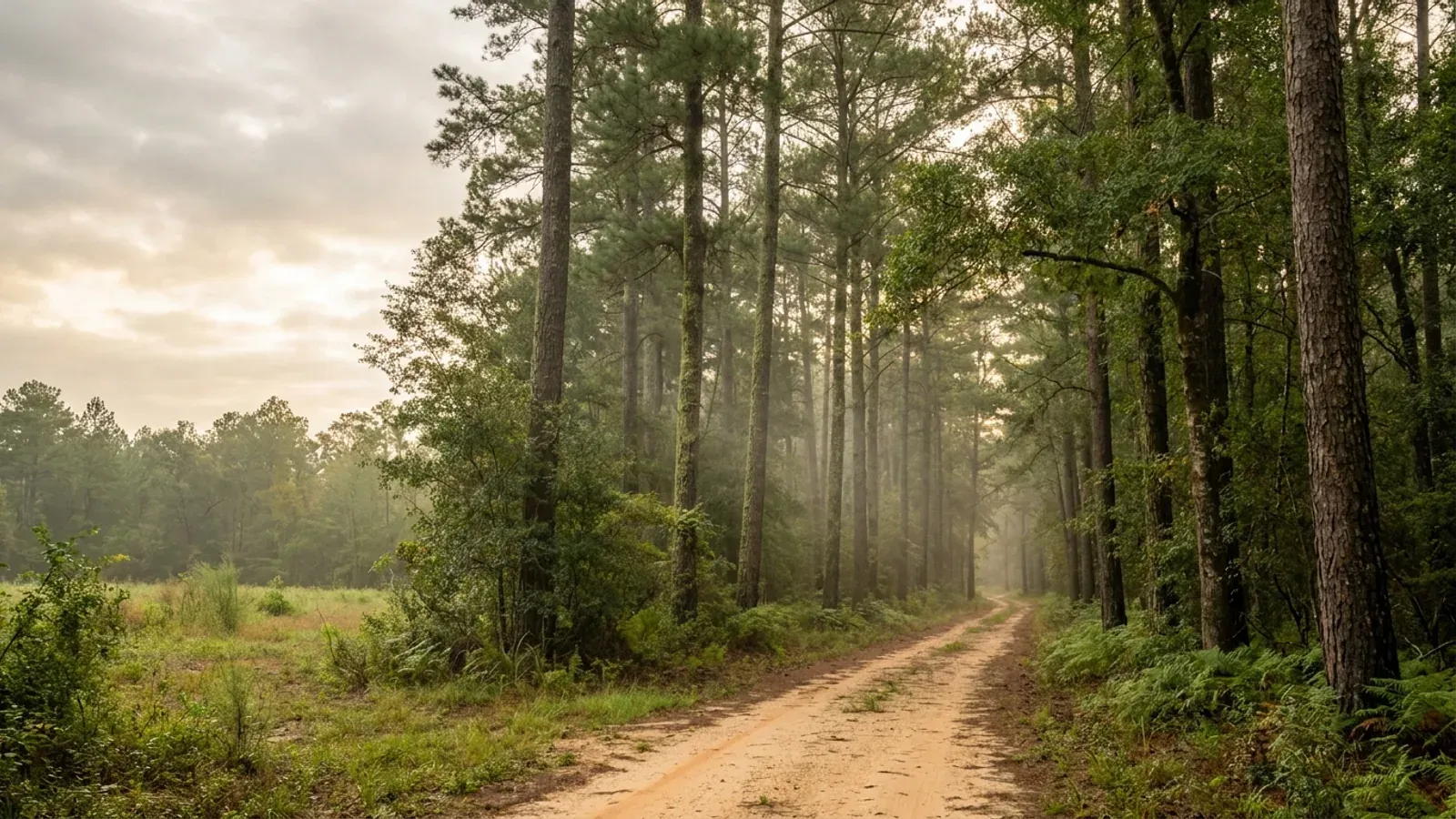
Wood County is the cheap-acreage half of East Texas. About 49,700 people live across 645 square miles, and 73 percent of them live outside every city limit; the largest town, Mineola, is 5,537 and Quitman, the seat, is 2,057. Fifty square miles of the county is water. That water changes who you deal with: within 2,000 feet of the project boundary of Lake Fork Reservoir the Sabine River Authority of Texas, not Wood County, is the authorised agent for your septic permit, and the county's own subdivision checklist tells you to bring a letter from the SRA. Move inland and it is the county's inspector again. The ground is Piney Woods sand over a clay subsoil that the first spade of a shovel will not show you, and down on the bottoms it is a true shrink-swell clay. Nobody in the county inspects the frame of a house.
Wood County at a glance
- County
- Wood County
- Population
- 49,688
- Where we build
- Quitman, Smith County, Van Zandt County, Gregg County
- Site visits
- Site walks arranged throughout Wood County, Quitman included
ZIPs 75783, 75773, 75494, 75765, 75497, 75410
Building conditions in Wood County
What actually changes from one Texas jurisdiction to the next: who issues the permit, whether the residential code is enforced there at all, what the structure has to be engineered to, and what the ground is like. These are the numbers your drawings have to satisfy.
TCEQ On-site Sewage Facility Authorized Agent search (OARS), county record for Wood, run 1 September 2026 — https://www.tceq.texas.gov/permitting/ossf/aa_search.html (the form posts to https://www6.tceq.texas.gov/oars/index.cfm?fuseaction=search.results)
Wood County Subdivision Checklist, New Subdivision / Phase to an Existing Subdivision, Revised Form 2026 — https://www.mywoodcounty.com/upload/page/0138/docs/Revised%20New%20Subdivision%20Checklist%202026.pdf
Quitman, Texas Code of Ordinances secs. 10-1, 10-2 and 10-25, recodification codified through Ordinance No. 021325(A) adopted 13 February 2025, read from api.municode.com (client 16039, product 17206) — https://library.municode.com/tx/quitman/codes/code_of_ordinances
Wood County Floodplain Administrator, Development Permit Application — https://www.mywoodcounty.com/upload/page/0122/Floodplain%20Permit.pdf
Wood County, Texas Subdivision Rules and Regulations, Revised and Amended 2026, Land Planning and Site Evaluation (OSSF) sec. 1.A, pp. 24-25, filed with the County Clerk May 2026 — https://www.mywoodcounty.com/upload/page/0138/docs/Approved%20Revised%20and%20Ammended%20Wood%20County%20Subdivision%20Rules%20and%20Regulations%202026.pdf
U.S. Census Bureau, Vintage 2025 county and sub-county population estimates (co-est2025-alldata.csv and sub-est2025.csv); 2025 Census Gazetteer counties and places files, GEOID 48499
Also worth knowing before you build in Wood County
- The surface lies about the subsoil, and the federal survey measures it
- The soil survey of Wood County maps 445,402 acres. Cuthbert fine sandy loam is the largest single map unit at 40,264 acres, and its profile reads 8.5 percent clay for the first nine inches and then 47.5 percent from nine inches to twenty-two. Freestone fine sandy loam, the second largest at 39,383 acres, reads 9.6 percent clay for eleven inches and 57.5 percent between twenty-eight and forty-four, with a linear extensibility of 12.2 percent down there. Woodtell is classified as a vertic soil with a smectitic mineralogy. A hand auger in the topsoil will tell you it is sand. The slab does not sit on the topsoil.
- A site here can fail for draining too fast as easily as too slow
- Two of the county's largest map units sit at opposite ends of the septic problem. Darco fine sand covers 41,495 acres across its two slope classes and is classified as somewhat excessively drained, running 90 percent sand and 9 percent clay from three inches all the way down to fifty-six. Gladewater clay covers 12,812 acres on the bottoms, is 50 percent clay at the surface and 66 percent between seventeen and forty-eight inches, and is classified as a smectitic Epiaquert. There is no percolation test in Texas; soil is classified by texture, and TCEQ's own rules say that Class Ia soils do not provide adequate treatment of wastewater through soil contact. Deep sand and heavy clay are both a problem, for opposite reasons, in the same county.
- Eight ways out of platting, and none of them costs you your septic permit
- Appendix A of the county's subdivision regulations lists eight Wood County exceptions. A plat is not required where a public road divides a tract and the remainders are under ten acres; where two adjacent owners adjust a common boundary and the same number of tracts and owners exist after as before; where a smaller tract is surveyed out solely to obtain financing with ownership remaining unified; on a legitimate lien foreclosure or a court-ordered partition, neither of which excuses a sham transaction; where an owner of two or more distinct adjacent tracts with a history of separate use sells one; where a tract is split in two and both lots are more than ten acres and no streets are laid out; and for a public water supply reservoir purchase. Some Texas counties attach a penalty to their exemptions and make the exempt land ineligible for an address or a septic permit. Wood County's list attaches no such penalty to any of the eight.
- Dividing the land carries a stiffer offence than building on it
- The county's subdivision regulations reproduce Local Government Code sec. 232.005 in full: the county attorney may sue to enjoin a violation or recover damages adequate for the county to undertake the construction necessary to bring about compliance, and a person who knowingly or intentionally violates a requirement commits a Class B misdemeanor. The regulations close in capitals: subject to the exceptions set out, no land in Wood County shall be divided, sold or conveyed until the owner, subdivider or developer shall first have the final subdivision plat approved by the Commissioners Court and filed with the County Clerk in the map records. By contrast, a violation of a county residential building standard under Chapter 233 is only a Class C. In this county the law's teeth are on how you divide the land, not on how you build the house.
- The county fire-code bracket turns on the census, and the census says no
- Local Government Code sec. 233.061(a) lets a commissioners court adopt a fire code if the county has more than 250,000 people or is adjacent to one that does. Wood County adjoins Smith County. The 2020 decennial census put Smith County at 233,479; the Census Bureau's Vintage 2025 estimate puts it at 252,549. Government Code sec. 311.005(3) defines population, for statutory purposes, as the population shown by the most recent federal decennial census. On that measure the bracket is not met and there is no county fire-code power to exercise. The Wood County Fire Marshal's own page describes the office as operating in accordance with Chapter 352 of the Local Government Code, county fire protection, and names no adopted code edition anywhere.
- There is no published base flood elevation over much of this county
- FEMA's Community Status Book lists Wood County as a community participating in the National Flood Insurance Program under CID 481055, alongside Hawkins, Mineola, Quitman and Yantis, with Alba and Winnsboro listed under their split counties. The county's entry carries the report's (M) flag, which the report's own legend defines as no elevation determined, all Zone A, C and X. That is why the county's permit form has a blank reading base flood elevation at the site is blank feet NGVD or is unavailable, and why it asks the applicant for an elevation certification. On a Zone A parcel with no published elevation, somebody has to survey it before the paperwork can be finished.
- Leasing spaces puts the county at your electric meter
- Wood County has adopted Infrastructure Development Standards for Manufactured Home, Mobile Home, Tiny Home, and RV Rental Communities under Local Government Code sec. 232.007, and the Commissioners Court states in them that it finds it necessary to regulate lodging and recreational vehicle parks in the unincorporated areas. An Infrastructure Development Plan must be approved before construction begins; the county performs periodic inspections and a final inspection, then issues a Certificate of Compliance within five business days. And then the rule with teeth: a utility may not provide utility services, including water, sewer, gas and electric services, to a community subject to a plan, or to a home in it, unless the owner provides the utility with a copy of that certificate. It binds municipalities, public utilities, nonprofit water supply corporations, the county and special districts alike. None of this reaches a single house you build to live in.
- The county taxes cabins and lake lodging at seven percent
- The Wood County Tax Assessor-Collector collects a county hotel and motel occupancy tax at seven percent of the room charge, less a one percent administrative reimbursement the operator may retain if payment is on time, due the twentieth of the month following the reporting period. The county's own questions and answers sheet names the establishments it reaches: hotels, motels, bed and breakfasts, marina lodging and cabins in the county. Failure to collect the tax, failure to file a return, filing a false return or failing to remit on time is described as a criminal misdemeanor offence, with a five percent penalty, a further five percent after thirty days, and ten percent interest after sixty. This is a tax obligation and not a building code, but it arrives with the first booking.
- A licensed plumber is required whatever the county turns out to do
- The rural exemption in the Texas Plumbing License Law expressly does not reach plumbing performed in conjunction with new construction. So a Texas-licensed plumber is required on a new house on unincorporated land here regardless of the county's building-code position and regardless of the fact that no county inspector is coming to look at the frame. It is the clearest example of the point that no county building code is not the same sentence as no rules, and the plumbing board that issues the licence runs to 1 September 2033.
- What the county actually asks for before it will approve a plat
- The 2026 checklist is specific and most of it is other people's paperwork. An original certified tax certificate with a raised embossed seal. A lienholder acknowledgment with a copy of the deed of trust. The septic letter, from the county or from the SRA. A stormwater pollution prevention plan if one acre or more will be cleared or disturbed. Will-serve letters from both the water supply corporation and the electric supplier, stating availability for the number of lots. An ETJ letter from the city if the land is within one mile of city limits. A TxDOT driveway application if the entrance is on a US, state or farm-to-market road. Groundwater certification from TCEQ if wells will supply the subdivision. A preliminary plat by email for review before the final. One mylar and three signed and notarised paper copies, no larger than 18 by 24 inches. Fees run 400 dollars for 1 to 10 lots, 800 for 11 to 20 and 1,200 for 21 or more.
- Your driveway is a numbered item on a Commissioners Court agenda
- Wood County approves road permits one at a time in open court. The agenda for 7 July 2026 carries the item consider and approve Road Permit number 2320 located within Precinct 4, on the consent agenda alongside the Treasurer's report and the Environmental Officer's reports. Each of the four precincts runs its own Road and Bridge yard with its own number, so the conversation about where your entrance goes and what pipe it needs starts with your precinct commissioner rather than with a central office. Where the entrance is on a US, state or farm-to-market road, TxDOT issues the permit instead.
- A new emergency services district is being formed right now
- On 23 June 2026 the Commissioners Court recorded the County Judge's acceptance of a petition in proper form for the creation of Wood County Emergency Services District No. 2, directed that it be filed with the County Clerk under Health and Safety Code sec. 775.015, and set a public hearing for 17 July 2026. This is worth watching rather than worrying about. An emergency services district in Texas can adopt and enforce a fire code under sec. 775.036, with a fire code official who reviews plans and can issue stop-work orders, and a district in another Texas county has done exactly that in a county with no residential building code. Whether this one will is not settled. The Fire Marshal's office on 903-763-2356 will know before anyone else.
- What the county says about your water well
- Wood County's subdivision regulations dispose of the individual well in one line: all water wells must meet TCEQ standards as stated in the Texas Administrative Code 76.001 and 290.41. Separately, and only where a plat draws its water supply from groundwater, Local Government Code sec. 232.0032 requires a report by a licensed engineer or licensed geoscientist certifying that adequate groundwater is available, conforming to TCEQ guidelines, with the information transmitted to any affected groundwater conservation district and to TCEQ. That conditional wording matters on a county page: ask the Subdivision Coordinator on 903-760-1007 whether a district reaches your tract before you assume either way, because the answer changes what a driller may do.
- The septic authority's own area stops at the city limit
- TCEQ records Wood County's authorised-agent area as the unincorporated county, not the entire county, and no city in Wood County holds an authorised-agent record of its own. TCEQ's results page then prints the fallback rule in its own words: if the city is not listed, contact the county. So a buyer inside Quitman, Mineola, Winnsboro, Hawkins, Alba or Yantis is sent back to the county even though the county's recorded area is the part outside those limits. It is the kind of gap that only shows up when you ring the wrong desk, and the county number for it is 903-763-5308.
USDA-NRCS Soil Data Access, SQL query over SSURGO survey area TX499 (Wood County, Texas), tables mapunit, component and chorizon, run 1 September 2026 — https://SDMDataAccess.sc.egov.usda.gov/Tabular/post.rest
USDA-NRCS Soil Data Access, SSURGO survey area TX499, component and chorizon tables, run 1 September 2026 — https://SDMDataAccess.sc.egov.usda.gov/Tabular/post.rest; 30 Texas Administrative Code sec. 285.33(b)(4)(D)
Wood County, Texas Subdivision Rules and Regulations, Revised and Amended 2026, Appendix A — Wood County Exceptions, pp. 41-42 — https://www.mywoodcounty.com/upload/page/0138/docs/Approved%20Revised%20and%20Ammended%20Wood%20County%20Subdivision%20Rules%20and%20Regulations%202026.pdf
Wood County, Texas Subdivision Rules and Regulations, Revised and Amended 2026, Penalties, p. 16, and Appendix A closing paragraph, p. 42 — https://www.mywoodcounty.com/upload/page/0138/docs/Approved%20Revised%20and%20Ammended%20Wood%20County%20Subdivision%20Rules%20and%20Regulations%202026.pdf; Texas Local Government Code secs. 232.005 and 233.157(b)
Texas Local Government Code sec. 233.061 and Government Code sec. 311.005(3); U.S. Census Bureau 2020 Census centre-of-population file CenPop2020_Mean_CO48.txt and Vintage 2025 county estimates; Wood County Fire Marshal and Office of Emergency Management — https://www.mywoodcounty.com/page/emc
FEMA, Community Status Book Report — Texas, Communities Participating in the National Flood Program — https://www.fema.gov/cis/TX.pdf; Wood County Floodplain Administrator Development Permit Application — https://www.mywoodcounty.com/upload/page/0122/Floodplain%20Permit.pdf
Wood County, Texas Infrastructure Development Standards for Manufactured Home, Mobile Home, Tiny Home, and RV Rental Communities, Revised and Amended 2026, secs. 1 and 2 — https://www.mywoodcounty.com/upload/page/0138/docs/Approved%20Revised%20and%20Amended%20Wood%20County%20Infrastructure%20Rules%20and%20Regulations%202026.pdf
Wood County Tax Assessor / Collector, Wood County Hotel/Motel Occupancy Tax — Typical Questions and Answers — https://www.woodcountytx.com/images/docs/LodgingTaxQandA.pdf
Texas Occupations Code secs. 1301.052 and 1301.003 — https://statutes.capitol.texas.gov/Docs/OC/htm/OC.1301.htm
Wood County Subdivision Checklist, Revised Form 2026 — https://www.mywoodcounty.com/upload/page/0138/docs/Revised%20New%20Subdivision%20Checklist%202026.pdf; Wood County Subdivision Application Form — https://www.mywoodcounty.com/upload/page/0138/docs/APPLICATION%20SUBDIVISION.pdf
Wood County Commissioners Court, Agenda, Regular Session, 7 July 2026, items 6 and 7 — https://www.mywoodcounty.com/upload/page/0088/AGENDA%2007-07-2026%20AT%209%20AM.pdf; Wood County Directory — https://www.mywoodcounty.com/page/county.directory
Wood County Commissioners Court, Agenda, Regular Session, 23 June 2026, item 12 — https://www.mywoodcounty.com/upload/page/0088/AGENDA%2006-23-2026%20AT%209%20AM.pdf; Texas Health and Safety Code secs. 775.015 and 775.036
Wood County, Texas Subdivision Rules and Regulations, Revised and Amended 2026, Use of Groundwater and Land Planning and Site Evaluation sec. 3, pp. 24-25 — https://www.mywoodcounty.com/upload/page/0138/docs/Approved%20Revised%20and%20Ammended%20Wood%20County%20Subdivision%20Rules%20and%20Regulations%202026.pdf; Texas Local Government Code sec. 232.0032
TCEQ On-site Sewage Facility Authorized Agent search (OARS), county record for Wood, run 1 September 2026 — https://www.tceq.texas.gov/permitting/ossf/aa_search.html; Wood County Directory, on-site sewage facility inspector — https://www.mywoodcounty.com/page/county.directory
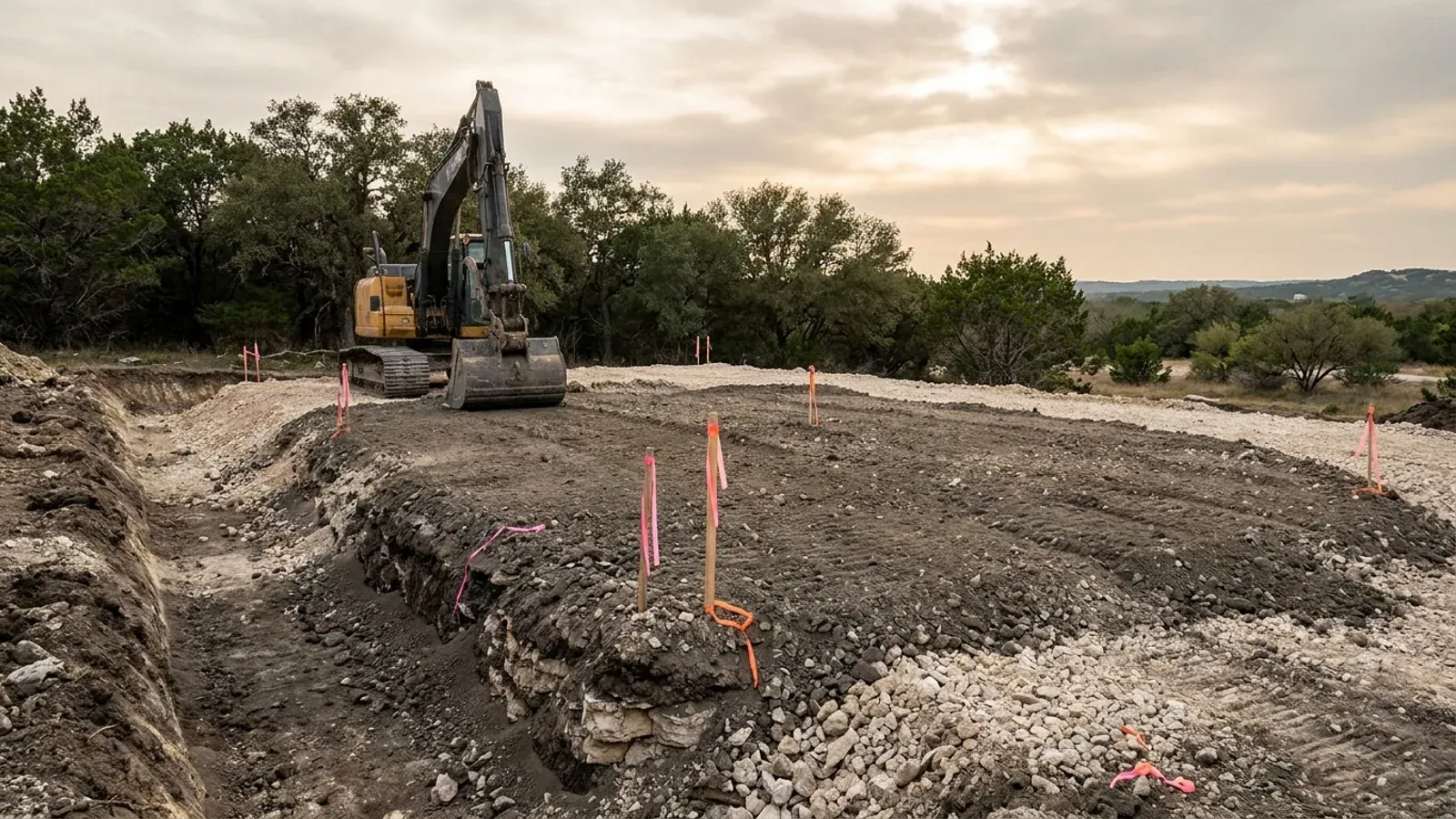
The expensive surprises are in the ground, not the building
What moves a Texas budget is usually below grade, and it is soil rather than rock: shrink-swell clay. The Blackland Prairie and the Gulf Coast clays move enough between a wet season and a dry one to drive the foundation design across the state's largest markets, which is why several DFW cities require an engineer's seal on the foundation of every new house. Those are the same conditions that decide whether a septic field passes its soil and site evaluation, so the grading plan, the foundation and the drainfield get resolved together rather than one at a time. We price the dirt before we price the building.
What we build in Wood County
All nine of our services — kits, custom plans, post-frame and steel construction, site preparation, permitting and engineering, through to turnkey builds — are available across Wood County. What a project costs depends far more on the parcel than on square footage, so we work from your land rather than from a rate card.
See what we buildWhat a build looks like
Three stages every Wood County project passes through, from a raw parcel to a finished home. Site work first, because that is where the budget is decided.
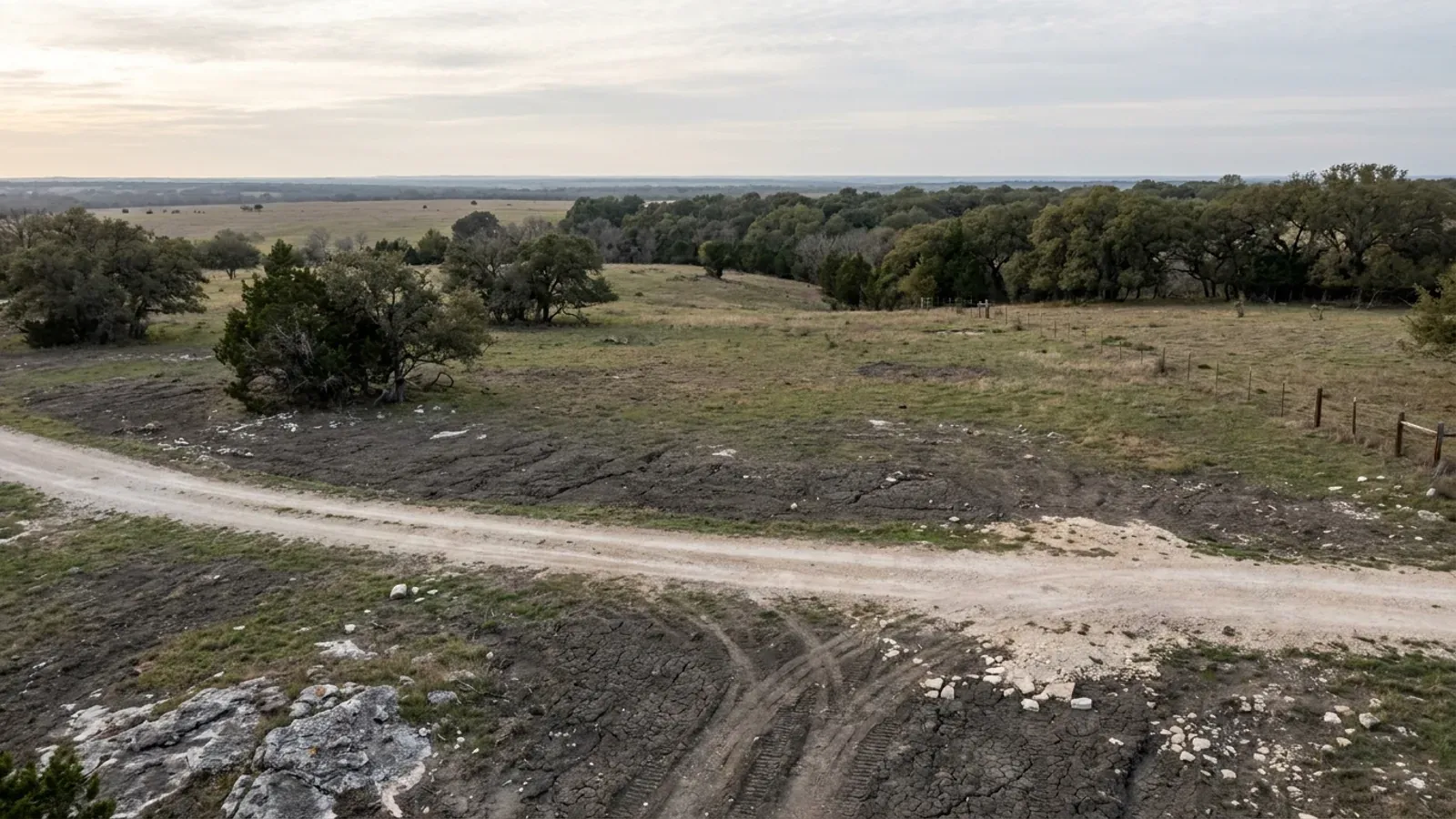
The parcel
Zoning, setbacks, flood zone and utility access get checked before anything is drawn.
Pad and permit
Clearing, grading and a compacted pad, while the submittal works through Wood County.
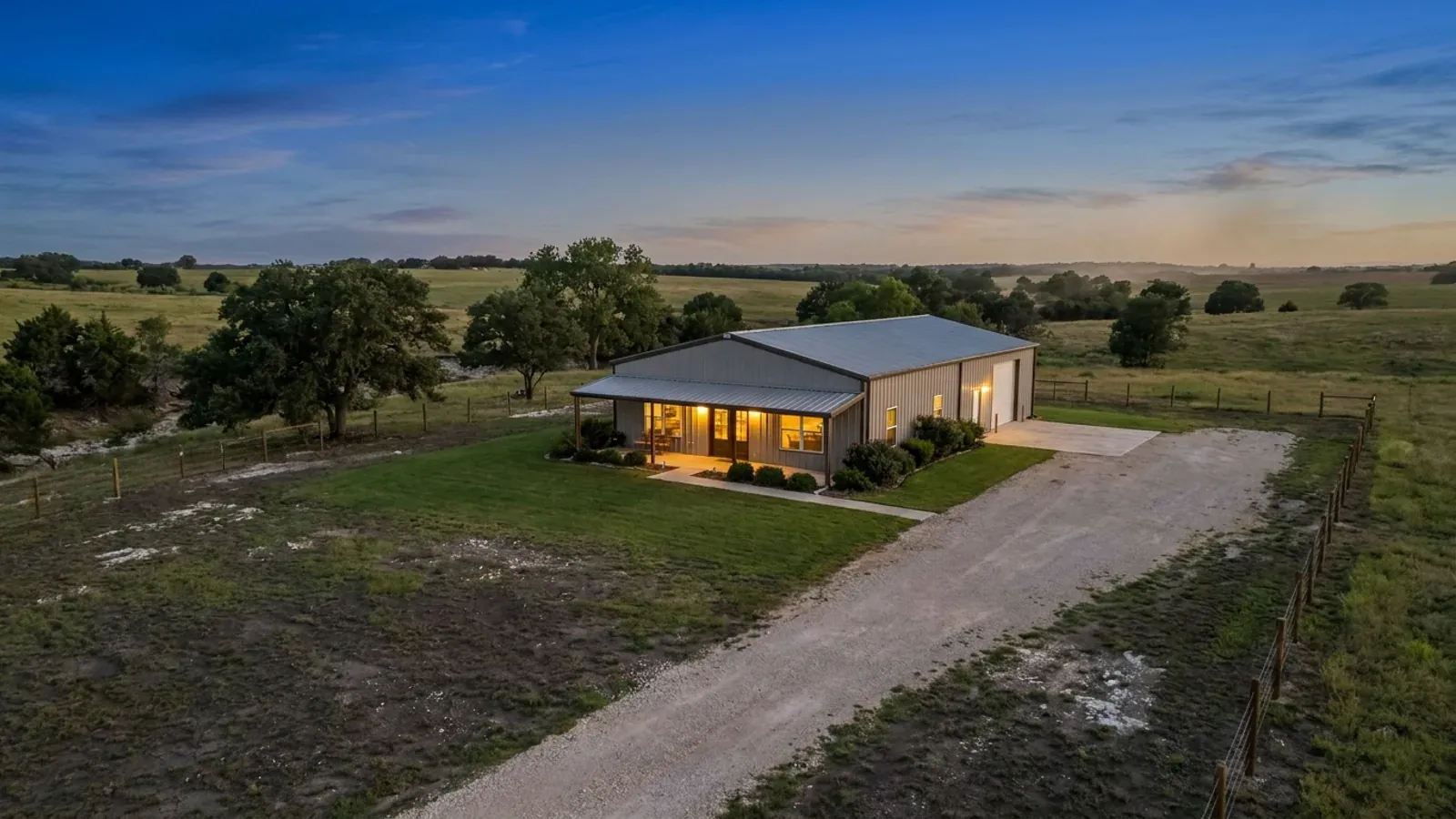
Frame to finish
Shell erected and dried in, then systems, insulation and interior finish through to CO.
Those are the rules for Wood County. Tell us what you want to build and we will draw it to them.
Where we build around Wood County
Wood County and the rural land around it. The buildable acreage for a project this size usually sits outside the city limits, which is frequently what changes who issues your permit.
Keep reading
The questions that usually come next once you know what Wood County allows.
Barndominium Cost Guide
Sourced per-square-foot ranges by tier and by size, with a calculator built on the same figures.
Read itIs It Legal in Texas?
Classification, zoning, the HOA gate, and why "nonresidential farm building" does not cover a home.
Read itHow Long Does It Take?
Census build-duration data, and what actually sets the permit clock where you are building.
Read itNearby areas we build in
Others we cover in this part of Texas. The permitting authority, the adopted design criteria and the zoning can all differ from one to the next.
Building in Wood County: common questions
10 questions we get asked most often about building in Wood County. If yours is not on the list, ask it directly.
Does Wood County have a building code, and will anyone inspect my barndominium?
Who permits my septic system out on Lake Fork — the county or the river authority?
Does having ten acres get me out of the septic permit?
The land is cheap and rural. What is most likely to catch me out?
Is the ground here sand or clay, and what does that mean for the slab?
Do I need the county's floodplain permit, and how much is it?
Does renting it out change anything?
I want to put several rental cabins or RV spaces on my land. Is that the same as building one house?
Quitman runs the 2024 code. Does that reach my land outside town?
So if the county does not inspect the house, what actually does get checked?
Building in Wood County?
Start with the plan. Tell us what you want to build and we will draw it, then confirm what Wood County will actually let you put on the parcel and what wind load it has to meet. That conversation costs nothing.