Barndominium Builders in Smith County, TX
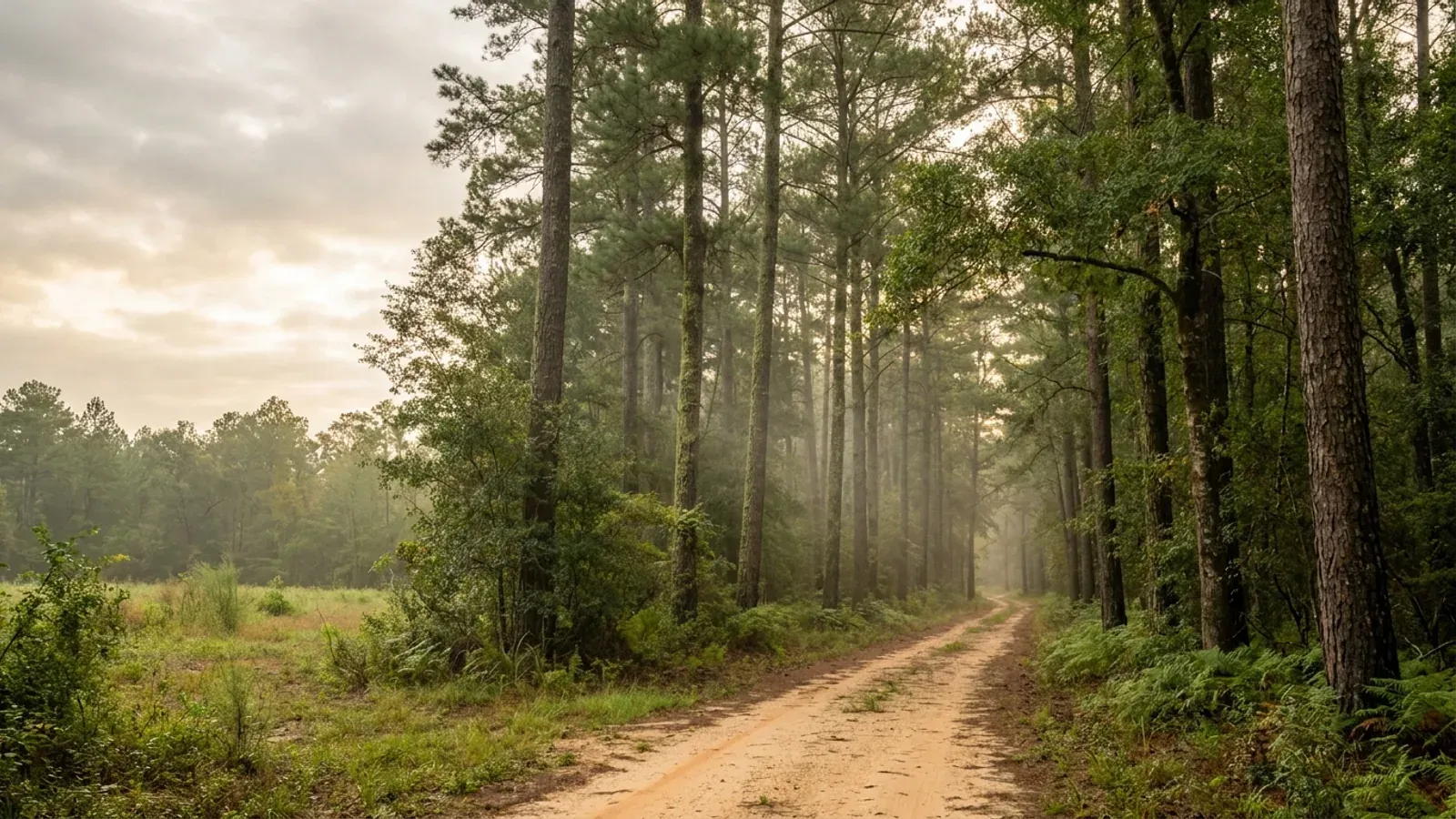
Smith County is the anchor of East Texas and the least metropolitan large county we build in. Tyler holds 113,723 of its 252,549 people; the other 107,566 live outside every city limit, spread across 834 square miles that make up more than nine tenths of the county's land. That is roughly 129 people to the square mile of unincorporated ground — thinner than a suburb, thicker than ranch country, and still filling up, with the unincorporated balance taking about three in every ten people the county has added since 2020. The ground is Piney Woods rather than Blackland: sandy loam at the surface across almost the whole county, with a clay horizon underneath it that decides where a drainfield can go. The county says its own position on building plainly. Its codified regulation library records, under Land Use, that other than subdivision regulations Smith County has no local building policies for construction in unincorporated areas. What actually gates a build here is the septic authorisation, a floodplain permit if the tract sits in a flood hazard area, and the restrictions recorded against the land itself.
Smith County at a glance
- County
- Smith County
- Population
- 252,549
- Where we build
- Tyler, Gregg County, Wood County, Henderson County
- Site visits
- We meet you on the tract, Tyler or anywhere else in Smith County
ZIPs 75701, 75702, 75703, 75704, 75705, 75706, 75707, 75708 and more
Building conditions in Smith County
What actually changes from one Texas jurisdiction to the next: who issues the permit, whether the residential code is enforced there at all, what the structure has to be engineered to, and what the ground is like. These are the numbers your drawings have to satisfy.
Smith County Codification Library, Section 10.01 Building and Construction Permit Policy — https://www.smith-county.com/172/County-Ordinances-Policies
TCEQ On-Site Sewage Facility Authorized Agent search, Smith County (county code 212), records for Smith County Authorized Agent, City of Noonday and Upper Neches River MWA — https://www.tceq.texas.gov/permitting/ossf/aa_search.html; Order Adopting Rules of Smith County, Texas for On-Site Sewage Facilities, Section 6
Order Adopting Rules of Smith County, Texas for On-Site Sewage Facilities, Sections 8 and 9, approved by TCEQ 7 April 2006, published in the TCEQ authorised agent register as the county's current order; 30 Texas Administrative Code ch. 285 Table III and TCEQ form TCEQ-0235
Smith County On-Site Sewage Facility page, Frequently Asked Questions — https://www.smith-county.com/507/On-Site-Sewage-Facility-; TCEQ rulemaking preamble amending 30 Texas Administrative Code sec. 285.3(f)(2), 2023
Smith County Flood Damage Prevention Regulation, adopted 8 September 2008, Article I sec. A, Article 3 secs. A and C, Article 5 sec. B(1) — https://www.smith-county.com/DocumentCenter/View/3098; Smith County Flood Plain Development Permit form — https://www.smith-county.com/DocumentCenter/View/1773
USDA-NRCS Soil Data Access, SSURGO survey area TX423 Smith County, chorizon and mapunit tables, queried 1 September 2026 — https://SDMDataAccess.sc.egov.usda.gov
Also worth knowing before you build in Smith County
- There is no groundwater conservation district here at all
- Groundwater district coverage is not statewide in Texas, and Smith County has none. The Texas Water Development Board's own 2021 joint-planning summary of modeled available groundwater by district files Smith County under the heading No District-County for all three relevant aquifers, the Carrizo-Wilcox, the Queen City and the Sparta. The nearest district stops at the line: the Neches and Trinity Valleys Groundwater Conservation District's 2025 management plan says it includes all of Cherokee, Anderson and Henderson counties. Nor has Smith County adopted the optional order under Local Government Code sec. 232.0032 requiring an engineer or geoscientist to certify that adequate groundwater is available for a subdivision. What remains is state law: a licensed water well driller and a state well report filed with the Water Development Board. That also means no district data and no district-set spacing.
- The county's own subdivision rules point at an agency abolished in 2009
- Section 2.5 of the Smith County Subdivision Regulations, in the edition revised 14 July 2023, carries a note saying the State of Texas through the Texas Residential Construction Commission requires all homes built in unincorporated areas or in cities without municipal inspections to be inspected at least three times before the buyer moves in, and directs the reader to contact that commission. The Texas Residential Construction Commission went through Sunset review in the 81st Legislature and was not continued; its Property Code chapters render as not found on the state statutes site while neighbouring chapters render in full. The note is a survival, not a live requirement. In unincorporated Smith County nobody inspects a house unless the owner or builder hires them.
- Tyler's extraterritorial jurisdiction is split into two zones with different plat authorities
- Smith County publishes the interlocal agreements that Local Government Code sec. 242.001 requires, in a table in its subdivision regulations. The county regulates subdivision in the extraterritorial jurisdictions of Arp, Hide-a-Way, New Chapel Hill, Noonday, Overton, Winona and Tyler Zone 3; the city regulates its own in Bullard, Lindale, Troup, Whitehouse and Tyler Zone 2. Two zones of the same city's outer ring, two different plat authorities. The county adds that these agreements do not give up drainage requirements set by TCEQ, constitutional limits on the county accepting road dedications, or county authority over manufactured-home rental communities.
- The Fire Marshal can inspect without a fire code, and the fee schedule shows the line
- Smith County's Fire Marshal's Inspections Division states that under Local Government Code sec. 352.016 all fire and life safety inspections in the unincorporated county must be performed by a fire inspector or approved designee, and names NFPA 101 and NFPA 1 as the inspection standard. The statute is the reason a standard can be named without a code being adopted: sec. 352.016(b) says that in the absence of a county fire code the marshal may inspect using any nationally recognized code or standard adopted by the state, and that the marshal shall inspect a structure if called on to do so. Subsections (c) and (d) let the county charge a business, multi-family dwelling or commercial property outright, but a single-family residence only where the owner requests the review. The county's published inspection fee schedule matches: apartment buildings from 200 dollars, commercial, industrial, restaurants, daycares, group and foster homes all priced, and no line at all for a one- or two-family dwelling.
- A licensed plumber is required even where nobody inspects
- The rural exemption in the Texas Plumbing License Law expressly does not reach plumbing performed in conjunction with new construction. So a Texas-licensed plumber is required on a new house on unincorporated Smith County land regardless of the county's building-code position, and regardless of the fact that no county inspector is coming to look at anything but the septic system. It is the clearest example that no county building code does not mean no rules.
- The state energy code reaches this land whatever the county does
- Health and Safety Code sec. 388.004 obliges a builder outside any municipality to certify that a new single-family house complies with the state energy standard and to keep that certification for three years. It applies in unincorporated Smith County whether or not the county has adopted anything. Smith County is climate zone 3A, hot-humid, on both the pre-2021 and the 2021 energy code maps — so unlike the counties around Dallas and Fort Worth, the answer here does not change with the edition.
- There is no percolation test in Texas, and a site can fail at both ends
- Texas does not use the percolation method at all. Chapter 285 classifies soil by texture class and assigns each a loading rate, from sandy Class Ia down to clay Class IV at a tenth of a gallon per square foot per day. Clay needs a very large drainfield. But the fast end fails too: the rules state that Class Ia soils do not provide adequate treatment of wastewater through soil contact, which forces imported soil or secondary treatment with disinfection. Both ends occur in Smith County, sometimes in the same profile — sand at the top, clay at trench depth. Only a registered sanitarian or a professional engineer can decide what system a site needs, and the county's own page says so.
- Platting is what the county actually reviews, and the fees are published
- Smith County adopted subdivision regulations under Local Government Code Chapter 232 on 23 February 2009, revised 14 July 2023. A final plat has to carry a water-system statement showing the source can deliver at 25 psi, a septic plan meeting both TCEQ's requirements and the county's designated representative's, a written 911 clearance letter so addresses can be issued, a tax certificate, and a TCEQ notice for any pond not wholly inside a single tract. Published plat fees are 25 dollars for a resubdivision or lot-line adjustment, 100 dollars where no roads are built and 250 dollars where roads are, with a construction bond of 20 dollars a foot and a maintenance bond of 30 dollars a foot on new roads. Approval is a Commissioners Court item in open session.
- The plat exemptions here are the statute's, with nothing added
- Some Texas counties bolt consequences onto the platting exemptions — one makes exempt land ineligible for an emergency address or a septic permit. Smith County does neither. Appendix 10 of its subdivision regulations reproduces Local Government Code sec. 232.0015 and adopts it as if copied in full, with no additional condition. So the agricultural, farm, ranch, wildlife management and timber use exemption, the exemption for four or fewer parts transferred to relatives within the third degree, and the exemption where every lot is more than ten acres all work on their own statutory terms here — including the snap-back in subsection (d), which brings the platting requirement straight back if the tract stops being used for agriculture.
- Where the land actually is: 834 square miles outside every city
- Smith County covers 921.5 square miles of land. Netting out the incorporated area of Tyler, Lindale, Whitehouse, Hideaway, Arp, Noonday, Winona, New Chapel Hill and the county's shares of Bullard, Troup and Overton leaves about 834 square miles unincorporated — more than nine tenths of the county's land, holding 107,566 people, or roughly 129 to the square mile. The frontier is at the edges: Bullard is up 39 percent since 2020, Noonday 28 percent, Lindale 23 percent and Whitehouse 21 percent, while Tyler itself grew 7 percent. The unincorporated balance absorbed about three in every ten people the county added.
- Stormwater rules do reach the unincorporated county
- Smith County and the City of Tyler are each a Regulated Small Municipal Separate Storm Sewer System under TCEQ's Texas Pollutant Discharge Elimination System general permit, and they signed an interlocal agreement in January and February 2008 to run the programme together. Under it Smith County takes responsibility for parts of the urbanized area outside Tyler's corporate limits. It is a water-quality programme rather than a building one, but it is another reminder that unincorporated does not mean unregulated.
Texas Water Development Board, Groundwater Management Area 11, Modeled Available Groundwater by Groundwater Conservation District, 2021 Joint Planning — https://www.twdb.texas.gov/groundwater/dfc/docs/summary/GMA11_MAGsbyGCD_2021.pdf; Neches and Trinity Valleys GCD Management Plan approved 10 January 2025
Smith County Subdivision Regulations, revised 14 July 2023, sec. 2.5 — https://www.smith-county.com/DocumentCenter/View/3067; Sunset Advisory Commission, Texas Residential Construction Commission agency page
Smith County Subdivision Regulations, revised 14 July 2023, sec. 2.1 Table 1, Subdivision Regulation Authority — https://www.smith-county.com/DocumentCenter/View/3067; Texas Local Government Code sec. 242.001
Smith County Fire Marshal Inspections — https://www.smith-county.com/380/Fire-Marshal-Inspections; Texas Local Government Code sec. 352.016 — https://tcss.legis.texas.gov/resources/LG/pdf/lg.352.pdf
Texas Occupations Code sec. 1301.052 — https://statutes.capitol.texas.gov/Docs/OC/htm/OC.1301.htm
Texas Health and Safety Code ch. 388 secs. 388.003 and 388.004 — https://statutes.capitol.texas.gov/Docs/HS/htm/HS.388.htm; U.S. Department of Energy county climate zone assignments for Texas FIPS 48423
30 Texas Administrative Code ch. 285 secs. 285.30 and 285.33(b)(4)(D); Smith County On-Site Sewage Facility page — https://www.smith-county.com/507/On-Site-Sewage-Facility-
Smith County Subdivision Regulations, revised 14 July 2023, secs. 4.1.6 to 4.1.9 and 4.2 — https://www.smith-county.com/DocumentCenter/View/3067; Smith County Subdivision Log Form Check List — https://www.smith-county.com/DocumentCenter/View/1772
Smith County Subdivision Regulations, revised 14 July 2023, Appendix 10 — https://www.smith-county.com/DocumentCenter/View/3067; Texas Local Government Code sec. 232.0015
U.S. Census Bureau, Vintage 2025 county and sub-county population estimates and the 2024 Gazetteer county and place files
Interlocal Cooperation Agreement for Storm Water Management between the City of Tyler and Smith County, executed 24 January and 13 February 2008 — https://www.smith-county.com/DocumentCenter/View/3101
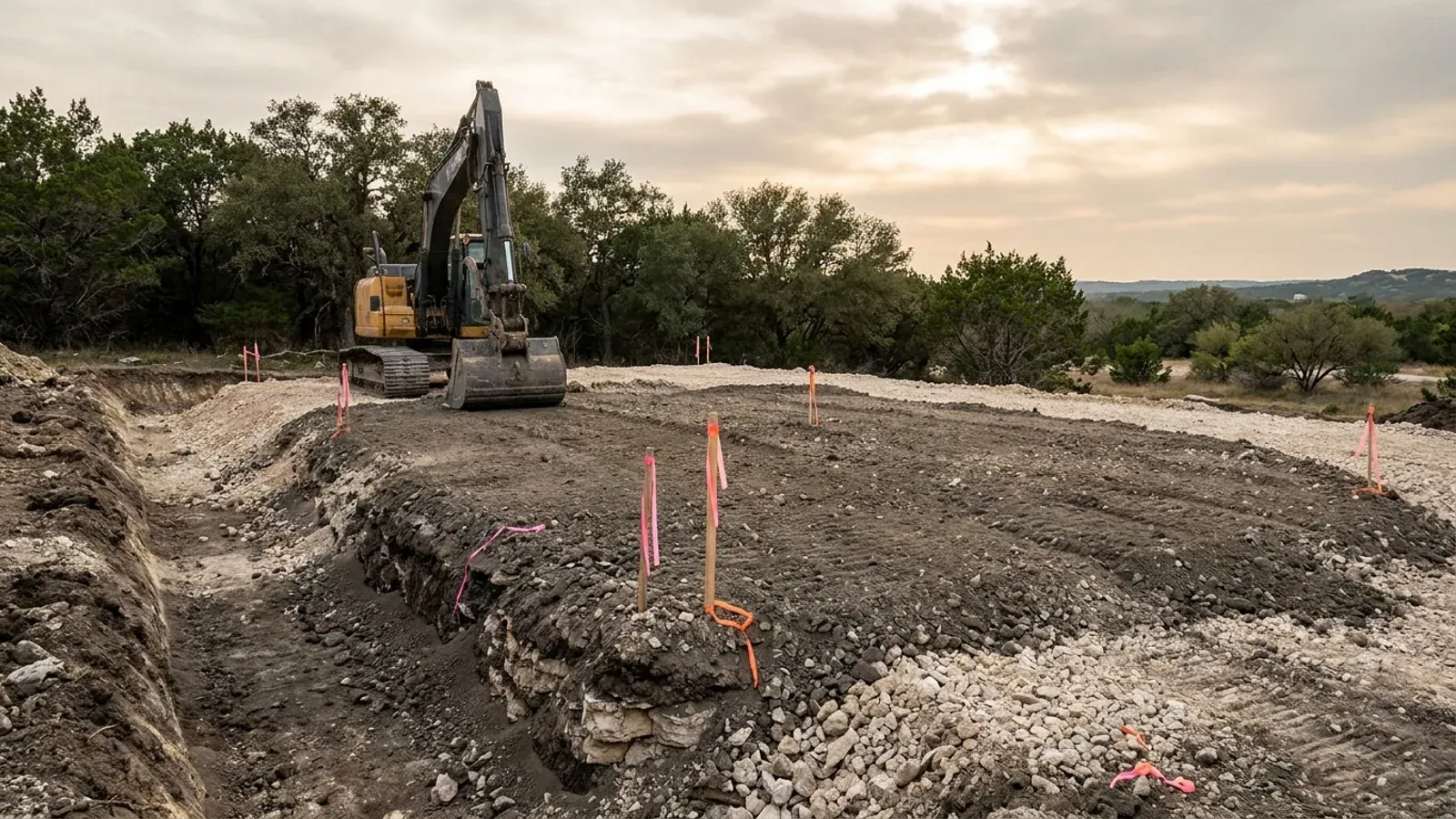
The expensive surprises are in the ground, not the building
What moves a Texas budget is usually below grade, and it is soil rather than rock: shrink-swell clay. The Blackland Prairie and the Gulf Coast clays move enough between a wet season and a dry one to drive the foundation design across the state's largest markets, which is why several DFW cities require an engineer's seal on the foundation of every new house. Those are the same conditions that decide whether a septic field passes its soil and site evaluation, so the grading plan, the foundation and the drainfield get resolved together rather than one at a time. We price the dirt before we price the building.
What we build in Smith County
All nine of our services — kits, custom plans, post-frame and steel construction, site preparation, permitting and engineering, through to turnkey builds — are available across Smith County. What a project costs depends far more on the parcel than on square footage, so we work from your land rather than from a rate card.
See what we buildWhat a build looks like
Three stages every Smith County project passes through, from a raw parcel to a finished home. Site work first, because that is where the budget is decided.
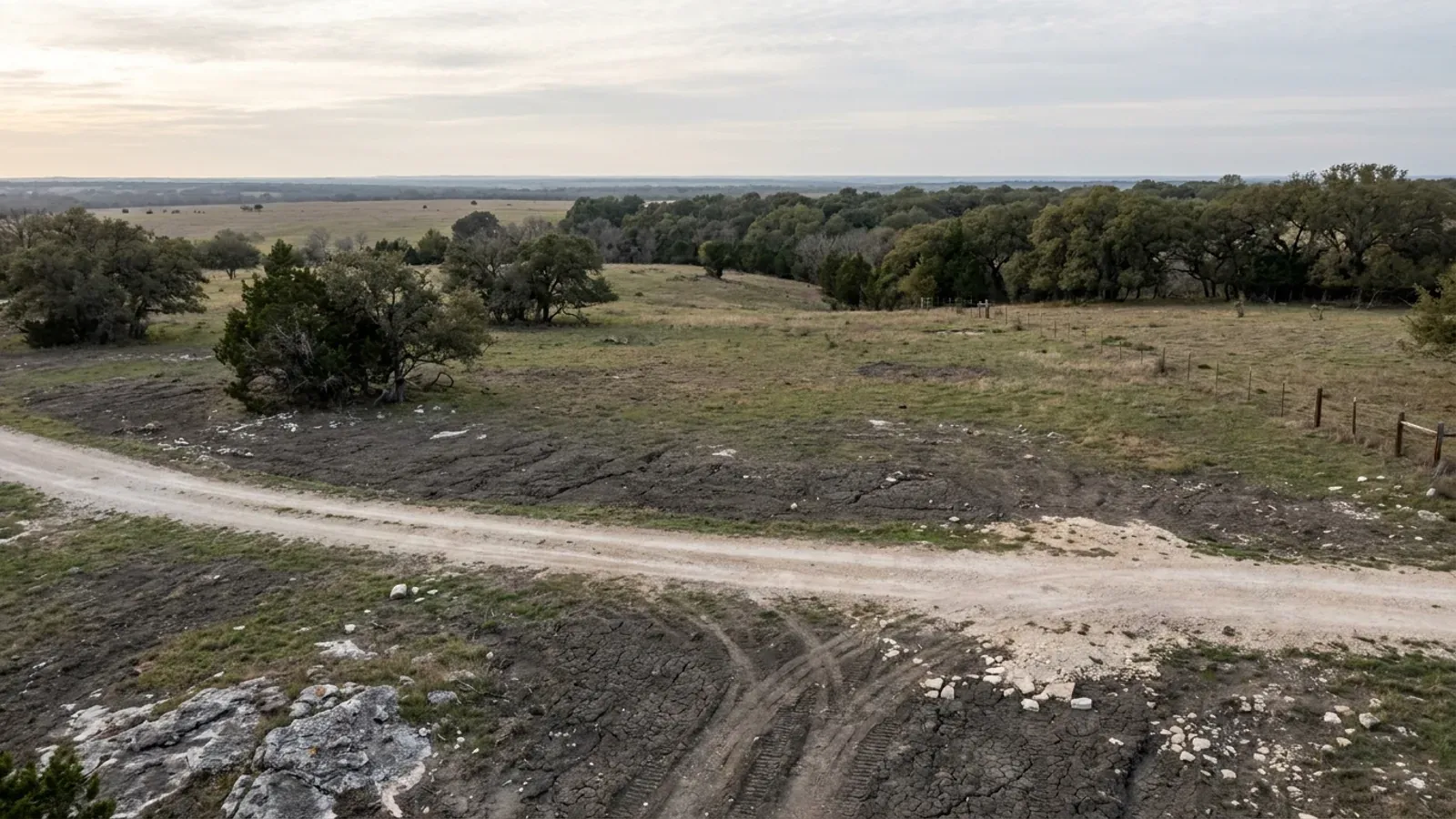
The parcel
Zoning, setbacks, flood zone and utility access get checked before anything is drawn.
Pad and permit
Clearing, grading and a compacted pad, while the submittal works through Smith County.
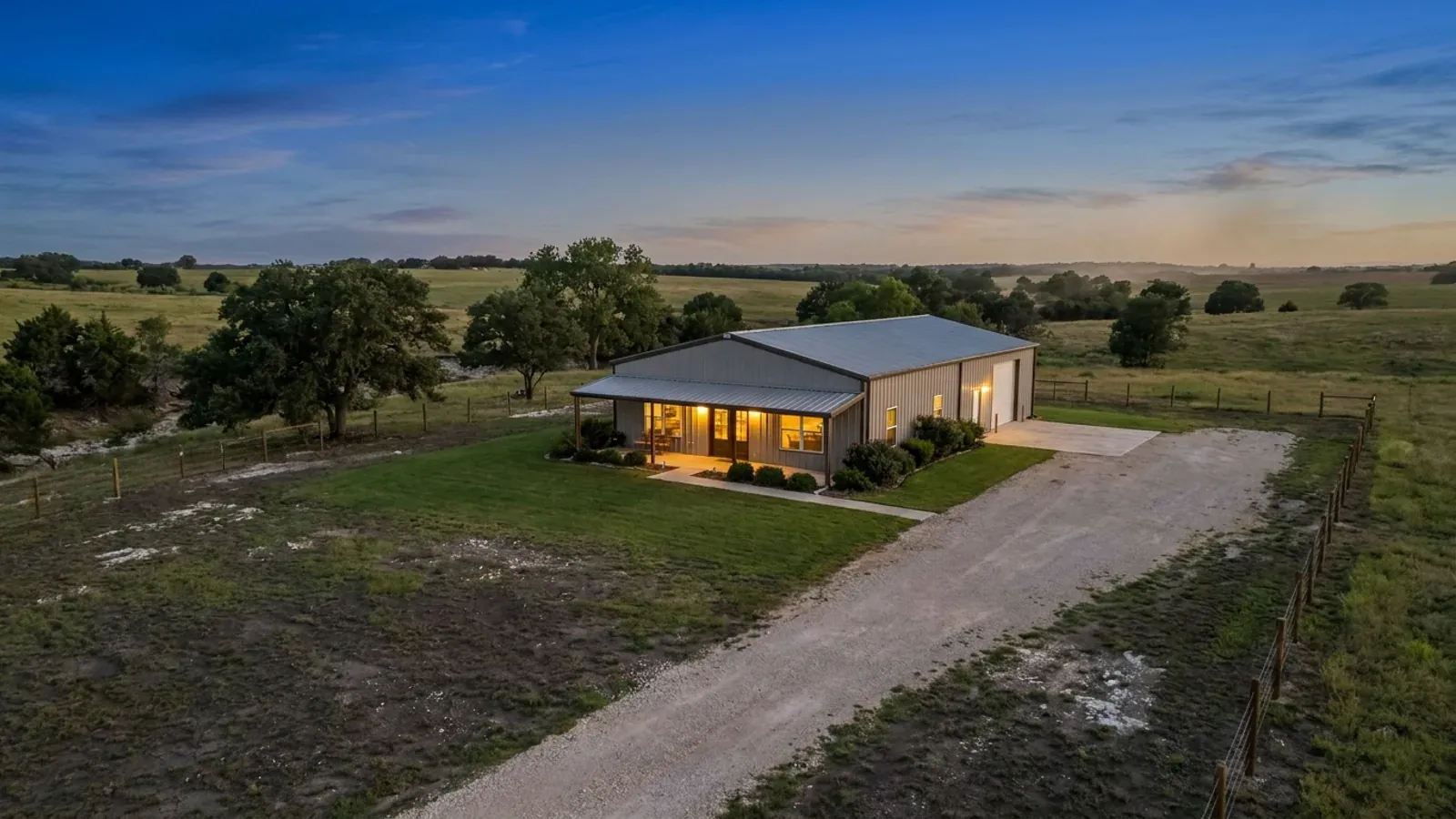
Frame to finish
Shell erected and dried in, then systems, insulation and interior finish through to CO.
Those are the rules for Smith County. Tell us what you want to build and we will draw it to them.
Where we build around Smith County
Smith County and the rural land around it. The buildable acreage for a project this size usually sits outside the city limits, which is frequently what changes who issues your permit.
Keep reading
The questions that usually come next once you know what Smith County allows.
Barndominium Cost Guide
Sourced per-square-foot ranges by tier and by size, with a calculator built on the same figures.
Read itIs It Legal in Texas?
Classification, zoning, the HOA gate, and why "nonresidential farm building" does not cover a home.
Read itHow Long Does It Take?
Census build-duration data, and what actually sets the permit clock where you are building.
Read itNearby areas we build in
Others we cover in this part of Texas. The permitting authority, the adopted design criteria and the zoning can all differ from one to the next.
Building in Smith County: common questions
9 questions we get asked most often about building in Smith County. If yours is not on the list, ask it directly.
Does Smith County have a building code, and do I need a permit to build?
So who inspects my house out here?
If there is no building permit, what actually gates the build?
How much land do I need for the septic system, and does the shop count?
I have more than ten acres. Does that exempt me from the septic rules?
What about the water well?
Is the ground here the expansive clay everyone warns about in Dallas and Waco?
What changes inside Tyler, Lindale, Whitehouse or the other towns?
Does any of this change if I rent the barndominium out?
Building in Smith County?
Start with the plan. Tell us what you want to build and we will draw it, then confirm what Smith County will actually let you put on the parcel and what wind load it has to meet. That conversation costs nothing.