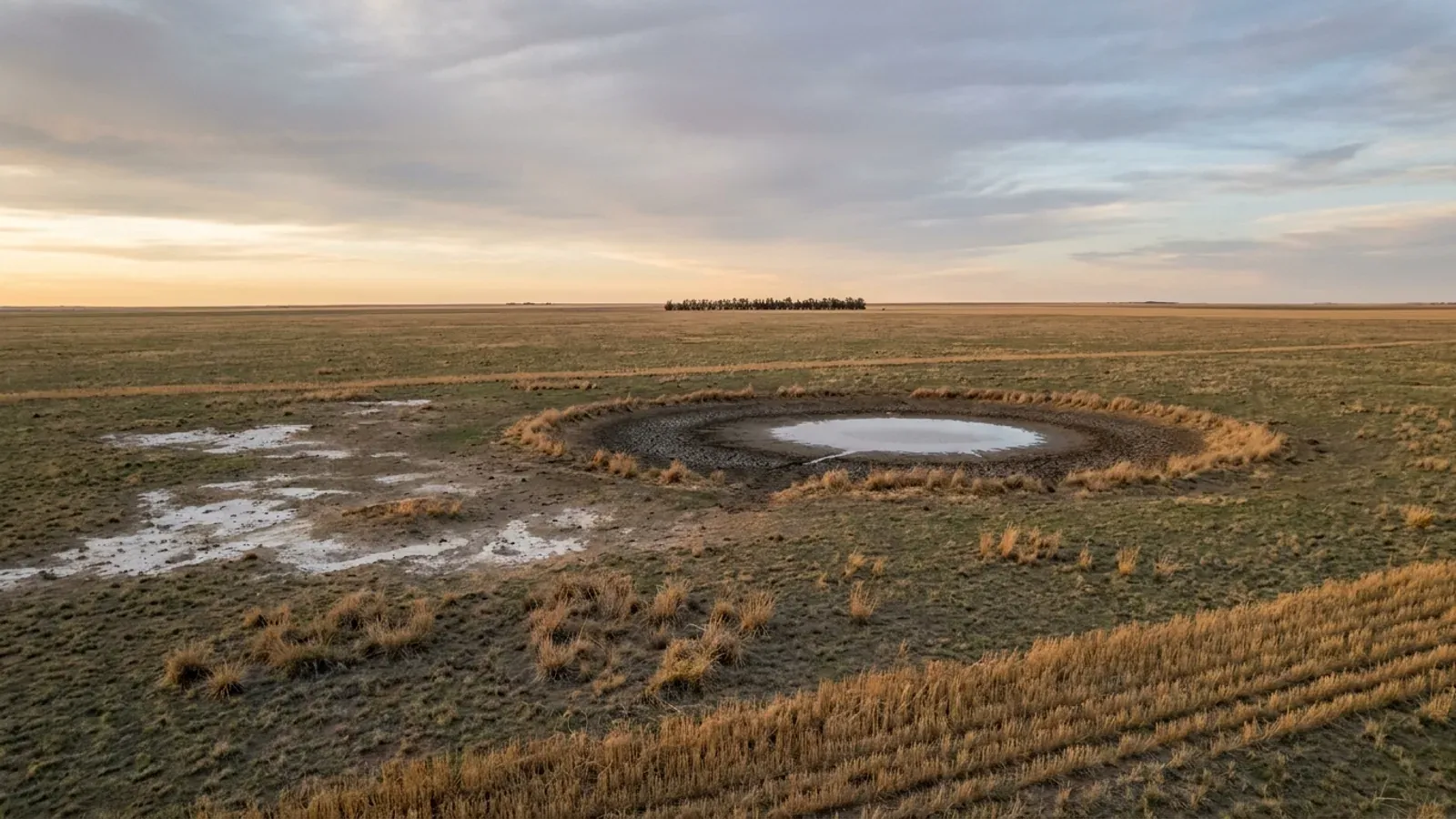
The flat short-grass High Plains of the Texas Panhandle, with a shallow playa basin holding water and pale caliche showing on a low rise.
Wichita County Edition set by the jurisdiction

Barndominium Builders in Wichita County, TX

Wichita County is the most citified county we build in and the emptiest once you cross the city line. Wichita Falls holds 101,949 of the county's 129,555 people, and about 7,100 live outside every city limit — five and a half percent of them, spread across roughly 530 square miles of the county's 628. That is near thirteen people to the square mile of unincorporated ground, thinner than any Texas county measured on this site. The ground is Rolling Red Plains, neither Blackland nor Piney Woods. Close to three quarters of the mapped acreage reads under thirty percent clay at the surface, while more than half carries thirty-five percent clay or more between eight inches and a metre down, which is where a slab and a drainfield sit. What gates a build here is not a building code. It is the septic authorisation, a floodplain permit inside a mapped hazard area, the airport zoning around Sheppard, and the mineral estate beneath 8,301 oil wells.

Wichita County at a glance

County
Wichita County
Population
129,555
Where we build
Wichita Falls, Abilene

ZIPs 76301, 76302, 76305, 76306, 76308, 76309, 76310, 76311 and more

Site visits
Site walks booked county-wide, Wichita Falls included

Building conditions in Wichita County

What actually changes from one Texas jurisdiction to the next: who issues the permit, whether the residential code is enforced there at all, what the structure has to be engineered to, and what the ground is like. These are the numbers your drawings have to satisfy.

Build conditions for Wichita County , Texas . BUILD CONDITIONS WICHITA COUNTY, TXWichita CountyEDITION PER JURISDI…ADOPTED RESIDENTIAL CODEEDITION PER JURISDI…This jurisdiction publishes no design wind speed. It is settled in writing with the authority overyour parcel before the frame is ordered.ZONING · NONE — A TEXAS COUNTY CANNOT ZONEHalf an acre on a public water suppl…Local Government Code sec. 233.153(d)(2) does not authorise acommissioners court to adopt or enforce zoning. But one land-use…WHO ISSUES THE PERMITWichita County Commissioners Court…Wichita County Commissioners Court, 900 7th Street, Room 270,Wichita Falls, TX 76301, (940) 766-8106; county switchboard (940)…
Build conditions for Wichita County, drawn from the sourced facts on this page. Every figure above is cited in the quick-facts panel below, with its source and vintage.
No county building code is on the record, and the record itself stops in 2021
Three separate routes were run at the question of whether Wichita County ever opted into the residential building code statute, and all three came up empty for the same structural reason. The county publishes no code of ordinances and no codified regulation library on its own domain — its site index lists 72 pages and 421 documents, and the only county-adopted instruments among them are the flood damage prevention ordinance and burn-ban orders. Its agendas and minutes archive filters by year and offers 2021 forward only. The archived copy of the county's retired website carries a commissioners court minutes archive that itself begins in 2012. So the August-to-October 2009 window, in which every confirmed Texas opt-in on this build landed, cannot be searched at all. And Local Government Code sec. 233.152 places no publication duty on a county, so an absent order is not the same as no order. The honest answer is that it is unestablished, and the county's phone number is the way to close it.

Wichita County site index and agendas archive — https://wichitacountytx.com/agendas/ and https://wichitacountytx.com/wp-sitemap.xml; archived Wichita County Commissioners' Court Minutes Archive — https://web.archive.org/web/20130402130633/http://www.co.wichita.tx.us:80/Commissioner/minutes/minutes.html; Texas Local Government Code sec. 233.152 — https://tcss.legis.texas.gov/resources/LG/htm/lg.233.htm

Seven septic designations in one county, and one office runs all of them
TCEQ's authorised agent register returns seven records for Wichita County. The county itself holds a designation whose area served is the entire county except the Town of Pleasant Valley; Pleasant Valley holds its own for its town limits; and the Cities of Burkburnett, Electra, Iowa Park, Cashion Community and Wichita Falls each hold a separate designation of their own. Every one of those five city records carries the same note: administered by the Wichita Falls / Wichita County Public Health District. The county's own order says the same thing from the other direction, naming that health district as the Designated Representative under 30 Texas Administrative Code sec. 285.2(17) for administration and enforcement inside its jurisdictional area. Seven pieces of paper, one counter. TCEQ files the county in Region 3, Abilene.

TCEQ On-Site Sewage Facility Authorized Agent search, Wichita County code 243, seven records returned — https://www.tceq.texas.gov/permitting/ossf/aa_search.html; An Order Governing On-Site Sewage Facilities in Wichita County, Section 8, adopted 5 October 2018 — https://www.wichitafallstx.gov/DocumentCenter/View/41715

The ten-acre septic exemption is dead here, and the order kills it by section number
The idea that ten acres frees you from the septic permit is alive in some Texas counties and dead in others, and Wichita County is emphatic. Section 7(a) of its on-site sewage facility order says a permit shall be required for all on-site sewage facilities regardless of acreage, and that the exception found in 30 Texas Administrative Code sec. 285.3(f)(2) shall not apply in the unincorporated areas of the county. Naming the state subsection it is displacing leaves no room to argue. The same section list goes further than most: a permit does not transfer automatically when the property is sold, and within 60 days before the sale or transfer of any property carrying a permitted system the seller has to pay an inspection fee and have the system inspected by a licensed designated representative of the health district. Fail that inspection and the permit is deemed invalid, and buyer or seller must apply for a new one.

An Order Governing On-Site Sewage Facilities in Wichita County, Section 7(a)-(c), adopted by the Commissioners Court 5 October 2018 and approved by the TCEQ Executive Director 6 December 2018 — https://www.wichitafallstx.gov/DocumentCenter/View/41715

In a flood hazard area the county wants 18 inches, and it will not take your drawings
Wichita County's Flood Damage Prevention Ordinance, passed by the Commissioners Court in August 2021 under Texas Water Code sec. 16.315, requires new residential construction and substantial improvement inside a special flood hazard area to have the lowest floor, including any basement, elevated to one and one half feet above the base flood elevation. A registered professional engineer, architect or land surveyor has to certify that before construction, and after it — before occupancy and before permanent utilities go in — a letter from one of them has to reach the Floodplain Administrator verifying the elevations. An amendment adopted 8 October 2021 tightened the paperwork: all surveys, site plans and drawings must be sealed by a professional engineer or registered surveyor, the completion letter must be on company letterhead and sealed, and hand-drawn plans presented by a property owner or builder will not be accepted. Outside the mapped hazard area none of this applies.

Wichita County Flood Damage Prevention Ordinance, Article I Section A, Article 4 Section C(1) as amended 8 October 2021, and Article 5 Section B(1) — WC_FloodDamagePreventionOrdinance_8-3-2021.pdf, published at https://wichitacountytx.com/download/flood-damage-prevention-ordinance/

Three quarters of the county reads loam on top and half of it is high-shrink clay underneath
This is the Rolling Red Plains, and the profile behaves nothing like the Blackland Prairie or the East Texas sands. Measured against the USDA soil survey for Wichita County, of 391,860 mapped acres about 284,500 have a surface horizon under thirty percent clay, but roughly 218,100 carry thirty-five percent clay or more somewhere between twenty centimetres and one metre down, and about 194,100 acres have a horizon rated at a linear extensibility of 6 or higher, which is the high shrink-swell band. The county's largest single map unit shows it exactly: Kamay silt loam on one to three percent slopes, 50,493 acres, reads twenty percent clay with a linear extensibility of 1.5 for the first twenty-five centimetres and then 42.5 percent clay at 7.5 all the way to two metres. A hand auger in the topsoil tells you the wrong thing about both the slab and the drainfield.

USDA-NRCS Soil Data Access, SSURGO survey area TX485 Wichita County, mapunit, component and chorizon tables, queried 1 September 2026 — https://SDMDataAccess.sc.egov.usda.gov

One land-use control does reach unincorporated ground here, and it issues permits
The usual Texas answer is that nothing outside a city limit decides what you may build. Around Sheppard Air Force Base that is wrong. Section 6410 of the City of Wichita Falls zoning appendix applies its airport regulations to all incorporated areas of the city and to unincorporated areas lying within an accident potential zone, a noise zone or a height restriction zone, and Section 6465 requires a permit for any structure inside an accident potential zone and for any use or structure inside a height restriction zone. The land use compatibility table at Section 6485 then decides the use itself: a detached single-family dwelling is marked N in the Clear Zone and in Accident Potential Zone I, Y with note 1 in Accident Potential Zone II, and N above 75 decibels day-night average. Note 1 caps density at one to two dwelling units per acre or lot coverage under twenty percent, whichever is greater. Note 3 bars any building, structure or above-ground utility from the Clear Zone outright. Local Government Code sec. 241.902 provides that where an airport compatible land use regulation conflicts with another regulation, the airport regulation controls. This is not a building code, and none of the Texas case law limiting a city's building-code reach outside its limits touches it.

City of Wichita Falls Code of Ordinances, Appendix B Zoning, secs. 6410, 6465 and 6485 with Notes 1 and 3 (Ord. No. 155-94, 20 December 1994; Ord. No. 32-2001, 3 April 2001; Ord. No. 8-2006, 7 February 2006) — https://wichitafallstx.gov/DocumentCenter/View/24510/Sec_6400_Airport_Zoning; Texas Local Government Code sec. 241.902 — https://tcss.legis.texas.gov/resources/LG/htm/lg.241.htm

Also worth knowing before you build in Wichita County

8,301 oil wells in 628 square miles, and the mineral estate outranks the house
This is old North Texas oil country and the numbers are not historical. The Railroad Commission's oil well count by county for February 2025 lists Wichita County with 4,249 regular producing wells, 806 shut-in, 2,493 shut-in under Rule 14(b)(2) and 753 injection wells — 8,301 in total, across a county of 628 square miles. That is about thirteen wells to the square mile. Under Texas law the mineral estate is the dominant estate, and the accommodation doctrine that limits it protects an existing surface use. In Merriman v. XTO Energy the Supreme Court of Texas noted that the landowner's home and barn were on the tract, and he still lost. A house you have not built yet is not an existing use at all. Whether the minerals under a particular tract were severed is a title question, answered by the County Clerk's records and the title commitment, not by anything the county publishes.

Railroad Commission of Texas, Oil Well Counts by County as of February 2025 — https://www.rrc.texas.gov/media/043piafg/oilwellct-021225.pdf; Merriman v. XTO Energy, Inc., No. 11-0494 (Tex. 2013)

And in the noise zones the city can stop the water being turned on
Section 6465(A)(2) of the Wichita Falls zoning appendix covers land inside the 65 decibel or greater noise contour shown in the current Air Installation Compatible Use Zone study for Sheppard Air Force Base. A permit is required there for any use or structure the compatibility table identifies as needing noise attenuation, and it issues only when the building official has approved the attenuation measures. The enforcement clause is the part worth reading twice: for commercial property no certificate of occupancy issues until compliance is confirmed by inspection, and for residential land uses required to attenuate, no water sales by the city or by the appropriate water districts or supply corporations shall be permitted until compliance is realised through inspection and approval of the building official. On a rural tract on a rural supply corporation, that is a real gate, and it is one that does not exist anywhere else in this county. Note 11 to the table sets the standard: residential use is discouraged between 65 and 69 decibels, strongly discouraged between 70 and 75, and prohibited above 75.

City of Wichita Falls Code of Ordinances, Appendix B Zoning, sec. 6465(A)(2) and sec. 6485 Note 11 — https://wichitafallstx.gov/DocumentCenter/View/24510/Sec_6400_Airport_Zoning

The county rewrote the state's aerobic sizing table with one of its own
Most Texas counties adopt the state septic rules and add a short list of departures. Wichita County's list includes something unusual: Section 7(i) of its order replaces the aerobic treatment unit sizing chart at Table II of 30 Texas Administrative Code sec. 285.91(2) with a chart of the county's own. It sizes on bedrooms or floor area, whichever drives the bigger number — three or fewer bedrooms and under 2,501 square feet gets 450 gallons a day, four bedrooms or 2,501 to 3,500 square feet gets 600, and the steps continue to 1,500 gallons a day at ten bedrooms or 11,500 square feet, with 150 gallons added for each further bedroom or each additional 1,500 square feet of living area. The chart's own wording is size of home and living area. Whether an attached shop bay counts toward that is the question a barndominium owner needs answered before the field is sized, and it is one for the health district's counter, not a website.

An Order Governing On-Site Sewage Facilities in Wichita County, Section 7(i), adopted 5 October 2018 — https://www.wichitafallstx.gov/DocumentCenter/View/41715; 30 Texas Administrative Code sec. 285.91(2) Table II

The septic fees are published, and they moved on 1 October 2025
The Wichita Falls-Wichita County Public Health District publishes what it charges for the work it does in the areas where it holds designated representative authority. As of 1 October 2025 a new conventional system inspection is 295 dollars, a new proprietary system with ongoing maintenance is 325 dollars, both figures including the 10 dollar state fee, a property transfer or existing system inspection is 178 dollars, and an additional site visit is 118 dollars. The district notes that the fee covers up to two site visits and that a further trip costs extra. The 10 dollar state element is not the county's: the county's own order directs it to the On-Site Wastewater Treatment Research Council under Health and Safety Code Chapter 367.

Wichita Falls-Wichita County Public Health District, OSSF Fees & Forms, new fees effective 1 October 2025 — https://www.wichitafallstx.gov/959/OSSF-Fees-Forms; An Order Governing On-Site Sewage Facilities in Wichita County, Section 9

Two airfields, not three, and no joint zoning board runs either
The naming trips people up. Section 6407 of the Wichita Falls zoning appendix defines Airport as Sheppard Air Force Base / Wichita Falls Regional Airport and Kickapoo Downtown Airport. The first of those is one shared civil-military field carrying two names, not two separate airfields, so the ordinance governs two airports in total. On the governance question, Texas law would allow two or more governments to create a joint airport zoning board where an airfield owned by a federal defence agency is involved, under Local Government Code sec. 241.014, with county seats on it. That is not what happened here. Section 6415 makes the City Commission itself responsible for all the duties and powers granted to an Airport Zoning Board, so the city acts alone, and its authority to reach beyond its limits comes from sec. 241.013, which is available to a political subdivision of more than 45,000 people. Wichita Falls stands at 101,949. Nothing in this arrangement gives Wichita County a vote.

City of Wichita Falls Code of Ordinances, Appendix B Zoning, secs. 6405-6455 (Ord. No. 155-94, 20 December 1994; Ord. No. 32-2001, 3 April 2001; Ord. No. 8-2006, 7 February 2006) — https://wichitafallstx.gov/DocumentCenter/View/24510/Sec_6400_Airport_Zoning; Texas Local Government Code secs. 241.011-241.014 — https://tcss.legis.texas.gov/resources/LG/htm/lg.241.htm

The airport rule that has no height floor is the one about glare
Most people assume airport zoning is a rule about tall things. Near Sheppard the sharper limb is Section 6455(A), which says that no use shall be made of land within any zone established by the ordinance in a way that creates electrical interference with navigational signals, makes it difficult for pilots to distinguish between airport lights and others, results in glare in the eyes of pilots, impairs visibility near the airport, creates bird strike hazards, or otherwise endangers aircraft. There is no height trigger in that sentence at all, which means yard lighting, a large reflective roof or a pond can be in scope where a low building is not. Section 6455(B) is the height limb, and it is unusually long: nothing may be placed or grown so as to penetrate a 100-to-1 slope from any point on a runway out to the limits of the extraterritorial jurisdiction without the city and Sheppard evaluating the impact. Local Government Code sec. 241.902 provides that where a compatible land use zoning regulation conflicts with another regulation, the airport regulation controls.

City of Wichita Falls Code of Ordinances, Appendix B Zoning, sec. 6455(A)-(C) — https://wichitafallstx.gov/DocumentCenter/View/24510/Sec_6400_Airport_Zoning; Texas Local Government Code secs. 241.901 and 241.902 — https://tcss.legis.texas.gov/resources/LG/htm/lg.241.htm

The county cannot regulate your outdoor lighting for the base, and the statute says why twice
Having an Air Force base in the county sounds like it should give the commissioners court a say over exterior lighting. It does not. The military limb of the county outdoor-lighting power, Local Government Code sec. 240.032(b-1), applies only to a county with a population of more than one million that has at least five United States military bases, and to a county adjacent to that one lying within five miles of a United States Army installation. Wichita County's population is about 129,500 and Sheppard is an Air Force installation, so both limbs fail independently; the bracket is written for Bexar County. The rest of that subchapter is about astronomical observatories, hundreds of miles away. And even where the power exists, sec. 240.0325(2)(A) forbids a commissioners court from regulating lighting that illuminates a tract maintained as a single family residence outside the boundaries of a platted subdivision.

Texas Local Government Code secs. 240.032 and 240.0325 — https://tcss.legis.texas.gov/resources/LG/htm/lg.240.htm; U.S. Census Bureau, Vintage 2025 county population estimates, co-est2025-alldata

The county fire code power is closed to Wichita County, and it could not reach a house anyway
Local Government Code sec. 233.061(a) lets a commissioners court adopt a fire code only in a county of more than 250,000 people or a county adjacent to one. Wichita County stands at about 129,500, and its neighbours are smaller still — Wilbarger about 12,500, Clay about 10,800, Archer about 9,100, Baylor about 3,500 — so neither limb opens. That matters less than it looks, because sec. 233.062(a) caps any county fire code at commercial establishments, public buildings and multifamily dwellings of four or more units. A single-family house is outside it by statute even in the counties that have one. A separate power with no population bracket, sec. 352.016, lets a county fire marshal inspect using a nationally recognised standard where no county fire code exists, and nothing Wichita County publishes shows it being used against a dwelling.

Texas Local Government Code secs. 233.061, 233.062 and 352.016 — https://tcss.legis.texas.gov/resources/LG/htm/lg.233.htm and https://tcss.legis.texas.gov/resources/LG/htm/lg.352.htm; U.S. Census Bureau, Vintage 2025 county population estimates, co-est2025-alldata

There is no groundwater district here, and the state has said so in the plainest way it can
Groundwater district coverage is not statewide in Texas, and Wichita County has none. It is a component county of the Texas Water Development Board's Groundwater Management Area 6, which contains five districts — Clear Fork, Gateway, Mesquite, Rolling Plains and Upper Trinity — and not one of them takes in Wichita County. The Rolling Plains district's own management plan states its extent as Baylor, Haskell and Knox Counties; Gateway's states Cottle, Foard, Hardeman and Motley and about 94 percent of Childress. More telling still, the district representatives of Groundwater Management Area 6 formally declared the Seymour Aquifer in Wichita County non-relevant for the purposes of joint planning on 17 November 2016. So no district permits your well, registers it or sets spacing. What is left is state law: a licensed water well driller, and a state well report filed with the Water Development Board.

Texas Water Development Board, Groundwater Management Area 6 — https://www.twdb.texas.gov/groundwater/management_areas/gma6.asp; Rolling Plains Groundwater Conservation District Management Plan 2020, general description and GAM Run 16-031 MAG — https://www.twdb.texas.gov/groundwater/docs/GCD/rpgcd/rpgcd_mgmt_plan2020.pdf; Gateway Groundwater Conservation District Management Plan 2015 — https://www.twdb.texas.gov/groundwater/docs/GCD/gatewaygcd/gatewaygcd_mgmt_plan2015.pdf

Where the land is: 85 percent of the county holds 5 percent of the people
Wichita County covers 627.6 square miles of land. Wichita Falls, Burkburnett, Iowa Park, Electra, Pleasant Valley and Cashion Community together account for roughly 95 of those square miles, leaving about 530 square miles — some 85 percent of the county — outside every city limit. The Census Bureau's balance-of-county estimate for 2025 puts about 7,100 people on that ground, against 129,555 in the county as a whole and 101,949 in Wichita Falls alone. That is close to thirteen people to the square mile of unincorporated land. For comparison, the same measure runs about 20 in Nueces County, 43 in McLennan, 57 in Chambers and 129 in Smith. The acreage in Wichita County is real, and it is genuinely empty.

U.S. Census Bureau, 2025 Gazetteer county and place files, and Vintage 2025 sub-county population estimates sub-est2025 — https://www2.census.gov/geo/docs/maps-data/data/gazetteer/2025_Gazetteer/ and https://www2.census.gov/programs-surveys/popest/datasets/2020-2025/cities/totals/sub-est2025.csv

The county registers rural storm shelters, and that is not the same as requiring one
Wichita County Emergency Management runs a free storm shelter registration for residents of the rural areas of the county: you file the location of your shelter so that emergency response personnel can check on you after a storm or other event, and the form asks for a very specific description, above ground or below, and which corner. Residents inside Burkburnett, Electra, Iowa Park and Wichita Falls register with their own police or fire departments instead. The county has separately run a residential safe room rebate programme, which its own notice of 19 September 2024 records as having reached the maximum number of applications available. Registration and rebates are what the county publishes. Neither is a requirement to build a shelter, and on unincorporated land with no adopted residential code nothing requires one. A shelter or safe room is a design decision made against ICC 500 and FEMA P-361 with a Texas-licensed engineer.

Wichita County Storm Shelter Registration — https://wichitacountytx.com/storm-shelter-registration-2/; Wichita County Residential Safe Room Application notice, 19 September 2024 — https://wichitacountytx.com/residential-safe-room-application/

The state energy code reaches this land whatever the county does
Health and Safety Code sec. 388.004 obliges a builder outside any municipality to certify that a new single-family house complies with the state energy standard and to keep that certification for three years. It applies in unincorporated Wichita County whether or not the county has adopted anything, and it is one of the few statewide construction requirements Texas has. The county sits in climate zone 3A on the pre-2021 map and on the 2021 and 2024 maps alike, so the insulation answer here does not shift with the edition the way it does around Dallas and Fort Worth. The Department of Energy's Building America programme files this county as Mixed-Humid, which is a colder and less humid design problem than anything on the Gulf side of the state.

Texas Health and Safety Code ch. 388 secs. 388.003 and 388.004 — https://statutes.capitol.texas.gov/Docs/HS/htm/HS.388.htm; U.S. Department of Energy county climate zone assignments for Texas FIPS 48485

A licensed plumber is required even where nobody inspects
The rural exemption in the Texas Plumbing License Law expressly does not reach plumbing performed in conjunction with new construction. So a Texas-licensed plumber is required on a new house on unincorporated Wichita County land regardless of the county's building-code position, and regardless of the fact that the only inspector coming out is the one looking at the septic system. It is the cleanest example on this page that no county building code does not mean no rules. The same goes for the water well driller and for the aerobic maintenance provider, who under the county's own order has to register with the health district's Environmental Health Division every year.

Texas Occupations Code sec. 1301.052 — https://statutes.capitol.texas.gov/Docs/OC/htm/OC.1301.htm; An Order Governing On-Site Sewage Facilities in Wichita County, Section 7(g) — https://www.wichitafallstx.gov/DocumentCenter/View/41715
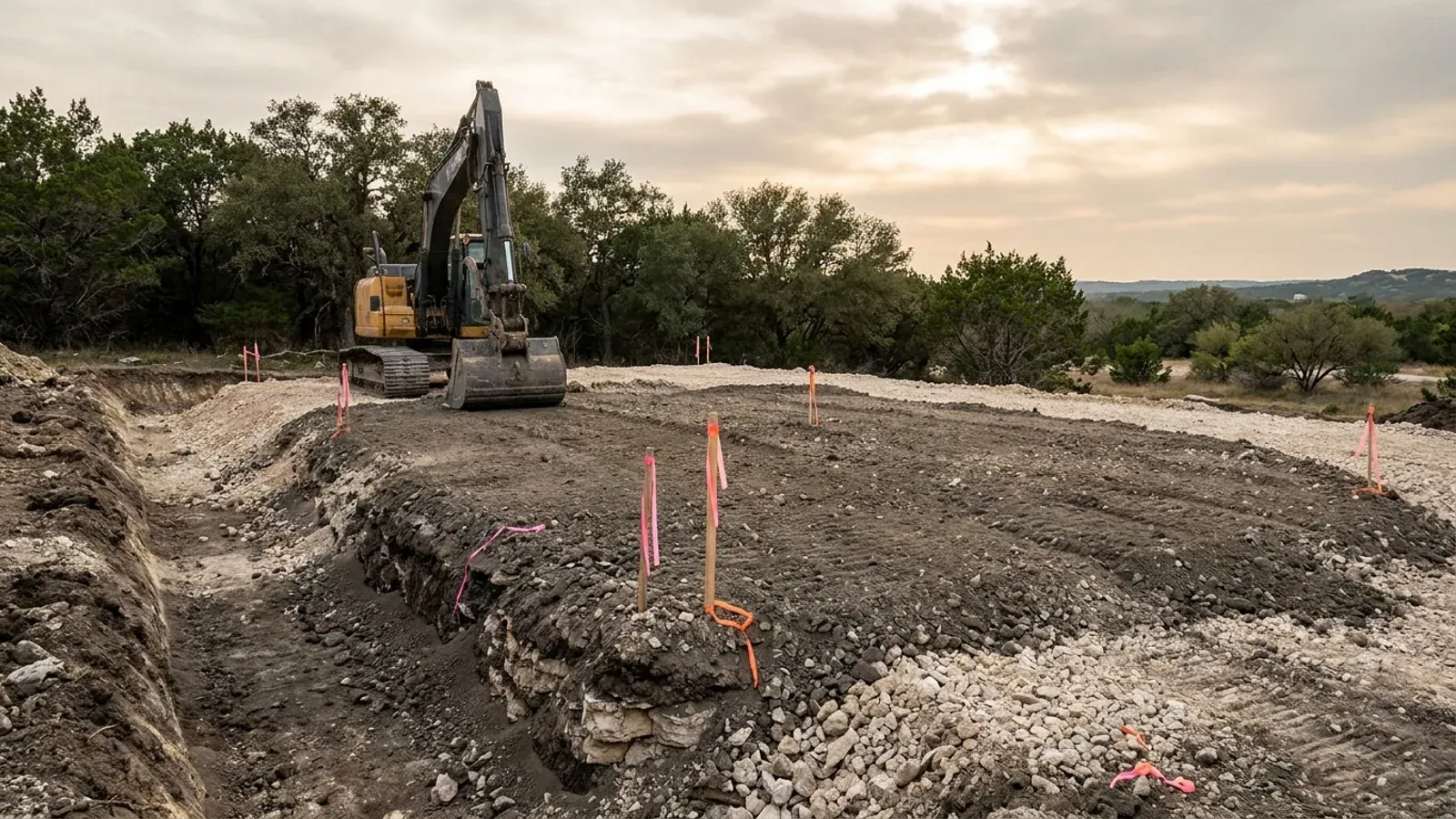
An excavator grading a compacted building pad on a cleared lot, with survey stakes and a drainage swale visible.
Below the slab

The expensive surprises are in the ground, not the building

What moves a Texas budget is usually below grade, and it is soil rather than rock: shrink-swell clay. The Blackland Prairie and the Gulf Coast clays move enough between a wet season and a dry one to drive the foundation design across the state's largest markets, which is why several DFW cities require an engineer's seal on the foundation of every new house. Those are the same conditions that decide whether a septic field passes its soil and site evaluation, so the grading plan, the foundation and the drainfield get resolved together rather than one at a time. We price the dirt before we price the building.

What we build in Wichita County

All nine of our services — kits, custom plans, post-frame and steel construction, site preparation, permitting and engineering, through to turnkey builds — are available across Wichita County. What a project costs depends far more on the parcel than on square footage, so we work from your land rather than from a rate card.

See what we build

What a build looks like

Three stages every Wichita County project passes through, from a raw parcel to a finished home. Site work first, because that is where the budget is decided.
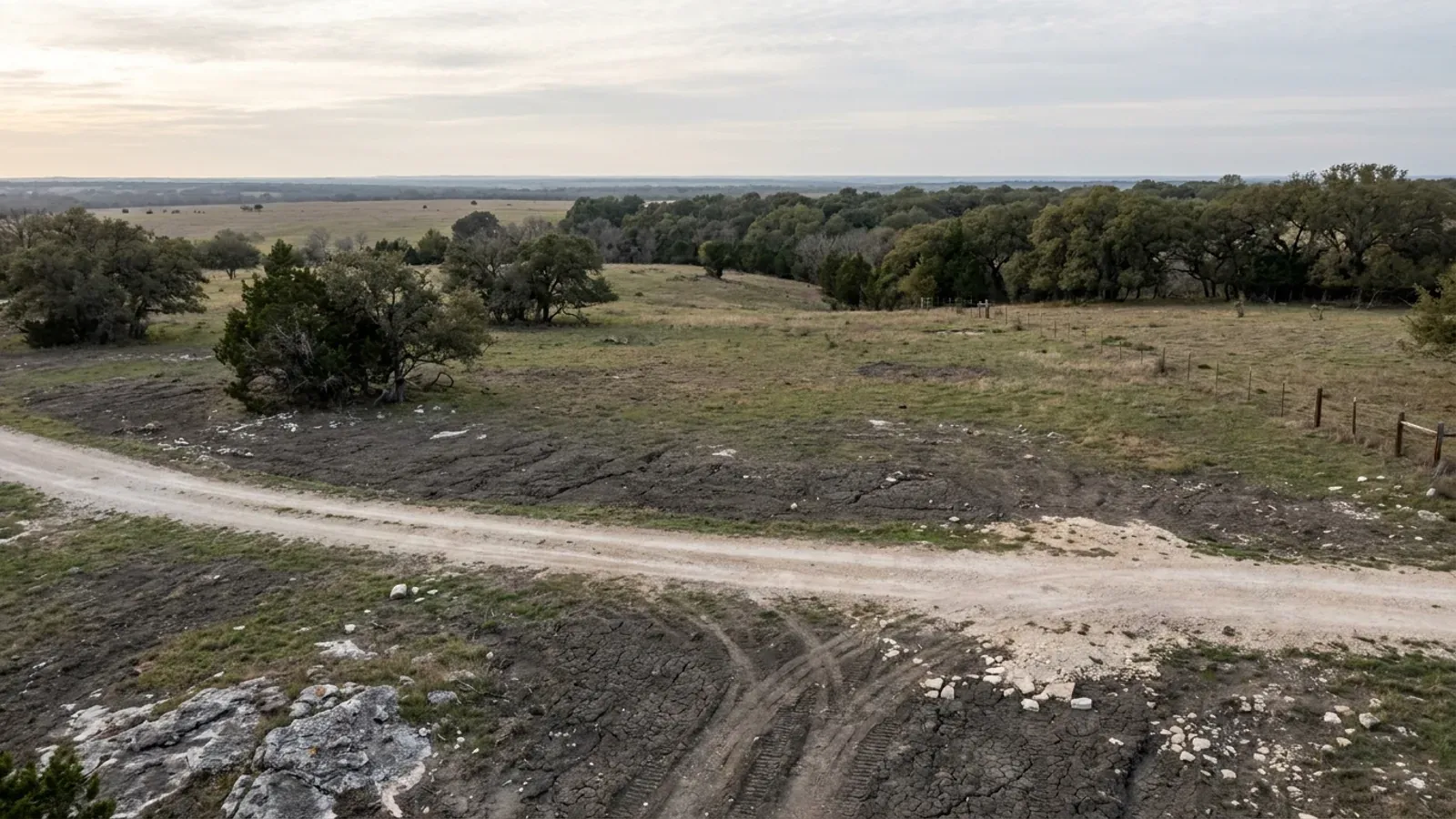
Aerial view of an undeveloped rural lot with cleared grass, a live oak and cedar elm treeline, and a pale gravel access track.
Stage one

The parcel

Zoning, setbacks, flood zone and utility access get checked before anything is drawn.

An excavator grading a compacted building pad on a cleared lot, with survey stakes and a drainage swale visible.
Stage two

Pad and permit

Clearing, grading and a compacted pad, while the submittal works through Wichita County.
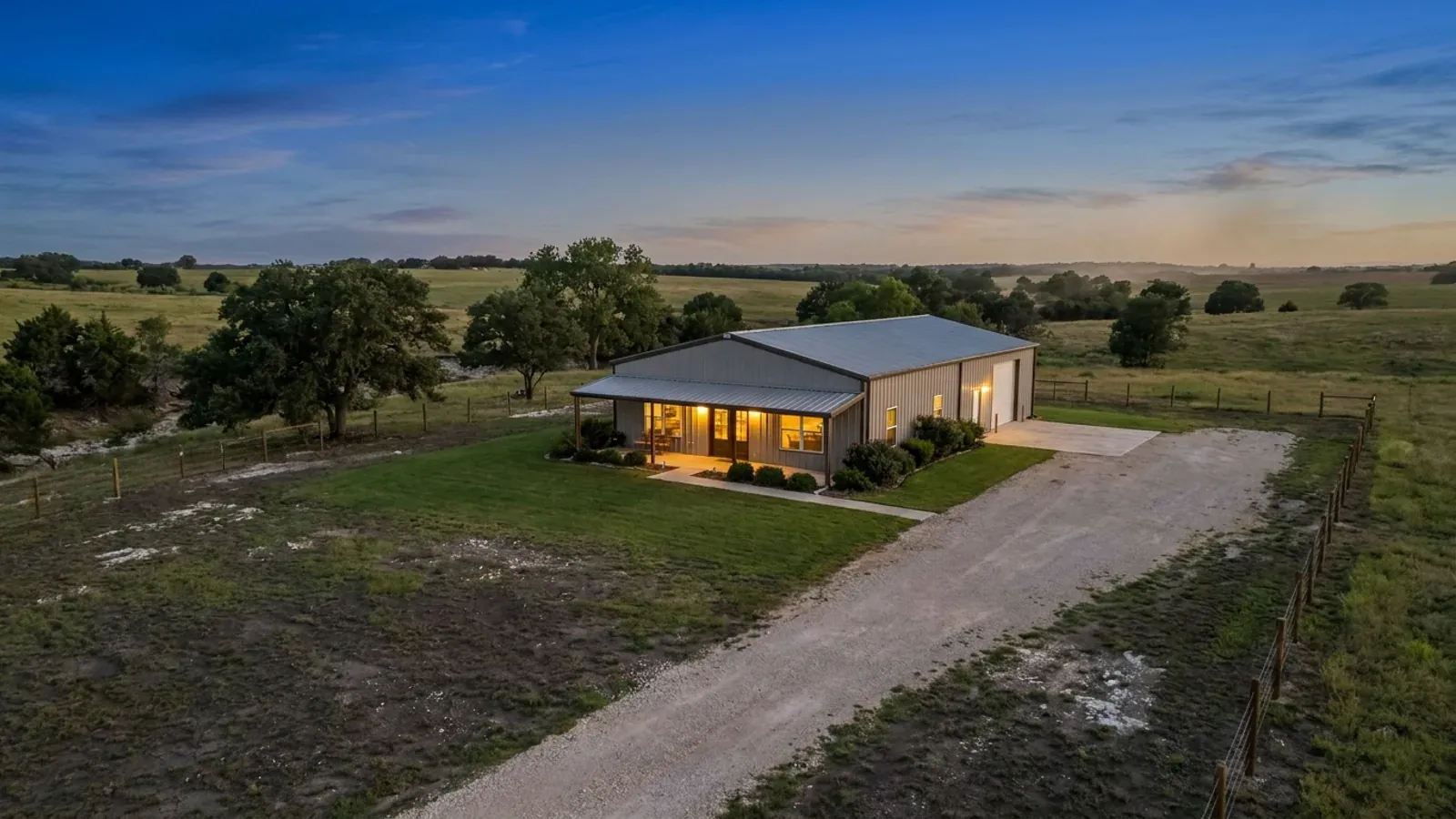
A finished barndominium at dusk with warm interior lighting glowing through its large windows.
Stage three

Frame to finish

Shell erected and dried in, then systems, insulation and interior finish through to CO.

Those are the rules for Wichita County. Tell us what you want to build and we will draw it to them.

Where we build around Wichita County

Wichita County and the rural land around it. The buildable acreage for a project this size usually sits outside the city limits, which is frequently what changes who issues your permit.

Our Wichita County service area, covering Wichita County and the surrounding rural acreage. This map marks the territory we serve, not a branch location.

Nearby areas we build in

Others we cover in this part of Texas. The permitting authority, the adopted design criteria and the zoning can all differ from one to the next.

Building in Wichita County: common questions

12 questions we get asked most often about building in Wichita County. If yours is not on the list, ask it directly.

Does Wichita County have a building code, and do I need a county permit to build?
There is no county building code on the record, and the honest position is that it is unestablished rather than proven either way. The only route by which a Texas county can have a residential building code at all is an order under Local Government Code Chapter 233, Subchapter F, and nothing published by Wichita County shows one. Three separate approaches were run at it. The county keeps no code of ordinances or codified regulation library on its own site — its published index runs to 72 pages and 421 documents, and the only county-adopted instruments in it are the flood ordinance and burn-ban orders. Its agendas and minutes archive begins in 2021. The archived copy of the county's retired website carries a minutes archive that starts in 2012. So the stretch in which the confirmed Texas opt-ins were adopted simply cannot be searched here, and that stretch is wider than it first appeared: the dated adoptions elsewhere run from October 2009 to September 2012. And Section 233.152 imposes no duty on a county to publish such an order, which means an absent order is not proof of no order. What the county does say about itself points one way: the Commissioners Court's own published description of its job includes reviewing and approving subdivision platting and rural wastewater treatment, and no building-code function at all. Even in a county that has opted in, incidentally, there is no county permit, no county fee and no county inspector — the builder contracts the inspections. Ring the Commissioners Court on (940) 766-8106 and ask before you rely on it.
So who inspects my house out here?
Nobody, unless you hire them, with two exceptions that are not building inspections. The septic system is inspected, by the Wichita Falls-Wichita County Public Health District acting as the county's designated representative, and that is a real inspection with a real fee. And if the tract sits in a mapped special flood hazard area, the county's flood ordinance requires elevation certification before you build and a sealed completion letter before occupancy and before permanent utilities are connected. Neither of those looks at your framing, your connections, your slab reinforcement or your wiring. What that leaves is a matter of choice rather than law: a third-party inspector, an engineer of record on the foundation, or a lender or insurer who wants one. On a steel-frame barndominium the foundation and the connection details are where the money and the risk sit, so a Texas-licensed engineer is the sensible default whatever the county does.
If there is no building permit, what actually gates the build?
Four things, and only the first two are county paperwork. First, the septic authorisation — no approved on-site sewage facility means no working house, and here that permit is required regardless of how much land you own. Second, a floodplain development permit, but only if the tract is inside a special flood hazard area; the county's ordinance is limited to those areas rather than reaching every structure countywide the way some Texas counties do. Third, platting, if you are dividing land rather than building on a tract that already exists — the Commissioners Court reviews and approves subdivision plats. Fourth, and this is the one people miss out here, the airport zoning around Sheppard Air Force Base, which the City of Wichita Falls applies to unincorporated land inside an accident potential zone, a noise zone or a height restriction zone. Behind all four sit the restrictions recorded against your own tract, which on rural North Texas acreage are often the only thing that actually says what you may build.
I have more than ten acres. Does that get me out of the septic permit?
No, and Wichita County is unusually direct about it. Section 7(a) of its on-site sewage facility order says a permit shall be required for all on-site sewage facilities regardless of acreage, and that the exception at 30 Texas Administrative Code sec. 285.3(f)(2) shall not apply in the unincorporated areas of the county. Naming the state subsection it is displacing removes the argument entirely. This varies genuinely across Texas — some counties adopt the state rules whole and the ten-acre exemption survives there with its four conditions intact — so the answer really is county by county, and in this one it is a flat no. Two further points from the same section list are worth knowing before you buy. A permit does not transfer automatically when the property changes hands. And within 60 days before the sale or transfer of any property carrying a permitted system, the seller has to pay an inspection fee and have the system inspected by a licensed designated representative of the health district; if it does not pass, the permit is deemed invalid and a new application is required.
Does the shop bay count when the septic system is sized?
This is the question that decides how big your drainfield gets, and in Wichita County it needs asking at the counter rather than assumed. Section 7(i) of the county's order does something few Texas counties do: it replaces the aerobic treatment unit sizing chart at Table II of 30 Texas Administrative Code sec. 285.91(2) with a chart of the county's own. That chart works on bedrooms or floor area, whichever produces the larger number — three or fewer bedrooms and under 2,501 square feet gives 450 gallons a day, and the steps climb to 1,500 gallons a day at ten bedrooms or 11,500 square feet, with 150 gallons added for each further bedroom or each additional 1,500 square feet of living area above that. The chart's own headings are size of home and living area. Neither term is defined in the order, and a barndominium is exactly the building where the difference between conditioned living space and an attached shop bay is large enough to change the design. Ring the Environmental Health Division on (940) 761-7820 and get the answer for your plan before the site evaluation. Only a registered sanitarian or a professional engineer can determine what system a site needs.
What about the water well?
There is no groundwater conservation district in Wichita County at all, which puts it at one end of a range that varies enormously across Texas. The county is a component county of the Texas Water Development Board's Groundwater Management Area 6, and the five districts inside that management area — Clear Fork, Gateway, Mesquite, Rolling Plains and Upper Trinity — none of them take it in. The Rolling Plains district's own management plan gives its extent as Baylor, Haskell and Knox; Gateway's gives Cottle, Foard, Hardeman, Motley and most of Childress. The management area's district representatives went further in 2016 and formally declared the Seymour Aquifer in Wichita County non-relevant for joint planning purposes. So no district permits your well, no district registers it, and there is no district spacing rule to work around when you site the house. What remains is state law: a licensed water well driller, and a state well report filed with the Water Development Board. Do not read that purely as good news. It also means no district data on what the aquifer is doing under your tract and nobody to call if a neighbour's well starts drawing yours down. Get a driller's opinion on depth and yield before you commit to a site.
Is the ground here the expansive clay everyone warns about in Dallas and Waco?
Not the same soil, but do not relax. Wichita County is Rolling Red Plains, not Blackland Prairie, and the pattern is different in a way that catches people out. Measured against the USDA soil survey, roughly 284,500 of the county's 391,860 mapped acres have a surface horizon under thirty percent clay — it walks and digs like loam. But about 218,100 acres carry thirty-five percent clay or more between twenty centimetres and a metre down, and about 194,100 acres have a horizon rated at a linear extensibility of 6 or higher, which is the high shrink-swell band. The largest single map unit in the county makes the point on its own: Kamay silt loam runs twenty percent clay at a linear extensibility of 1.5 for the first twenty-five centimetres, then 42.5 percent clay at 7.5 from there down to two metres. That is precisely the depth a slab's active zone and a septic trench bottom occupy. On the statutory side, the Engineering Practice Act removes the private-dwelling engineering exemption for the design of a residential slab located on expansive soil, but both limbs of that provision are conditioned on the residential code as applied in the jurisdiction, and on unincorporated land where no such code applies neither limb has a local referent. The practical answer is that this is settled tract by tract by a geotechnical investigation, and an engineer-sealed foundation design is the sensible default on a barndominium slab either way.
Sheppard Air Force Base is right there. Does that change what I can build?
It can, and on a rural tract this is the most important paragraph on the page. Everything else about unincorporated Wichita County points to nobody deciding what you may build. Around Sheppard that is not true, and the control belongs to the city rather than the county. Section 6410 of the City of Wichita Falls zoning appendix applies its airport regulations to all incorporated areas of the city and to unincorporated areas lying within an accident potential zone, a noise zone or a height restriction zone; Section 6455(C) reaches the corporate limits and the extraterritorial jurisdiction; and Section 6465 requires a permit for any structure in an accident potential zone and for any use or structure in a height restriction zone. The land use compatibility table at Section 6485 then decides the use. A detached single-family dwelling is marked N in the Clear Zone and in Accident Potential Zone I, Y subject to note 1 in Accident Potential Zone II, and N above 75 decibels day-night average; note 1 caps density at one to two dwelling units per acre or lot coverage under twenty percent, whichever is greater, and note 3 bars any building, structure or above-ground utility from the Clear Zone. In the 65 decibel and greater noise contour, note 11 discourages residential use, and Section 6465(A)(2) says that for residential uses required to attenuate, no water sales by the city or by the appropriate water districts or supply corporations are permitted until the building official has inspected and approved the attenuation. Local Government Code sec. 241.902 provides that the airport regulation controls over a conflicting one. None of this is a building code, so the Texas cases about a city's building-code reach outside its limits do not apply to it. There is no joint airport zoning board: Section 6415 makes the City Commission the Airport Zoning Board, acting alone. Establish which zone, if any, a tract falls in before you make an offer — the zone geometry is set by the base's Air Installation Compatible Use Zone study, and the city Planning Division on (940) 761-7451 is where that gets answered.
Does the county regulate outdoor lighting because of the base?
No, and the statute closes the door twice. The military limb of the county outdoor-lighting power is Local Government Code sec. 240.032(b-1), and it applies only to a county with a population of more than one million that has at least five United States military bases, and to a county adjacent to that one lying within five miles of a United States Army installation. Wichita County's population is about 129,500 and Sheppard is an Air Force installation, so both limbs fail on their own terms; the bracket was written for Bexar County and Joint Base San Antonio. The remaining limbs of that subchapter are about astronomical observatories — the McDonald Observatory at 57 miles, the George and Stephen F. Austin observatories at five — none of which is anywhere near here. And even in a county where the power does exist, sec. 240.0325(2)(A) prohibits the commissioners court from regulating lighting that illuminates a tract maintained as a single family residence located outside the boundaries of a platted subdivision. The airport zoning glare rule described above is a city power under Chapter 241 and is a separate question.
This is tornado country. What does the code actually require?
Nothing, on unincorporated land with no adopted residential code — and that is the honest answer rather than a comfortable one. It is worth separating three things. First, what the county publishes: Wichita County Emergency Management runs a free storm shelter registration for residents of the rural areas of the county, so that responders can check on you afterwards, and it has separately run a residential safe room rebate programme, which its own notice of 19 September 2024 records as having reached the maximum number of applications available. Neither is a requirement to build one. Second, what a code would say: where a residential code applies at all, the model codes govern how a shelter or safe room is built, not whether you must have one, and they do that by pointing at the ICC 500 standard. Outside a city limit here there is no adopted residential code to point at anything. Third, what to actually do: a shelter or safe room is a design decision, made against ICC 500 and FEMA P-361 with a Texas-licensed engineer, and we will build to a sealed design that an engineer specifies. We make no claim about how any building of ours would perform in a tornado, and nothing here is engineering advice. The National Weather Service office in Norman maintains a public record of the Red River Valley tornado outbreak of 10 April 1979, which it describes as among the most significant ever to occur in western north Texas and southern Oklahoma, and which is the local reason this question gets asked at all.
There are oil wells everywhere out here. Does that affect where I can build?
It can, and the law is not on the surface owner's side. The Railroad Commission's February 2025 count puts 8,301 oil wells in Wichita County — 4,249 regular producing, 806 shut-in, 2,493 shut-in under Rule 14(b)(2) and 753 injection — across 628 square miles, which is about thirteen to the square mile. In Texas the mineral estate is the dominant estate, and the accommodation doctrine that limits it protects an existing surface use. In Merriman v. XTO Energy the Supreme Court of Texas recorded that the landowner's home and barn stood on the tract, and he still lost his case. A house you have not built yet is not an existing use at all, which is why this belongs in the buying decision rather than the building one. Whether the minerals under a specific tract were severed, and what surface rights any lease reserves, is a title question. Ask the County Clerk's records and read the title commitment, and if there is a producing well or a pipeline easement on the tract, get the location surveyed before you site anything. The county publishes its own reminder about pipeline markers and safe digging for the same reason.
What changes inside Wichita Falls, Burkburnett, Iowa Park or Electra?
A great deal, and not all of it in the direction you would guess. Inside a city limit a Texas municipality enforces its own adopted edition of the International Residential Code, issues a real permit, reviews plans, charges a fee and sends an inspector — none of which exists at county level. Each city picks its own edition and may amend it, including by deleting requirements, so confirm the current edition with that city rather than assuming a regional answer. The septic question does not invert here the way it does in some Texas counties: the same Wichita Falls-Wichita County Public Health District administers on-site sewage facilities for the county and for Burkburnett, Electra, Iowa Park, Cashion Community and Wichita Falls alike, so the counter is the same one wherever you are. Only the Town of Pleasant Valley runs its own. Outside the city line but inside a city's extraterritorial jurisdiction, a Texas municipality cannot enforce its building codes on you, but it can require you to plat, and around Sheppard its airport zoning does reach out there. Confirm which side of every one of those lines a tract falls on before you make an offer.

Building in Wichita County?

Start with the plan. Tell us what you want to build and we will draw it, then confirm what Wichita County will actually let you put on the parcel and what wind load it has to meet. That conversation costs nothing.