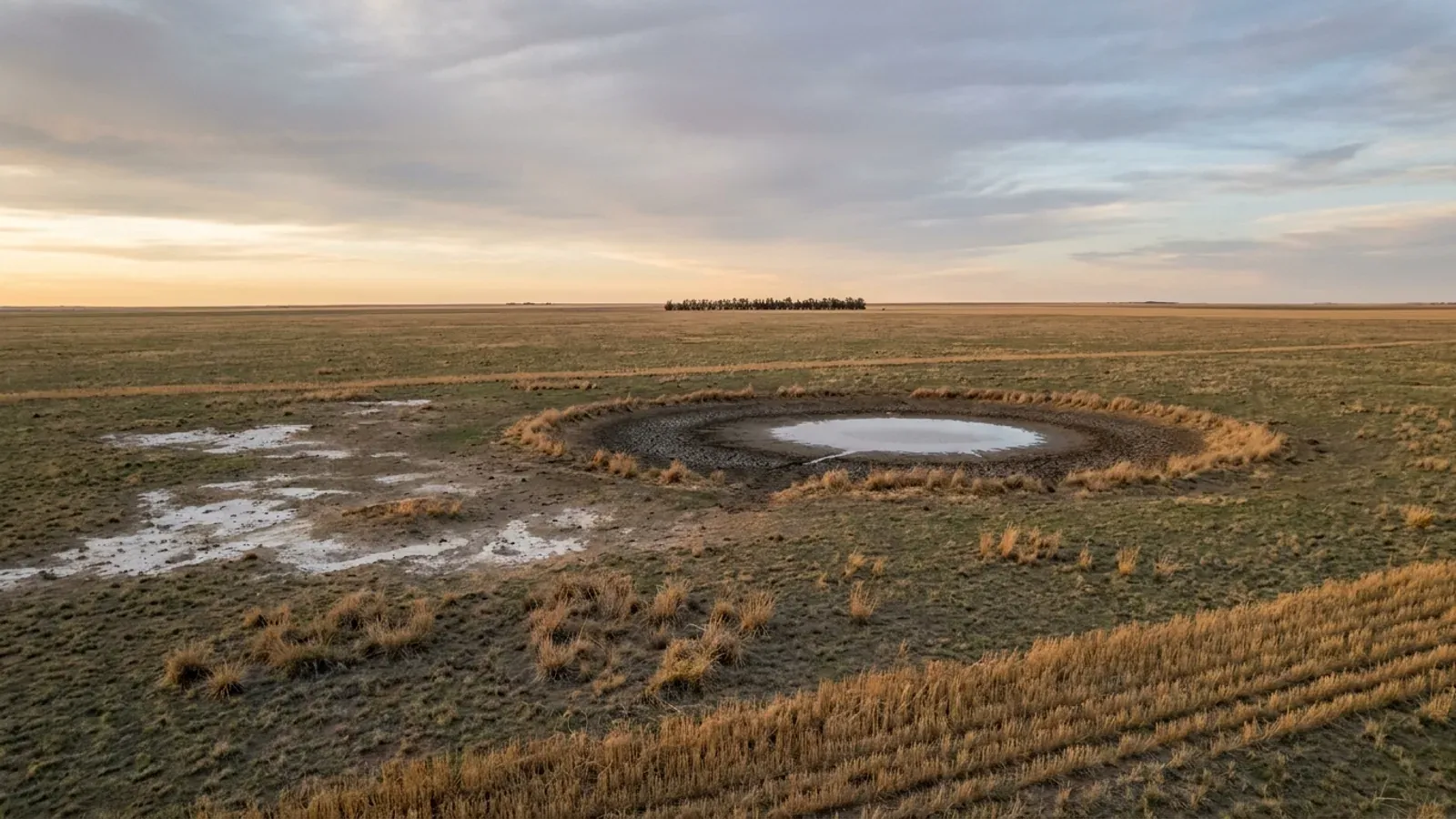
Barndominium Builders in Wichita Falls, TX
Wichita Falls is a slightly shrinking city — 101,951 at the Census Bureau's 2025 estimate, down from 102,283 in 2020, across 72.2 square miles — and its zoning says plainly what it is. SF-1, the district the code itself calls large lot, takes 8,500 square feet. There is no agricultural district and no acreage minimum anywhere in the zoning appendix, so a barndominium on real land here is nearly always a project for the five-mile extraterritorial jurisdiction or for unincorporated Wichita, Archer or Clay County rather than for a city lot. Two things follow you out there. The city plats in all three counties and publishes a separate fee schedule for each. And the airport zoning in section 6400, adopted under the Airport Zoning Act, applies by its own terms inside the limits, in the extraterritorial jurisdiction, and on unincorporated land that falls in an accident potential, noise or height zone around Sheppard Air Force Base.
Wichita Falls at a glance
- County
- Wichita County
- Population
- 101,951
- Where we build
- Wichita Falls, Wichita County, Amarillo, Abilene
- Site visits
- Site walks scheduled throughout Wichita Falls and Wichita County
ZIPs 76301, 76302, 76305, 76306, 76308, 76309, 76310
Building conditions in Wichita Falls
What actually changes from one Texas jurisdiction to the next: who issues the permit, whether the residential code is enforced there at all, what the structure has to be engineered to, and what the ground is like. These are the numbers your drawings have to satisfy.
City of Wichita Falls Code of Ordinances, Ch. 22, Art. XI, Secs. 22-700 and 22-701 (eCode360, current through Ord. No. 33-2026 adopted 4 August 2026); City of Wichita Falls, Adopted Building Codes and Amendments
City of Wichita Falls Code of Ordinances, Ch. 22 attachment, IRC 2015 Amendments (eCode360, page 22-R:1)
City of Wichita Falls Code of Ordinances, App. B Zoning, Secs. 6410, 6465 and 6485, and the AICUZ study for Sheppard Air Force Base referenced there (Ord. 155-94 adopted 20 December 1994; Ord. 32-2001 adopted 3 April 2001; Ord. 8-2006 adopted 7 February 2006)
City of Wichita Falls Code of Ordinances, App. B Zoning, Secs. 6515 and 6516 (Ordinance 24-2003, sec. 1, adopted 1 April 2003)
USDA-NRCS Soil Data Access (SSURGO), survey area TX485 Wichita County, map units 373360, 373387, 373335 and 373395, queried 1 September 2026
City of Wichita Falls Code of Ordinances, Ch. 54, Art. II, Secs. 54-31, 54-63, 54-64 and 54-92 (Ordinance 16-2022 adopted 17 May 2022)
Also worth knowing before you build in Wichita Falls
- The district the code calls large lot is 8,500 square feet
- SF-1 Single-Family Residential District (Large Lot) takes a minimum lot area of 8,500 square feet, 60 feet of lot width, a 35-foot height limit, 50 percent maximum building coverage and one primary dwelling unit per lot. It is the largest-lot residential district in the ordinance. There is no agricultural district, no estate district and no district measured in acres anywhere in Appendix B — so acreage here means the extraterritorial jurisdiction or the unincorporated county, not a city lot
- Storm shelters — what the adopted code actually says
- Section R323 of the 2015 IRC is adopted and unamended. It does not require a storm shelter. It is a scope provision: it applies to the construction of storm shelters built as separate detached buildings or as safe rooms within buildings, and where one is built it must be constructed in accordance with ICC/NSSA-500. The one mandate in the adopted code books is in the building code, at Section 423.4, and it reaches Group E occupancies — schools — not dwellings. Separately, the Wichita Falls Fire Department runs a voluntary online storm shelter registration so responders know where shelters are
- Residential fire sprinklers
- Wichita Falls did not delete IRC Section R313, so on the face of the adopted code the 2015 edition's R313.2 stands as written. The state statute is what answers the question: Occupations Code Section 1301.551(i) provides that after 1 January 2009 a municipality may not enact an ordinance, bylaw, order, building code or rule requiring the installation of a fire sprinkler protection system in a new or existing one- or two-family dwelling, while allowing a city to let a contractor offer one for a fee. Because the city wrote nothing local either way, ask Building and Code Administration how it applies to your plan set
- A five-mile extraterritorial jurisdiction that crosses three counties
- At 101,951 people the city falls in the top bracket of Local Government Code Section 42.021(a), which gives a five-mile extraterritorial jurisdiction. The Planning Division's own 2026 fee sheet proves where that reaches: it publishes plat fees in three columns — Wichita County, Archer County and Clay County — with a final plat up to five acres at $295.00 in Wichita and Archer and $523.00 in Clay. A city cannot enforce its building code in the extraterritorial jurisdiction, but it does plat there
- The city registers contractors — and that is not a state licence
- Building and Code Administration issues a contractor registration that expires one year from the date issued, on a form that has the applicant acknowledge it is unlawful to start work requiring a permit before the permit is issued, or to occupy a new structure before the building, electrical, gas, plumbing, mechanical and fire protection systems are inspected and a certificate of occupancy is issued. Code compliance bonds of $25,000, $50,000 and $100,000 are separate forms. Texas has no state licence for a residential building contractor at all, so a city registration is exactly what it says and nothing more
- Climate zone 3A, and an energy chapter the city did not adopt
- Wichita County is climate zone 3A on both the pre-2021 and the 2021 and 2024 maps, so the zone does not shift with the edition quoted — unlike eight Texas counties where it does. The city's own adoption stops at IRC Chapter 10, leaving out Chapter 11, the energy efficiency chapter, and its adopted codes list names a 2006 IECC. Health and Safety Code Section 388.003(a) is the governing rule for a house: the energy efficiency chapter of the IRC as it existed on 1 May 2015, effective 1 September 2016
City of Wichita Falls Code of Ordinances, App. B Zoning, Secs. 3050, 3060 and 3080 (Ordinance 30-2022 adopted 16 August 2022)
City of Wichita Falls Code of Ordinances, Ch. 22 attachment, IRC 2015 Amendments; City of Wichita Falls, Adopted Building Codes and Amendments (2015 IBC Sec. 423.4); City of Wichita Falls Fire Department, Storm Shelter Registration
City of Wichita Falls Code of Ordinances, Ch. 22, Sec. 22-701 and the Ch. 22 IRC 2015 Amendments attachment; Texas Occupations Code Sec. 1301.551(i)
Texas Local Government Code Sec. 42.021(a); City of Wichita Falls Planning Division, 2026 Schedule and Fees, revised 5 January 2026; U.S. Census Bureau, Vintage 2025 subcounty population estimates, GEOID 4879000
City of Wichita Falls Building and Code Administration, Application for Contractors Registration; City of Wichita Falls, Building Forms, Fees and Applications
U.S. Department of Energy / PNNL climate zone assignments for Wichita County, FIPS 48485; City of Wichita Falls Code of Ordinances Sec. 22-700; City of Wichita Falls, Adopted Building Codes and Amendments; Texas Health and Safety Code Sec. 388.003(a)
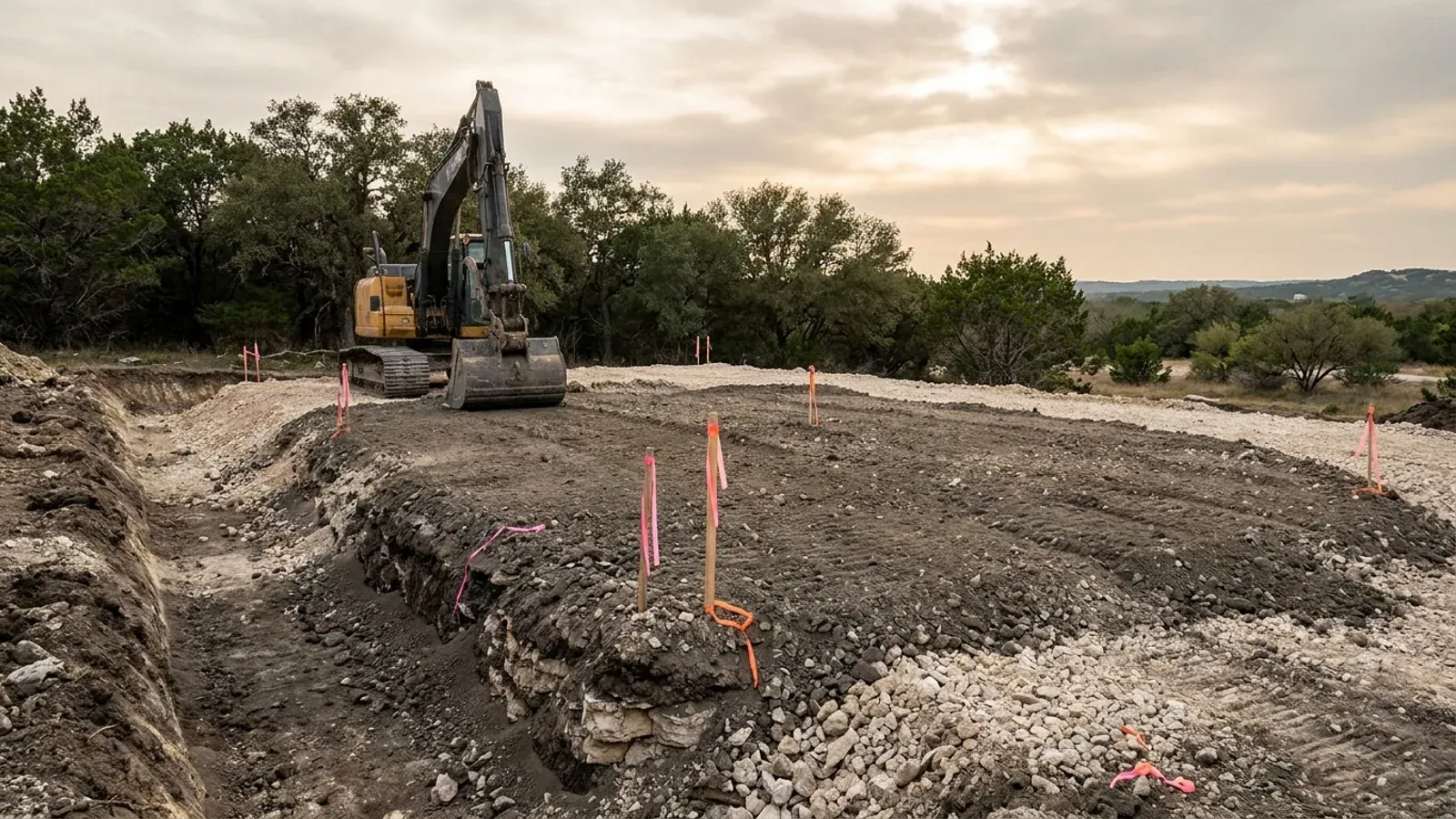
The expensive surprises are in the ground, not the building
What moves a Texas budget is usually below grade, and it is soil rather than rock: shrink-swell clay. The Blackland Prairie and the Gulf Coast clays move enough between a wet season and a dry one to drive the foundation design across the state's largest markets, which is why several DFW cities require an engineer's seal on the foundation of every new house. Those are the same conditions that decide whether a septic field passes its soil and site evaluation, so the grading plan, the foundation and the drainfield get resolved together rather than one at a time. We price the dirt before we price the building.
What we build in Wichita Falls
All nine of our services — kits, custom plans, post-frame and steel construction, site preparation, permitting and engineering, through to turnkey builds — are available across Wichita County. What a project costs depends far more on the parcel than on square footage, so we work from your land rather than from a rate card.
See what we buildWhat a build looks like
Three stages every Wichita Falls project passes through, from a raw parcel to a finished home. Site work first, because that is where the budget is decided.
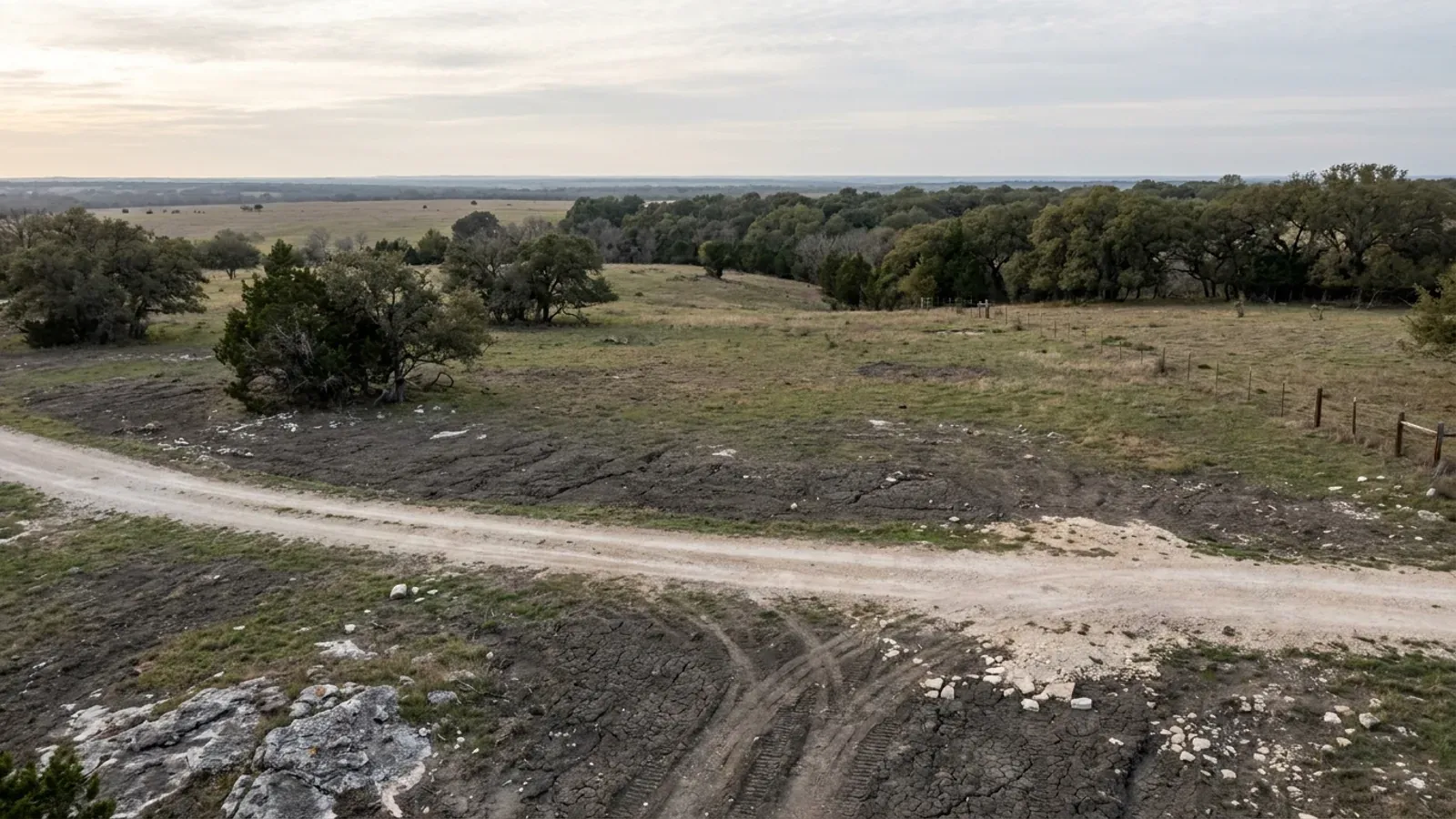
The parcel
Zoning, setbacks, flood zone and utility access get checked before anything is drawn.
Pad and permit
Clearing, grading and a compacted pad, while the submittal works through Wichita County.
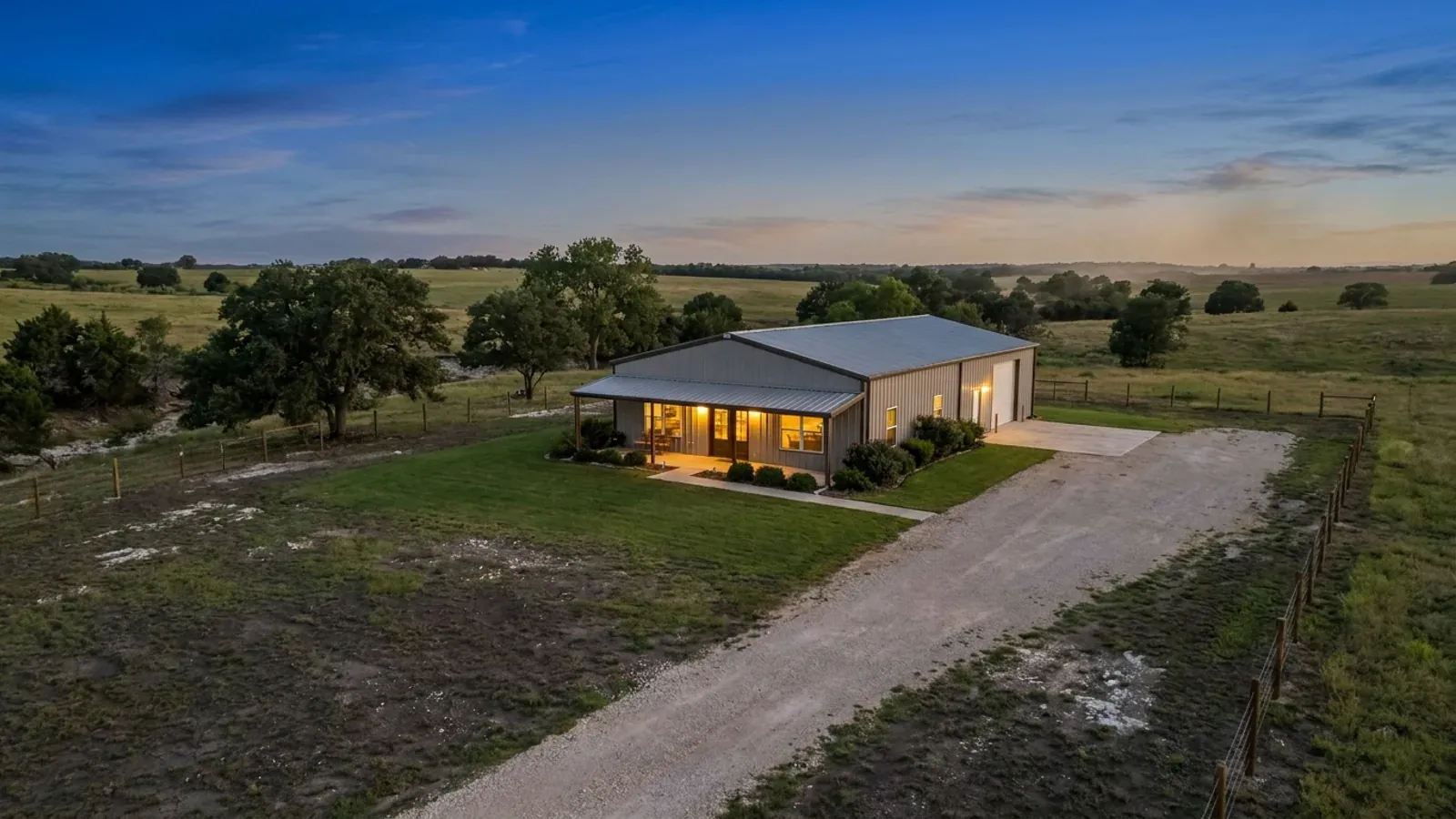
Frame to finish
Shell erected and dried in, then systems, insulation and interior finish through to CO.
Those are the rules for Wichita County. Tell us what you want to build and we will draw it to them.
Where we build around Wichita Falls
Wichita County and the rural land around it. The buildable acreage for a project this size usually sits outside the city limits, which is frequently what changes who issues your permit.
Keep reading
The questions that usually come next once you know what Wichita Falls allows.
Barndominium Cost Guide
Sourced per-square-foot ranges by tier and by size, with a calculator built on the same figures.
Read itIs It Legal in Texas?
Classification, zoning, the HOA gate, and why "nonresidential farm building" does not cover a home.
Read itHow Long Does It Take?
Census build-duration data, and what actually sets the permit clock where you are building.
Read itNearby areas we build in
Others we cover in this part of Texas. The permitting authority, the adopted design criteria and the zoning can all differ from one to the next.
Building in Wichita Falls: common questions
12 questions we get asked most often about building in Wichita Falls. If yours is not on the list, ask it directly.
What building code does Wichita Falls use, and has the city changed it?
Which of those four amendments actually changes a drawing?
Wichita Falls had one of the worst tornadoes in American history. Does the building code require a storm shelter?
What actually happened here in 1979, and what did the engineers conclude?
Can I build a barndominium on acreage inside the Wichita Falls city limits?
How big a shop can I put beside the house, and how far from the property line?
What does Sheppard Air Force Base mean for land I am looking at outside town?
Is there a permit for that, and who decides?
What changes when my land is outside the city limits?
What is the ground like, and will the slab need an engineer?
Is there a groundwater district, and what does a well involve?
Does Wichita Falls license builders, and should I be checking one?
Building in Wichita Falls?
Start with the plan. Tell us what you want to build and we will draw it, then confirm what Wichita County will actually let you put on the parcel and what wind load it has to meet. That conversation costs nothing.