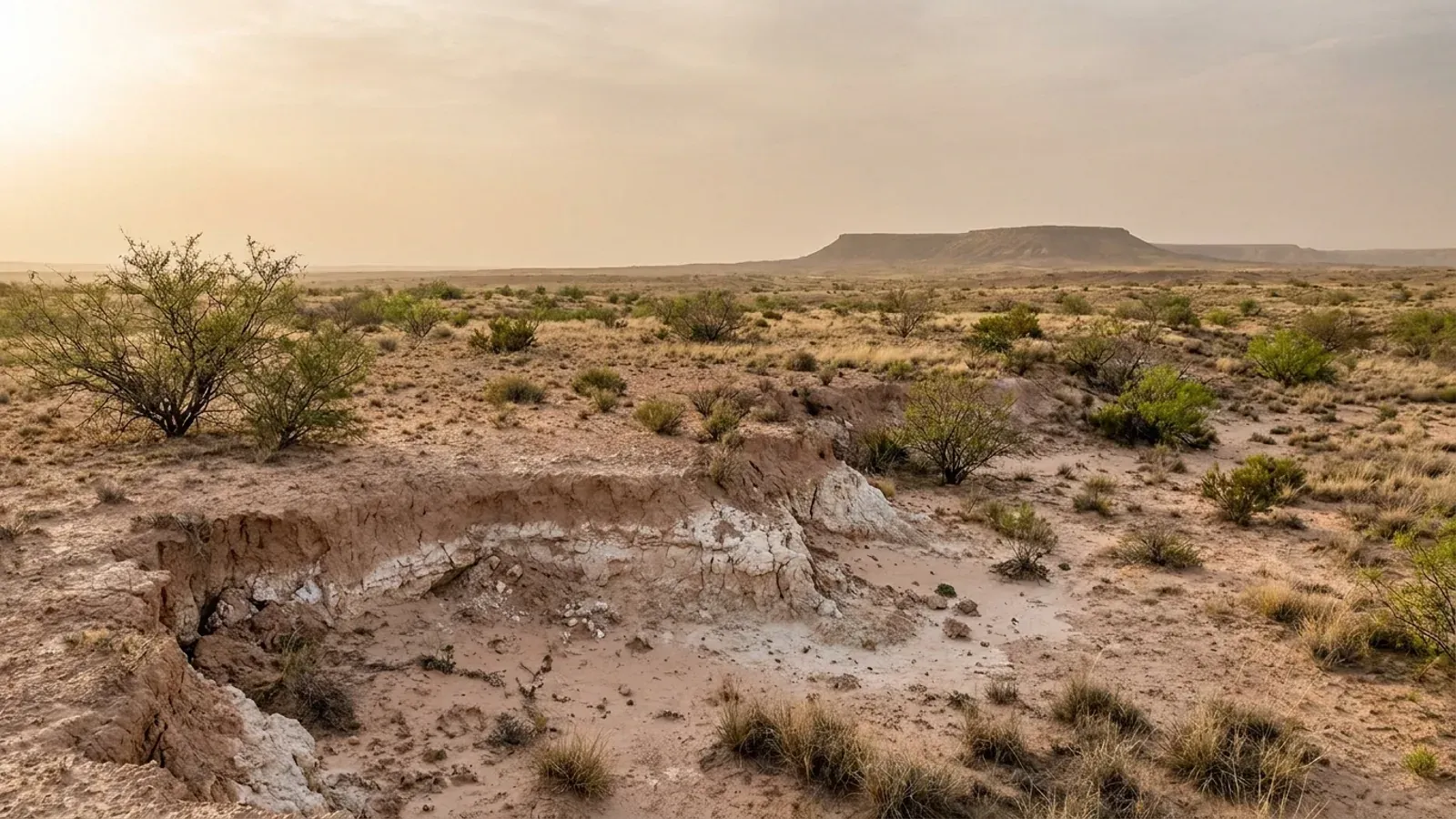
Open semi-arid West Texas rangeland with sparse mesquite and a hard white caliche layer breaking through a shallow cut bank.
Tom Green County 2021 IRC as adopted here

Barndominium Builders in San Angelo, TX

San Angelo runs the 2021 International Residential Code, adopted at Sec. 4.04.092 of the Code of Ordinances, and it is one of the few Texas cities that fills in the code's climatic and geographic design table instead of leaving it blank. The ordinance publishes a 115 mph ultimate design wind speed, a 12-inch frost line, a five-pound ground snow load and a slight-to-moderate termite rating, so the numbers a Concho Valley build gets engineered to come from the city's own adopted text rather than from an assumption. The shop bay is the other reason to read the zoning ordinance early. On an ordinary residential lot an accessory building is capped at 600 square feet or half the house, whichever is greater. In the Ranch and Estate district, which takes a one-acre minimum lot, Sec. 402.B allows accessory buildings up to the full floor area of the residence or ten percent of the site, whichever is greater, and sets no separate height cap.

San Angelo at a glance

County
Tom Green County
Population
100,640
Where we build
San Angelo, Tom Green County, Abilene, Midland

ZIPs 76901, 76903, 76904, 76905

Site visits
Site visits scheduled across San Angelo and the rest of Tom Green County

Building conditions in San Angelo

What actually changes from one Texas jurisdiction to the next: who issues the permit, whether the residential code is enforced there at all, what the structure has to be engineered to, and what the ground is like. These are the numbers your drawings have to satisfy.

Build conditions for San Angelo , Tom Green County, Texas : design wind speed 115 mph ultimate design (90 mph nominal design). BUILD CONDITIONS SAN ANGELO, TXTom Green County2021 IRCDESIGN WIND SPEED115 mph ultimate de…San Angelo fills in IRC Table R301.2(1), which its ordinance styles Table 301.2(1), with its ownfigures at Sec. 4.04.092: ground snow load five psf, nominal design wind speed 90 mph and ultimat…ZONING · R&E RANCH AND ESTATE43,560 sq ft (one acre), minimum lot…R&E is the only San Angelo residential district measured in acres;RS-1 and RS-2 drop to 5,000 square feet. Sec. 303.A describes it as…BUILDING PERMIT FEE, PRICED SEPARATELY FOR TH…$125.00 base fee, plus $0.19 per squ…From the City of San Angelo Fee Schedule effective 22 January 2026.A residential remodel or repair is $0.15 per square foot of the…WHO ISSUES THE PERMITCity of San Angelo Building Permits…52 W. College Ave., first floor, Community Development Building, SanAngelo, TX 76903. Phone (325) 657-4210, press 1 for inspections.…
Build conditions for San Angelo, drawn from the sourced facts on this page. Every figure above is cited in the quick-facts panel below, with its source and vintage.
Adopted residential code
2021 International Residential Code, adopted at Sec. 4.04.092 of the Code of Ordinances by Ord. No. 2023-017 on 7 February 2023, alongside the 2021 IBC, the 2021 IECC commercial provisions and the 2020 National Electrical Code. Section R313 Automatic Fire Sprinkler Systems is deleted in its entirety

San Angelo Code of Ordinances Ch. 4, Art. 4.04, Div. 3, Sec. 4.04.092, codified through Ord. No. 2025-103 (Supp. 10); City of San Angelo, Codes & Regulations

San Angelo publishes its own design figures
The adopting ordinance amends IRC Table R301.2(1) and fills in every cell: 115 mph ultimate design wind speed and 90 mph nominal design, a five psf ground snow load, moderate weathering, a 12-inch frost line depth, a slight to moderate termite rating, a 32 degree F winter design temperature, no ice barrier underlayment, and an air freezing index of 50. Most Texas cities publish nothing at all

San Angelo Code of Ordinances Sec. 4.04.092, Table 301.2(1) as amended

The shop bay, and why the district matters more than the acreage
Zoning Ordinance Sec. 402.B lets an accessory building in the Ranch and Estate district reach 100 percent of the principal residence or 10 percent of the site area, whichever is greater, set back 5 feet at the sides and 10 feet at the rear, sited to the rear of the house. On every other residential lot Sec. 402.A caps it at 600 square feet or half the principal building. Neither provision sets a height limit, so the binding cap is the district's 35 feet

San Angelo Zoning Ordinance (Ch. 12, Exhibit A), Art. 4, Sec. 402 and Art. 5, Sec. 501

The permit fee prices the two halves of the building differently
A residential building permit is a $125.00 base fee plus $0.19 per square foot of living area and $0.15 per square foot of garage, carport, porch, patio and accessory building. A separate foundation-only permit is $125.00 for a dwelling and $85.00 for a residential accessory structure, and no permit is required for an accessory structure under 120 square feet with no utilities. San Angelo levies no development impact fee

City of San Angelo Fee Schedule, effective 22 January 2026, Building and Construction Related Fees

What the ground does under a Concho Valley slab
USDA soil survey data for Tom Green County put an indurated restriction — cemented caliche or bedrock — within a metre of the surface on 424,760 of 986,490 mapped acres, 43 percent of the county. Tarrant soils hit bedrock at 25 centimetres and Cho hits a petrocalcic horizon at 23. Angelo clay loam, the county's largest soil at 253,224 acres, is a Mollisol running 42.5 percent clay with a linear extensibility of 7.5 below 15 centimetres. True shrink-swell Vertisols exist here but cover only 16,233 acres

USDA-NRCS Soil Data Access (SSURGO), survey area TX451 Tom Green County, mapunit, component, chorizon and corestrictions tables, queried 1 September 2026

Floodplain freeboard is a three-way test, not a single figure
Sec. 12.05.008(b)(1) requires the lowest floor of a new residential structure, including a basement, to be elevated to a minimum of two feet above the base flood elevation, one foot above the fully developed 100-year flood elevation, or one foot above the 500-year flood elevation, whichever is more restrictive, certified to the floodplain administrator by a registered professional engineer, architect or land surveyor. The 500-year limb is unusual and it is the one that catches people on the Concho

San Angelo Code of Ordinances Ch. 12, Art. 12.05, Sec. 12.05.008 (1996 Code sec. 12.408; Ordinance adopted 16 November 2010)

Also worth knowing before you build in San Angelo

Goodfellow Air Force Base is inside the airport zoning ordinance by name
Sec. 2.07.251 creates the San Angelo-Tom Green County joint airport zoning board under Local Government Code Sec. 241.014 by Ord. No. 2018-121 of 2 October 2018 — five members, two appointed by the commissioners court, two by the city council, and an elected chairman. The zoning ordinance it administers defines airport as San Angelo Regional Airport/Mathis Field and Goodfellow Air Force Base, and carries separate height limits for each. Both sets end with the same saving clause: nothing in the chapter prohibits a structure up to 45 feet above the surface of the land, and no permit is required below 75 feet in the horizontal, conical and outer approach zones

San Angelo Code of Ordinances Ch. 2, Art. 2.07, Div. 16, Secs. 2.07.251-2.07.253; Ch. 12, Exhibit B, Secs. 3-3-2, 3-3-4 and 3-3-7; Texas Local Government Code Sec. 241.014

The county regulates septic even inside the city limits
TCEQ's authorized agent record for Tom Green County returns a single agent, the Tom Green County Authorized Agent, with the area served recorded as the entire county and no city carve-out. The permit office is 113 W Beauregard Ave in San Angelo and the county's order was adopted 18 August 2014 and approved by TCEQ on 9 September 2014. The city's own residential permit application sends applicants to the county health department for the septic permit

TCEQ On-Site Activity Reporting System, authorized agent search, Tom Green County, run 1 September 2026; City of San Angelo Residential Building Permit Application (approved September 2023)

San Angelo is carved out of its groundwater district by name
The Lipan-Kickapoo Water Conservation District covers part of Tom Green, Runnels and Concho counties, but its own management plan excludes San Angelo, Christoval, Grape Creek, the Red Creek Municipal Utility District and the area northwest of the city north of the Middle Concho River and south and west of US Highway 87. Inside the district, Rule 9.1 spaces every well 330 feet from the nearest well and 50 feet from the property line, and Rule 2.1 provides that a domestic or livestock well on 10 acres or less is not exempt and must be permitted before drilling

Lipan-Kickapoo Water Conservation District, Groundwater Management Plan 2023-2028, Location and Extent; District Rules adopted 4 August 2004 with amendments adopted 1 November 2006 and 5 September 2007, Rules 2.1, 7.2 and 9.1; Texas Water Code Sec. 36.117

A registration number is not a licence, and the ordinance says so
Sec. 4.03.031 requires general and building contractors to register annually with the building official, and Sec. 4.03.038 requires the registered contractor number to appear on all advertising, preceded by the words Registered Contractor or the letters RC, and on the contractor's vehicles. Plumbing and electrical contractors must register but pay no fee, because Occupations Code Secs. 1301.551 and 1305.201 forbid the city to charge them one. Registration is a city permission to pull permits; Texas issues no state licence for a residential builder to hold

San Angelo Code of Ordinances Ch. 4, Art. 4.03, Secs. 4.03.031-4.03.038; Texas Occupations Code Secs. 1301.551 and 1305.201

The utility release is the enforcement point
The city states that an electrical permit and a passing inspection performed by the City of San Angelo or its representatives are required for all electric service releases to AEP, and that it will not provide an electric service release without one. The same applies to a plumbing permit and gas service releases to Atmos. Outside the limits the water gate is sharper still: the subdivision ordinance requires an owner of unplatted property in the extraterritorial jurisdiction who wants city water to voluntarily petition for annexation, and the city extends no water at all beyond the edge of that jurisdiction

City of San Angelo, Building Permits & Inspections; San Angelo Land Development and Subdivision Ordinance (Ch. 12, Exhibit C), Water Facilities, sections E and F

No masonry rule, and one narrow design review
San Angelo's zoning ordinance sets no exterior building material standard and no masonry percentage for a single-family dwelling; the only masonry provisions in it govern fences. The one exception is geographic: Sec. 212 exempts a property used exclusively for a single-family detached dwelling from urban design review in the River Corridor, Downtown and Cultural District overlay zones, with the exception of a property adjacent to the Concho River

San Angelo Zoning Ordinance (Ch. 12, Exhibit A), Art. 2, Sec. 212 and Art. 5, Secs. 509 and 513, full-text review of the Supp. 10 printing

Livestock separation runs against the new house
Sec. 3.06.003 makes it unlawful to keep cows, horses, goats or other hoofed animals in a pen within 100 feet of any residence other than the owner's own, and Sec. 3.06.002 sets 500 feet for swine. Sec. 3.06.005 then applies the same distances to new construction: once a new home is occupied, the livestock owner has 30 days to move the animals back to the required distance. On a 150-foot-wide Ranch and Estate lot that is a real siting question in both directions

San Angelo Code of Ordinances Ch. 3, Art. 3.06, Secs. 3.06.002, 3.06.003 and 3.06.005

How much city is in the city
60.06 square miles of land and 100,640 people at the Census Bureau's 2025 estimate, about 1,676 to the square mile. The city sits right on a statutory line: the same series shows it below 100,000 from 2021 to 2023 and back above it in 2024, against a 2020 estimates base of 99,903. Tom Green County as a whole is 120,602

U.S. Census Bureau, Vintage 2025 subcounty population estimates (sub-est2025) and 2024 Gazetteer place file, GEOID 4864472
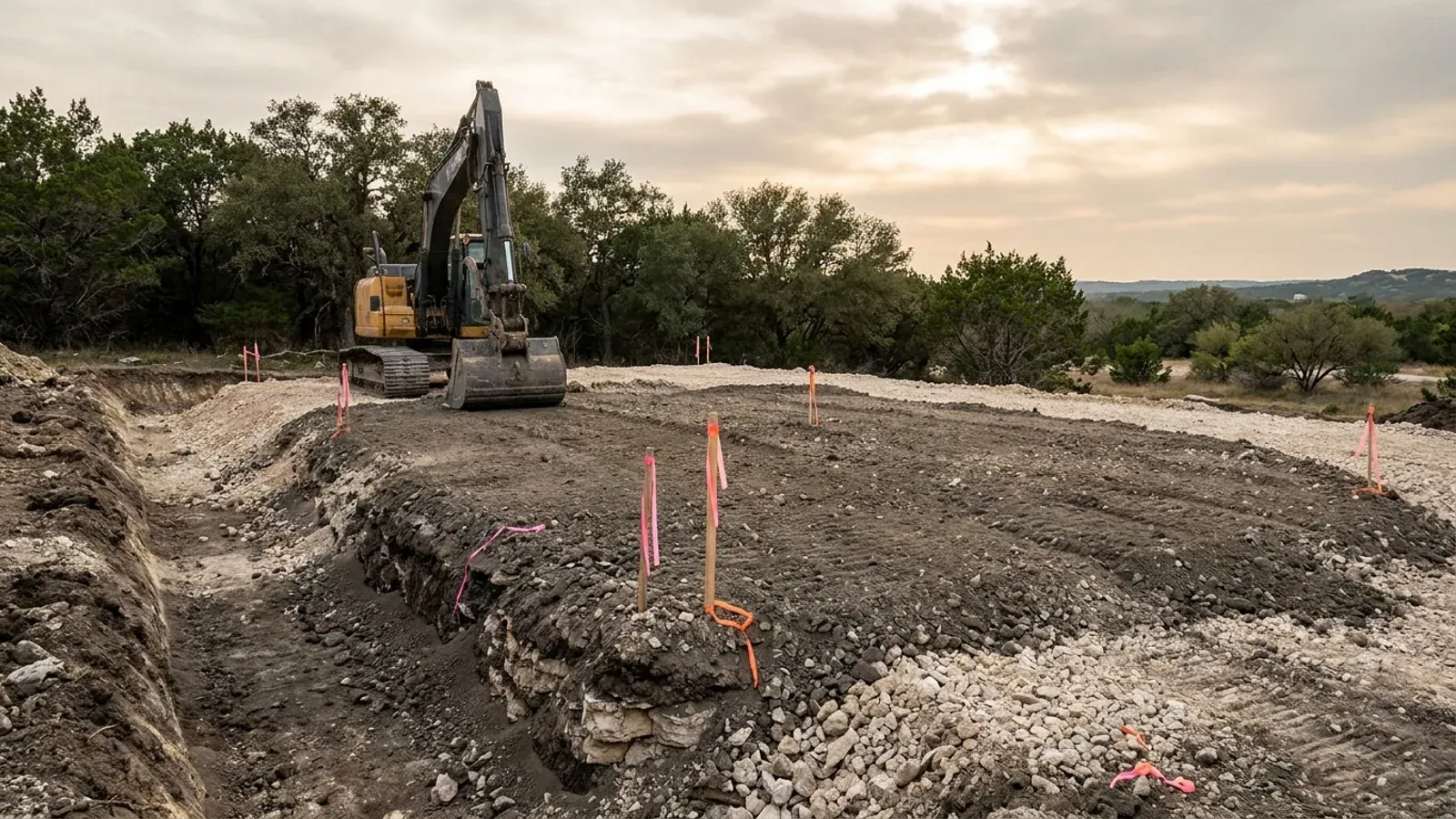
An excavator grading a compacted building pad on a cleared lot, with survey stakes and a drainage swale visible.
Below the slab

The expensive surprises are in the ground, not the building

What moves a Texas budget is usually below grade, and it is soil rather than rock: shrink-swell clay. The Blackland Prairie and the Gulf Coast clays move enough between a wet season and a dry one to drive the foundation design across the state's largest markets, which is why several DFW cities require an engineer's seal on the foundation of every new house. Those are the same conditions that decide whether a septic field passes its soil and site evaluation, so the grading plan, the foundation and the drainfield get resolved together rather than one at a time. We price the dirt before we price the building.

What we build in San Angelo

All nine of our services — kits, custom plans, post-frame and steel construction, site preparation, permitting and engineering, through to turnkey builds — are available across Tom Green County. What a project costs depends far more on the parcel than on square footage, so we work from your land rather than from a rate card.

See what we build

What a build looks like

Three stages every San Angelo project passes through, from a raw parcel to a finished home. Site work first, because that is where the budget is decided.
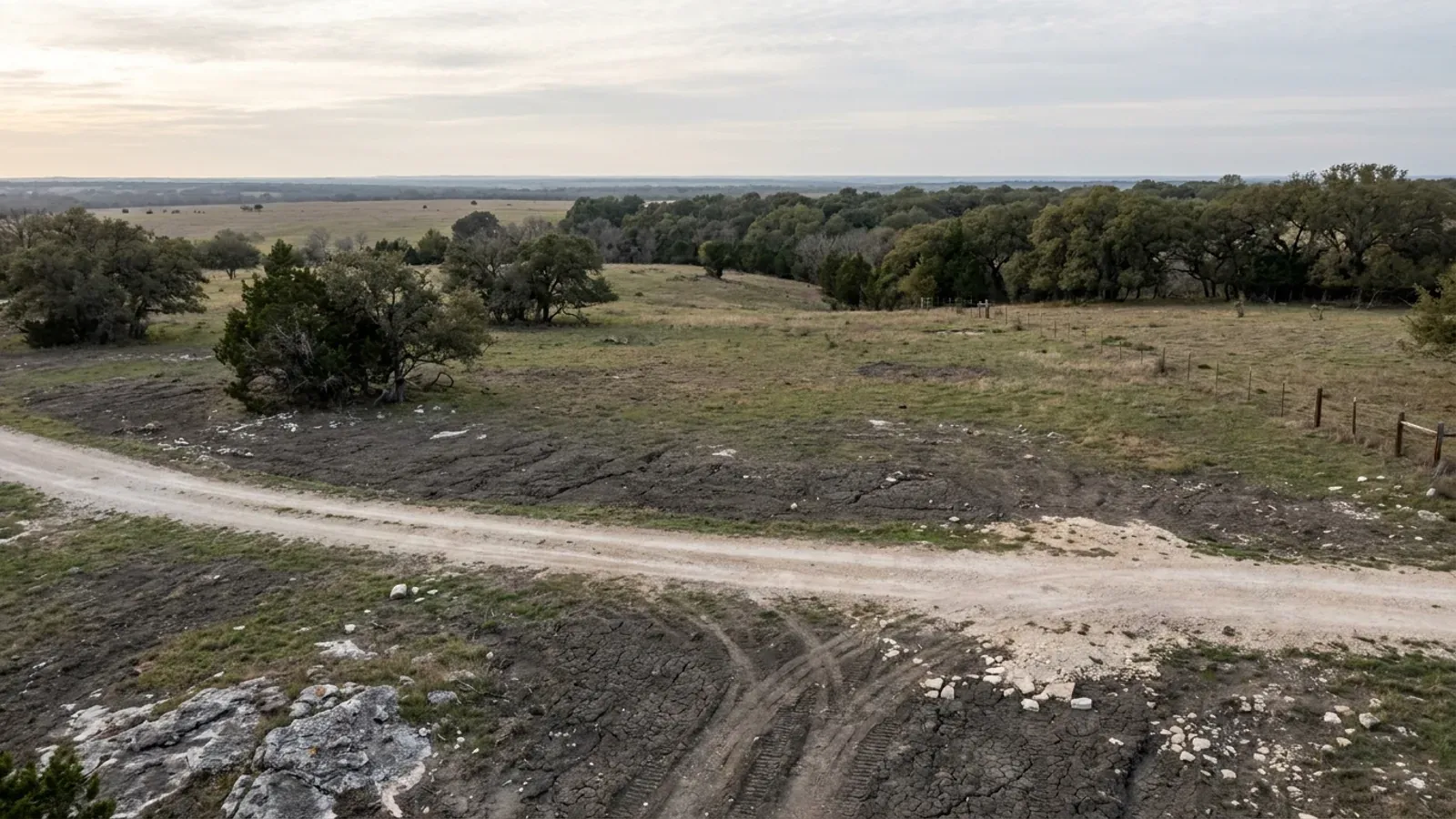
Aerial view of an undeveloped rural lot with cleared grass, a live oak and cedar elm treeline, and a pale gravel access track.
Stage one

The parcel

Zoning, setbacks, flood zone and utility access get checked before anything is drawn.

An excavator grading a compacted building pad on a cleared lot, with survey stakes and a drainage swale visible.
Stage two

Pad and permit

Clearing, grading and a compacted pad, while the submittal works through Tom Green County.
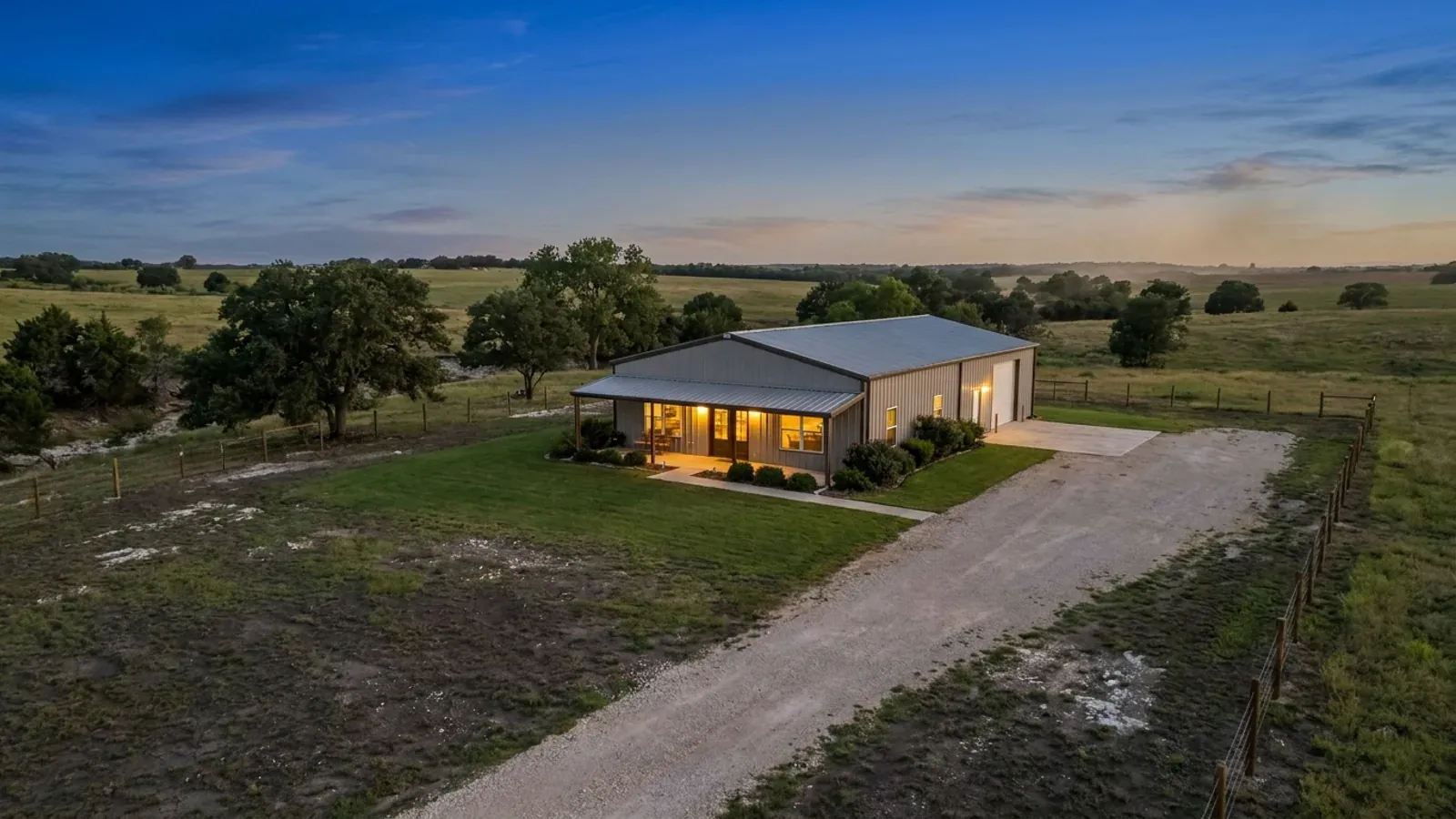
A finished barndominium at dusk with warm interior lighting glowing through its large windows.
Stage three

Frame to finish

Shell erected and dried in, then systems, insulation and interior finish through to CO.

Those are the rules for Tom Green County. Tell us what you want to build and we will draw it to them.

Where we build around San Angelo

Tom Green County and the rural land around it. The buildable acreage for a project this size usually sits outside the city limits, which is frequently what changes who issues your permit.

Our San Angelo service area, covering Tom Green County and the surrounding rural acreage. This map marks the territory we serve, not a branch location.

Nearby areas we build in

Others we cover in this part of Texas. The permitting authority, the adopted design criteria and the zoning can all differ from one to the next.

Building in San Angelo: common questions

12 questions we get asked most often about building in San Angelo. If yours is not on the list, ask it directly.

What code does San Angelo build to, and has the city changed it?
The 2021 International Residential Code, adopted by reference at Sec. 4.04.092 of the Code of Ordinances by Ord. No. 2023-017 on 7 February 2023, together with the 2021 IBC, the 2021 IECC commercial provisions and the 2020 National Electrical Code. The city has changed it in several places, and the changes run both ways. Section R313 Automatic Fire Sprinkler Systems is deleted in its entirety, which removes the townhouse mandate as well as the one- and two-family mandate state law already bars a city from imposing. Section R403.1.6 Foundation anchorage is rewritten to a stricter local specification with half-inch anchor bolts at a maximum of six feet on centre, two bolts to each plate section, and express provision for cold-formed steel framing, which is directly relevant to a metal-framed build. Section R602.6.1 on drilling and notching top plates is rewritten, and the smoke and carbon monoxide alarm locations are expanded. One thing San Angelo did not do is delete the accessory-structure permit exemption, which Temple and Lufkin both did. Ask the permits office for the current amendment list before you finalise drawings.
Does San Angelo publish design figures I can actually build to?
Yes, and that is unusual in Texas. There is no state-level table of design criteria to fall back on, so every figure on a Texas page has to come from a named city's own ordinance, and most cities publish nothing. San Angelo fills in IRC Table R301.2(1) inside the adopting section itself: a 115 mph ultimate design wind speed with a 90 mph nominal design equivalent, a five pound per square foot ground snow load, moderate weathering, a 12-inch frost line depth, a slight to moderate termite rating, a 32 degree Fahrenheit winter design temperature, no ice barrier underlayment required, and an air freezing index of 50. It also records the flood hazard entries, a first ordinance adopted 27 July 1976 and a current map dated 19 June 2012. One cell is worth flagging: the seismic entry reads Seismic Design: Category 0, and the model code's categories are letters rather than numbers, so confirm with the building official how the city applies that cell before an engineer designs to it. None of these numbers travel outside the city limits.
Can I put a big detached shop beside the house inside the city limits?
In the Ranch and Estate district, yes, and generously. Zoning Ordinance Sec. 402.B permits accessory buildings and structures in R&E up to 100 percent of the principal residential building or 10 percent of the site area, whichever is greater, with a five-foot side yard and a ten-foot rear yard, provided they sit to the rear of the house. On a one-acre R&E lot, ten percent of the site is over 4,300 square feet before the whichever-is-greater limb has even looked at the house. Everywhere else in the city, Sec. 402.A caps an accessory building at 600 square feet or 50 percent of the floor area of the principal building, whichever is greater. Height is the part people expect to bite and here it does not: San Angelo sets no accessory-building height limit at all, so the binding cap is the district maximum of 35 feet and two and a half storeys, which clears a tall overhead door comfortably. One detail to plan around: an accessory building attached to, or within ten feet of, the principal building is treated as integral to it and takes the principal building's setbacks.
Which San Angelo zoning district still takes an acre?
One. R&E, Ranch and Estate, has a 43,560 square foot minimum lot for a single-family unit with minimum dimensions of 150 by 150 feet, a 40-foot front yard, 15-foot side yards, a 20-foot rear yard, a maximum floor area ratio of 0.20 and a 35-foot, two-and-a-half-storey height limit. Sec. 303.A describes it as intended for low density detached single-family residences on lots of at least one acre in a suburban or rural setting, and as a holding zone for vacant land annexed to the city. Every other residential district is measured in square feet and drops fast: RS-1 and RS-2 at 5,000, zero lot line and twinhome at 2,500, townhouse at 1,875. The district table carries a footnote worth reading before you settle on an acre: additional lot area may be required under state law where wastewater will be disposed of through an on-site system, so the acre is a starting point, not the answer.
What will the city charge for the permit?
San Angelo prices the two halves of a barndominium at two different rates, which almost no Texas fee schedule does. The residential building permit is a $125.00 base fee plus $0.19 per square foot of living area and $0.15 per square foot of garage, carports, porches, patios and accessory buildings. A remodel or repair is $0.15 per square foot of the entire building under repair. A foundation-only permit, which needs building official approval and complete plans for construction within 30 days, is $125.00 for a single-family dwelling and $85.00 for a residential accessory structure. The minimum permit fee is $25.00, and no permit is required for an accessory structure under 120 square feet with no utilities. Electrical, plumbing and mechanical permits are pulled separately by separate registered contractors. There is no development impact fee in San Angelo: the fee schedule has no impact-fee section and the Code of Ordinances has no impact-fee provision, so unlike Killeen or Waco there is no per-service-unit charge on top. Water tap connections start at $100.00 where the developer has stubbed out, plus the cost of trench repair, and cost one and a half times the schedule outside the city. All figures are the city's own published schedule effective 22 January 2026.
What is the ground like out here, and will the slab need an engineer?
Different from anywhere east of here, and the difference is a cost line rather than a movement risk. USDA soil survey data for Tom Green County show an indurated restriction — cemented caliche or bedrock — within a metre of the surface on 424,760 of 986,490 mapped acres. Tarrant soils, the county's second largest at 162,853 acres, sit on lithic bedrock at 25 centimetres; Cho hits a petrocalcic horizon at 23 centimetres; Mereta's soil classification is literally Petrocalcic Calciustolls. That is an excavation and trenching problem, not a heave problem. Angelo clay loam, the largest soil in the county at 253,224 acres, does run 42.5 percent clay with a linear extensibility of 7.5 below 15 centimetres, and genuine shrink-swell Vertisols are present in Tobosa and Lipan clays, but they cover only 16,233 acres of the county. On the legal question, be careful with what you read elsewhere: Occupations Code Sec. 1001.056(c)(2) removes the private-dwelling engineering exemption for a residential dwelling slab on expansive soil, but both of its limbs are keyed to the expansive-soil provisions of the IRC as applied in the jurisdiction, and the exemption returns where the slab meets that code as applied. Whether your parcel reaches the trigger is a soil report question, not a map question. The city's own new-residence handout puts it plainly: due to the soil composition and other environmental factors, the foundation plan may need to be engineer designed, stamped and signed. Get a geotechnical report and a Texas-licensed engineer on the parcel.
Does Goodfellow Air Force Base restrict what I can build near it?
It does, through airport zoning rather than a building code, and San Angelo's instrument names the base directly. Sec. 2.07.251 creates the San Angelo-Tom Green County joint airport zoning board under Local Government Code Sec. 241.014, by Ord. No. 2018-121 of 2 October 2018, with two members appointed by the commissioners court, two by the city council and an elected chairman. The airport zoning ordinance it administers defines airport to mean San Angelo Regional Airport/Mathis Field and Goodfellow Air Force Base, and sets separate approach, transition, horizontal and conical zones and height limits for each, keyed to airport elevations of 1,915 feet above sea level at Mathis Field and 1,877 at Goodfellow. For a house the practical answer is reassuring. Both sets of height limits end with the same saving clause: nothing in the chapter prohibits construction of any structure to a height up to 45 feet above the surface of the land, and no permit is required below 75 feet in the horizontal and conical zones, in the approach zones beyond 4,200 feet from a runway end, or in the transition zones beyond the horizontal zone. A single-storey shop-and-house under the district's 35-foot cap is comfortably under both. The live provision is the use restriction, which bars any use that creates glare in the eyes of flyers, makes airport lights hard to distinguish, or interferes with airport radio — and that has no height floor at all. Where the zones actually fall is a map question: the boundaries are incorporated by reference to a 1969 city map and a 1973 Goodfellow map. Call the airport administration at (325) 659-6409 before you site a tall structure or a bright yard light.
Does the county regulate outdoor lighting because of the base?
No, and it has no power to. Local Government Code Chapter 240, Subchapter B is the provision that lets a Texas county regulate outdoor lighting near a military installation, and Sec. 240.032(b-1) brackets it to a county with a population of more than one million that has at least five United States military bases, plus any adjacent county within five miles of a United States Army installation. Tom Green County has about 120,600 people and one installation, and Goodfellow is an Air Force base, so neither limb reaches it. The other limbs of the same section are observatory limbs, running 57 miles from McDonald Observatory and five miles from the George and Stephen F. Austin State University observatories, and none of those reaches the Concho Valley either. What does exist is a city ordinance of general application: Article 8.11 of the Code of Ordinances requires luminaires to be shielded and directed so the beam is not thrown across a bounding property line above three feet, and caps intensity at the property line abutting a residential use at 0.25 footcandles. That is a neighbour rule, not a base rule — but the airport zoning ordinance's glare provision is a base rule, and it is the one to think about on a rural tract near Goodfellow.
Is my land in a groundwater conservation district, and can I drill a well?
That depends on which side of a boundary you are on, and San Angelo is on the outside of it. The Lipan-Kickapoo Water Conservation District covers part of Tom Green, Runnels and Concho counties, but its own management plan excludes San Angelo, Christoval, Grape Creek, the Red Creek Municipal Utility District and the area northwest of the city that lies north of the Middle Concho River and south and west of US Highway 87 up to the Coke County line. The district says most of those places were excluded because they draw surface water. Inside the district, the rules are real and they constrain where a house goes on a tract. Rule 9.1 requires every well to be at least 330 feet from the nearest well or authorised well site and 50 feet from the nearest property line, though a well used solely for domestic and livestock use may come within 10 feet of a property line if the annular space is cemented from the surface to the top of the production layer. Rule 2.1 is the cliff: a well used solely for domestic use or livestock on 10 acres or less is not exempt and must be permitted before drilling. Even an exempt well needs a preregistration form filed with and approved by the district before the rig turns, and it is still subject to the spacing rules. Statewide, Water Code Sec. 36.117 makes the exemption conjunctive — over 10 acres and incapable of producing more than 25,000 gallons a day — and a district may not cap production from an exempt well, but it must require it to be registered and cased. A Texas licensed water well driller and pump installer is required either way. Call the district at (325) 651-0919 with your legal description before you assume you are outside it.
Who issues the septic permit, and does it change inside the city?
No, it does not change. TCEQ's authorized agent record for Tom Green County returns one agent, the Tom Green County Authorized Agent, and the area served is recorded as the entire county with no city carve-out — which means a San Angelo address on an unsewered lot still gets its on-site sewage facility permit from the county, not the city. The permit office is at 113 W Beauregard Ave in San Angelo, and the county's order regulating on-site sewage facilities was adopted 18 August 2014 and approved by TCEQ's Executive Director on 9 September 2014. The city's own residential building permit application says so on its face, directing applicants to the Tom Green County Health Department for the septic permit. Two things follow for a barndominium. The zoning table's own footnote warns that additional lot area may be required under state law where wastewater goes to an on-site system, so the one-acre R&E minimum is not automatically enough. And the drainfield generally has to be sized and sited before the building footprint is fixed, because moving a drainfield later is far harder than moving a shop door.
What happens if the parcel is near the Concho River or in a flood zone?
Two separate things, and both are worth checking early. On flood elevation, San Angelo does not publish a single freeboard number. Sec. 12.05.008(b)(1) requires the lowest floor of a new residential structure, including a basement, to be elevated to a minimum of two feet above the base flood elevation, one foot above the fully developed 100-year flood elevation, or one foot above the 500-year flood elevation, whichever is more restrictive — and a registered professional engineer, architect or land surveyor has to certify to the floodplain administrator that the standard is met. The 500-year limb is the one people do not expect. Enclosed areas below the lowest floor need at least two openings totalling one square inch for every square foot of enclosed area, with the bottom of every opening no higher than a foot above grade. The floodplain administrator is the city engineer. Separately, the River Corridor District Overlay Zone brings a design review requirement: Sec. 212 exempts a property used exclusively for a single-family detached dwelling from that review, with the express exception of a property adjacent to the Concho River. So a house on the river is one of the few residential situations in San Angelo where an application for urban design review is actually required.
What changes if my land is outside the San Angelo city limits?
The building code stops following you, and the utilities become the lever instead. The subdivision ordinance governs the division and development of land inside the city and inside its extraterritorial jurisdiction, but the city's building code and zoning do not reach the ETJ. How far the ETJ runs is a live question here, and worth asking rather than assuming: Local Government Code Sec. 42.021 gives three and a half miles to a municipality with 50,000 to 99,999 inhabitants and five miles at 100,000 or more, and San Angelo is sitting on that line — the Census Bureau's 2025 estimate is 100,640, the same series shows the city below 100,000 from 2021 through 2023, and the 2020 estimates base was 99,903. Ask Planning at (325) 657-4210 which distance the city administers and where the line falls on your parcel. Two water rules bite in the ETJ. First, an owner of unplatted property in the extraterritorial jurisdiction who asks for city water must voluntarily petition in writing for annexation of the area to be served. Second, the city extends no water mains or water service beyond the edge of its ETJ at all. Water tap connections outside the city also cost one and a half times the in-city schedule. Beyond all that it is unincorporated Tom Green County, where a different set of answers applies: the Commissioners Court adopted Local Government Code chapter 233 subchapter F on 8 June 2010, so a residential code does reach a house out there, but the county may not require a building permit, charge a fee for one, or employ inspectors under section 233.154(a)(3). The septic permit still comes from the same county office either way.

Building in San Angelo?

Start with the plan. Tell us what you want to build and we will draw it, then confirm what Tom Green County will actually let you put on the parcel and what wind load it has to meet. That conversation costs nothing.