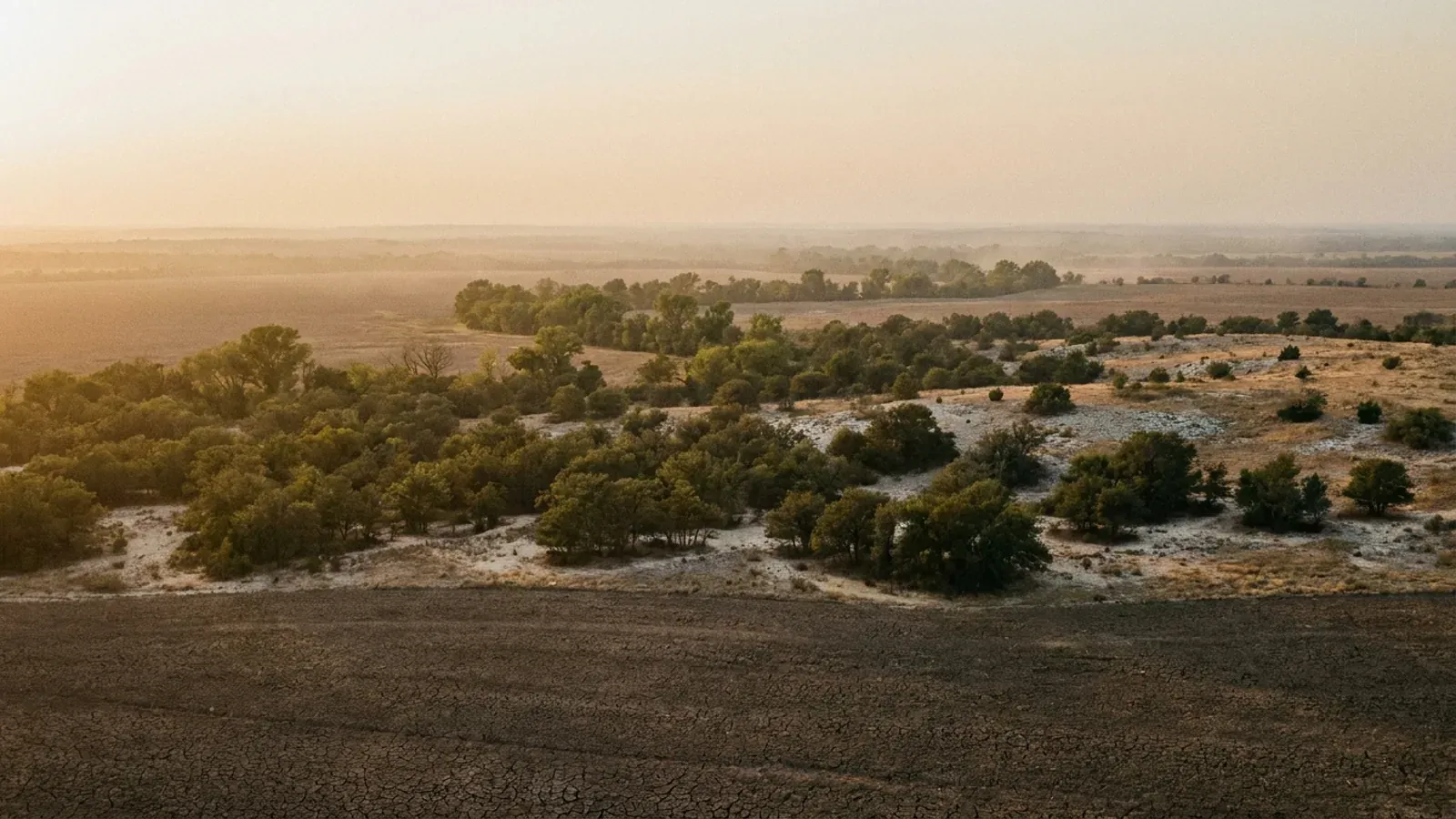
Barndominium Builders in Bryan, TX
Bryan and College Station get written about as one place, and on the questions that actually decide a barndominium they are not one place at all. Bryan runs the 2021 International Residential Code with its energy chapter struck out and pointed at the 2018 energy code; College Station, across the line, is on the 2024 editions of both. Bryan has real open ground — 55 square miles at about 1,660 people to the square mile, growing faster than its neighbour since 2020 — and its agricultural-open district permits a house, a barn and a shed on an acre as of right. But an acre is the ceiling rather than the floor: Bryan has no larger residential district, and a detached shop of 1,501 square feet or more needs a conditional use permit on any lot in the city. For real acreage the answer is the extraterritorial jurisdiction or unincorporated Brazos County, and the rules change at both lines.
Bryan at a glance
- County
- Brazos County
- Population
- 91,996
- Where we build
- Bryan, College Station, Brazos County, Grimes County
- Site visits
- We come to the land — Bryan and the rest of Brazos County alike
ZIPs 77801, 77802, 77803, 77807, 77808
Building conditions in Bryan
What actually changes from one Texas jurisdiction to the next: who issues the permit, whether the residential code is enforced there at all, what the structure has to be engineered to, and what the ground is like. These are the numbers your drawings have to satisfy.
Bryan Code of Ordinances Secs. 14-19, 14-46, 14-47, 14-266 and 14-298, read from the codified text (Supplement 31, codified through Ord. No. 2766 of 9 December 2025); City of College Station Building Codes page, cstx.gov
Bryan Code of Ordinances Sec. 130-34(a)(4) and (a)(5), Special and supplementary regulations
Bryan Code of Ordinances Sec. 14-47, amendment adding IRC Section R109.5 (Special Inspection Reports by Third Party)
Bryan Code of Ordinances Secs. 14-20 (IBC Section 1907) and 14-47 (IRC Chapter 4, R403.1, R403.1.3.3 and R404.1.1); City of College Station 2024 International Residential Code amendments, item 19, cstx.gov
USDA-NRCS SSURGO data for survey area TX041, Brazos County, via Soil Data Access; NRCS Official Series Description for the Tabor series; Texas Occupations Code Sec. 1001.056(c)(2)
Bryan Code of Ordinances Secs. 130-3, 130-10(b), 130-11(b), 130-34(q), 114-42, 114-43(a), 114-44(b) and 114-47(a)
Also worth knowing before you build in Bryan
- Bryan and College Station remove the sprinkler requirement two different ways
- Section 14-47 amends IRC R313.2, on automatic fire systems for one- and two-family dwellings, by replacing the words 'shall be installed' with 'if installed'. It does not strike the section; it converts a mandate into a conditional. Townhouses get a separate exception at R313.1 — no sprinklers required provided the building is not over two storeys, not over 12,000 square feet of total building area, has fire access per the fire code and a two-hour UL-rated fire wall between dwelling units. College Station reaches the same outcome by deleting the section outright: its 2024 amendments strike R309, Automatic Fire Sprinkler Systems, in its entirety, and give the reason as state law barring municipalities from requiring sprinklers in one- and two-family dwellings. Same result, two mechanisms, and even two different section numbers, because the provision moved from R313 to R309 between editions.
- Bryan Texas Utilities serves both cities, and it is a separate application
- The municipal electric utility is not a Bryan-only thing: BTU's own Service Entrance Requirements Manual describes a reconnection being judged by the City of Bryan inside Bryan, by the City of College Station inside College Station, or by BTU personnel outside the city limits, and its new construction page covers customers getting power to sites 'in Bryan, College Station, and surrounding areas'. What it does change is the process. BTU's portal is, in its own words, 'completely separate' from the City of Bryan's, with different accounts and no shared records — so a new build means two applications. There are no application fees for a Line Design project, but the customer pays a Contribution In Aid of Construction, described as 'their contribution towards the construction cost of their project', and the clock does not start until that is paid, the meter loop is mounted, the damage waiver signed and the easements executed.
- Over 200 amps, BTU wants a load analysis before it will price the connection
- The Service Entrance Requirements Manual is explicit: 'For all installations greater than 200 Amps, prior to service being extended or determination of any CIAC amount, an electric load analysis must be provided by the Customer or their contractor to BTU Line Design with enough detail to adequately size BTU's electric facilities.' A barndominium with a working shop — welder, compressor, lift, a sub-panel out in the bay — goes past 200 amps routinely rather than exceptionally, so on this build type the load analysis is a scheduled step, not an edge case. The published turnaround either side of it: three to five business days where only a meter is being set, seven to ten business days where any construction is needed, counted from after the utility locates are verified.
- In the extraterritorial jurisdiction Bryan reaches the plat, not the building
- Chapter 110, Article IV applies Bryan's subdivision design standards in the ETJ with named modifications. Streets serving lots of one acre or greater need meet Brazos County standards only. Lot width is 100 feet for one-acre-plus lots on a local or collector road and 360 feet for any lot taking access to an arterial or greater. Minimum lot area is one acre where there is on-site sewage disposal, in accordance with county standards, and 5,000 square feet where there is wastewater collection. Front setbacks are 25 feet on county roads and 50 feet on state or federal roads. Water distribution lines must still meet city standards including International Fire Code fire flow. Streetlights and sidewalks are not required over an acre, and parkland dedication is not required at all. What is absent from that list is any building requirement — the adopted residential code applies 'within the corporate limits of the city' and does not travel into the ETJ.
- One acre is Bryan's ceiling — and College Station's is three
- Bryan's largest-lot residential district is A-O, agricultural-open, at a one-acre minimum with a 150-foot width, 300-foot depth and a 50-foot front setback. Nothing in Bryan's dimensional table goes above it for single-family use. College Station's zoning runs the other way: its R Rural district requires three acres average and two acres absolute per dwelling unit at a maximum of 0.33 units to the acre, and its WE Wellborn Estate district two acres, with E Estate at one. So the intuition that Bryan is the half with the land is only half right. Bryan is the less dense of the two in aggregate, at about 1,660 people per square mile against roughly 2,490, and it has grown faster since 2020 — but College Station is the one whose zoning contemplates multi-acre residential parcels inside its limits.
- Two chapters of Bryan's code point opposite ways at a rented shop
- Section 130-34(a)(1) defines a residential accessory structure as one 'without separate kitchen facilities, not used for commercial purposes and not rented'. Section 130-34(b)(1)e says an accessory dwelling unit 'shall not be rented or leased and may not be issued utility meters separate from the main structure', and caps it between 400 and 1,000 square feet, to the rear of the main dwelling, by conditional use permit only. Meanwhile Section 114-42 defines a short-term rental to include 'any residential home, dwelling unit, room, or accessory building rented in whole or in part for less than 30 consecutive days' and taxes it. So the zoning chapter forbids letting the accessory building and the tax chapter contemplates it. Both provisions are live and published, and anyone planning guest quarters or a rental shop should put that question to the city before it is built rather than after.
- Contractors register with the city, and inspections are on a 48-hour clock
- Texas issues no residential building contractor licence, but Bryan requires registration of its own. Section 14-20 adds IBC 105.1.3, making it the duty of everyone who contracts to construct, enlarge, alter, repair, move or demolish a building 'to first register with the chief building official', with plumbing, mechanical, irrigation and electrical contractors also registering their state licence before the matching permit will issue, and general liability coverage required before any licence is registered. On the other side of the counter, Section 14-20's amendment to IBC 110.5 commits the city: on a request for inspection of work that will be covered in later phases, 'the city inspectors shall perform the inspection within 48 workday hours', excluding weekends and holidays.
- A shed with a socket in it needs a permit
- Section 14-47 rewrites the IRC's permit exemption for accessory buildings. In Bryan the exemption covers one single-storey detached accessory structure per residential lot, not more than 120 square feet, and only if it is not in a floodplain or a public utility or surface drainage easement, is not permanently affixed to the ground, and 'is not provided with utilities (sewer, water, gas or electricity)'. Anything under 7.5 feet from a principal building is treated as integral to it and takes the same setbacks. A barndominium shop is nowhere near that line, and neither is a storage building with power run out to it. College Station uses the same 120-square-foot figure but conditions it differently, requiring the structure to be in the rear yard.
- In the floodplain, one foot above base flood elevation and a separate permit
- Section 46-23 requires a floodplain development permit 'for all proposed construction within regulatory floodplains or other areas of flooding identified by the City of Bryan'. Section 46-43 sets the elevation: new construction or substantial improvement of a residential structure in Zones A1-30, AE and AH must have the lowest floor including basement elevated to one foot above base flood elevation, machinery and equipment included; in an AO zone it is the depth number on the flood map above the highest adjacent grade, or at least two feet where no depth number is given. Section 14-47 amends the IRC's own flood provisions at R322.1 and R322.2.1 to point at Chapter 46 instead — so the elevation answer in Bryan comes from the stormwater chapter, not the building code. This matters more than it might because two of the county's four largest soil map units, Ships clay and Gladewater clay, are the frequently flooded Brazos and Navasota bottoms.
- Bryan's building code sends the septic question to the county
- Section 14-20 amends IBC 101.4.3 by deleting the reference to the International Private Sewage Disposal Code and replacing it with 'the Brazos County OSSF Requirements, ON-SITE SEWAGE FACILITY'. So even inside the city limits, where Bryan's own adopted code governs the building, the on-site sewage rules Bryan's code points at are the county's. In the extraterritorial jurisdiction Section 110-79 goes further, setting a minimum lot area of one acre for any lot on on-site sewage disposal and requiring it to be 'in accordance with the county standards'. Two different instruments, and the septic answer comes from the county in both of them.
- Termite treatment is a paperwork step at both ends of the build
- Section 14-47 amends IRC R318.2 on chemical termiticide treatment: 'The method of application and contractor hired to apply the chemicals shall be submitted to the Building Department when applying for the Building Permit, and verification of the application shall be turned in prior to issuance of the Certificate of Occupancy.' It is a small requirement that is easy to miss at the front of a project and expensive to discover at the end of one, because the certificate of occupancy is what it holds up. College Station carries the identical amendment word for word — at R305.2 rather than R318.2, because the section renumbered between the 2021 and 2024 editions. Neither city publishes a termite infestation probability rating of its own.
Bryan Code of Ordinances Sec. 14-47, amendments to IRC R313.1 and R313.2; City of College Station 2024 International Residential Code amendments, item 14, cstx.gov
Bryan Texas Utilities Service Entrance Requirements Manual, 10th Edition, BTU General Policies and Procedures paragraphs 2 and 6; BTU New Construction page, btutilities.com
Bryan Texas Utilities Service Entrance Requirements Manual, 10th Edition, BTU General Policies and Procedures paragraphs 2 and 8
Bryan Code of Ordinances Secs. 110-79 and 14-46(a)
Bryan Code of Ordinances Sec. 62-161, Building setbacks and lot standards; College Station Unified Development Ordinance Secs. 5.1 and 5.2; U.S. Census Bureau 2024 Gazetteer place file and Vintage 2025 sub-county population estimates
Bryan Code of Ordinances Secs. 130-34(a)(1), 130-34(b)(1) and 114-42
Bryan Code of Ordinances Sec. 14-20, amendments adding IBC Section 105.1.3 and amending IBC Section 110.5
Bryan Code of Ordinances Sec. 14-47, amendment to IRC Section R105.2 item 1; City of College Station 2024 International Residential Code amendments, item 2, cstx.gov
Bryan Code of Ordinances Secs. 46-23 and 46-43, and Sec. 14-47 amendments to IRC Sections R322.1 and R322.2.1; USDA-NRCS SSURGO map unit acreages for survey area TX041
Bryan Code of Ordinances Sec. 14-20, amendment to IBC Section 101.4.3, and Sec. 110-79(5)(g)
Bryan Code of Ordinances Sec. 14-47, amendment to IRC Section R318.2; City of College Station 2024 International Residential Code amendments, item 15, cstx.gov
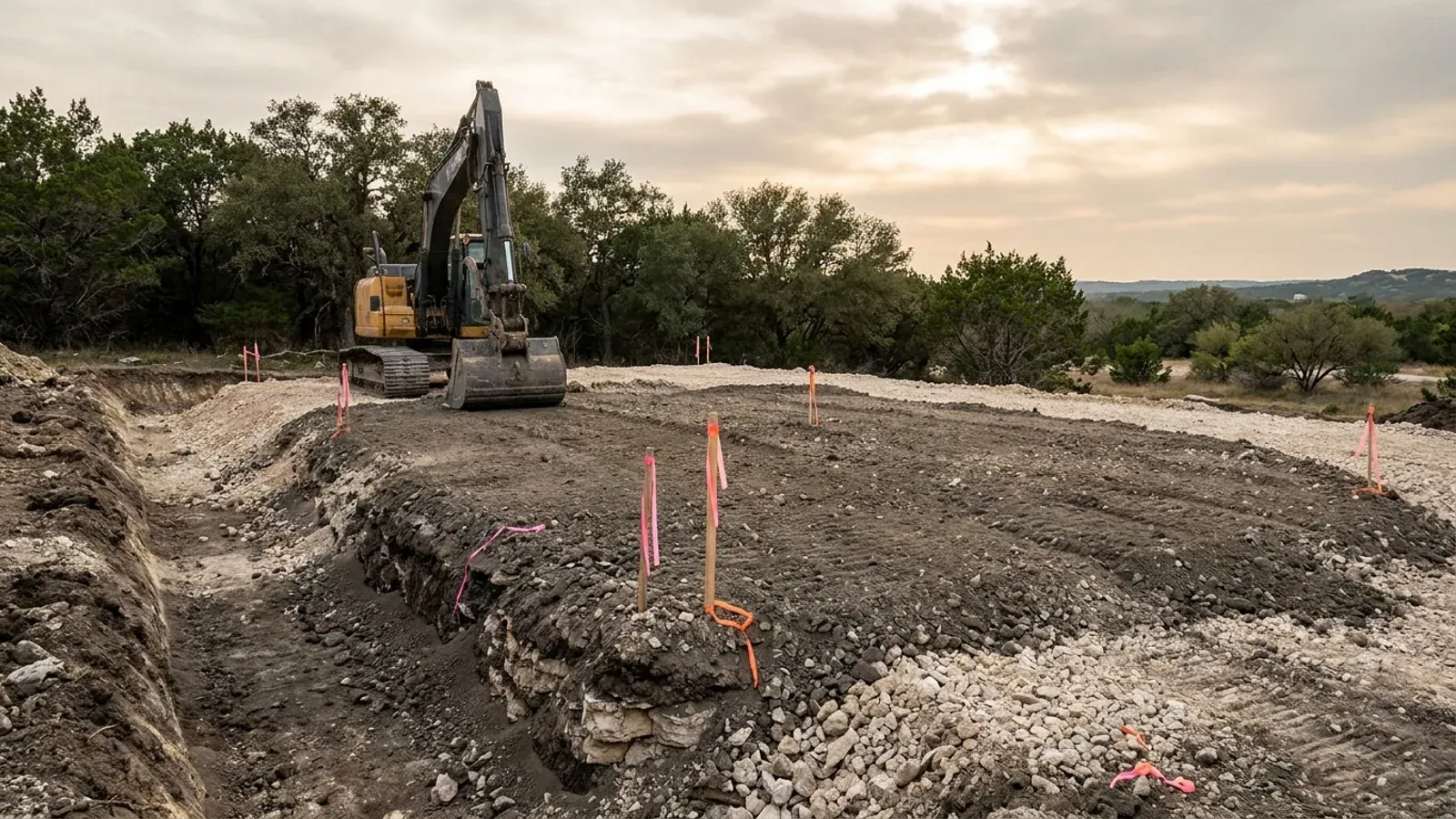
The expensive surprises are in the ground, not the building
What moves a Texas budget is usually below grade, and it is soil rather than rock: shrink-swell clay. The Blackland Prairie and the Gulf Coast clays move enough between a wet season and a dry one to drive the foundation design across the state's largest markets, which is why several DFW cities require an engineer's seal on the foundation of every new house. Those are the same conditions that decide whether a septic field passes its soil and site evaluation, so the grading plan, the foundation and the drainfield get resolved together rather than one at a time. We price the dirt before we price the building.
What we build in Bryan
All nine of our services — kits, custom plans, post-frame and steel construction, site preparation, permitting and engineering, through to turnkey builds — are available across Brazos County. What a project costs depends far more on the parcel than on square footage, so we work from your land rather than from a rate card.
See what we buildWhat a build looks like
Three stages every Bryan project passes through, from a raw parcel to a finished home. Site work first, because that is where the budget is decided.
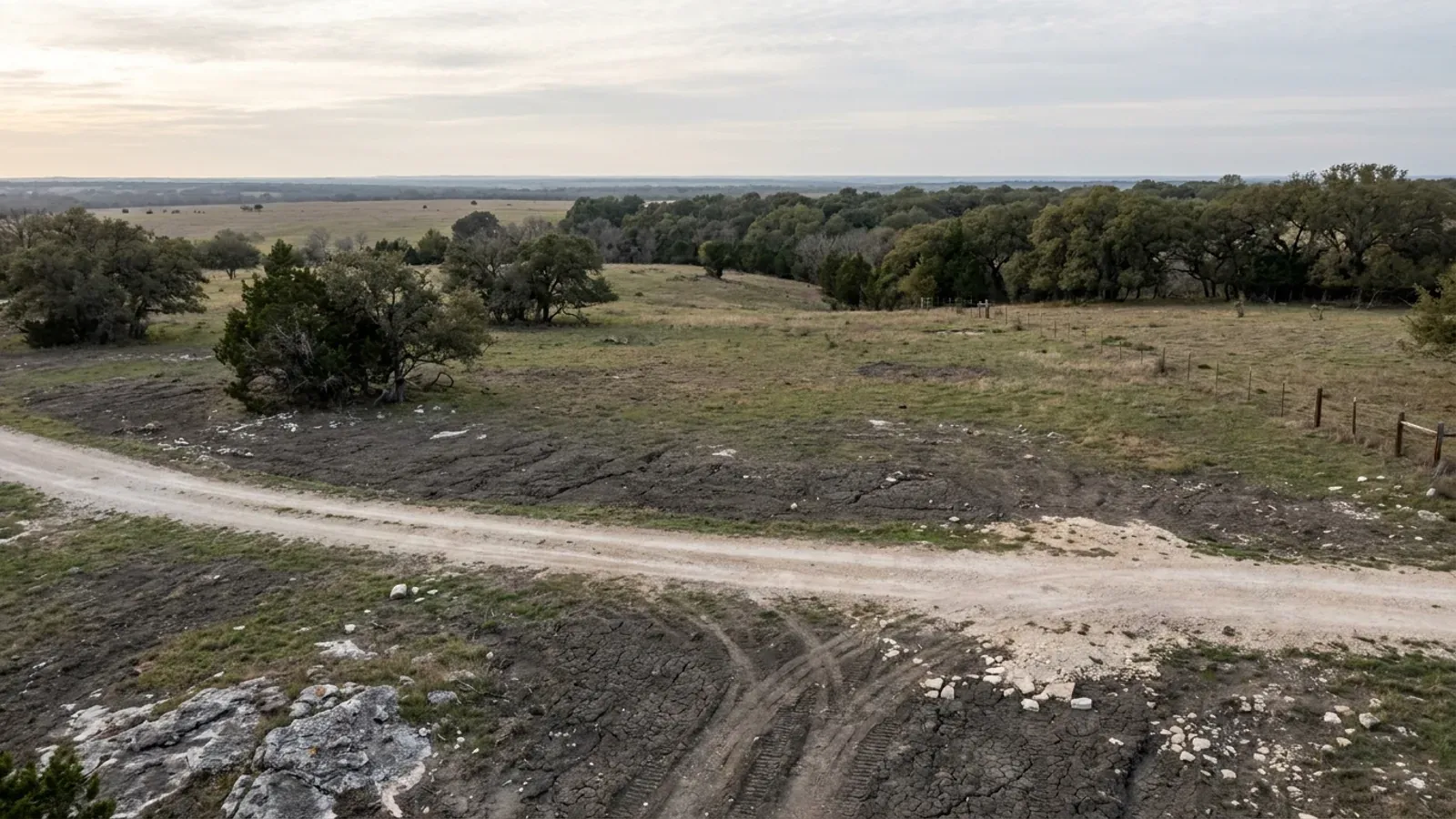
The parcel
Zoning, setbacks, flood zone and utility access get checked before anything is drawn.
Pad and permit
Clearing, grading and a compacted pad, while the submittal works through Brazos County.
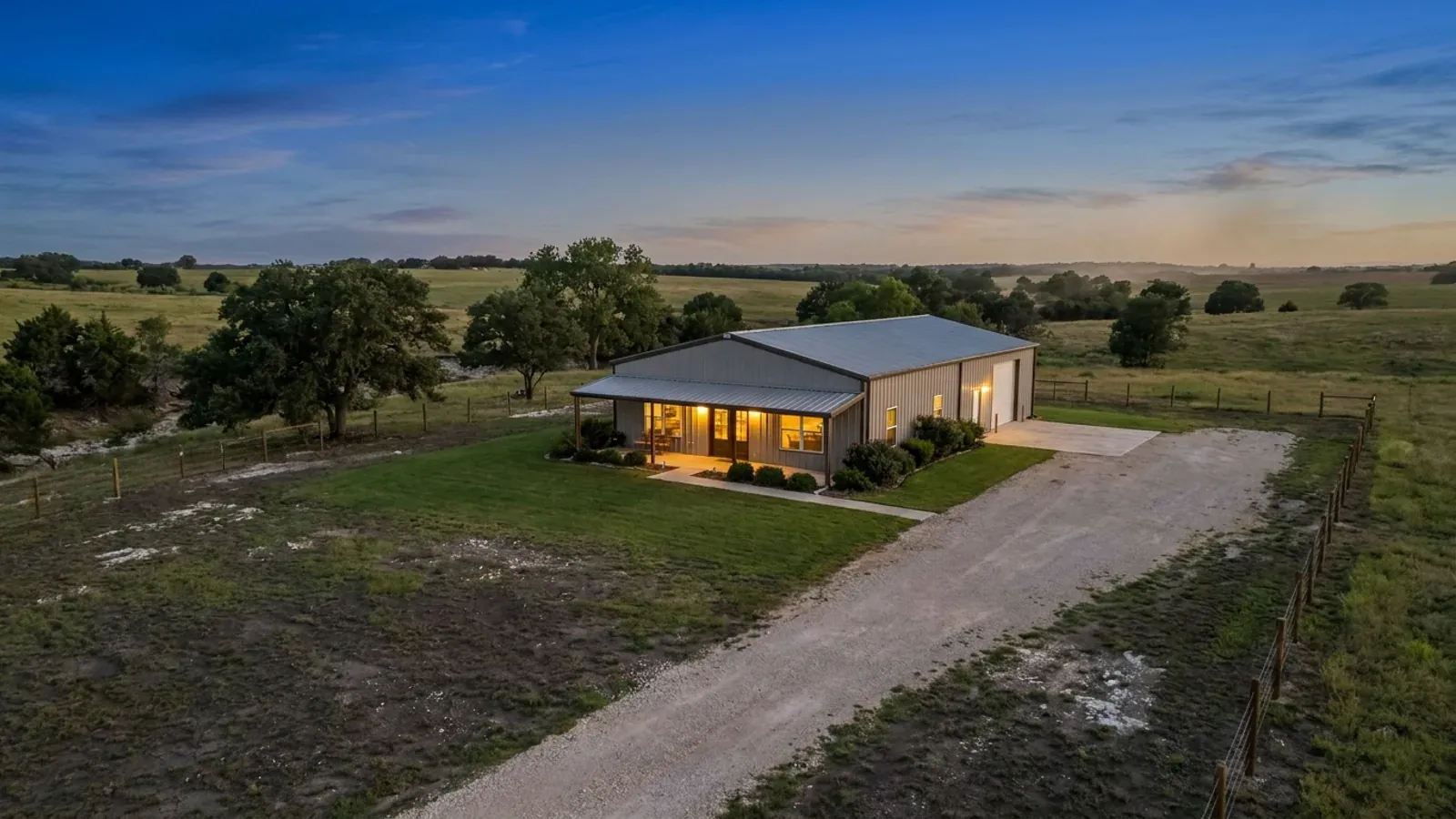
Frame to finish
Shell erected and dried in, then systems, insulation and interior finish through to CO.
Those are the rules for Brazos County. Tell us what you want to build and we will draw it to them.
Where we build around Bryan
Brazos County and the rural land around it. The buildable acreage for a project this size usually sits outside the city limits, which is frequently what changes who issues your permit.
Keep reading
The questions that usually come next once you know what Bryan allows.
Barndominium Cost Guide
Sourced per-square-foot ranges by tier and by size, with a calculator built on the same figures.
Read itIs It Legal in Texas?
Classification, zoning, the HOA gate, and why "nonresidential farm building" does not cover a home.
Read itHow Long Does It Take?
Census build-duration data, and what actually sets the permit clock where you are building.
Read itNearby areas we build in
Others we cover in this part of Texas. The permitting authority, the adopted design criteria and the zoning can all differ from one to the next.
Building in Bryan: common questions
10 questions we get asked most often about building in Bryan. If yours is not on the list, ask it directly.
Which building code applies to a barndominium in Bryan?
Is Bryan the same as College Station for building purposes?
How big can the shop be?
Will a steel-framed building need a special inspection?
Does the foundation have to be engineered?
What is the ground actually like here?
Can I let a barndominium out to students, or run it as a short-term rental?
What changes if I build outside the city limits?
Do I deal with the city and the electric utility separately?
What does Bryan charge, and is there an impact fee?
Building in Bryan?
Start with the plan. Tell us what you want to build and we will draw it, then confirm what Brazos County will actually let you put on the parcel and what wind load it has to meet. That conversation costs nothing.