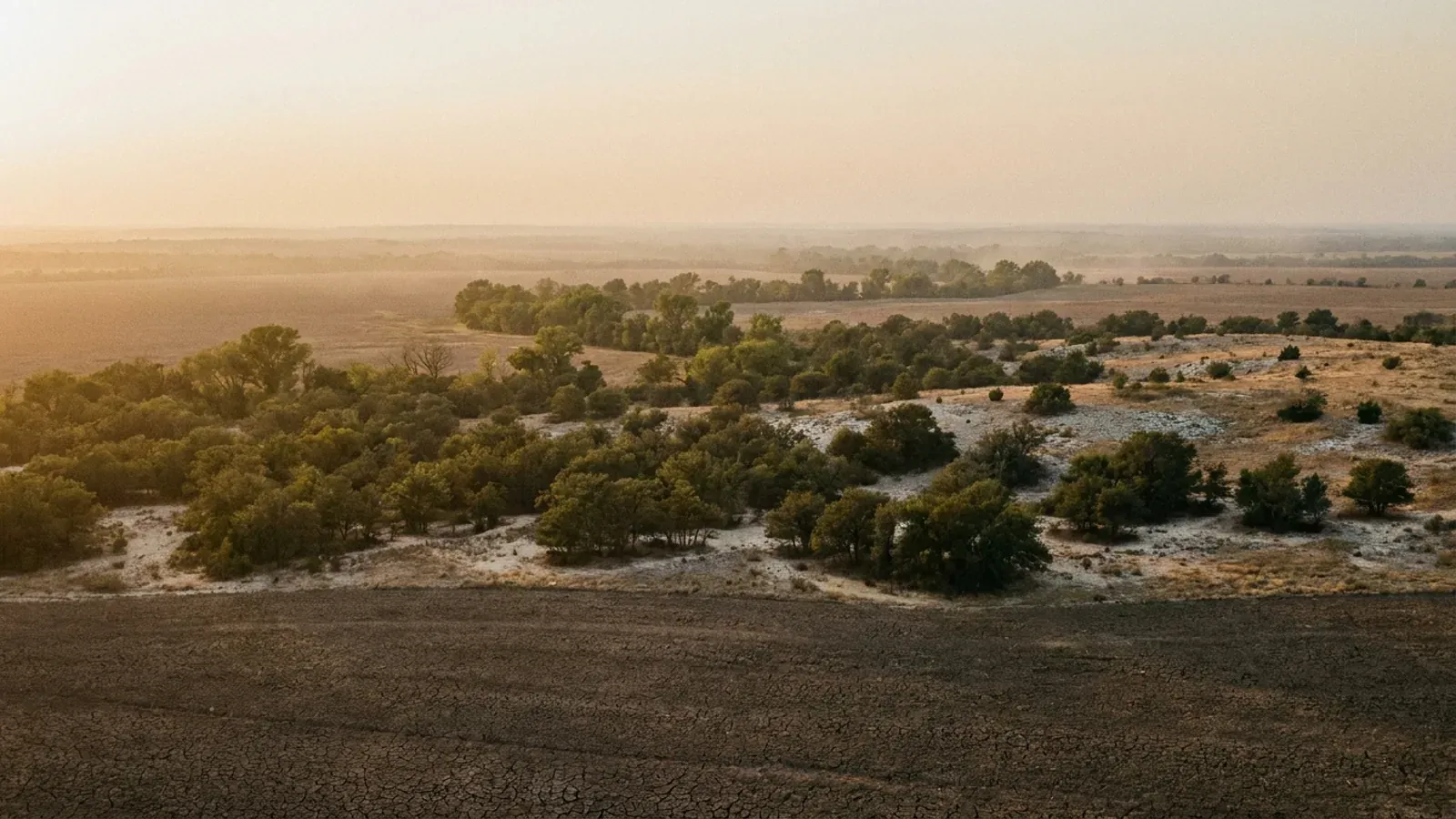
Open rolling Blackland Prairie cropland grading into a post oak belt of the Eastern Cross Timbers, with a pecan-lined creek.
Brazos County 2024 IRC as adopted here

Barndominium Builders in College Station, TX

College Station is 127,472 people on 51.16 square miles, and what matters most about building here is how sharply it differs from Bryan next door. The two share a set of engineering design guidelines and little else: separate codes, separate zoning, separate fees. College Station moved to the 2024 International Residential Code by Ordinance 4646, effective 1 January 2026, and amended it heavily — the residential sprinkler section is deleted outright, and the turned-down-footing provision replaced with a locally developed minimum foundation standard. Two local rules then shape a barndominium here more than the code does. A detached accessory building that is not a garage is capped at an eight-foot eave height, which pushes a workshop under the house's own roof or into the garage category. And the Shared Housing rule measures the building rather than the people in it.

College Station at a glance

County
Brazos County
Population
127,472
Where we build
College Station, Bryan, Brazos County, Grimes County

ZIPs 77840, 77843, 77845

Site visits
Site walks booked across College Station and the Brazos County land around it

Building conditions in College Station

What actually changes from one Texas jurisdiction to the next: who issues the permit, whether the residential code is enforced there at all, what the structure has to be engineered to, and what the ground is like. These are the numbers your drawings have to satisfy.

Build conditions for College Station , Brazos County, Texas . BUILD CONDITIONS COLLEGE STATION…Brazos County2024 IRCADOPTED RESIDENTIAL CODE2024 IRCThis jurisdiction publishes no design wind speed. It is settled in writing with the authority overyour parcel before the frame is ordered.ZONING · R RURAL3 acres average per dwelling unit, 2…R Rural is the largest-lot residential district and the one thatcarries a barndominium. It also sets the largest setbacks in the…IMPACT AND PERMIT FEESWater, wastewater and roadway impact…College Station adopted system-wide water, wastewater and roadwayimpact fees in 2016 under Local Government Code Chapter 395,…WHO ISSUES THE PERMITCity of College Station Planning & D…1101 Texas Avenue, College Station, TX 77840. Building Division979.764.3570, cspds@cstx.gov; the Planner-on-Call answers zoning…
Build conditions for College Station, drawn from the sourced facts on this page. Every figure above is cited in the quick-facts panel below, with its source and vintage.
The no-more-than-four rule is gone
College Station limited unrelated occupants of a dwelling to four from 1939 until 2025. Senate Bill 1567 of the 89th Legislature ended it. The statute reaches only a home-rule city under 250,000 people that contains, or adjoins, the campus of an institution of higher education enrolling more than 20,000 — which is College Station and Texas A&M almost exactly. It forbids any occupancy limit based on age, familial status, occupation, relationship status or degree of affinity or consanguinity. The city amended its definition of family by Ordinance 2025-4619 on 11 September 2025 and repealed both the Restricted Occupancy Overlay and the High Occupancy Overlay by Ordinance 2025-4620 the same night. The codified UDO definition now reads simply: a family is any number of persons occupying a single dwelling unit.

Texas Local Government Code Chapter 211, Subchapter D, added by Acts 2025, 89th Leg., R.S., Ch. 841 (S.B. 1567), effective 1 September 2025; City of College Station Ordinances 2025-4619 and 2025-4620; UDO Article 11, Definitions, Family

But the city now measures the building instead
What replaced the occupancy cap is a use called Shared Housing, defined by Ordinance 2026-4675 of 23 April 2026 as a congregate living facility as defined by the International Building Code, identified by a combination of characteristics: more than four bedrooms of similar size, or rooms such as dens, offices or game rooms that could sleep more than four; bathroom parity in excess of four; more than one story used to hold down the footprint for impervious cover; no garage, or a garage that can support additional living space; and a parking area that will take more than four vehicles. Shared Housing is not a permitted use in R Rural, WE, E, WRS, RS, GS, D or T. A large barndominium can present several of those characteristics at once, so the design is worth walking past the Planner-on-Call before it is drawn.

College Station UDO Article 11, Definitions, Shared Housing (Ord. No. 2026-4675, 23 April 2026), and Article 6, Section 6.3.C Use Table

Eight feet of eave on a detached shop
UDO section 6.5.B.5 restricts accessory buildings other than garages, carports and living quarters to a minimum 15-foot rear setback and a maximum building eave height of eight feet. That rules out a freestanding workshop with a 12- or 14-foot overhead door. Section 6.5.B.1 adds that all accessory uses combined may occupy no more square footage than 25 percent of the habitable floor area of the principal structure or 400 square feet, whichever is greater — but garage or carport area devoted to vehicle storage is excluded from that calculation, and garages and carports are excluded from the eave rule. The two clean routes are therefore to put the shop under the principal roof, or to build it as a garage, which carries a 20-foot rear setback and a 20-foot side setback where it takes access from a side street.

College Station UDO Article 6, Section 6.5.B, Accessory Structures

The 2024 code, and no published design table
The city adopted the 2024 family of I-Codes and the 2023 National Electrical Code by Ordinance 4646 on 13 November 2025, effective 1 January 2026 — putting College Station on a newer edition than most of Texas. It publishes its local amendments code by code. What it does not publish is Table R301.2: neither the IRC nor the IBC amendments fill in a design wind speed, frost depth, snow load, seismic category or termite rating, and no part of IBC Table 1609 is amended. Nine miles away in Bryan the answer may be different, and it has to be asked there rather than assumed from here.

City of College Station Building Code Adoption History (12/30/25) and the 2024 IRC and 2024 IBC adopted amendments published on the city's Building Codes page

R Rural still exists inside the city
College Station keeps a genuine large-lot district in its limits. R Rural requires an average of 3 acres per dwelling unit and an absolute minimum of 2, allows a maximum of 0.33 dwelling units per acre across a subdivision, and sets 50-foot front and rear setbacks, a 20-foot side setback and 30 percent maximum impervious cover. Below it, WE Wellborn Estate is 2 acres and E Estate is 1 acre with subdivisions that may contain rural infrastructure. Single-Family Detached is permitted by right in every one of them. The city's own subdivision rules also contemplate private septic systems, licensed through the County Health Department, and streets built to rural standards in rural residential subdivisions.

College Station UDO Article 5, Sections 5.1 and 5.2, and Article 8, Subdivision Design and Improvements

A local minimum foundation standard
College Station replaced the IRC's generic provision for slabs-on-ground with turned-down footings. Amendment 19 to the 2024 IRC deletes R403.1.3.3 and substitutes: all slabs-on-ground with turned-down footings shall comply with the minimum foundation standard in Section 1907.2 of the International Building Code — the city's stated reason being that the IBC section references a minimum foundation standard specifically developed for use in this area. The IBC amendments then add Section 1907.1.1, requiring compliance with a Minimum Foundation Standard published as a figure with those amendments. Very few Texas cities draw their own residential foundation detail.

City of College Station 2024 IRC adopted amendment 19 and 2024 IBC adopted amendment 60

Also worth knowing before you build in College Station

Sprinklers deleted, and the reason written in
In the 2024 IRC the residential sprinkler requirement sits at Section R309, not the R313 of earlier editions. College Station's amendment 14 reads: Section R309 (Automatic Fire Sprinkler Systems) is amended by deleting the section in its entirety — with the stated reason that state law prohibits a municipality from requiring an automatic fire sprinkler system in one- and two-family dwellings. The city both deleted the section and recorded the preemption in the same breath, which is not how every Texas city has handled it.

City of College Station 2024 International Residential Code adopted amendments, amendment 14

What the city charges
The FY26 Planning & Development Services fee schedule, updated 1 January 2026, prices a new single-family or duplex building at $0.74 per square foot. Accessory living quarters or a pool house are also $0.74 per square foot with a $127 minimum; every other accessory building is $0.56 per square foot with a $63 minimum. A remodel or addition is $0.75 per square foot with a $127 minimum. Parkland dedication for single-family is $1,106 in lieu of land plus $4,150 park development, $5,256 per dwelling unit, collected before the final plat is filed. Fees are adjusted every 1 October by the Consumer Price Index.

City of College Station Planning & Development Services Fee Schedule, updated 1 January 2026

A guest suite needs the owner living there
UDO section 6.5.B.7 allows accessory living quarters in single-family areas only where the property owner resides on site and uses the property as their primary residence, with one accessory living quarter per building plot, no more than two unrelated persons in it, and one additional off-street parking space. A bed and breakfast, treated as a home occupation accessory to a single-family dwelling under section 6.5.C.2, likewise has to be the permanent residence of the proprietor, is capped at four rooms and four unrelated individuals overnight, and may have no cooking facilities in the individual rooms. Neither route lets a second dwelling on the lot be a pure income unit.

College Station UDO Article 6, Sections 6.5.B.7 and 6.5.C.2

Every contractor registers
The city added Section 105.1.3 to the IBC requiring every individual who contracts to construct, enlarge, alter, repair, move or demolish a building, or to do electrical, gas, mechanical or plumbing work, to register first with the Building Official. Plumbing, HVAC, irrigation, electrical and electrical sign contractors must register their state licence with the city before the matching permit will issue, and must carry general liability cover as state law provides for that trade. The single exception is the homeowner permit the city added at IRC R105.2.4, which lets an owner permit work on their own homestead without registering — though the electrical, plumbing and mechanical work still has to be permitted and installed by licensed contractors.

City of College Station 2024 IBC adopted amendment 1 (Section 105.1.3) and 2024 IRC adopted amendment 4 (Section R105.2.4)

What stops at the city line
UDO section 1.4.B applies only four things outside the limits: applicable portions of the sign standards in Article 7, Article 8 subdivision design and improvements, Article 10 enforcement, and applicable definitions in Article 11. No zoning, no use table and no building code reach the extraterritorial jurisdiction. College Station and Brazos County are jointly the primary platting authority in the Brazos County portion of the ETJ, and Burleson County is the primary platting authority in the Burleson County portion — the city's ETJ crosses a county line. The one construction rule that does reach out there is lawn irrigation: a licence and a city irrigation permit are required for a system connected to the water supply within the limits or the ETJ.

College Station UDO Article 1, Section 1.4, Jurisdiction, and 2024 IRC adopted amendment 31 (Sections P2902.5.3.1 and P2902.5.3.2)

The ground under College Station
This is not Hill Country limestone and it is not Blackland Prairie. The USDA-NRCS type location for the Zack series is inside College Station, off Copperfield Drive, described as taken 2,000 feet south under a post oak tree. Zack is classed fine, smectitic, thermic Udertic Paleustalfs, with linear extensibility of 6 cm or more in the upper metre and, in NRCS's own words, soil that cracks when dry with cracks half an inch to an inch and a half wide extending 20 inches or more. The Kurten series, also typed in Brazos County, runs 40 to 60 percent clay. Along the Brazos itself the Ships series is the bottomland clay. Expansive clay is what removes the private-dwelling exemption for slab design under Occupations Code section 1001.056(c)(2), and IRC R403.1.8 routes expansive-soil foundations to the IBC.

USDA-NRCS Official Series Descriptions for the ZACK, KURTEN and SHIPS series, and Texas Occupations Code section 1001.056(c)(2)

Termite treatment becomes paperwork
The city amended IRC R305.2 so that the method of application and the contractor hired to apply the chemicals must be submitted to the Building Department when applying for the building permit, and verification of the application turned in before the certificate of occupancy issues. The stated reason is so the department can verify the structure has actually been treated. It is a small amendment that changes the order of operations on site.

City of College Station 2024 International Residential Code adopted amendments, amendment 15

Twelve inspections, and 180 days to start
The city publishes a fixed sequence: plumbing and sewer rough, building foundation, plumbing top out, electrical rough-in, mechanical rough-in, building framing, energy and insulation, electrical new service, plumbing final, electrical final, mechanical final, building final — a minimum of twelve for new construction, with the rough-ins required before framing and the finals before the building final. Once the permit issues, construction must begin within 180 days or the permit can expire. The city also amended IRC R109.1.1 to let the Building Official require a form survey by a Texas-licensed surveyor before concrete is placed.

City of College Station Single Family Dwelling/Duplex building permit page, and 2024 IRC adopted amendment 7

Shared with Bryan, and not shared
The two cities do share something concrete: College Station's subdivision article requires water lines, gravity sanitary sewer, streets and drainage to be built to the B/CS Unified Design Guidelines, a joint Bryan and College Station engineering standard. What they do not share is the part most people assume they do. Separate adopted code editions, separate zoning ordinances, separate fee schedules, separate impact fees, separate inspection departments. A figure taken from one city and applied in the other is simply the wrong number.

College Station UDO Article 8, Subdivision Design and Improvements, Sections K, L and N
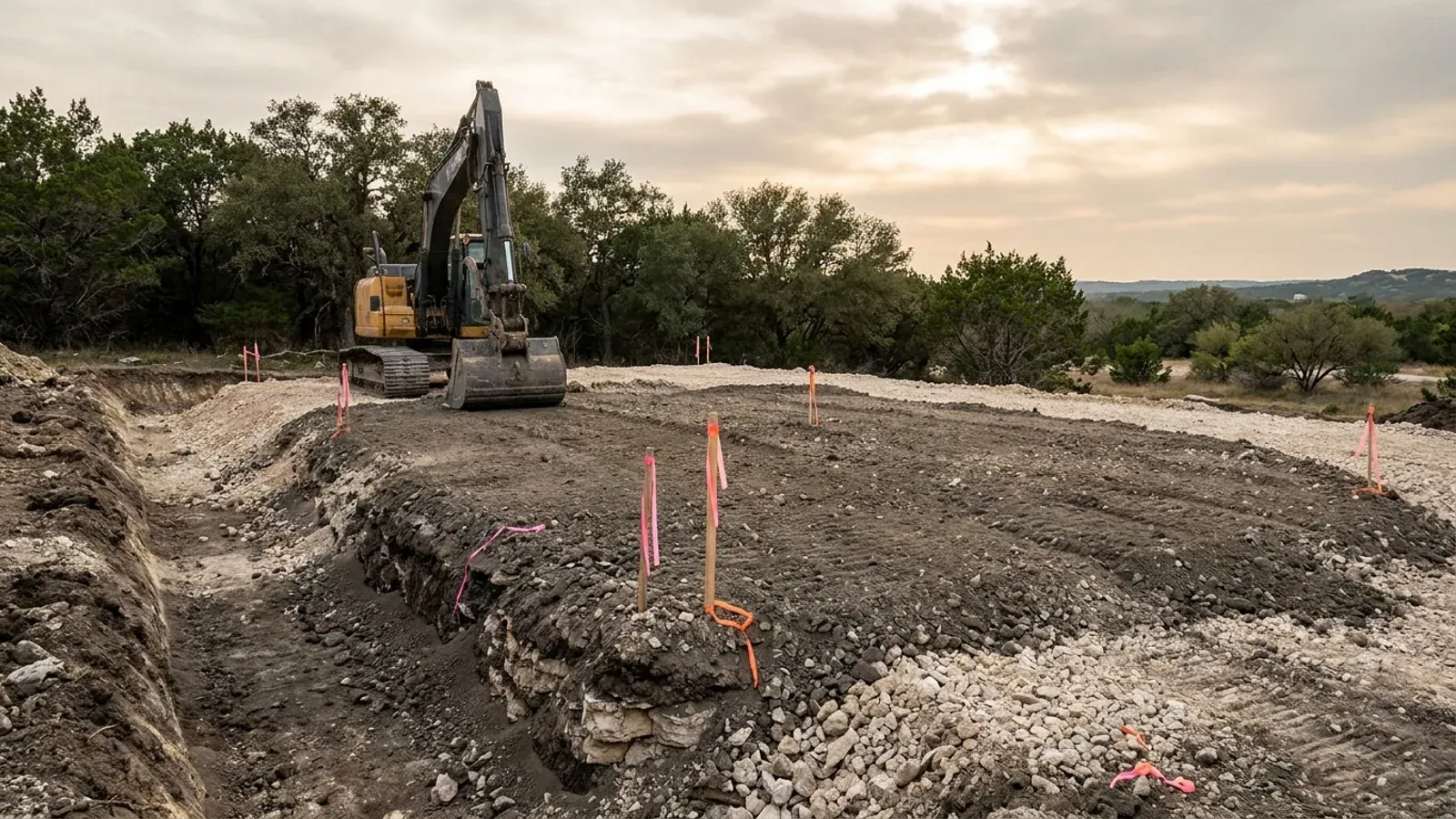
An excavator grading a compacted building pad on a cleared lot, with survey stakes and a drainage swale visible.
Below the slab

The expensive surprises are in the ground, not the building

What moves a Texas budget is usually below grade, and it is soil rather than rock: shrink-swell clay. The Blackland Prairie and the Gulf Coast clays move enough between a wet season and a dry one to drive the foundation design across the state's largest markets, which is why several DFW cities require an engineer's seal on the foundation of every new house. Those are the same conditions that decide whether a septic field passes its soil and site evaluation, so the grading plan, the foundation and the drainfield get resolved together rather than one at a time. We price the dirt before we price the building.

What we build in College Station

All nine of our services — kits, custom plans, post-frame and steel construction, site preparation, permitting and engineering, through to turnkey builds — are available across Brazos County. What a project costs depends far more on the parcel than on square footage, so we work from your land rather than from a rate card.

See what we build

What a build looks like

Three stages every College Station project passes through, from a raw parcel to a finished home. Site work first, because that is where the budget is decided.
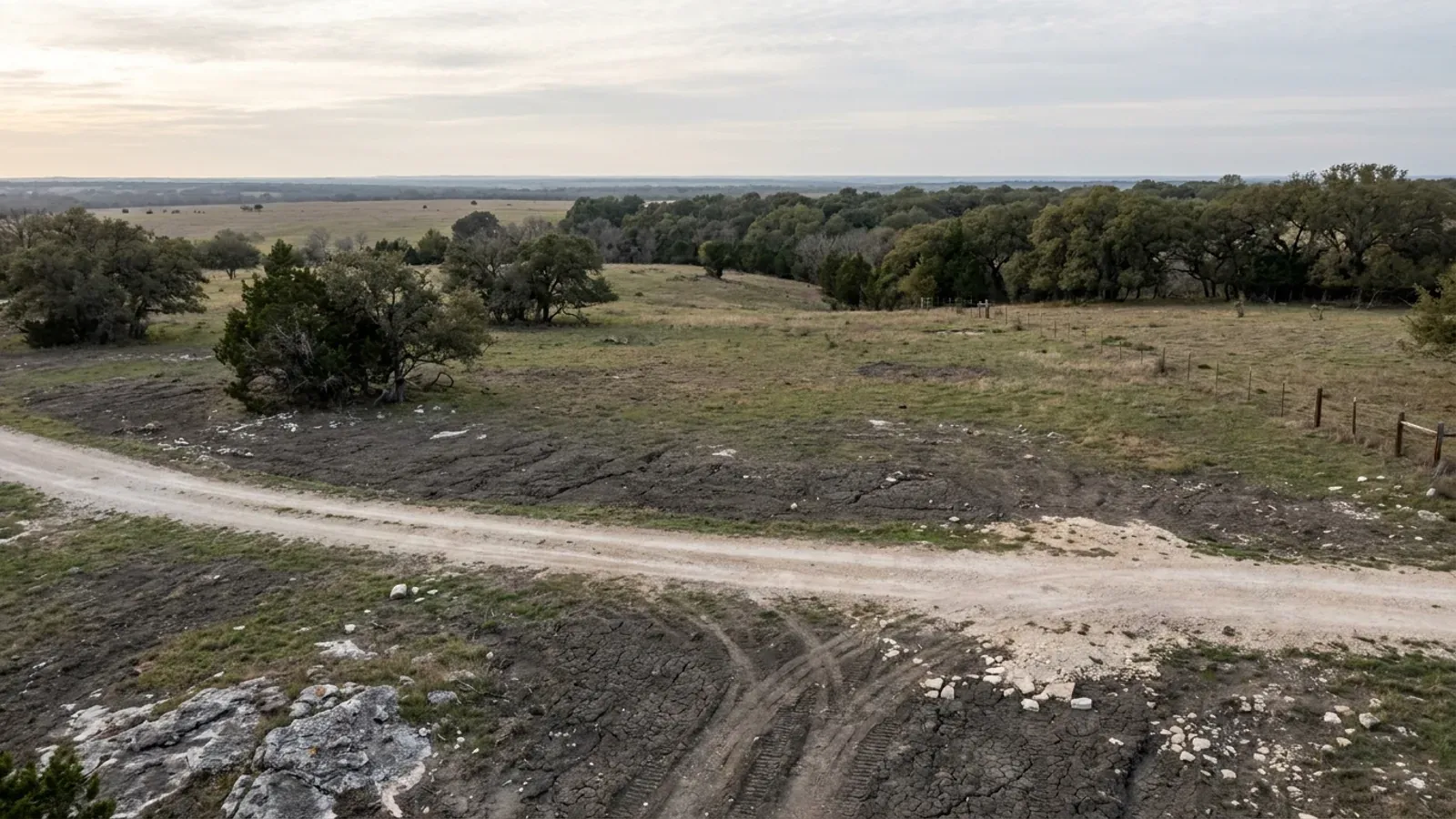
Aerial view of an undeveloped rural lot with cleared grass, a live oak and cedar elm treeline, and a pale gravel access track.
Stage one

The parcel

Zoning, setbacks, flood zone and utility access get checked before anything is drawn.

An excavator grading a compacted building pad on a cleared lot, with survey stakes and a drainage swale visible.
Stage two

Pad and permit

Clearing, grading and a compacted pad, while the submittal works through Brazos County.
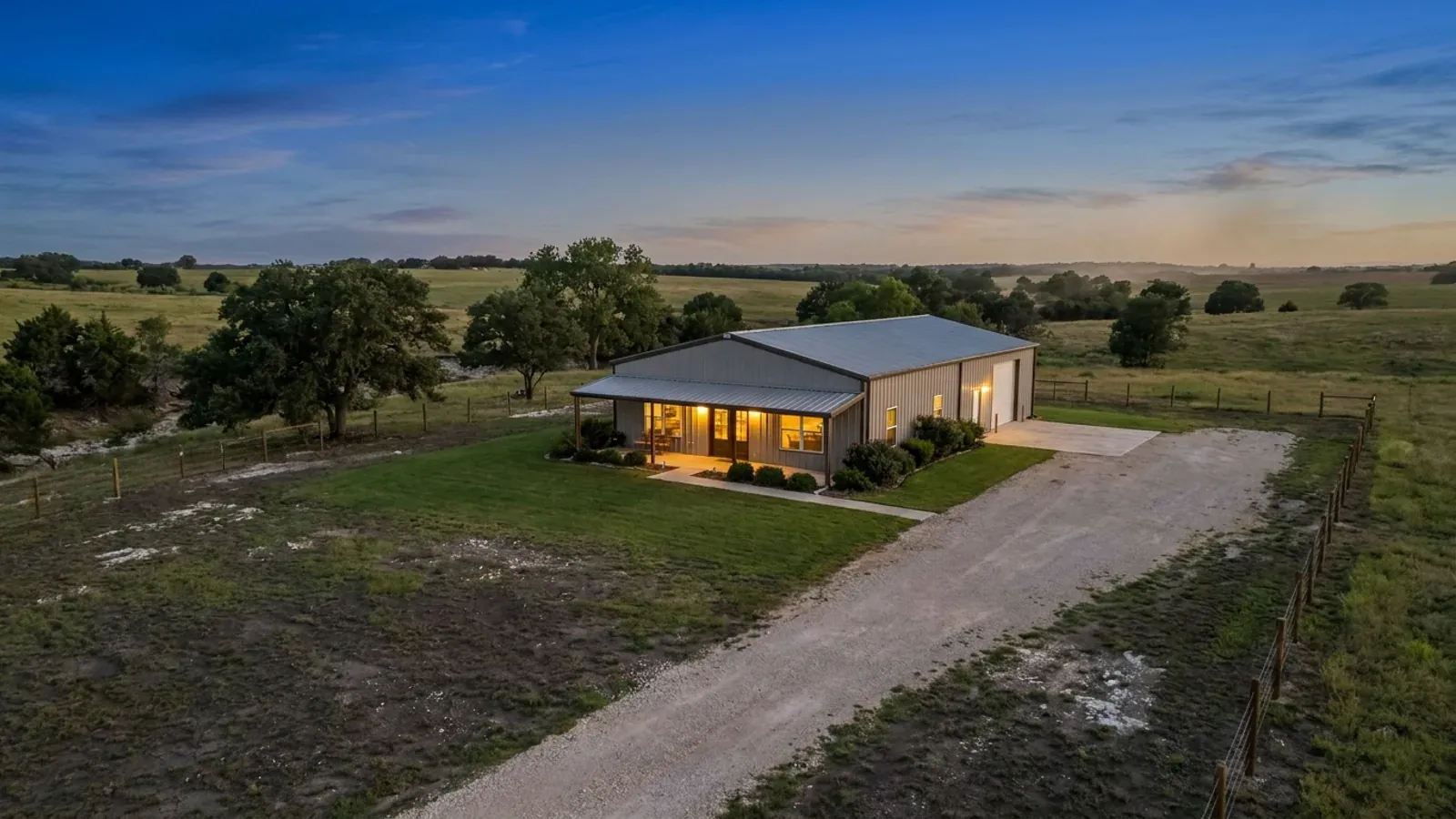
A finished barndominium at dusk with warm interior lighting glowing through its large windows.
Stage three

Frame to finish

Shell erected and dried in, then systems, insulation and interior finish through to CO.

Those are the rules for Brazos County. Tell us what you want to build and we will draw it to them.

Where we build around College Station

Brazos County and the rural land around it. The buildable acreage for a project this size usually sits outside the city limits, which is frequently what changes who issues your permit.

Our College Station service area, covering Brazos County and the surrounding rural acreage. This map marks the territory we serve, not a branch location.

Nearby areas we build in

Others we cover in this part of Texas. The permitting authority, the adopted design criteria and the zoning can all differ from one to the next.

Building in College Station: common questions

8 questions we get asked most often about building in College Station. If yours is not on the list, ask it directly.

Can I build a barndominium inside the College Station city limits?
Yes, and the zoning is more accommodating than most people expect — but the shape of the building matters more here than in most Texas cities. Single-Family Detached is permitted by right in R Rural, WE Wellborn Estate, E Estate, WRS, RS, GS, D and T. Where a barndominium is one structure with living space and a shop bay under a single roof, it is simply a single-family dwelling and is permitted as such, with 35 feet of height to work in. The rule that bites is UDO section 6.5.B.5: a detached accessory building that is not a garage, carport or living quarters is limited to an eight-foot maximum eave height and a 15-foot rear setback. A freestanding workshop with a tall overhead door does not fit inside that. Section 6.5.B.1 adds a cap of 25 percent of the habitable floor area of the house, or 400 square feet, whichever is greater, on all accessory uses combined — with vehicle-storage garage and carport area excluded from the calculation. So the two clean paths are to attach the shop to the house, or to build it as a garage, which carries a 20-foot rear setback and a 20-foot side setback where it takes access from a side street. Neither the sizes nor the setbacks are guesswork; both are in the adopted text, and the Planner-on-Call at 979.764.3570 will confirm them against your specific lot.
Is College Station's "no more than four" occupancy rule still in force?
No. It ran from 1939 to 2025 and the Legislature ended it. Senate Bill 1567 of the 89th Legislature added Subchapter D to Chapter 211 of the Local Government Code, effective 1 September 2025, and it applies only to a home-rule city of fewer than 250,000 people that contains, or is adjacent to, the campus of an institution of higher education with more than 20,000 students — a description that fits College Station and Texas A&M almost exactly, and reaches very few other Texas cities. Section 211.053(a) forbids any occupancy limit based on age, familial status, occupation, relationship status, or whether occupants are related by a degree of affinity or consanguinity. What a city may still do is cap occupancy at no more restrictive than one person per sleeping room of 70 square feet plus one more for each additional 50 square feet, and it may still apply limits grounded in a building code, a fire code or Department of State Health Services standards. College Station amended its definition of family by Ordinance 2025-4619 on 11 September 2025 and repealed both the Restricted Occupancy Overlay and the High Occupancy Overlay by Ordinance 2025-4620 the same night. Two things to be careful of. The city's older printed handouts still quote the four-person rule, so check the codified ordinance rather than a leaflet. And section 211.056 says plainly that none of this stops a property owner enforcing rules or deed restrictions imposed by a property owners' association or other private agreement — in a market like this one, the covenant may now be the binding document.
Can I rent the barndominium out, or build it as an investment?
You can let a single-family dwelling, and since September 2025 the city can no longer count who is living in it. But College Station replaced the head-count rule with a rule about the building, and that one does apply to a barndominium. Ordinance 2026-4675 of 23 April 2026 redefined Shared Housing as a congregate living facility as defined by the International Building Code, identified by a combination of characteristics: more than four bedrooms of a similar size, or dens, offices or game rooms that could sleep more than four; bathroom parity in excess of four; more than one story used to keep the footprint down for impervious cover; no garage, or a garage that can support additional living space; and a parking area that will take more than four vehicles. Shared Housing is not a permitted use in R Rural, WE, E, WRS, RS, GS, D or T — only in the multi-family and urban districts. A five-bedroom barndominium with a bonus room over the shop and a wide concrete apron can present several of those at once. The definition is written as a judgement about a combination of characteristics rather than an automatic trigger, so it is a conversation to have with Planning before the plan is finalised, not after. Separately, a second dwelling on the lot is tightly drawn: accessory living quarters under section 6.5.B.7 require the owner to live on the property as their primary residence, and a bed and breakfast under section 6.5.C.2 must be the proprietor's permanent residence. Neither can be a pure income unit.
Which code applies, and what design criteria does the city publish?
College Station adopted the 2024 family of International Codes and the 2023 National Electrical Code by Ordinance 4646 on 13 November 2025, effective 1 January 2026. That puts it on a newer edition than most Texas cities; the previous edition, the 2021 I-Codes under Ordinance 4352, governs permits taken out before 1 January 2026. The amendments are substantial and published code by code. Among the ones that matter on a barndominium: the residential sprinkler section, R309 in the 2024 numbering, is deleted in its entirety on state preemption grounds; IRC Chapter 11 on energy is deleted and one- and two-family dwellings sent to the 2024 IECC as amended; R403.1.3.3 is replaced so that slabs-on-ground with turned-down footings must meet a minimum foundation standard developed for this area and published as a figure with the city's IBC amendments; the permit exemption for a detached accessory structure is narrowed to 120 square feet, in the rear yard, not affixed, not in a drainage easement and with no utilities; and R305.2 now requires the termite applicator and method to be filed at permit application and proof of treatment before the certificate of occupancy. What the city does not publish is Table R301.2. Neither its IRC nor its IBC amendments fill in a design wind speed, frost depth, ground snow load, seismic category or termite rating, and IBC Table 1609 is not amended. Brazos County is climate zone 2A on both the pre-2021 and the 2021/2024 maps, so unlike Dallas or Fort Worth the envelope specification does not shift with the edition. For the design figures a plans examiner will actually apply, the Building Division on 979.764.3570 is the source.
Does the foundation need an engineer here?
Very often, and the ground is the reason rather than a blanket city rule. The USDA-NRCS type location for the Zack soil series is inside College Station itself, off Copperfield Drive, described as taken under a post oak tree. Zack is classified fine, smectitic, thermic Udertic Paleustalfs, with linear extensibility of 6 cm or more in the upper metre and soil that in NRCS's own description cracks when dry, with cracks half an inch to an inch and a half wide reaching 20 inches or more. The Kurten series, also typed in Brazos County, carries 40 to 60 percent clay in its control section, and along the river the Ships series is the Brazos bottomland clay. That is Post Oak Savannah ground, not Hill Country limestone and not pure Blackland, and it is expansive. Texas Occupations Code section 1001.056(c)(2) removes the private-dwelling exemption from engineering design for a residential slab located on expansive soil that meets the expansive soil classification provisions of the IRC as applied in the jurisdiction, and IRC R403.1.8 routes expansive-soil foundations to the IBC, which is to say to an engineer. College Station has gone one step further and adopted its own Minimum Foundation Standard for slabs-on-ground with turned-down footings, published as a figure with its IBC amendments. The parcel decides, a soils investigation tells you which case you are in, and we engage a Texas-licensed professional engineer where the ground calls for one.
What changes the moment I am outside the city limits?
Almost everything. UDO section 1.4.B applies only four things in the extraterritorial jurisdiction: applicable portions of the sign standards in Article 7, Article 8 subdivision design and improvements, Article 10 enforcement, and applicable definitions in Article 11. There is no city zoning out there, no use table, no Shared Housing rule and no city building code. The platting authority is shared: College Station and Brazos County are jointly primary in the Brazos County part of the ETJ, and Burleson County is primary in the part that lies in Burleson County, so the city's ETJ crosses a county line and the answer changes with it. The one construction rule that expressly reaches into the ETJ is lawn irrigation — a licensed irrigator and a city irrigation permit are required for any system connected to the water supply inside the limits or the ETJ, with exceptions for an agricultural operation, an OSSF disposal field and a system on a domestic groundwater well. Beyond that, unincorporated Brazos County is where the county's own rules take over, and Brazos County's published guidance tells enquirers directly to check with Bryan, College Station, Kurten or Wixon Valley for anything inside their limits or ETJs. Septic is the county's: College Station's own subdivision article says private septic systems must meet the requirements of, and be licensed through, the County Health Department. A domestic or livestock well in Brazos County falls under the Brazos Valley Groundwater Conservation District, which exempts wells incapable of producing more than 50,000 gallons a day from permitting but requires the registration form to be filed before the well is drilled.
What does a permit cost and how does the process run?
The FY26 Planning & Development Services fee schedule, updated 1 January 2026, prices a new single-family or duplex building at $0.74 per square foot. Accessory living quarters or a pool house are also $0.74 per square foot with a $127 minimum; every other accessory building — a detached shop included — is $0.56 per square foot with a $63 minimum. Remodels and additions are $0.75 per square foot with a $127 minimum. Fees are adjusted every 1 October against the Consumer Price Index. On top of the permit come impact fees, adopted city-wide in 2016 under Local Government Code Chapter 395, assessed at final plat and collected with the building permit: water and wastewater key off meter size, and for the standard 5/8-inch by 3/4-inch residential meter the city publishes $2,325 for water from 1 January 2026 and $3,300 for wastewater; the roadway fee keys off the service area, published at $1,876.24, $4,030.72, $4,741.36 and $5,692.64 per single-family dwelling unit in Areas A, B, C and D respectively. Parkland dedication for single-family is $1,106 in lieu of land plus $4,150 park development, $5,256 per dwelling unit, collected before the final plat is filed. Procedurally, every contractor must register with the Building Official first; a homeowner may permit work on their own homestead without registering, though the electrical, plumbing and mechanical work still has to be permitted and installed by licensed contractors. Applications and inspection scheduling run through eTRAKiT. New construction takes a minimum of twelve inspections in a published order, and once the permit issues construction must begin within 180 days.
Is there really land left in College Station, or should I be looking outside it?
There is some, and the city's own rules are the proof — but it is a narrow band and it is worth being honest about that. College Station covers 51.16 square miles for 127,472 people, and it keeps R Rural on the books at an average of 3 acres per dwelling unit, an absolute minimum of 2, and a subdivision density cap of 0.33 dwelling units per acre. Below that sit WE Wellborn Estate at 2 acres and E Estate at 1 acre, where subdivisions may contain rural infrastructure. The subdivision article contemplates private septic systems inside the city's platting jurisdiction and lets streets in rural residential subdivisions be built to rural standards. None of that language survives in a genuinely built-out suburb. That said, the WE and WRS districts are map-limited to areas the Comprehensive Plan designates as Wellborn, so you cannot rezone to them anywhere you like, and the larger tracts thin out quickly as you move toward campus. If the parcel that suits you turns out to be beyond the limits, that is a different answer rather than a worse one: unincorporated Brazos County, and Bryan with its own separately adopted code, are where the bigger tracts sit, and the rules there are theirs rather than College Station's.

Building in College Station?

Start with the plan. Tell us what you want to build and we will draw it, then confirm what Brazos County will actually let you put on the parcel and what wind load it has to meet. That conversation costs nothing.