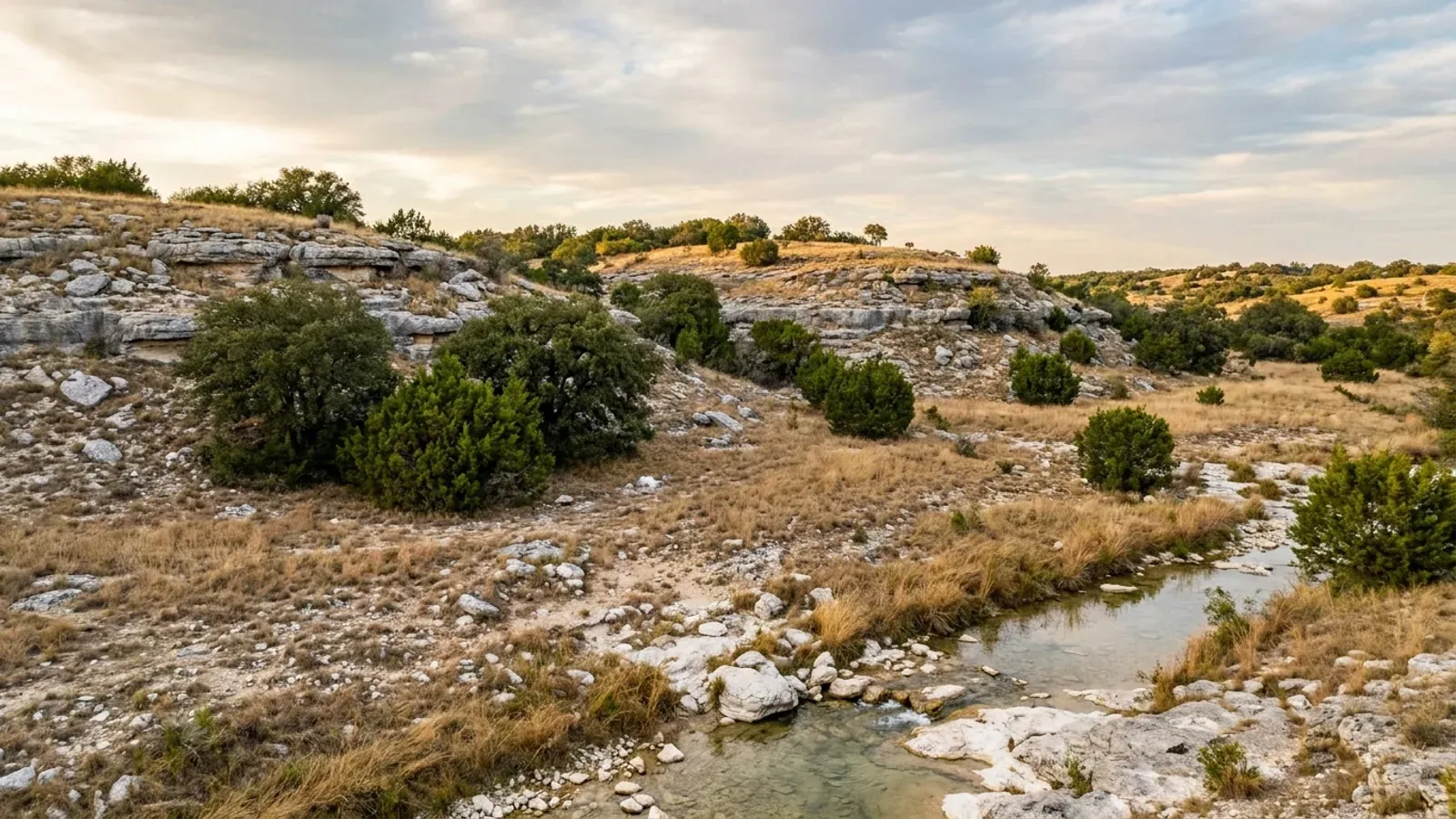
Barndominium Builders in Hays County, TX
Hays County is the county where two Texas stories meet. It is one of the fastest-growing counties in the state, up almost a quarter in five years, and a large part of it sits over the Edwards Aquifer recharge zone, where the state regulates construction on land the county cannot write a building code for. West of the escarpment, around Wimberley, Driftwood and Dripping Springs, is Trinity aquifer acreage country with thin soil over limestone. East of it, Kyle and Buda are I-35 commuter towns growing by subdivision. The rules do not treat those two halves alike, and neither should a builder. On a rural tract the sequence is not what it is in a city: the parcel has to be compliant before anything, the septic design decides how much land you actually need, and the well has a different answer depending on which side of the county it is drilled on.
Hays County at a glance
- County
- Hays County
- Population
- 304,390
- Where we build
- Kyle, Comal County, Travis County, Guadalupe County, New Braunfels
- Site visits
- Site walks arranged throughout Hays County, Kyle included
ZIPs 78666, 78640, 78610, 78620, 78676, 78619, 78737, 78652 and more
Building conditions in Hays County
What actually changes from one Texas jurisdiction to the next: who issues the permit, whether the residential code is enforced there at all, what the structure has to be engineered to, and what the ground is like. These are the numbers your drawings have to satisfy.
TCEQ, Edwards Aquifer: Private Residences, tceq.texas.gov/permitting/eapp/edwards-aquifer-private-residences, page-dated 17 February 2026
Hays County On-Site Sewage Facility Regulations, Order of the Commissioners Court adopted 4 June 2013, Sec. 10.D and Table 10-1, approved by TCEQ 18 February 2014
bseacd.org/types-of-well-permits and bseacd.org/about; Special District Local Laws Code Secs. 8843.103 and 8843.104 as amended by H.B. 3903, 83rd Legislature, 2013
Hays County Development Services FAQ, Development and Floodplain, hayscountytx.gov Faq.aspx; Local Government Code Secs. 233.153 and 233.154
TCEQ On-Site Activity Reporting System, authorized agent search for Hays County, county code 105, run 1 September 2026
Hays County Development Services FAQ and Floodplain page; Hays County Development Services Fee Schedule effective 1 January 2026
Also worth knowing before you build in Hays County
- The shop bay does not enlarge the drainfield
- Texas sizes a single-family septic system from the number of bedrooms or the living area of the home, whichever gives the larger figure, so a 1,800 square foot three-bedroom living space with a 2,200 square foot shop is a 300 gallon-per-day house rather than a 375. An authorised agent is allowed to be stricter and some Texas counties are. Hays County's order lists its stricter rules exhaustively at Section 10 and none of them redefines living area. What it does add is a rule about second structures: a garage apartment, pool house or guest cottage keeps the lot in the single-family class only if its usable floor space is under half the primary dwelling's, it is not offered for public use or rental, and it cannot be sold separately.
- Ten acres buys you nothing here either
- The belief that ten acres exempts a house from the septic rules is wrong statewide, and TCEQ said so in its own words when it amended the rule in 2023 because the old wording had been misinterpreted as an exemption from the entirety of Chapter 285. Hays County forecloses it in county text: a permit is required for all on-site sewage facilities regardless of the size of the lot or acreage onto which it is installed.
- Rental changes who may build the system
- Hays County states that a homeowner can install their own residential on-site sewage facility, and that only a licensed installer can install a system used for commercial use, including rental houses. The same distinction runs through the order: a group of rental dwelling units is sized as non-residential at one acre per dwelling unit equivalent, and the county's published OSSF application fee is $610 for a single-family residence against $910 for a non-single-family one. A barndominium intended as a guest house or a short-term let is not automatically on the same track as the one you live in.
- No plat, no permits at all
- The county states that if a property that is required to be platted is not, the owner will be unable to get any county approvals including development authorisations, on-site sewage facility permits or driveway permits, and that non-compliant property will be unable to legally develop in Hays County. The sewage order says the same from the other side: only lots platted under county regulations, or legally in existence before the order took effect, are eligible for a permit. The county sells the answer in advance for a $100 parcel compliancy determination, and a pre-development meeting with staff can be booked online.
- Dividing land brings a water availability test with a six-acre answer
- Hays County requires a water and wastewater service plan for a subdivision plat. Where individual wells will serve new development in a Priority Groundwater Management Area, the certifier must obtain historical water levels from the groundwater district, walk the perimeter looking for undocumented wells, confirm documented wells within 500 feet, and estimate annual recharge with a Texas Water Development Board approved groundwater availability model. Where projected withdrawal exceeds estimated recharge, the minimum lot size becomes 6 acres, or the applicant prorates it against another supply, or offsets it by putting other land under a perpetual conservation easement.
- Hit a void and everything stops
- Over the recharge zone the ground itself is a regulated feature. TCEQ defines a sensitive feature as a permeable geologic or artificial feature where surface water may reach the aquifer rapidly, and requires that on discovering one during construction all regulated activities near it stop immediately and TCEQ is notified. A Texas-licensed professional geologist must evaluate it, no construction or soil-disturbing activity may proceed until TCEQ approves a protection plan, and TCEQ has one week to review a complete plan. Typically no activity should occur within 50 feet of the feature meanwhile.
- Two feet above the base flood, and the maps are being redrawn
- Hays County's flood damage prevention chapter requires the lowest floor, including basement, machinery and electrical equipment, to be at least two feet above the base flood elevation in the 100-year floodplain. The county cites Texas Water Code Secs. 16.313, 16.315 and 16.318 as the authority. It also states that its current flood hazard data dates back to the late 1970s through the late 1990s and that preliminary updated maps are in circulation, so a tract's flood status is worth checking against the county's own map viewer rather than an old certificate.
- Other people's rules reach unincorporated land
- The county lists in its own regulations the outside water quality rules that govern parts of the unincorporated county: Austin's environmental ordinances in Austin's extraterritorial jurisdiction, and the water quality ordinances of Buda, Dripping Springs, Kyle and San Marcos in theirs; the Lower Colorado River Authority's Highland Lakes Watershed Ordinance in parts of western Hays County; TCEQ's Edwards Aquifer program over the recharge and contributing zones; and TCEQ's construction stormwater permitting program for any construction disturbing more than one acre anywhere in Hays County.
- The county is three markets, not one
- Hays County's population estimate rose from 243,984 on 1 July 2020 to 304,390 on 1 July 2025, up 24.8 percent across 677 square miles. The growth is not evenly spread. Kyle went from 46,431 to 69,917, up 50.6 percent, and Dripping Springs more than doubled from 5,122 to 11,167. Wimberley went from 2,888 to 2,909, a gain of 21 people, and its density inside its own city limits is about 325 per square mile. The I-35 side is filling in by subdivision while the western county stays acreage country.
- A licensed plumber is required even where nothing else is
- The rural exemption in the Texas plumbing licence law expressly excludes plumbing performed in conjunction with new construction. Alongside it, a builder working outside the limits of any municipality must certify that the house complies with the state energy code and keep that certification for three years. Both apply on land with no building permit and no county inspector.
TCEQ form TCEQ-0235 item 8 and 30 TAC Ch. 285 Table III; Hays County On-Site Sewage Facility Regulations Sec. 10 and Sec. 10.D.4
Hays County On-Site Sewage Facility Regulations Sec. 10.W.1; 30 TAC Sec. 285.3(f)(2) as amended 2023
Hays County Development Services FAQ, On-Site Sewage Facilities; Hays County OSSF Regulations Sec. 10.A.1 and 10.D.1(C); Development Services Fee Schedule effective 1 January 2026
Hays County Development Services FAQ, Planning and Subdivisions; Hays County OSSF Regulations Sec. 10.C.1; Development Services Fee Schedule effective 1 January 2026
Hays County Development Regulations Ch. 715 Secs. 1.01, 3.04 and 3.06 and Ch. 705 Table 705.05.01, revised version 17 January 2025
TCEQ, Edwards Aquifer: Sensitive Features Encountered During Construction, tceq.texas.gov/permitting/eapp/sensitive-features-encountered-during-construction
Hays County Development Regulations Ch. 735 Secs. 1.02 and the elevation standards, revised version 17 January 2025; Hays County Floodplain page
Hays County Development Regulations Ch. 725 Sec. 4.03, revised version 17 January 2025
U.S. Census Bureau vintage 2025 county and sub-county population estimates and the 2024 Census Gazetteer county and place files
Texas Occupations Code Sec. 1301.052; Texas Health and Safety Code Secs. 388.003(a) and 388.004
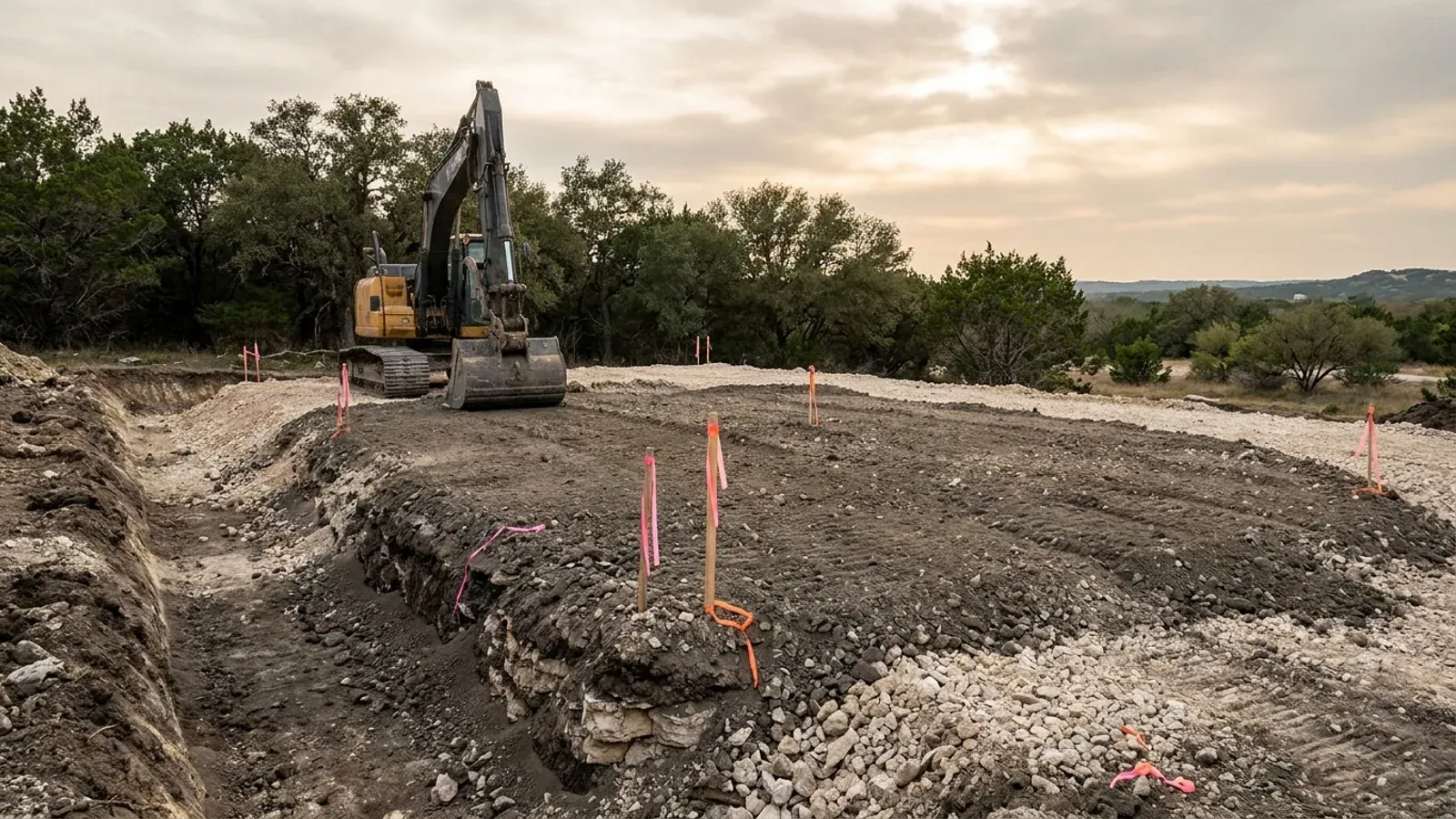
The expensive surprises are in the ground, not the building
What moves a Texas budget is usually below grade, and it is soil rather than rock: shrink-swell clay. The Blackland Prairie and the Gulf Coast clays move enough between a wet season and a dry one to drive the foundation design across the state's largest markets, which is why several DFW cities require an engineer's seal on the foundation of every new house. Those are the same conditions that decide whether a septic field passes its soil and site evaluation, so the grading plan, the foundation and the drainfield get resolved together rather than one at a time. We price the dirt before we price the building.
What we build in Hays County
All nine of our services — kits, custom plans, post-frame and steel construction, site preparation, permitting and engineering, through to turnkey builds — are available across Hays County. What a project costs depends far more on the parcel than on square footage, so we work from your land rather than from a rate card.
See what we buildWhat a build looks like
Three stages every Hays County project passes through, from a raw parcel to a finished home. Site work first, because that is where the budget is decided.
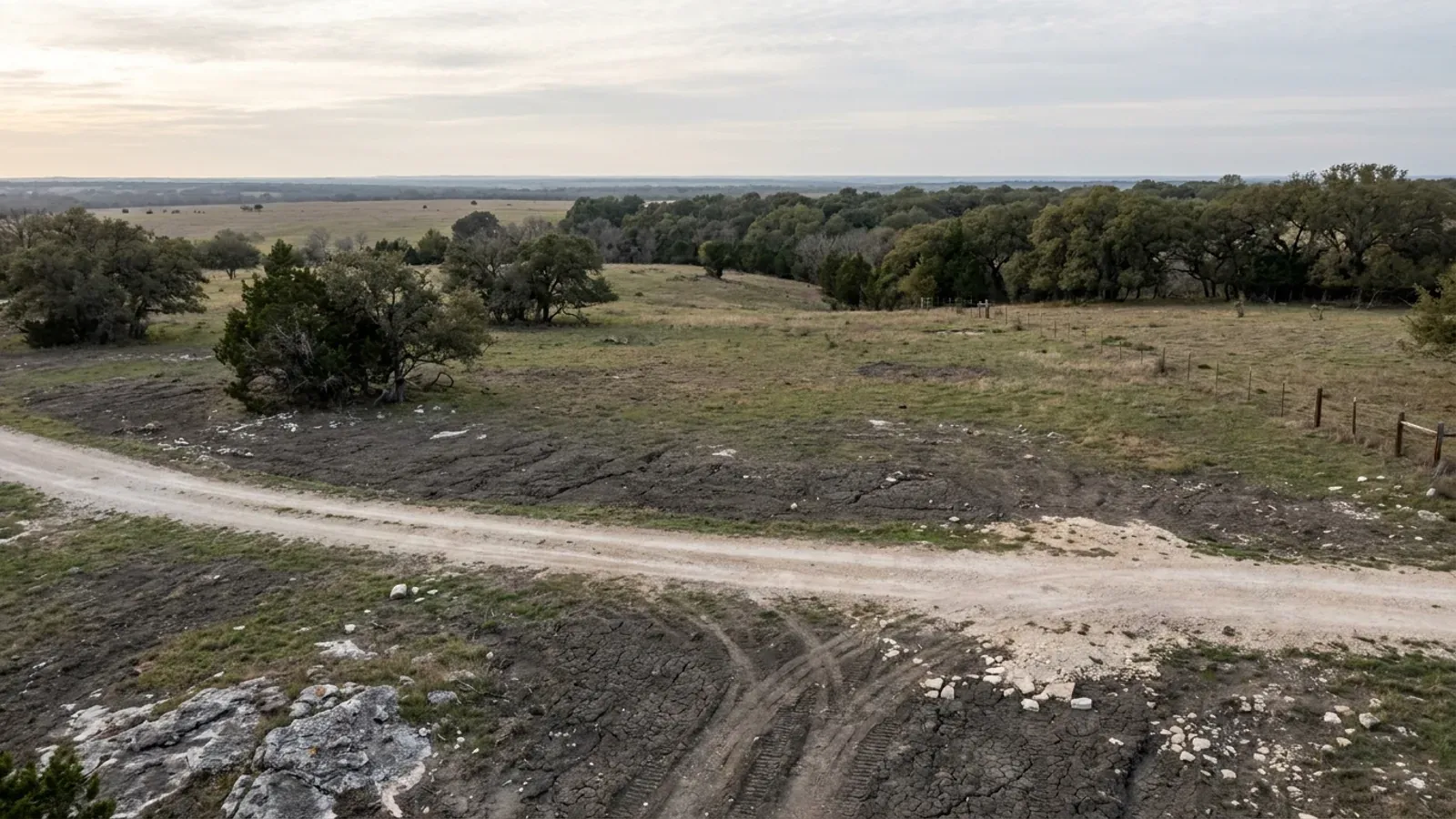
The parcel
Zoning, setbacks, flood zone and utility access get checked before anything is drawn.
Pad and permit
Clearing, grading and a compacted pad, while the submittal works through Hays County.
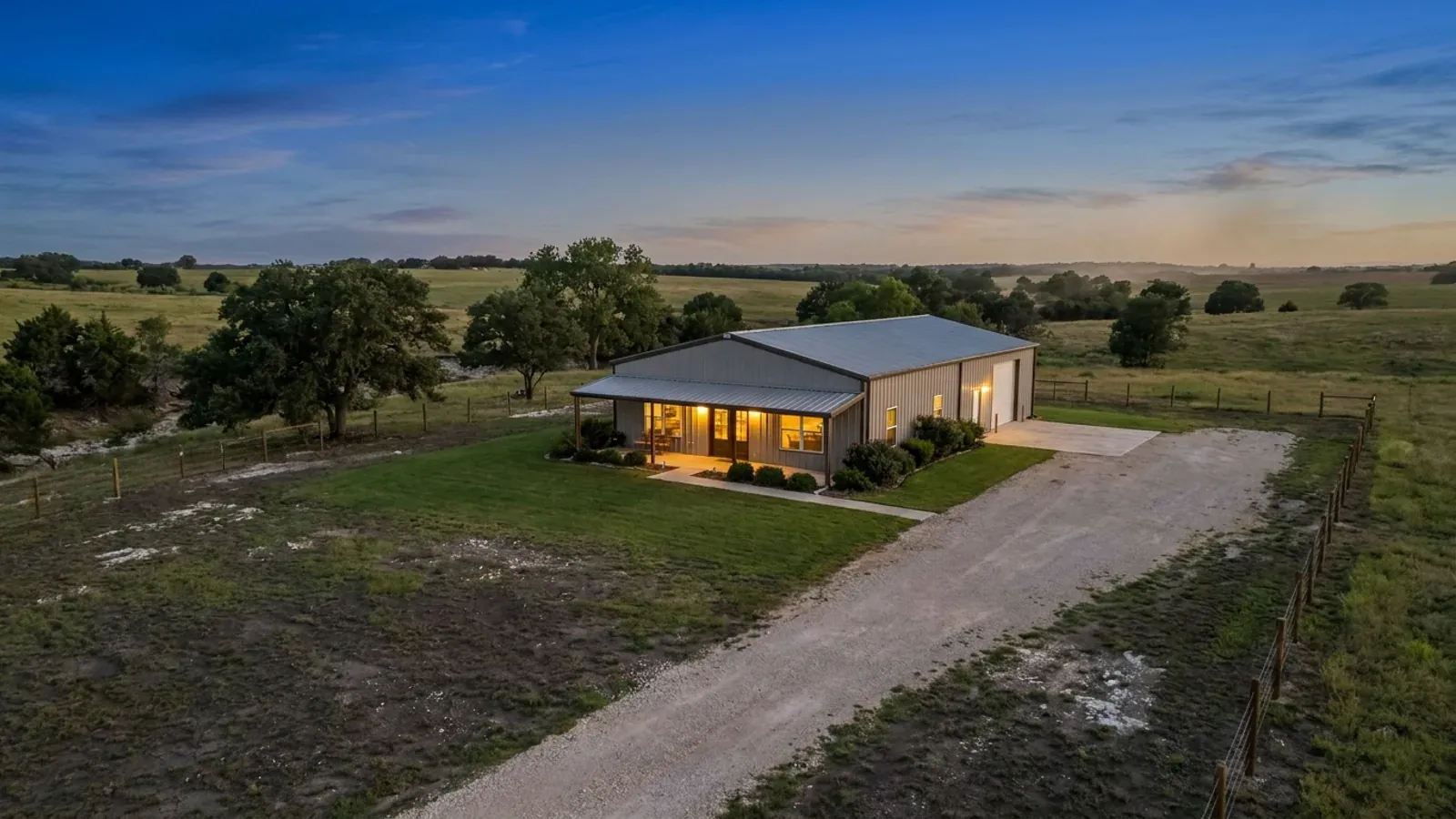
Frame to finish
Shell erected and dried in, then systems, insulation and interior finish through to CO.
Those are the rules for Hays County. Tell us what you want to build and we will draw it to them.
Where we build around Hays County
Hays County and the rural land around it. The buildable acreage for a project this size usually sits outside the city limits, which is frequently what changes who issues your permit.
Keep reading
The questions that usually come next once you know what Hays County allows.
Barndominium Cost Guide
Sourced per-square-foot ranges by tier and by size, with a calculator built on the same figures.
Read itIs It Legal in Texas?
Classification, zoning, the HOA gate, and why "nonresidential farm building" does not cover a home.
Read itHow Long Does It Take?
Census build-duration data, and what actually sets the permit clock where you are building.
Read itNearby areas we build in
Others we cover in this part of Texas. The permitting authority, the adopted design criteria and the zoning can all differ from one to the next.
Building in Hays County: common questions
9 questions we get asked most often about building in Hays County. If yours is not on the list, ask it directly.
Do I need a building permit for a barndominium on unincorporated land in Hays County?
My land is over the Edwards Aquifer recharge zone. Does that stop me building?
How much land do I actually need?
Do I need a permit for my well?
Who issues the septic permit, and does living inside a town change it?
Everyone says rural Texas has no rules. What actually applies out here?
Is there a percolation test?
I want to build in Wimberley or Dripping Springs and let it out part of the year. Does that change anything?
I am thinking about splitting a tract. What should I know first?
Building in Hays County?
Start with the plan. Tell us what you want to build and we will draw it, then confirm what Hays County will actually let you put on the parcel and what wind load it has to meet. That conversation costs nothing.