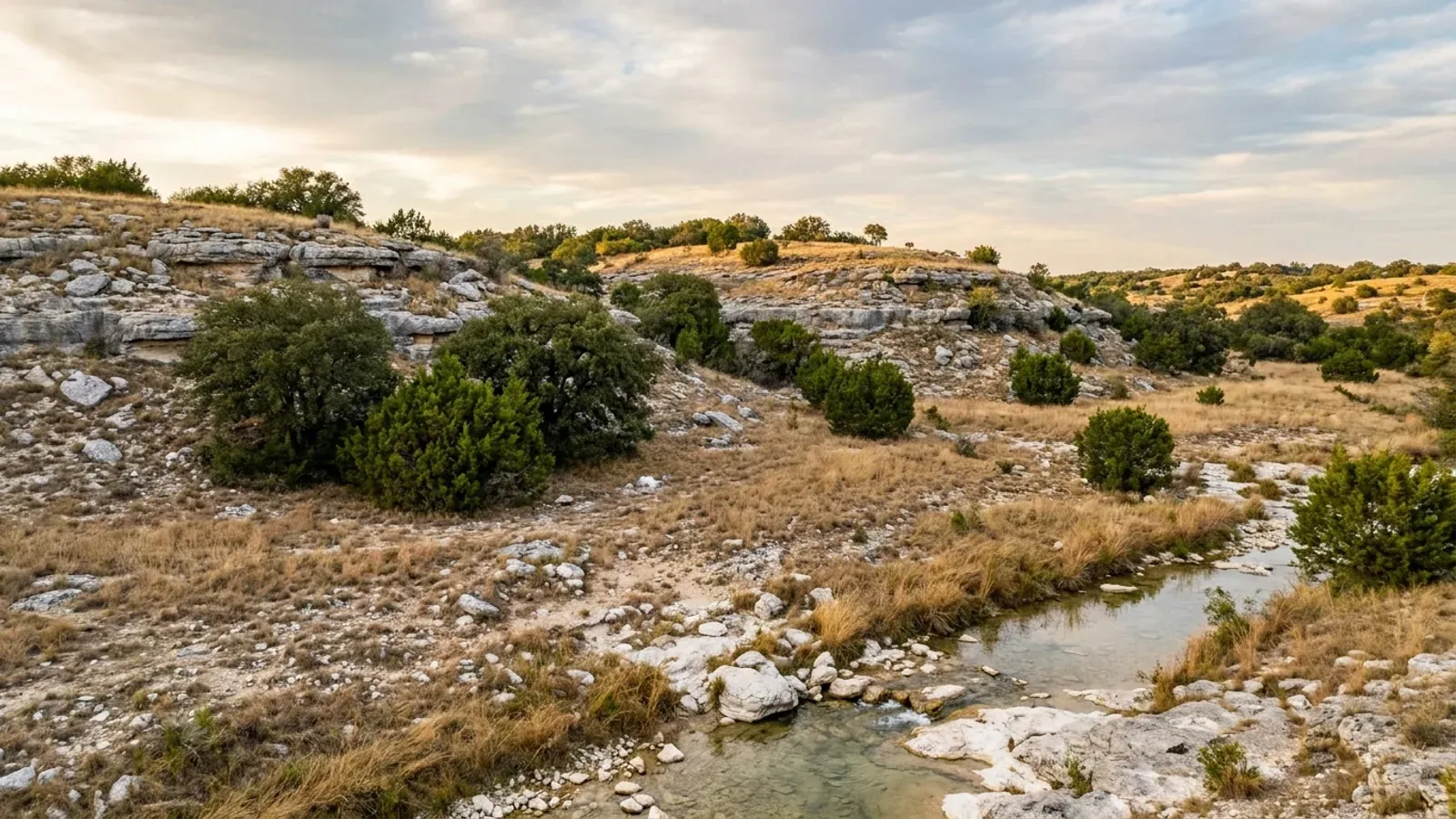
Rolling Texas Hill Country limestone hills with live oak motts, Ashe juniper, and a clear creek over white limestone cobble.
Comal County 2021 IRC as adopted here

Barndominium Builders in New Braunfels, TX

New Braunfels went from 91,640 people in 2020 to 122,492 in 2025, and unlike the built-out suburbs a growth rate like that usually flatters, this one still has ground under it. The city's own platting ordinance sets minimum lot sizes for lots on septic inside the city limits, and its APD and R-1A-43.5 districts start at 15,000 square feet and a full acre — that is a city that still expects acreage. Two things then shape the build here. New Braunfels sits in Comal County and Guadalupe County at once, so there is one permit answer inside the limits and two different ones the moment you cross out of them. And a great deal of it lies over the Edwards Aquifer recharge zone, where the city will not record a plat until TCEQ has approved it and a lot on septic has to be a full acre rather than a half. The code is the 2021 IRC, amended, with all fourteen Table R301.2 design values filled in.

New Braunfels at a glance

County
Comal County
Population
122,492
Where we build
New Braunfels, Comal County, Guadalupe County, San Antonio, Hays County

ZIPs 78130, 78132, 78133

Site visits
Site visits arranged across New Braunfels and out into Comal County

Building conditions in New Braunfels

What actually changes from one Texas jurisdiction to the next: who issues the permit, whether the residential code is enforced there at all, what the structure has to be engineered to, and what the ground is like. These are the numbers your drawings have to satisfy.

Build conditions for New Braunfels , Comal County, Texas : design wind speed 115 mph. BUILD CONDITIONS NEW BRAUNFELS, TXComal County2021 IRCDESIGN WIND SPEED115 mphUltimate design wind speed, from the Table R301.2 values the city inserts at section 14-29(d). Notopographic effects, no special wind region and no windborne debris zone.ZONING · APD AND R-1A-43.515,000 sq ft (APD); 43,560 sq ft — o…The two districts that work at acreage scale. Both permit a detachedone-family dwelling, an accessory building or structure, one…PERMIT REVIEW CLOCK10 business daysPublished review target of the issuing authorityIMPACT AND PERMIT FEESRoadway and water/wastewater impact…New Braunfels levies both, under Chapter 100 (roadway, Ord. No.2013-69) and Chapter 130, Article VI (water and wastewater), on…WHO ISSUES THE PERMITCity of New Braunfels Building Safet…City Hall, 550 Landa Street, New Braunfels, TX 78130. BuildingSafety 830-221-4041 ext. 1; city switchboard 830-221-4000.…
Build conditions for New Braunfels, drawn from the sourced facts on this page. Every figure above is cited in the quick-facts panel below, with its source and vintage.
Every design value published
New Braunfels fills in all fourteen cells of Table R301.2: ground snow load 5 psf, ultimate design wind speed 115 mph, no topographic effects, no special wind region, no windborne debris zone, seismic design category A, weathering negligible, frost line depth 0, termite Moderate, winter design temperature 30 degrees, no ice barrier underlayment, flood hazards yes, air freezing index 29, mean annual temperature 68.5 degrees.

New Braunfels Code of Ordinances section 14-29(d), Table R301.2 Climatic and Geographic Design Criteria, as adopted by Ord. No. 2023-76

The city is in two counties
New Braunfels lies in Comal County and Guadalupe County and nowhere else. At the 2025 estimate 95,016 residents were on the Comal side and 27,476 on the Guadalupe side, of 122,492 in total. One city code covers both, but the septic permit, the floodplain administrator, the plat filing and the deed records all follow whichever county the parcel is actually in.

U.S. Census Bureau 2020 place-by-county reference file for Texas and Vintage 2025 subcounty population estimates

The recharge zone gate
Section 118-7 of the city's subdivision platting ordinance says that any plat located over the recharge zone of the Edwards Aquifer must have approval from the Texas Commission on Environmental Quality before the final plat is filed for record. The city has written the state's permit into its own recording sequence, so the TCEQ approval comes before the plat, not after.

New Braunfels Code of Ordinances section 118-7, Edwards recharge zone (Ord. No. 2006-84)

Sprinklers are not mandatory
The 2021 IRC requires an automatic residential sprinkler system in every new one- and two-family dwelling. New Braunfels rewrote R313.2 so that it reads: where automatic residential fire sprinkler systems are installed, they shall be designed and installed in accordance with IRC Section P2904 or NFPA 13D. The city kept the standard and removed the requirement.

New Braunfels Code of Ordinances section 14-29(e), local amendment to IRC R313.2

Short-term letting is not open here
In a town this size that trades on tubing, Gruene and the river, the zoning ordinance still says short-term rental within residential districts is prohibited, and prohibited in any floodway inside the city limits whatever the zoning. Where it is allowed, it needs a short-term rental permit in every district plus a special use permit in every district except C-4, C-4A and C-4B, annual renewal, a fire marshal inspection and hotel occupancy tax compliance.

New Braunfels Code of Ordinances section 144-5.17, Short term rental or occupancy (as amended by Ord. No. 2024-96)

Where the acreage is
Two districts work at scale. APD, the agricultural and pre-development district, needs 15,000 square feet per dwelling, 100 feet of width and depth, and permits barns and farm equipment storage by right. R-1A-43.5 needs a full acre. Both allow a detached one-family dwelling, an accessory building and one accessory dwelling per lot. Where there is no public or community sewer the floor rises to half an acre, and to one acre on the Edwards Aquifer recharge zone.

New Braunfels Code of Ordinances sections 144-3.4-1 and 144-3.4-2, district regulations

Also worth knowing before you build in New Braunfels

No square-foot cap on the shop
The accessory structure rules set no maximum floor area at all. What they do set is a limit of two detached accessory buildings per lot, a height no greater than the main building, a five-foot side setback, a three-foot rear setback, a rule that accessory buildings occupy no more than 30 percent of the rear yard, and a front yard of 60 feet or a position behind the main building, whichever is less. An accessory building may not be used for human habitation — but an accessory dwelling, a guest house or a garage loft, is separately allowed.

New Braunfels Code of Ordinances section 144-5.4, Accessory uses and structures

Review clock
The city states that once the application is made and paid for, review usually takes approximately 10 business days for a first response on residential projects and 20 business days on commercial. The reviewing desks can include the Building Division, Planning, Environmental Services, the Public Works Engineering Division, the Fire Department and the utility providers.

City of New Braunfels Building Permits page, Building Permit Procedures

The published fees
Residential permit application fee $50. Residential new construction and additions are charged at $0.50 per square foot under Building Permit Fee Schedule A. Residential plan review is 25 percent of the permit cost, capped at $2,500. Inspections are $35, and a re-inspection fee doubles with each failed inspection. A shed or storage building built on site is $75, a foundation permit $150.

New Braunfels Code of Ordinances Appendix D, Schedule of Fees, sections A and B

Two feet of freeboard
The city amended IRC R322.2.1 so that in flood hazard areas the lowest floor must be at base flood elevation plus two feet, or the design flood elevation, whichever is higher. In shallow flooding AO zones it is the depth number on the FIRM plus one foot, and not less than three feet where no depth number is given. The permit exemption for small accessory buildings is also switched off entirely on any property carrying a Special Flood Hazard Area.

New Braunfels Code of Ordinances sections 14-29(f) and 14-29(b), local amendments to IRC R322.2.1 and R105.2

What stops at the city line
The platting ordinance reaches into the extraterritorial jurisdiction, but section 118-3(d) states that unless otherwise authorised by law the city shall not regulate, in its ETJ, the use of a building or property, the bulk, height or number of buildings on a tract, the size of a building including any floor-area ratio, or the number of residential units per acre. On septic lot sizes the ordinance is blunter still: if in the ETJ or otherwise outside the city limits, the respective county's standards apply. A petition to be released from the ETJ carries a $200 filing fee.

New Braunfels Code of Ordinances section 118-3(d), section 118 lot-size provisions, and Appendix D Schedule of Fees

The energy code cannot be weakened
Comal and Guadalupe are both named affected counties in Health and Safety Code section 386.001(2). Under section 388.003(e), local amendments in an affected county may not result in less stringent energy efficiency requirements than the energy chapter of the IRC or the IECC. That floor does not apply everywhere in Texas — Waco and McLennan County, for instance, are not on the list — but it applies on both sides of New Braunfels' county line.

Texas Health and Safety Code sections 386.001(2) and 388.003(e)

Appendices struck out
New Braunfels adopts IRC appendices AE, AF, AH, AJ, AK, AM, AO, AQ tiny houses, AR, AS and AW 3D-printed building construction in their entirety — and deletes AI private sewage disposal, AL permit fees, AV board of appeals, and AT solar-ready provisions. Appendix AT is the clearest example of a requirement that exists in the model code and simply does not exist here.

New Braunfels Code of Ordinances section 14-29, appendix provisions

The well is permitted, not just drilled
The Edwards Aquifer Authority states that it has regulatory jurisdiction in all of Bexar, Medina and Uvalde counties and portions of Atascosa, Caldwell, Comal, Guadalupe and Hays. The city's platting ordinance follows that split directly: where proposed lots will be served by wells drawing groundwater regulated by the Authority, the plat must carry an engineer's projected water use analysis and documentation from the Authority of a permit allocation adequate to meet it — and the allocation cannot involve leased water rights.

Edwards Aquifer Authority, Jurisdiction and Monitoring Areas, and New Braunfels Code of Ordinances Chapter 118 groundwater availability provisions

The envelope gets tested
The city's energy amendments require an approved third party to inspect the thermal envelope components and to run a blower-door test, with a maximum air leakage of 5.0 air changes per hour or 0.28 cfm per square foot of enclosure area, tested to ANSI/RESNET/ICC 380, ASTM E779 or ASTM E1827 and reported at 50 pascals. The insulation letter and a signed written test report both go to the building official.

New Braunfels Code of Ordinances sections 14-29(l) and 14-29(m), local amendments to IRC N1102.4.1.1 and N1102.4.1.2
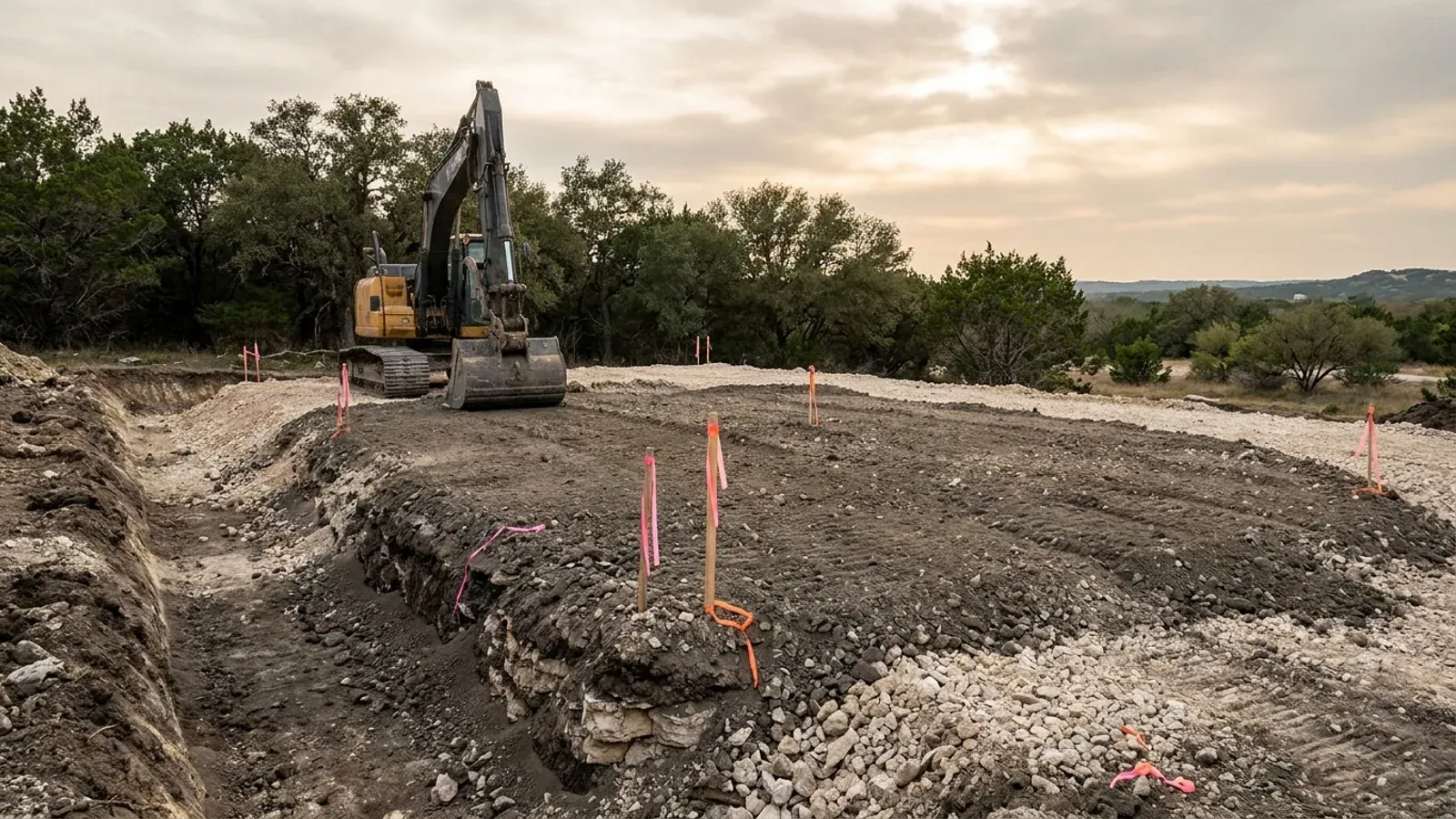
An excavator grading a compacted building pad on a cleared lot, with survey stakes and a drainage swale visible.
Below the slab

The expensive surprises are in the ground, not the building

What moves a Texas budget is usually below grade, and it is soil rather than rock: shrink-swell clay. The Blackland Prairie and the Gulf Coast clays move enough between a wet season and a dry one to drive the foundation design across the state's largest markets, which is why several DFW cities require an engineer's seal on the foundation of every new house. Those are the same conditions that decide whether a septic field passes its soil and site evaluation, so the grading plan, the foundation and the drainfield get resolved together rather than one at a time. We price the dirt before we price the building.

What we build in New Braunfels

All nine of our services — kits, custom plans, post-frame and steel construction, site preparation, permitting and engineering, through to turnkey builds — are available across Comal County. What a project costs depends far more on the parcel than on square footage, so we work from your land rather than from a rate card.

See what we build

What a build looks like

Three stages every New Braunfels project passes through, from a raw parcel to a finished home. Site work first, because that is where the budget is decided.
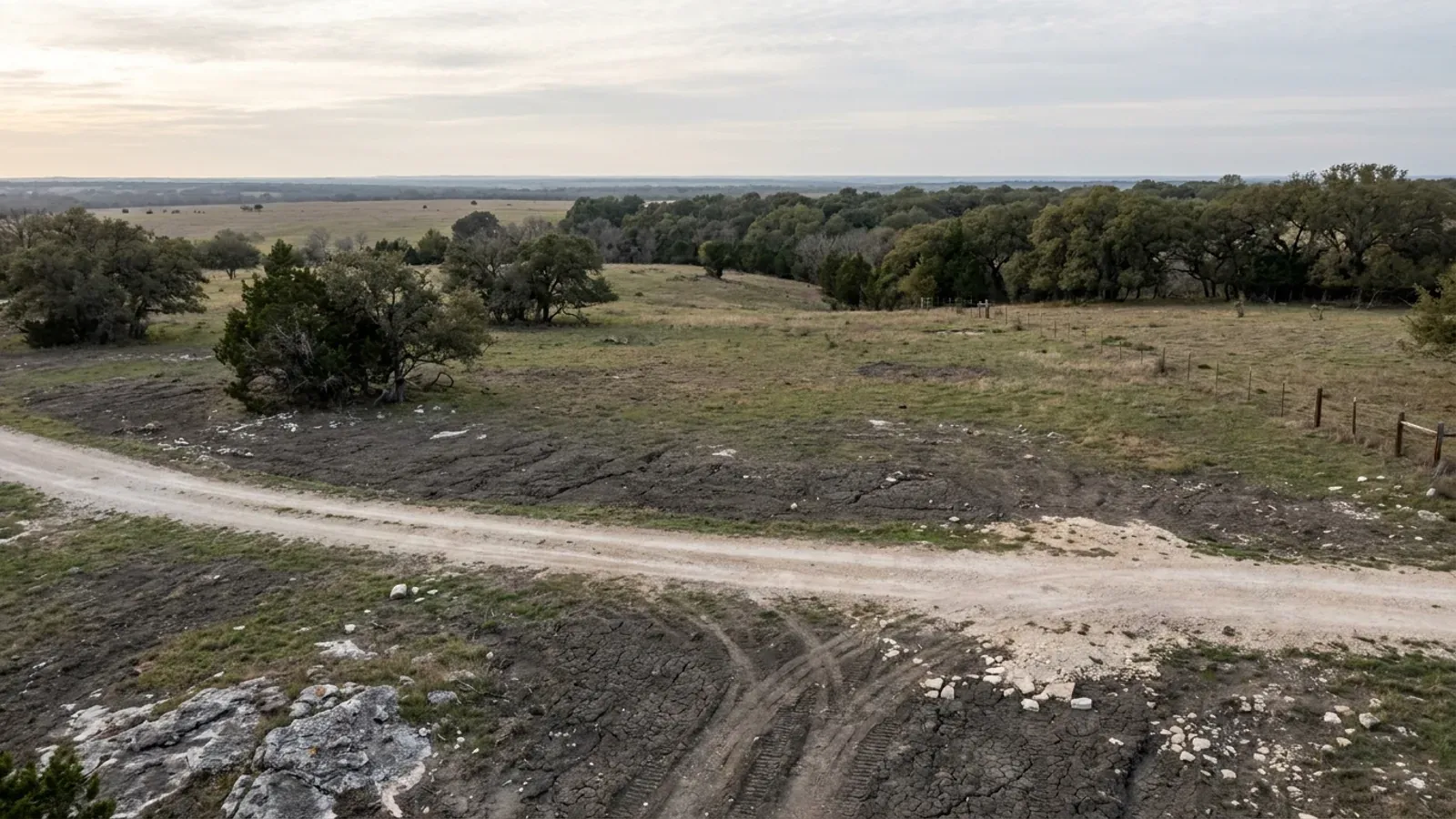
Aerial view of an undeveloped rural lot with cleared grass, a live oak and cedar elm treeline, and a pale gravel access track.
Stage one

The parcel

Zoning, setbacks, flood zone and utility access get checked before anything is drawn.

An excavator grading a compacted building pad on a cleared lot, with survey stakes and a drainage swale visible.
Stage two

Pad and permit

Clearing, grading and a compacted pad, while the submittal works through Comal County.
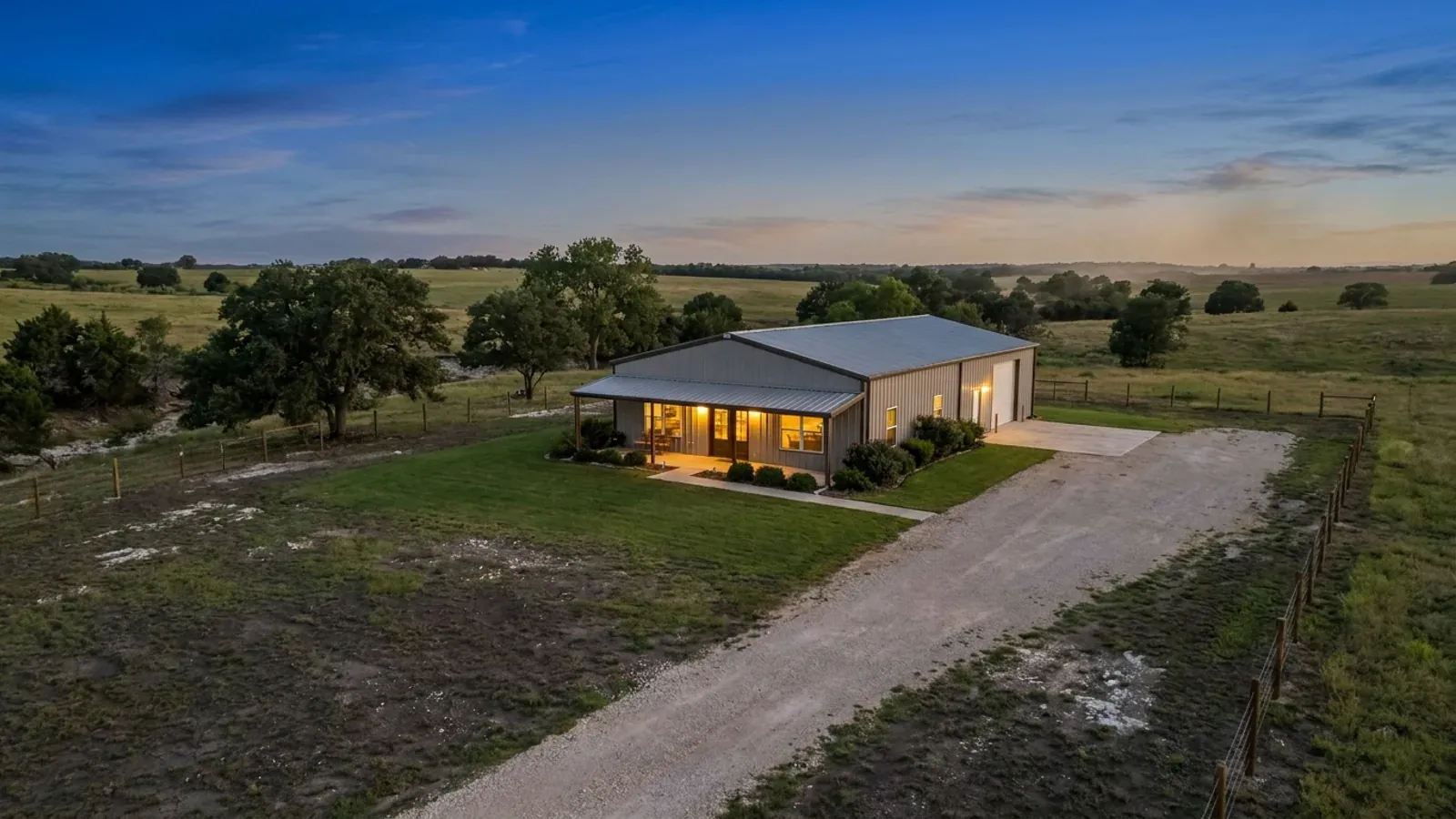
A finished barndominium at dusk with warm interior lighting glowing through its large windows.
Stage three

Frame to finish

Shell erected and dried in, then systems, insulation and interior finish through to CO.

Those are the rules for Comal County. Tell us what you want to build and we will draw it to them.

Where we build around New Braunfels

Comal County and the rural land around it. The buildable acreage for a project this size usually sits outside the city limits, which is frequently what changes who issues your permit.

Our New Braunfels service area, covering Comal County and the surrounding rural acreage. This map marks the territory we serve, not a branch location.

Nearby areas we build in

Others we cover in this part of Texas. The permitting authority, the adopted design criteria and the zoning can all differ from one to the next.

Building in New Braunfels: common questions

8 questions we get asked most often about building in New Braunfels. If yours is not on the list, ask it directly.

Can I build a barndominium inside the New Braunfels city limits?
Yes, and the zoning ordinance is unusually accommodating about it. In the APD agricultural and pre-development district and in R-1A-43.5, a detached one-family dwelling, an accessory building or structure, one accessory dwelling per lot, and barns and farm equipment storage are all permitted by right. There is no masonry requirement of the kind that shuts the building type out of some North Texas suburbs, and section 144-5.4 puts no square-foot cap on an accessory building at all. Where a barndominium is one building with living space and a shop bay under a single roof, it is simply a one-family dwelling and is permitted as such; the 35-foot height limit in both districts leaves plenty of room. A separate detached shop is an accessory building, and there the rules bite differently: no more than two per lot, no taller than the house, not more than 30 percent of the rear yard, and it may not be used for human habitation. If the plan is to live above the shop, that is an accessory dwelling, and one per lot is allowed.
What does the Edwards Aquifer recharge zone actually change for me?
Three things, and two of them are the city's own doing rather than the state's. First, section 118-7 of the platting ordinance says that any plat located over the recharge zone must have TCEQ approval before the final plat can be filed for record — so the state approval sits ahead of the recording, not alongside it. Second, throughout the zoning ordinance the minimum lot area where there is no public or community sewer is half an acre, and a full acre on the recharge zone; the platting ordinance adds that a lot over the recharge zone is governed by TCEQ's current standards. Third, where lots will be served by wells drawing groundwater the Edwards Aquifer Authority regulates, the plat has to carry an engineer's water-use analysis and Authority documentation of a permit allocation big enough to cover it, and that allocation cannot be leased water rights. TCEQ's own guidance covers construction on the recharge zone in Williamson, Travis, Hays, Comal, Bexar, Medina, Uvalde and Kinney counties, and it points Comal County enquiries to its San Antonio regional office on 210-490-3096.
Which county am I actually in, and does it matter?
New Braunfels straddles the Comal and Guadalupe county line, and it matters a great deal — just not for the building code. Inside the city limits one adopted code applies across the whole municipality, so the county line changes nothing about the permit, the inspections or the design criteria. It changes almost everything else. The septic permit comes from the authorised agent for the county the parcel sits in; the floodplain administration, the plat filing and the recorded deed restrictions all follow the county; and outside the city limits it is the county, not the city, whose rules apply. At the 2025 estimate about 95,000 New Braunfels residents were on the Comal side and about 27,500 on the Guadalupe side. Comal is the seat county. Get the county straight from the title commitment before anything else, because half the answers on a rural parcel here turn on it.
Does New Braunfels require an engineer on the foundation?
The city has not published a blanket rule that every one- and two-family foundation be sealed, the way some North Texas jurisdictions have. What applies here is state law and the code as adopted. Occupations Code section 1001.056(c)(2) removes the private-dwelling exemption for engineering design relating to a residential dwelling slab located on expansive soil that meets the expansive soil classification provisions of the IRC as applied in the jurisdiction — and the city publishes that statute in full on its own Building Safety page. IRC R403.1.8 routes expansive-soil foundations to the IBC, which is to say to an engineer. New Braunfels sits on the Balcones Escarpment, where the ground can change over a short distance: limestone and thin soil over rock on one side, deeper soils on the other. The honest answer is that the parcel decides, a soils investigation tells you which case you are in, and we engage a Texas-licensed professional engineer where the ground calls for one. The city also amended R403.1.6 with its own monolithic-slab anchorage rules, which is worth knowing before the plate layout is drawn.
Can I rent the barndominium out on a short-term basis?
Not on an ordinary residential lot. Section 144-5.17 states plainly that short-term rental within residential districts is prohibited, and that it is prohibited in any floodway inside the city limits regardless of zoning. That covers APD and R-1A-43.5, the two districts where the acreage actually is. Where a short-term rental is possible, it needs a city short-term rental permit in every district, plus a special use permit in every district except C-4, C-4A and C-4B, and it comes with real conditions: occupancy of two per sleeping room plus two, one full bathroom per five occupants, one off-street parking space per sleeping room, a posted decal and evacuation plan, general commercial liability cover of at least $500,000, proof of hotel occupancy tax compliance, and an annual renewal that turns on passing a fire marshal inspection. Operating without a permit draws a $2,000 non-compliance fee. And the section expressly does not override a deed restriction — where the two conflict, the more stringent wins.
What changes the moment I am outside the city limits?
In the extraterritorial jurisdiction, the city keeps its platting ordinance and loses almost everything else. Section 118-3(d) states that unless otherwise authorised by law the city shall not regulate, in its ETJ, the use of a building or property, the bulk, height or number of buildings on a tract, the size of a building including any floor-area ratio, or the number of residential units per acre. On septic lot sizes the ordinance says it directly: if in the ETJ or otherwise outside the city limits, the respective county's standards apply. Beyond the ETJ, it is county ground — and a Texas county has no general residential building-code authority in its unincorporated area unless its commissioners court adopted an order under Local Government Code Chapter 233, Subchapter F. Even where one exists there is no county permit, no county fee and no county inspector; the builder contracts the required inspections privately. What does still apply out there is the septic permit from the county's authorised agent, the floodplain rules, the Edwards Aquifer regime where the parcel sits over it, the Edwards Aquifer Authority where the well draws regulated groundwater, and recorded deed restrictions, which Texas courts enforce.
How long does a permit take and what does the city charge?
The city states that once the application is made and paid for, review usually takes approximately 10 business days for a first response on a residential project and 20 on a commercial one, and that incomplete plans delay it. Applications go through the online permit portal; new residential and commercial plans are reviewed in ProjectDox, which needs its own account separate from the portal login. The published fees are in Appendix D of the Code of Ordinances: a $50 residential permit application fee, residential new construction and additions at $0.50 per square foot under Schedule A, residential plan review at 25 percent of the permit cost capped at $2,500, inspections at $35 with re-inspection fees doubling each time, $75 for a storage building built on site and $150 for a foundation permit. On top of those, New Braunfels levies roadway impact fees under Chapter 100 and water and wastewater impact fees under Chapter 130 — the roadway amounts sit in an exhibit held at the city offices rather than in the code text, and they vary by service area, so the number has to be pulled for your specific address. Section 100-6 means no permit and no certificate of occupancy issue until they are paid.
Is there really land left in New Braunfels, or should I be looking further out?
There is, which makes this city unlike most fast-growing places of its size. The clearest evidence is in the city's own rules: New Braunfels writes minimum lot sizes for lots served by septic tanks inside the city limits, keeps an agricultural and pre-development district on the books, permits barns and farm equipment storage by right in two districts, and its platting ordinance contemplates new subdivisions served by individual groundwater wells. None of that gets written for a built-out suburb. The city covers about 45 square miles for 122,492 people, and the population climbed 33.7 percent in five years — growth that in this part of the Hill Country still means land being subdivided rather than infill. That said, the acreage thins as you move toward the core, and the recharge zone raises the septic minimum to a full acre where it applies. If the parcel you want turns out to be outside the limits, that is not a worse answer, only a different one: Comal County to the north and west and Guadalupe County to the south and east are where the larger tracts are, and the rules there are the county's, not the city's.

Building in New Braunfels?

Start with the plan. Tell us what you want to build and we will draw it, then confirm what Comal County will actually let you put on the parcel and what wind load it has to meet. That conversation costs nothing.