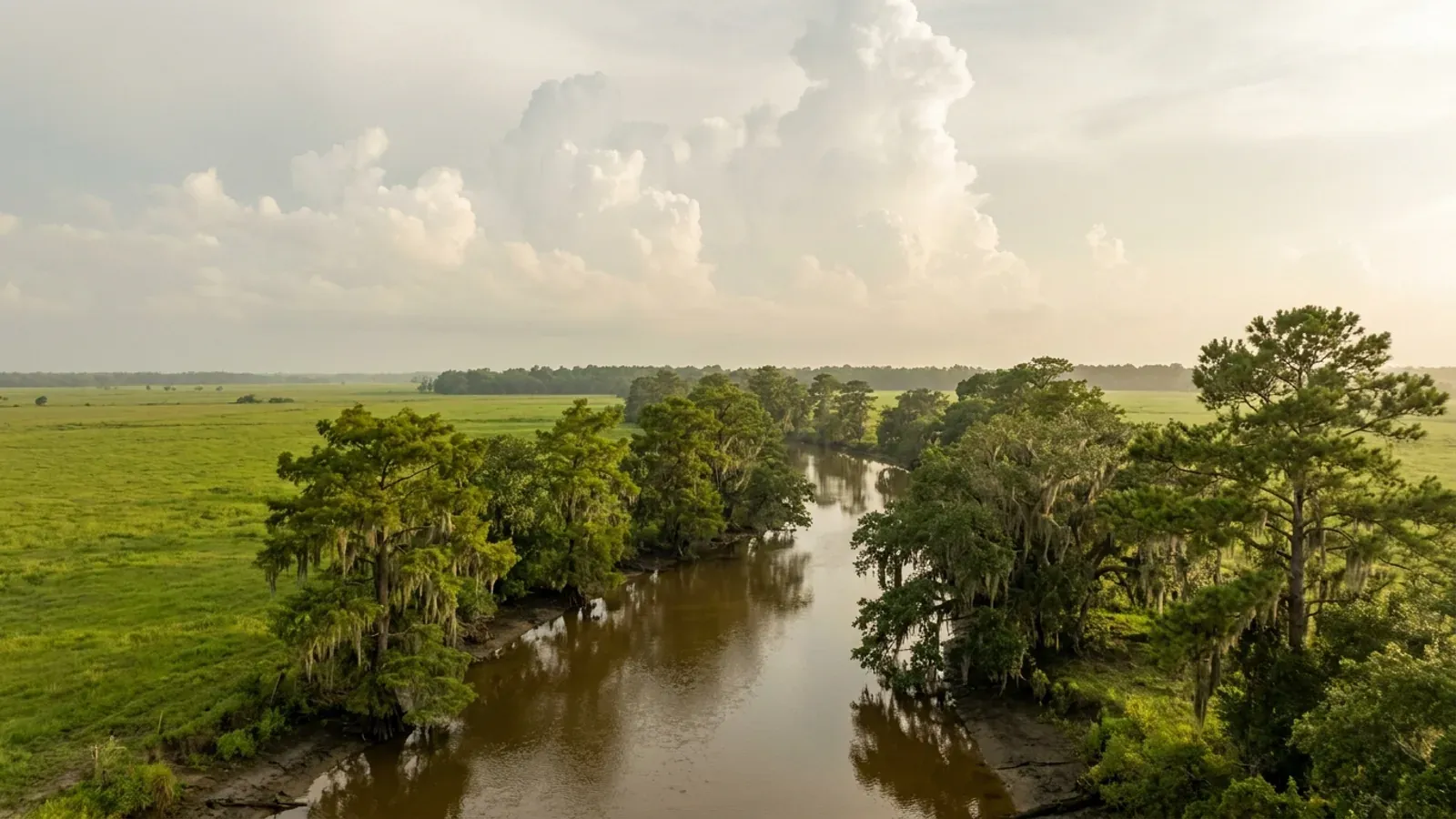
Barndominium Builders in Fort Bend County, TX
Fort Bend County is the heartland of Texas special districts. TCEQ counts 207 active municipal utility districts here, out of 1,563 statewide, plus 14 of Texas's 30 active levee improvement districts. Each is a political subdivision that sold bonds to put water, sewer and drainage in the ground, and each levies its own property tax on top of the county and any city. That tax is the part that surprises people. What a district does not do is approve your building. Nor does the county: its engineering department publishes a letter saying Fort Bend has adopted no zoning and no building codes for single-family homes. What it does require is a Residential Development Permit for any enclosed structure or slab of 400 square feet or more, and its permit page names a barn and a workshop. Add the septic order, a minimum slab elevation and recorded deed restrictions and you have the real picture.
Fort Bend County at a glance
- County
- Fort Bend County
- Population
- 975,191
- Where we build
- Richmond, Sugar Land, Houston, Waller County
- Site visits
- Site walks arranged throughout Fort Bend County, Richmond included
ZIPs 77469, 77406, 77407, 77471, 77441, 77461, 77417, 77464 and more
Building conditions in Fort Bend County
What actually changes from one Texas jurisdiction to the next: who issues the permit, whether the residential code is enforced there at all, what the structure has to be engineered to, and what the ground is like. These are the numbers your drawings have to satisfy.
TCEQ Water Districts Database, District Count Report for Fort Bend County and statewide, run 1 September 2026
TCEQ Water Districts Database, District Count Report for Fort Bend County and statewide, run 1 September 2026
Texas Water Code sections 49.452(a-1) and 49.4521(a)
Texas Water Code section 49.452(f)
Fort Bend County Engineering, Verification Letter: Building Codes, Certificates of Occupancy, and Zoning Ordinances, dated 1 January 2025
Fort Bend County Engineering, Do I need to apply for a permit? and Development Permits pages
Also worth knowing before you build in Fort Bend County
- What the county permit costs
- Development Permit $100, $150 in the floodplain, $250 on an unplatted tract; a residential driveway onto a county road is $150 and includes one inspection
- Six in ten residents live outside any city
- 581,659 of the county's 975,191 residents live in the balance of the county, outside every incorporated place, which is why so much of Fort Bend is served by districts rather than by a city
- The database will not tell you if your land is in a district
- TCEQ's Water Districts Database searches on the first part of a district's name or the full district number, not by address or parcel, so it confirms a district exists without saying whether your land sits inside it
- A district changes your bill, not your drawings
- Nothing in Water Code chapter 49 gives a utility or levee district approval over the design of a house, and the county's Environmental Health department lists MUD inspections and approvals among the services it does not provide
- Signs at two entrances
- A district subject to the purchaser-notice rule must post signs indicating its existence at two principal entrances to the district, which is the only district disclosure you can see from the road
- Acreage buys you nothing on septic here
- The county's on-site sewage facility order requires every construction, alteration, extension or repair to be permitted and inspected regardless of the size of the tract of land
- No do-it-yourself septic in Fort Bend
- All construction of any type of on-site sewage facility must be by a Registered Installer, with no property owner or homeowner installations unless the owner is also a Registered Installer
- Septic capacity keys off living area
- TCEQ sizes an on-site sewage facility on bedrooms or the living area of the home rather than total structure area, so shop floor area does not count against you at state level
- What the septic permit costs
- A single-family residential on-site sewage facility permit is $575, including a $10 TCEQ fee, covering plan review and two inspections, and an aerobic system carries a $50 annual maintenance fee
- There is a minimum slab elevation
- Outside a recorded subdivision the slab must sit at the greater of several criteria, including two feet above the highest natural ground around the foundation where there is no curb
- Not in the windstorm catastrophe area
- Insurance Code section 2210.003 lists Fort Bend as a second tier coastal county, but the commissioner has designated only the fourteen first tier counties and part of Harris, so no windstorm certificate applies here
- The county's own letter points at deed restrictions
- The verification letter closes by telling the reader to refer to any deed restrictions that may be found in the property deed
- Climate zone 2A on both maps
- Fort Bend County is climate zone 2A, Hot-Humid, on the pre-2021 and the 2021 and 2024 IRC county assignments alike, so the insulation specification does not turn on which edition applies
- A licensed plumber is required even out here
- Plumbing on new construction must be performed by a licensed plumber whether or not any building code applies to the site
Fort Bend County Engineering, Development Permits, fee schedule effective 1 October 2022
U.S. Census Bureau Vintage 2025 sub-county population estimates, sub-est2025.csv
TCEQ Water Districts Database search instructions, www14.tceq.texas.gov/iwud
Texas Water Code chapter 49; Fort Bend County Environmental Health, Service Area, Services Not Provided
Texas Water Code section 49.451(a)
Order Adopting Rules of Fort Bend County, Texas for On-Site Sewage Facilities, section 10(a)
Order Adopting Rules of Fort Bend County, Texas for On-Site Sewage Facilities, section 10(b)
30 TAC 285.91 Table III and TCEQ form TCEQ-0235
Fort Bend County Environmental Health, Permit/Inspection Fees, current as of 26 May 2023
Fort Bend County Interim Atlas 14 Drainage Criteria Manual and Minimum Slab Elevation Criteria, December 2019, revised September 2021
Texas Insurance Code sections 2210.003 and 2210.005; Texas Department of Insurance, Designated Catastrophe Areas
Fort Bend County Engineering, Verification Letter: Building Codes, Certificates of Occupancy, and Zoning Ordinances
IRC climate zone county tables, 2018 and 2024 editions, cross-checked against DOE report PNNL-33270
Texas Occupations Code section 1301.052
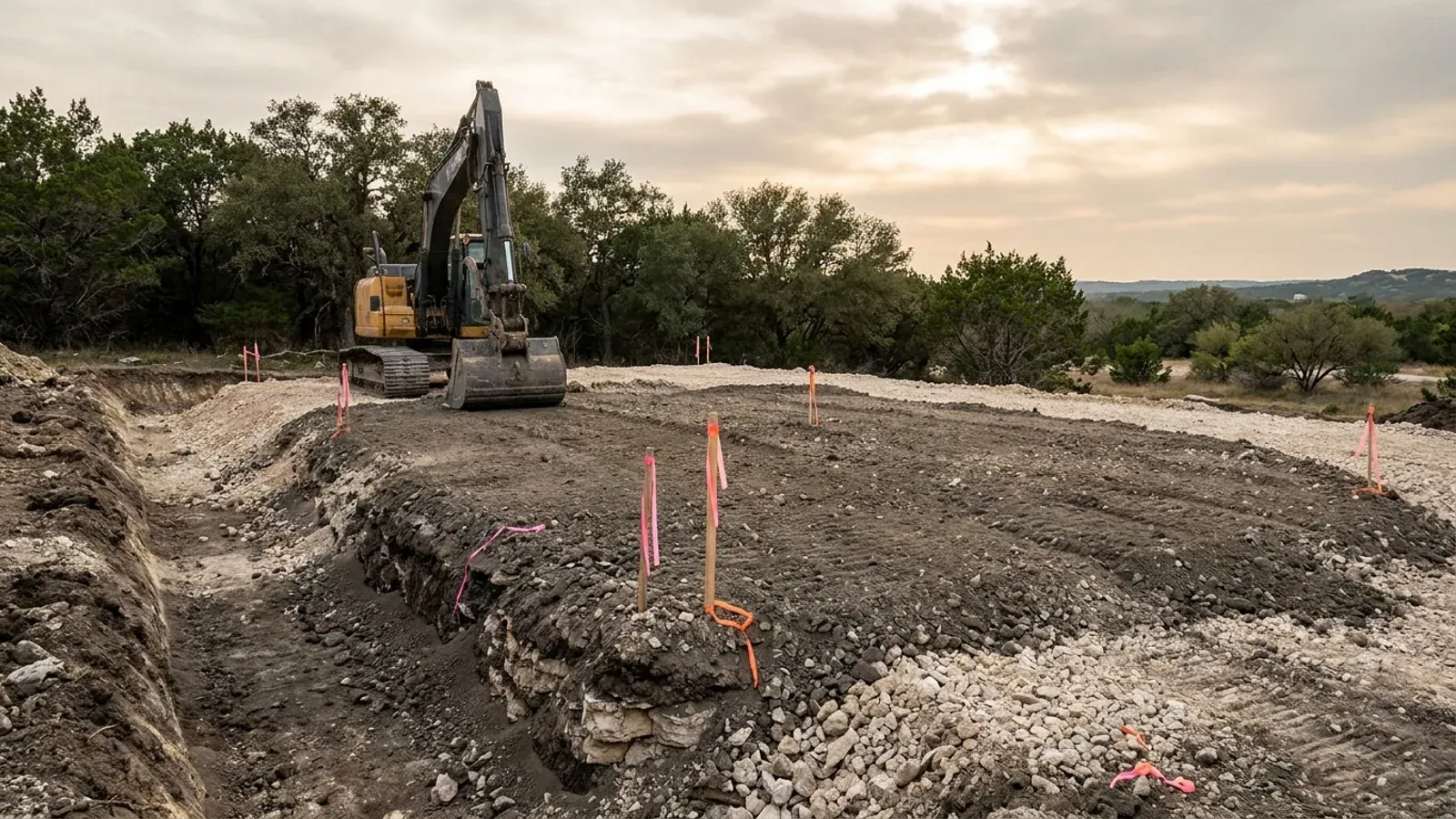
The expensive surprises are in the ground, not the building
What moves a Texas budget is usually below grade, and it is soil rather than rock: shrink-swell clay. The Blackland Prairie and the Gulf Coast clays move enough between a wet season and a dry one to drive the foundation design across the state's largest markets, which is why several DFW cities require an engineer's seal on the foundation of every new house. Those are the same conditions that decide whether a septic field passes its soil and site evaluation, so the grading plan, the foundation and the drainfield get resolved together rather than one at a time. We price the dirt before we price the building.
What we build in Fort Bend County
All nine of our services — kits, custom plans, post-frame and steel construction, site preparation, permitting and engineering, through to turnkey builds — are available across Fort Bend County. What a project costs depends far more on the parcel than on square footage, so we work from your land rather than from a rate card.
See what we buildWhat a build looks like
Three stages every Fort Bend County project passes through, from a raw parcel to a finished home. Site work first, because that is where the budget is decided.
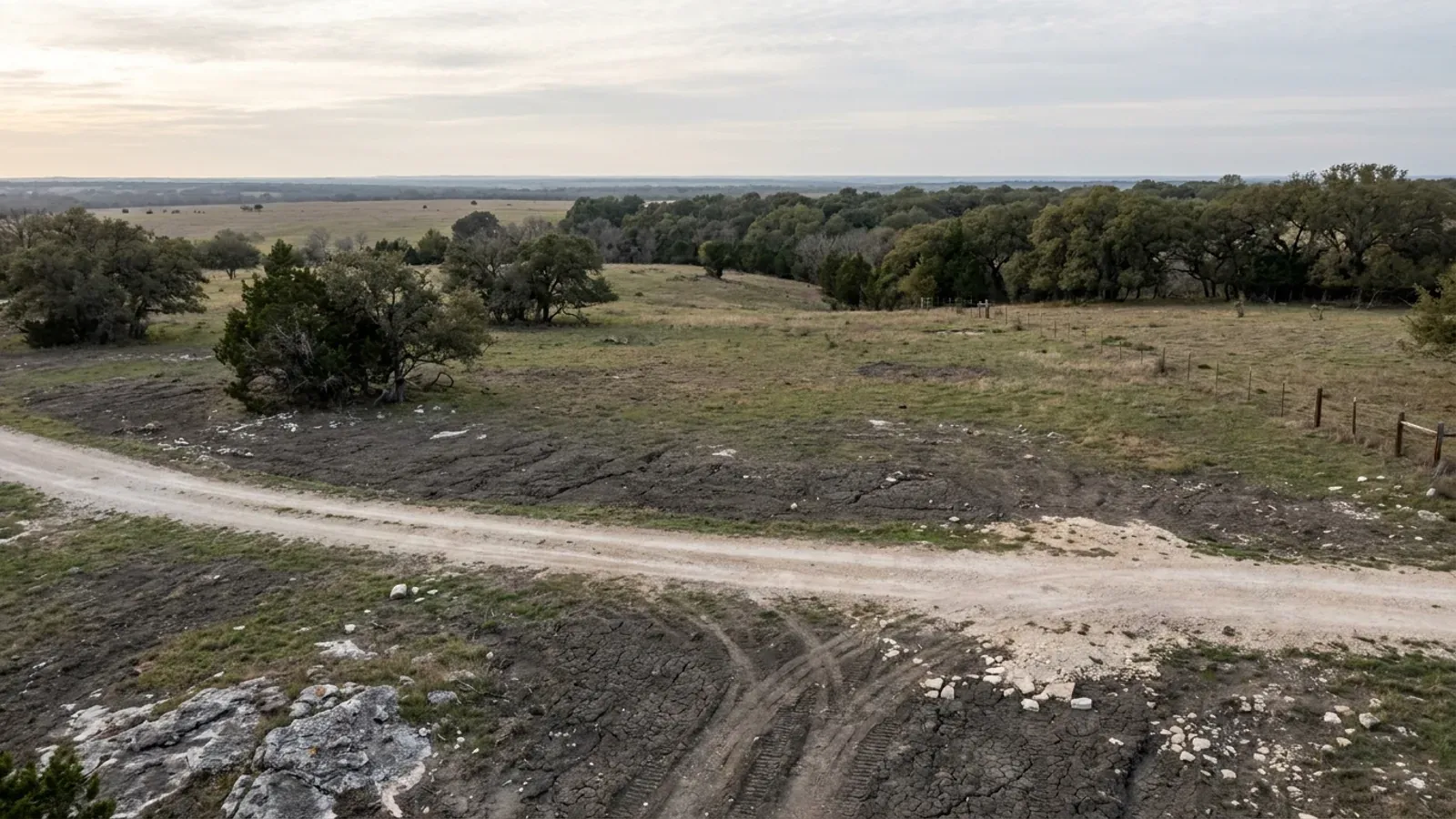
The parcel
Zoning, setbacks, flood zone and utility access get checked before anything is drawn.
Pad and permit
Clearing, grading and a compacted pad, while the submittal works through Fort Bend County.
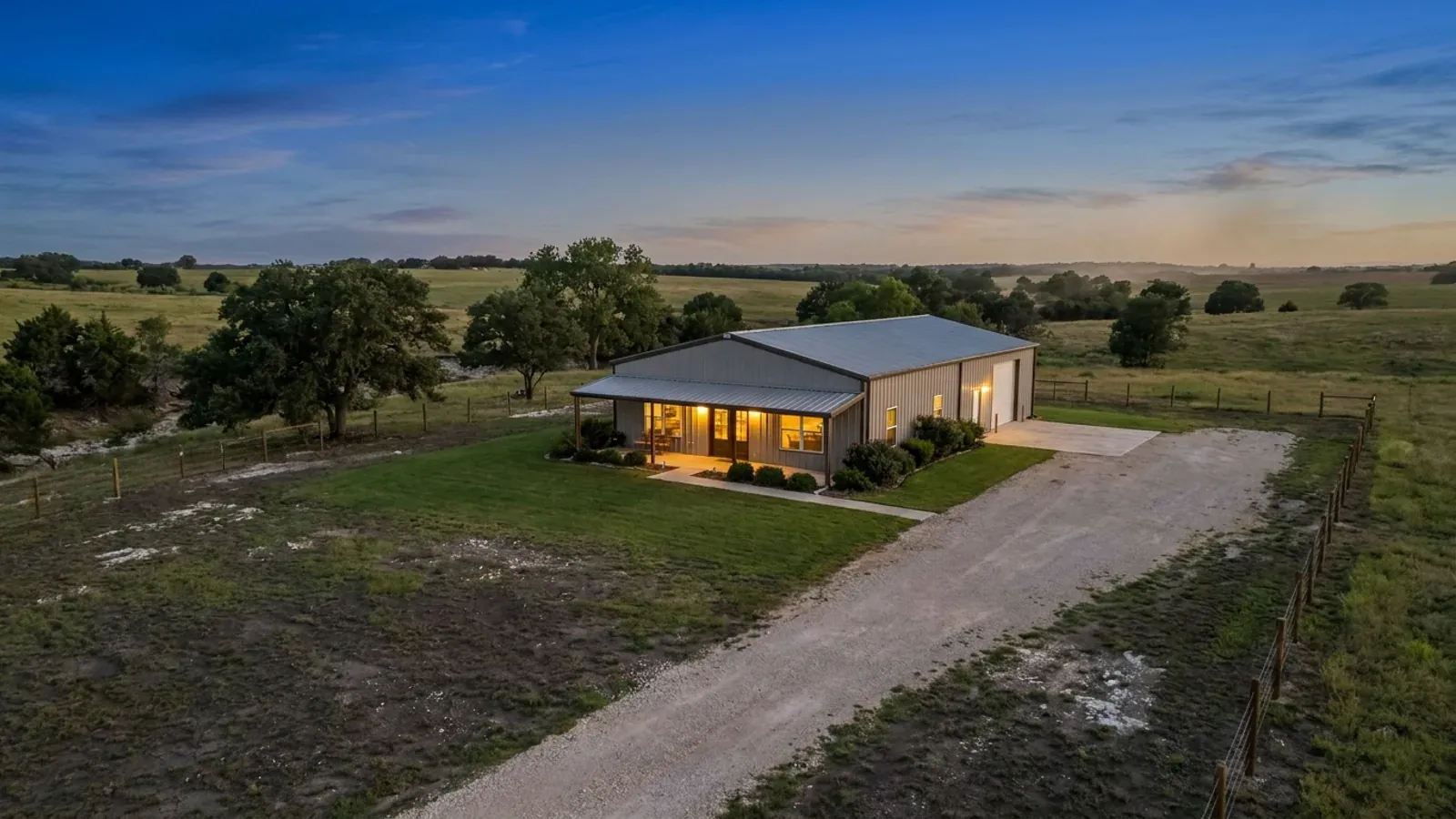
Frame to finish
Shell erected and dried in, then systems, insulation and interior finish through to CO.
Those are the rules for Fort Bend County. Tell us what you want to build and we will draw it to them.
Where we build around Fort Bend County
Fort Bend County and the rural land around it. The buildable acreage for a project this size usually sits outside the city limits, which is frequently what changes who issues your permit.
Keep reading
The questions that usually come next once you know what Fort Bend County allows.
Barndominium Cost Guide
Sourced per-square-foot ranges by tier and by size, with a calculator built on the same figures.
Read itIs It Legal in Texas?
Classification, zoning, the HOA gate, and why "nonresidential farm building" does not cover a home.
Read itHow Long Does It Take?
Census build-duration data, and what actually sets the permit clock where you are building.
Read itNearby areas we build in
Others we cover in this part of Texas. The permitting authority, the adopted design criteria and the zoning can all differ from one to the next.
Building in Fort Bend County: common questions
10 questions we get asked most often about building in Fort Bend County. If yours is not on the list, ask it directly.
What is a MUD, and can it stop me building a barndominium?
How do I find out whether the land I am looking at is in a district?
What notice is a seller supposed to give me?
Does Fort Bend County enforce a building code on unincorporated land?
So there is no county permit at all?
Is unincorporated Fort Bend County rural?
Where in the county can you actually build on acreage?
What does the county require for septic?
Is Fort Bend County in the coastal windstorm area?
What else binds a build out here?
Building in Fort Bend County?
Start with the plan. Tell us what you want to build and we will draw it, then confirm what Fort Bend County will actually let you put on the parcel and what wind load it has to meet. That conversation costs nothing.