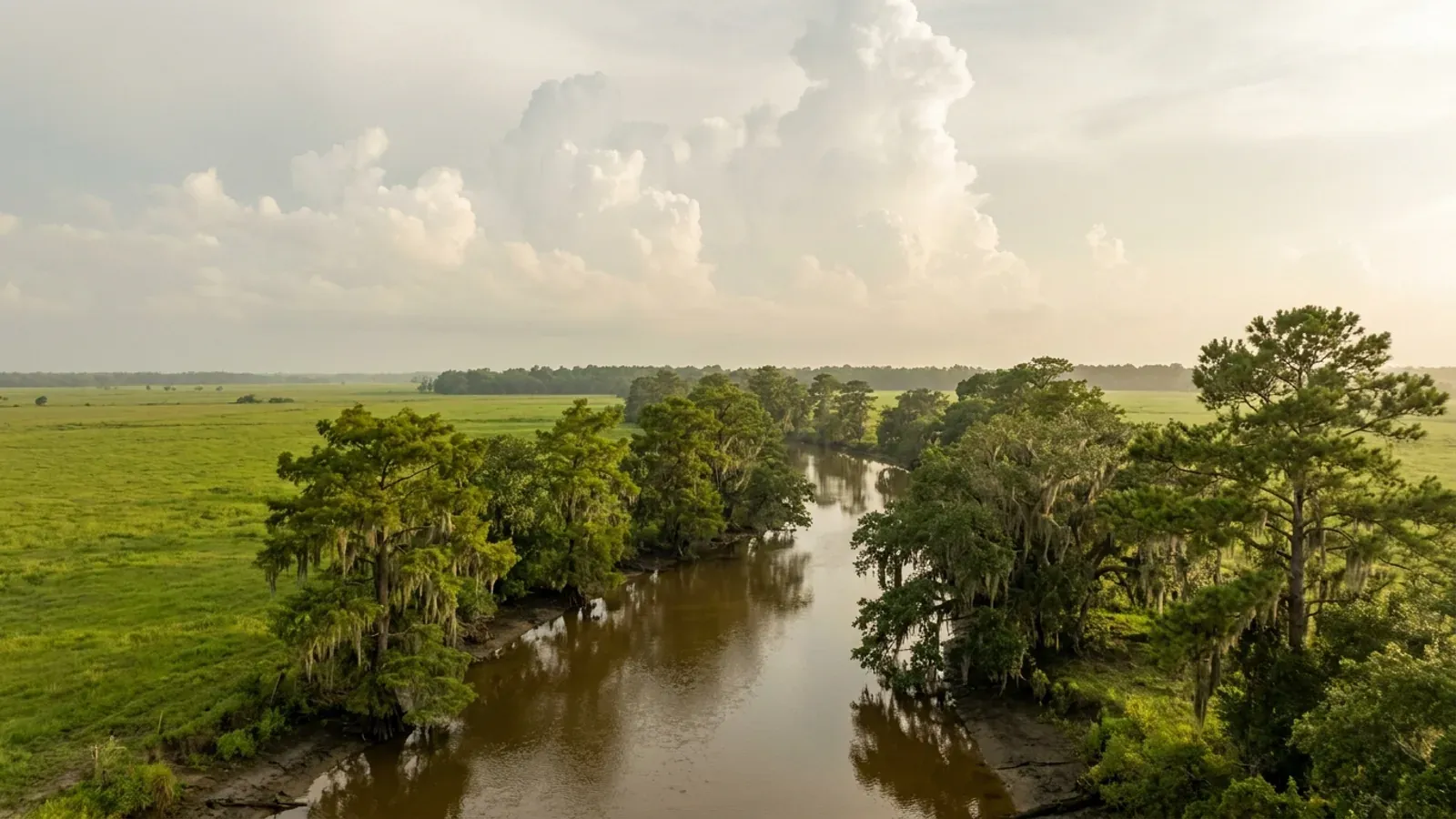
Flat green Gulf Coastal Plain near Houston with a slow bayou, live oaks draped in Spanish moss, and cumulus building overhead.
Harris County 2021 IRC as adopted here

Barndominium Builders in Houston, TX

Houston is the largest city in the United States without a city-wide comprehensive zoning ordinance, and the City puts that in writing: its Planning and Development Department issues an Official City of Houston Zoning Letter saying so plainly. For a barndominium that does not mean anything goes. It means the recorded deed restrictions on your lot do the work zoning does everywhere else — and Houston is unusual in helping to enforce them. No building permit is issued until someone swears, under penalty of perjury, that the construction and the use will not violate the covenants running with the land. Chapter 42 still fixes a minimum lot size and a minimum building line, and where a deed restriction demands a deeper setback than the ordinance does, the ordinance says the deed restriction controls. So the restrictions on a tract are the first thing we read, not the last.

Houston at a glance

County
Harris County
Population
2,304,580
Where we build
Houston, Pasadena, Montgomery County, Fort Bend County, Conroe

ZIPs 77002, 77007, 77008, 77018, 77024, 77035, 77045, 77049 and more

Site visits
Site walks booked across Houston and the Harris County land around it

Building conditions in Houston

What actually changes from one Texas jurisdiction to the next: who issues the permit, whether the residential code is enforced there at all, what the structure has to be engineered to, and what the ground is like. These are the numbers your drawings have to satisfy.

Build conditions for Houston , Harris County, Texas : design wind speed Set by the Houston Construction Code. BUILD CONDITIONS HOUSTON, TXHarris County2021 IRCDESIGN WIND SPEEDSet by the Houston…Houston's design criteria table sits inside the Houston Construction Code, which section 10-1 ofthe Code of Ordinances states is published as a separate code. No City of Houston figure is quote…ZONING · NO ZONING DISTRICT — HOUSTON HAS NO…3,500 sq ft inside the city; 5,000 s…Code of Ordinances section 42-181(a). A plat may not include a lotunder 1,400 sq ft except on the performance standards in section…WHO ISSUES THE PERMITCity of Houston Planning and Develop…611 Walker Street, 6th Floor, Houston, TX 77002 · 832.393.6600 ·planningdepartment@houstontx.gov. Deed restriction questions go to… Design criteria are filled in by the jurisdiction under Table R301.2 and are confirmed per parcel before any drawing is sealed.
Build conditions for Houston, drawn from the sourced facts on this page. Every figure above is cited in the quick-facts panel below, with its source and vintage.
No zoning ordinance, and the City says so on letterhead
The Planning and Development Department issues an Official City of Houston Zoning Letter which states: "The City of Houston does not have a city-wide comprehensive zoning ordinance." It names two exceptions — land use and height/hazard rules around Bush Intercontinental, Hobby and Ellington airports under Chapter 9 of the Code of Ordinances, and TIRZ No. 1, St. George Place, where zoning regulations do control use. The letter closes by warning that it "does not address any separately filed restrictions that may be applicable to a property."

City of Houston Planning & Development Department, Official City of Houston Zoning Letter dated 6 January 2026, signed by Director Vonn Tran — houstontx.gov/planning/DevelopRegs

No building permit without a sworn deed-restriction declaration
Section 10-3(a) of the Code of Ordinances: "No building permit shall be issued until a declaration ... has been submitted to the building official stating that the construction, alteration, or repair for which the building permit is sought, and the use to which the improvement or building is to be put, will not violate deed restrictions or restrictive covenants running with the land." Section 10-3(b) requires it to be subscribed "as true under penalty of perjury." Only demolition, like-for-like repair and interior remodelling that does not change the use and occupancy classification are excepted, and section 10-3.1 applies the same rule to a certificate of occupancy.

City of Houston Code of Ordinances §§ 10-3 and 10-3.1 (Municode, codified through Ord. No. 2026-0650, eff. 28 July 2026, Supp. No. 92)

The City itself sues to enforce private covenants
The Legal Department's Deed Restriction Enforcement Team writes that "the City is authorized to enforce, by suit for injunction, certain restrictions that affect subdivisions within the City" and that it is "the section of the City that takes people to civil court." The authority is Local Government Code § 212.153, which lets a municipality sue to enjoin or abate a covenant violation, and Chapter 10, Article XV of the Code of Ordinances. Under § 10-553(a) the city attorney may seek to compel "the repair or demolition of any structure or portion thereof that is in violation." Section 10-552(a) sets civil penalties of not more than $1,000.00 per day, each day a separate violation.

City of Houston Legal Department, Deed Restrictions page (houstontx.gov/legal/deed.html); Code of Ordinances §§ 10-551 to 10-555; Tex. Local Gov't Code § 212.153

What the City will and will not go to court over
Section 10-551 defines the restrictions Houston enforces as those that affect the character of the use of the property; fix a setback from property, street or lot lines; "affect the size of a lot or the size, type, and number of structures that may be built on the lot"; regulate the orientation or fronting of a structure; or regulate construction of a fence. That third limb is the one a shop-house proposal runs into. The state definition in Local Government Code § 212.152 is wider still and also reaches covenants that "regulate architectural features of a structure" — the clause that decides arguments about metal cladding — but Houston's own list stops short of it.

City of Houston Code of Ordinances § 10-551; Tex. Local Gov't Code § 212.152

Minimum lot size and minimum building line do zoning's job
Chapter 42 sets a minimum single-family lot of 3,500 sq ft inside the city and 5,000 sq ft in the extraterritorial jurisdiction (§ 42-181(a)) — the outer figure being the larger one. Front building lines run 25 ft on a major thoroughfare (§ 42-152(a)), 25 ft front and 10 ft to the back and sides on a collector street, and 20 ft front and 10 ft back and side on a local street (§ 42-156). Section 42-156(c) gives a garage or carport facing the street its own 20 ft line, which is what a shop door usually is.

City of Houston Code of Ordinances §§ 42-152, 42-156, 42-181 (Chapter 42 rewritten by Ord. No. 2013-343, 24 April 2013; § 42-181 amended by Ord. No. 2023-801, eff. 27 Nov 2023)

Houston is not in the coastal windstorm area
A Houston address does not sit in the Texas Department of Insurance designated catastrophe area, and neither does unincorporated Harris County. Harris is the single partial county on TDI's map and both limbs must be met: the structure has to be east of Highway 146 and inside the city limits of Seabrook, La Porte, Shoreacres, Pasadena or Morgan's Point. So none of the WPI-1 to WPI-8 windstorm certification chain, and none of the 2024 IRC coastal edition under 28 Texas Administrative Code § 5.4013, applies to a build in Houston.

Tex. Ins. Code § 2210.003 first tier coastal counties and the Texas Department of Insurance designated catastrophe area description for Harris County; 28 Tex. Admin. Code § 5.4013

Also worth knowing before you build in Houston

Adopted code and climate zone
Houston's Construction Code update adopted the 2021 International Residential Code and the 2021 International Energy Conservation Code, alongside the 2021 Uniform Mechanical Code, the 2021 Uniform Plumbing Code and the 2023 National Electrical Code — so Houston runs the Uniform plumbing and mechanical codes, not the International ones. Houston sits in climate zone 2A, and unusually for a large Texas city that answer does not move with the code edition: all four counties the city reaches into are 2A on both the pre-2021 and the 2021 climate maps.

City of Houston, "Houston Construction Code Modernization — 2021 Building Code Adoption," presentation to the City Council Transportation, Technology and Infrastructure Committee, 24 August 2023 (houstontx.gov)

The Construction Code is a separate volume
Section 10-1 of the Code of Ordinances states that "the Construction Code is published as a separate code" and is "continued in full force and effect to the same extent as if set out in full herein," and that it was formerly known as the Building Code. That is why Houston's residential amendments and its design-criteria table are not in the Code of Ordinances you find on Municode — they live in the Construction Code volume held by the Houston Permitting Center.

City of Houston Code of Ordinances § 10-1 (Municode, Supp. No. 92)

Neighbourhoods can tighten lot size and setbacks themselves
Special Minimum Lot Size and Special Minimum Building Line are neighbourhood-initiated designations under Chapter 42. The minimum is set at the smallest lot size, or the front setback, already met by at least 70 percent of properties in the application area — 60 percent in a City-designated historic district. A designation binds future subdivision and new construction, not existing lots or houses, and it expires unless renewed. Where one applies, section 42-181(e) says it controls over the ordinary minimum lot size.

City of Houston Planning & Development Department, Special Minimum Lot Size / Special Minimum Building Line program page (houstontx.gov/planning/Min-Lot_Size-Min_Bldg_Line.html); Code of Ordinances §§ 42-170 to 42-179, 42-197 to 42-208

A lot without a sewer connection answers to TCEQ
Section 42-180(b) provides that a lot which will not be served by a wastewater collection system "shall meet the minimum requirements of the Texas Commission on Environmental Quality," and that the applicant must supply a letter from TCEQ evidencing compliance. Where such a lot is platted in a special flood hazard area it must also satisfy the city and the county engineer on where the on-site sewage system goes. That is the provision that governs an acreage tract on the city's edge.

City of Houston Code of Ordinances § 42-180(b) (Municode, Supp. No. 92)

Every Houston conveyance carries a deed-restriction notice
Section 10-556 requires the seller of restricted property inside the city to give the buyer a recorded notice, in the form prescribed by Ordinance No. 89-1312, at or before closing, signed and acknowledged by both and then filed in the county real property records. Failing to do it is a misdemeanour carrying a fine of not more than $500.00, with each conveyance a separate offence. It is the cheapest early warning a buyer gets about what a tract will and will not allow.

City of Houston Code of Ordinances § 10-556 (Ord. No. 89-1312, 20 Sept 1989; amended Ord. No. 2014-364, 30 April 2014)

The City publishes what a house permit costs
Houston's City-Wide Fee Schedule prices a one- and two-family dwelling structural building permit by IBC construction type and by floor area. As of 1 January 2026, Type VB — unprotected wood frame — carries a Tier 3 base charge of $815.07 covering the first 1,224.89 square feet, then $5.36 for each additional 8.17 square feet, rising to a $1,066.86 base at Tier 4 and $1,536.83 at Tier 5. Type IIB, the unprotected non-combustible band a steel-framed building falls in, carries the same $815.07 Tier 3 base on a different square-foot step. A separate administrative fee of $33.56 is collected on issuance or amendment of the permit under section 10-2.

City of Houston City-Wide Fee Schedule, cohweb.houstontx.gov/FIN_FeeSchedule — rows dated "As Of" 01/01/2026, authority printed as Bldg. Code Sec. 118.2.1, 602.5 / 602.2, Table 601 and City Code Ch. 10, Art. I, Sec. 10-2

The permit application goes to Planning as well as to the building official
Under section 10-2 the building official forwards every application for a new structure, an addition, a change of occupancy, a driveway or curb cut, a parking area, a fence over eight feet, a retaining wall or a masonry wall to the director of Planning and Development, to check compliance with Chapters 26, 33 and 42 of the Code and the Construction Code provisions on driveways, sidewalks, parking lots and alleys. A separate review fee stated in the city fee schedule is collected at permit issuance.

City of Houston Code of Ordinances § 10-2 (Municode, Supp. No. 92)
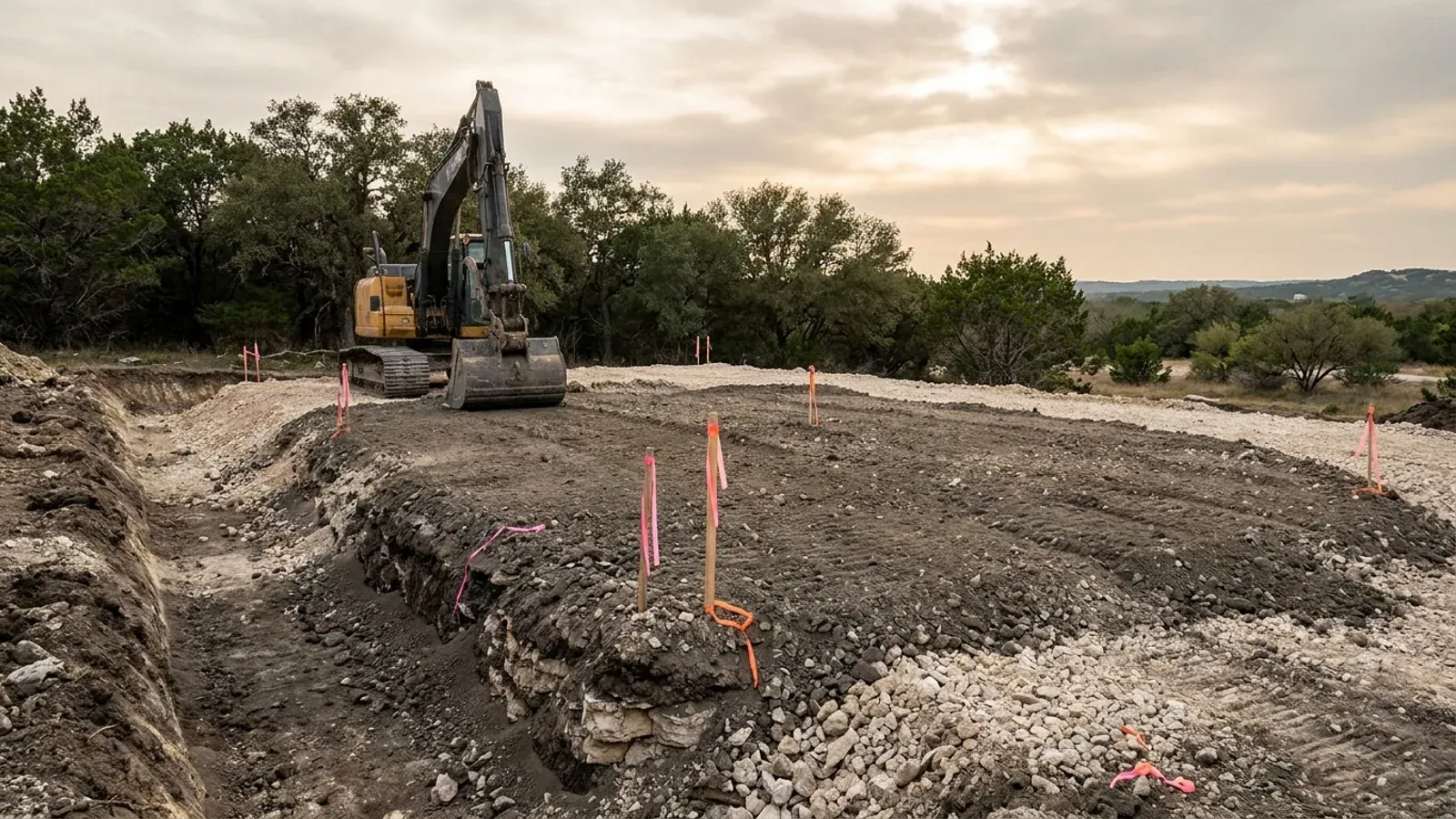
An excavator grading a compacted building pad on a cleared lot, with survey stakes and a drainage swale visible.
Below the slab

The expensive surprises are in the ground, not the building

What moves a Texas budget is usually below grade, and it is soil rather than rock: shrink-swell clay. The Blackland Prairie and the Gulf Coast clays move enough between a wet season and a dry one to drive the foundation design across the state's largest markets, which is why several DFW cities require an engineer's seal on the foundation of every new house. Those are the same conditions that decide whether a septic field passes its soil and site evaluation, so the grading plan, the foundation and the drainfield get resolved together rather than one at a time. We price the dirt before we price the building.

What we build in Houston

All nine of our services — kits, custom plans, post-frame and steel construction, site preparation, permitting and engineering, through to turnkey builds — are available across Harris County. What a project costs depends far more on the parcel than on square footage, so we work from your land rather than from a rate card.

See what we build

What a build looks like

Three stages every Houston project passes through, from a raw parcel to a finished home. Site work first, because that is where the budget is decided.
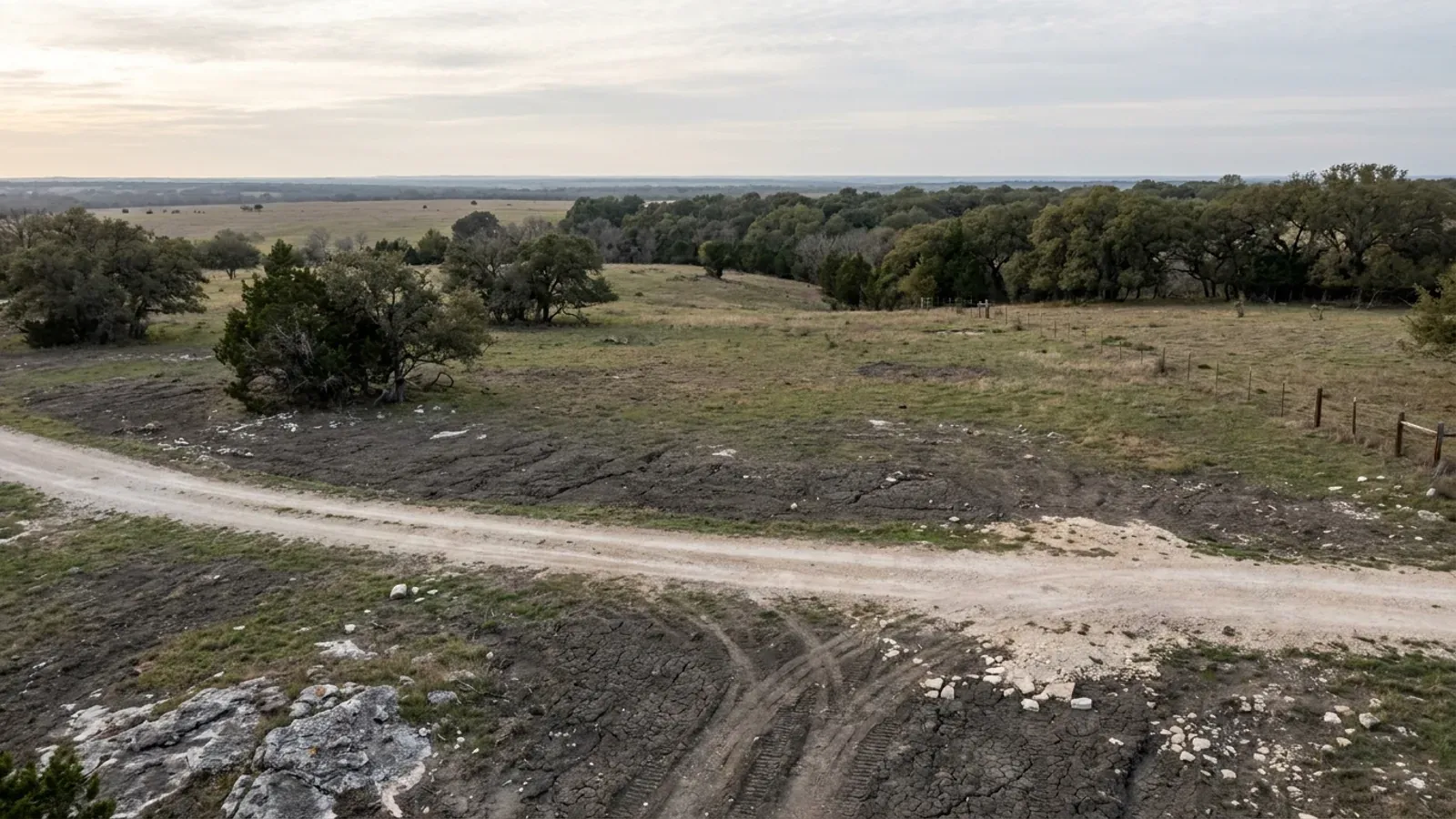
Aerial view of an undeveloped rural lot with cleared grass, a live oak and cedar elm treeline, and a pale gravel access track.
Stage one

The parcel

Zoning, setbacks, flood zone and utility access get checked before anything is drawn.

An excavator grading a compacted building pad on a cleared lot, with survey stakes and a drainage swale visible.
Stage two

Pad and permit

Clearing, grading and a compacted pad, while the submittal works through Harris County.
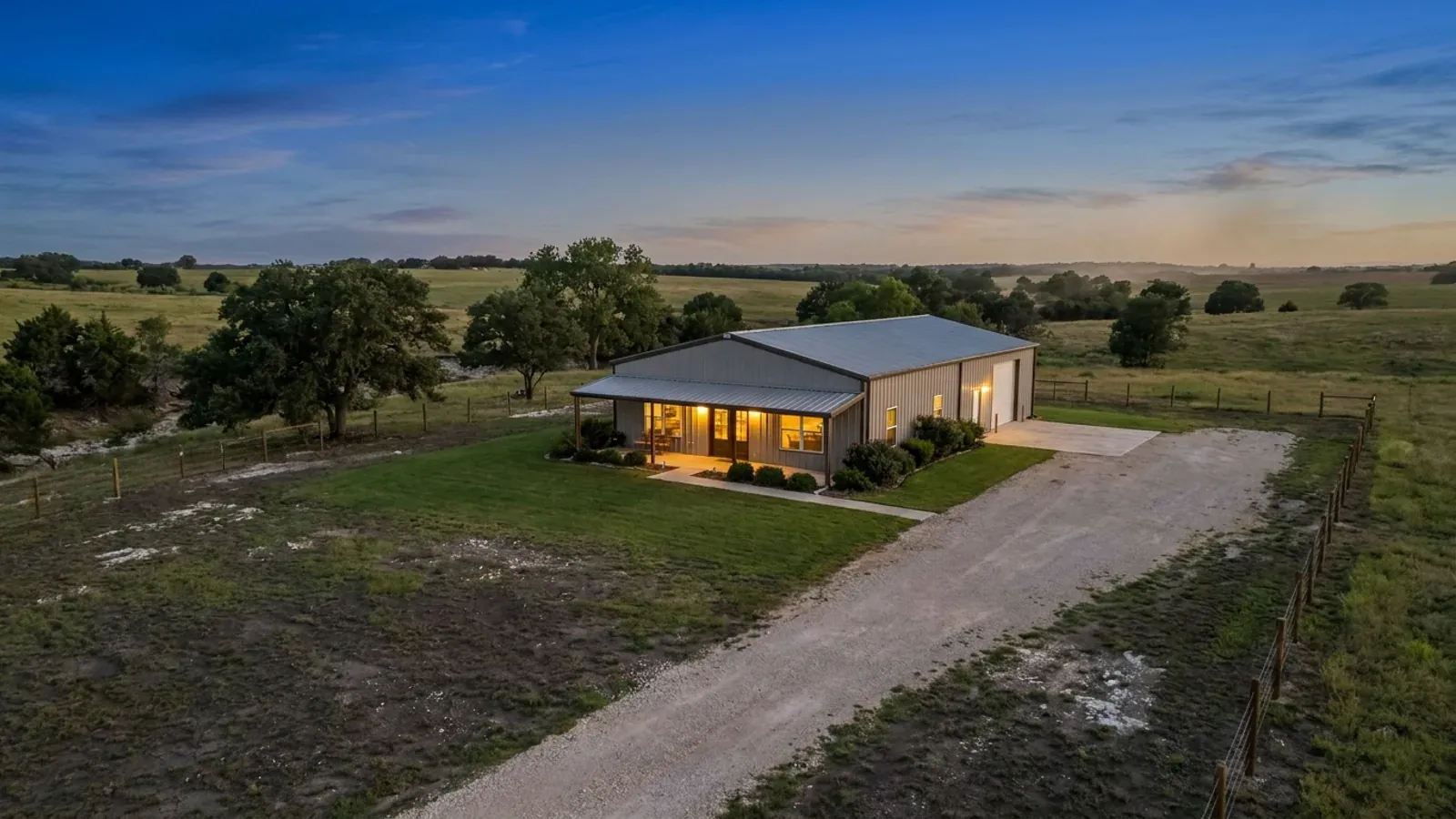
A finished barndominium at dusk with warm interior lighting glowing through its large windows.
Stage three

Frame to finish

Shell erected and dried in, then systems, insulation and interior finish through to CO.

Those are the rules for Harris County. Tell us what you want to build and we will draw it to them.

Where we build around Houston

Harris County and the rural land around it. The buildable acreage for a project this size usually sits outside the city limits, which is frequently what changes who issues your permit.

Our Houston service area, covering Harris County and the surrounding rural acreage. This map marks the territory we serve, not a branch location.

Nearby areas we build in

Others we cover in this part of Texas. The permitting authority, the adopted design criteria and the zoning can all differ from one to the next.

Building in Houston: common questions

8 questions we get asked most often about building in Houston. If yours is not on the list, ask it directly.

Houston has no zoning — does that mean I can put a barndominium anywhere?
No. It means the question moves from the zoning map to the deed. The City's own zoning letter says Houston has no city-wide comprehensive zoning ordinance, and then warns that the letter "does not address any separately filed restrictions that may be applicable to a property." Those separately filed restrictions — the recorded covenants on your subdivision — are what decide whether a steel-framed house with a shop attached can be built. Houston layers three more things on top: the platting rules in Chapter 42, the airport height and land-use areas around Bush Intercontinental, Hobby and Ellington, and TIRZ No. 1 at St. George Place, where zoning regulations genuinely do control use.
Is it true the City of Houston enforces private deed restrictions?
Yes, and it is genuinely unusual. Texas Local Government Code § 212.153 lets a municipality sue in any court of competent jurisdiction to enjoin or abate a covenant violation, and Houston has taken that up in Chapter 10, Article XV of its Code of Ordinances. The Legal Department runs a Deed Restriction Enforcement Team with its own hotline on 832.393.6333, and describes itself as the section of the City that takes people to civil court. Under § 10-553(a) the city attorney can ask a court to compel repair or demolition of the offending structure, and § 10-552(a) allows civil penalties of up to $1,000 a day. The City steps back if a property owners' association with authority to enforce files suit first.
Can I live in the shop while the house is being built?
Only if nothing on your title forbids it, and the clause that forbids it is common. A 1953 Travis County deed restriction reproduced verbatim by the Texas Court of Appeals at Austin in Cliffhanger Developments, LLC v. Lubitz, No. 03-24-00555-CV, affirmed 14 August 2026, reads: "No garage or garage apartment or other facilities shall be used for residence purposes until the principal dwelling house is erected." That covenant was enforced by permanent injunction, and the court recorded that the 2022 purchaser took title subject to "all presently recorded and validly existing restrictions." In Houston the point bites twice, because you must swear on the permit application that the use you intend does not violate the covenants.
Is Houston in the coastal windstorm area?
No, and the misconception is worth correcting because Houston reads as a coastal city. The Texas Department of Insurance designated catastrophe area covers fourteen whole counties plus one partial. Harris is the partial one, and both conditions have to be satisfied: the structure must be east of Highway 146 and inside the city limits of Seabrook, La Porte, Shoreacres, Pasadena or Morgan's Point. Houston is not among them, and unincorporated Harris County is not in the area either. So a Houston build needs no WPI-8 windstorm certificate, and the 2024 IRC edition that applies on the designated coast does not apply here.
What lot size and setbacks will actually apply to my Houston tract?
Chapter 42 sets the floor. A single-family lot with wastewater collection service must be at least 3,500 square feet inside the city and 5,000 square feet in the extraterritorial jurisdiction, under § 42-181(a). Front building lines run 25 feet on a major thoroughfare, 25 feet on a collector street and 20 feet on a local street, with 10 feet to the back and sides, and a garage or carport facing the street gets its own 20-foot line under § 42-156(c). Then read the ordinance's own concession in § 42-150(b): the chapter's building lines are minimum standards, and "where deed restrictions provide for a greater building line or setback, the deed restrictions shall control." A neighbourhood-approved Special Minimum Lot Size or Special Minimum Building Line, if one covers your block, overrides both.
Which code does a Houston build follow, and does the climate zone change with it?
Houston's Construction Code update adopted the 2021 International Residential Code and the 2021 International Energy Conservation Code, along with the 2021 Uniform Mechanical and Uniform Plumbing Codes and the 2023 National Electrical Code — so Houston is one of the few large Texas cities running the Uniform plumbing and mechanical codes rather than the International ones. Houston is in climate zone 2A, and that does not shift with the edition: every county the city reaches into is 2A on both the older and the 2021 climate maps. Dallas and Fort Worth cannot say the same. Houston's own amendments and design-criteria table sit in the Construction Code volume, which § 10-1 of the Code of Ordinances confirms is published separately from the Code of Ordinances; the Houston Permitting Center holds it.
Where do Houston buyers actually find land for a barndominium?
Rarely inside Loop 610. The buildable acreage sits in the ring counties, and the regulatory picture there is different again: outside a city's limits a Texas county has no general building-code authority unless its commissioners court adopted a Local Government Code Chapter 233 Subchapter F order, and even where one exists there is no county permit, no county fee and no county inspector — the builder contracts the three required inspections privately. Montgomery County to the north, Liberty County to the northeast, Waller County to the west and Grimes County beyond it are where most Houston barndominium projects end up. Note that Houston's extraterritorial jurisdiction reaches five miles beyond the city limits, and Chapter 42 platting and building lines follow it out there.
Do you hold a Texas contractor's licence?
There is no such thing to hold. Texas issues no state licence for a residential building contractor, so nobody building houses in Houston has one, and anyone implying otherwise is describing a licence that does not exist. Trades that are licensed — electrical, plumbing, mechanical — are licensed separately by the state, and Houston requires those trades to be permitted through the Houston Permitting Center. Where the work needs an engineer, and on Gulf Coast clay a slab often does, that engineer is licensed by the Texas Board of Professional Engineers and Land Surveyors and we engage one.

Building in Houston?

Start with the plan. Tell us what you want to build and we will draw it, then confirm what Harris County will actually let you put on the parcel and what wind load it has to meet. That conversation costs nothing.