
Barndominium Builders in Grand Prairie, TX
Grand Prairie is the rare DFW city that is two places at once. The northern end is dense and industrial, wrapped around the airport corridor and Joe Pool Lake; the city then runs a long way south past Cedar Hill toward open Ellis County prairie, and it was still taking raw acreage into its limits down there in 2025. Those limits fall in three counties, Dallas, Tarrant and Ellis, which is why owners here are given three different answers about which rules apply. There is only one answer. Inside the city limits Grand Prairie is the building authority, so a single Building Inspections counter on West Main Street permits and inspects every house whichever county line the deed falls on. The city adopted the 2021 IRC and the 2021 IECC together in December 2021, and that adoption, not the county, is what sets the climate zone at 2A.
Grand Prairie at a glance
- County
- Dallas County
- Population
- 209,434
- Where we build
- Grand Prairie, Dallas, Irving, Garland, Mesquite
- Site visits
- Site walks booked across Grand Prairie and the Dallas County land around it
ZIPs 75050, 75051, 75052, 75054, 76065
Building conditions in Grand Prairie
What actually changes from one Texas jurisdiction to the next: who issues the permit, whether the residential code is enforced there at all, what the structure has to be engineered to, and what the ground is like. These are the numbers your drawings have to satisfy.
Grand Prairie Code of Ordinances ch. 7, art. IV, secs. 7-108 and 7-109; City of Grand Prairie Building Inspections code adoption notice
U.S. Census Bureau 2020 place-by-county relationship file for Texas (FIPS place 30464); City of Grand Prairie Residential New Construction Permit page
Grand Prairie Ord. No. 11131-2021, secs. 9 and 10; 2021 IRC climate zone assignments for Texas counties
Recommended Amendments to the 2021 International Residential Code, North Central Texas Council of Governments, Table R301.2(1), adopted into Grand Prairie Code sec. 7-108
NCTCOG 2021 IRC amendments, R401.2, adopted into Grand Prairie Code sec. 7-108; City of Grand Prairie Residential New Construction Permit requirements
Grand Prairie Unified Development Code Article 22, Schedule 22.3-1a, adopted 2 September 2025 by Ordinance No. 11756-2025
Also worth knowing before you build in Grand Prairie
- Where the acreage is zoned
- The Agriculture (A) district carries a five-acre minimum lot and a 1,600 sq ft minimum house, the smallest minimum living area of any single-family district in the city, against 2,600 sq ft on the one-acre SF-E estate lots. Land newly brought into the city is zoned A unless a less restrictive district is sought.
- Still taking in land
- In August 2025 the city annexed about 22.699 acres in Ellis County, south of U.S. Highway 287 and north of Lakeview Drive, out of a 198.07-acre tract, on the owner's own petition. A city with no frontier left does not do that.
- Published permit fees
- A new single-family or two-family dwelling permit is $1,000.00 plus $100.00 for plan review. A detached garage or accessory building over 400 sq ft is $0.25 per square foot. An earthwork permit is $100.00 on a lot of half an acre or more, and is required on any residential lot larger than half an acre. General contractors must register with the city at $75.00 a year, and every registration expires on 28 February.
- Inspection sequence
- Six grouped inspection steps: foundation piers and erosion control; underground plumbing with the form board survey uploaded before the pour; foundation slab; framing, brick ties and the Ufer ground; the rough trades and meter release; then building, electrical, plumbing, mechanical and zoning finals with a precise final grade survey and a termite treatment verification form. Third-party energy inspections are required at framing, insulation and final.
- No certificate of occupancy on a house
- Grand Prairie does not issue a certificate of occupancy for a single-family home. A certificate of completion is available on request once every final inspection, document and associated permit is closed out.
- Sprinklers out, floodplain moved
- The adopted regional amendments delete IRC R313.2, so there is no residential fire sprinkler mandate, and delete R322 flood-resistant construction, which the city runs instead through its own floodplain article. A finished floor elevation certificate is required where a house sits within 200 feet of the floodplain.
Grand Prairie Unified Development Code Article 3, secs. 3.1.1 and 3.2.1; Article 6, Table 6A
City of Grand Prairie Riverbend annexation ordinance, hearing held 19 August 2025 under Local Government Code sec. 43.0673
Grand Prairie Unified Development Code Article 22, secs. 22.2.13 and 22.2.23; Grand Prairie Code of Ordinances sec. 7-10
City of Grand Prairie Building Inspections, New Single-Family Construction CSS inspection step, grouping and document requirements
City of Grand Prairie Residential New Construction Permit page, citing Unified Development Code Article 13, sec. 2
NCTCOG 2021 IRC amendments, R313.2 and R322, adopted into Grand Prairie Code sec. 7-108; Grand Prairie Unified Development Code Article 15
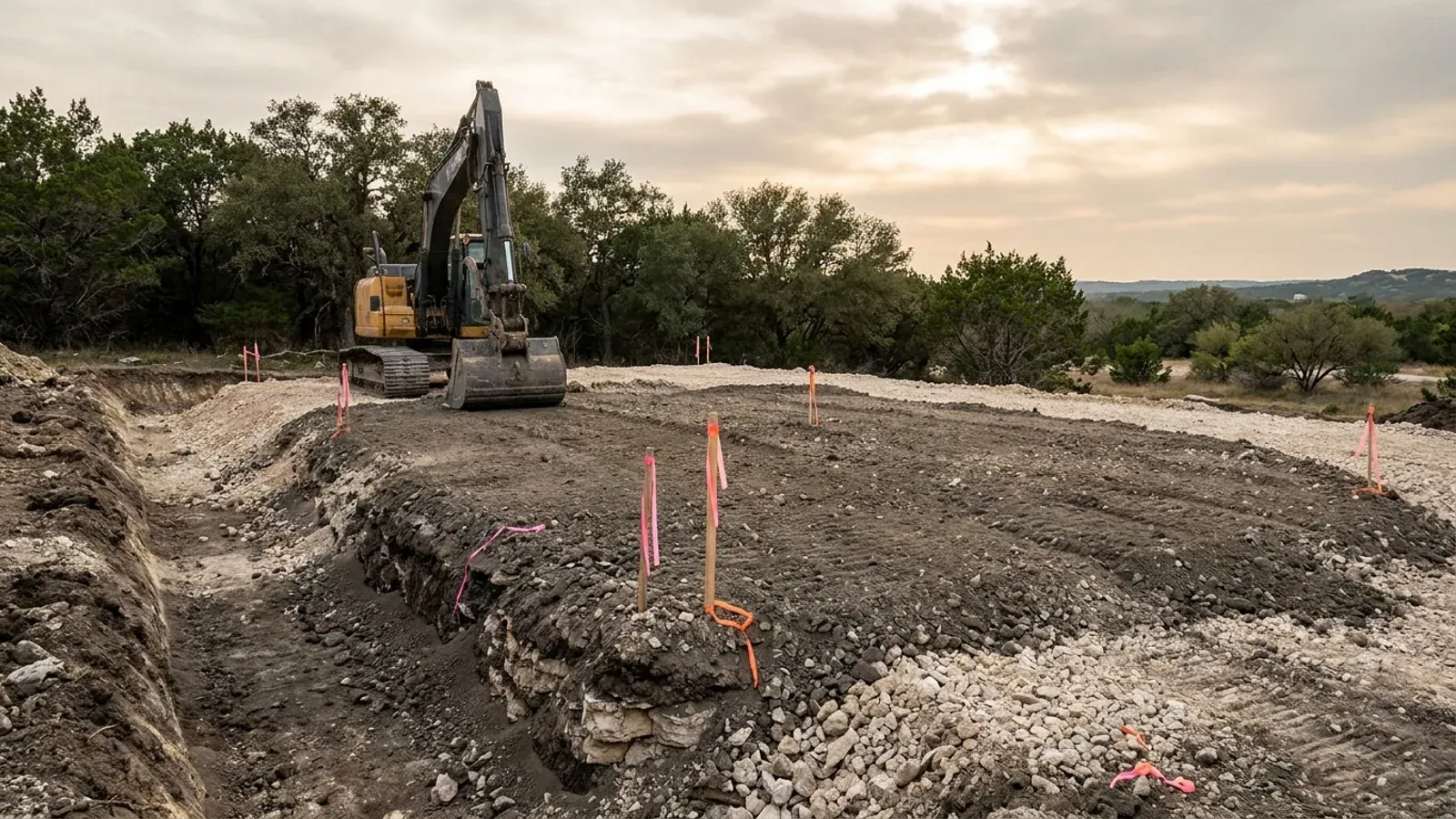
The expensive surprises are in the ground, not the building
What moves a Texas budget is usually below grade, and it is soil rather than rock: shrink-swell clay. The Blackland Prairie and the Gulf Coast clays move enough between a wet season and a dry one to drive the foundation design across the state's largest markets, which is why several DFW cities require an engineer's seal on the foundation of every new house. Those are the same conditions that decide whether a septic field passes its soil and site evaluation, so the grading plan, the foundation and the drainfield get resolved together rather than one at a time. We price the dirt before we price the building.
What we build in Grand Prairie
All nine of our services — kits, custom plans, post-frame and steel construction, site preparation, permitting and engineering, through to turnkey builds — are available across Dallas County. What a project costs depends far more on the parcel than on square footage, so we work from your land rather than from a rate card.
See what we buildWhat a build looks like
Three stages every Grand Prairie project passes through, from a raw parcel to a finished home. Site work first, because that is where the budget is decided.
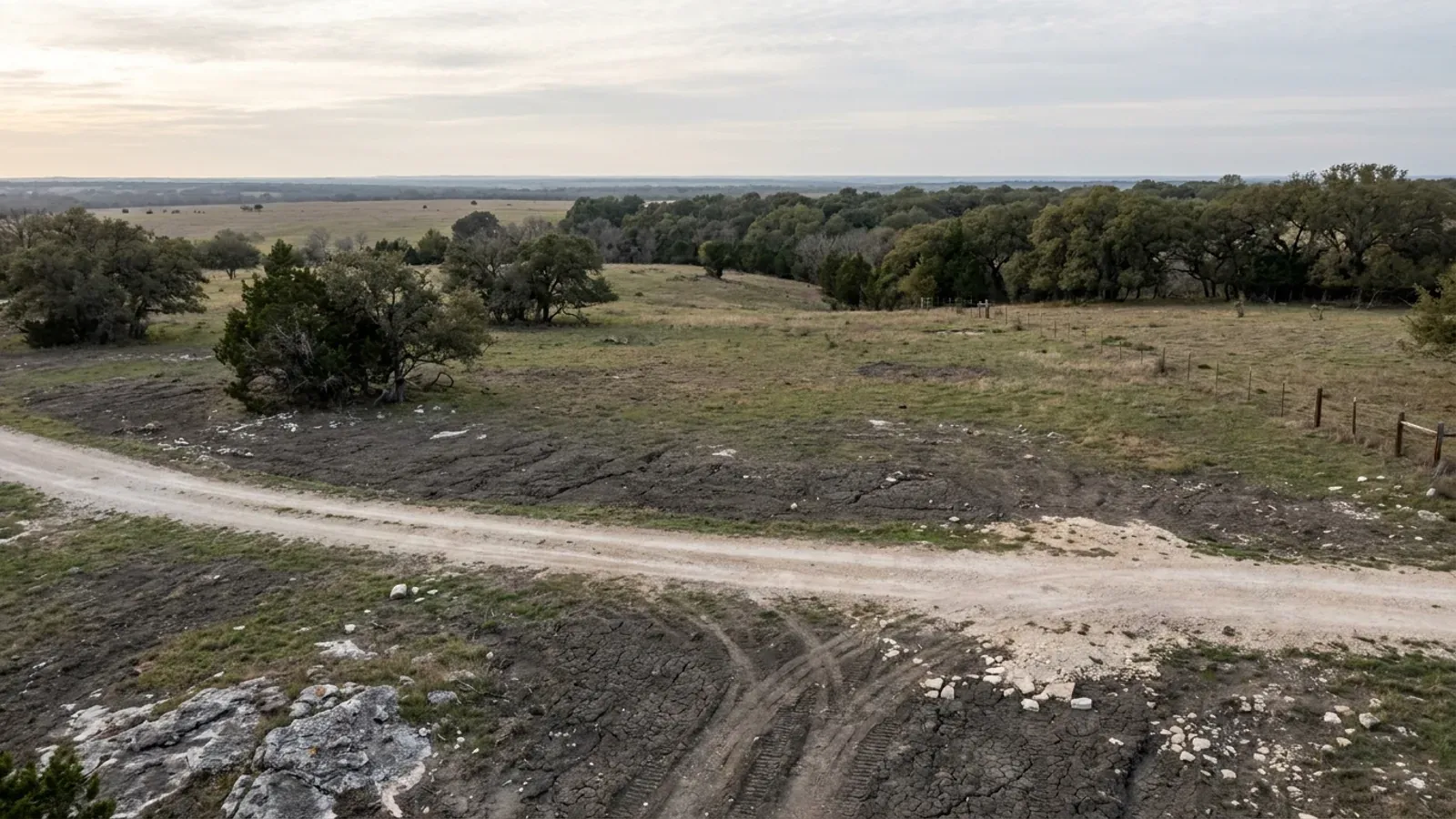
The parcel
Zoning, setbacks, flood zone and utility access get checked before anything is drawn.
Pad and permit
Clearing, grading and a compacted pad, while the submittal works through Dallas County.
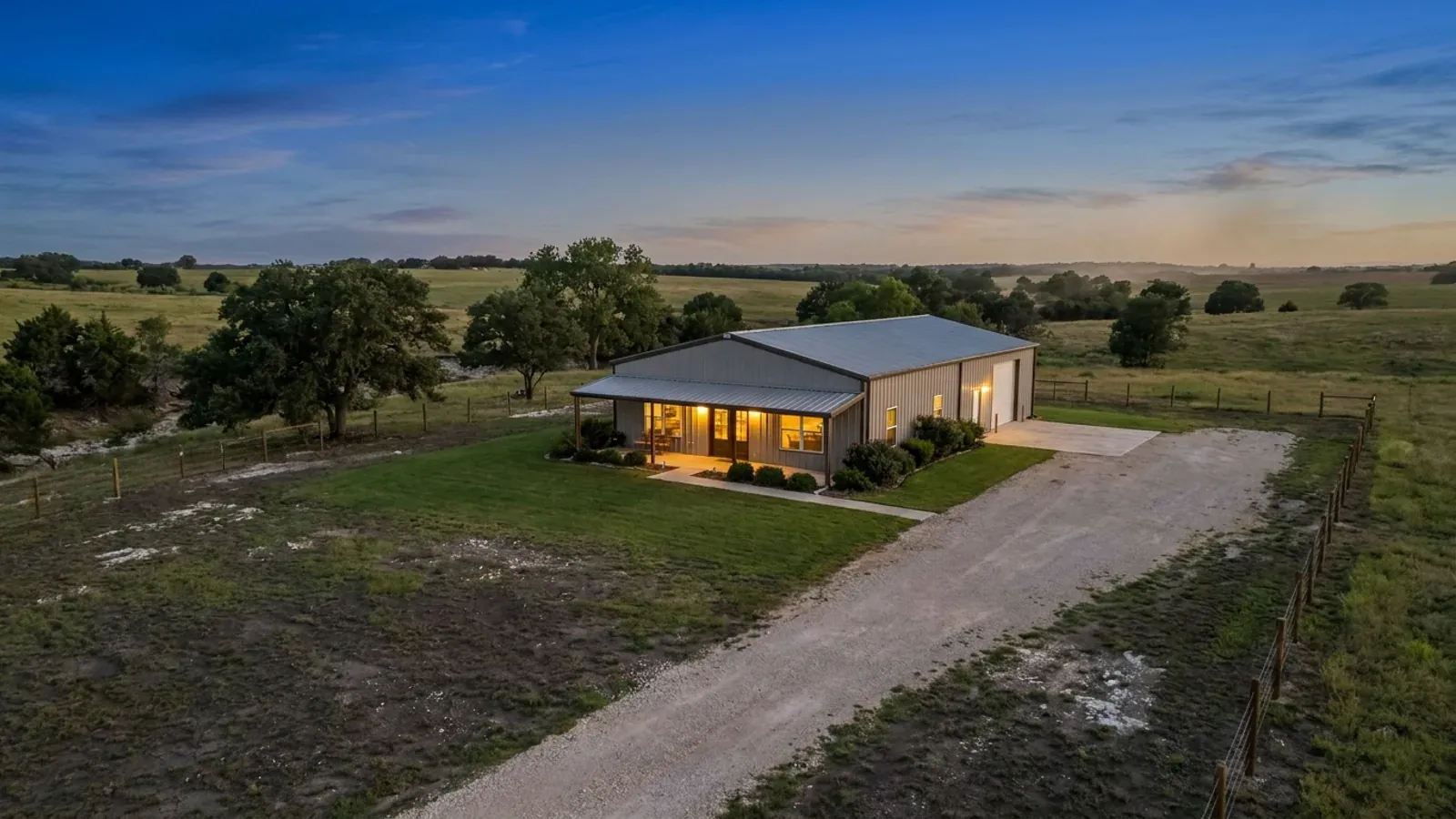
Frame to finish
Shell erected and dried in, then systems, insulation and interior finish through to CO.
Those are the rules for Dallas County. Tell us what you want to build and we will draw it to them.
Where we build around Grand Prairie
Dallas County and the rural land around it. The buildable acreage for a project this size usually sits outside the city limits, which is frequently what changes who issues your permit.
Keep reading
The questions that usually come next once you know what Grand Prairie allows.
Barndominium Cost Guide
Sourced per-square-foot ranges by tier and by size, with a calculator built on the same figures.
Read itIs It Legal in Texas?
Classification, zoning, the HOA gate, and why "nonresidential farm building" does not cover a home.
Read itHow Long Does It Take?
Census build-duration data, and what actually sets the permit clock where you are building.
Read itNearby areas we build in
Others we cover in this part of Texas. The permitting authority, the adopted design criteria and the zoning can all differ from one to the next.
Building in Grand Prairie: common questions
7 questions we get asked most often about building in Grand Prairie. If yours is not on the list, ask it directly.
My Grand Prairie lot is in Ellis County, not Dallas County. Whose rules apply?
Is Grand Prairie climate zone 2A or 3A? I have been told both.
Do I need an engineer for the foundation?
Is there actually land in Grand Prairie to put a barndominium on?
What does a permit cost and how long does it take?
Will Grand Prairie let me have a metal exterior?
What if my land is in Grand Prairie's ETJ rather than inside the city?
Building in Grand Prairie?
Start with the plan. Tell us what you want to build and we will draw it, then confirm what Dallas County will actually let you put on the parcel and what wind load it has to meet. That conversation costs nothing.