Barndominium Builders in Gregg County, TX
Gregg County is 273 square miles, the eighth-smallest county in Texas by land area, and it sits on top of the East Texas oil field. That shapes the answer here more than any code does. Chapter 233 of the Local Government Code is the whole of a Texas county's authority over structures and it holds no general building-code subchapter, so out in the unincorporated county there is no plan review of a house and no county building inspector. What there is instead is a septic permit that gates the build, a driveway culvert that goes to the Commissioners Court by street address, an NRCS soil map on which one acre in five is rated frequently flooded, and a title question about who owns the minerals that most buyers never think to ask. Inside Longview, Kilgore, Gladewater or any of the county's five smaller towns, that city's own code and building official apply instead, and Longview replaced three cycles of code at once on 1 July 2026.
Gregg County at a glance
- County
- Gregg County
- Population
- 126,095
- Where we build
- Longview, Smith County, Tyler, Wood County
- Site visits
- Site visits scheduled across Gregg County, Longview out to the county line
ZIPs 75601, 75602, 75603, 75604, 75605, 75662, 75693, 75647 and more
Building conditions in Gregg County
What actually changes from one Texas jurisdiction to the next: who issues the permit, whether the residential code is enforced there at all, what the structure has to be engineered to, and what the ground is like. These are the numbers your drawings have to satisfy.
Merriman v. XTO Energy, Inc., No. 11-0494 (Tex., 21 June 2013), Justice Johnson, read from the Supreme Court of Texas Opinions FY2013 volume on txcourts.gov; Getty Oil Co. v. Jones, 470 S.W.2d 618 (Tex. 1971)
Gregg County Commissioners Court minutes, regular meeting of 6 May 2019; Texas Local Government Code Secs. 233.061 and 233.062(a); U.S. Census Bureau county population figures
Order Adopting Rules of Gregg County, Texas for On-Site Sewage Facilities, Secs. 4, 10(A) and 16, approved 31 March 2026
USDA NRCS Soil Data Access, SSURGO survey area TX608 Upshur and Gregg Counties, county overlap for Gregg, muaggatt flood frequency summed by acre
USDA NRCS Soil Data Access, SSURGO chorizon clay and linear extensibility values for the major components of the Cuthbert, Kirvin, Sacul and Bowie map units in Gregg County
Gregg County Commissioners Court minutes, full-text search of the county minutes portal 2016-2026; example item, regular meeting of 14 October 2025, 565 Ronnie Brown Road
Also worth knowing before you build in Gregg County
- The county runs the septic programme inside Longview too
- TCEQ's authorised agent register lists four records for Gregg County. The Gregg County Authorized Agent serves the unincorporated county plus Clarksville City, Gladewater, Lakeport, Warren City and, in TCEQ's own word, Longview temporarily. The City of Longview holds its own authorised agent designation but the record says it is temporarily administered by Gregg County. No river authority or lake district appears, so the 2,000-foot band that shifts jurisdiction elsewhere in Texas does not apply here.
- The shop bay does not enlarge the drainfield
- Texas sizes a single-family septic system off the number of bedrooms or the living area of the home, whichever gives the larger figure, and the shop is not living area. Gregg County's own application form asks, under Single Family Residence, for Number of Bedrooms and Living Area in square feet, and marks living area as required. The county's order adopts Chapter 285 whole and lists its stricter rules exhaustively in Section 10, and none of them redefines living area the way some Texas authorised agents do.
- What the septic permit costs, and what it is stricter about
- The county's order sets permit fees at $350 residential and $450 commercial, with a $100 re-inspection fee. Beyond permitting on any size tract, its only stricter rules are that all maintenance be performed by a TCEQ-registered maintenance company unless the owner qualifies under one of three named exceptions, that inspections happen no less than once every three months, and that every testing report state the sludge level in the pump tank and the condition of the spray area.
- How much land the septic rules actually require
- The Gregg County Health Department applies the state minimum without raising it: half an acre with community water, or one acre with a water well. It also names the exception, telling owners to contact the office about lots that do not meet those criteria but were platted before 1 January 1988. The site evaluation and design must be done by a registered sanitarian or a professional engineer, and the technical information sheet has to be signed by a designer with a registration number.
- Longview replaced three cycles of code in one step
- The City of Longview moved from the 2012 International Residential Code to the 2021 edition effective 1 July 2026, along with the 2021 IBC, IPC, IMC, IFGC, IEBC and IPMC and the 2026 National Electrical Code, keeping the 2015 IECC unchanged. The city's own adoption materials delete IRC section R313, automatic fire sprinkler systems, in its entirety, delete IRC chapter 11 and point at the 2015 IECC instead, and give the design wind speed for Longview as 104 mph, changed from the 90 mph in the code it replaced.
- No groundwater district today, and the court is trying to change that
- Gregg County lies in no confirmed groundwater conservation district, so a domestic well needs no district permit and the rule of capture governs. On 14 July 2026 the Commissioners Court approved a professional services agreement for legal work on creating a groundwater conservation district, deliberated on the creation of the Northeast Texas Groundwater Conservation District, and appointed the County Judge to a multi-county committee to create a regional district. Anyone drilling should check where that has got to.
- The floodplain administrator is the Maintenance Director
- Gregg County has no planning or development department, and the person who administers its flood damage prevention order is the county's Maintenance Director, Jeremy Hughes, on (903) 237-2581. The unincorporated county has been in the regular phase of the National Flood Insurance Program since 3 January 1990 as community 480261, and every community in the county shares a countywide effective flood map dated 3 September 2014.
- Call 811 before you dig, and the oil-field exception is not yours
- The Underground Facility Damage Prevention and Safety Act requires anyone intending to excavate to notify a one-call notification centre no earlier than 14 days and no later than 48 hours before starting, excluding weekends and holidays. Its exceptions cover agricultural operations, oil and gas exploration or production outside an easement, and excavation by someone who owns the land and operates all the underground facilities on it. A landowner digging footings over somebody else's gathering lines is in none of those.
- A clear span over 24 feet pulls in an engineer
- The Engineering Practice Act exempts a private dwelling from its licensing requirements, and also exempts a one-storey building of not more than 5,000 square feet with no clear span greater than 24 feet. But where such a building has unsupported spans greater than 24 feet, the statute says only the trusses, beams or other roof-supporting members must be engineered or pre-engineered. A detached shop with a 40-foot clear span is squarely in that sentence, and it applies whether or not a county code does.
- A licensed plumber is required even where nothing else is
- The rural exemption in the Texas plumbing licence law expressly excludes plumbing performed in conjunction with new construction. It is one of a handful of statewide requirements that survive the absence of any county building code, and it applies on land with no permit and no inspector. A builder working outside the limits of any municipality must also certify the house against the state energy code and keep that certification for three years.
- A city's code stops at the city line
- In Town of Lakewood Village v. Bizios the Supreme Court of Texas held that a general-law city has no authority to enforce its building codes in its extraterritorial jurisdiction, and read Local Government Code Sec. 233.153(c) as a precedence rule rather than a grant of power. The Dallas Court of Appeals reached the same conclusion for a home-rule city in Collin County v. City of McKinney, though Gregg County sits outside that court's district, so it is persuasive here rather than binding. A city can still make you plat.
- Climate zone 3A, whichever edition applies
- Gregg County is climate zone 3A, hot-humid, on the pre-2021 map and on the 2021 and 2024 map alike. It is not one of the eight Texas counties whose insulation specification depends on which edition a jurisdiction adopted, so the zone is the same in Longview on the 2021 codes as it is on unincorporated land under the state energy code.
- The land, and how little of it there is
- Gregg County covers 273.38 square miles of land, among the smallest county areas in Texas, and held an estimated 126,095 people on 1 July 2025. Of those, 22,606 live outside every city limit, which is 17.9 percent of the county. That unincorporated remainder, roughly 113,000 acres once the towns are taken out, is where a barndominium goes, and it is not evenly usable once the flood map and the oil field are laid over it.
- The field under your feet, in numbers
- The East Texas oil field lies in central Gregg, western Rusk, southern Upshur, southeastern Smith and northeastern Cherokee counties, and about 30,340 wells have been drilled within its 140,000 acres since October 1930. The Railroad Commission counted 3,317 oil wells in Gregg County as of February 2025, of which 2,690 were regular producing, in a county of 273 square miles. During the boom one city block in Kilgore held forty-four wells.
TCEQ On-Site Sewage Facility Authorized Agent Registry (OARS), county search for Gregg, run 1 September 2026
Gregg County Health Department Application for On-Site Sewage Facility; Gregg County OSSF Order Secs. 8 to 10; TCEQ form TCEQ-0235 item 8
Order Adopting Rules of Gregg County, Texas for On-Site Sewage Facilities, Secs. 10(B), 10(C) and 12, approved 31 March 2026
Gregg County Health Department, How to Obtain a GCHD Permit for an On-Site Sewage Facility, and its Technical Information for Permit sheet
City of Longview Building Inspection, Newly Adopted Codes, longviewtexas.gov, and the city's 2021 International Residential Code Significant Changes and Suggested Amendments presentation
Texas Water Development Board Confirmed Groundwater Conservation Districts map; Gregg County Commissioners Court minutes, regular meeting of 14 July 2026
Texas Water Development Board, Texas Flood floodplain administrator directory; FEMA Community Status Book Report for Texas, report dated 1 September 2026
Texas Utilities Code Secs. 251.001, 251.151 and 251.156
Texas Occupations Code Sec. 1001.056(a)(2)(A), (a)(2)(F) and (b)
Texas Occupations Code Sec. 1301.052; Texas Health and Safety Code Secs. 388.003(a) and 388.004
Town of Lakewood Village v. Bizios, 493 S.W.3d 527 (Tex. 2016); Collin County, Texas v. The City of McKinney, No. 05-17-00546-CV (Tex. App.-Dallas, 10 May 2018)
DOE/PNNL climate zone assignments and the published IRC county tables for the 2018 and 2024 editions
U.S. Census Bureau 2024 Gazetteer county file and Vintage 2025 subcounty population estimates, sub-est2025
Julia Cauble Smith, East Texas Oilfield, Handbook of Texas Online, Texas State Historical Association; Railroad Commission of Texas, Oil Well Counts by County, February 2025
The expensive surprises are in the ground, not the building
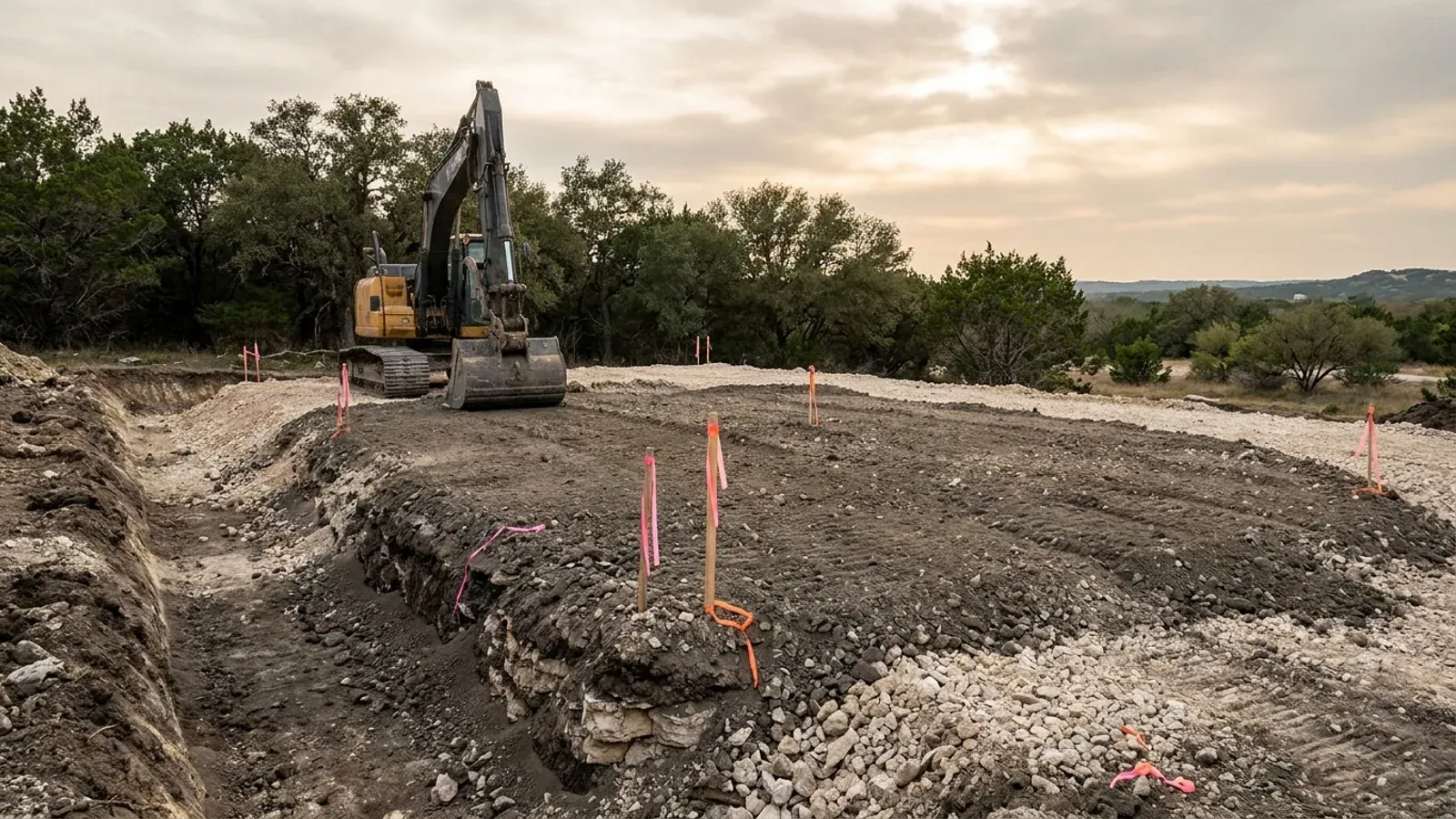
What moves a Texas budget is usually below grade, and it is soil rather than rock: shrink-swell clay. The Blackland Prairie and the Gulf Coast clays move enough between a wet season and a dry one to drive the foundation design across the state's largest markets, which is why several DFW cities require an engineer's seal on the foundation of every new house. Those are the same conditions that decide whether a septic field passes its soil and site evaluation, so the grading plan, the foundation and the drainfield get resolved together rather than one at a time. We price the dirt before we price the building.
What we build in Gregg County
All nine of our services — kits, custom plans, post-frame and steel construction, site preparation, permitting and engineering, through to turnkey builds — are available across Gregg County. What a project costs depends far more on the parcel than on square footage, so we work from your land rather than from a rate card.
See what we buildWhat a build looks like
Three stages every Gregg County project passes through, from a raw parcel to a finished home. Site work first, because that is where the budget is decided.
The parcel
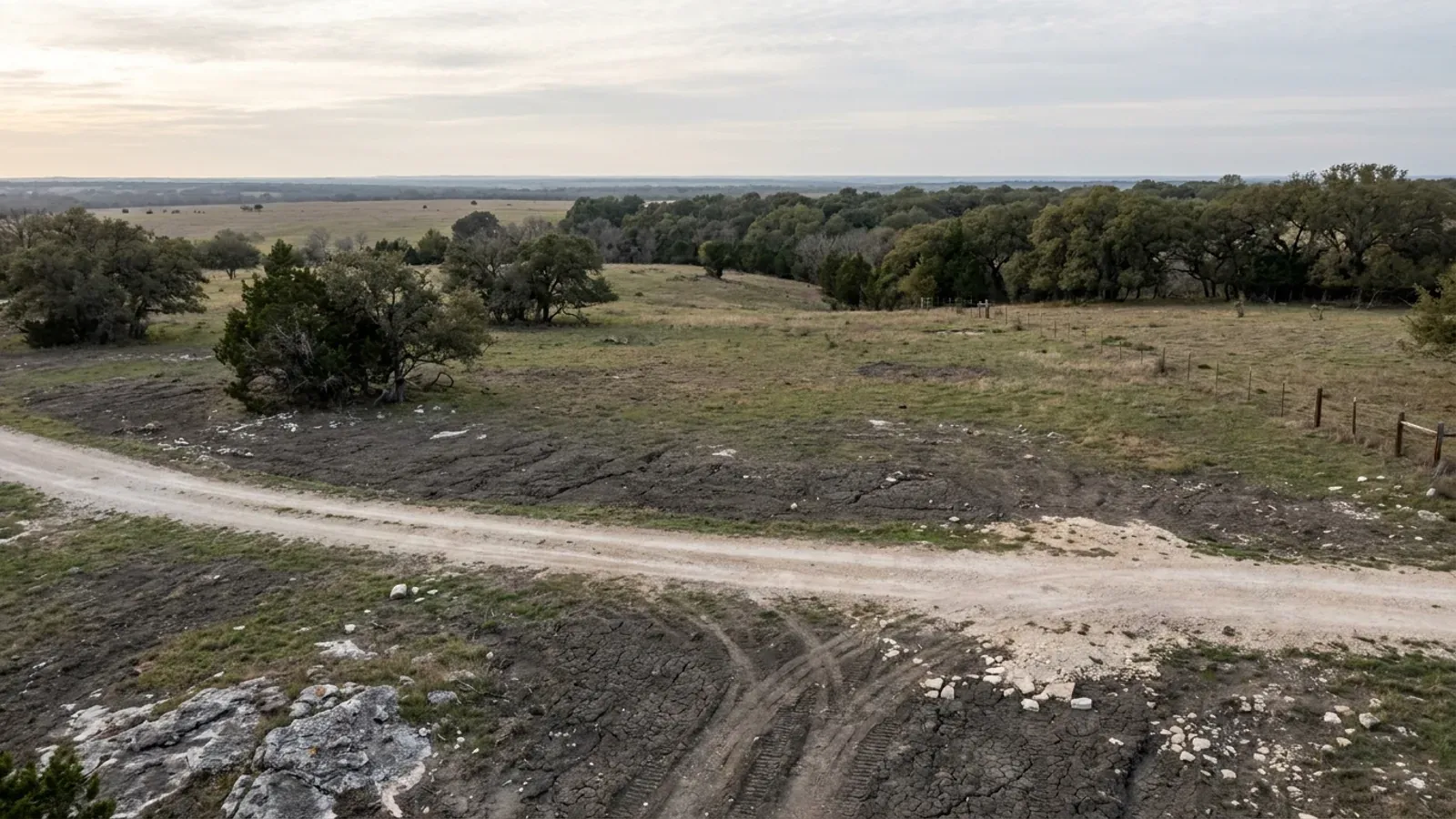
Zoning, setbacks, flood zone and utility access get checked before anything is drawn.
Pad and permit
Clearing, grading and a compacted pad, while the submittal works through Gregg County.
Frame to finish
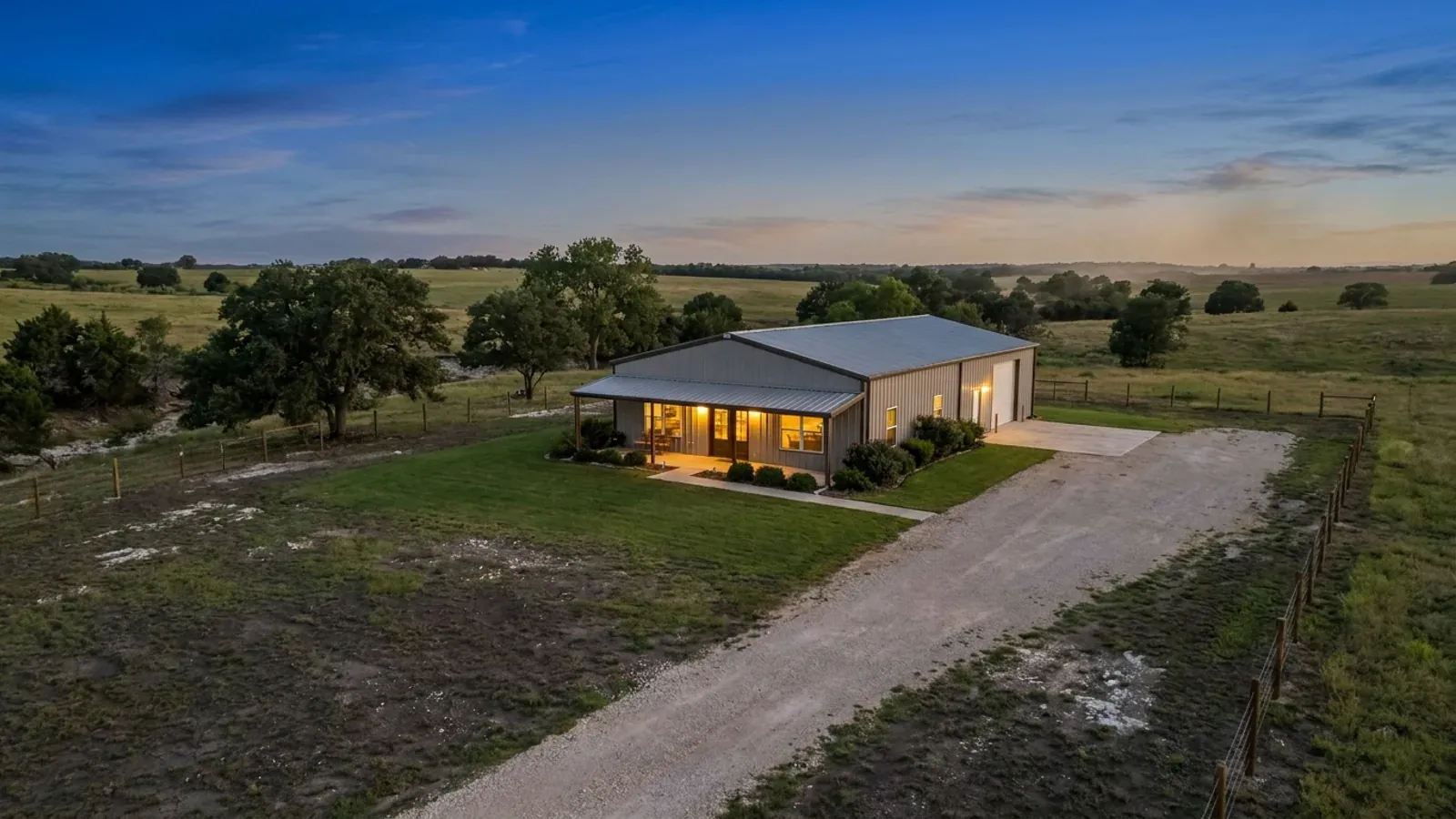
Shell erected and dried in, then systems, insulation and interior finish through to CO.
Those are the rules for Gregg County. Tell us what you want to build and we will draw it to them.
Where we build around Gregg County
Gregg County and the rural land around it. The buildable acreage for a project this size usually sits outside the city limits, which is frequently what changes who issues your permit.
Keep reading
The questions that usually come next once you know what Gregg County allows.
Barndominium Cost Guide
Sourced per-square-foot ranges by tier and by size, with a calculator built on the same figures.
Read itIs It Legal in Texas?
Classification, zoning, the HOA gate, and why "nonresidential farm building" does not cover a home.
Read itHow Long Does It Take?
Census build-duration data, and what actually sets the permit clock where you are building.
Read itNearby areas we build in
Others we cover in this part of Texas. The permitting authority, the adopted design criteria and the zoning can all differ from one to the next.
Building in Gregg County: common questions
10 questions we get asked most often about building in Gregg County. If yours is not on the list, ask it directly.
Do I need a building permit for a barndominium on unincorporated land in Gregg County?
Everyone says the minerals matter in East Texas. How much?
What do I actually do first, in what order?
Is the soil in Gregg County good to build on?
Does my shop bay make the septic system bigger?
Is there a percolation test?
I want to rent it out, or use it as a guest house. Does anything change?
Do I have to plat, and does anything block the septic permit?
Is Gregg County in the coastal windstorm regime?
Everyone says rural Texas has no rules. Is that right?
Building in Gregg County?
Start with the plan. Tell us what you want to build and we will draw it, then confirm what Gregg County will actually let you put on the parcel and what wind load it has to meet. That conversation costs nothing.