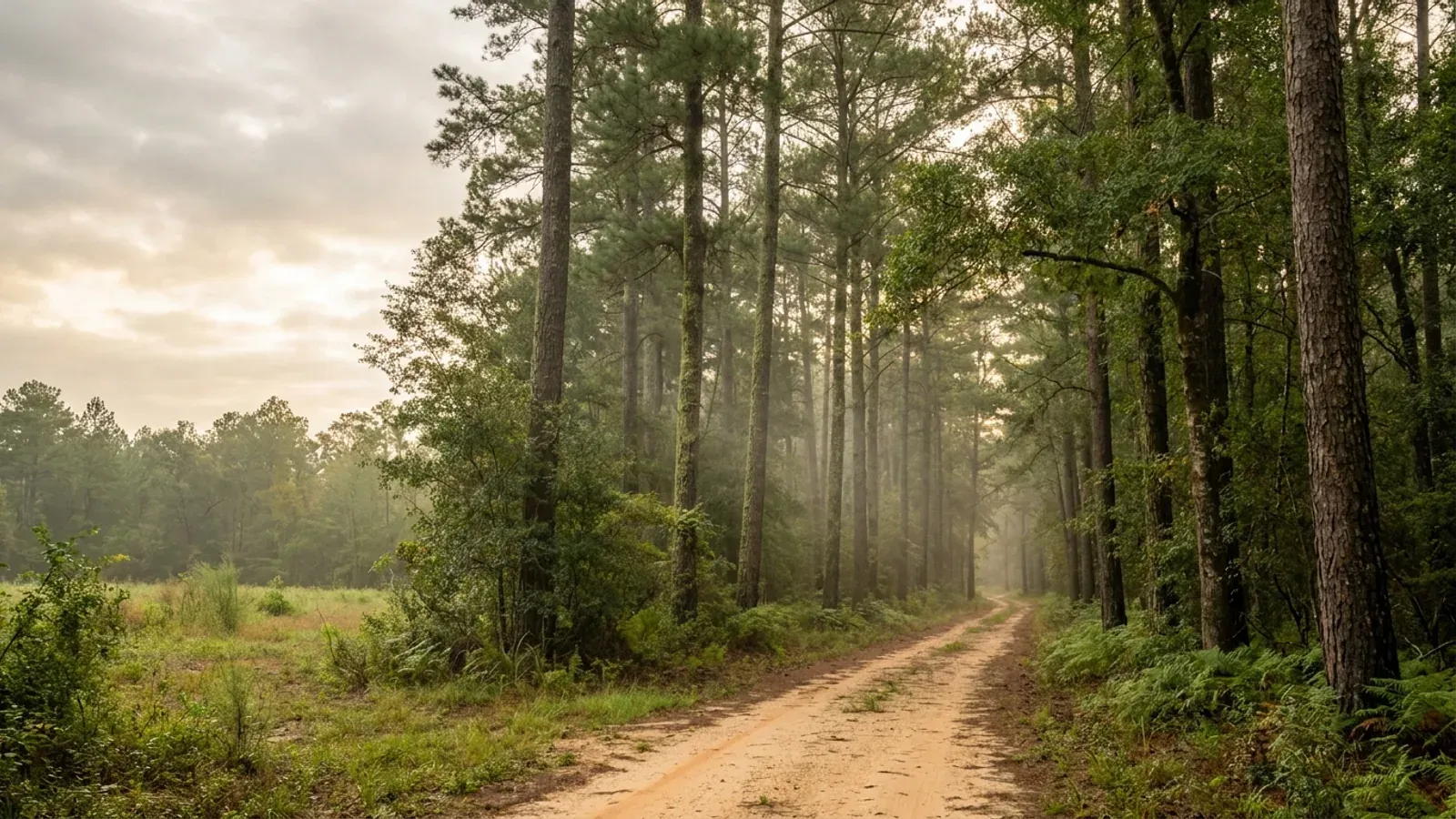
Tall pines in the East Texas Piney Woods with a sandy track cutting through green understorey.
Smith County 2021 IRC as adopted here

Barndominium Builders in Tyler, TX

Tyler is the centre of the Piney Woods and one of the few East Texas cities still adding people — 113,723 at the Census Bureau's 2025 estimate, up 7.1 percent since 2020, across 57.79 square miles. There is real ground here: the Residential Estate district takes a minimum one-acre lot inside the limits, and the Agricultural district takes an acre as well. But settle one thing before you draw anything. Tyler's Unified Development Code caps an accessory building at 50 percent of the square footage of the principal structure and at 16 feet in height, with no exception for large lots and none for the Agricultural district. Sixteen feet is short of what a shop bay with a tall overhead door wants, so inside the city limits the workshop generally belongs under the same roof as the living space, where the district's 42-foot height limit applies instead. Outside the limits the answer changes twice.

Tyler at a glance

County
Smith County
Population
113,723
Where we build
Tyler, Smith County, Gregg County, Van Zandt County, Henderson County

ZIPs 75701, 75702, 75703, 75704, 75707

Site visits
We meet you on the parcel, anywhere in Tyler or Smith County

Building conditions in Tyler

What actually changes from one Texas jurisdiction to the next: who issues the permit, whether the residential code is enforced there at all, what the structure has to be engineered to, and what the ground is like. These are the numbers your drawings have to satisfy.

Build conditions for Tyler , Smith County, Texas . BUILD CONDITIONS TYLER, TXSmith County2021 IRCADOPTED RESIDENTIAL CODE2021 IRCThis jurisdiction publishes no design wind speed. It is settled in writing with the authority overyour parcel before the frame is ordered.ZONING · RE RESIDENTIAL ESTATE, AND AG AGRICU…RE: 43,560 sq ft (one acre), 50 ft m…RE and AG are the only two Tyler districts measured in acres.Everything else drops fast — R-1A at 9,000 sq ft, R-2 at 7,500, R-1…PERMIT REVIEW CLOCK5 business daysPublished review target of the issuing authorityWATER METER AND TAP, AND SEWER TAP — TYLER LE…$2,107 for a 5/8-inch meter and wate…Published by Tyler Water Utilities on its New Construction page, bymeter size: a 1-inch meter and tap is $2,168 and $4,244.50 with…WHO ISSUES THE PERMITCity of Tyler Building Services, Dev…Tyler Development Center, 423 W. Ferguson St., Tyler, TX 75702.Building Services (903) 531-1151, fax (903) 531-1155; Planning (903…
Build conditions for Tyler, drawn from the sourced facts on this page. Every figure above is cited in the quick-facts panel below, with its source and vintage.
Adopted residential code
2021 International Residential Code, adopted at Sec. 6-150 by Ord. No. O-2023-104 on 25 October 2023 and required on all building plans from 1 January 2024, together with the 2021 IECC and the 2023 National Electrical Code

City of Tyler, Current Code References; Tyler Code of Ordinances Ch. 6, Art. IX, Sec. 6-150

The detached shop question
Unified Development Code Sec. 10-79 caps an accessory building at 50 percent of the square footage of the principal structure and at 16 feet in height, with no exception for acreage and none for the Agricultural district

Tyler Unified Development Code, Art. III, Div. D, Sec. 10-79 (printed 30 September 2024, last amendment 11 September 2024)

What the ground does under a Tyler slab
Cuthbert fine sandy loam is the county's single largest soil at 80,458 acres, and USDA soil survey data give it 8.5 percent clay and a plasticity index of 3.5 in the top 23 centimetres, then 47.5 percent clay and a plasticity index of 29.5 immediately below. Kirvin does the same thing at 28 centimetres. The sand at the surface is not what the footing lands in

USDA-NRCS Soil Data Access (SSURGO), survey area TX423, map units 575791 and 575806, queried 1 September 2026

Permit review clock
Prescreening takes up to two business days once documents are submitted correctly, then about five business days for a house and about ten for a commercial building. If staff request corrections the review time restarts. Permits are valid six months from issue

City of Tyler, Development & Planning FAQs

Building permit fee and how the building is measured
$0.35 per square foot of building area for all new residential construction, plus a plan check fee of 20 percent of the total permit fee, with a $50 minimum. The residential checklist asks for total under-roof square footage on the floor plan — for a new house, for an addition and for an accessory structure alike

City of Tyler, Schedule of Fees; City of Tyler Building Services, Residential Checklist

The one thing Tyler cannot weaken
Texas lets a municipality amend its adopted code freely, including by removing requirements, and Tyler has removed two. The energy chapter is the exception: Smith County is a named affected county at Health and Safety Code Sec. 386.001(2)(T), and Sec. 388.003(e) provides that local amendments may not result in less stringent energy efficiency requirements in affected counties than the IRC energy chapter or the IECC

Texas Health and Safety Code Secs. 386.001(2), 388.002(1) and 388.003(e); Texas Local Government Code Sec. 214.212(c)(1)

Also worth knowing before you build in Tyler

Residential fire sprinklers
Tyler's residential-code amendments in Sec. 6-151 say nothing about sprinklers at all — the section is neither deleted nor rewritten, which is unusual among Texas cities. Occupations Code Sec. 1301.551(i) provides that after 1 January 2009 a municipality may not enact an ordinance, bylaw, order, building code or rule requiring the installation of a fire sprinkler protection system in a new or existing one- or two-family dwelling, while allowing a city to let a contractor offer one for a fee

Tyler Code of Ordinances Ch. 6, Art. IX, Sec. 6-151; Texas Occupations Code Sec. 1301.551(i)

Piers, fill and the pre-pour inspection
The city's published code-adoption handout states that piers in a slab will not be accepted without engineer design, and that the alternative is either a compaction test on every lift of fill or footings extended 12 inches into undisturbed soil, citing IRC 403.1.4. The pre-pour slab inspection happens after rebar is set and termite treatment is done, with string lines up or a form-board survey completed

City of Tyler, Code Adoption Changes — 2021 International Residential Code

Septic is a county permit even inside the city
TCEQ's authorized agent search returns four records for Smith County. The Smith County authorized agent serves the unincorporated county plus the cities of Hideaway and Tyler; the City of Noonday is its own agent inside its limits; and the Upper Neches River Municipal Water Authority is the agent for the Lake Palestine water quality zone, within 525 feet of the 355 msl take line

TCEQ On-Site Activity Reporting System, authorized agent search, Smith County, run 1 September 2026

No masonry or exterior-material rule
Tyler's Unified Development Code sets no exterior building-material or masonry-percentage standard for a single-family dwelling. The only masonry requirements in the code are for fences, screening walls and dumpster enclosures, and the only facade provisions govern signs

Tyler Unified Development Code, full-text search of the September 2024 printing

Acreage in the ETJ may not need a city plat
UDC Sec. 10-101(b)(1) exempts the division of land into parts greater than five acres from city subdivision approval, where each part has access and no public improvement is to be dedicated — but the city will not extend utilities or issue a building permit for property that has not received final plat approval where approval is required

Tyler Unified Development Code, Art. IV, Sec. 10-101

Tyler is not on the coast
Smith County does not appear on the Texas Department of Insurance list of designated catastrophe area counties, which names Aransas, Brazoria, Calhoun, Cameron, Chambers, Galveston, Jefferson, Kenedy, Kleberg, Matagorda, Nueces, Refugio, San Patricio and Willacy, plus part of Harris County. TDI states the areas have not changed with the adoption of the 2024 building codes

Texas Department of Insurance, Designated Catastrophe Areas and legacy county maps pages

How much city is in the city
57.79 square miles of land and 113,723 people at the 2025 estimate, about 1,970 to the square mile — roughly a third of Plano's density, and up 7.1 percent from the 106,182 counted in 2020

U.S. Census Bureau, Vintage 2025 subcounty population estimates and 2024 Gazetteer place file, GEOID 4874144
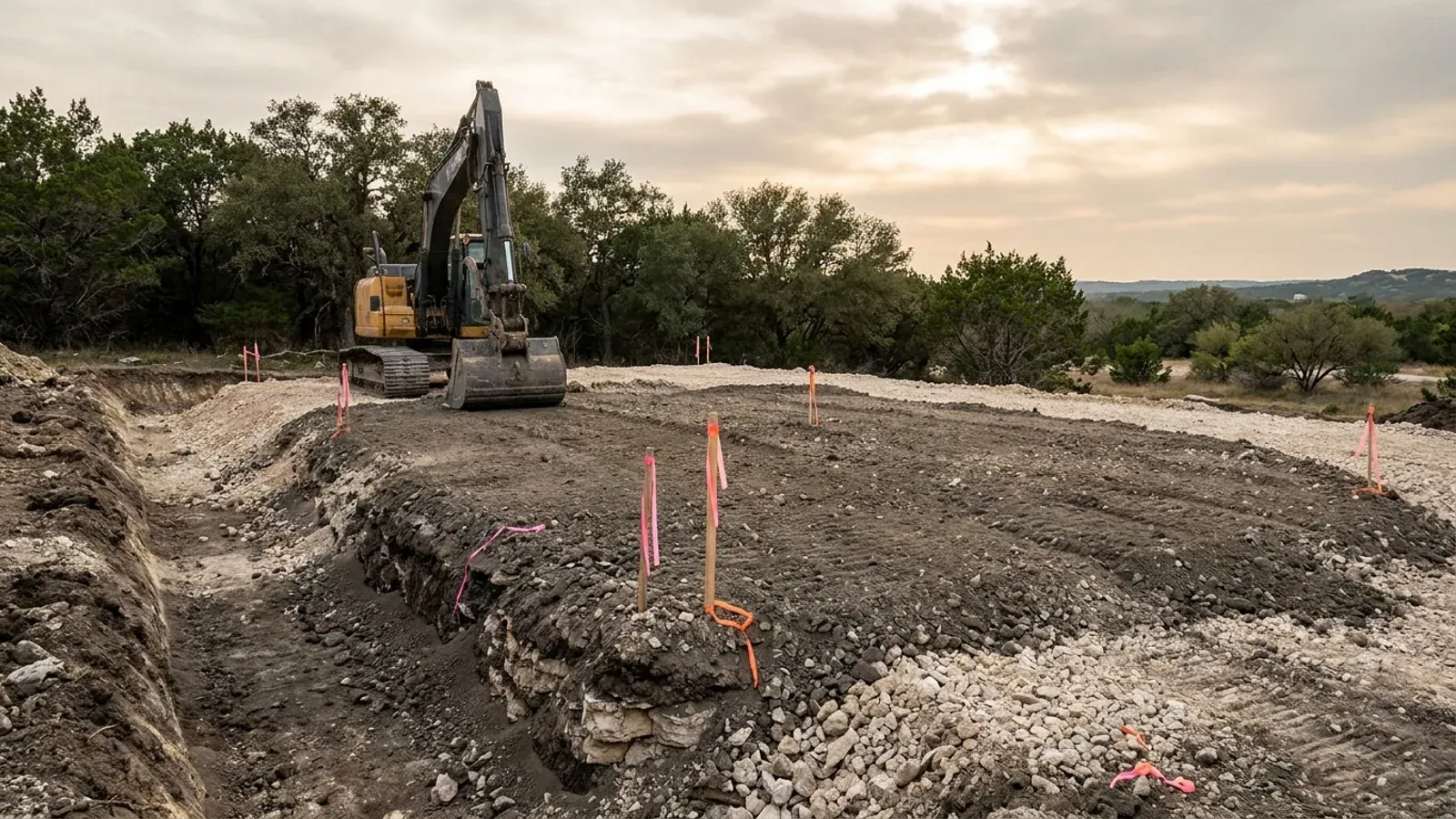
An excavator grading a compacted building pad on a cleared lot, with survey stakes and a drainage swale visible.
Below the slab

The expensive surprises are in the ground, not the building

What moves a Texas budget is usually below grade, and it is soil rather than rock: shrink-swell clay. The Blackland Prairie and the Gulf Coast clays move enough between a wet season and a dry one to drive the foundation design across the state's largest markets, which is why several DFW cities require an engineer's seal on the foundation of every new house. Those are the same conditions that decide whether a septic field passes its soil and site evaluation, so the grading plan, the foundation and the drainfield get resolved together rather than one at a time. We price the dirt before we price the building.

What we build in Tyler

All nine of our services — kits, custom plans, post-frame and steel construction, site preparation, permitting and engineering, through to turnkey builds — are available across Smith County. What a project costs depends far more on the parcel than on square footage, so we work from your land rather than from a rate card.

See what we build

What a build looks like

Three stages every Tyler project passes through, from a raw parcel to a finished home. Site work first, because that is where the budget is decided.
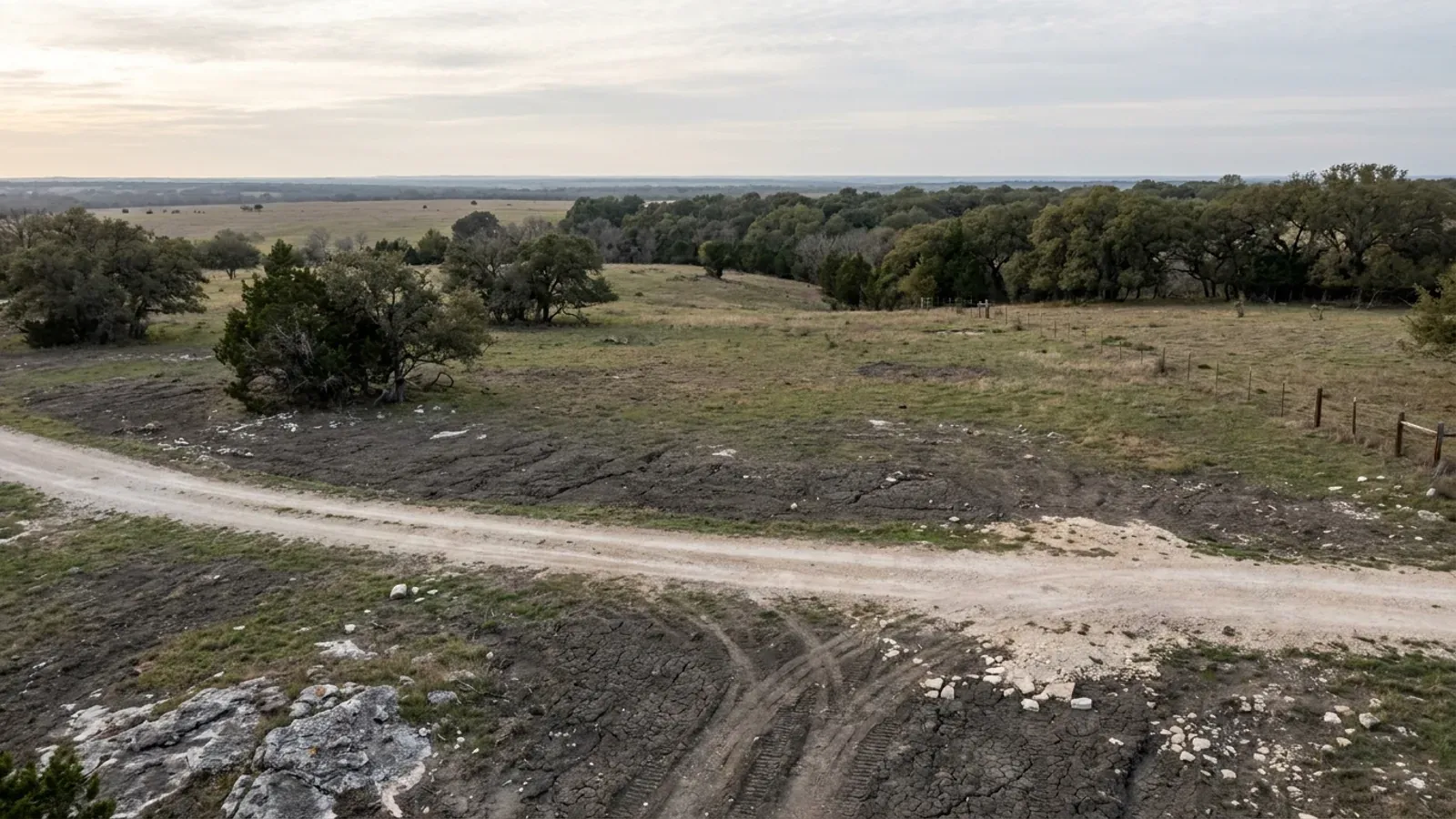
Aerial view of an undeveloped rural lot with cleared grass, a live oak and cedar elm treeline, and a pale gravel access track.
Stage one

The parcel

Zoning, setbacks, flood zone and utility access get checked before anything is drawn.

An excavator grading a compacted building pad on a cleared lot, with survey stakes and a drainage swale visible.
Stage two

Pad and permit

Clearing, grading and a compacted pad, while the submittal works through Smith County.
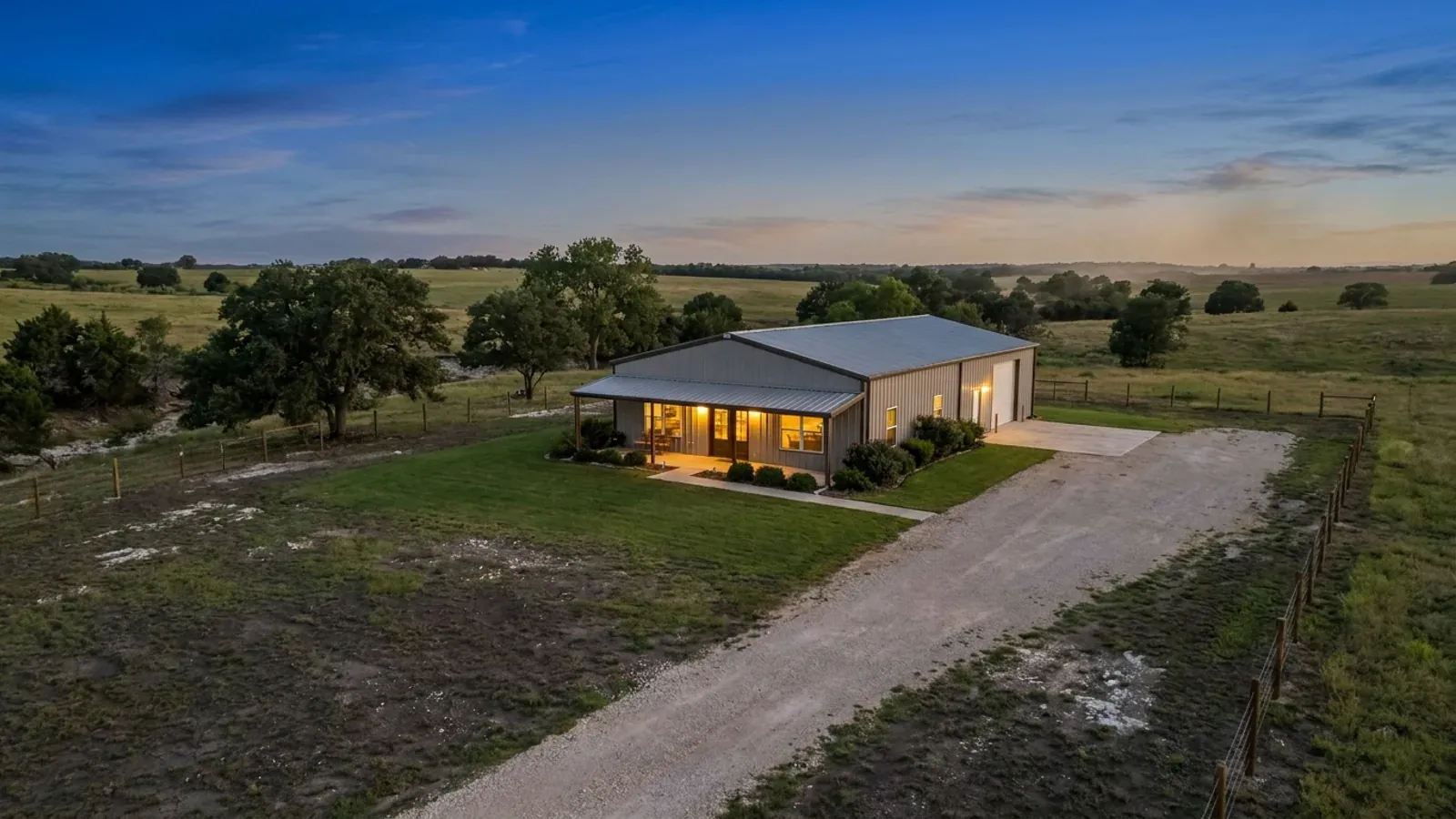
A finished barndominium at dusk with warm interior lighting glowing through its large windows.
Stage three

Frame to finish

Shell erected and dried in, then systems, insulation and interior finish through to CO.

Those are the rules for Smith County. Tell us what you want to build and we will draw it to them.

Where we build around Tyler

Smith County and the rural land around it. The buildable acreage for a project this size usually sits outside the city limits, which is frequently what changes who issues your permit.

Our Tyler service area, covering Smith County and the surrounding rural acreage. This map marks the territory we serve, not a branch location.

Nearby areas we build in

Others we cover in this part of Texas. The permitting authority, the adopted design criteria and the zoning can all differ from one to the next.

Building in Tyler: common questions

8 questions we get asked most often about building in Tyler. If yours is not on the list, ask it directly.

Can I put a big detached shop beside the house inside Tyler city limits?
Not a big one. Unified Development Code Sec. 10-79 caps an accessory building at 50 percent of the square footage of the principal structure and at 16 feet in height, and it adds that an accessory building may not occupy more than 30 percent of the required rear yard. There is no exception for a large lot and none for the Agricultural district. Sixteen feet is below what a shop bay with a tall overhead door usually needs, so on a Tyler city lot the workshop is normally designed as part of the house rather than as a separate building — under one roof the district height limit applies instead, which is 42 feet in RE, AG and every single-family district. Sec. 10-79(a)(3) is worth reading alongside it: an accessory building placed closer than 10 feet to the principal building is treated as part of the principal building for setback purposes.
Which Tyler zoning districts still take an acre?
Two. RE, Residential Estate, has a 43,560 square foot minimum lot — the code describes it as intended for detached single-family housing on minimum one acre lots — with 50 foot front and rear setbacks, 12.5 foot interior sides, 30 percent maximum lot coverage and a 42 foot height limit. AG, Agricultural, also takes one acre, allows 42 feet and 2.5 storeys, and sets a 25 foot front yard for a residential use and 100 feet for livestock. The nonresidential use table permits a single-family detached dwelling in AG. Every other residential district is measured in square feet and drops quickly: R-1A at 9,000, R-2 at 7,500, R-1B and R-1C at 6,000.
What code does Tyler build to, and has the city changed it?
The 2021 International Residential Code, adopted at Sec. 6-150 of the Code of Ordinances by Ord. No. O-2023-104 on 25 October 2023 and required on all building plans from 1 January 2024, alongside the 2021 IBC, IECC, IMC, IPC, IFGC, IFC and Existing Building Code and the 2023 National Electrical Code. Yes, the city has changed it. Sec. 6-151 deletes IRC Section 320 in its entirety and deletes Figure R403.3(1); it rewrites R112 into a locally constituted Construction Board of Adjustment and Appeals; it requires a 6-mil ASTM E1745 Class A vapor retarder under the slab; it caps an attic appliance passageway at 20 feet and requires a 250-pound-rated pull-down stair to an HVAC unit; and a May 2025 ordinance pulls seven mechanical provisions forward out of the 2024 IRC into the adopted 2021 book. Ask Building Services for the current amendment list before you finalise drawings.
Does Tyler make me sprinkler a new house?
Tyler's own residential-code amendments do not address sprinklers at all — Sec. 6-151 neither deletes nor rewrites the model code's residential sprinkler section, which in the 2021 edition Tyler adopted is R313.2. The state statute is what answers the question: Occupations Code Sec. 1301.551(i) provides that after 1 January 2009 a municipality may not enact an ordinance, bylaw, order, building code or rule requiring the installation of a multipurpose residential fire protection sprinkler system or any other fire sprinkler protection system in a new or existing one- or two-family dwelling. The same subsection lets a city allow a contractor to offer the installation for a fee. Because Tyler wrote nothing local either way, confirm how Building Services applies it to your plan set.
What will the city charge, and how long does review take?
The residential building permit is $0.35 per square foot of building area for all new construction, plus a plan check fee of 20 percent of the total permit fee, with a $50 minimum. The residential checklist asks for total under-roof square footage on the floor plan, and it asks for it the same way for a new house, an addition and an accessory structure — so a shop bay is measured, not waived. Trades are permitted separately. Review runs up to two business days of prescreening once the documents are submitted correctly, then about five business days for a house; if staff request corrections the clock restarts. A permit is good for six months and can be extended while work and inspections are active. A zoning change, if you need one, takes 45 to 60 days.
What is the ground like, and will the slab need an engineer?
East Texas soil misleads at the surface. Cuthbert fine sandy loam is the largest single soil in Smith County at 80,458 acres, and USDA soil survey data put it at 8.5 percent clay with a plasticity index of 3.5 for the first 23 centimetres — then 47.5 percent clay with a plasticity index of 29.5 in the horizon directly beneath. Kirvin makes the same jump at 28 centimetres. Whether that reaches the code's expansive-soil trigger is a question for the soil report on your parcel, not for a map, and Tyler's amendments leave IRC R403.1.8 untouched. What the city does publish is firm: its code-adoption handout says piers in a slab will not be accepted without engineer design, and that the alternative is a compaction test on every lift of fill or footings taken 12 inches into undisturbed soil.
What changes if my land is outside the city limits?
Quite a lot. The Unified Development Code divides the city and its extraterritorial jurisdiction into four zones. Zone 1 is inside the limits and everything applies. In Zone 2, the suburban ring, the subdivision and street standards apply but the city's building code and zoning do not follow you. Zone 3 is the rural strip created by highway right-of-way annexations north of town, where plats are governed by Smith County regulations under an interlocal agreement. Zone 4 is city-owned land around Lake Tyler under a separate chapter. Sec. 10-101(b)(1) also exempts divisions into parts greater than five acres from city subdivision approval where each part has access and no public improvement is dedicated. One thing does not change at the city line: on-site sewage. TCEQ lists the Smith County authorized agent as serving the unincorporated county plus the cities of Hideaway and Tyler, so the septic permit is a county permit either way — and inside the Lake Palestine water quality zone, within 525 feet of the 355 msl take line, it is the Upper Neches River Municipal Water Authority instead.
Does the Gulf Coast windstorm regime apply in Tyler?
No. Smith County is not one of the fourteen counties on the Texas Department of Insurance list of designated catastrophe area counties, and it is not the part of Harris County that is included. So none of the coastal machinery reaches Tyler: no TDI windstorm inspection, no WPI certificate chain, and none of the state rule that puts the 2024 IRC on coastal construction regardless of what a city adopted. In Tyler the city's own adopted edition is the whole answer, which is why the 2021 IRC and the local amendments in Chapter 6 matter as much as they do.

Building in Tyler?

Start with the plan. Tell us what you want to build and we will draw it, then confirm what Smith County will actually let you put on the parcel and what wind load it has to meet. That conversation costs nothing.