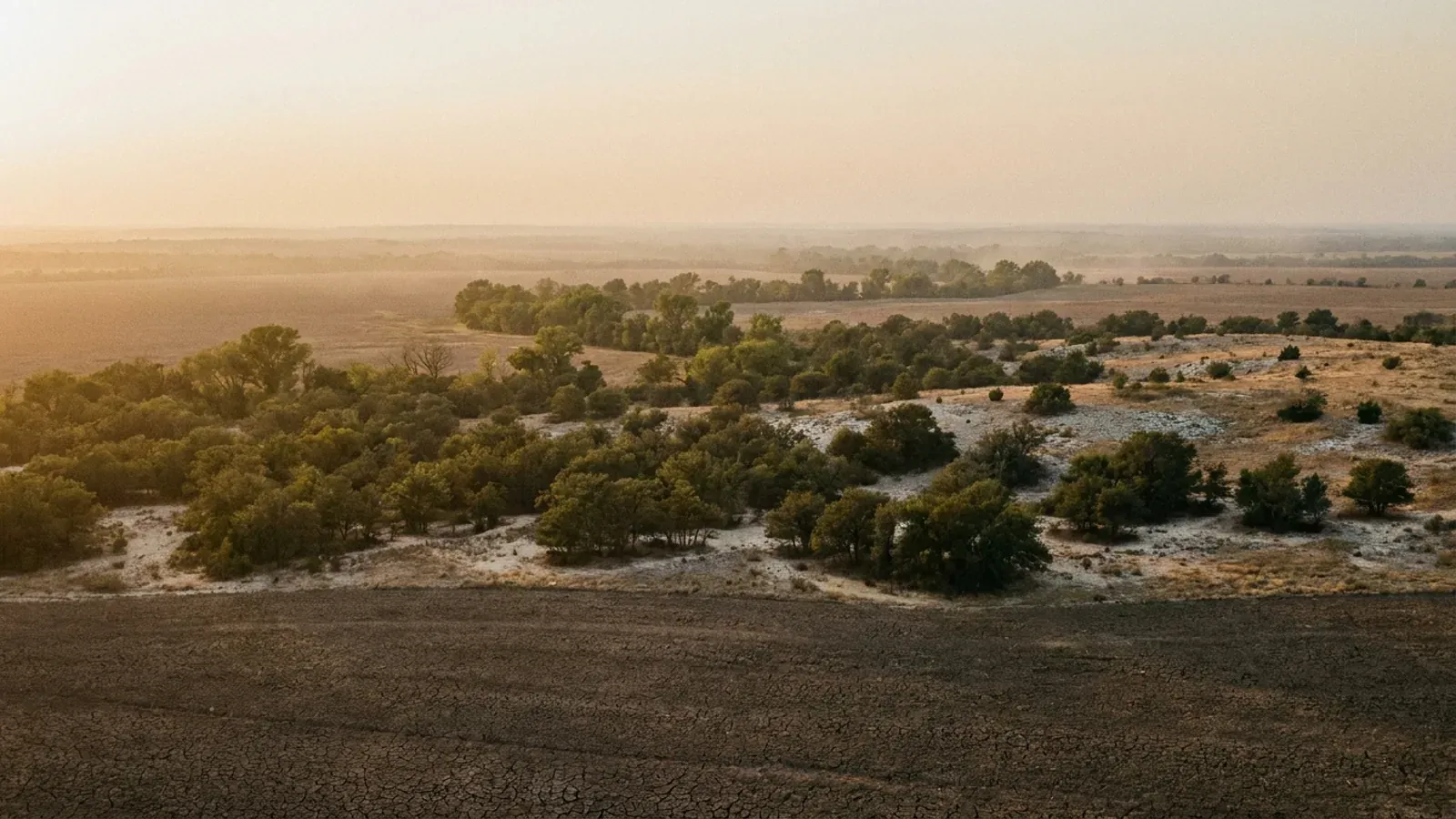
Open rolling Blackland Prairie cropland grading into a post oak belt of the Eastern Cross Timbers, with a pecan-lined creek.
Travis County Builder's election: the IRC published as of 1 May 2008, or the version applicable inside the corporate limits of the City of Austin as adopted here

Barndominium Builders in Travis County, TX

Travis County is not one place to build in, and the line runs down Interstate 35. West of it the ground is Edwards Plateau limestone, thin soil over rock and karst, sitting on the Edwards and Trinity aquifers. East of it the ground is Blackland Prairie clay, where the shrink-swell that puts a licensed engineer on a slab actually applies. The county wrote that split into its own rules: septic evaluation pits dug to a restrictive horizon, a foot of soil demanded above solid or fractured rock, drainfield cover required on grades over ten percent, and a federal endangered-species map that stops at I-35. There is a great deal of land here. Two hundred and ninety-one thousand people live outside every city limit in Travis County, spread across at least four hundred and fifty square miles, and that population grew by twenty percent in five years while the county as a whole grew by seven. Travis is one of the few Texas counties that opted into Subchapter F, and it is one of the very few that also requires a permit before any construction at all.

Travis County at a glance

County
Travis County
Population
1,389,670
Where we build
Austin, Williamson County, Hays County, Burnet County

ZIPs 78653, 78641, 78669, 78617, 78660, 78738, 78645, 78621 and more

Site visits
Site visits across Travis County, from Austin to the far side of the county

Building conditions in Travis County

What actually changes from one Texas jurisdiction to the next: who issues the permit, whether the residential code is enforced there at all, what the structure has to be engineered to, and what the ground is like. These are the numbers your drawings have to satisfy.

Build conditions for Travis County , Texas : design wind speed 105 mph where the builder elects Austin's version; Travis County publishes none. BUILD CONDITIONS TRAVIS COUNTY, TXTravis CountyBUILDER'S ELECTIONDESIGN WIND SPEED105 mph where the b…Travis County adopted no amendments and no design criteria table of its own with Chapter 480, soon the 1 May 2008 limb of the election there is no locally published design wind speed. On the…ZONING · NONE — A TEXAS COUNTY CANNOT ZONE, A…One acre for any residential structu…Local Government Code section 233.153(d)(2) does not authorise anopted-in commissioners court to adopt or enforce zoning, and Travis…IMPACT AND PERMIT FEESPublished fees on a rural Travis Cou…Travis County charges nothing for a building permit under Chapter480 because that chapter issues none. What is published: the…WHO ISSUES THE PERMITTravis County Transportation and Nat…700 Lavaca Street, Suite 540, Austin, TX 78701; mailing address P.O.Box 1748, Attn: Permits, Austin, TX 78701. Phone (512) 854-4215.…
Build conditions for Travis County, drawn from the sourced facts on this page. Every figure above is cited in the quick-facts panel below, with its source and vintage.
Travis County opted in — and the code is a choice, not a single rule
Travis County is one of the few Texas counties to have adopted a residential building code for its unincorporated area. Chapter 480 of the Travis County Code was adopted on 1 September 2009 and renumbered with effect from 1 June 2018. Section 480.004(a) reads that new residential construction of a single-family house or duplex "shall conform to the version of the International Residential Code published as of May 1, 2008, or the version of the International Residential Code that is applicable inside the corporate limits of the City of Austin." That is a genuine election between a 2006-vintage code and Austin's current 2024 edition, and section 480.007 makes the builder declare which one before work starts. The county asks for that statement on the permit application itself. What the opt-in does not create is a county building department: no permit under Chapter 480, no fee, no county inspector.

Travis County Code Title 2, Subtitle 19, Chapter 480, sections 480.003 to 480.009, with the adoption credit line for Order 2009-09-01 Item 4 and Order 2018-05-15 Item 7 — online.encodeplus.com/regs/traviscounty-tx; Travis County TNR, "Single-Family Home / Manufactured Home Permit"

A permit is required before any construction — and it is not the septic permit
Section 464.061(a) of the Travis County Code is unusually broad: "A development permit or Special Flood Hazard Area Development Permit is required before any construction or other development begins within the unincorporated areas of Travis County," including "the initial disturbance of soils associated with clearing, grading, drilling, or excavation activities," new construction, utilities and the subdivision of land. Section 464.061(c) adds that a development permit is required "in addition to any other permit that may be required." The county puts it plainly on its own Development Services page: "Any development in Travis County requires a permit." That permit is a floodplain, drainage and water-quality review under Chapters 464 and 482. It is not a building-code plan review, and no county inspector examines the framing.

Travis County Code sections 464.061(a) and (c); Travis County TNR Development Services — traviscountytx.gov/tnr/development-services

Your septic authority may not be the county — it depends which side of the lake you are on
The TCEQ's authorised agent register returns eight records for Travis County. The Travis County authorised agent covers the unincorporated county plus Leander, Manor, San Leanna and Webberville. But in the "Restricted & Water Quality Zones of Lakes Buchanan, Inks, Lyndon B. Johnson, Marble Falls, and Travis" the authorised agent is the Lower Colorado River Authority, which enforces its own Highland Lakes Watershed Ordinance. Austin, Bee Cave, West Lake Hills, Rollingwood and Mustang Ridge each run their own programme inside their city limits. The TCEQ prints the tie-breaker on the results page: "Do you live in a subdivision that contains property within 2000' of a lake or river? Find the name of the lake under the area served column. If the lake is not listed, contact the county."

TCEQ OSSF Authorized Agent search (OARS), county code 227, run 1 September 2026 — tceq.texas.gov/permitting/ossf/aa_search.html; Travis County Code sections 448.002 and 448.005

One acre minimum on any water source, one acre per residential unit, and no ten-acre escape
Travis County adopted septic rules stricter than the state's and says so at section 448.009. Section 448.032(b) sets "the minimum lot size for a residential structure served by an OSSF, regardless of whether the lot or tract is served by a public water supply," at one acre, where the state allows half an acre on a public supply. Section 448.032(c)(1) says "Each residential unit served by an OSSF is considered a separate structure" and requires "at least one acre of land for each residential unit," which is the answer to a barndominium with separate guest quarters. Section 448.033(a) is headed "No Exemptions" and reads: "All OSSFs in the jurisdictional area of Travis County are subject to the provisions of this chapter regardless of the size of the lot on which the OSSF is located." And section 448.037(a) caps total daily effluent at 60 gallons per tenth of an acre.

Travis County Code Chapter 448, Rules of Travis County, Texas for On-Site Sewage Facilities, sections 448.009, 448.032(b), 448.032(c)(1), 448.033(a) and 448.037(a); 30 TAC section 285.4(a)(1)

Over the Edwards Aquifer, the acreage test and the impervious-cover test decide it
Construction on the Edwards Aquifer recharge or contributing zone is regulated by the TCEQ under 30 TAC Chapter 213, and a Water Pollution Abatement Plan must be approved before construction starts. But the TCEQ publishes two thresholds for a private residence. No individual plan may be required where "the construction of your residence is on a lot that is larger than five acres, with no more than one single-family residence located on that lot," or where the construction "does not exceed 20% impervious cover (IC) within the property's legal boundaries," and the TCEQ specifies that impervious cover "includes rooftops, driveways, concrete pads, sheds, sidewalks." A shop bay, an apron and a drive are precisely those. Rainwater harvesting from the roof can be used to bring an adjusted figure down to 20 percent. Both tests are arithmetic against the legal boundary, which means the same acreage that satisfies the septic minimum often settles the aquifer question too.

TCEQ, "Edwards Aquifer: Private Residences" (last modified 17 February 2026) — tceq.texas.gov/permitting/eapp/edwards-aquifer-private-residences; TCEQ, "Water Pollution Abatement Plan" — tceq.texas.gov/permitting/eapp/wpap.html; Travis County Code section 482.916(a)(2)

West of I-35 there is a federal permit on the land, on ground with no building code
Travis County's own words: the county "is home to 14 endangered species protected under the federal Endangered Species Act," and for seven of them — "the golden-cheeked warbler and six cave-dwelling (karst) invertebrates" — "the habitat for these species is found west of Interstate 35. Activities east of IH-35 will not impact these seven species." Removing that habitat "is illegal without the proper permits regardless of the time of year." A landowner may go to the U.S. Fish and Wildlife Service for a section 10(a)(1)(B) permit, or use the county-administered Balcones Canyonlands Conservation Plan, which has no application fee, gives a habitat determination typically within three weeks, and charges a mitigation fee by the acre of habitat impacted. Three listed salamander species in western Travis County are outside the plan and go to the Service directly.

Travis County TNR, "Development in Endangered Species Habitat" — traviscountytx.gov/tnr/nr/dev-species; Travis County Code section 482.916(a)(3)

Also worth knowing before you build in Travis County

The county does enforce a fire code — on commercial buildings, not on your house
Travis County adopted a fire code under Subchapter C of chapter 233 of the Local Government Code, which is open only to large counties. Chapter 201 of the Travis County Code adopts the International Fire Code, 2015 Edition with Appendix Chapters B, C and D, and section 201.007 says no person may construct or substantially improve "any Building" in unincorporated Travis County without a Building Permit from the Fire Marshal's Office. But "Building" is defined narrowly, as "a Commercial Establishment, Public Building, or multifamily building consisting of more than three units," and "Commercial Establishment" expressly excludes "a multifamily residential dwelling consisting of less than four units" and "private garages, carports, sheds, or agricultural buildings." A single-family barndominium you live in is outside it. A building let out or run as a business is a question for the Fire Marshal, because the definition turns on whether "any phase of commercial or business activity occurs" there.

Travis County Code Chapter 201, Fire Code, sections 201.001, 201.002, 201.003, 201.007, 201.012 and 201.064

Building it to let costs you the exemption the county code gives an owner-builder
Section 480.009 makes it a Class C misdemeanour to fail to give the required notice, and then removes the penalty for one class of person: an individual is not liable if "the new residential construction is built by the individual or the individual acts as the individual's own contractor" and "the individual intends to use the residence as the individual's primary residence." Both limbs are required. Build it as a rental, a short-term let or income property and that defence is simply not available. There is a second consequence on the septic side: section 448.033(d)(5) lets the county revoke the License to Operate where "the property on which the OSSF is located is used for a purpose other than that described in the original application," and a groundwater district in southwestern Travis County lists "event/lodging venues" among the non-exempt uses that need a production permit for a well.

Travis County Code sections 480.009(c) and 448.033(d)(5); Southwestern Travis County Groundwater Conservation District, Well Registration — swtcgcd.com/well-registration

The floodplain rule here is measured off the 500-year flood, not the 100-year
Travis County replaced its floodplain chapter on 30 April 2019 to reflect NOAA Atlas 14 rainfall data. Section 464.031 defines the minimum flood protection elevation as "Two feet above the 0.2 percent annual chance floodplain if the property is located outside the Colorado River Corridor floodplain," two feet above the 1 percent floodplain inside that corridor, or two feet above the 1 percent floodplain as calculated using Atlas 14. Section 464.121 applies that to all new residential construction "within the 0.2 percent annual chance floodplain, within 100 feet of a zone A," and within zones A, A1-30, AE and AH. The county cites sections 16.3145 and 16.315 of the Texas Water Code as its authority. An attached garage below that elevation has its own rule.

Travis County Code Chapter 464, sections 464.001(b)(2), 464.031 and 464.121, as replaced by Order 2019-04-30 Item 30

A well here is registered, and often permitted, by a district — not simply drilled
Two groundwater conservation districts operate in Travis County and they are different bodies with different boundaries. The Barton Springs-Edwards Aquifer Conservation District, created in 1987, states that its "territory covers 430 square miles in parts of Travis, Hays, and Caldwell counties," managing both the Edwards and Trinity aquifers in its original territory from the Colorado River in Austin to northern Kyle. The Southwestern Travis County Groundwater Conservation District was created by House Bill 4345 effective 1 September 2017 and confirmed by voters in November 2019; its territory is "a portion of the southwest corner of Travis County," bounded by the Colorado River to the north, Blanco and Burnet counties to the west, Hays County to the southwest and the Barton Springs district to the southeast. Registration is required for all existing wells in that district, and a Well Drilling Authorization is required to drill a new one.

Barton Springs-Edwards Aquifer Conservation District, "About the District" — bseacd.org/about; Southwestern Travis County Groundwater Conservation District, "Background" and "Well Registration" — swtcgcd.com; Travis County Code section 482.103(c)

In Austin's ETJ, the city can make you plat but cannot enforce its building code
Title 30 of the Austin City Code is titled "Austin/Travis County Subdivision Regulations," and section 30-1-1 says it "applies to the subdivision of land in the portion of the City of Austin's extraterritorial jurisdiction that is within Travis County." Its own source line names a City/County subdivision agreement. Travis County states the statute at section 482.103: under section 242.001 a plat in the ETJ "must be approved by both the municipality and the County," and where their rules conflict "the more stringent provisions prevail." Building codes are a different answer. Texas courts have held that a city cannot enforce its building codes beyond its corporate limits — the Supreme Court in Town of Lakewood Village v. Bizios for general-law cities, and the Dallas Court of Appeals in Collin County v. City of McKinney for home-rule cities, which held that McKinney "lacks authority to enforce its building codes" in its ETJ "but it has authority to require a landowner to plat its property." Ask the city and read the title commitment.

Austin City Code Title 30, section 30-1-1; Travis County Code sections 482.103 and 464.241; Town of Lakewood Village v. Bizios, 493 S.W.3d 527 (Tex. 2016); Collin County v. City of McKinney, No. 05-17-00546-CV (Tex. App.—Dallas 10 May 2018)

291,385 people live outside every city limit here, and that number is growing fast
Travis County reached 1,389,670 people in 2025. Austin's Travis County portion accounts for 929,657 of them. The balance of the county — everyone outside every city limit — is 291,385, up from 242,646 in 2020. That is growth of 48,739 people, or 20.1 percent, in five years, against 7.2 percent for the county as a whole; the unincorporated area added more people over that period than the City of Austin did. Travis County has 994.3 square miles of land, and even counting the entire area of all 22 incorporated places holding territory in the county, at least 455 square miles of it lies outside any city. That is a ceiling of about 640 people per square mile out there, or roughly one person per acre, and the real figure is lower.

U.S. Census Bureau Vintage 2025 population estimates, co-est2025-alldata.csv and sub-est2025.csv; 2025 Census Gazetteer county and place files for land area

Get the platting answer in writing before anything else
Section 482.105 of the Travis County Code gives a landowner a route most people never find: where a division of land meets one of the statutory exceptions to platting, "at the request of the owner(s) of the land, the County Executive will issue a letter to the owner(s) acknowledging the exception in order to facilitate the issuance of permits and approvals by the County or other jurisdictions." The county may ask for documentation first. Section 482.106 is the warning attached to it: even where platting is not required, the land is still subject to county regulation under statutes other than chapter 232. The acreage thresholds differ depending on where you are — more than five acres escapes platting in a city's extraterritorial jurisdiction, but more than ten acres is needed to escape it in the county.

Travis County Code sections 482.105 and 482.106; Local Government Code sections 212.004(a) and 232.0015(f)

The septic evaluation is dug to rock, which is why the west side costs more
Travis County's septic rules read like a Hill Country geology report. Section 448.035 requires "that backhoe pits be excavated to a depth of two feet below the bottom of the proposed excavation or to a restrictive horizon, whichever is less," with profile holes and a soil analysis report on every application. Section 448.037(b)(4) requires "a minimum of one foot of soil between the drip emitter and solid or fractured rock." Section 448.037(h) requires erosion control matting or 80 percent vegetative cover on drainfields with finished grades over 10 percent, and the county's own application asks the site plan to mark "areas of slope greater than or equal to 15%." On the eastern side of the county the problem is the opposite one: that is Blackland Prairie clay, and shrink-swell soil is what removes the exemption that would otherwise let a slab be designed without a Texas-licensed engineer.

Travis County Code sections 448.035, 448.037(b)(4) and 448.037(h); Travis County TNR, "Residential OSSF (Septic System) Permit"; Occupations Code section 1001.056(c)(2); IRC R403.1.8 referring expansive-soil foundations to IBC section 1808.6
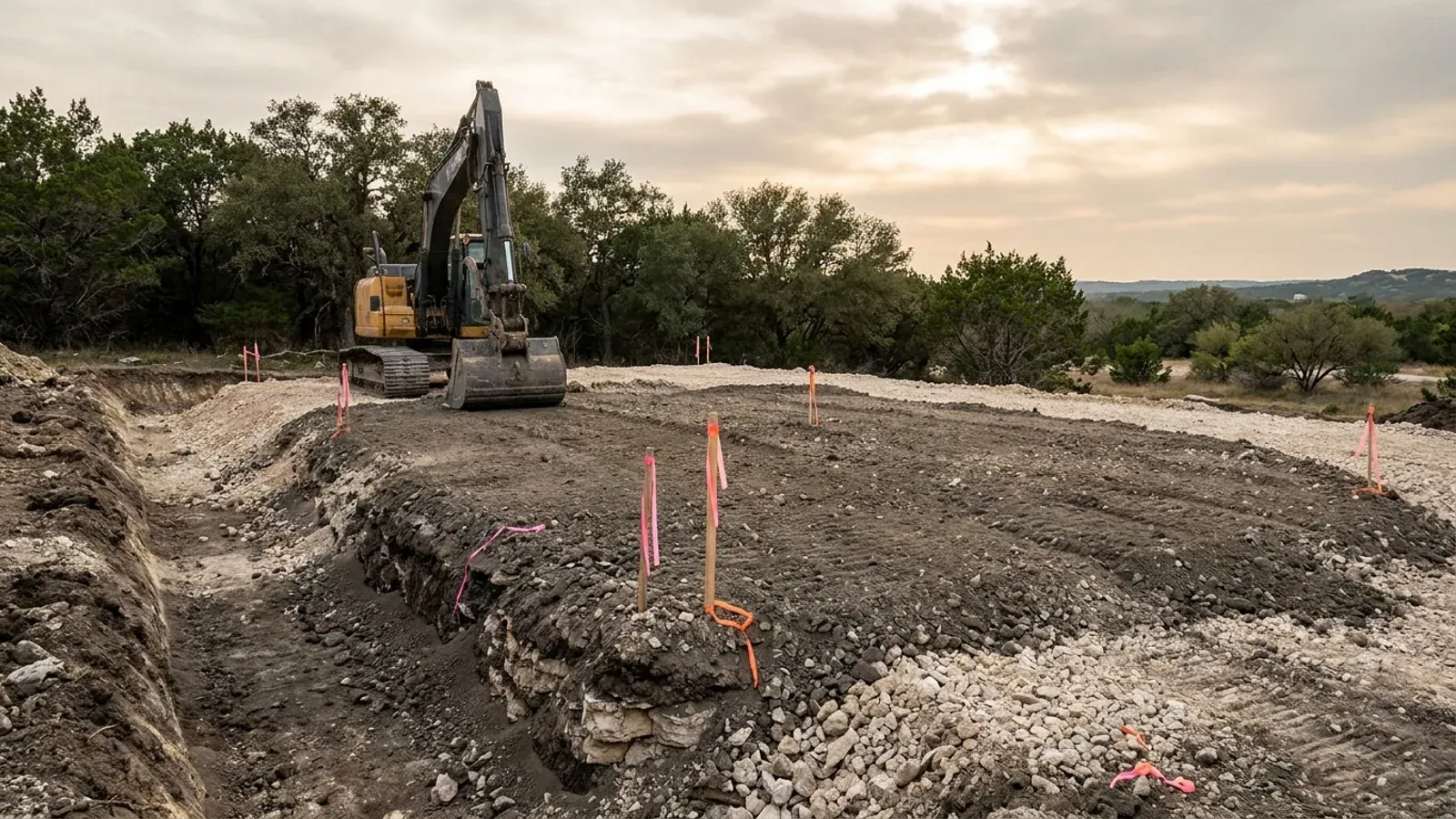
An excavator grading a compacted building pad on a cleared lot, with survey stakes and a drainage swale visible.
Below the slab

The expensive surprises are in the ground, not the building

What moves a Texas budget is usually below grade, and it is soil rather than rock: shrink-swell clay. The Blackland Prairie and the Gulf Coast clays move enough between a wet season and a dry one to drive the foundation design across the state's largest markets, which is why several DFW cities require an engineer's seal on the foundation of every new house. Those are the same conditions that decide whether a septic field passes its soil and site evaluation, so the grading plan, the foundation and the drainfield get resolved together rather than one at a time. We price the dirt before we price the building.

What we build in Travis County

All nine of our services — kits, custom plans, post-frame and steel construction, site preparation, permitting and engineering, through to turnkey builds — are available across Travis County. What a project costs depends far more on the parcel than on square footage, so we work from your land rather than from a rate card.

See what we build

What a build looks like

Three stages every Travis County project passes through, from a raw parcel to a finished home. Site work first, because that is where the budget is decided.
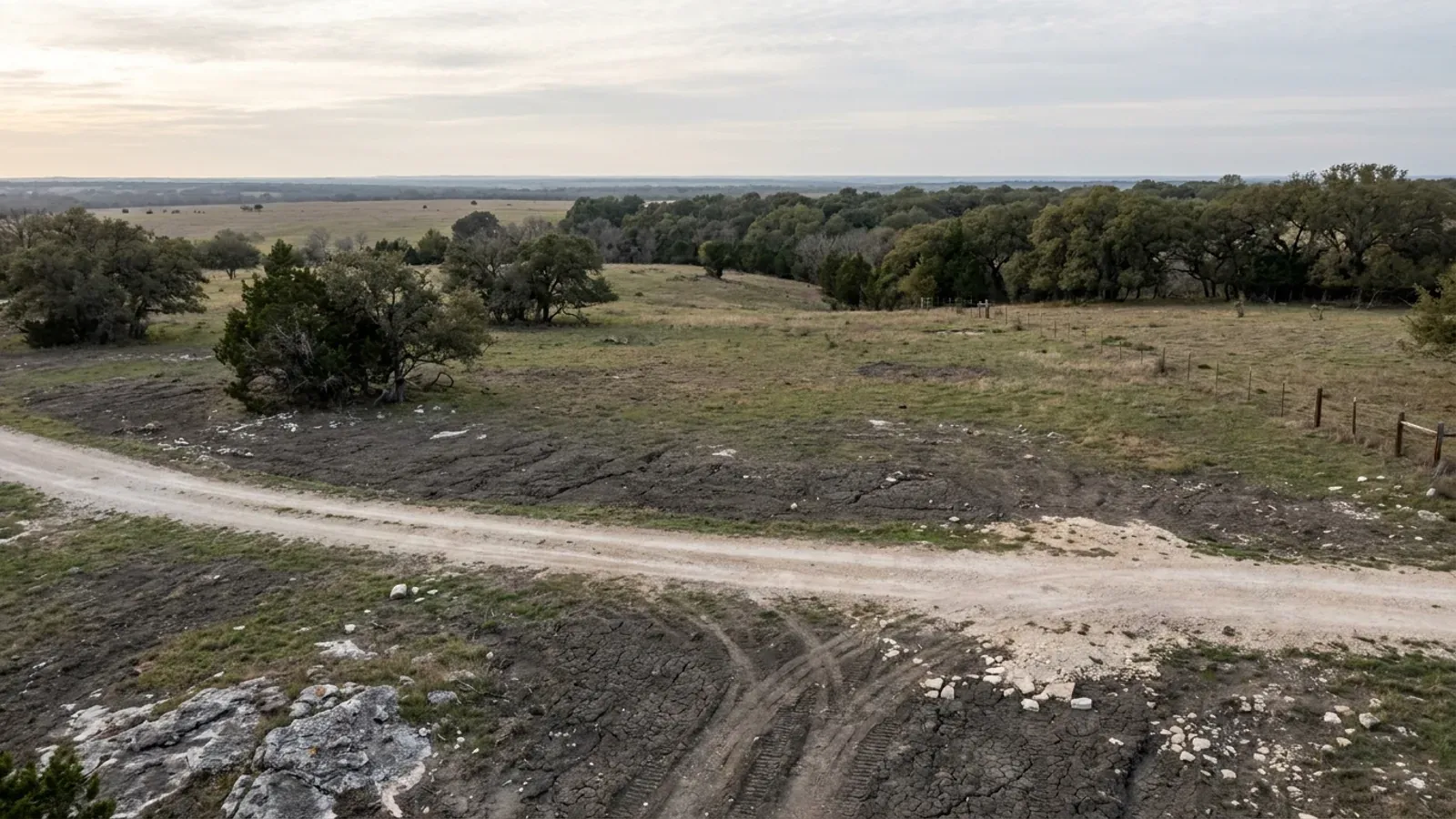
Aerial view of an undeveloped rural lot with cleared grass, a live oak and cedar elm treeline, and a pale gravel access track.
Stage one

The parcel

Zoning, setbacks, flood zone and utility access get checked before anything is drawn.

An excavator grading a compacted building pad on a cleared lot, with survey stakes and a drainage swale visible.
Stage two

Pad and permit

Clearing, grading and a compacted pad, while the submittal works through Travis County.
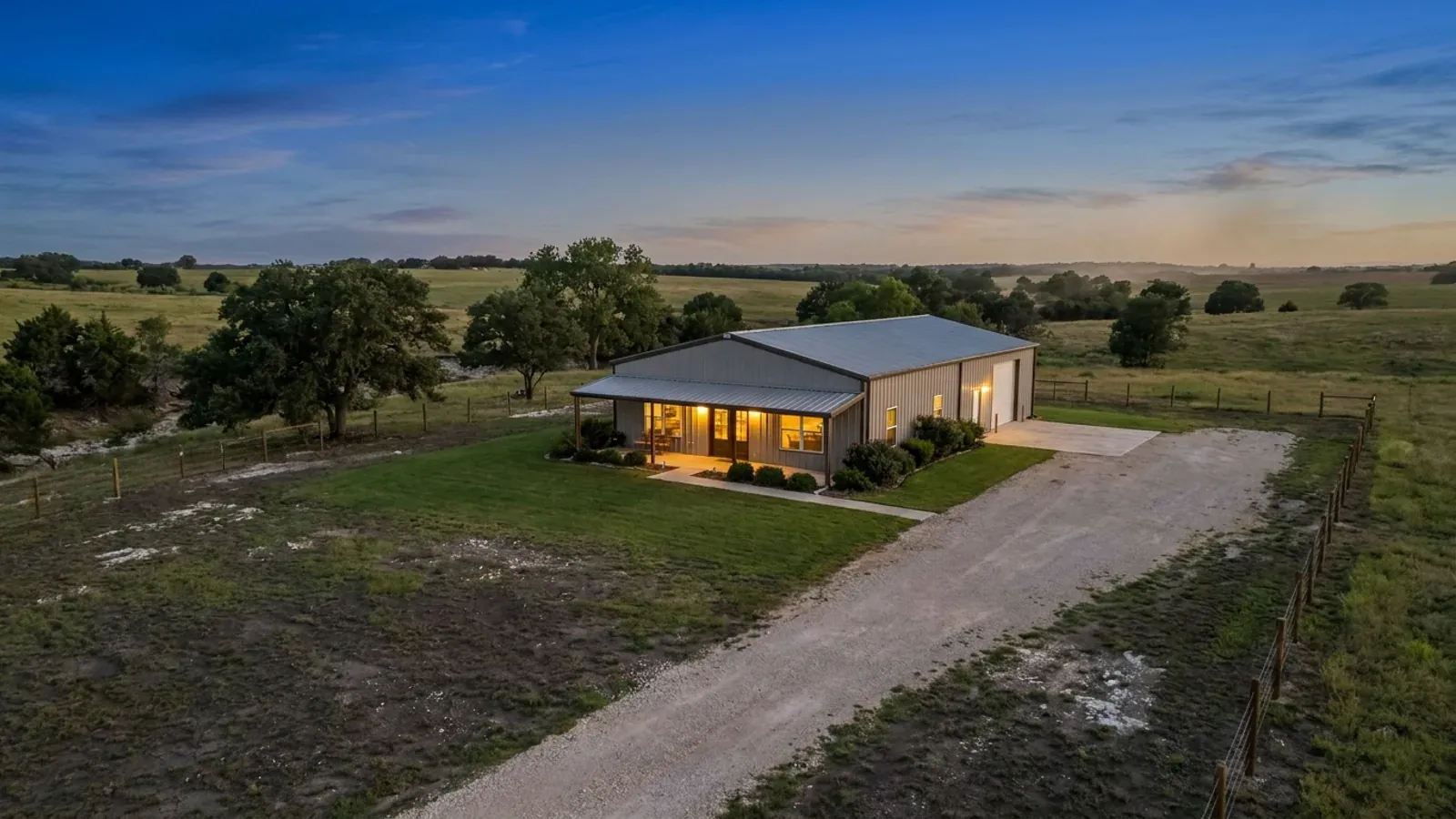
A finished barndominium at dusk with warm interior lighting glowing through its large windows.
Stage three

Frame to finish

Shell erected and dried in, then systems, insulation and interior finish through to CO.

Those are the rules for Travis County. Tell us what you want to build and we will draw it to them.

Where we build around Travis County

Travis County and the rural land around it. The buildable acreage for a project this size usually sits outside the city limits, which is frequently what changes who issues your permit.

Our Travis County service area, covering Travis County and the surrounding rural acreage. This map marks the territory we serve, not a branch location.

Nearby areas we build in

Others we cover in this part of Texas. The permitting authority, the adopted design criteria and the zoning can all differ from one to the next.

Building in Travis County: common questions

8 questions we get asked most often about building in Travis County. If yours is not on the list, ask it directly.

Does Travis County have a building code for a barndominium?
Yes, and that makes it unusual. Most Texas counties have no residential building-code authority at all in their unincorporated area. Travis County adopted Chapter 480 of its code on 1 September 2009, applying Subchapter F of chapter 233 of the Local Government Code. Under it, new residential construction must conform either to the International Residential Code published as of 1 May 2008 or to the version applicable inside the City of Austin, and the builder picks which and says so in advance. What the opt-in does not create is a county building department. There is no building permit under Chapter 480, no fee for it, and no county inspector. The builder arranges three inspections privately — foundation before concrete, framing and mechanical before drywall, and completion — from a closed list of six kinds of qualified inspector, then files the reports with Travis County Transportation and Natural Resources within ten days of the final one.
So do I need a permit from the county before I start?
Yes, but not the one people expect. Section 464.061(a) of the Travis County Code requires a development permit before any construction or other development begins anywhere in the unincorporated county, and that reaches the first disturbance of soil for clearing, grading or excavation. The county states it as plainly as it can on its own site: any development in Travis County requires a permit. That permit is a floodplain, drainage and water-quality review, not a building-code plan review. Section 482.916 tells you what the application has to prove: compliance with the LCRA's Highland Lakes Watershed Ordinance if you are in the Lake Travis watershed, with the TCEQ's Edwards Aquifer rules if you are over the recharge or contributing zone, with section 10 of the federal Endangered Species Act, with the Clean Water Act where it applies, and with any municipal requirements if you are inside a city's extraterritorial jurisdiction. The permit desk is on (512) 854-4215.
Who issues the septic permit, and how much land do I need?
Usually Travis County Transportation and Natural Resources, which the county's code names as the authorised agent for the unincorporated county. But not always: in the restricted and water-quality zones of Lake Travis the TCEQ's register shows the Lower Colorado River Authority as the authorised agent instead, and several small cities run their own programmes inside their limits. Check the register before you assume. On acreage, Travis County is stricter than the state. Section 448.032(b) requires one acre for a residential structure on a septic system whatever the water source, where the state allows half an acre on a public supply. Each additional residential unit — a guest apartment, a separate cabin — needs another acre, because section 448.032(c)(1) treats each one as a separate structure. And section 448.033(a) is headed No Exemptions: every system is permitted regardless of lot size, so the widespread belief that ten acres exempts a rural tract does not hold here. There are two documents to get, not one: a Permit to Construct, and then a License to Operate.
My land is over the Edwards Aquifer. What does that actually mean for the build?
It means a state permit can sit on land that has no building code over it. Construction on the Edwards Aquifer recharge zone is regulated by the TCEQ under 30 TAC Chapter 213, and where a Water Pollution Abatement Plan is required it must be approved before construction commences, with a published fee based on acreage running from a $650 minimum to a $10,000 maximum. But the TCEQ publishes two thresholds for a private residence, and acreage often clears them. No individual plan may be required where the residence sits on a lot larger than five acres with no more than one single-family residence on it, or where the construction does not exceed 20 percent impervious cover within the property's legal boundaries. The TCEQ counts rooftops, driveways, concrete pads, sheds and sidewalks toward that figure, which on this building type means the shop, the apron and the drive all count. Rainwater harvesting from the roof can bring an adjusted figure down under 20 percent. It is worth computing properly against the deed boundary rather than estimating. The TCEQ's Austin region office handles Travis County on 512-339-2929.
Is western Travis County really different from eastern Travis County?
Materially, and the county draws the line itself at Interstate 35. West of it is Edwards Plateau limestone: thin soil over rock, karst, and the Edwards and Trinity aquifers underneath. The county's septic rules are written for exactly that, requiring evaluation pits dug to a restrictive horizon, a foot of soil above solid or fractured rock beneath a drip emitter, and erosion control on drainfields sloping more than ten percent. The federal endangered-species picture stops at the same line: Travis County states that habitat for the golden-cheeked warbler and six cave-dwelling karst invertebrates is found west of I-35, and that activities east of it will not affect those seven species. East of the line is Blackland Prairie, and that ground brings a different problem — shrink-swell clay, which is what removes the exemption that would otherwise allow a slab foundation to be designed without a Texas-licensed engineer. The honest answer is that the site controls the answer, and a soil report on the actual parcel settles it.
What changes if I rent it out or use it as a short-term let?
Three things, and they are worth knowing before you build rather than after. First, Chapter 480's protection for an owner-builder requires both that you build it yourself or act as your own contractor and that you intend to use it as your own primary residence. Let it, and that defence is gone. Second, Travis County does enforce a county fire code — Chapter 201 adopts the 2015 International Fire Code and requires a Fire Marshal's building permit for a commercial establishment, a public building or a multifamily building of more than three units. The definition of commercial establishment turns on whether any phase of commercial or business activity occurs there, and it excludes dwellings of fewer than four units and private garages and sheds. Whether a let single-family house falls inside it is a question for the Fire Marshal, and worth asking in writing. Third, the county can revoke the License to Operate for your septic system if the property is used for a purpose other than the one in the original application.
I am inside Austin's extraterritorial jurisdiction. Whose rules apply?
Platting is joint. Title 30 of the Austin City Code is titled Austin/Travis County Subdivision Regulations, and section 30-1-1 applies it to subdivision of land in the part of Austin's ETJ that lies in Travis County, under a City/County subdivision agreement. Travis County's own code records the statute: a plat in the ETJ must be approved by both the city and the county, and where their rules conflict the more stringent prevails. Building codes are a different answer. Texas courts have held that a city cannot enforce its building codes outside its corporate limits — the Texas Supreme Court in Town of Lakewood Village v. Bizios for general-law cities, and the Dallas Court of Appeals in Collin County v. City of McKinney for home-rule cities, holding that the city lacked authority to enforce building codes in its ETJ but could require the landowner to plat. Since 1 September 2023 there is also a release route: a resident, or the owners of a majority in value of the area, may petition the Austin City Clerk under Senate Bill 2038, and if the city takes no action within 45 days the area is released by operation of law. The Clerk's office takes those petitions on 512-974-2210. Release changes who regulates subdivision, not whether it is regulated — the county takes over.
Do I need a permit to drill a water well?
It depends on the parcel, and two separate districts are involved. The Barton Springs-Edwards Aquifer Conservation District, created in 1987, covers 430 square miles across parts of Travis, Hays and Caldwell counties. The Southwestern Travis County Groundwater Conservation District, created by House Bill 4345 effective 1 September 2017 and confirmed by voters in November 2019, covers the southwest corner of the county between the Colorado River, the Blanco and Burnet county lines, Hays County and the Barton Springs district. In the southwestern district all existing wells must be registered, registration is free, and drilling a new well needs a Well Drilling Authorization; a production permit is required on top of that for non-exempt uses, which the district's own list includes event and lodging venues. Not every part of the county sits inside a district, so check the parcel on each district's map first. Separately, Travis County's own subdivision rules at section 482.214 bar groundwater service to a subdivision from any aquifer other than the Trinity or the Edwards.

Building in Travis County?

Start with the plan. Tell us what you want to build and we will draw it, then confirm what Travis County will actually let you put on the parcel and what wind load it has to meet. That conversation costs nothing.